
The sports technology sector is growing. Startups now use wearables to track athlete biometrics, AI platforms to engage fans, and advanced systems to manage ticketing. As a result, they collect and process sensitive data, including health records, payment information, GPS locations, and fan behavior insights. Choosing the right SOC 2 Vendors for Sports Tech Startups is therefore a critical decision. The wrong vendor can waste months of engineering effort and significantly increase compliance costs. In contrast, the right partner can streamline your first audit, strengthen data protection, and support sales growth.
To help you decide, we created this comprehensive guide to the top 12 SOC 2 Vendors for Sports Tech Startups in 2026.
Why Sports Tech Startups Have Unique SOC 2 Challenges
- Biometric and health data sensitivity: Wearables and performance analytics platforms collect heart rate, sleep quality, GPS positioning, and injury recovery metrics. This sits at the intersection of health regulations and general data protection law.
- Real-time data pipelines: Sports tech commonly uses high-frequency streaming architectures that compliance platforms must monitor without disrupting latency-sensitive workloads.
- Multi-party data sharing: A single sports tech platform may share data with leagues, broadcast partners, betting operators, merchandise brands, and venue operators simultaneously, each requiring its own vendor risk management documentation.
- Seasonal audit windows: Sports organisations often demand compliance documentation in alignment with pre-season contracts, creating compressed timelines that favour automation-heavy platforms.
- Mixed infrastructure: Many sports tech companies run edge computing at stadiums, on-premises servers at training facilities, and multi-cloud workloads, a complexity that tests the integration depth of any SOC 2 tool.
Top 12 Best SOC 2 Vendors for Sports Tech Startups
1. Vanta

Vanta is the market leader in compliance automation by customer count, it built its reputation by making SOC 2 accessible to SaaS startups without dedicated security staff. Its core engine connects to cloud infrastructure, identity providers, HR systems, and code repositories via API, then runs automated tests against AICPA Trust Services Criteria and 35+ other frameworks continuously.
Features
- 400+ native integrations covering AWS, GCP, Azure, Okta, GitHub, Jira, BambooHR, and Rippling
- 1,200+ automated hourly control tests across frameworks
- AI Agent 2.0 for guided remediation, policy builder, and vendor risk questionnaires
- Real-time Trust Center with AI chatbot for sharing security posture with prospects
- Continuous access reviews with automated reminders
- Multi-framework cross-mapping (SOC 2, ISO 27001, HIPAA, GDPR, PCI DSS, NIST).
Pros
- Largest integration library (400+), best for complex sports tech stacks
- Strong startup support with dedicated customer success
- AI Agent 2.0 reduces manual compliance effort significantly
- Trust Center accelerates enterprise sales conversations
- Well-recognised brand that enterprise buyers trust
Cons
- Higher base price ($10K/yr) versus budget alternatives
- Onboarding can require additional professional services spend
- Some non-core frameworks less polished than SOC 2.
Pricing
Vanta Core starts at approximately $10,000–$15,000 per year for a single framework. Mid-market deals typically land in the $25,000–$50,000 range. Enterprise contracts exceed $80,000 annually.
Verdict
Best fit for sports tech startups at Series A and above that handle athlete biometrics or fan PII across complex multi-cloud stacks. Vanta’s 400+ integrations make it the safest choice when your infrastructure is non-standard. The Trust Center is a genuine sales asset when pitching to leagues or broadcasters who ask ‘show me your security page.
2. Drata
Drata is the high-rated SOC 2 platform and the favourite among developer-centric teams. Its automation philosophy runs daily tests rather than Vanta’s hourly cadence, but the depth of developer tooling; GitHub Actions integration, infrastructure-as-code monitoring, and Slack-native notifications makes it the preferred choice for engineering-led sports tech companies.
Features
- 300+ integrations with strong depth for developer tools and CI/CD pipelines
- Automates questionnaire sending and scoring
- Daily automated evidence collection across 20+ frameworks
- Auditor collaboration portal with pre-scoped audit requirements
- Risk management with built-in risk register and treatment tracking
- Drata Academy for in-platform security awareness training
Pros
- Developer-first design: GitHub, GitLab, CI/CD deeply integrated
- Agentic AI for vendor risk saves significant manual effort
- Excellent auditor collaboration portal speeds audit cycles
- Strong cross-framework support including HIPAA and ISO 27001
Cons
- Daily (not hourly) test cadence may leave brief gaps
- Less hand-holding for non-technical compliance owners
Pricing
Drata Foundation starts at approximately $7,500–$15,000 per year for a single framework with up to 25 employees. Mid-market plans range from $25,000–$50,000. Enterprise contracts can exceed $100,000 annually. Implementation fees are charged separately.
Verdict
Best fit for engineering-led sports tech startups, particularly performance analytics platforms, sports betting data providers, and API-first infrastructure companieswhose developers want a compliance tool that speaks their language. If your CTO cares about SOC 2 as much as your sales team, choose Drata.
3. Secureframe
Secureframe positions itself as the most guided compliance automation platform in the market. Its combination of automated evidence collection and access to in-house compliance experts (former auditors and security engineers) makes it the closest thing to having a virtual compliance officer without hiring one. For sports tech startups without a dedicated security team, this advisory layer is a meaningful differentiator.
Features
- 300+ integrations across cloud, identity, endpoint, and SaaS tools
- In-house team of compliance experts available for guidance and readiness reviews
- Employee training modules on security awareness embedded in the platform
- Vendor risk management with automated questionnaire workflows
- Automated penetration testing scheduling and tracking.
Pros
- Best advisory support layer among all automation platforms
- Secureframe AI significantly speeds policy creation and remediation
- Vendor management features well-suited to multi-partner sports ecosystems
- Strong 300+ integration library competitive with Drata and Vanta
- Excellent for teams without a dedicated compliance or security hire.
Cons
- Additional framework add-ons priced at $7,500 each
- Some users report slower integration setup for unusual tooling.
Pricing
Secureframe Fundamentals starts at approximately $7,500–$20,000 per year. Growth plans targeting mid-size companies run $20,000–$50,000. Enterprise pricing is quote-based. Additional frameworks cost approximately $7,500 each.
Verdict
Best fit for sports tech startups at the seed and Series A stage whose founding team has product and business expertise but lacks in-house security knowledge. Fan engagement platforms, sports nutrition apps, and early-stage wearable companies will especially benefit from Secureframe’s advisory layer.
4. Sprinto
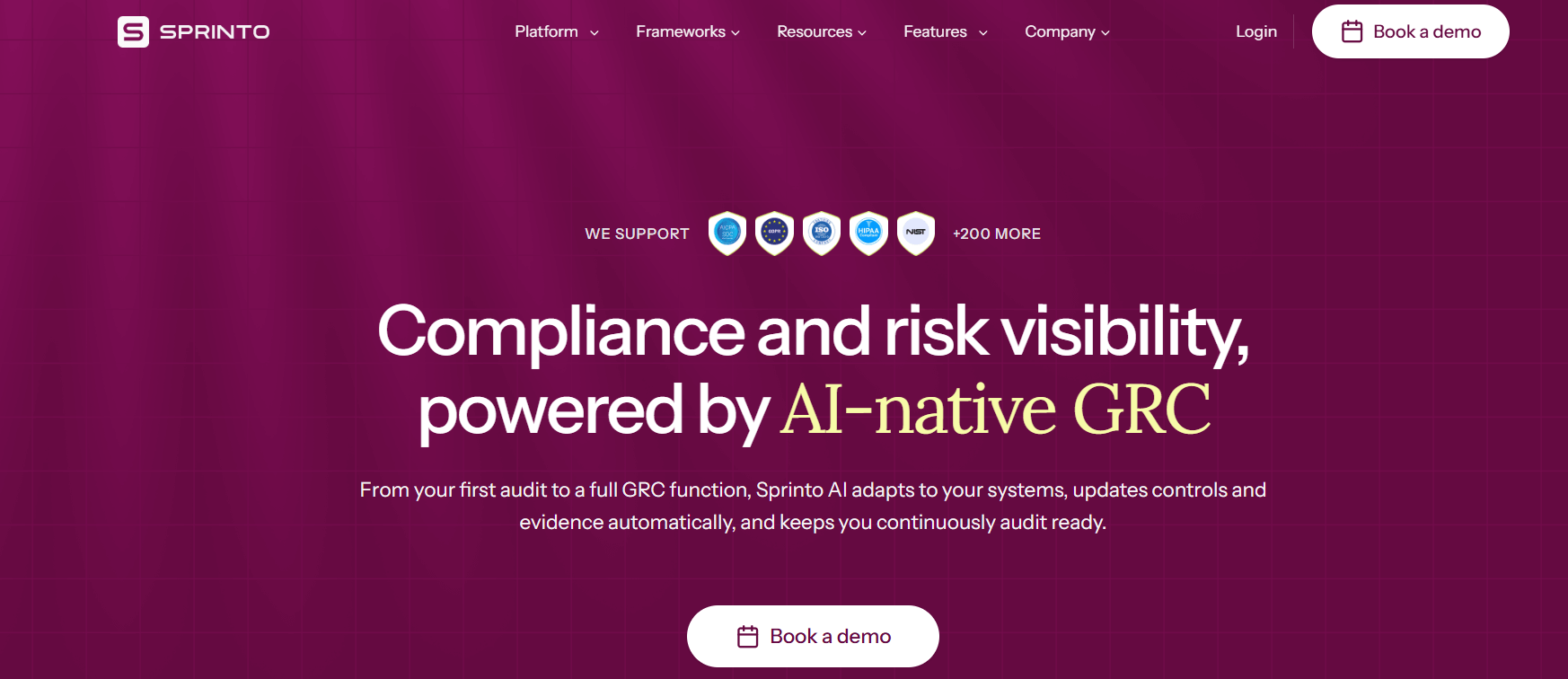
Sprinto runs automated tests twice per day, supports approximately 20 frameworks, and offers an unusually guided compliance workflow that walks non-technical teams through every requirement step-by-step. Its built-in mobile device management (MDM) checks are a notable differentiator for sports tech startups that issue company devices to field staff and coaching teams.
Features
- 200+ integrations with twice-daily automated control testing
- Guided compliance workflows with in-app checklists for non-technical teams
- Built-in MDM checks for endpoint device compliance
- AI-native GRC positioning for autonomous compliance monitoring
- Strong presence in APAC and EMEA startup markets
- Support for SOC 2, HIPAA, ISO 27001, GDPR, and PCI DSS.
Pros
- Most affordable entry point among Tier 1 compliance platforms
- Excellent guided workflows, ideal for first-time compliance owners
- Built-in MDM checks valuable for field-device-heavy sports tech teams
- Twice-daily testing cadence catches issues faster than daily alternatives.
Cons
- Smaller integration library (200+) versus Vanta (400+) or Drata (300+)
- Scalability concerns for large enterprises or complex multi-framework programs
- Less brand recognition with US enterprise buyers compared to Vanta or Drata
- Long-term support depth uncertain as company is younger than competitors
Pricing
Sprinto pricing starts at approximately $6,000–$8,000 per year for a single framework at the startup tier. Growth plans range from $15,000–$30,000. Enterprise pricing is custom-quoted. Generally the most cost-effective option for sub-50-employee companies.
Verdict
Best fit for pre-Series A sports tech startups with budgets under $10,000 per year and no dedicated security hire. Particularly strong for sports coaching platforms, sports event management software, and fitness apps that need SOC 2 to unlock their first enterprise deal without breaking the bank.
5. Thoropass
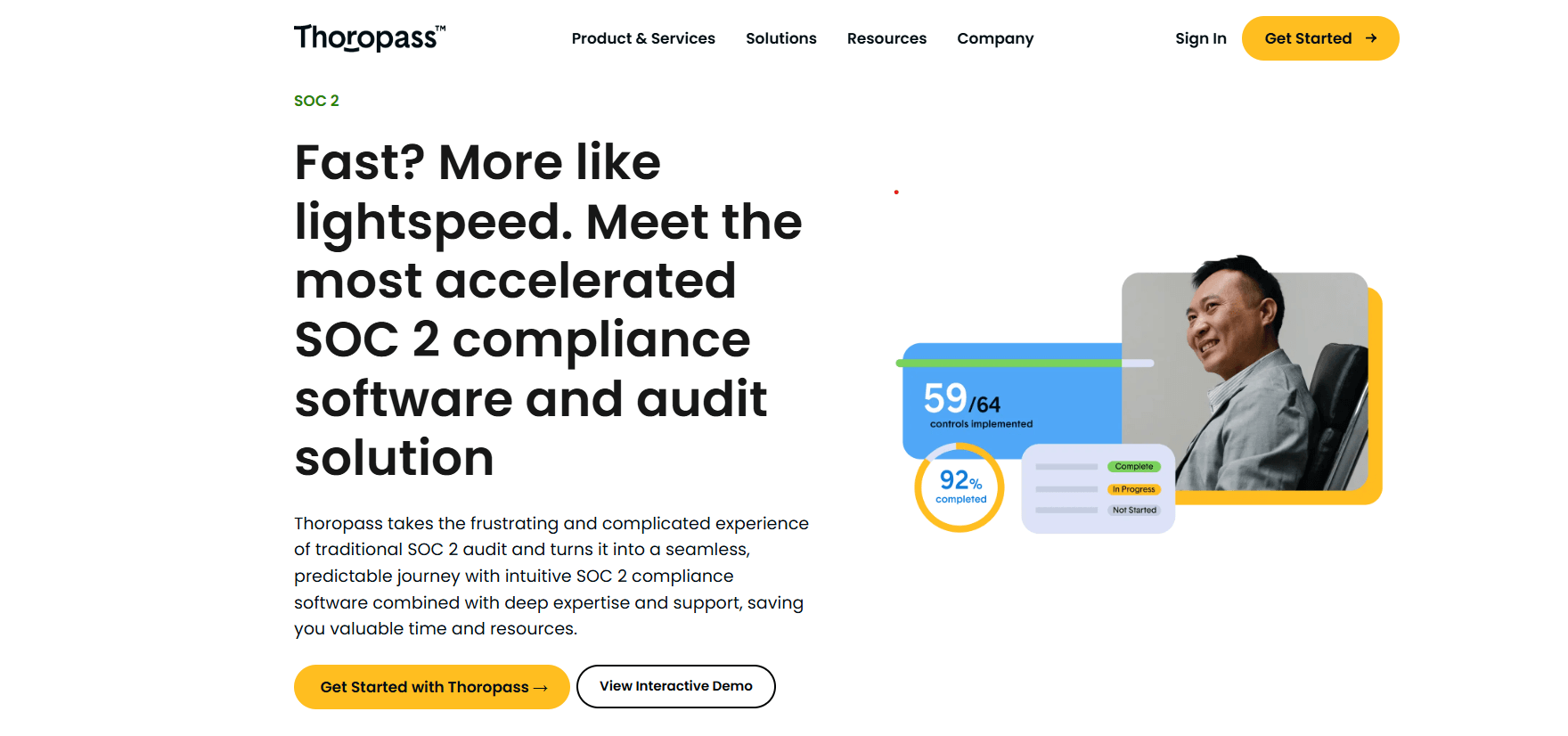
Thoropass offers the most distinctive value proposition in the market: a bundled platform-plus-auditor model. Rather than purchasing compliance software and then finding a separate CPA firm, Thoropass provides both under one contract. Its proprietary First Pass AI has reportedly cut audit cycles from an industry average of 73 days to approximately 29 days, a compelling advantage for sports tech startups facing contract deadlines from leagues or broadcast partners.
Features
- Bundled compliance software plus in-house AICPA-peer-reviewed audit services
- First Pass AI reduces audit cycle from ~73 days to ~29 days
- 200+ integrations with continuous monitoring
- Single-vendor accountability for platform and audit deliverable
- Readiness gap assessment included in most packages
- Support for SOC 2, ISO 27001, HIPAA, GDPR, PCI DSS, and CCPA
Pros
- One vendor, one contract eliminates audit firm sourcing complexity
- First Pass AI dramatically reduces audit timelines
- Single point of accountability reduces blame-shifting between software and auditor
- Bundled pricing can be economical versus separate platform + CPA firm fees
- Strong choice when facing hard contract deadlines from sports organisations
Cons
- Bundled model means less flexibility to choose your preferred auditor
- Higher upfront quote versus software-only platforms
- 200+ integrations, smaller library than Vanta or Drata
Pricing
Thoropass packages start at approximately $8,700–$20,000 per year inclusive of the audit. Comprehensive SOC 2 Type II packages range from $20,000–$80,000 depending on scope, company size, and framework count. Pricing is quote-based.
Verdict
Best fit for sports tech startups facing a hard deadline, a league contract, broadcast partnership, or investor due diligence event and wanting a single vendor to handle both the compliance platform and the audit. Particularly strong for ticketing platforms and sports media companies closing enterprise deals on tight timelines.
6. Scytale
Scytale is a compliance automation platform with a strong advisory DNA and exceptional EMEA market presence. It supports 30+ frameworks and positions itself as a 24/7 automated compliance team. For sports tech startups expanding from emerging markets into European leagues and broadcast deals where GDPR and ISO 27001 requirements often accompany SOC 2, Scytale’s combined framework coverage is a significant advantage.
Features
- 30+ compliance frameworks including SOC 2, ISO 27001, GDPR, HIPAA, PCI DSS, and CCPA
- AI GRC Agent for continuous monitoring, policy recommendations, and gap remediation
- Built-in compliance advisory with access to in-house GRC experts
- Trust Centre included across all plans
- Strong EMEA regulatory coverage with European data residency options
- 100+ integrations with focus on quality over quantity.
Pros
- 30+ frameworks excellent for multi-standard compliance programs
- Strong advisory layer competitive with Secureframe
- Best EMEA compliance coverage including GDPR and European frameworks
- AWS Rising Star recognition signals strong cloud-native integration
Cons
- 100+ integrations, significantly fewer than Vanta (400+) or Drata (300+)
- Pricing not publicly listed; requires sales engagement for quotes.
Pricing
Scytale’s Build tier starts at approximately $7,500 per year. Full packages with advisory services for a small-to-mid-sized SaaS business typically fall between $10,000 and $25,000 per year. Enterprise pricing is custom.
Verdict
Best fit for sports tech startups operating internationally particularly those expanding into the European market and needing simultaneous SOC 2 and GDPR/ISO 27001 coverage. Ideal for sports analytics platforms, betting data providers, and media rights technology companies with international clients.
7. Scrut Automation
Among SOC 2 Vendors for Sports Tech Startups, Scrut Automation stands out by combining compliance automation with Cloud Security Posture Management (CSPM) in a single cloud-native platform.It offers more than 50 pre-built compliance frameworks, including UAE PDPL, COPPA, and FERPA. As a result, sports tech startups operating across multiple regions can manage diverse compliance requirements more efficiently than with platforms that support fewer frameworks.
Features
- 50+ pre-built compliance frameworks including SOC 2, ISO 27001, GDPR, PCI DSS, HIPAA, and UAE PDPL
- Built-in CSPM for continuous cloud security configuration monitoring
- 1,500+ pre-mapped controls with 400+ automated tests
- 200 ready-to-use policy templates:
Pros
- CSPM built-in eliminates need for a separate cloud security tool
- 1,500+ pre-mapped controls reduces custom control mapping effort
- Strong APAC support teams and regional expertise
- Custom framework builder handles niche sports regulation requirements
Cons
- Learning curve for new users, especially with advanced configurations
- Integration reliability issues noted in some G2 reviews.
Pricing
Scrut uses custom pricing based on organisation size and requirements.
Verdict
Best fit for sports tech startups operating across multiple jurisdictions that need broad multi-framework coverage and built-in cloud security monitoring. Well-suited to sports data companies building global compliance programs from scratch.
8. Hyperproof
Hyperproof is a compliance operations platform that differs from most tools on this list: rather than maximising automation, it prioritises compliance program management. It excels at cross-department task assignment, risk register management, and audit trail documentation. Its unlimited-user pricing model is a notable advantage for sports tech companies with large cross-functional teams spanning engineering, legal, operations, and venue management.
Features
- Unlimited-user pricing, no per-seat cost scaling
- Advanced risk register with treatment tracking and risk scoring
- Strong audit management workflow for complex multi-framework programs
- 20+ frameworks including SOC 2, ISO 27001, NIST CSF, and FedRAMP.
Pros
- Unlimited users, ideal for large cross-functional sports tech teams
- Strong for organisations running multiple concurrent audit cycles
- EU data residency instance available for European sports organisations
- Excellent for established compliance teams needing program visibility
Cons
- Less automation than Vanta, Drata, or Secureframe, more manual evidence uploads
- Steep learning curve for new compliance owners.
Pricing
Hyperproof starts at approximately $12,000 per year with unlimited users. Enterprise contracts range from $40,000–$100,000+ annually depending on the number of frameworks and program complexity. Pricing is quote-based.
Verdict
Best fit for mid-market sports tech companies (50–500 employees) with a dedicated compliance officer or team who need program-level visibility across multiple audits and frameworks. Particularly strong for sports technology holding companies managing compliance across multiple product lines or subsidiaries.
9. OneTrust
For sports tech companies already using OneTrust for privacy management, a common scenario for platforms handling fan data under GDPR or CCPA extending to SOC 2 certification automation within the same ecosystem eliminates the integration overhead of adopting a standalone compliance tool.
Features
- Full integration with the OneTrust GRC, privacy, and ESG platform ecosystem
- AICPA-aligned SOC 2 and ISO 27001 certification automation
- Pre-built policy templates and control library
- Audit-ready reporting with customisable evidence packages
- Enterprise-grade access controls and data governance.
Pros
- Single vendor for privacy + GRC + SOC 2 reduces tool sprawl significantly
- Enterprise-grade governance and access controls
- Mature procurement process trusted by large sports organisations.
Cons
- Enterprise-only pricing, not suitable for seed or Series A startups
- Multi-week procurement cycles make it slow for urgent compliance needs.
Pricing
OneTrust Certification Automation does not publish list pricing. Public buyer reports indicate enterprise contracts requiring multi-week procurement cycles. Budget planning should assume $50,000+ annually for typical enterprise SOC 2 implementations.
Verdict
Best fit for large sports technology companies and sports media organisations already using OneTrust for GDPR or CCPA privacy management that want to extend compliance into SOC 2 without adding a new vendor. Not appropriate for startups under Series C or companies without an existing OneTrust footprint.
10. Optro (AuditBoard)
AuditBoard now Optro is the enterprise standard for integrated audit management, risk, and compliance. While it covers SOC 2 among many other frameworks, its real strength is as a platform for internal audit teams rather than as a startup compliance tool. Sports technology companies at scale publicly listed sports media groups, major venue technology operators, or enterprise sports data businesses will find AuditBoard’s SOX, internal audit, and ERM capabilities uniquely valuable alongside its SOC 2 support.
Features
- Comprehensive audit management including SOC 2, SOX, ISO 27001, and ERM
- Cross-functional risk management with board-level reporting
- Advanced workflow automation for audit cycles and control testing
- Document management with version control and e-signature
- Integration with major GRC and ERP platforms.
Pros
- Excellent for organisations where internal audit and SOC 2 overlap
- Board-level reporting capabilities unmatched by startup-focused platforms
- Strong integration with ERP and financial systems
Cons
- Quote-only pricing with long procurement cycles
- Steep implementation and training requirements
- SOC 2 automation less purpose-built than standalone compliance platforms.
Pricing
Pricing is entirely quote-based with no public list price. Based on market reports, enterprise contracts typically start at $50,000 per year and scale to $200,000+ for large organisations. Implementation and training fees are charged separately.
Verdict
Best fit for publicly listed sports technology companies, major sports media organisations, or venue technology operators that need SOC 2 as one component of a broader enterprise audit management and ERM program. Not appropriate for startups of any stage.
11. Comp AI
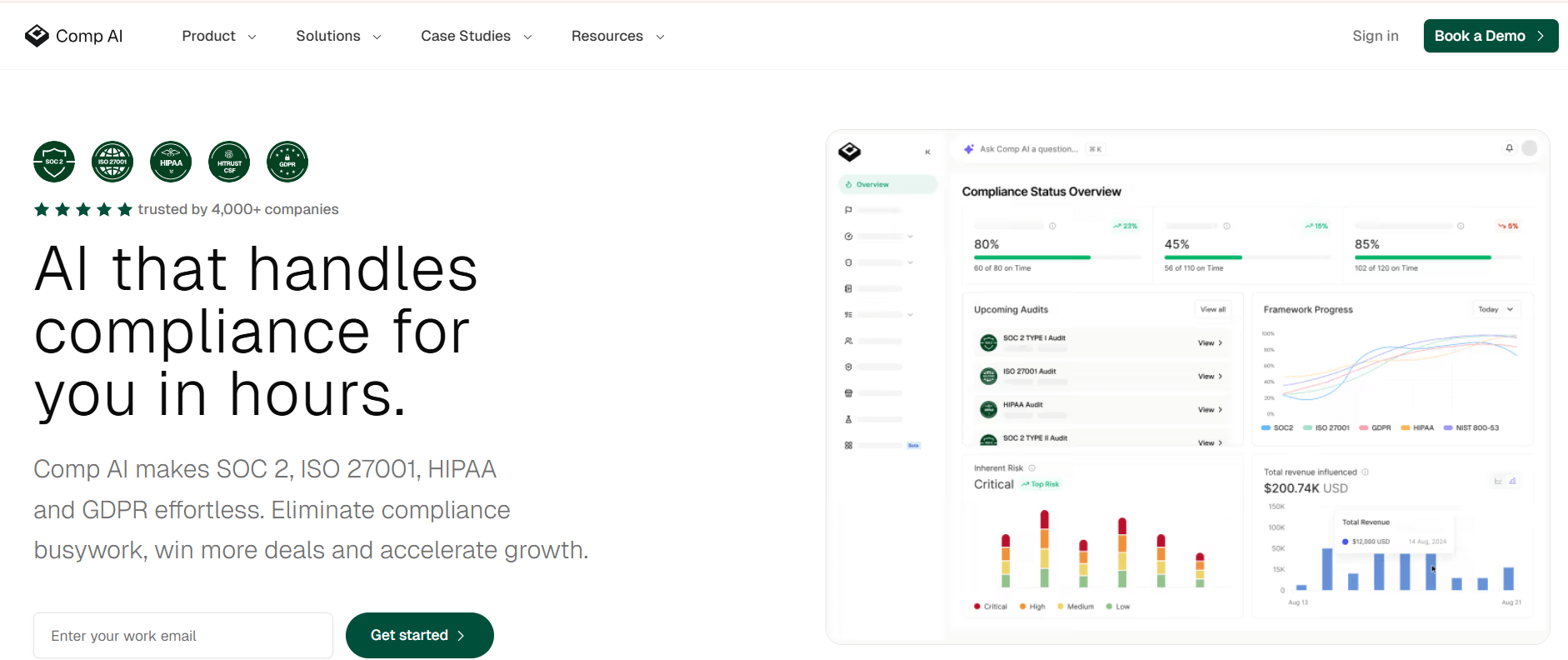
Comp AI is the most affordable compliance automation platform on this list and one of the fastest-growing tools for pre-seed and seed-stage startups. It offers a streamlined path to SOC 2 readiness with AI-assisted policy generation and evidence collection at a fraction of the cost of enterprise platforms. For sports tech founders who need to demonstrate security credentials to an angel investor or early pilot customer without spending $10,000+, Comp AI represents a genuinely viable option.
Features
- AI-powered policy generation covering all required SOC 2 policies
- Automated evidence collection for foundational cloud infrastructure controls
- 80+ integrations covering major cloud providers and identity systems
- Trust Center included for sharing security posture with prospects
- Simple onboarding designed for non-technical founders
- Flat pricing model.
Pros
- Most affordable option, accessible for bootstrapped and pre-seed teams
- Flat pricing avoids per-seat cost shock as team grows
- AI policy generation is genuinely time-saving for founders without legal resources
- Fast onboarding, can be operational in days rather than weeks
- Good for demonstrating security posture before formal SOC 2 audit
Cons
- Fewer integrations (80+) limits coverage for complex sports tech stacks
- Less audit-firm network and support than enterprise platforms
- Framework coverage limited to 10 standards versus 30–50+ for competitors.
Pricing
Comp AI pricing starts at approximately $3,000 per year, making it the most budget-friendly option in this comparison. Plans for small teams typically fall in the $3,000–$8,000 range. Enterprise pricing is available on request.
Verdict
Best fit for pre-seed and seed-stage sports tech founders who need a credible security posture for early investor meetings or pilot customer conversations without committing to a $10,000+ platform. Ideal as a starting point that can be migrated to Vanta, Drata, or Secureframe at Series A.
12. Strike Graph
Strike Graph takes a relationship-first approach to SOC 2, positioning itself as a flexible compliance platform particularly suited to companies with non-standard infrastructure or custom security architectures. Its risk-based approach to control selection allows sports tech companies with unusual technology stacks custom-built venue IoT networks, proprietary athlete tracking hardware, or bespoke data pipelines to design a compliance program that reflects their actual security posture rather than forcing them into a generic control set.
Features
- Risk-based control selection tailored to your actual infrastructure
- Flexible framework mapping for custom security architectures
- 60+ integrations with focus on API-accessible custom connections
- Built-in auditor network for streamlined Type I and Type II audit engagement
- Continuous control monitoring with customisable test parameters
- Support for SOC 2, ISO 27001, HIPAA, and custom frameworks.
Pros
- Most flexible control mapping, ideal for non-standard sports tech architectures
- Risk-based approach produces a more defensible and accurate compliance posture
- Built-in auditor network simplifies audit firm sourcing
- Good fit for hardware-software hybrid sports tech companies
- Competitive pricing accessible to smaller startup budgets.
Cons
- Fewer integrations (60+) requires more manual evidence for broad tool stacks
- Less automation depth than Vanta, Drata, or Secureframe
- Smaller customer base means less community knowledge and peer benchmarking.
Pricing
Strike Graph pricing starts at approximately $5,000 per year for a single framework. Growth plans targeting mid-size companies range from $10,000–$25,000. Pricing is quote-based for enterprise and multi-framework packages.
Verdict
Best fit for sports tech hardware companies, custom venue technology providers, and sports data startups with proprietary infrastructure that does not fit neatly into the standard integration libraries of larger platforms.
How to Choose the Right SOC 2 Vendor from the Top 12 Best SOC 2 Vendors for Sports Tech Startups
- Assess your compliance maturity and budget
- Map your tech stack to integration libraries.
- Consider geographic and framework scope.
- Evaluate audit firm compatibility.
The top 12 best SOC 2 vendors for sports tech startups covered represent the full spectrum of what the compliance automation market has to offer in 2026 — from enterprise GRC platforms to startup-friendly tools, and specialised mid-market platforms.
No single platform is universally best. The right choice depends on your stage, your stack, your geographic markets, and how quickly you need to close the audit. A pre-seed founder building a sports fitness app needs Comp AI or Sprinto, not Hyperproof.
The best time to begin your SOC 2 program was when you signed your first enterprise customer. Use this guide to shortlist two or three vendors from the top 12 best SOC 2 vendors for sports tech startups that fit your stage and stack, request demos in the same week, and ask each one the same set of questions. You will know within two conversations which platform is the right fit for your team.