

An MLOps platform selling to enterprise customers eventually hits the same wall as every infrastructure vendor: the deal stalls in security review until the company produces a SOC 2 report. When the platform handles customer training data, model artifacts, and production inference endpoints, the review often goes deeper than it would for conventional SaaS. Security teams want clear answers about model access, data retention, and third-party AI dependencies and MLOps companies cannot always pull those answers from an off-the-shelf compliance playbook.
That makes the choice of SOC 2 providers for MLOps platform companies especially important. A generic compliance consultant might help a marketing SaaS company document access controls and move on. An MLOps company needs to go further. It must show who can push a new model version to production, how training data moves between environments, which parts of its stack rely on OpenAI, Anthropic, or a managed vector database, and how the company documents those controls in a system description that a CISO can actually evaluate.
What Makes SOC 2 Different for MLOps Platform Companies?
SOC 2 uses the same five Trust Services Criteria for MLOps companies, but the evidence and audit scope differ. Auditors pay particular attention to:
- Data: Access, retention, deletion, and customer-data isolation.
- Models: Versioning, approvals, change logs, and rollback processes.
- Infrastructure: Security controls for GPUs, Kubernetes, containers, and cloud environments.
- Security: IAM, encryption, secrets management, and logging across a larger system.
- Operations: Third-party LLM risks, incident response, continuity, and vendor management.
The audit scope depends on the product. A simple model-serving API needs fewer controls than a full MLOps platform that stores training data and runs fine-tuning. Companies should choose SOC 2 Providers for MLOps Platform Companies that understand their specific architecture and risk profile rather than apply a generic SaaS checklist.
Top 12 SOC 2 Providers for MLOps Platform Companies
1. Vanta
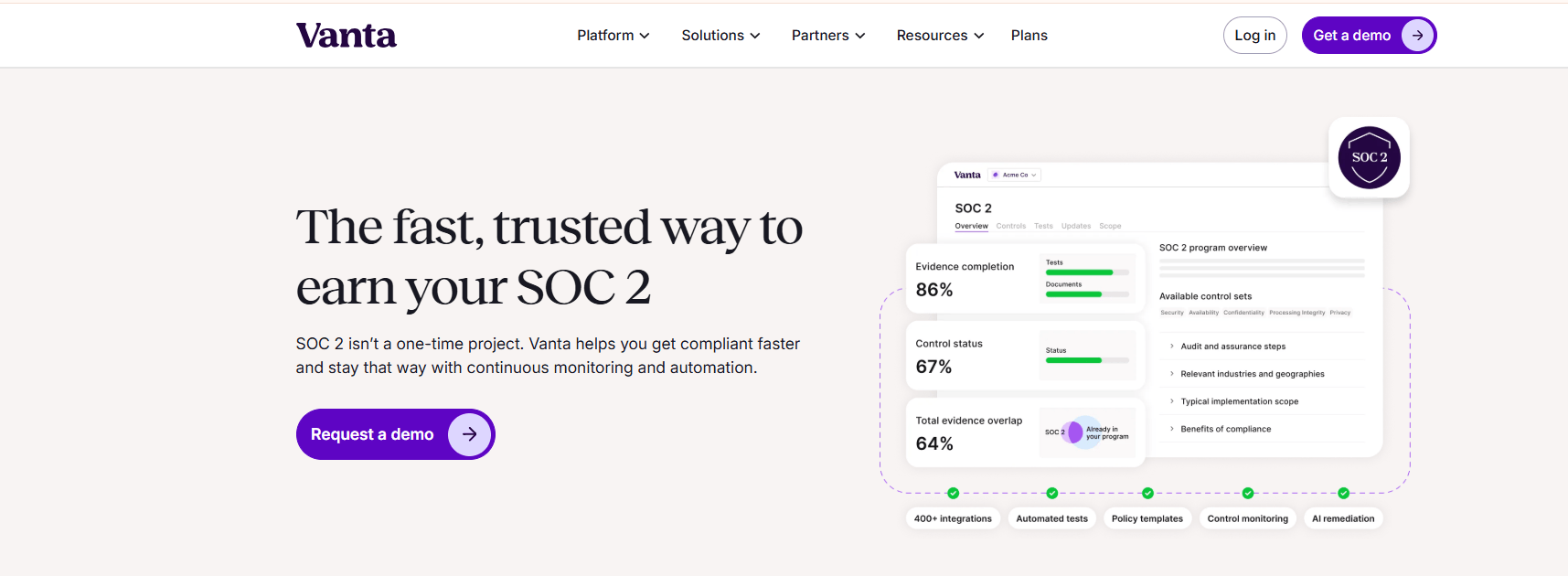
Vanta leads the compliance automation market by customer count. It serves more than 15,000 organizations and offers 400+ integrations across 35+ compliance frameworks. Vanta does not conduct audits itself. Instead, it automates evidence collection and continuously tests controls. It then packages the evidence for the CPA firm the customer chooses. Vanta now positions itself as an “Agentic Trust Platform.” Its AI features help review evidence, identify gaps, and suggest remediation steps.
Why It Fits MLOps Platform Companies
Vanta supports ISO 42001 and the NIST AI Risk Management Framework. This makes it useful for MLOps companies that need AI governance alongside SOC 2. Vanta works especially well with cloud-native stacks. Companies using AWS, Azure, or GCP alongside tools like Okta and GitHub can automate much of their evidence collection.
However, custom infrastructure can reduce automation. MLOps companies running on-premises GPU clusters or bespoke ML systems may still need to collect more evidence manually.
Features
- 400+ integrations across cloud, identity, code, and device management
- Automated control testing and continuous monitoring
- AI-powered evidence review and gap detection
- Remediation suggestions
- Trust Center for security and compliance information
- AI-assisted security questionnaire responses
- Support for 35+ frameworks
- ISO 42001 and NIST AI RMF support
- Vendor and third-party risk management
Pros
- Large integration library for complex ML technology stacks
- Support for AI governance frameworks
- Extensive auditor partner network
- Strong automation capabilities
Cons
- Custom and on-premises ML infrastructure can reduce automation
- Vanta does not publish pricing
- Some buyers report concerns about renewal pricing
Pricing
Vanta uses custom pricing. Customers must contact sales for a quote. The company does not publish prices for its four tiers.
Best For
Vanta suits cloud-native MLOps companies pursuing their first SOC 2 audit. It also works well for companies building broader programs that include SOC 2, ISO 27001, or AI governance frameworks.
Verdict
Vanta stands out among SOC 2 Providers for MLOps Platform Companies because of its broad integrations and framework support. Its automation can reduce manual evidence collection for cloud-native teams.
However, Vanta may not suit companies with complex on-premises ML infrastructure. Teams that want more hands-on audit support may prefer providers such as Secureframe or Thoropass. Early-stage companies focused mainly on price may also find Sprinto more attractive.
Overall, Vanta works best for MLOps companies that prioritize automation, integrations, and flexibility across multiple compliance frameworks.
2. Drata
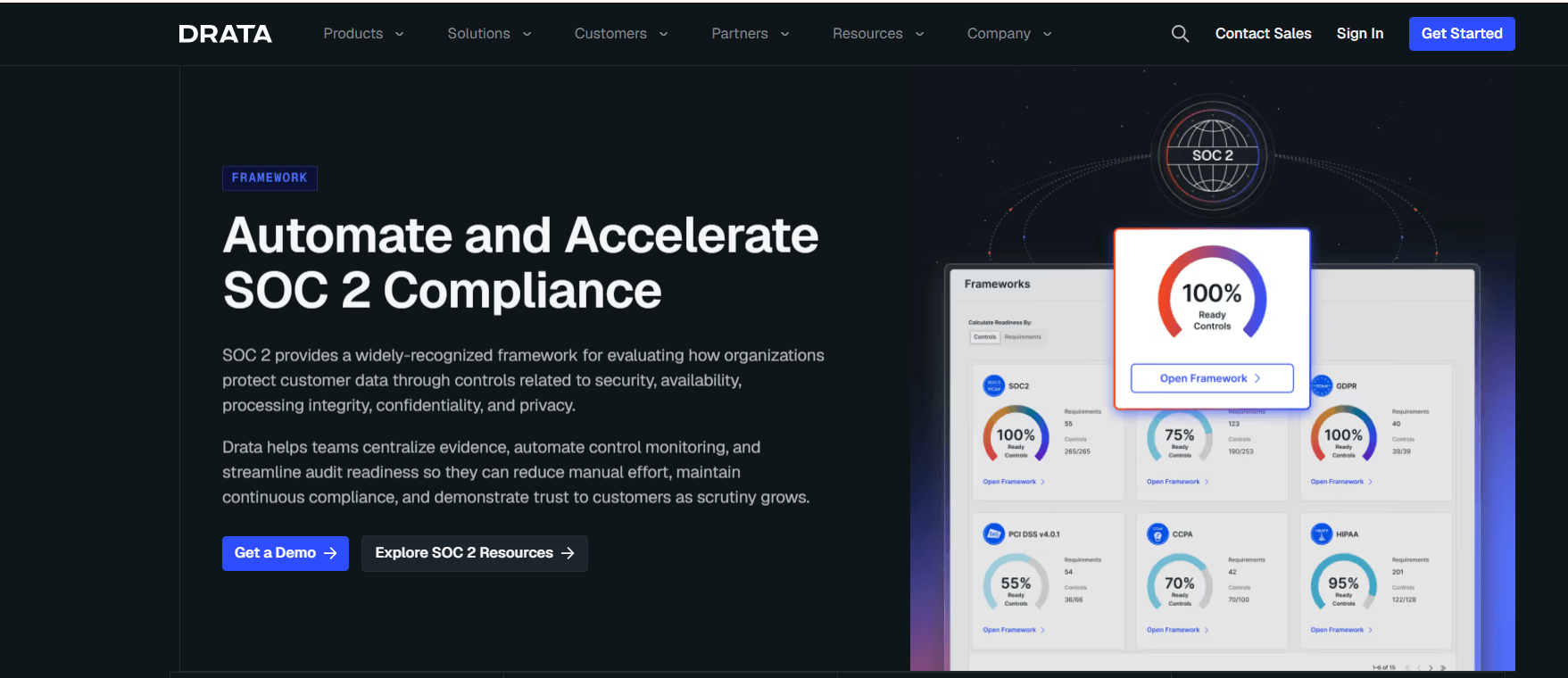
Drata is Vanta’s closest competitor in compliance automation. It surpassed $100 million in ARR and had more than 7,000 customers in early 2025. It later grew to more than 8,000 customers. Drata provides compliance software rather than audit services. Customers still work with an external CPA firm for their SOC 2 audit.
Why It Fits MLOps Platform Companies
Drata focuses heavily on cloud infrastructure and CI/CD pipelines. It also provides detailed control monitoring and custom logic-based tests. This approach suits engineering-led MLOps companies. Technical teams can build custom tests for training pipelines, model-serving clusters, and other ML infrastructure. Drata supports SOC 2, ISO 27001, HIPAA, GDPR, PCI DSS, CMMC, NIS2, DORA, and FedRAMP. Teams can also create custom frameworks and map their own controls across standards.
This flexibility helps MLOps companies build internal AI governance controls. It also reduces duplicate work when companies adopt additional frameworks.
Features
- 270+ native integrations
- Cloud, identity, version control, HRIS, MDM, and ticketing integrations
- Real-time control health monitoring
- Custom logic-based tests
- Cross-framework control mapping
- Integrated Trust Center through SafeBase
- AI-powered vendor risk management
- Auditor-facing review hub
Pros
- Strong engineering fit for CI/CD-heavy MLOps environments
- Custom framework builder for AI-specific controls
- Cross-framework mapping reduces duplicate compliance work
- Unlimited users without per-seat pricing
- High customer satisfaction and support ratings
Cons
- Custom and on-premises infrastructure can reduce automation
- Pricing remains quote-only
- Less cost-effective for pre-revenue startups
- Drata does not emphasize ISO 42001 or NIST AI RMF as strongly as some competitors
Pricing
Drata uses custom pricing. Customers must contact sales for a quote. Third-party buyer data reports annual costs ranging from roughly $9,600 to $60,000 or more.
Best For
Drata works best for growth-stage MLOps and AI infrastructure companies. It suits teams with strong engineering resources and complex cloud or CI/CD environments.
Verdict
Drata ranks highly among SOC 2 Providers for MLOps Platform Companies because it gives engineering teams more control over compliance testing. Its custom logic and cross-framework mapping also support complex MLOps environments.
However, Drata may not offer the best value for early-stage startups. Companies that need named AI governance frameworks may also prefer Vanta.
3. Secureframe
Secureframe launched in 2020. It now serves more than 6,000 customers and offers 300+ integrations. Secureframe became an early compliance platform to support ISO 42001 and the NIST AI Risk Management Framework. This gives MLOps companies a direct path to AI governance alongside SOC 2.
Secureframe provides compliance automation rather than audit services. However, its team includes former auditors and compliance professionals who provide hands-on support.
Why It Fits MLOps Platform Companies
Secureframe stands out for its AI governance support. MLOps companies can use the platform for SOC 2 while preparing for ISO 42001 or NIST AI RMF requirements.
Its framework catalog also includes CMMC 2.0, FedRAMP, and NIST 800-53. These frameworks can help companies selling AI infrastructure to regulated industries or government customers.
Secureframe also offers more hands-on support than some automation-first platforms. This can help engineering teams that do not have a dedicated compliance specialist.
Features
- 300+ integrations
- AI-powered risk assessment
- AI Evidence Validation
- ISO 42001 support
- NIST AI RMF support
- Cross-framework control mapping
- Vendor risk management
- Automated certification-expiry reminders
- Trust Center
- CMMC-focused Defense tier
Pros
- Strong support for AI governance frameworks
- Hands-on support for first-time audits
- Broad compliance framework coverage
- Strong fit for regulated MLOps companies
- High customer satisfaction ratings
Cons
- Pricing is sales-led
- May cost more than Sprinto for simple SOC 2 programs
- Some features depend on company size or plan
Pricing
Secureframe uses custom pricing. Customers must request a quote. Third-party estimates put typical annual costs around $20,500, with some small-company programs starting near $7,500 per year.
Best For
Secureframe suits MLOps companies with complex environments. It also works well for teams planning to adopt ISO 42001 or NIST AI RMF alongside SOC 2.
Verdict
Secureframe is one of the strongest SOC 2 Providers for MLOps Platform Companies with upcoming AI governance requirements. Its early support for ISO 42001 and NIST AI RMF gives it a clear advantage. It also offers strong human support during the audit process. Teams focused mainly on cost may prefer Sprinto. Engineering-heavy teams may prefer Drata for deeper infrastructure automation.
4. Sprinto
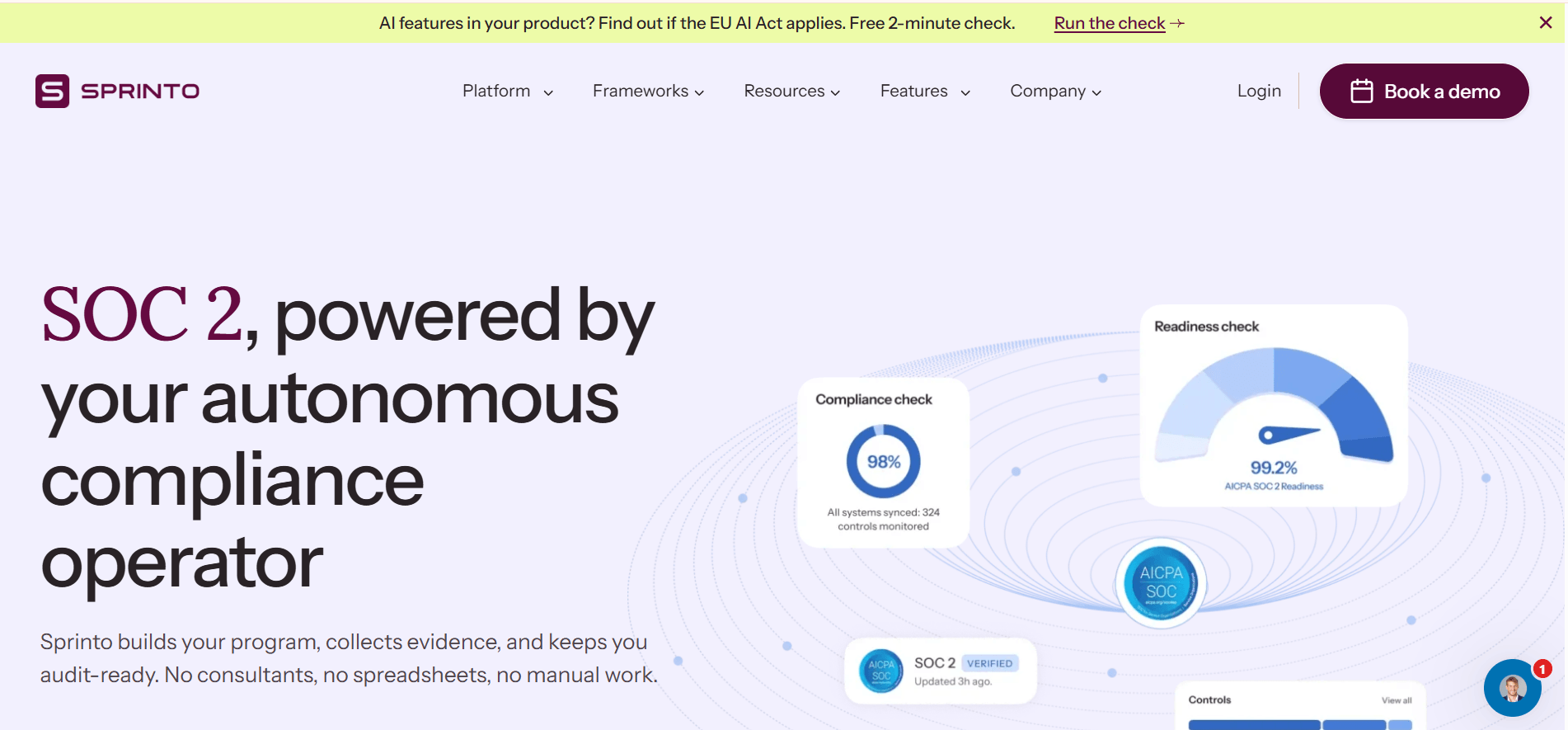
Sprinto is a compliance automation platform built around its “Autonomous Trust Platform.” It uses AI-powered workflows to manage audits, risks, policies, and continuous compliance. Sprinto supports more than 200 frameworks. However, only about 25+ receive native automation. The remaining frameworks use more manual workflows. Sprinto does not perform audits. Customers choose their own CPA firm, while Sprinto provides the compliance platform and auditor access.
Why It Fits MLOps Platform Companies
Sprinto focuses on speed and affordability. It works best for early-stage companies using standard cloud infrastructure.
However, MLOps companies with unusual infrastructure may need more manual work. Custom feature stores, self-hosted model registries, and uncommon identity systems can fall outside Sprinto’s strongest integrations.
Sprinto also does not emphasize ISO 42001 or NIST AI RMF as strongly as Secureframe or Vanta. Companies with immediate AI governance needs should consider this limitation.
Features
- AI-powered control testing
- Automated evidence collection
- No per-seat charges
- Auditor-agnostic model
- AI-generated security questionnaire responses
- Built-in Trust Center
- 200+ digitized frameworks
- 25+ natively automated frameworks
Pros
- Lower entry cost for first-time SOC 2 programs
- Strong option for lean teams
- Simple bundled pricing
- High customer satisfaction ratings
- No per-seat pricing
Cons
- Some integration and SCIM details remain unclear
- Some users report reliability issues
- Less emphasis on AI governance
- Less suitable for unusual ML infrastructure
Pricing
Sprinto uses custom pricing. Third-party estimates place single-framework SOC 2 programs around $6,000–$10,000 per year.
Best For
Sprinto suits early-stage MLOps companies using standard cloud infrastructure. It works especially well for teams pursuing their first SOC 2 on a limited budget.
Verdict
Sprinto offers strong value among SOC 2 Providers for MLOps Platform Companies. It works best when speed and price matter more than advanced AI governance.
Companies with custom infrastructure should compare Sprinto’s integrations against their own stack. Teams planning ISO 42001 soon may get more value from Secureframe or Vanta.
5. Scytale
Scytale combines compliance automation with advisory services. It supports more than 80 frameworks, including ISO 42001, SOX ITGC, and Germany’s C5 standard. Scytale also provides dedicated compliance advisors. These advisors help companies design controls and prepare for audits. Scytale does not issue SOC 2 reports. Instead, it helps companies prepare for audits and manage ongoing compliance.
Why It Fits MLOps Platform Companies
Scytale works well for MLOps companies with complex compliance requirements. This includes teams that need ISO 42001 alongside SOC 2. Its advisory model also helps companies that lack internal compliance expertise. The platform uses AI to review evidence and identify potential gaps. However, human advisory support remains Scytale’s main differentiator.
Features
- 80+ supported frameworks
- ISO 42001 support
- Dedicated compliance advisors
- AI-assisted evidence review
- Continuous control monitoring
- Automated evidence collection
Pros
- Broad framework coverage
- Strong advisory support
- Good option for teams without compliance specialists
- Supports AI governance requirements
Cons
- Lower brand recognition than Vanta or Drata
- Less public pricing information
- Less focused on pure automation
Pricing
Scytale uses custom pricing. Customers must contact sales for a quote.
Best For
Scytale suits MLOps companies with unusual framework requirements. It also works well for teams that need hands-on compliance guidance.
Verdict
Scytale stands out among SOC 2 Providers for MLOps Platform Companies when advisory support and framework breadth matter most. It can help teams manage AI governance alongside traditional compliance.
6. Hyperproof

Hyperproof is an enterprise-focused GRC platform. It targets organizations managing several compliance frameworks at once. The platform supports companies that already have mature compliance programs. It works less like a first-time SOC 2 tool and more like a central system for ongoing GRC management.
Why It Fits MLOps Platform Companies
Hyperproof supports ISO 42001 and NIST AI RMF. It also provides coverage relevant to EU AI Act requirements. This makes it useful for mature MLOps companies expanding their AI governance programs. It is less suitable for startups completing their first SOC 2.
Features
- Automated evidence collection
- AWS, Azure, GCP, and Okta integrations
- Cross-framework control mapping
- User access reviews
- Vendor risk management
- Unlimited users
Pros
- Strong multi-framework capabilities
- AI governance framework support
- Unlimited users
- Good fit for mature compliance teams
Cons
- Steeper learning curve
- Often requires a dedicated GRC lead
- Implementation adds significant cost
- Not ideal for first-time SOC 2 programs
Pricing
Hyperproof uses custom pricing. Third-party estimates place starting costs around $12,000 per year. Implementation can add another $10,000–$30,000.
Best For
Hyperproof suits mid-market and enterprise MLOps companies. It works best for organizations managing three or more compliance frameworks.
Verdict
Hyperproof is one of the more mature SOC 2 Providers for MLOps Platform Companies. It makes sense when an MLOps company has moved beyond its first SOC 2 and needs centralized multi-framework management. For a startup, however, the cost and complexity may outweigh the benefits.
7. Thoropass
Thoropass combines compliance software with a licensed CPA assurance practice. It provides the software and services. Laika Compliance, LLC, doing business as Thoropass Assurance, operates the CPA practice that issues SOC reports. This model connects compliance work and auditing in one workflow. Companies do not need to hand evidence from a compliance platform to a separate auditor.
Why It Fits MLOps Platform Companies
Thoropass can issue both SOC 2 and ISO 42001 under one CPA engagement. This makes it useful for MLOps companies that need both security and AI governance credentials.
The approach can also reduce duplicated audit work. A company can use one engagement to support US enterprise buyers and European or regulated customers.
Thoropass also supports SOC 1, ISO 27001, HIPAA, HITRUST, GDPR, CMMC, Cyber Essentials, and PCI DSS. It offers penetration testing and AI governance assessments as well.
Features
- Connected audit workflow with in-platform auditors
- First Pass AI for evidence review
- SOC 1 and SOC 2 support
- ISO 27001 and ISO 42001 support
- HIPAA, HITRUST, GDPR, CMMC, and PCI DSS coverage
- Risk register and vendor management
- Access review tools
- Penetration testing with 90-day free retesting
- 100+ integrations
- AI governance assessment services
Pros
- One CPA engagement can cover SOC 2 and ISO 42001
- Connected software and audit workflows can reduce duplicated work
- Published starting prices provide more pricing visibility
- Supports multiple security and AI governance frameworks
- AICPA peer review passed for the stated 2024–2025 period
Cons
- Less useful for companies that already have a compliance platform
- Less suitable for teams that want a completely independent audit provider
- Custom infrastructure can reduce automation
- Bundled services can cost more than software-only platforms
Pricing
For organizations with fewer than 100 employees, Thoropass lists these starting prices:
- SOC 2 Type 1: $9,995
- Launch: $12,995
- Scale: $18,995
- Fortress: $27,995
Companies with more than 100 employees receive custom pricing. Software, readiness work, and unusual scope may cost extra.
Best For
Thoropass suits MLOps and AI infrastructure companies that want SOC 2 and ISO 42001 through one CPA engagement. It works especially well for teams without a strong preference for a separate auditor.
Verdict
Thoropass stands out among SOC 2 Providers for MLOps Platform Companies because it combines compliance software with CPA assurance. It offers a particularly strong option for companies pursuing both SOC 2 and AI governance. Its published starting prices also make budgeting easier.
Companies that already use a compliance platform may prefer a dedicated audit firm such as Schellman or A-LIGN.
8. Schellman
Schellman ranks among the largest and most established SOC 2 audit firms. The firm issues more than 1,000 SOC reports each year. Schellman operates as a licensed CPA firm. It performs the actual attestation and does not require clients to use a specific GRC platform. The firm also operates as a FedRAMP 3PAO and holds DoD facility clearance.
Why It Fits MLOps Platform Companies
Schellman brings specific AI controls expertise to SOC 2 audits. Its published methodology addresses AI within SOC 2 engagements.
This makes the firm a strong option for MLOps companies facing detailed enterprise security reviews. It also supports cloud and ML platforms.
Schellman can run SOC 2 and ISO 27001 through a single-assessor model. It also offers AI Red Teaming, ISO 42001 assessments, and SOC for Supply Chain reporting.
Features
- AI-specific SOC 2 control methodology
- AI Red Teaming
- ISO 42001 assessments
- SOC 2 and ISO 27001 under one assessor
- FedRAMP 3PAO services
- PCAOB registration
- ISO 27001 certification body accreditation
- SOC for Supply Chain reporting
Pros
- Strong enterprise credibility
- Specific AI-controls audit methodology
- Extensive accreditation portfolio
- Strong fit for federal and defense-related work
- Supports complex compliance programs
Cons
- One of the most expensive firms on this list
- Type 2 audits can reach $100,000
- Larger firms can take longer than boutique providers
- Less suitable for early-stage startups
Pricing
Third-party estimates put pricing around:
- Type 1: $15,000–$30,000
- Type 2: $20,000–$100,000
Schellman uses custom quotes for individual engagements.
Best For
Schellman suits enterprise MLOps and AI infrastructure companies. It works especially well for regulated industries, government-adjacent businesses, and companies facing high-scrutiny buyers.
Verdict
Schellman is a premium choice among SOC 2 Providers for MLOps Platform Companies. Its AI controls methodology and enterprise reputation give it a strong advantage.
However, early-stage companies may not need this level of audit depth. Insight Assurance, Prescient Security, or Thoropass can offer more accessible alternatives.
9. A-LIGN
A-LIGN is a compliance audit firm founded in 2009. It combines credentialed auditors with its A-SCEND audit management platform. The firm operates as a licensed CPA practice. It also holds ISO 27001 certification body accreditation and operates a major FedRAMP 3PAO practice. This makes A-LIGN a strong option for companies that want one provider for several frameworks.
Why It Fits MLOps Platform Companies
A-LIGN uses A-SCEND to reuse evidence across multiple frameworks. This can reduce duplicated audit work for MLOps companies. Companies can combine SOC 2 with ISO 27001, HITRUST, or FedRAMP. A-LIGN also supports ISO 42001, giving AI-focused companies an option for AI governance.
Features
- A-SCEND audit management platform
- Cross-framework evidence reuse
- FedRAMP 3PAO services
- ISO 27001 and ISO 27701 accreditation
- ISO 42001 support
- SOC 2, CMMC, HITRUST, and PCI coverage
Pros
- Strong option for multi-framework compliance
- Established FedRAMP practice
- Supports government and public-sector requirements
- More accessible pricing than Schellman for some scopes
- Reduces duplicated evidence collection
Cons
- Better suited to mid-market and enterprise companies
- Larger engagements can take several weeks
- Less emphasis on AI-specific audit methodology
- Pricing remains custom
Pricing
Third-party estimates put pricing around:
- Type 1: $10,000–$20,000
- Type 2: $15,000–$50,000
- A-LIGN quotes each engagement individually.
Best For
A-LIGN suits mid-market and enterprise MLOps companies. It works particularly well for teams planning SOC 2 alongside ISO 27001, HITRUST, or FedRAMP.
Verdict
A-LIGN offers a strong middle ground among SOC 2 Providers for MLOps Platform Companies. It makes sense for companies with a broader compliance roadmap. Teams planning for FedRAMP or HITRUST should consider it seriously. Companies focused mainly on AI governance may prefer Schellman or Thoropass for more specialized support.
10. Prescient Security
Prescient Security operates a licensed CPA assurance division called Prescient Assurance. The firm provides SOC attestation alongside FedRAMP, CMMC, HITRUST, PCI, and ISO services. Prescient uses a risk-based audit approach. Instead of applying the same checklist to every company, its auditors scope controls around the client’s actual risk.
The firm also has auditors across the U.S., EMEA, and APAC.
Why It Fits MLOps Platform Companies
MLOps companies often have unusual audit boundaries. Training environments, model infrastructure, and inference APIs may operate separately.
Prescient’s risk-based approach can account for those differences. Teams can focus audit work on the systems that create the most risk.
This makes Prescient a strong option for growth-stage AI, SaaS, fintech, and healthtech companies.
Features
- Risk-based SOC 2 scoping
- Customized audit approach
- SOC 1 and SOC 2
- HIPAA, GDPR, CCPA, and PCI support
- FedRAMP, CMMC, and HITRUST experience
- CREST and CSA STAR credentials
- Auditors across the U.S., EMEA, and APAC
Pros
- Flexible audit scoping
- Consultative approach
- Broad compliance coverage
- International auditor presence
- Competitive pricing
Cons
- Less enterprise brand recognition than Schellman or A-LIGN
- Less explicit AI-controls methodology
- Pricing varies by engagement
Pricing
Third-party estimates put pricing around:
- Type 1: $5,000–$35,000
- Type 2: $10,000–$30,000
Prescient quotes each engagement individually.
Best For
Prescient suits growth-stage MLOps and AI companies that need a right-sized audit scope. It also works well for companies serving customers across multiple regions.
Verdict
Prescient is a strong value option among SOC 2 Providers for MLOps Platform Companies. Its risk-based approach works well when a standard SaaS audit does not match an MLOps environment. It also offers broad framework coverage without the premium pricing of firms such as Schellman. For companies with complex international operations, its global auditor presence adds another advantage.
11. Insight Assurance
Insight Assurance is a licensed CPA firm based in Tampa. It focuses on startups and growth-stage SaaS, cloud, and technology companies.
Its audit teams include professionals with Big Four experience. The firm also holds CMMC C3PAO and FedRAMP 3PAO accreditations.
Why It Fits MLOps Platform Companies
Insight Assurance combines a boutique approach with experience in complex cloud environments. This makes it a strong choice for an MLOps startup pursuing its first SOC 2.
The firm also offers a faster timeline than many larger audit firms. Its typical timeline ranges from three to six weeks.
Features
- CMMC C3PAO accreditation
- FedRAMP 3PAO accreditation
- Big Four-trained audit staff
- Three-to-six-week timeline
- SaaS and cloud technology focus
- Independent CPA attestation
Pros
- Fast audit timeline
- Lower pricing than many large audit firms
- Strong cloud and SaaS experience
- Federal-related credentials
- Good fit for first-time SOC 2 audits
Cons
- Less enterprise brand recognition
- Less AI-specific audit methodology
- Custom pricing
Pricing
Third-party estimates put pricing around:
- Type 1: $12,000–$25,000
- Type 2: $20,000–$45,000
The firm quotes each engagement individually.
Best For
Insight Assurance suits startup and growth-stage MLOps companies. It works especially well for teams that want an independent CPA firm with a faster turnaround.
Verdict
Insight Assurance offers a practical middle ground among SOC 2 Providers for MLOps Platform Companies.
It makes sense for startups that have outgrown the cheapest boutique firms but do not need Schellman’s enterprise reputation.
Its biggest advantage is speed. Prescient Security may have an edge for companies that need broader international auditor coverage.
12. BARR Advisory
BARR Advisory is a licensed CPA firm that uses what it calls a “Coordinated Audit” approach.
The firm maps evidence across SOC 2, ISO 27001, HITRUST, PCI DSS, and CMMC. This approach helps companies avoid repeating the same audit work across different frameworks.
BARR focuses on cloud-native SaaS, infrastructure, healthcare, and government organizations.
Why It Fits MLOps Platform Companies
BARR has experience with cloud environments built on AWS, Azure, and GCP. This makes it relevant for MLOps companies running multi-cloud infrastructure.
Its coordinated audit model also helps companies preparing for multiple compliance frameworks. Healthcare AI companies can benefit from its HITRUST experience.
Features
- Coordinated audits across multiple frameworks
- SOC 2 and ISO 27001
- HITRUST, PCI DSS, and CMMC
- ISO 27001 and ISO 27701 accreditation
- AWS, Azure, and GCP experience
- Healthcare and government-sector experience
Pros
- Strong cloud infrastructure focus
- Good fit for multi-cloud MLOps environments
- Lower Type 1 entry price
- Strong healthcare AI potential
- Supports multiple compliance frameworks
Cons
- Longer audit timeline than several competitors
- Less AI-specific methodology
- Custom pricing
Pricing
Third-party estimates put pricing around:
- Type 1: $5,000–$20,000
- Type 2: $15,000–$50,000
BARR Advisory quotes engagements individually.
Best For
BARR suits cloud-native and multi-cloud MLOps companies. It also fits AI companies that expect to pursue HITRUST for healthcare customers.
Verdict
BARR Advisory offers a strong option among SOC 2 Providers for MLOps Platform Companies when cloud infrastructure and multi-framework compliance matter.
Its lower Type 1 pricing can help smaller teams. However, its longer timeline makes it less attractive when speed matters.
For healthcare-focused MLOps companies, the HITRUST experience may justify the longer process.
Conclusion
Choosing among SOC 2 Providers for MLOps Platform Companies depends on more than price. MLOps companies need to consider their infrastructure, audit scope, compliance roadmap, and customer requirements.
Vanta and Drata stand out for automation and complex cloud environments. Secureframe adds stronger hands-on support and AI governance capabilities. Sprinto and Scytale can appeal to companies that want a simpler or more cost-conscious compliance program.
Thoropass stands apart by combining compliance software with CPA assurance. It also offers a strong path to SOC 2 and ISO 42001 through one engagement.
For companies that need an independent audit firm, the choice changes. Schellman offers the strongest enterprise and AI-controls credibility. A-LIGN works well for companies planning broader frameworks such as FedRAMP or HITRUST. Prescient Security offers flexible, risk-based scoping, while Insight Assurance provides a faster option for startups and growth-stage teams. BARR Advisory makes sense for cloud infrastructure companies with multi-framework or healthcare requirements.
The right provider should match the company’s actual environment. A cloud-native MLOps startup does not need the same audit approach as a defense-focused AI infrastructure company.
Before choosing a provider, teams should compare four things: audit scope, automation, framework coverage, and total cost. They should also confirm whether the provider understands model infrastructure, data pipelines, access controls, third-party AI services, and production inference systems.
Ultimately, the best SOC 2 Providers for MLOps Platform Companies are not simply the firms with the longest feature lists. They are the providers that can turn an MLOps company’s real technical environment into clear, defensible evidence that enterprise customers can trust.