

scrChoosing the best Cardiology EMR Software in 2026 can help cardiology practices streamline clinical workflows, improve patient care, and manage medical records more efficiently. Cardiologists handle complex patient histories, diagnostic tests, imaging results, and treatment plans, so they need electronic medical record (EMR) systems that support their specialized requirements. However, with numerous solutions available, finding the right platform can be challenging. Therefore, practices must evaluate each option based on its cardiology-specific features, ease of use, interoperability, and overall cost.
Moreover, the right cardiology EMR software can simplify appointment scheduling, automate clinical documentation, support e-prescribing, and integrate with diagnostic tools such as electrocardiograms (ECGs) and echocardiography systems. As a result, healthcare providers can reduce administrative workloads and focus more on patient outcomes. Additionally, features such as billing integration, clinical decision support, and secure data exchange can help practices improve operational efficiency while maintaining compliance with healthcare regulations.
In this guide, we review the top 10 best cardiology EMR software solutions in 2026, comparing their key features, benefits, pricing considerations, and potential limitations. Whether you run a small cardiology clinic or manage a large cardiovascular practice, this comparison will help you identify a solution that fits your clinical workflows, budget, and long-term goals.
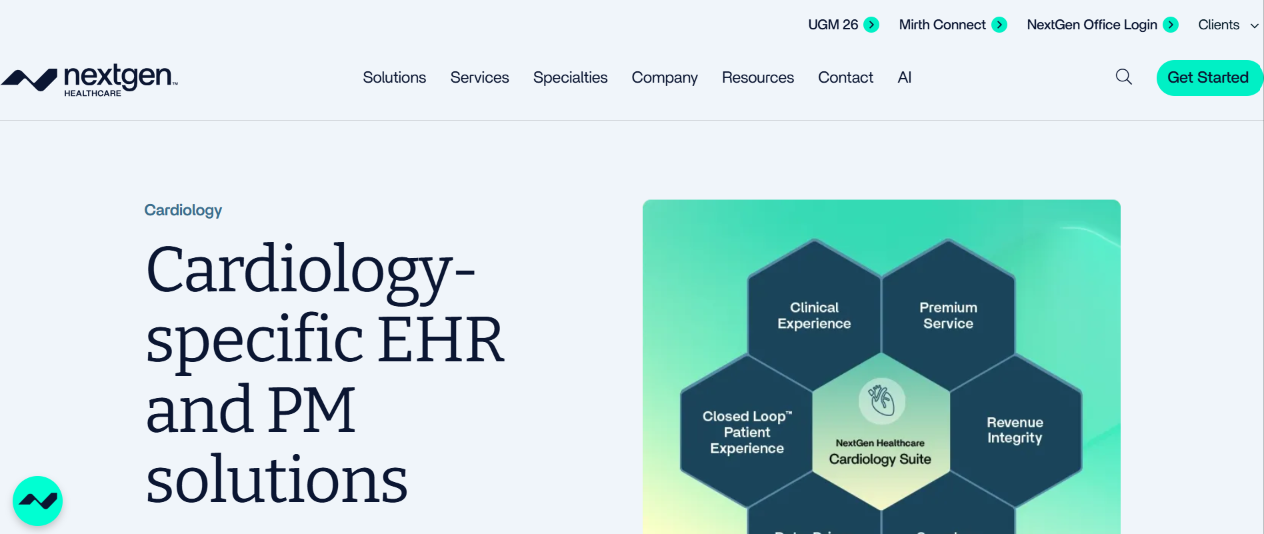
NextGen Healthcare is a strong candidate for cardiology groups that need more than general-purpose charting. Its official cardiology page describes more than 400 cardiology-specific enhancements, workflows for different cardiovascular specialties, scorecards for cardiovascular risk factors, and connectivity with cardiology devices and diagnostic systems. Its broader platform also covers patient access, digital intake, virtual visits, secure messaging, and financial workflows. This depth makes it particularly worth evaluating for clinics with multiple providers, complex procedures, or a high volume of diagnostic information
Features
- Specialty-specific documentation for general/non-invasive, invasive, interventional, electrophysiology, and vascular workflows.
- Cardiovascular risk scorecards that can capture and trend measures such as CHA₂DS₂-VASc, HAS-BLED, and other risk tools.
- Connectivity options for PACS, pacemakers, stress tests, nuclear medicine, ECG/EKG, laboratories, and related data sources.
- Cardiology-focused quality and MIPS reporting workflows, plus disease monitoring and notifications.
- Patient scheduling, digital forms, secure messaging, telehealth, and remote patient monitoring capabilities.
- AI-assisted ambient documentation that generates draft structured notes for clinician review, according to the vendor.
Pros
- Its cardiology-specific depth is a meaningful advantage over systems that rely mainly on generic templates.
- Device connectivity and risk scorecards may help teams bring relevant cardiovascular information into a more consistent workflow.
- The product spans clinical and administrative tasks, which may reduce the need to coordinate separate tools.
- It is worth shortlisting for multi-provider groups that need structured specialty workflows and room to scale.
Cons
- The breadth of the platform may be more than a solo practice needs, and a larger implementation can require substantial planning.
- Public list pricing was not available on the cardiology product page; buyers should request a written quote that itemizes licenses, interfaces, implementation, and support.
Overview. AdvancedMD targets independent cardiologists and small-to-medium cardiology groups. Its cardiology offering combines EHR, practice management, billing, and patient engagement, with templates for common cardiology encounters and procedures. The vendor also describes API-based connections to labs, diagnostic tools, imaging systems, and other EHRs. As a result, it is a practical option for clinics that want to coordinate clinical and business workflows in one cloud-based platform. [2]
Features
- Prebuilt templates for common interventional and non-interventional cardiology visits and procedures, with options to create custom templates.
- Automated data-entry shortcuts and prompts for repeated clinical documentation.
- Integrated scheduling, patient intake, medical billing, coding, and patient engagement tools.
- APIs and integration options for laboratories, diagnostic equipment, imaging, and other provider systems.
- Cloud access across supported devices, with vendor-managed updates and support.
Pros
- The product is explicitly positioned for independent and smaller cardiology practices rather than only large hospital networks.
- Combining EHR, practice management, and billing can simplify vendor management and reduce duplicate entry between systems.
- Custom templates allow practices to reflect their own documentation patterns.
- The vendor publishes general medical-specialty pricing ranges, giving buyers an initial budget reference.
Cons
- Not every integration is necessarily included in the base package; practices should validate interface availability and fees.
- The published pricing range covers medical specialties broadly, not a guaranteed cardiology-specific offer.
Practice Fusion is positioned for smaller practices, including clinics with one to three clinicians. Its cardiology page highlights customizable flowsheets, links to local labs and imaging centers, cardiology-oriented templates, appointment management, and billing support. This makes it a potential fit for a smaller practice that needs useful specialty documentation without immediately adopting a large enterprise system. Nevertheless, a practice with complex cardiac imaging or device workflows should test the product carefully before choosing it. [4]
Features
- Editable charting templates for cardiovascular disease, chest pain, carotid duplex, device testing, and related clinical scenarios.
- Customizable flowsheets and connections to local laboratories and imaging centers.
- Online booking, recurring appointments, and automated appointment reminders.
- Insurance eligibility checks, diagnosis-code search, and electronic superbill export or transfer to a billing partner.
- E-prescribing and staff access controls, subject to the vendor’s plan and applicable requirements.
Pros
- Public pricing makes it easier for small practices to establish an initial software budget.
- The product focuses on the needs of smaller practices, where implementation simplicity and predictable operating costs can matter.
- Customizable templates and flowsheets can support common cardiology documentation needs.
- Practices may be able to retain an existing billing process rather than replacing every administrative tool at once.
Cons
- The platform is aimed at smaller practices, so larger cardiology groups should validate its ability to handle their reporting, permissions, and multi-location requirements.
- Its cardiology template support should not be mistaken for guaranteed native integration with every ECG, echocardiography, PACS, or cardiac-device system.
PracticeSuite offers a cardiology-oriented platform that combines EHR, practice management, billing, and patient-facing functions. Its cardiology materials specifically mention templates for procedures such as stress tests, EKGs, and catheterization, as well as the ability to reference imaging reports and test results in patient records. It also highlights clinical dashboards, telehealth, quality reporting, and denial management. Therefore, it deserves consideration from independent clinics and growing groups that want specialty workflows alongside revenue-cycle tools. [6]
Features
- Cardiology templates for EKGs, stress tests, catheterization, and related documentation.
- Clinical dashboards that bring key patient information into a customizable view.
- Access to imaging reports and diagnostic results within patient records, subject to the practice’s setup and interfaces.
- Scheduling, patient portal, secure messaging, and telehealth tools.
- Cardiology billing support for procedure codes and modifiers, plus claims and denial management.
- Quality tracking and reporting features designed to support applicable cardiology measures.
Pros
- The vendor describes cardiology-specific documentation and billing needs, rather than presenting only a generic EMR.
- Its modular approach may let a practice choose EHR, scheduling, billing, and engagement capabilities according to need.
- Denial management and claims visibility can help practices monitor unresolved revenue-cycle work.
- It serves both independent practices and multi-provider groups, making it a candidate for gradual growth.
Cons
- Pricing is quote-based, so comparing the platform with published-price alternatives requires a sales discussion.
- A practice should verify the exact diagnostic interfaces, data migration scope, and cardiology templates included in its proposed package.

athenaOne brings together EHR, practice management, patient engagement, and revenue-cycle capabilities. Its cardiology offering emphasizes interoperability and coordinated workflows. The vendor also describes a pricing model tied to practice collections, rather than a single public per-provider subscription. That approach may appeal to practices looking for a broader operational partner, especially when claims administration and external data exchange are as important as the clinical record itself. [8]
Features
- Cardiology-focused EHR and practice workflows.
- Patient communication and engagement tools that support contact beyond the office visit.
- Revenue-cycle management services integrated with clinical and patient-facing workflows.
- Broad connectivity with external healthcare organizations, including labs, imaging centers, pharmacies, hospitals, and other participants in the healthcare ecosystem, according to the vendor.
- Ongoing platform updates and support for evolving interoperability and administrative workflows.
Pros
- The platform combines clinical records, patient engagement, and financial operations instead of treating billing as an entirely separate function.
- Interoperability is a central part of its value proposition, which may benefit cardiologists who coordinate care across multiple organizations.
- A collections-based pricing model may reduce large upfront software costs and align some vendor fees with practice revenue.
- The vendor publishes cardiology-specific material and case studies that practices can use as a starting point for questions.
Cons
- A percentage-of-collections model can become expensive as collections grow; compare projected total fees against fixed-fee alternatives.
- The actual percentage, minimums, included services, contract terms, and exit arrangements must be confirmed in the proposal.
6. Epic (Cupid)
Epic’s Cupid module is the cardiovascular information system that sits inside Epic’s EHR, and it anchors cardiology programs at many of the largest U.S. health systems. Cupid supports cardiology, electrophysiology, and vascular workflows, so clinicians chart, order, and read results from one shared patient record. According to KLAS reports, Epic holds 43.7% of U.S. acute care hospitals and 56.9% of beds, and Epic won the 2026 Best in KLAS Overall Health System Suite award for the sixteenth consecutive year.
Epic earns the top spot among the Best Cardiology EMR software in 2026 for enterprise programs, although smaller independent practices will find it a heavier undertaking.
Features
- Multi-modality, procedure-specific documentation across invasive and non-invasive cardiology, electrophysiology, and vascular medicine.
- Structured cath lab and echo reporting, including interactive coronary artery diagrams and wall-motion scoring diagrams.
- HL7 v2 interfaces through Epic Bridges that connect orders and results to PACS, ECG management systems, and transcription tools.
- Registry support, including NCDR reporting, plus consult, follow-up, and referral workflows.
- Supply and inventory tracking for cath and EP labs, which hospitals use to manage bar-coded devices.
Pros
- One chart for the whole health system, which removes the data silos that separate cardiology from primary care and the ICU.
- Strong vendor momentum, with Epic adding hospitals while competitors lose them.
- Broad ecosystem of integrations for devices, imaging, and remote monitoring.
Cons
- Integrators report gaps around mobile access, wearable data, and custom cardiology reporting that hospitals often fill with add-on tools.
- The platform fits hospital-owned and large multi-site programs far better than solo or small group practices.
7. INFINITT Cardiology Suite
INFINITT Cardiology Suite earned the 2026 Best in KLAS award in the cardiology category, and KLAS gave it a performance score of 89 out of 100. The company dedescribes their product as a web-based PACS and structured reporting system built for cardiovascular care. It covers echocardiography, non-invasive vascular imaging, EKG management, nuclear medicine, and cardiac catheterization, and organizations can run it standalone or integrate it with INFINITT PACS and leading EHR platforms.
Features
- Secure, web-based access to studies from anywhere.
- Unified reporting that combines stress EKG and nuclear medicine in a single template.
- Standardized report templates across cardiology and vascular procedures.
- Automated data collection that simplifies submission to STS and state registries.
- Streamlined data submission for ICAVL, ICAEL, and ICANL accreditation.
Pros
- Top-ranked by KLAS customers for performance, satisfaction, and partnership in 2026.
- KLAS commentary describes the system as intuitive and easy for cardiologists to use.
- Registry and accreditation workflows reduce manual abstraction work.
Cons
- It does not replace an ambulatory EMR, so practices still need a separate EHR and practice management system.
- A few users report occasional connectivity issues and early implementation hiccups.
Merge Cardio is Merative’s web-enabled cardiovascular information system. Merative, which spun out of IBM’s Watson Health business, markets Merge Cardio as a 10-year Best in KLAS winner in cardiology, and in 2026 KLAS ranked it among the top three cardiology monitoring solutions. Its companion product, Merge Hemo, won the 2026 Best in KLAS award for cardiology hemodynamics for the fourteenth year.
Merge Cardio 12.5, now commercially available, adds FDA-cleared AI measurement tools from partner Us2.ai, so echo labs can cut variability and tedious manual measurements. As a result, Merge Cardio stays highly relevant among the Best Cardiology EMR software in 2026 for imaging-heavy programs, even though a rival took the 2026 top ranking.
Features
- Clinical structured reporting modules for every cardiology subspecialty, delivered through a web-based tool.
- Pre-populated data that flows from modality devices directly into the clinical report and the EHR.
- AI-generated echocardiogram measurements through the Us2.ai integration in version 12.5.
- Cardiology analytics, workstation integrations, and a single comprehensive view of each patient’s studies.
- Integration with Merge Hemo for cath lab hemodynamic monitoring and with Merge VNA for image storage.
Pros
- Long track record in KLAS rankings across cardiology and hemodynamics.
- Automated data flow from modality to report reduces transcription and rework.
- Practical AI that targets a known pain point, echo measurement variability.
Cons
- Like INFINITT, it is a CVIS and imaging platform rather than a full ambulatory EMR with billing.
- Merge Cardio finished behind INFINITT in the 2026 CVIS ranking, so buyers should compare references carefully.
- Customers must upgrade to reach version 12.5 and its AI capabilities, which adds project effort.
9. Canvas Medical
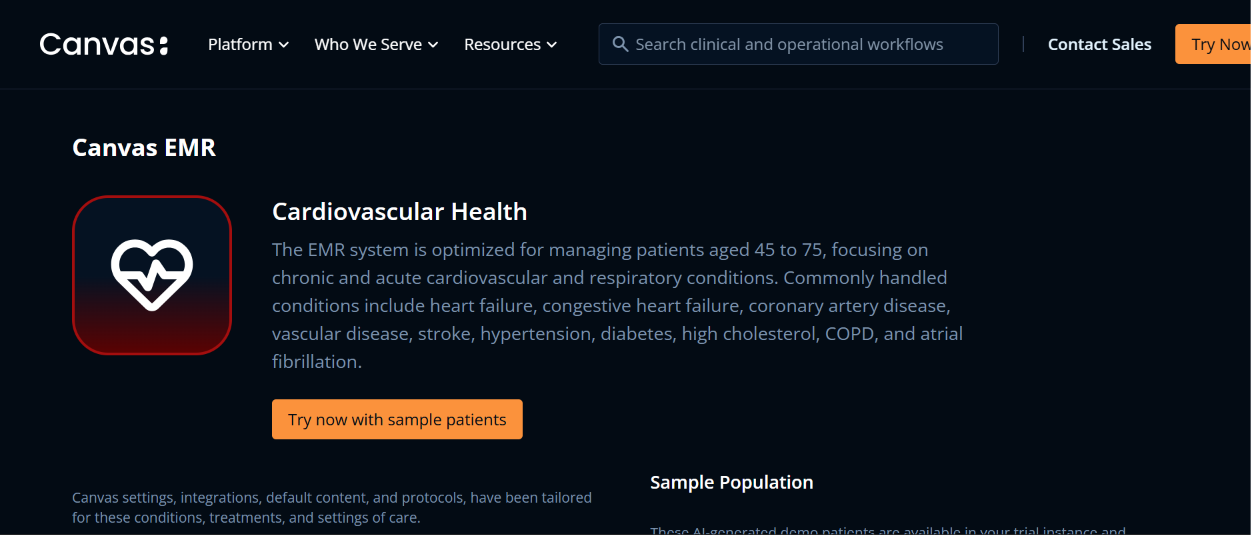
Canvas builds its EMR as a platform: it ships specialty EMRs, including a Cardiovascular configuration designed for heart failure, coronary artery disease, atrial fibrillation, and complex cardiac care, and then lets practices extend the system with plugins and AI agents.
This approach matters because it differs sharply from legacy vendors. In fact, tech-forward and virtual cardiology groups increasingly list Canvas among the Best Cardiology EMR software in 2026 when they want to automate workflows rather than adapt to rigid templates. Canvas also publishes a virtual cardiology case study and offers trial EMRs with sample patients.
Features
- A pre-built Cardiovascular specialty EMR that practices can try with sample patients.
- Plugin and SDK framework, plus FHIR and API access, for custom automations and third-party integrations.
- AI agents such as Hyperscribe (clinical copilot), a Claim Coding Agent, and a Parsing Agent for labs and documents.
- Hands-on training, with Canvas stating that practices can see patients in two weeks or less.
- Scheduling, charting, billing, and telehealth in one platform.
Pros
- Exceptional flexibility for groups with unusual care models, such as virtual or cardiometabolic programs.
- Modern API-first architecture that suits practices with developer resources.
- Fast launch timeline compared with large enterprise rollouts.
Cons
- Canvas emphasizes configurability, so confirm how it handles echo, cath, and device-clinic interfaces before you commit.
- The company is younger and smaller than Epic, NextGen, or athenahealth, which may concern risk-averse buyers.
10. CureMD
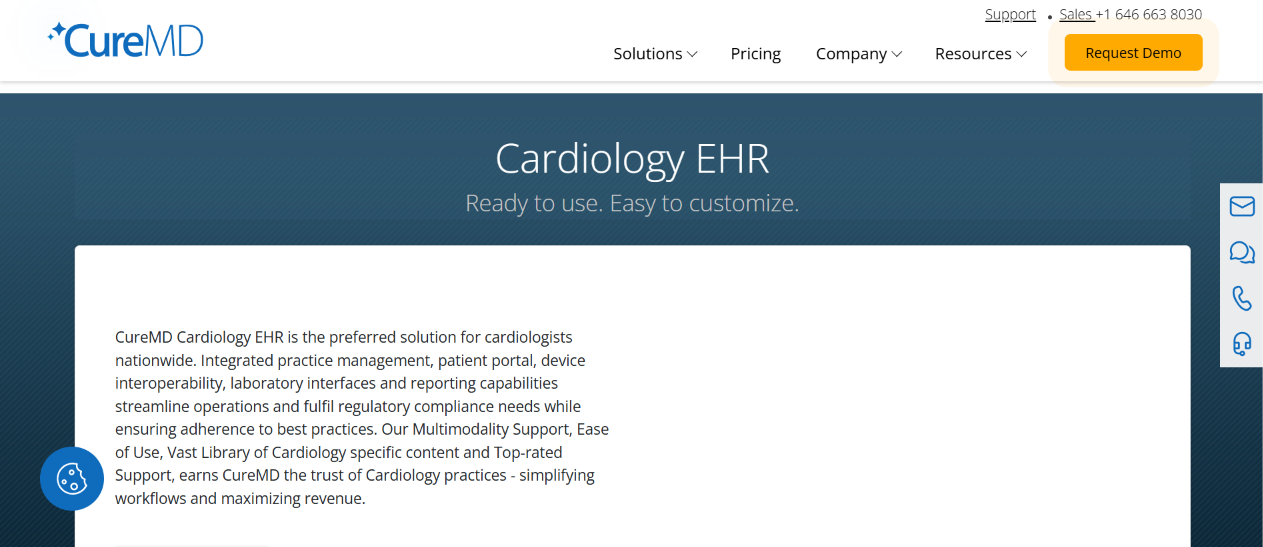
CureMD has served healthcare for roughly three decades and now supports 30-plus specialties. Its cardiology EHR promises automated EKG imports, structured cardiac assessments, and PACS integration, and its platform bundles practice management, billing, a patient portal, and an AI medical scribe that writes SOAP notes with ICD-10, CPT, and RxNorm codes. CureMD reports HIPAA compliance, SOC 2 Type II attestation, and ONC certification.
Cardiology groups looking for one vendor to handle charting and collections often shortlist it. For that reason, CureMD appears on many lists of the Best Cardiology EMR software in 2026 for small and mid-sized practices.
Features
- Condition-specific cardiology templates for angina, coronary artery disease, heart failure, and similar diagnoses.
- Device interfaces for stress testing, EKG, echo, Holter, and spirometry through partners such as Welch Allyn and Midmark.
- An EKG management system that digitizes, stores, and attaches EKG objects to the chart.
- AI Medical Billing that CureMD says delivers 98% first-pass clean claims.
- AI Contact Center and a mobile EHR for scheduling, intake, and anywhere access.
Pros
- A true all-in-one platform that reduces compatibility problems between clinical and billing systems.
- Broad AI features for documentation, coding, and patient access.
- Cardiology device and PACS integration listed as standard capabilities.
Cons
- Reviewers report mixed quality of customer support for EHR and practice management issues.
- The company’s accuracy and savings claims come from its own marketing.