

Choosing among the many SOC 2 Compliance Platforms for Companies with 10-50 Employees ranks as one of the most consequential decisions a small, growing company makes on its path toward earning enterprise trust. Because a lean team rarely has the luxury of a dedicated compliance officer, the right platform effectively becomes that missing hire, mapping controls, gathering evidence, and keeping the business audit-ready without pulling focus away from product and growth. Consequently, founders and heads of security in this headcount range cannot simply pick whichever tool has the loudest marketing; they need software that matches their budget, their tech stack, and their pace.
Moreover, a ten-to-fifty-person company faces pressures that larger organizations rarely feel in quite the same way. An enterprise prospect or investor often triggers the urgency, demanding a SOC 2 report before a deal closes, yet the company still has to keep costs proportional to a modest runway. As a result, the best options balance meaningful automation against approachable pricing, since an overbuilt, enterprise-grade platform wastes money on capabilities a small team will never use, while an underpowered tool leaves too much manual evidence-gathering behind.
Top 12 Best SOC 2 Compliance Platforms for Companies with 10-50 Employees
Secureframe positions itself squarely toward startups and small security teams, and it backs that positioning with a wide integration library plus built-in security awareness training. Because many ten-to-fifty-person companies lack a formal training program, bundling that requirement directly into the compliance platform removes one more manual task from the founder’s plate.
Features
- 300+ integrations spanning AWS, Azure, Google Cloud, Slack, and Jira
- Automated evidence collection paired with continuous control monitoring
- Built-in employee security training and policy acknowledgment tracking
- Vendor risk management module for tracking third-party subprocessors
- Trust page for sharing security posture with prospective customers
Pros
- Fast onboarding that suits a first-time SOC 2 audit
- Competitive entry pricing relative to Vanta and Drata
- Training and policy management bundled in rather than sold separately
Cons
- Advanced customization options are more limited than some enterprise-focused competitors
- Pricing can climb once a company adds a second framework or exceeds baseline employee counts
Pricing
Secureframe often starts near $5,000 to $15,000 per year for a small team pursuing a single framework, though some sources place higher tiers up to $35,000 depending on scope; the company issues a custom quote after reviewing team size and infrastructure.
Final Thought
Given its blend of affordability and ease of onboarding, Secureframe consistently appears among recommended SOC 2 Compliance Platforms for Companies with 10-50 Employees, particularly for a company completing its very first audit.
Sprinto built its platform specifically around fast-moving, cloud-native startups, and its pricing model reflects that focus: rather than charging per seat, Sprinto prices by framework, which keeps the bill predictable as a small team hires. The platform also emphasizes prescriptive, step-by-step guidance so a founder without a security background can still complete each control.
Features
- Framework-based pricing instead of per-employee seat fees
- Automated compliance checks that run without agents on most connected systems
- Prebuilt policy library aligned to SOC 2 Trust Services Criteria
- Live chat support and dedicated implementation specialists during setup
- Integrated risk assessment workflow for identifying and tracking gaps
Pros
- Cost-effective for early-stage teams, often cited as the most affordable major platform
- Prescriptive guidance that reduces guesswork for first-time compliance owners
- No per-seat penalty as headcount grows within the 10-50 employee range
Cons
- Fewer deep integrations than larger competitors like Vanta or Drata
- Advanced reporting customization lags behind more enterprise-oriented tools
Pricing
Sprinto’s published estimates land between $8,000 and $20,000 per year for startups, with some sources citing entry plans near $500 per month; the vendor confirms exact numbers through a sales conversation based on framework count.
Final Thought
Sprinto stands out as one of the most budget-friendly options among small-team-focused vendors, making it an easy first stop for a founder pricing out early-stage compliance software.
Scytale differentiates itself by pairing AI-driven automation with dedicated GRC expert support, so a small company gets both software and a human advisor who reviews evidence and answers questions along the way. This hybrid model appeals to teams that want automation but still feel unsure about interpreting a specific control requirement.
Features
- AI-powered evidence review that flags gaps before an auditor does
- Dedicated compliance advisor included in the standard engagement
- Multi-framework cross-mapping across SOC 2, ISO 27001, GDPR, and HIPAA
- Customizable Trust Center for sharing compliance status externally
- Continuous monitoring dashboard with plain-language remediation guidance
Pros
- Human expert support reduces the learning curve significantly
- Strong customer-reported audit success rate
- Clear, modern interface that avoids unnecessary complexity
Cons
- Built mainly for SaaS and tech companies, so brick-and-mortar businesses may find some features irrelevant
- Custom pricing means a founder cannot get a ballpark figure without a sales call
Pricing
Scytale does not publish standard pricing; the company builds quotes around company size, chosen frameworks, and the level of advisory support requested, so a first conversation is necessary to estimate the annual cost.
Final Thought
For a small team that wants automation plus a knowledgeable human safety net, Scytale offers one of the more supportive paths through a first SOC 2 engagement.
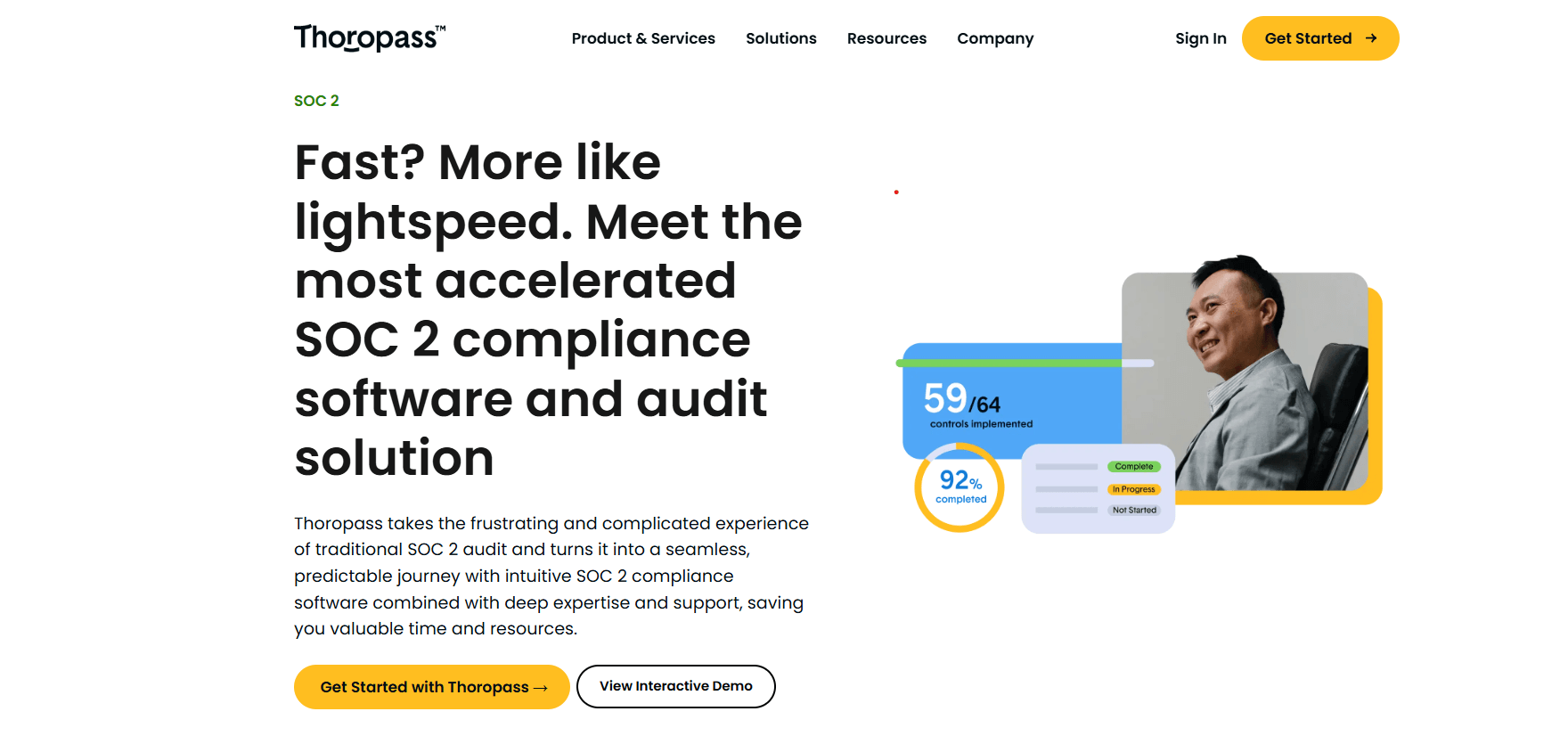
Thoropass bundles the compliance platform and the audit itself into a single relationship, which appeals to a small company that wants one vendor to own the entire process from readiness through report delivery. The company supports more than thirty frameworks and pairs automation with in-house audit delivery rather than only handing off to a third-party CPA firm.
Features
- Combined compliance automation and audit delivery under one contract
- AI-supported evidence review that speeds up auditor sign-off
- Continuous monitoring across cloud infrastructure and SaaS tools
- Expert guidance from in-house compliance specialists
- Support for over thirty frameworks, useful for companies serving regulated industries
Pros
- One vendor relationship simplifies contracting and reduces coordination overhead
- Bundled audit can shorten the overall timeline to a finished report
- Broad framework coverage supports future compliance needs
Cons
- Bundled pricing can feel less flexible for a team that already has a preferred external auditor
- Total cost sits on the higher side for the smallest teams in the 10-50 employee range
Pricing
Thoropass estimates smaller platform-and-audit packages at roughly $14,500 to $30,000 or more per year, though the company does not publish a fixed rate card and instead scopes pricing to company size and audit complexity.
Final Thought
Thoropass fits a small company that prefers a single accountable partner for both software and audit delivery, even if that convenience carries a somewhat higher price tag.
Strike Graph markets itself as an accessible entry point for cost-sensitive teams, and it backs that positioning with a free starter tier that lets a company begin mapping controls before committing to a paid plan. This approach suits a ten-person company still deciding whether it can absorb compliance costs this fiscal year.
Features
- Free Launch tier for early exploration of controls and gap analysis
- Automated evidence collection tied to common cloud and SaaS integrations
- Risk assessment workflows aligned to Trust Services Criteria
- Auditor marketplace that connects companies with vetted CPA firms
- Policy generator that speeds up initial documentation
Pros
- Free entry tier lowers the barrier for the smallest teams to get started
- Transparent published pricing beyond the free tier, unlike several competitors
- Straightforward setup that does not require heavy technical resources
Cons
- Integration library is narrower than larger, more established platforms
- Advanced features may require an upgrade sooner than expected as the program matures
Pricing
Strike Graph offers a free Launch tier, with paid plans starting at roughly $9,000 per year and published pricing available directly on the vendor’s website, a rarity among the platforms in this list.
Final Thought
Strike Graph deserves a look from any company hesitant to commit budget before validating the process, since its free tier removes much of that early-stage risk.

Vanta remains one of the most widely recognized names among modern compliance automation vendors, and it built its reputation by making the path to a first SOC 2 report feel less intimidating. The platform connects to a company’s cloud infrastructure, HR system, and identity provider, then continuously checks that the required controls stay in place between audits rather than only at a single point in time.
Features
- Automated evidence collection across 375+ integrations, including AWS, Google Cloud, GitHub, and Okta
- Continuous control monitoring that flags drift the moment a setting falls out of compliance
- Built-in policy templates that a small team can adapt instead of writing from scratch
- A Trust Center that lets prospects and customers view security posture without a lengthy questionnaire
- Auditor collaboration workspace that keeps evidence requests organized in one thread
Pros
- Fast time to audit readiness thanks to guided onboarding
- Large auditor network that already knows the platform, which speeds report delivery
- Clean, intuitive interface that non-technical founders can navigate
Cons
- Pricing sits toward the higher end for a ten-person team
- Per-framework add-ons can raise the annual bill quickly once ISO 27001 or HIPAA enters the picture
Pricing
Vanta does not publish list pricing, but small teams typically see quotes starting around $20,000 to $30,000 per year, with the exact figure shaped by headcount, integrations, and the number of frameworks pursued.
Final Thought
Because it pairs strong automation with a mature auditor network, Vanta earns its spot near the top of most shortlists of SOC 2 Compliance Platforms for Companies with 10-50 Employees, even though budget-conscious teams should confirm the full quote before committing.
Drata takes a similar continuous-monitoring approach to Vanta, though it leans harder into multi-framework reuse, which helps a small company that expects to add ISO 27001 or GDPR mapping down the road. Instead of rebuilding a compliance program from zero for each new standard, Drata maps shared controls once and reuses the same evidence across frameworks.
Features
- Cross-framework control mapping that reduces duplicate evidence work
- Real-time risk register that tracks identified gaps alongside remediation owners
- Automated employee onboarding and offboarding checks tied to HR system changes
- Custom framework builder for companies with unique customer security requirements
- Detailed audit trail that timestamps every control check for auditor review
Pros
- Strong reporting and dashboards that make board updates easier
- Reliable integrations with common DevOps and cloud tools
- Responsive customer support during the initial implementation window
Cons
- The interface carries a slightly steeper learning curve than some rivals
- Smaller teams may not need the multi-framework depth right away, so they pay for capacity they will grow into later
Pricing
Drata’s published estimates for small teams run roughly $7,500 to $15,000 per year for a single framework, though multi-framework bundles push the total higher; the vendor issues custom quotes after a short discovery call.
Final Thought
Drata suits a ten-to-fifty-person company that already anticipates chasing a second or third framework within the next year or two, since the reuse of mapped controls pays off quickly.
Hyperproof leans into flexibility, offering unlimited users and more than one hundred prebuilt compliance framework templates so a growing company can manage SOC 2 alongside NIST, GDPR, or other requirements from the same workspace. The platform emphasizes program management as much as evidence automation, which helps a small team that wants a single source of truth for every compliance task.
Features
- Unlimited user seats, which avoids per-seat pricing surprises as a team grows
- 100+ prebuilt framework templates covering SOC 2, ISO 27001, NIST, and GDPR
- Free custom framework creation for company-specific security requirements
- Risk register and task management tools built directly into the platform
- Integrations with common cloud, identity, and ticketing systems
Pros
- Unlimited users make budgeting predictable for a growing headcount
- Strong fit for a company that expects to manage several frameworks simultaneously
- Solid program-management tools beyond pure evidence collection
Cons
- Pricing is not published, requiring a sales conversation to get a real number
- Implementation can take longer than lighter-weight, startup-focused tools
Pricing
Hyperproof uses custom, contact-based pricing built around company size and the number of frameworks managed; third-party review sites report an average implementation window of roughly three months.
Final Thought
Hyperproof works well for a small company that already senses it will outgrow a single-framework tool, since the unlimited-seat model and template library scale smoothly.
Trustero applies generative AI throughout its workflow, using it to draft policies, interpret control requirements in plain language, and answer compliance questions inside the platform itself. For a small team without in-house compliance expertise, that AI assistant functions like a built-in advisor available at any hour.
Features
- AI-generated policy drafts tailored to the company’s actual tech stack
- Conversational assistant that explains control requirements in plain English
- Continuous control monitoring across connected cloud and SaaS systems
- Audit-ready evidence repository organized by Trust Services Criteria
- Readiness scoring that shows how close a company sits to audit day
Pros
- AI assistance lowers the knowledge barrier for non-specialist teams
- Modern, streamlined interface built for speed
- Useful for a company that wants to self-serve most of the process
Cons
- Smaller auditor network compared with more established competitors
- Pricing remains fully custom, with no published figures to anchor expectations
Pricing
Trustero uses custom pricing with no published free tier; a company requests a personalized quote based on team size, chosen framework, and contract length.
Final Thought
Trustero suits a small, technically comfortable team that wants an AI-first experience and does not mind requesting a custom quote to see the real numbers.
ZenGRC, now part of the Reciprocity and AuditBoard family of products, brings a risk-management-first perspective to SOC 2 readiness. Rather than treating compliance as a checklist alone, it ties controls back to a broader risk register, which benefits a small company that also wants a lightweight enterprise risk view without buying a separate tool.
Features
- Centralized risk register connected directly to compliance controls
- Workflow automation for evidence requests and control owner assignments
- Prebuilt SOC 2 control mapping alongside other common frameworks
- Reporting dashboards suited for sharing status with leadership or investors
- Document repository that keeps policies and evidence organized in one place
Pros
- Strong risk-management lens that goes beyond a simple compliance checklist
- Backed by the broader AuditBoard ecosystem, which adds long-term stability
- Useful reporting for companies that need to update a board or investor group
Cons
- Perceived cost runs higher relative to some startup-focused alternatives
- Implementation can take longer than lighter, more self-service platforms
Pricing
ZenGRC does not publish standard pricing; third-party review aggregators describe the perceived cost as high relative to peers, with an average implementation time of about three months and a reported return-on-investment window near nineteen months.
Final Thought
ZenGRC fits a small company that wants its SOC 2 program folded into a broader risk-management practice rather than treated as a standalone project.
Formerly known as Tugboat Logic, OneTrust Certification Automation now sits inside the much larger OneTrust privacy and security platform. That connection gives a small company room to grow into privacy management, data mapping, and vendor risk tools under the same vendor relationship as its compliance work scales alongside the business.
Features
- Guided SOC 2 readiness assessment with control-by-control walkthroughs
- Automated evidence collection through common cloud integrations
- Access to the wider OneTrust suite for privacy and data governance needs
- Policy templates aligned to SOC 2 Trust Services Criteria
- Auditor-facing workspace for streamlined evidence sharing
Pros
- Room to expand into privacy and data governance tools under one vendor
- Established brand with a long track record in the GRC space
- Structured, guided workflow suited to first-time compliance owners
Cons
- The broader OneTrust ecosystem can feel like more platform than a ten-person company needs
- Sales-driven pricing process takes longer than self-service competitors
Pricing
OneTrust does not publish pricing for Certification Automation; a company works with a sales representative to scope a quote, which typically reflects both the compliance module and any additional OneTrust products added later.
Final Thought
OneTrust Certification Automation makes sense for a small company that anticipates needing privacy or data-governance tools soon after finishing its first SOC 2 report.
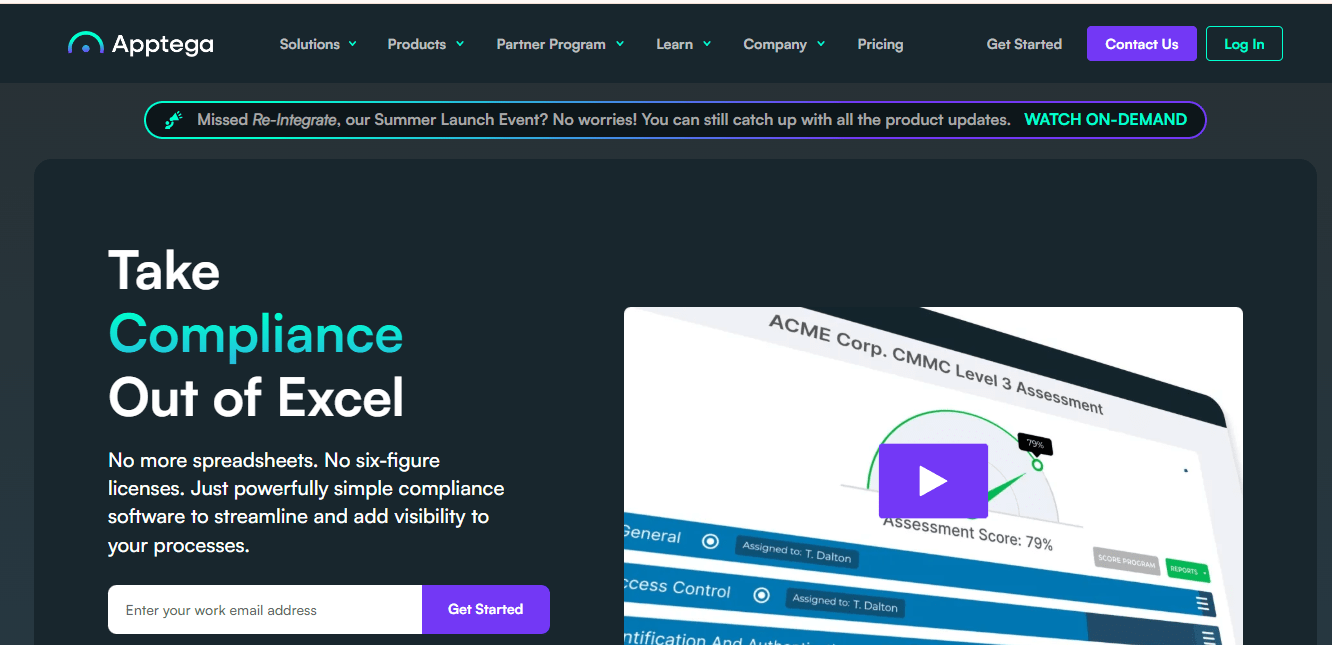
Apptega focuses on cybersecurity and compliance program management with an emphasis on visual, easy-to-understand dashboards. Many small teams appreciate that Apptega maps a single set of implemented controls across multiple frameworks automatically, so satisfying a customer’s SOC 2 request does not mean starting a separate project for ISO 27001 later.
Features
- Cross-framework control mapping covering SOC 2, ISO 27001, NIST, and more
- Visual dashboards that translate technical control status into plain-language summaries
- Vendor and third-party risk tracking built into the same workspace
- Task management tools for assigning and tracking remediation work
- Marketplace of vetted compliance and audit partners for companies needing extra help
Pros
- Dashboards make it easy to explain compliance status to non-technical stakeholders
- Flexible enough to support a company managing several frameworks at once
- Partner marketplace helps a small team find an auditor without a separate search
Cons
- Less automated evidence collection than some pure-play compliance automation tools
- Pricing requires a sales conversation rather than being available upfront
Pricing
Apptega uses custom, quote-based pricing tailored to the number of frameworks and users involved; the company typically scopes the quote after a short discovery call with the prospective customer.
Final Thought
As one of the more visually approachable SOC 2 Compliance Platforms for Companies with 10-50 Employees, Apptega works especially well for a founder who needs to explain compliance progress to a board that does not speak security jargon.