

Landing your first enterprise client as a solo founder often hits the same wall: a security questionnaire that demands a SOC 2 report you don’t have. Fortunately, the market now offers a wide range of SOC 2 compliance solutions for solo founders, so you no longer need a compliance team, a dedicated security hire, or months of runway to earn that badge. Instead, today’s platforms automate evidence collection, generate policies on your behalf, and connect you directly with vetted auditors, which means a single founder can move from a blank slate to audit-ready in a matter of weeks rather than quarters.
That said, choosing the right platform is not as simple as picking the biggest name in the space. Because pricing models, automation depth, and support levels differ significantly from vendor to vendor, a founder who compares options carefully avoids overpaying for features they will never use. Furthermore, since enterprise buyers increasingly treat a SOC 2 report as a baseline requirement rather than a bonus, selecting the right compliance partner early can directly speed up how fast you close your next deal.
This article breaks down the twelve strongest platforms on the market today, so you can find the one that fits your stage, budget, and timeline before your next big prospect asks the question.
Top 12 Best SOC 2 Compliance Solutions for Solo Founders
Sprinto focuses squarely on helping startups clear their first SOC 2 audit, and its guided workflows make it a practical shortlist entry among SOC 2 compliance solutions for solo founders who want structure without a steep learning curve. The platform runs automated checks twice daily and compresses weeks of manual control mapping into a pre-built framework tailored to cloud-native companies.
Features
- More than 200 integrations covering AWS, GCP, GitHub, and common SaaS tools
- Twice-daily automated compliance checks for continuous assurance
- Pre-mapped SOC 2 control set that shortens the setup phase considerably
- Guided task assignment so a non-technical founder still knows what to do next
- Dashboard-level visibility into audit readiness percentage
Pros
- Strong presence in the startup market, with workflows built for lean teams
- Frequently discounted when bundling a second framework at signing
- Realistic timeline expectations, generally six to ten weeks to a first report
Cons
- Advanced plans grow expensive quickly once you move beyond a single framework
- Some reviewers note the platform still needs a dedicated internal owner to hit its stated timeline
Pricing
Sprinto’s startup plans generally range from about $6,000 to $10,000 per year for a single framework, while advanced multi-framework plans can run $11,000 to $15,000 or more.
Final Thought
Sprinto works well for a founder who wants a prescriptive, checklist-driven path to a first SOC 2 report without reinventing the process from scratch.
Scytale pairs AI-driven automation with dedicated human advisory support, and that combination is precisely why it appears on many shortlists of SOC 2 compliance solutions for solo founders who want a partner rather than just a piece of software. Instead of leaving you with a checklist, Scytale assigns compliance experts alongside its AI evidence-review agent to manage policy customization and respond to auditor questions.
Features
- AI-driven evidence review that automates a large share of collection tasks
- Dedicated compliance advisors who handle policy customization
- Support for SOC 2 alongside ISO 27001, GDPR, and other common frameworks
- Guided auditor communication that reduces founder involvement in back-and-forth queries
- Continuous monitoring dashboard for control status
Pros
- Human expert support removes much of the guesswork for a first-time founder
- AI automation handles a large percentage of repetitive evidence-gathering
- Positioned specifically around getting compliance right on the first attempt
Cons
- Because it blends software with services, pricing sits above pure self-serve platforms
- Less appealing for a founder who prefers a fully DIY, hands-off-support approach
Pricing
Scytale quotes pricing individually based on company size and framework scope; budget in a similar range to other mid-tier startup compliance platforms, generally in the five-figure annual range.
Final Thought
Scytale is a strong match for a solo founder who wants a guiding hand throughout the process instead of navigating an unfamiliar audit alone.
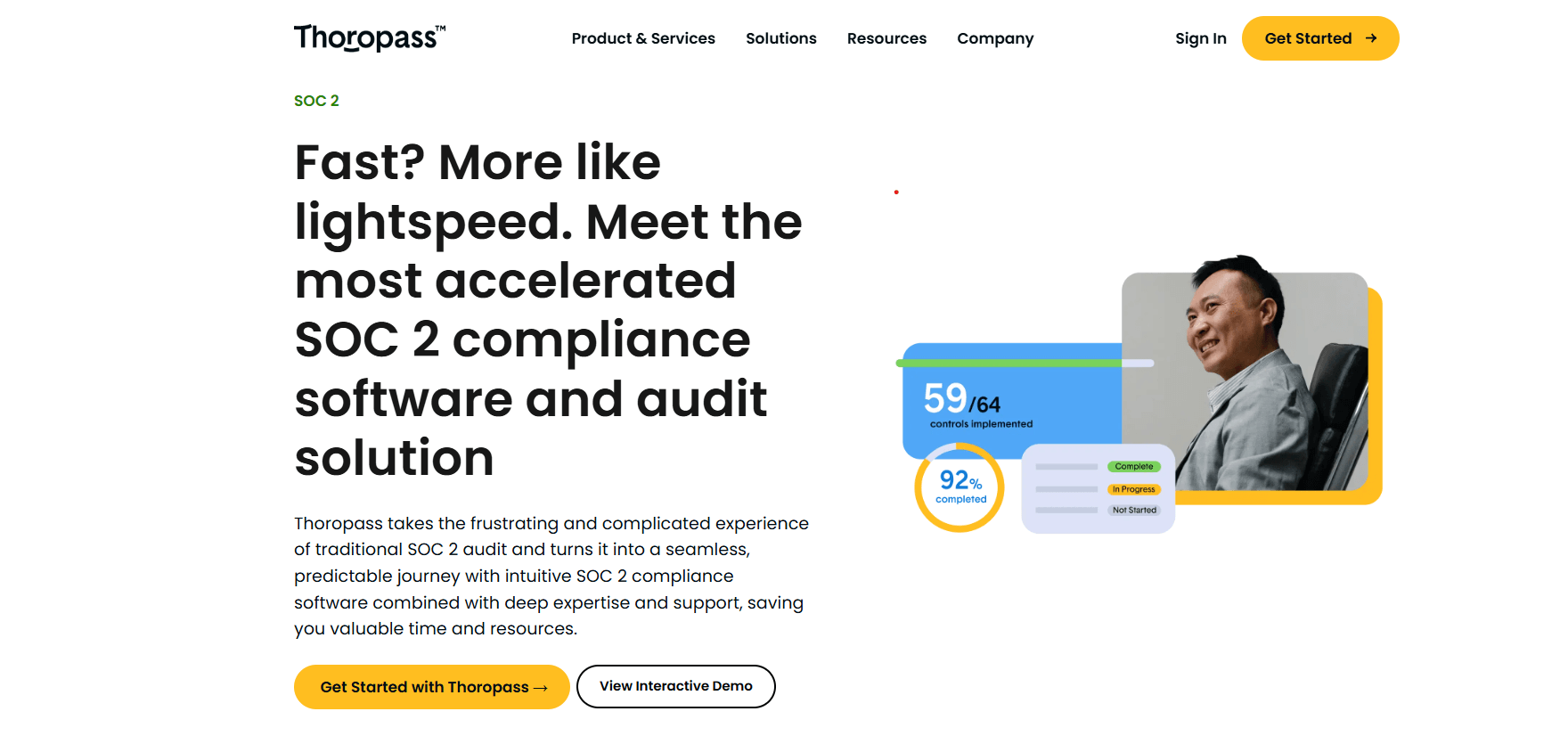
Thoropass takes a different approach by bundling the software platform and the audit itself into a single vendor relationship, which appeals to founders who dislike coordinating between a compliance tool and a separate audit firm. That combined model makes it one of the more streamlined SOC 2 compliance solutions for solo founders juggling every other part of the business alone.
Features
- Compliance automation software and the audit delivered by the same company
- Continuous control monitoring integrated with audit-firm expectations
- Support for SOC 2, ISO 27001, HIPAA, and PCI DSS on one platform
- Dedicated onboarding specialists who walk founders through initial setup
- Audit scheduling handled inside the same contract, removing an extra vendor search
Pros
- One vendor, one invoice, and one point of contact for both software and audit
- Reduces the coordination overhead of managing separate platform and auditor relationships
- Clear, guided path from onboarding through the finished report
Cons
- Bundling the audit fee into the platform contract makes it harder to compare pricing against tools that separate the two costs
- Less flexibility if you already have a preferred, independent audit firm
Pricing
Thoropass pricing is quote-based and combines platform and audit fees into one contract, so request an itemized breakdown before comparing it against unbundled competitors.
Final Thought
Thoropass suits a founder who values simplicity above all else and would rather sign with one vendor than manage two separate relationships during a first audit.
Oneleet was built around the idea that compliance and genuine security should never be separate exercises, and it backs that philosophy by bundling real, human-led penetration testing directly into its compliance subscription. As a result, it stands out among SOC 2 compliance solutions for solo founders who want more than checkbox paperwork and are willing to pay for actual security validation alongside the audit.
Features
- Manual penetration testing performed by certified security professionals, not automated scans alone
- Automated evidence collection, continuous monitoring, and policy management in one workspace
- Vendor risk management and an AI-assisted security-questionnaire tool
- Optional access to fractional CISO-style guidance
- Findings from pen tests tracked and logged directly as usable audit evidence
Pros
- Genuine penetration testing bundled in, rather than sold as a costly add-on
- Strong fit for a founder who wants real security improvements, not just an audit badge
- Praised by users for turning security into a continuous practice rather than a once-a-year scramble
Cons
- No published pricing, and bundled services tend to push the total cost higher than pure automation tools
- Does not support running multiple frameworks in parallel, so plan to sequence SOC 2 and ISO 27001 rather than pursue both at once
Pricing
Oneleet quotes are fully custom; independent estimates place small-team annual pricing anywhere from roughly $8,000 to $60,000, depending on bundled services like pen testing and advisory time.
Final Thought
Oneleet is worth the premium for a solo founder who wants an actual security partner and is prepared to pay more for pen testing and expert oversight bundled into the same contract.
ComplyJet has carved out a reputation for transparent, published pricing in a category where most vendors hide costs behind a sales call, which makes it one of the most budget-friendly SOC 2 compliance solutions for solo founders comparing real numbers instead of vague estimates. The platform automates evidence collection across cloud, identity, and HR systems while pairing that automation with hands-on human support.
Features
- Published pricing starting from roughly $4,000 per year, unusually transparent for the category
- Over 350 integrations included on every plan tier
- Support for SOC 2, ISO 27001, HIPAA, and GDPR from one dashboard
- Access to a network of more than 40 vetted, independent audit firms
- Hands-on expert support that walks founders through control setup
Pros
- Rare, fully published pricing that removes the guesswork of a sales negotiation
- Lowest advertised starting price among platforms compared in this roundup
- Human guidance included rather than sold separately, which matters for a first-time founder
Cons
- Smaller integration and framework footprint than category giants like Vanta or Drata
- Less brand recognition with large enterprise procurement teams, at least for now
Pricing
ComplyJet publishes tiered plans starting around $4,000 to $8,000 per year for the platform, with audit fees arranged separately starting near $3,000 through its auditor network.
Final Thought
ComplyJet is an excellent starting point for a cost-conscious solo founder who wants predictable pricing and real support without an opaque sales process.

Vanta remains the most widely adopted name in the compliance automation category, and it consistently shows up first whenever founders search for SOC 2 compliance solutions for solo founders because of its enormous integration library and its brand recognition with enterprise procurement teams. The platform connects to your cloud infrastructure, identity provider, and code repositories, then runs continuous, automated tests against SOC 2 controls so you spend less time chasing screenshots. Consequently, a one-person company can lean on Vanta’s guided workflows instead of hiring a compliance specialist.
Features
- Hundreds of native integrations across AWS, GCP, Azure, GitHub, Okta, and Google Workspace
- Continuous, automated control monitoring rather than one-time, point-in-time checks
- A public-facing Trust Center that lets you share your security posture with prospects
- Built-in vendor and AI risk management workflows
- Access to a large, vetted network of independent auditors
Pros
- Fastest route to audit-readiness thanks to mature, prescriptive workflows
- Strong brand recognition that reassures enterprise buyers during due diligence
- Broad framework coverage beyond SOC 2, including ISO 27001, HIPAA, and GDPR
Cons
- Onboarding demands more hands-on engineering time than most solo founders expect
- Pricing sits above several leaner alternatives built specifically for one-person teams
Pricing
Vanta uses custom quotes rather than published rate cards, though early-stage plans generally start in the thousands of dollars per year and scale with company size and framework count.
Final Thought
Vanta suits a solo founder who already has enterprise deals on the table and needs the most recognizable badge on the pitch deck, even though the setup curve is steeper than some of its rivals.
Drata built its reputation on real-time, continuous compliance monitoring, and it remains a favorite among growth-stage teams that plan to add frameworks beyond SOC 2 later. While it was originally designed with larger engineering teams in mind, its automation depth still makes it one of the more capable SOC 2 compliance solutions for solo founders who expect to scale quickly and want a platform that grows alongside the business.
Features
- Automated evidence collection tied to live control status rather than static snapshots
- Support for SOC 2, ISO 27001, HIPAA, PCI DSS, and additional frameworks on one dashboard
- Risk management module with a built-in risk register
- Workspace tooling for policy management and employee onboarding tasks
- Auditor collaboration tools that keep evidence requests inside the platform
Pros
- Deep automation reduces manual evidence-gathering as the company grows
- Multi-framework roadmap avoids a costly platform migration later
- Strong reporting dashboards that make audit readiness easy to track
Cons
- Feature depth can feel like overkill for a single founder with no engineering team yet
- Custom pricing means costs can climb quickly once you add frameworks or seats
Pricing
Drata does not publish flat pricing; startup-tier annual contracts typically land in a similar range to Vanta, with the final quote shaped by company size, integrations, and chosen frameworks.
Final Thought
Choose Drata if you are a solo founder today but expect to hire fast and pursue multiple frameworks within the next year, since the platform is built to absorb that growth without a switch.
Secureframe positions itself as a friendlier on-ramp into compliance automation, and its emphasis on intuitive design makes it approachable for a founder who has never managed an audit before. It supports more than thirty frameworks, so it works well as one of several SOC 2 compliance solutions for solo founders who anticipate needing HIPAA or ISO 27001 down the line without abandoning their existing setup.
Features
- More than 300 pre-built integrations across common startup tech stacks
- Daily automated control testing that flags drift before it becomes a gap
- Policy template library that shortens the documentation phase
- Built-in auditor matching, which removes a coordination step many founders dread
- Streamlined onboarding checklist tailored to first-time compliance programs
Pros
- Genuinely easier onboarding experience than several higher-end competitors
- Built-in access to auditors simplifies a process that otherwise requires outside research
- Wide framework coverage protects your investment as requirements expand
Cons
- Depth of automation can vary by integration, so verify coverage for your exact stack first
- Support responsiveness has been inconsistent according to some user reviews
Pricing
Secureframe relies on custom, quote-based pricing; expect entry-level annual plans priced competitively against Vanta and Drata, with the final number depending on integrations and audit scope.
Final Thought
Secureframe fits a solo founder who wants guided hand-holding through a first SOC 2 audit without sacrificing the ability to add more frameworks later.
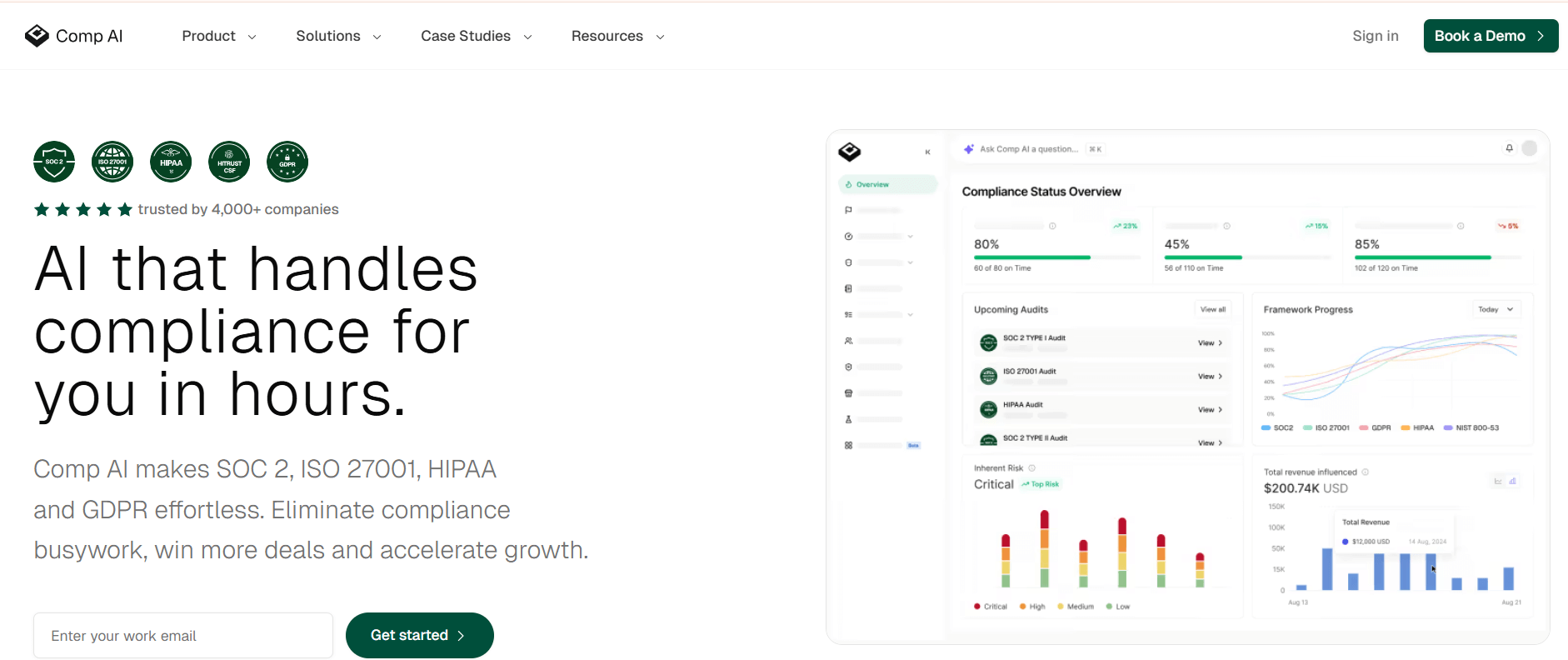
Comp AI leans directly into affordability and speed, and its open-source roots give it a distinct identity among SOC 2 compliance solutions for solo founders who want to start for free and upgrade only when they are ready for an audit. A free, do-it-yourself tier grants access to policy generation, vendor management, and risk tooling before you ever pay a cent, while paid plans bundle the audit and even a penetration test.
Features
- A genuinely free starter tier covering all frameworks, a trust portal, and AI risk tooling
- Paid plans that bundle a third-party audit and pen test into one price
- AI-generated policies customized to your company rather than generic templates
- 500-plus integrations, including developer-friendly tools like GitHub and Vercel
- Direct 1:1 Slack access to the compliance team for real-time support
Pros
- Free tier removes the biggest barrier to entry for a pre-revenue solo founder
- Paid plan advertises audit-ready status in as little as fourteen days
- Money-back guarantee reduces the financial risk of trying the platform
Cons
- The free DIY tier still requires real founder time and compliance knowledge to execute well
- Paid plans carry a twelve-month minimum term, which limits flexibility if priorities shift
Pricing
Comp AI offers a $0-per-month starter tier, a $997-per-month Done-For-You plan aimed at companies up to 25 people, and custom pricing for larger teams.
Final Thought
Comp AI is arguably the single best entry point for a bootstrapped solo founder, since it lets you test the waters for free before committing a real budget to an audit.
Strike Graph markets itself as a cost-effective governance, risk, and compliance solution, and its lighter-weight Launch tier has become a common recommendation across founder communities for very early-stage teams. That combination of affordability and simplicity earns it a spot among practical SOC 2 compliance solutions for solo founders who need something now and plan to upgrade once an enterprise deal is on the line.
Features
- Simplified onboarding built for teams with no dedicated compliance staff
- Support for SOC 2 Type I and Type II, plus ISO 27001 and HIPAA
- Risk assessment tooling built into the core workflow
- Evidence collection automation tied to common cloud and identity providers
- A lighter entry-level tier positioned for very early-stage companies
Pros
- Frequently cited as the go-to option for the earliest stage of a compliance journey
- More approachable pricing than several enterprise-leaning competitors
- Straightforward interface that does not require a dedicated compliance hire to operate
Cons
- Smaller integration library compared with category leaders like Vanta or Drata
- May require a platform switch later if you need deeper multi-framework automation
Pricing
Strike Graph pricing is quote-based, though its Launch tier is consistently positioned as one of the more affordable entry points for a first-time compliance program.
Final Thought
Strike Graph makes sense as a starting platform for a solo founder who needs a functional SOC 2 program today and is comfortable upgrading later as the company scales.
Scrut Automation combines continuous control monitoring with a risk-first dashboard, and it is frequently mentioned alongside the leading names when founders compare SOC 2 compliance solutions for solo founders operating on a tighter runway. The platform emphasizes automated risk assessments in addition to standard evidence collection, giving founders a clearer picture of overall exposure, not just audit checklist status.
Features
- Automated risk register that ties directly into control mapping
- Continuous compliance monitoring across cloud and SaaS integrations
- Support for SOC 2 alongside ISO 27001, HIPAA, and several other frameworks
- Vendor risk assessment workflows included in the core platform
- Centralized dashboard tracking audit readiness percentage in real time
Pros
- Strong risk-management lens that goes beyond simple compliance checklists
- Multi-framework support suits a founder expecting future certification needs
- Competent automation for the price relative to larger enterprise-focused rivals
Cons
- Pricing is meaningfully higher than newer, leaner entrants once you scale beyond the entry tier
- Custom quotes make upfront budgeting harder for a founder without a sales conversation
Pricing
Scrut Automation is quote-based, with independent estimates placing typical annual costs anywhere from roughly $20,000 to $80,000 depending on framework scope and company size.
Final Thought
Scrut suits a solo founder who wants a genuine risk-management platform rather than pure audit-prep software, provided the higher price still fits the budget.
SecureSlate was engineered specifically for fast-growing SaaS companies that want to avoid manual spreadsheet tracking, and it earns a place among SOC 2 compliance solutions for solo founders who need their existing tech stack mapped to SOC 2 controls without heavy manual configuration. The platform proactively flags compliance gaps before an auditor ever sees them, which helps a founder fix problems early rather than scrambling during audit week.
Features
- Automated mapping between your existing tech stack and SOC 2 controls
- Proactive gap alerts that surface issues before formal audit fieldwork begins
- Integrations built around common critical business and infrastructure tools
- Primarily focused on SOC 2, rather than spreading resources across many frameworks
- Streamlined dashboard designed for teams without a dedicated compliance function
Pros
- Sharp, SOC 2-specific focus rather than a broad, unfocused GRC feature set
- Proactive gap detection helps a solo founder avoid last-minute audit surprises
- Positioned well for fast-growing SaaS companies that need speed over breadth
Cons
- Narrower framework coverage than multi-framework platforms like Vanta or Drata
- Less suited to a founder who anticipates needing a broader GRC platform soon
Pricing
SecureSlate uses custom, quote-based pricing tailored to company size and audit scope; request a demo for an exact figure specific to a solo-founder-stage business.
Final Thought
SecureSlate is a sensible pick for a founder who wants a tool built exclusively around SOC 2 rather than a sprawling, multi-purpose compliance suite.