Synthetic data startups sell something unusual: infrastructure that generates data instead of simply storing it. That puts them in a unique position during enterprise procurement. A security reviewer at a bank or hospital system may not care that your output is “synthetic.” They still want to know who can access your generation pipelines, what happens to source data you receive, and whether your access controls can withstand an independent audit.
That’s where SOC 2 certification firms for synthetic data startups come in. They help companies prepare for SOC 2, automate evidence collection, manage controls, and, in some cases, provide audit services.
What is Synthetic Data Startups
A synthetic data platform can study patterns in the real dataset and then generate new, artificial records that preserve similar patterns without reproducing the original records.
Why do companies use it?
Synthetic data can help companies:
- Test software without exposing real customer information
- Train AI/ML models when real data is sensitive or limited
- Share datasets with developers or partners more safely
- Develop products faster without waiting for access to production data
- Create more examples when they don’t have enough real-world data
Why Synthetic Data Startups Need SOC 2 Compliance
SOC 2 is increasingly important for synthetic data companies because enterprise buyers often require it during procurement, especially in regulated industries like healthcare, finance, and insurance.
The audit mainly looks at how the company protects and manages its systems and data, including:
- Customer data: Access controls, encryption, retention, and deletion when customer datasets are used.
- AI infrastructure: Security around GPUs, data pipelines, model-serving systems, and MLOps tools.
- Customer isolation: Separating data, outputs, and credentials in multi-tenant environments.
- Vendors and incidents: Managing third-party AI/ML providers, cloud services, security incidents, and business continuity.
The important distinction is that SOC 2 evaluates your company’s security and operational controls not the quality or scientific accuracy of your synthetic data. It does not prove that the data is statistically accurate, scientifically sound, or safe to use. Those areas require separate validation and assessments.
Top 12 Best SOC 2 Certification Firms for Synthetic Data Startups
1. Vanta
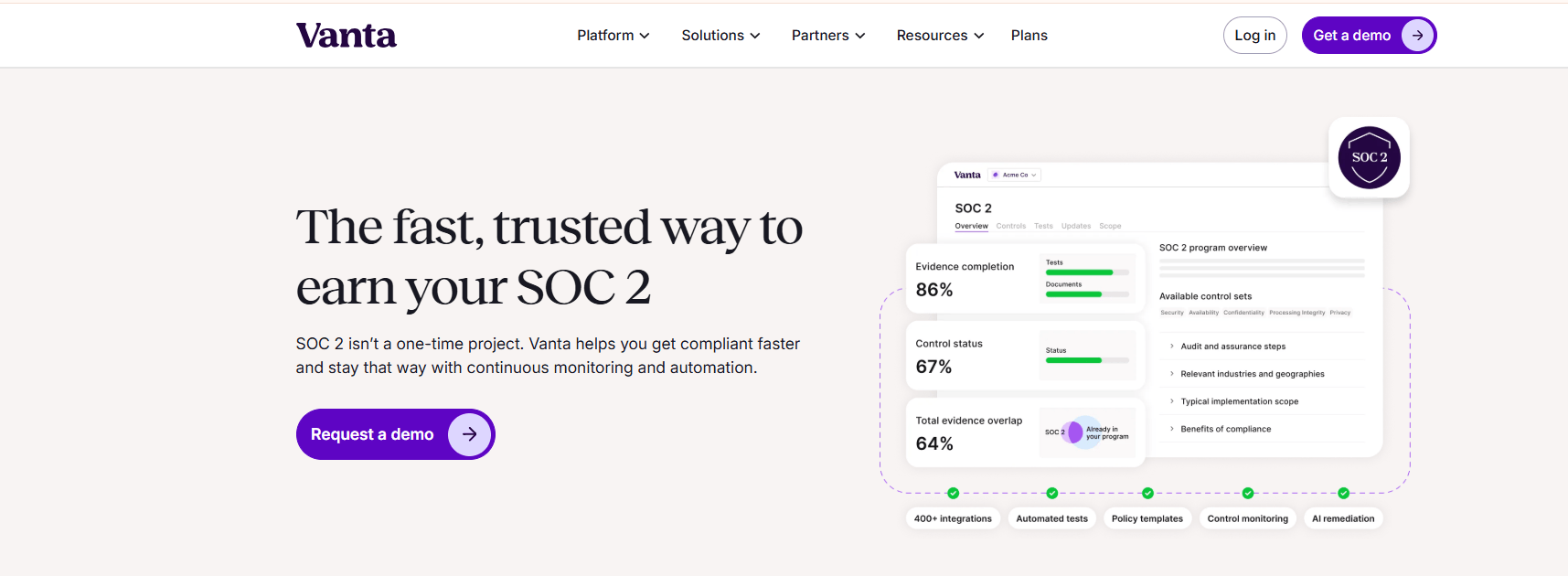
Vanta is one of the most widely adopted compliance automation platforms. It continuously collects evidence across cloud, HR, and identity systems. Vanta provides the software; an independent CPA firm performs the SOC 2 examination and issues the report.
Why It Fits Synthetic Data Startups
Vanta’s integration library, reported at more than 400 connectors, gives synthetic data startups a strong chance of finding support for their cloud provider, identity system, and code repository, even when they use a less conventional stack.
That matters for teams running GPU infrastructure or specialized MLOps tools instead of a standard SaaS environment.
Key SOC 2 Features
- Automated evidence collection
- Continuous control monitoring
- Policy templates
- Trust center
- Vendor risk management
- Security questionnaire automation
- Control mapping across frameworks such as SOC 2, ISO 27001, and HIPAA
Synthetic Data Relevance
Vanta supports major cloud providers such as AWS, GCP, and Azure, as well as common identity providers and code-hosting platforms. These systems form the infrastructure layer for many data-generation pipelines.
Teams should still check Vanta’s current integration directory for specialized ML platforms and data warehouses before assuming native support.
Pricing
Vanta does not publish fixed pricing on its main website. Its AWS Marketplace listing shows Essentials, Plus, and Professional packages starting at around $14,000 for a 12-month contract covering one to 20 employees.
Pros
- Large integration and auditor-network footprint
- Fast time-to-evidence for a first audit
- Strong trust-center and questionnaire-automation tools
Cons
- No published list pricing
- Additional frameworks and modules can increase costs
- Broad functionality may provide less specialized guidance than providers focused on first-time compliance teams
Best For
Synthetic data startups that want broad integration coverage and access to a large network of auditors familiar with the platform.
Verdict
Best if: You want a broadly compatible default and don’t need hands-on advisory support built into the contract.
Consider another provider if: You’re pre-seed and highly price-sensitive, or you want a named compliance expert included in your package.
2. Drata

Drata is a SOC 2 compliance automation platform that helps synthetic data startups prepare for audits through continuous, real-time control monitoring across multiple compliance frameworks. For companies comparing SOC 2 certification firms for synthetic data startups, it’s important to note that Drata provides the compliance software, while an independent CPA firm conducts the SOC 2 examination.
Why It Fits Synthetic Data Startups
Drata works well for companies that expect their compliance needs to grow. A synthetic data startup might start with SOC 2 to close its first enterprise deal and later add ISO 27001 or HIPAA-related controls as it enters healthcare or international markets.
Key SOC 2 Features
- Continuous control monitoring
- Automated evidence collection
- Policy management
- Risk scoring
- Risk tracking
- Audit workflows
Synthetic Data Relevance
Drata’s reported 300+ connectors cover major cloud platforms, identity providers, and development tools such as GitHub. Teams should confirm support for specialized data-science and model-serving platforms because, like most compliance platforms, Drata focuses heavily on general SaaS and cloud infrastructure.
Pricing
Drata offers Foundation, Advanced, and Enterprise plans but does not publish dollar amounts. Some sources cite an AWS Marketplace starting point around $7,500 per year for the entry tier.
Pros
- Strong continuous-monitoring capabilities
- Good multi-framework mapping
- Smooth auditor handoff
Cons
- No public pricing
- Less mature teams may need around two months for implementation
- Similar feature and pricing territory to Vanta means stack fit often determines the better choice
Best For
Engineering-heavy synthetic data teams that expect to add several compliance frameworks within the next 12–24 months.
Verdict
Best if: Your roadmap already includes additional frameworks and you want strong continuous monitoring from day one. Consider another provider if: You only need SOC 2 for the foreseeable future and want a lower entry cost.
3. Secureframe
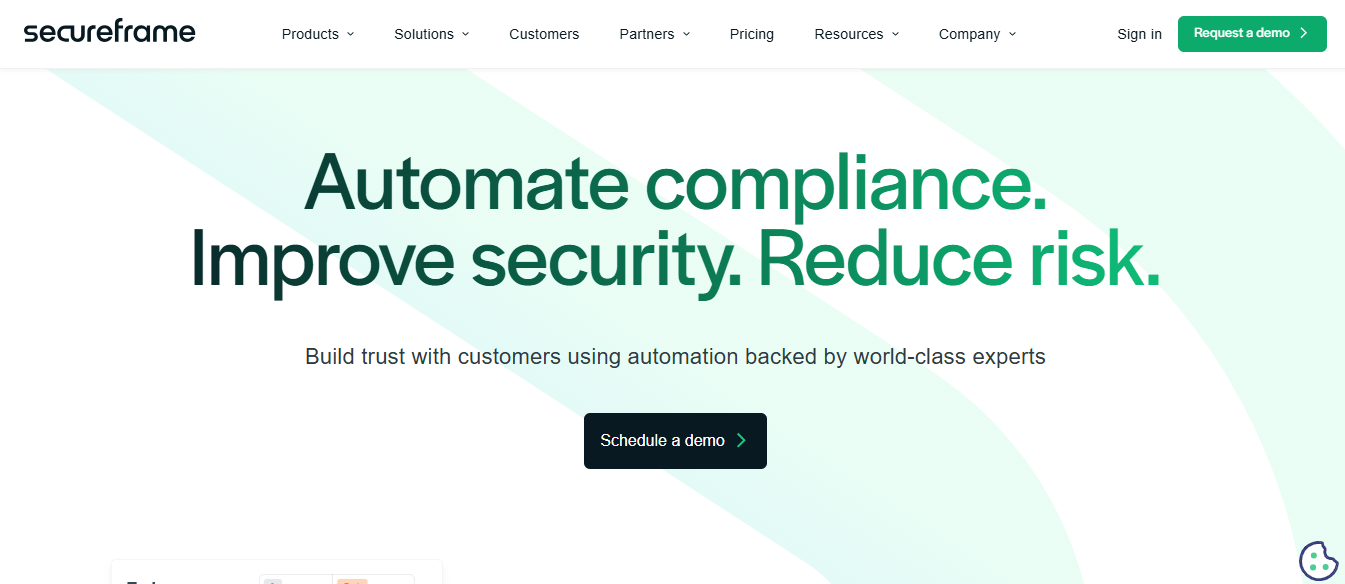
Secureframe combines compliance automation with more guided onboarding. It automates evidence collection and monitoring while an independent CPA firm performs the SOC 2 examination.
Why It Fits Synthetic Data Startups
Secureframe’s guided implementation can help founders and engineering leads who don’t have dedicated compliance staff. That makes it particularly useful for small startups pursuing their first enterprise deal.
Key SOC 2 Features
- Evidence automation
- Continuous monitoring
- Security-awareness training
- Policy management
- Vendor-risk tracking
- Customer-facing trust portal
Synthetic Data Relevance
Secureframe integrates with common cloud providers, identity systems, and code repositories used across SaaS and data-infrastructure stacks. Teams should verify support for niche MLOps and data-labeling tools before committing.
Pricing
Secureframe does not publish pricing. Third-party and procurement estimates place typical contracts between roughly $7,500 per year for a small, single-framework team and $80,000+ per year for larger, multi-framework enterprises. Reported median pricing sits around $20,000.
Pros
- Guided onboarding helps teams without compliance expertise
- Broad framework support
- Built-in security-awareness training
Cons
- Some customers report multi-month implementation timelines
- Tier restrictions can limit access to certain features
- No published pricing floor
Best For
Synthetic data startups without a dedicated security or compliance hire that want more guidance from their compliance platform.
Verdict
Best if: You need more hands-on support than a self-serve platform provides. Consider another provider if: Your engineering team can manage a more self-directed compliance process and you want to avoid tier restrictions.
4. Sprinto
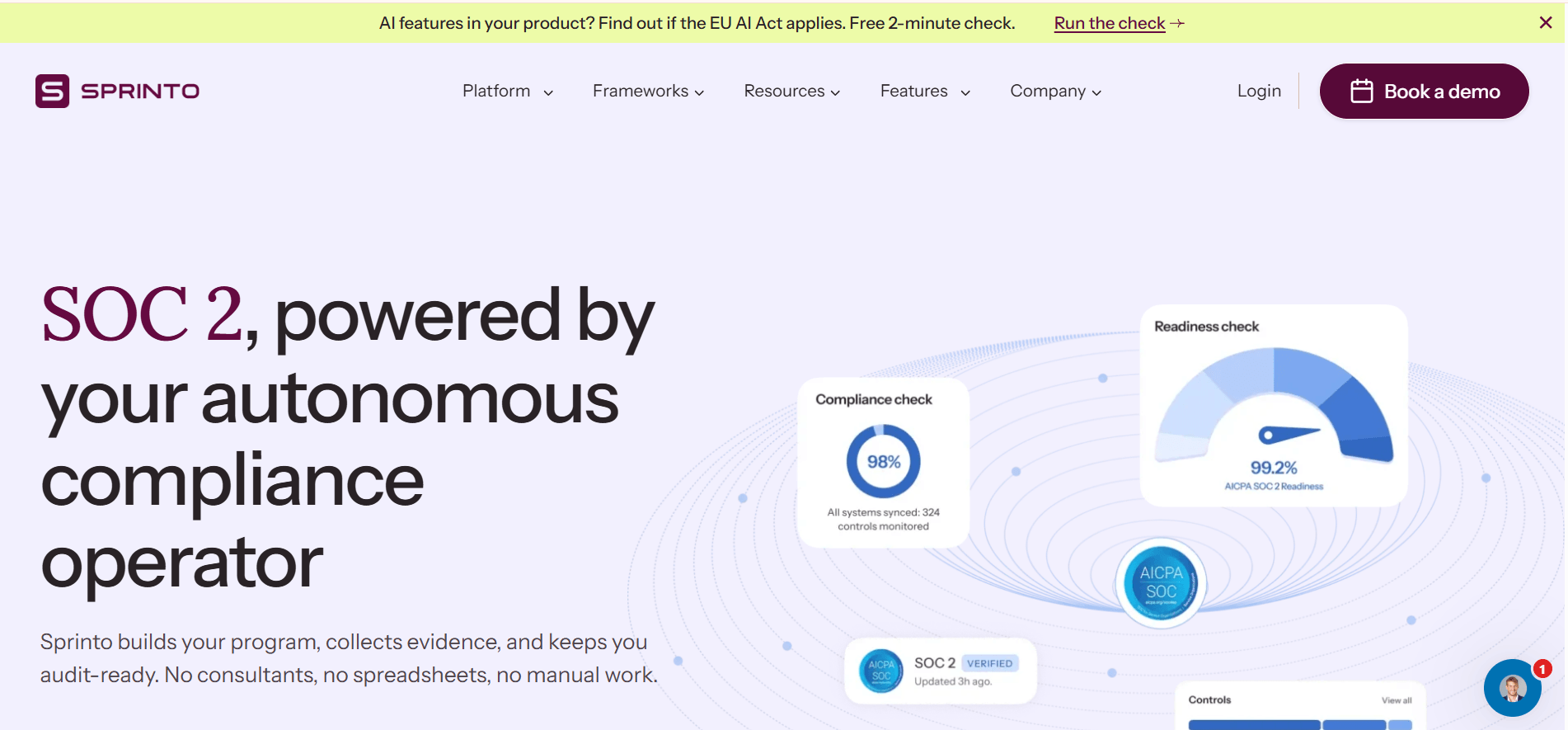
Sprinto targets early-stage, cloud-native companies that want to reach their first SOC 2 audit quickly. The platform automates evidence collection and control mapping, while an independent CPA firm performs the examination.
Why It Fits Synthetic Data Startups
Sprinto’s founder-friendly onboarding and pre-mapped frameworks suit an early-stage synthetic data company that needs to close its first enterprise or healthcare-adjacent deal without a large compliance budget.
Key SOC 2 Features
Synthetic Data Relevance
Sprinto works well with cloud-hosted, API-driven companies, which matches the infrastructure behind many synthetic data platforms. Teams with significant on-premises infrastructure may find it less suitable.
Pricing
Sprinto does not publish a public rate card. Third-party estimates place annual contracts between roughly $6,000 and $30,000. Some sources report entry points around $4,000–$6,000 for the smallest teams. Audit fees remain separate and go to an independent CPA firm.
Pros
- Fast, guided path to a first SOC 2 report
- Supports frameworks beyond SOC 2
- Strong reputation for customer support responsiveness
Cons
- Less suited to on-premises or hybrid infrastructure
- No public list pricing
- Smaller integration library than Vanta or Drata
Best For
Pre-seed and seed-stage synthetic data startups with standard cloud infrastructure that want their first SOC 2 report on a tight budget and timeline.
Verdict
Best if: Speed and cost matter more than integration breadth. Consider another provider if: Your infrastructure includes significant on-premises or highly customized components.
5. Thoropass
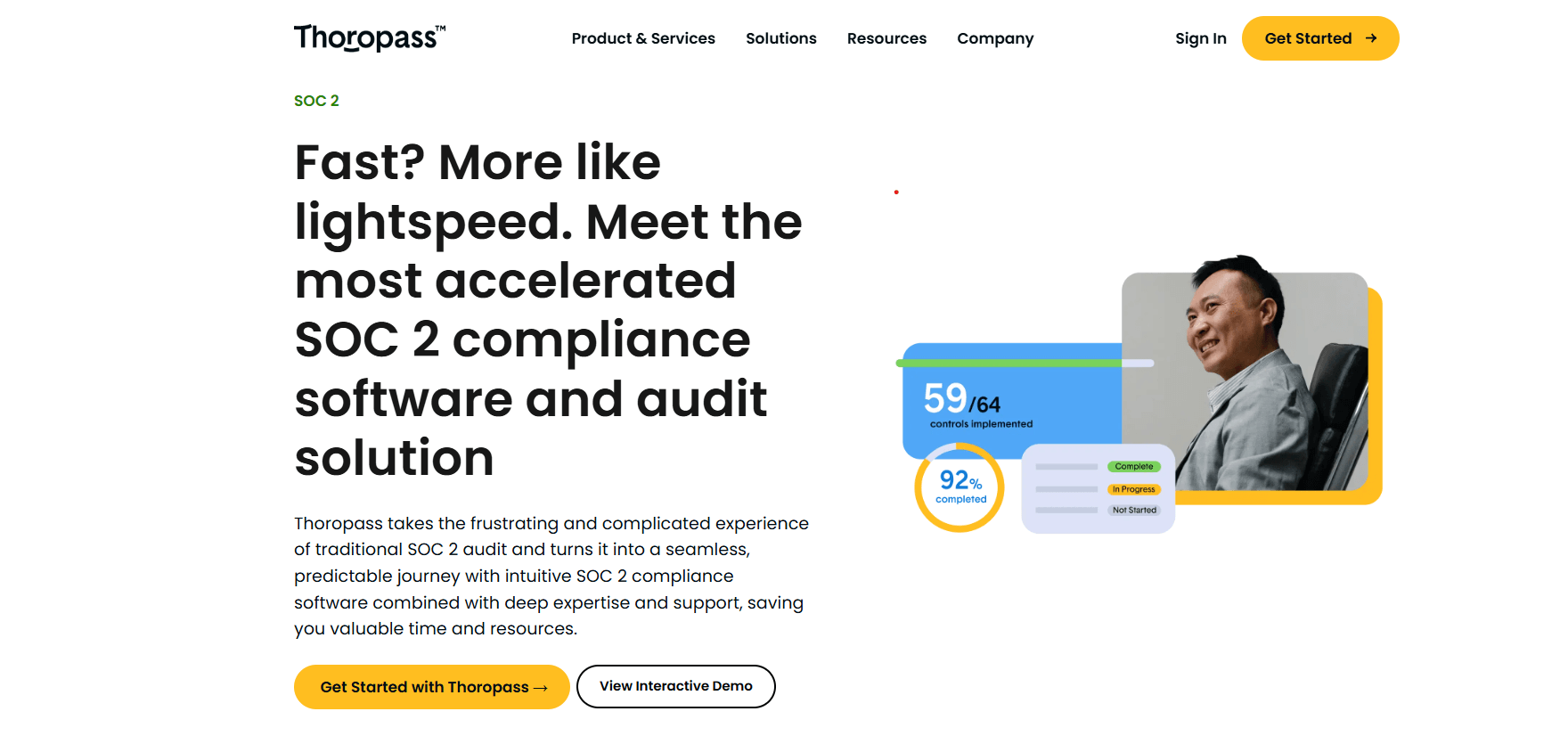
Thoropass takes a different approach from the platforms above. It combines compliance automation software with an in-house CPA audit capability. This model lets customers manage the platform subscription and audit through one vendor and, in many cases, one contract.
Why It Fits Synthetic Data Startups
Thoropass reduces vendor coordination. Instead of finding one company for compliance software and another for the audit, a startup can manage both through one provider.
Key SOC 2 Features
- Evidence-collection automation
- First Pass AI for AI-assisted evidence review
- Risk registers
- Vendor tracking
- Access-review workflows
- Penetration-testing add-ons with free retesting windows
Synthetic Data Relevance
Thoropass supports SOC 2, ISO 27001, HIPAA, PCI DSS, and HITRUST. That range can help a synthetic data company that expects to serve healthcare AI customers and may eventually need HITRUST. Cloud and development-tool integrations reportedly number more than 100. Teams should verify support for specific ML and data-infrastructure tools.
Pricing
Thoropass does not publish a fixed rate card. Third-party sources report a confirmed observed base or observation fee near $8,700 per year and a median full deal size of approximately $30,000–$50,000, depending on scope.
Thoropass says its bundled model can save 25–50% compared with buying a platform and separate audit services.
Pros
- One vendor handles software and CPA auditing
- Broad framework coverage, including HITRUST
- Bundled penetration testing with retesting
Cons
- Customers have less freedom to choose their audit firm
- Some reports suggest the platform can feel less customizable at larger scale
- No public pricing floor
Best For
Synthetic data startups that want one vendor, one contract, and one relationship for both compliance software and auditing.
Verdict
Best if: Vendor consolidation matters more than choosing your own auditor. Consider another provider if: You want to select or change your audit firm independently from your compliance software provider.
6. Scytale
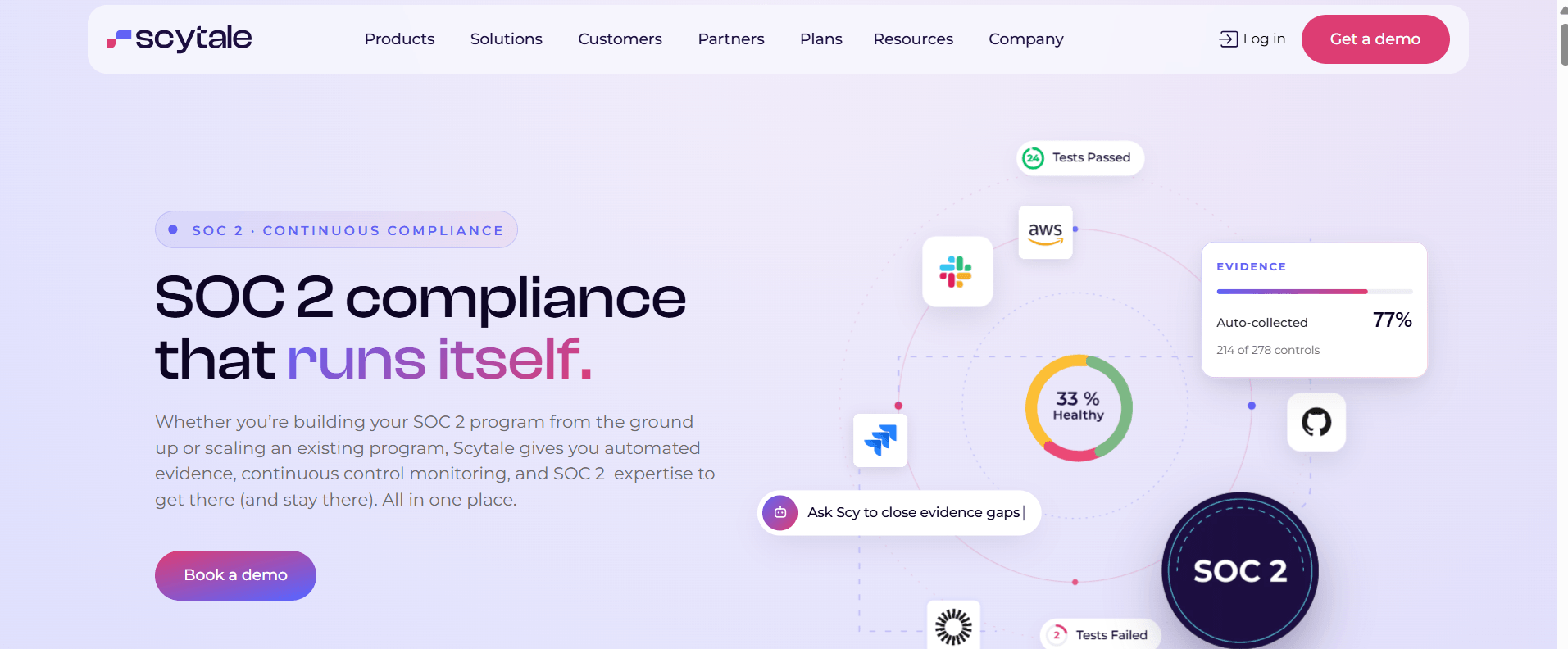
Scytale combines compliance automation with a named compliance expert. It targets teams that lack an internal compliance lead and want expert guidance alongside the software.
Why It Fits Synthetic Data Startups
Small synthetic data teams without dedicated security staff can benefit from Scytale’s expert-led approach, especially when they prepare for their first SOC 2 audit.
Key SOC 2 Features
- Continuous control monitoring
- Evidence collection
- Policy management
- Risk assessments
- Cross-framework mapping
- Audit coordination
- Support for 80+ compliance frameworks, including ISO 42001
Synthetic Data Relevance
Scytale’s reported 100+ integrations give it a smaller integration footprint than Vanta and Drata. Synthetic data companies with specialized GPU, data-pipeline, or ML tooling should therefore check the integration list carefully.
Pricing
Scytale does not publish fixed pricing on its main website. Third-party and AWS Marketplace-related sources put its starting price around $7,500–$8,000 per year.
Pros
- Named compliance expert helps first-time teams
- Broad framework library
- Strong reputation for ease of use and support
Cons
- Smaller integration library than the largest competitors
- Not designed for complex enterprise GRC requirements
- No public list pricing
Best For
First-time compliance teams that want expert guidance alongside automation.
Verdict
Best if: You don’t have internal compliance expertise and want a named expert involved. Consider another provider if: Your infrastructure relies heavily on long-tail tools that a smaller connector library may not support.
7. Oneleet
Oneleet started as a penetration-testing firm and expanded into compliance. It combines compliance automation with in-house penetration testing and vCISO guidance.
Why It Fits Synthetic Data Startups
Enterprise buyers often expect a penetration test alongside a SOC 2 report, even though SOC 2 itself does not require one. By bundling penetration testing with compliance automation, Oneleet can simplify security planning and budgeting for startups.
Key SOC 2 Features
- Continuous control monitoring
- Automated evidence collection
- In-house penetration testing
- Code security scanning
- vCISO-led security program design
- AI-assisted risk assessment
- AI-assisted security questionnaire drafting with human review
Synthetic Data Relevance
Oneleet integrates with major cloud providers, GitHub, and Google Cloud. Its sequential, one-framework-at-a-time approach may create limitations for companies that need to pursue SOC 2 and ISO 27001 or HIPAA simultaneously.
Pricing
Oneleet does not publish fixed pricing. Third-party estimates place typical contracts between approximately $12,000 and $60,000+ per year, depending on the platform, testing, and advisory services included.
Pros
- Bundled penetration testing addresses a common enterprise requirement
- vCISO guidance helps teams without dedicated security leadership
- Strong reported customer satisfaction
Cons
- Shorter track record than Vanta or Drata
- Sequential framework approach limits parallel programs
- No self-hosted or fully inspectable option
Best For
Synthetic data startups that want their SOC 2 program to improve their actual security posture, not simply produce a report.
Verdict
Best if: You want compliance automation, penetration testing, and security guidance from one provider. Consider another provider if: You need to run SOC 2 alongside multiple frameworks immediately.
8. Hyperproof

Hyperproof is a compliance operations and GRC platform for organizations that manage several security and regulatory frameworks at once.
Why It Fits Synthetic Data Startups
A synthetic data company selling into healthcare or finance may need SOC 2 alongside HIPAA-related controls, ISO 27001, or custom internal controls. Hyperproof’s control-mapping approach supports this type of overlapping compliance program.
Key SOC 2 Features
- Centralized evidence repositories
- Cross-framework control mapping
- Audit workflows
- Collaboration tools for teams managing multiple audits
Synthetic Data Relevance
Hyperproof reportedly offers around 60 integrations, fewer than the leading point solutions. A synthetic data startup with a broad or unconventional cloud and data stack should expect more manual evidence work than it would with Vanta or Drata.
Pricing
Hyperproof uses custom pricing based on organization size and GRC scope. Third-party comparisons cite starting prices around $12,000 per year.
Pros
- Strong fit for parallel framework programs
- Centralized compliance operations
- Good collaborative workflow
Cons
- Smaller integration library
- New users may face a learning curve
- More expensive and complex than necessary for a simple first SOC 2 audit
Best For
Growing synthetic data companies managing SOC 2 alongside two or more additional frameworks.
Verdict
Best if: Your compliance program already spans multiple frameworks. Consider another provider if: You only need a quick first SOC 2 report and don’t have many integrations.
9. Scrut Automation
Scrut Automation takes a risk-first approach to compliance. It connects compliance controls to an underlying risk register instead of treating compliance as a standalone checklist. The platform supports SOC 2, ISO 27001, HIPAA, PCI DSS, and GDPR-related controls.
Why It Fits Synthetic Data Startups
Synthetic data companies often connect security controls directly to operational risks, such as access to GPU infrastructure or source-data systems.
Scrut’s risk-first model helps companies connect compliance activities to those underlying risks.
Key SOC 2 Features
- Continuous control monitoring
- Cross-framework evidence mapping
- Customer-facing trust portal
- Auditor workspace for evidence review
Synthetic Data Relevance
Scrut’s cross-framework mapping helps startups that expect to pursue several frameworks.
Pricing
Scrut does not publish list pricing.
Pros
- Connects compliance work to security risk
- Cross-framework mapping reduces duplicate evidence work
- Trust portal supports enterprise security reviews
Cons
- Initial setup may require vendor assistance
- Some users report integration-sync issues
- Vendor-risk assessment is less mature than the core compliance workflow
Best For
Synthetic data startups that want to integrate SOC 2 into a broader security-risk program.
Verdict
Best if: You want compliance and risk management in one platform. Consider another provider if: You want the fastest and simplest setup experience.
10. TrustCloud
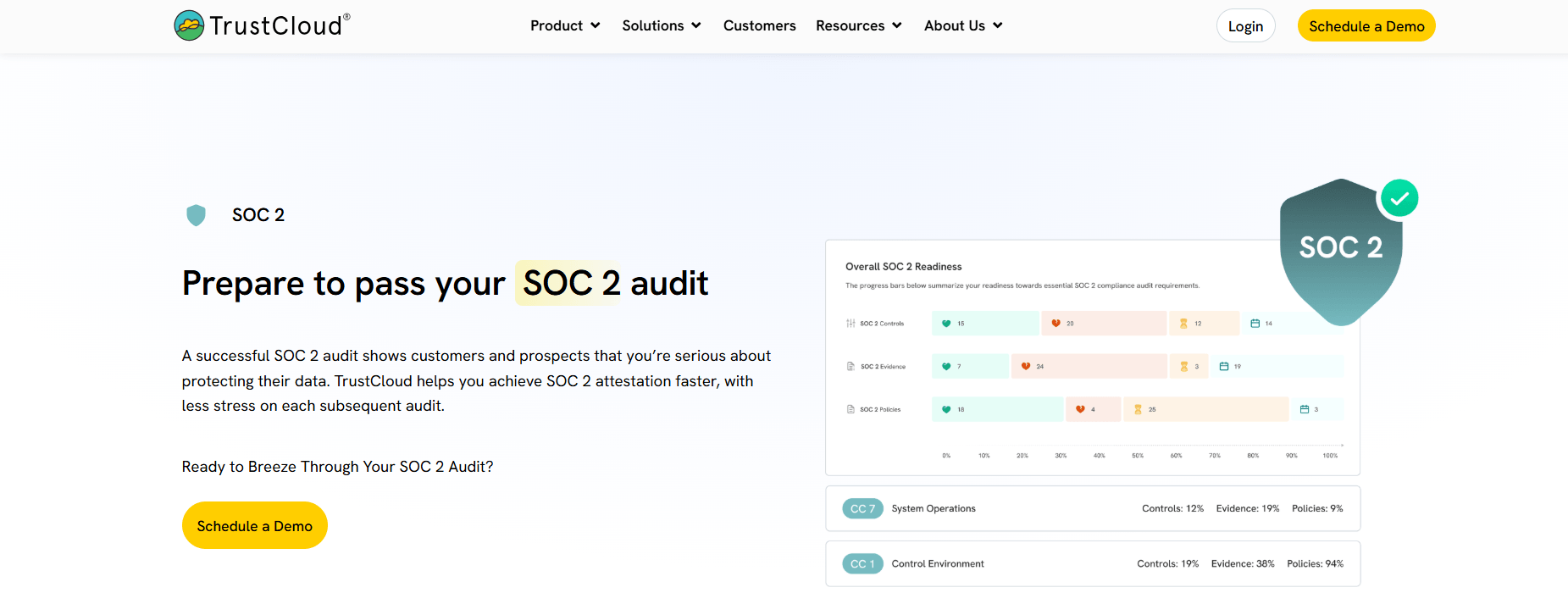
TrustCloud is a compliance and security-assurance platform that can be considered among SOC 2 Certification Firms for Synthetic Data Startups. It stands out by offering a free tier for very small teams while also providing a broader enterprise GRC suite.
Why It Fits Synthetic Data Startups
The free tier can benefit pre-seed and seed-stage synthetic data startups. Companies with fewer than roughly 20 employees can reportedly access SOC 2 Type I and Type II readiness tools, automated evidence collection, and a public trust portal without paying for the software.
The independent CPA audit fee remains separate.
Key SOC 2 Features
- Automated API-based evidence collection
- Continuous control monitoring
- Auditor-facing workspace
- Public trust portal for security questionnaires
Synthetic Data Relevance
TrustCloud provides compliance software rather than CPA audit services. It does not issue the SOC 2 report. Companies should check TrustCloud’s current integration documentation before assuming that it supports their specific synthetic data stack.
Pricing
TrustCloud offers a reported free tier for companies with fewer than approximately 20 employees. The tier covers SOC 2 readiness and evidence automation. Paid tiers depend on the size and scope of the GRC program and require a quote.
Some sources suggest the free-tier structure may have changed, so startups should confirm current availability directly before budgeting. The independent audit fee remains separate and commonly falls somewhere between $8,000 and $28,000 across the broader market.
Pros
- Lowest-cost entry point for very early-stage teams
- Auditor-facing workspace simplifies handoff
- Broader enterprise suite supports growth
Cons
- Smaller independent review footprint than Vanta or Drata
- Paid pricing remains opaque
- Reports about the current free tier vary
Best For
Very early-stage synthetic data startups that want to begin SOC 2 readiness before committing to a significant software budget.
Verdict
Best if: You’re very early-stage and need to start collecting evidence without adding a large software expense. Consider another provider if: You need the largest integration library or a long-established auditor network.
11. OneTrust
OneTrust is a large privacy, security, and governance platform. Its Compliance Automation product supports SOC 2 as part of a much broader suite covering privacy management, third-party risk, and enterprise GRC.
Why It Fits Synthetic Data Startups
Synthetic data companies that process customer-provided source data or operate across several jurisdictions may benefit from managing privacy and SOC 2-related compliance in the same platform.
Key SOC 2 Features
- Compliance automation for control monitoring
- Automated evidence collection
- Privacy management
- Consent management
- Third-party risk management
Synthetic Data Relevance
A synthetic data company that processes source datasets containing personal data may need controls that go beyond SOC 2. OneTrust’s privacy tooling can support areas such as data mapping, consent, and subject-access requests.
However, companies that generate data from non-personal or public datasets may not need the breadth of the OneTrust platform.
Pricing
OneTrust does not publish a simple rate card for its Compliance Automation module. Third-party estimates place observed annual pricing around $20,000–$40,000 for the compliance module. Pricing can increase based on additional modules, users, jurisdictions, and languages.
The independent SOC 2 audit fee remains separate.
Pros
- Strong privacy-management capabilities
- Enterprise-grade platform with broad module coverage
- Useful for companies with significant multi-jurisdictional privacy exposure
Cons
- Multiple modules can quickly increase costs
- More complex than a dedicated first-SOC-2 platform
- Enterprise procurement can take more time
Best For
Synthetic data companies with substantial source-data privacy requirements that want privacy and compliance management from one enterprise vendor.
Verdict
Best if: Your privacy requirements genuinely justify enterprise-grade privacy tooling alongside SOC 2. Consider another provider if: SOC 2 is your only major compliance requirement.
12. Optro (formerly AuditBoard)
Optro, formerly AuditBoard, is an enterprise internal-audit, SOX-compliance, and risk-management platform. SOC 2 is one framework within the broader platform rather than its primary focus.
Why It Fits Synthetic Data Startups
Optro makes more sense for an enterprise-stage synthetic data company that already operates a formal internal-audit function.
Public or late-stage private companies preparing for SOX compliance alongside SOC 2 may benefit from this broader platform.
Key SOC 2 Features
- SOC 2 management within a broader control and audit-management framework
- SOX controls testing
- Enterprise risk management
- Board-level audit reporting
Synthetic Data Relevance
For a large synthetic data company with dedicated internal-audit or risk teams, Optro can connect SOC 2 to the broader governance and risk program.
Early- and growth-stage startups generally won’t need this level of functionality.
Pricing
Optro does not publish pricing.
Vendr’s third-party procurement data puts the median deal size around $45,895 per year, with an observed range of approximately $21,180–$110,551. These figures reflect Optro’s position as an enterprise GRC and internal-audit suite rather than a SOC 2 point tool.
Pros
- Connects SOC 2 with SOX, internal audit, and enterprise risk management
- Strong fit for public and soon-to-be-public companies
- Mature enterprise audit workflows
Cons
- More expensive than SOC 2-focused platforms
- Overkill for startups that only need SOC 2
- SOC 2 automation is secondary to its broader audit capabilities
Best For
Enterprise-stage or pre-IPO synthetic data platforms that need SOC 2 within a formal internal-audit and SOX program.
Verdict
Best if: You already need, or are approaching the need for, a full internal-audit and SOX-related function. Consider another provider if: SOC 2 is your only current compliance requirement.
Conclusion
Choosing the right SOC 2 provider depends on your startup’s stage, technical environment, budget, and long-term compliance goals. For most synthetic data startups, Vanta offers the strongest all-round option, while Sprinto is particularly well suited to early-stage teams looking for a faster, simpler path to their first audit. Drata is a strong choice for companies preparing to scale across multiple compliance frameworks.
For larger synthetic data companies, Optro and OneTrust become more relevant when SOC 2 sits alongside broader risk, privacy, and governance requirements. Thoropass and Oneleet are worth considering if you want more hands-on audit or security support.
Most importantly, don’t choose a provider based on price or brand name alone. Look at the integrations you need, the level of audit support provided, what is included in the quoted price, and how well the platform can support your compliance roadmap as your company grows.
SOC 2 can help synthetic data startups build trust with enterprise customers, but it is only one part of a broader security, privacy, and AI governance strategy.