

Enterprise buyers no longer sign a contract without proof of security discipline, and that single fact has turned SOC 2 into a revenue gate rather than a back-office checkbox. Consequently, the search for reliable SOC 2 Providers for Companies with 500+ Employees has become a board-level priority for security, IT, and procurement leaders alike. Unlike a ten-person startup chasing its first Type I report, an organization with 500 or more employees juggles distributed engineering teams, multiple business units, legacy on-premises systems, and often two or three overlapping frameworks at once. As a result, the platform or firm you choose must scale far beyond a simple evidence-collection checklist.
This article walks through the twelve strongest options on the market today, ranked with large, complex organizations in mind rather than early-stage startups. Because headcount changes everything about how a compliance program is scoped, staffed, and budgeted, this guide leans deliberately toward platforms built to handle thousands of employees, dozens of integrations, and multi-framework overlap. Furthermore, every listing below includes a direct link to the provider’s website, a plain-language overview, a breakdown of core features, a bulleted list of pros and cons, current pricing context, and a final thought to help you shortlist quickly.
Whether your organization is evaluating automation-first platforms or full-scale governance, risk, and compliance (GRC) suites, this roundup of the leading SOC 2 Providers for Companies with 500+ Employees gives you a grounded starting point for due diligence.
Top 12 Best SOC 2 Providers for Companies with 500+ Employees
Scytale blends AI-driven automation with hands-on GRC expert support, and it markets itself explicitly to startups, scaling companies, and enterprises alike. Because it automates more than 40 security and privacy frameworks from a single dashboard, Scytale suits a 500-plus-employee organization that expects its compliance scope to keep expanding as new business units, regions, or customer segments come online.
Features
- AI GRC Agent for automated evidence review and gap analysis
- Continuous control monitoring across 40-plus frameworks
- Vendor risk management and automated user access reviews
- Optional penetration testing and virtual CISO add-ons
- Dedicated GRC experts guiding teams through each audit cycle
Pros
- Broad framework coverage supports organizations juggling several certifications at once
- Combines automation with genuine human oversight rather than a pure self-service model
- Add-on services reduce the need to manage separate vendors for pen testing or vCISO work
Cons
- Smaller review volume than Vanta or Drata makes independent benchmarking harder
- Some users report a learning curve when configuring less common frameworks
Pricing
Base pricing starts near $7,500 per year.
Final Thought
Scytale fits well among SOC 2 Providers for Companies with 500+ Employees for security teams that want an AI-forward platform without giving up access to real compliance experts when questions get complicated.
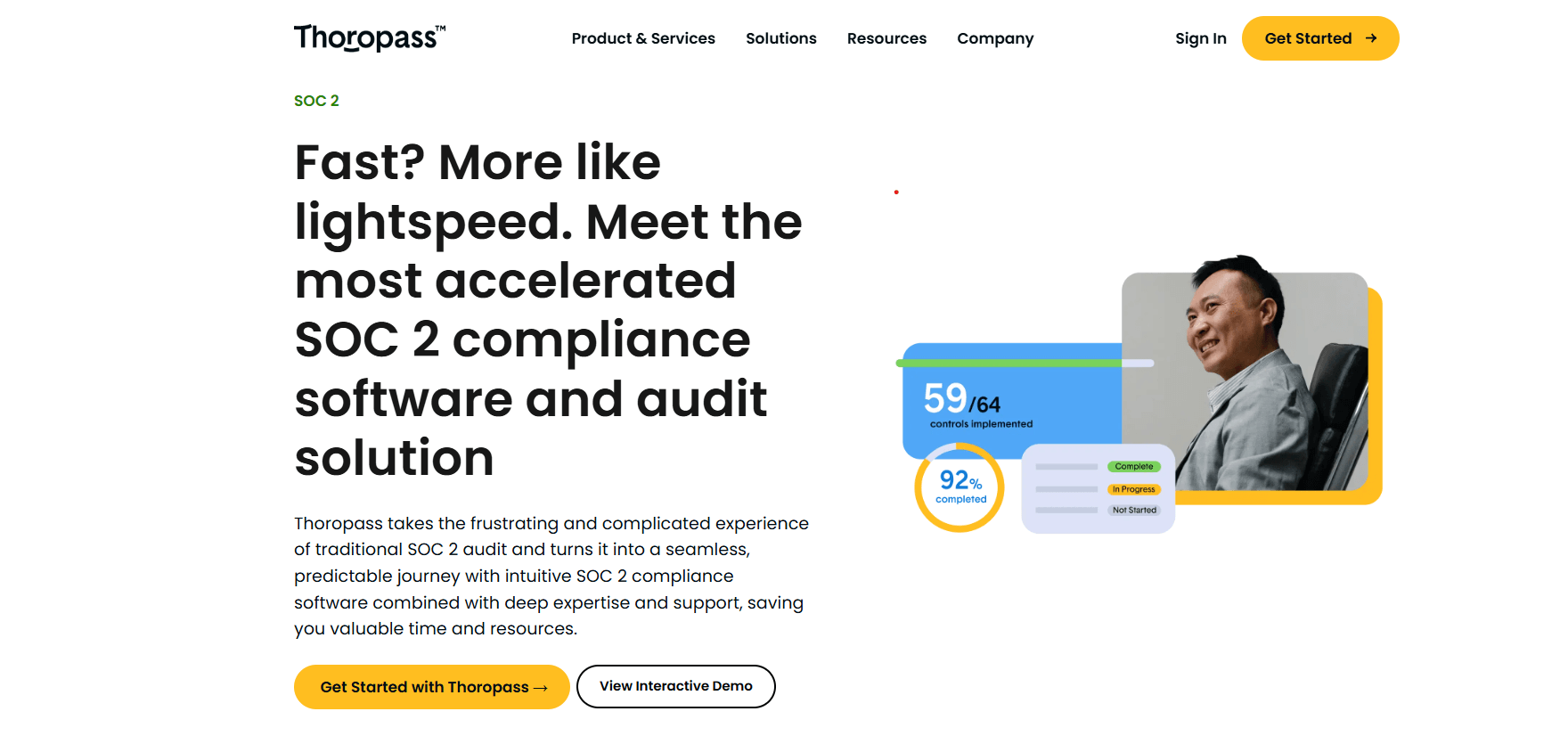
Thoropass, formerly known as Laika, folds the audit itself into the platform through its affiliated audit entity, Laika Compliance, LLC. This tight bundling of software and attestation sets Thoropass apart from tools that require you to contract a separate CPA firm, and large organizations often value the single point of accountability that results. Thoropass currently supports more than 30 frameworks, including SOC 2, HIPAA, and PCI DSS.
Features
- Combined compliance software and in-house audit delivery
- Integrations with cloud platforms, identity providers, and version control systems
- People-management table for tracking training completion and task ownership
- Real-time dashboards summarizing compliance status by team
- Success managers embedded in onboarding and audit preparation
Pros
- One vendor for both software and audit simplifies procurement and reduces handoff friction
- Success-manager support helps large, cross-functional teams stay aligned on tasks
- Broad framework catalog supports organizations expanding beyond SOC 2 alone
Cons
- Some procurement teams flag the in-house audit structure as a conflict-of-interest consideration worth reviewing
- Users report occasional performance and interface clutter as configurations grow more complex
Pricing
Thoropass pricing starts at roughly $14,500 per year.
Final Thought
Thoropass belongs on this list of SOC 2 Providers for Companies with 500+ Employees because it removes the friction of coordinating between a software vendor and a separate audit firm, which large organizations often appreciate when timelines are tight.
Oneleet takes a security-first stance, built by a team with a background in offensive security rather than pure compliance tooling. Its standout feature is genuine, manual penetration testing woven directly into the compliance workflow rather than treated as a separate line item, which is particularly relevant for a large enterprise that must demonstrate active security testing, not just passive evidence collection.
Features
- Manual penetration testing performed by certified security experts, logged as audit evidence
- Verify AI engine for automated evidence validation and security questionnaire responses
- Vetted network of partner CPA firms for the actual SOC 2 attestation
- Continuous monitoring, policy management, and vendor risk management in one platform
- Founder-level offensive security expertise embedded in product design
Pros
- Bundled penetration testing meaningfully strengthens the security posture behind the compliance report
- AI-assisted questionnaire handling reduces manual load on security teams fielding many vendor requests
- Clean, modern interface earns favorable marks from reviewers switching from older tools
Cons
- Oneleet is not itself a licensed CPA firm, so the audit still runs through a partner auditor
- Less suited to organizations that want a full multi-framework GRC suite beyond security-centric certifications
Pricing
Oneleet’s pricing is quote-based and scales with company size, integration count, and whether penetration testing is bundled into the annual contract
Final Thought
Oneleet stands out among SOC 2 Providers for Companies with 500+ Employees for security-conscious enterprises that see compliance and real-world penetration testing as inseparable parts of the same program.
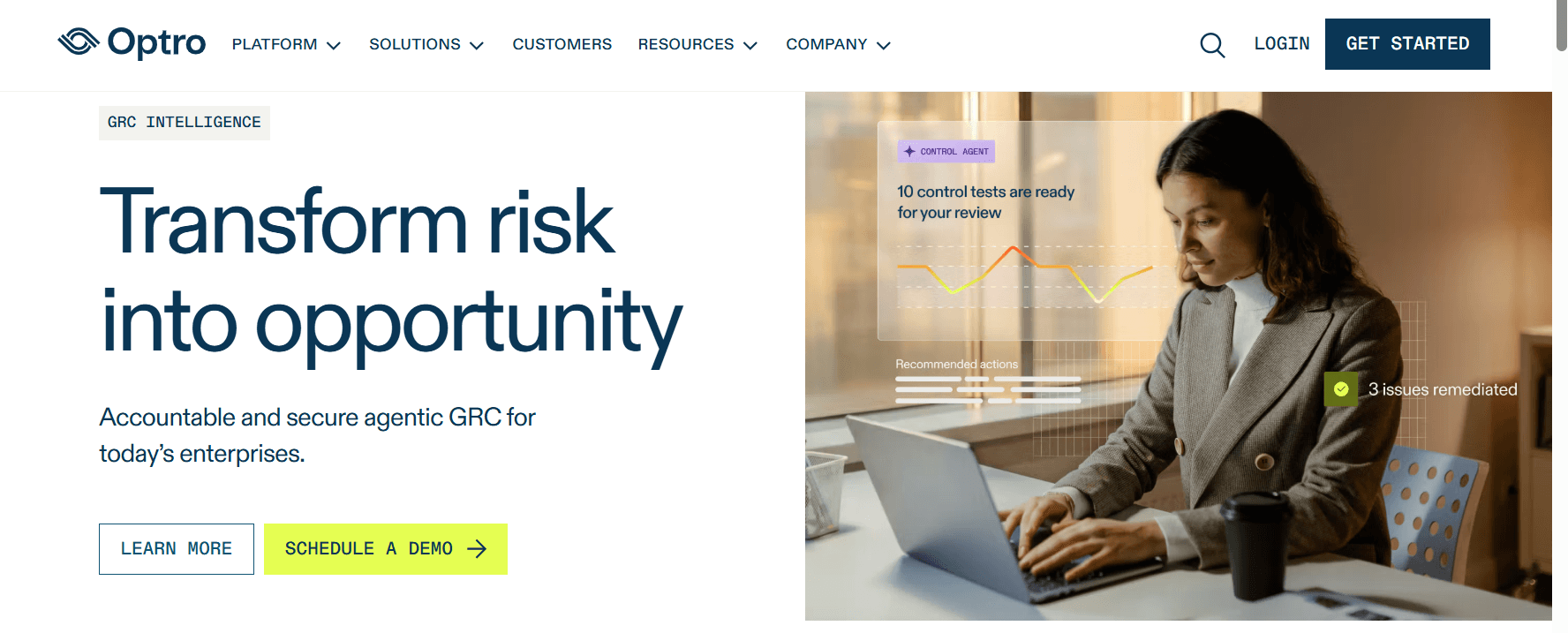
Optro, rebranded from AuditBoard in March 2026, is the enterprise heavyweight on this list. More than half of the Fortune 500 and seven of the Fortune 10 already run on its platform, and roughly 59 percent of its users work at companies with more than 1,000 employees. Rather than a lightweight evidence tool, Optro connects audit, risk, information security, controls, and compliance data through eight interconnected modules, making it a natural fit once a SOC 2 program sits alongside SOX, internal audit, and enterprise risk management.
Features
- Eight connected modules covering SOX, operational audit, multi-framework compliance, and third-party risk
- CrossComply module for mapping shared evidence across SOC 2, ISO 27001, HIPAA, and more
- Unlimited stakeholder licensing so large organizations can extend visibility without per-seat penalties
- Autonomous control testing and AI-driven risk insights
- Deep integrations with enterprise systems such as Workday, SAP, and Oracle NetSuite
Pros
- Purpose-built for large, mature organizations with dedicated internal audit and risk functions
- Unlimited stakeholder licenses widen adoption across departments without added cost
- Unifies SOC 2 with SOX, ESG, and enterprise risk reporting on one data core
Cons
- Significantly more expensive than lightweight automation tools, and often overkill for a leaner mid-market team
- Native continuous monitoring is generally viewed as less agile than security-first compliance platforms
Pricing
SOC 2 Type I audits cost between $10,000 and $60,000,
Type II audits range from $30,000 to $100,000 depending on company size.
Final Thought
Optro is arguably the most enterprise-oriented name among SOC 2 Providers for Companies with 500+ Employees, and it makes the most sense for a public company or large private organization that needs SOC 2 to live alongside SOX and internal audit rather than as a standalone project.
OneTrust built its reputation on privacy automation — GDPR, CCPA, and global data-protection regulation — before expanding into broader security and third-party risk management. For a 500-plus-employee organization that treats privacy and security compliance as intertwined disciplines, OneTrust offers one of the widest regulatory footprints on this list, spanning more than 50 pre-mapped frameworks and 300-plus global jurisdictions.
Features
- Continuous monitoring and automated evidence collection for SOC 2, ISO 27001, and related frameworks
- Third-Party Risk Exchange for vendor risk scoring and questionnaire management
- Broad integration ecosystem covering Microsoft Purview, ServiceNow, Snowflake, and Databricks
- Modular architecture that lets teams start with privacy or security and expand over time
- Global regulatory intelligence spanning privacy, security, and ESG obligations
Pros
- Unmatched breadth for organizations managing privacy and security compliance under one roof
- Strong third-party and vendor risk management capabilities beyond SOC 2 alone
- Modular design allows a phased rollout across large, multi-department organizations
Cons
- Modular pricing can balloon quickly once additional capabilities are added
- Implementation and support quality can vary across modules
Pricing
OneTrust does not publish pricing; costs are quote-based and scale with the modules selected, company size, and jurisdictional scope, which typically places it in the enterprise software price range alongside other full GRC suites.
Final Thought
OneTrust is a compelling choice among SOC 2 Providers for Companies with 500+ Employees when privacy regulation carries equal weight with security compliance inside your organization’s risk program.
ServiceNow IRM extends the familiar Now Platform into governance, risk, and compliance, which makes it a natural fit for any enterprise that already runs its IT service management, incident response, and configuration management database (CMDB) on ServiceNow. Rather than standing up a separate compliance tool, large organizations can fold SOC 2 evidence collection directly into workflows their teams already use every day.
Features
- Native integration with the Now Platform, including CMDB, incident management, and single sign-on
- Policy and compliance management alongside vendor risk management in one suite
- Quantitative risk scoring capabilities beyond basic likelihood-times-impact heat maps
- Workflow automation that routes findings, remediation tasks, and approvals like any other ServiceNow ticket
- Privacy Management add-on for DPIA-style assessments alongside security compliance
Pros
- Ideal for enterprises already standardized on ServiceNow for IT service management
- Risk, compliance, and IT operations data live in a single system of record
- Strong workflow automation and escalation logic inherited from the core ITSM platform
Cons
- Provides limited value to organizations not already invested in the ServiceNow ecosystem
- Implementation generally requires significant professional services support
Pricing
ServiceNow does not publish IRM pricing publicly. Third-party estimates place typical annual costs in the $250,000-to-$500,000-plus range, reflecting per-user licensing and the platform’s broader ITSM footprint.
Final Thought
ServiceNow IRM is best reserved for organizations already committed to the Now Platform, and within that group, it ranks among the most operationally efficient SOC 2 Providers for Companies with 500+ Employees available today.
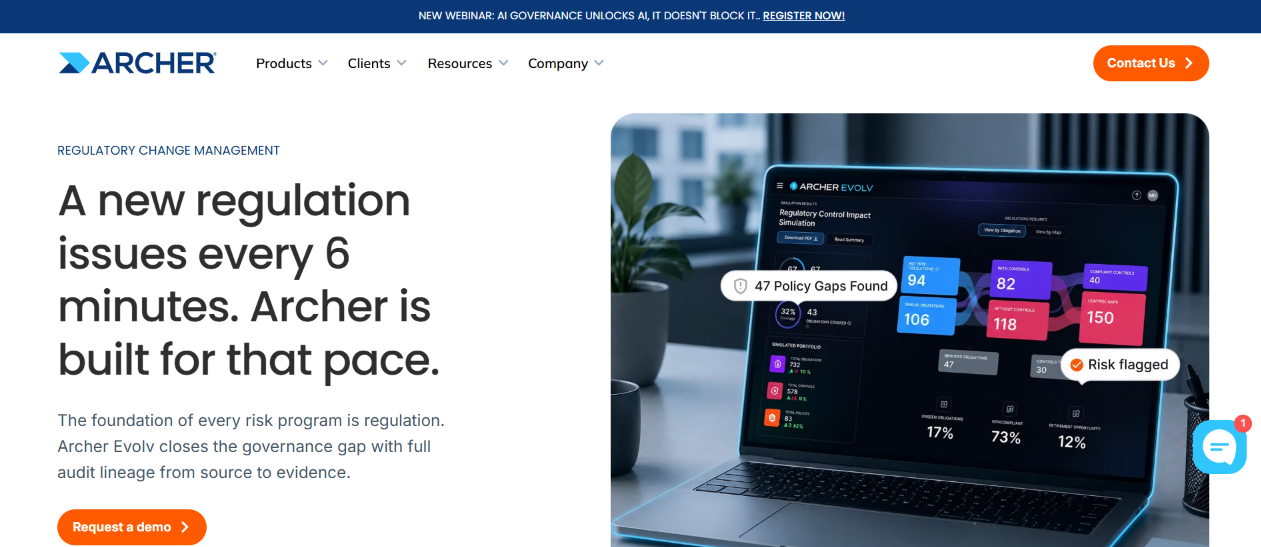
RSA Archer is one of the most established names in enterprise GRC, and it offers deep configurability across risk management, compliance, audit, and third-party risk. It is most commonly deployed at large enterprises with significant IT and professional-services resources, which makes it a fit for highly regulated organizations that need maximum control over how SOC 2 evidence connects to a broader risk taxonomy.
Features
- Highly configurable workflow and control-structure design
- Centralized risk register spanning operational, IT, and third-party risk
- Audit management module supporting planning, fieldwork, and issue remediation
- Deep customization options for organizations with complex or regulated control environments
- Long-standing presence in financial services and other heavily regulated industries
Pros
- Maximum configurability for organizations with non-standard or highly regulated control structures
- Mature platform with decades of enterprise GRC deployment experience
- Strong fit for organizations already running other Archer risk modules
Cons
- Configuration and implementation typically require dedicated technical and professional-services resources
- Per-user pricing model can scale poorly for organizations needing broad internal access
Pricing
RSA Archer uses custom, quote-based pricing tied to modules, user counts, and implementation scope; as with other legacy enterprise GRC platforms, buyers should expect a multi-month sales cycle and a total cost of ownership evaluated over several years rather than a single year.
Final Thought
RSA Archer suits organizations that need the deepest possible configurability among SOC 2 Providers for Companies with 500+ Employees, particularly those operating in financial services or other heavily regulated sectors.
LogicGate Risk Cloud is known for flexible, no-code workflow configuration, which lets large organizations tailor policy management, risk management, and audit processes without heavy reliance on professional services. It occupies a middle ground between lightweight compliance automation and legacy platforms like Archer, and it has invested specifically in FAIR-aligned quantitative risk scoring for teams that want dollar-based risk quantification rather than a simple heat map.
Features
- No-code workflow builder for custom risk, compliance, and audit processes
- FAIR-aligned quantitative risk analysis for dollar-based risk scoring
- Self-serviceable configuration that reduces dependence on outside consultants
- Cross-mapping support for SOC 2 alongside other frameworks a large organization may run concurrently
- Centralized policy and control library shared across departments
Pros
- Self-serviceable platform that mid-market and enterprise teams can modify without heavy professional-services spend
- Genuine quantitative risk-scoring capability, which is rare among GRC platforms at this price point
- High configurability without the steep implementation curve typical of legacy suites
Cons
- Pricing is entirely quote-based, making early budget planning harder
- Still requires a dedicated internal owner to get full value from its configurability
Pricing
LogicGate does not publish pricing, and prospective buyers must contact the company directly for a quote reflecting company size, module selection, and workflow complexity.
Final Thought
LogicGate is a smart middle-ground choice among SOC 2 Providers for Companies with 500+ Employees for large organizations that want enterprise-grade configurability without committing to the cost and complexity of the very largest legacy GRC suites.
Hyperproof is a compliance-operations platform built specifically for organizations already past their first certification and now running three or more frameworks in parallel. With customers including Stripe, Databricks, and HashiCorp, it targets exactly the profile of a 300-to-2,500-employee company with a dedicated compliance function, which places it squarely in scope for larger organizations evaluating their next compliance platform.
Features
- Automated evidence collection through its Hypersyncs integrations
- Cross-framework control mapping across more than 100 supported frameworks, including SOC 2, ISO 27001, and HIPAA
- Custom fields and Scopes for tailoring programs by department, region, or business unit
- User Access Review automation across systems such as AWS, Azure, Google, and Okta
- Real-time dashboards for tracking compliance status across teams
Pros
- Purpose-built for multi-framework programs, so one control answer cascades across a dozen or more frameworks
- Custom Scopes make it easier to segment a large organization by department or region
- Strong fit for companies that already passed a first SOC 2 and need to scale their compliance operation
Cons
- Not the fastest or cheapest option for a company pursuing its very first SOC 2 report
- Pricing is not published, and quotes vary significantly based on users and frameworks
Pricing
Entry-level Hyperproof plans start around $12,000 per year, while the median enterprise contract sits closer to $40,000 annually, with buyers on the high end paying $54,000 or more depending on frameworks, users, and integrations.
Final Thought
Hyperproof rounds out this list of SOC 2 Providers for Companies with 500+ Employees as the strongest option for a large organization that has outgrown its first compliance tool and now needs to manage several frameworks side by side.

Vanta remains one of the most recognizable names among SOC 2 Providers for Companies with 500+ Employees, and it has steadily expanded from a startup-focused SOC 2 tool into a broader trust-management platform. It now supports large organizations pursuing SOC 2 alongside ISO 27001, HIPAA, PCI DSS, GDPR, and even SOX ITGC controls, which matters once a company crosses the 500-employee mark and typically has more than one framework in play. Because Vanta cross-maps overlapping controls across frameworks, a large security team can avoid duplicating the same evidence request four different ways.
Features
- Continuous, automated evidence collection across 400+ native integrations
- Cross-framework control mapping for SOC 2, ISO 27001, HIPAA, PCI DSS, GDPR, and NIST
- AI-assisted responses to inbound enterprise security questionnaires
- Built-in auditor marketplace and vendor risk management module
- Trust Center for publishing a live security posture to customers and prospects
Pros
- Widest integration library of any platform on this list, which suits sprawling enterprise tech stacks
- Strong multi-framework overlap reduces duplicate evidence work for large teams
- High G2 review volume gives buyers a large sample size for due diligence
Cons
- Pricing rises quickly once a company adds frameworks or exceeds the Growth tier
- Some enterprise users describe the standardized control set as rigid for non-standard architectures
Pricing
Vanta uses quote-based pricing that scales with company size and framework count. Buyer-reported ranges run from roughly $10,000 to $15,000 per year for the Core plan, $15,000 to $30,000 for Plus, $30,000 to $80,000 for Scale, and above $80,000 for Enterprise. Larger organizations should also budget an additional $10,000 to $50,000 for the independent SOC 2 audit itself, since Vanta’s subscription covers only the automation layer.
Final thought
Vanta earns its spot near the top of this list of SOC 2 Providers for Companies with 500+ Employees because it combines integration depth with genuine multi-framework support, making it a dependable default for enterprise security teams that want breadth without sacrificing usability.

Drata has positioned itself as an AI-native compliance automation and “agentic trust management” platform, and it runs automated tests daily against more than 250 integrations. Because Drata offers unlimited users on every tier, it scales cleanly across a large workforce without punishing a company for adding headcount, which is a meaningful advantage once an organization passes 500 employees and needs broad internal access to compliance dashboards.
Features
- Daily automated control testing across more than 20 supported frameworks
- Custom framework builder for bespoke enterprise security questionnaires
- Built-in auditor access and evidence-sharing workspace
- Unlimited seats at every pricing tier
- Formal partnerships with audit firms including A-LIGN, Prescient Assurance, and Johanson Group
Pros
- Unlimited-user pricing model favors larger headcounts and cross-functional control owners
- Deep cross-framework mapping keeps SOC 2, ISO 27001, and HIPAA evidence in sync
- Preferred-auditor relationships can shorten the path from readiness to report
Cons
- Some reviewers note that automation depth depends on following Drata’s prescribed workflow closely
- Physical-site or non-cloud evidence collection is less mature than its cloud-native tooling
Pricing
Drata’s published starting point sits around $7,500 per year for a single-framework Foundation plan, but enterprise-scale contracts commonly run from $15,000 up to $100,000 or more annually depending on frameworks, integrations, and support tier. The unlimited-user model is worth highlighting again here, since a 700-person company pays the same per-seat cost as a 70-person one.
Final Thought
Drata deserves serious consideration on any shortlist of SOC 2 Providers for Companies with 500+ Employees, particularly for engineering-heavy organizations that want continuous automation without a per-seat penalty as the company grows.
Secureframe differentiates itself through a hands-on, guided approach: every account is paired with a named compliance expert who helps map controls before the audit window opens. For a large organization without a dedicated in-house compliance hire, this human layer often proves just as valuable as the automation itself, and it explains why Secureframe continues to close the gap with larger competitors at the enterprise tier.
Features
- 300+ integrations spanning cloud infrastructure, HR systems, and identity providers
- Daily automated testing with policy-creation templates built in
- Named compliance success manager on higher-tier plans
- Support for more than 35 frameworks with cross-mapped evidence
- Streamlined onboarding designed to reduce time to audit readiness
Pros
- Guided, white-glove onboarding suits teams without dedicated compliance staff
- Competitive entry pricing relative to Vanta and Drata at comparable scope
- Strong usability scores in independent review platforms
Cons
- Pricing is not published and requires a sales conversation to confirm
- Larger, multi-entity organizations may need custom scoping support
Pricing
Secureframe typically starts between $8,000 and $12,000 per year at the entry tier and climbs to a reported $20,000 to $38,000 range for companies operating at enterprise scale with multiple frameworks. As with its two closest rivals, exact figures depend on headcount, integration count, and framework selection.
Final Thought
Secureframe is a strong pick among SOC 2 Providers for Companies with 500+ Employees for organizations that value structured, expert-led guidance over a fully self-serve model.
Pingback: Top 12 Best SOC 2 Compliance Platforms for Companies with 10-50 Employees