

Mid-market companies now sit squarely in the crosshairs of enterprise procurement teams, and that shift has made SOC 2 far more than a checkbox exercise. As organizations scale past their first hundred employees and start closing larger contracts, prospective customers routinely demand proof that data stays safe, systems stay available, and internal controls actually work. Consequently, the search for reliable SOC 2 Certification Firms for Mid-Market Companies has become one of the most consequential vendor decisions a growing business will make this year.
Choosing among the many providers on the market is not simple, however, because the landscape splits into two overlapping categories. On one side sit compliance automation platforms that streamline evidence collection, monitor controls continuously, and connect teams with a licensed auditor. On the other side sit the AICPA-accredited CPA firms and specialized assurance practices that actually issue the SOC 2 report, since only an independent, licensed CPA firm may sign that opinion. Many mid-market companies therefore end up using one of each: a software platform to gather evidence and an audit firm to perform the attestation. Understanding this distinction early, and knowing which providers excel at each role, will save your team months of frustration and thousands of dollars in wasted spend.
This guide walks through twelve of the strongest options available today, blending established audit firms with leading compliance automation platforms so you can build the pairing that fits your headcount, budget, and industry.
Top 12 Best SOC 2 Certification Firms for Mid-Market Companies
1. A-LIGN
A-LIGN operates as a technology-enabled security and compliance services firm, and it has grown into one of the largest independent providers of SOC 2 audits in the United States. Because the firm pairs a large in-house CPA practice with a proprietary compliance platform called A-SCEND, it can move mid-market clients through readiness, fieldwork, and reporting without handing work off to a third-party vendor. This single-source model appeals strongly to companies with two hundred or more employees that also need ISO 27001, PCI DSS, or HITRUST work done alongside SOC 2.
Features
- In-house team of more than 400 auditors, with over 200 dedicated specifically to SOC engagements
- Proprietary A-SCEND platform for scoping, evidence collection, and auditor collaboration
- Multi-framework capability spanning SOC 1, SOC 2, ISO 27001, PCI DSS, HITRUST, and FedRAMP
- Dedicated account and engagement teams for mid-market and enterprise clients
Pros
- Handles both readiness advisory and the formal audit under one roof, reducing coordination overhead
- Deep bench strength supports fast scheduling even during peak audit season
- Strong reputation among enterprise customers, which smooths vendor risk reviews
Cons
- Pricing sits above boutique firms, which can strain a leaner mid-market budget
- Larger engagement teams sometimes mean less direct partner-level attention than a boutique firm offers
Pricing
Type 2 engagements typically run from roughly $15,000 to $75,000 depending on scope, trust services criteria selected, and the number of in-scope systems, with multi-framework bundles often reducing the per-framework cost.
Final Thought
A-LIGN suits mid-market companies that want a single, high-capacity partner capable of scaling from a first SOC 2 report into a full multi-framework compliance program without switching vendors.
Schellman stands out among SOC 2 Certification Firms for Mid-Market Companies because it is one of the largest independent providers of SOC examinations in the country, issuing thousands of SOC reports each year across nearly sixty types of assessments. The firm maintains a split structure, with Schellman & Company handling attest work and Schellman Compliance managing advisory services, which preserves auditor independence while still offering clients a coordinated experience. Its cloud-native methodology and PCAOB registration make it a frequent choice for growth-stage SaaS companies moving toward enterprise scale.
Features
- Single-assessor model that lets clients pursue SOC 2 and ISO 27001 concurrently
- PCAOB-registered practice with deep experience across fintech, healthtech, and cloud infrastructure
- Cloud-native audit methodology built around modern DevOps and CI/CD environments
- Broad framework coverage including SOC 1, SOC 2, ISO 27001, ISO 27701, PCI DSS, and HITRUST
Pros
- Exceptionally strong brand recognition that customers rarely question during vendor reviews
- High auditor volume translates into predictable scheduling and turnaround times
- Concurrent multi-framework audits cut down on duplicate evidence requests
Cons
- Premium positioning means costs run higher than boutique or startup-focused firms
- High demand can mean longer lead times to secure a preferred audit window
Pricing
Engagements generally range from $20,000 to well over $100,000 for a Type 2 report, with final cost shaped by company size, systems in scope, and whether the client bundles SOC 2 with ISO 27001.
Final Thought
Growth-stage and mid-market companies that plan to scale toward enterprise customers, and that want a report nobody questions, will find Schellman one of the safest bets on this list.
3. Coalfire
Coalfire built its reputation on federal compliance work, including FedRAMP and CMMC assessments, and that heritage carries directly into its commercial SOC 2 practice. Headquartered in Westminster, Colorado, the firm operates as one of the largest FedRAMP third-party assessment organizations in the country, and it applies that same rigor to SOC 2 engagements for mid-market technology and healthcare companies. Any organization whose roadmap eventually touches government or defense contracts benefits from starting the compliance relationship here.
Features
- Deep federal-adjacent expertise spanning FedRAMP, CMMC, and DoD-related assessments
- Substantial, well-resourced commercial SOC 2 practice alongside its government work
- Nationwide office footprint supporting distributed and hybrid engineering teams
- Integrated advisory services for penetration testing and application security
Pros
- A natural fit for companies that expect to pursue FedRAMP or CMMC later, since the same firm can carry both engagements
- Federal-grade rigor produces reports that hold up well under intense enterprise scrutiny
- Strong bench of assessors reduces the risk of losing a key team member mid-audit
Cons
- Federal-capability premium raises pricing above firms like Schellman or A-LIGN for pure commercial SOC 2 work
- Less negotiating room on fees compared with boutique or mid-tier alternatives
Pricing
Commercial SOC 2 Type 2 engagements commonly land between $25,000 and $80,000 in year one, with renewal-year pricing typically settling between $15,000 and $40,000.
Final Thought
Coalfire earns its spot among the leading SOC 2 Certification Firms for Mid-Market Companies whenever a client’s growth plan includes government or defense customers down the road.
Sensiba brings decades of accounting-firm depth to the SOC 2 market, giving mid-market clients access to partner-level attention without the price tag of a national mid-tier firm. As a full-service CPA firm with a dedicated IT assurance practice, Sensiba often becomes attractive to companies that already use it, or a similar regional firm, for tax and financial statement work and want to consolidate their professional-services relationships.
Features
- Full-service CPA firm with an established, dedicated IT assurance practice
- Direct partner involvement throughout scoping, fieldwork, and reporting
- Experience across SaaS, fintech, and real estate technology clients
- Ability to bundle SOC examinations with broader financial and tax advisory services
Pros
- Senior-level attention that many boutique clients describe as more personal than larger national firms
- Competitive pricing relative to A-LIGN, Schellman, or Coalfire for similarly scoped engagements
- Useful single-vendor consolidation if the company already relies on a CPA firm for other services
Cons
- Smaller total audit capacity than the largest national players, which can affect scheduling flexibility
- Less brand recognition internationally compared with Schellman or A-LIGN
Pricing
Typical Type 2 engagements fall in the $18,000 to $60,000 range, with exact fees depending on the number of trust services criteria and systems included in scope.
Final Thought
Growth-stage and mid-market companies between roughly fifty and five hundred employees that want senior attention without enterprise-level pricing should place Sensiba near the top of their shortlist.
BARR Advisory built its practice around cloud-native audits, and the firm treats AWS, Azure, and GCP evidence as the default rather than a special case. Founded in Kansas City and now operating in more than twenty countries with a remote-first team, BARR is one of the few U.S. firms accredited to perform both SOC 2 attestations and ISO 27001 certifications, which makes it especially efficient for mid-market SaaS companies pursuing both frameworks at once.
Features
- Accredited to issue both SOC 2 reports and ISO 27001 certifications
- Cloud-native audit approach built specifically for modern SaaS infrastructure
- Fixed-rate pricing model that removes budget surprises mid-engagement
- Team credentials spanning CPA, CISA, CISSP, and CIPP designations
Pros
- Adaptive audit methodology reportedly cuts client evidence-gathering effort significantly
- Remote-first structure gives distributed engineering teams flexible scheduling across time zones
- High client retention and a strong net promoter score reflect consistent service quality
Cons
- Boutique scale means less bandwidth than the largest national firms during peak season
- Less suited to on-premises or legacy infrastructure environments than to cloud-native stacks
Pricing
Engagements are generally fixed-fee and fall between $20,000 and $65,000 for a first Type 2 report, with year-two renewals typically priced lower once baseline evidence exists.
Final Thought
Cloud-first mid-market companies running primarily on AWS, Azure, or GCP will likely find BARR Advisory’s methodology the smoothest fit on this list.
Insight Assurance has grown quickly by operating a dual structure: a CPA-licensed audit arm handles the formal attestation, while a separate consulting division manages advisory and readiness work. That separation preserves auditor independence while still giving clients hands-on strategic guidance, and the firm layers AI-powered evidence review on top to speed up turnaround times without sacrificing audit quality.
Features
- Dual-structure model separating independent attestation from advisory consulting
- AI-assisted evidence review that accelerates fieldwork and reporting
- Broad framework coverage including ISO 27001, PCI DSS, HIPAA, GDPR/CCPA, FedRAMP, and CMMC
- Responsive, globally distributed audit teams suited to companies with international operations
Pros
- Faster audit communication cycles benefit teams working across multiple time zones
- Comprehensive framework menu reduces the need to bring in additional vendors later
- Growing reputation for combining speed with genuine audit rigor
Cons
- Newer market entrant with a shorter track record than firms like Schellman or A-LIGN
- Rapid growth can occasionally strain scheduling capacity during high-demand periods
Pricing
Type 2 pricing typically ranges from $15,000 to $55,000, positioning Insight Assurance competitively against both boutique and mid-tier firms.
Final Thought
Companies with international customer bases or distributed teams that need fast, responsive communication should give Insight Assurance serious consideration among the available SOC 2 Certification Firms for Mid-Market Companies.
7. Vanta
Vanta helped popularize continuous compliance automation, and it remains one of the most recognized names among software-based SOC 2 Certification Firms for Mid-Market Companies. The platform automates evidence collection across cloud infrastructure, HR systems, and code repositories, then connects clients with a network of partner CPA firms to complete the actual attestation. Its enormous auditor network and broad integration library make it a low-friction starting point for companies new to compliance automation.
Features
- Continuous, automated evidence collection across cloud, HR, and engineering tool integrations
- Large network of partner auditors already familiar with the platform’s evidence format
- Support for more than twenty frameworks beyond SOC 2, including ISO 27001 and HIPAA
- Built-in trust center for sharing security posture directly with prospects and customers
Pros
- Massive brand recognition smooths procurement conversations with enterprise customers
- Auditor familiarity with the platform often shortens fieldwork time
- Strong integration library covers most common mid-market technology stacks
Cons
- Standardized, template-driven policies can feel rigid for companies with unconventional infrastructure
- Pricing is not published and tends to rise meaningfully at renewal
- Support responsiveness varies by plan tier, and the audit itself still requires a separate CPA partner
Pricing
Vanta does not publish pricing, but industry benchmarks put annual costs around $15,000 to $30,000 for small and mid-sized organizations, excluding the separate auditor fee, with year-two renewals often increasing.
Final Thought
Vanta remains a sensible default for mid-market companies that want the broadest auditor network and don’t mind a fairly standardized, DIY-style compliance workflow.

Drata has become a heavy hitter specifically within the mid-market segment, thanks to a polished interface, an extensive integration catalog, and automated tests that run daily rather than on a fixed schedule. The platform positions itself as an AI-native GRC solution and pushes real-time alerts the moment a control fails, which appeals to compliance teams that want to catch drift before it becomes an audit finding.
Features
- More than 250 integrations with daily automated control testing
- Support for over twenty security frameworks with cross-mapped evidence to reduce duplicate work
- Built-in auditor access and collaboration tools that streamline the SOC 2 audit itself
- AI-assisted evidence review and gap identification across the control environment
Pros
- Clean engineering and interface design that internal teams consistently praise
- Strong auditor collaboration portal, frequently cited as best-in-class
- Cross-mapped controls make pursuing SOC 2 alongside ISO 27001 considerably more efficient
Cons
- Support can feel reactive rather than proactive during complex evidence disputes
- The platform can feel disjointed when managing very large or unusually complex evidence sets
- No public pricing, which complicates side-by-side budget comparisons
Pricing
Reported budgets place mid-market Drata programs between roughly $15,000 and $50,000 annually, again separate from the CPA firm’s audit fee, with multi-framework bundles offering better per-framework value.
Final Thought
Mid-market SaaS companies running multiple frameworks simultaneously, and that want the best available auditor collaboration experience, tend to get the most value out of Drata.
Secureframe built its platform around intuitive design and multi-framework support, and it has developed particular strength among companies that have already completed one SOC 2 cycle and now need to manage compliance as an ongoing program rather than a one-time project. With more than 300 integrations and support across more than thirty-five frameworks, the platform scales comfortably as mid-market companies add HIPAA, PCI DSS, or CMMC requirements over time.
Features
- Over 300 integrations paired with daily automated compliance testing
- Support across more than thirty-five frameworks, including a CMMC-specific tier for defense contractors
- Guided policy creation tools and streamlined employee onboarding workflows
- Dedicated compliance manager support included with mid-market plans
Pros
- Well-designed guided workflows reduce the learning curve for teams without a dedicated compliance hire
- Clear evidence requirements make ongoing program management noticeably easier
- CMMC tier adds real value for mid-market companies pursuing defense contracts
Cons
- No public pricing tiers, which forces every prospect through a sales process before seeing numbers
- Comparison shopping against competitors takes more effort without published rates
Pricing
Mid-market Secureframe programs, running 50 to 500 employees, typically land in the $15,000 to $45,000 annual range, exclusive of separate CPA audit fees.
Final Thought
Companies moving from a first SOC 2 report into an ongoing, multi-framework compliance program will likely appreciate Secureframe’s structured, guided approach the most.
Sprinto focuses on speed-to-compliance through an AI-native GRC platform that adapts to companies of nearly any size, from early-stage startups through mid-market organizations. The platform runs automated tests twice daily, emphasizes guided workflows over blank-slate setup, and maintains a strong presence among companies pursuing their very first SOC 2 report on a tight timeline.
Features
- More than 200 integrations with automated testing that runs twice per day
- Support for roughly twenty frameworks with guided, step-by-step compliance workflows
- AI-native risk visibility that updates internal controls and evidence automatically
- Strong onboarding experience purpose-built for teams without prior compliance experience
Pros
- Guided workflows meaningfully reduce time-to-audit-readiness for first-time SOC 2 teams
- Pricing tends to run lower than Vanta or Drata for comparable mid-market scope
- Platform adapts well as a company grows from startup into mid-market headcount
Cons
- Long-term scalability and automation depth need careful evaluation for larger, more complex environments
- Smaller integration library than Drata or Secureframe for highly specialized tech stacks
Pricing
Sprinto’s published guidance and market benchmarks suggest annual costs between roughly $7,500 and $30,000 for mid-market scope, again excluding the independent CPA audit fee.
Final Thought
Price-sensitive mid-market companies pursuing SOC 2 for the first time, or wanting a lighter-weight platform than Vanta or Drata, will find Sprinto a compelling, cost-effective option.
KirkpatrickPrice focuses squarely on information security auditing, and that narrow focus shows up in the firm’s auditor responsiveness, a trait clients consistently highlight. The firm serves technology companies of varying sizes but has carved out particular strength with growth-stage and mid-market organizations that want a licensed CPA firm without the premium pricing of a national brand.
Features
- Specialized, security-first audit methodology across SOC 1, SOC 2, PCI DSS, and HIPAA
- Direct auditor access throughout the engagement rather than layered account management
- Educational resources and training designed to help internal teams understand control requirements
- Flexible engagement scoping for companies still maturing their control environment
Pros
- Auditors are known for responsiveness and clear communication throughout fieldwork
- Competitive pricing relative to larger national and mid-tier firms
- Strong fit for first-time SOC 2 organizations that need extra guidance along the way
Cons
- Smaller firm footprint than A-LIGN, Schellman, or Coalfire, which can limit capacity at scale
- Less brand recognition among the largest enterprise procurement teams
Pricing
Engagements commonly range from $15,000 to $50,000 for a Type 2 report, making KirkpatrickPrice one of the more budget-friendly specialist options for mid-market teams.
Final Thought
Mid-market companies that value hands-on communication and a security-first audit philosophy over sheer brand size will likely appreciate what KirkpatrickPrice delivers.
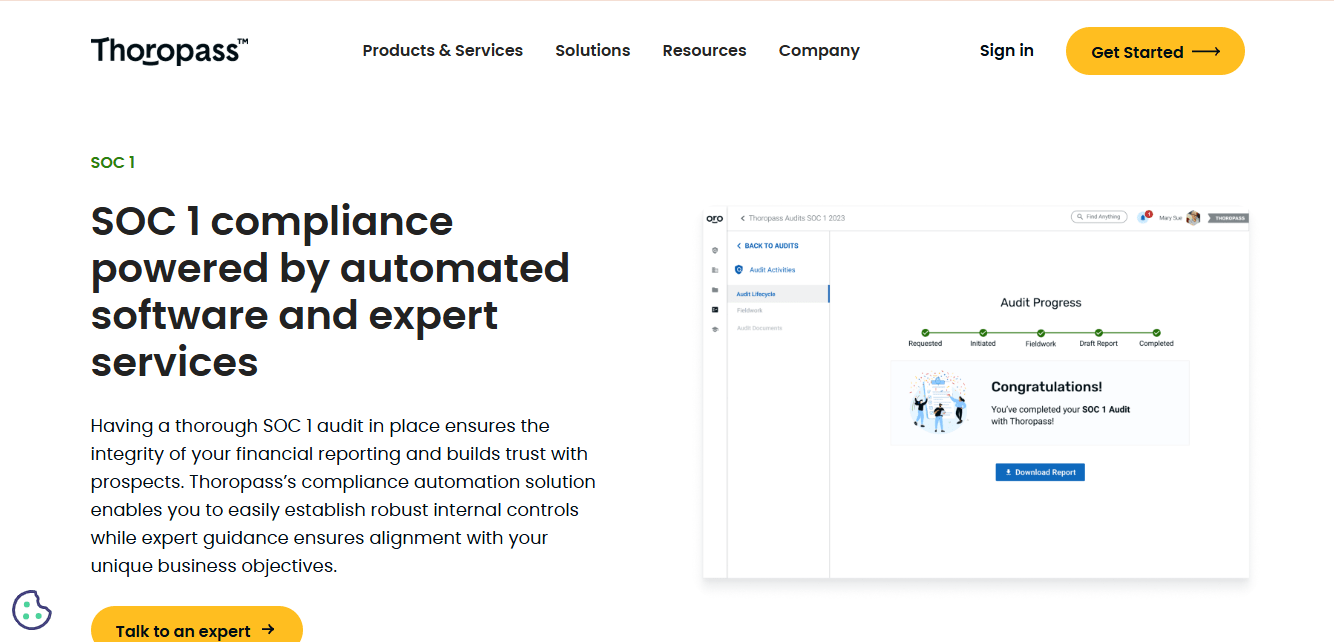
Thoropass differentiates itself by combining compliance automation software with an in-house audit team, meaning clients can complete both evidence collection and the formal attestation on a single platform rather than coordinating between two vendors. That integrated approach appeals to mid-market companies that want fewer moving parts and a single point of accountability for the entire SOC 2 journey.
Features
- Single platform that bundles evidence automation with an in-house licensed audit team
- Continuous control monitoring integrated directly with the audit workflow
- Support for multiple frameworks, including SOC 2, ISO 27001, HIPAA, and PCI DSS
- Guided onboarding designed to shorten the path from kickoff to report delivery
Pros
- Eliminates the handoff friction that occurs when a separate software vendor and audit firm must coordinate
- Transparent, unified timeline from readiness through the final report
- Well suited to companies pursuing their first SOC 2 who want fewer vendor relationships to manage
Cons
- Less specialized depth in niche frameworks compared with firms like Coalfire or BARR Advisory
- Smaller audit bench than the largest national CPA firms
Pricing
Bundled software-plus-audit packages generally start in the $20,000 to $45,000 range for a first Type 2 engagement, with add-on frameworks priced incrementally.
Final Thought
Mid-market companies that prefer one vendor for the entire compliance lifecycle, from evidence collection to signed report, will find Thoropass’s integrated model genuinely convenient.