

Series C funding changes the compliance conversation overnight. What once felt like an optional trust signal now becomes a hard requirement, since enterprise buyers routinely demand a signed SOC 2 report before they’ll even open contract negotiations. As a result, founders and security leaders quickly discover that not all SOC 2 vendors for series C and later companies are built for this stage of growth, many platforms cater to early-stage startups chasing their first, simple certification, while others assume the multi-framework complexity, vendor risk oversight, and governance rigor that a scaling company actually needs. Therefore, choosing the right partner requires looking past flashy landing pages and instead evaluating real automation depth, integration coverage, audit-partner flexibility, and total cost of ownership.
Furthermore, because Series C and later companies rarely stop at a single certification, this guide takes a deliberately broader view of the market. It compares cloud-native automation platforms designed for fast-moving SaaS teams, enterprise-grade GRC suites built for companies approaching an eventual public offering, and specialized audit firms that plug directly into whichever software a company already uses. Consequently, the twelve options that follow reflect how compliance actually gets bought and used at scale, not just which tool has the most polished demo.
Top 12 Best SOC 2 Vendors for Series C and Later Companies
Hyperproof positions itself as a multi-framework GRC platform rather than a narrow SOC 2 point solution, and that positioning makes it the natural next step for a Series C or later company outgrowing a startup-focused compliance tool. It centralizes compliance, risk, and security workflows across more than 140 frameworks, including SOC 2, ISO 27001, and NIST SP 800-53, with an unlimited-stakeholder model that avoids per-seat licensing costs.
Features
- A library of 100-plus frameworks with dedicated SOC 2 support built into the core workflow.
- An unlimited-stakeholder model, letting companies scale GRC participation without per-seat fees.
- “Comply” and “Mitigate” modules that tightly link controls to a live risk register.
- Vendor risk management and continuous control monitoring for maturing security programs.
- System-of-record reporting suited to boards and enterprise customers requesting deeper assurance.
Pros
- Most enterprise-oriented platform in the category that still reasonably serves mid-market buyers.
- Unlimited stakeholders remove a common cost trap as compliance ownership spreads across teams.
- Strong fit for companies managing several frameworks and a growing vendor risk program simultaneously.
Cons
- Quote-based enterprise pricing can run higher than startup-focused automation platforms.
- Implementation and governance-model setup take longer than lighter, self-serve competitors.
Pricing
Hyperproof uses custom, quote-based pricing with no public rate card. Buyer guides place mid-market deployments in the tens of thousands of dollars annually, scaling toward six figures for larger, multi-framework enterprise programs with vendor risk management included.
Final Thought
Hyperproof earns its place among SOC 2 Vendors for Series C and Later Companies that have outgrown a single-framework tool and need a genuine system of record for a maturing GRC function.
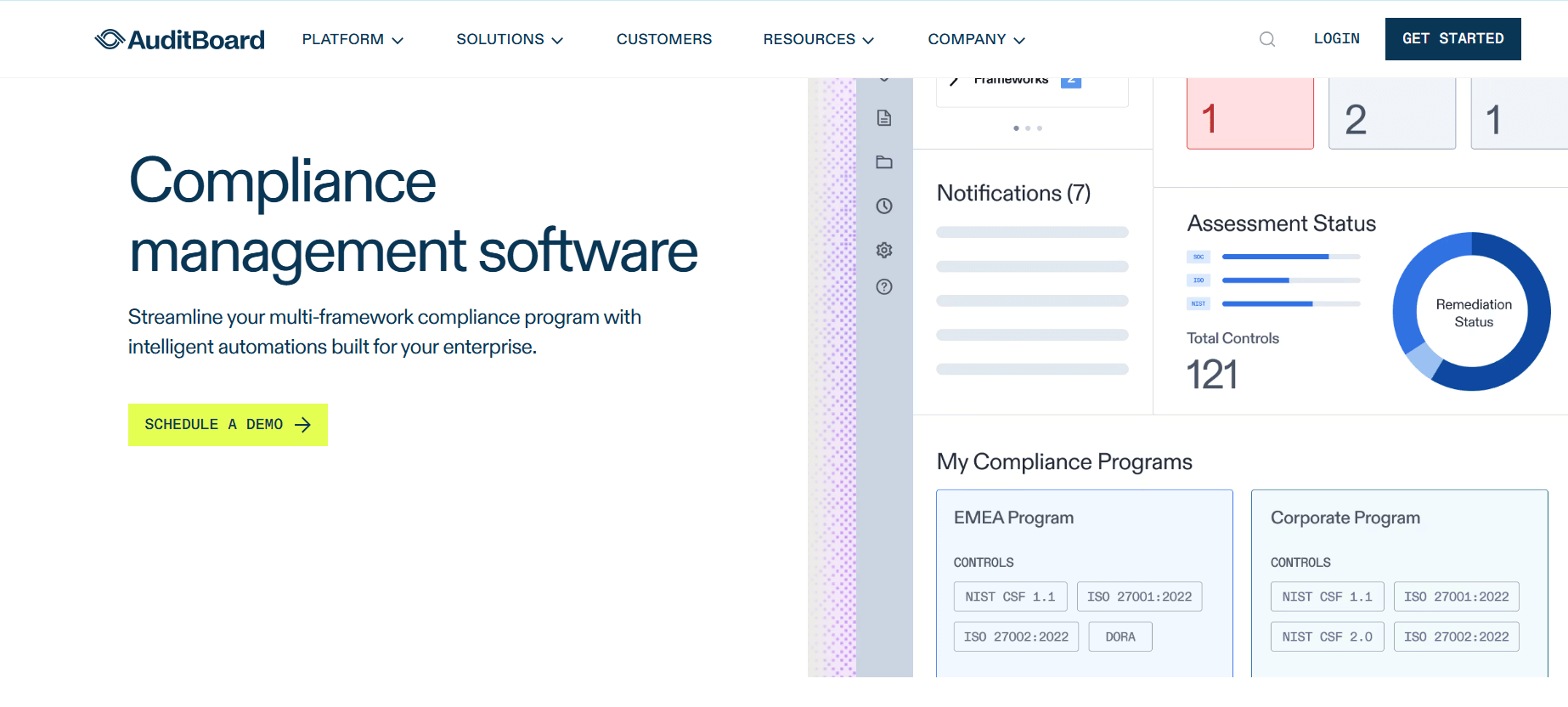
AuditBoard connects audit, SOX, risk, and compliance management into one unified platform, which makes it a favorite of internal audit teams at companies approaching or planning for an eventual IPO. Where most compliance automation platforms focus narrowly on SOC 2 evidence collection, AuditBoard treats SOC 2 as one workstream inside a broader enterprise risk and internal audit program.
Features
- Unified audit, SOX compliance, risk management, and controls testing in a single system.
- Purpose-built workflows for internal audit teams managing multi-entity, multi-framework programs.
- Strong support for companies preparing for SOX compliance ahead of a public offering.
- Enterprise-grade access controls, workflow automation, and audit-trail integrity.
Pros
- The natural fit when the project lead is the VP of Internal Audit and SOX is on the roadmap.
- Consolidates audit, risk, and compliance work that would otherwise live in separate tools.
- Scales cleanly to public-company governance requirements as a Series C company matures toward IPO.
Cons
- Heavier setup and configuration burden than lighter, SOC 2-only tools.
- Overkill for a company whose only near-term goal is a first SOC 2 Type 2 report.
Pricing
AuditBoard pricing generally starts around $50,000 a year.
Final Thought
AuditBoard is best reserved for SOC 2 Vendors for Series C and Later Companies that are already thinking about SOX readiness and want one platform to carry them from private-company compliance into public-company governance.
OneTrust grew out of privacy management and has since expanded into a comprehensive trust platform spanning GRC, third-party risk, ESG, and AI governance alongside SOC 2 and ISO 27001 support. For a Series C or later company whose compliance obligations extend well beyond SOC 2 into GDPR, CCPA, or emerging AI governance requirements, OneTrust consolidates all of it into a single vendor relationship.
Features
- Tech Risk and Compliance module covering SOX, SOC 2, ISO 27001, HIPAA, and PCI DSS.
- Market-leading privacy automation for GDPR, CCPA, LGPD, and 100-plus global privacy regulations.
- AI-powered regulatory intelligence that tracks changes across 300-plus jurisdictions automatically.
- Third-party and vendor risk management with a large pre-built vendor database.
- A unified Trust Intelligence Platform spanning privacy, GRC, and AI governance.
Pros
- Unmatched breadth across privacy, GRC, third-party risk, and AI governance in one platform.
- A strong choice for global companies juggling GDPR, CCPA, and SOC 2 simultaneously.
- Recognized as a Gartner Magic Quadrant Visionary for AI Governance Platforms.
Cons
- Reviewers frequently cite a cluttered interface and a steep learning curve.
- Pricing and setup complexity assume dedicated enterprise compliance and privacy resources.
Pricing
OneTrust’s GRC and Compliance Automation modules are typically estimated at $20,000 to $50,000-plus a year.
Final Thought
OneTrust fits SOC 2 Vendors for Series C and Later Companies whose compliance mandate has already expanded beyond SOC 2 into global privacy law and enterprise risk management.
A-LIGN is not a compliance automation platform in the Vanta or Drata mold; it is the world’s largest issuer of SOC 2 reports, and its proprietary A-SCEND platform integrates directly with Vanta, Drata, Secureframe, and Sprinto so a Series C company can keep its existing automation tool while working with a top-tier audit firm. With more than 31,000 audits completed and ten accreditations spanning SOC 2, ISO 27001, HITRUST, FedRAMP, and CMMC, A-LIGN is built for companies that need multiple certifications handled under one roof.
Features
- A-SCEND audit-management platform with EvidenceIQ AI evidence scoring and cross-framework evidence reuse.
- Direct integration with leading compliance automation platforms, avoiding a forced tool migration.
- Ten accreditations, including AICPA, PCI DSS, ISO 27001, HITRUST, FedRAMP 3PAO, and CMMC C3PAO.
- Remote-first audit delivery with turnaround as fast as two to four weeks for well-prepared clients.
- Massive scale that supports predictable scheduling even during peak audit season.
Pros
- The largest issuer of SOC 2 reports globally, which carries real weight with enterprise customers.
- Works alongside existing automation tools rather than requiring a platform switch.
- A strong option for companies expanding toward FedRAMP or public-sector customers.
Cons
- As primarily an audit firm, it does not replace a company’s underlying evidence-collection platform.
- Best value appears when a company already runs multiple frameworks; single-framework buyers may not see the same ROI.
Pricing
A SOC 2 Type II engagement with A-LIGN typically runs $15,000 to $50,000, depending on scope and company size, with multi-framework engagements priced higher once ISO 27001, HITRUST, or FedRAMP work is bundled in.
Final Thought
A-LIGN is worth shortlisting among SOC 2 Vendors for Series C and Later Companies specifically for the audit itself, especially for organizations that already run automation software and now need a scaled, multi-framework audit partner.
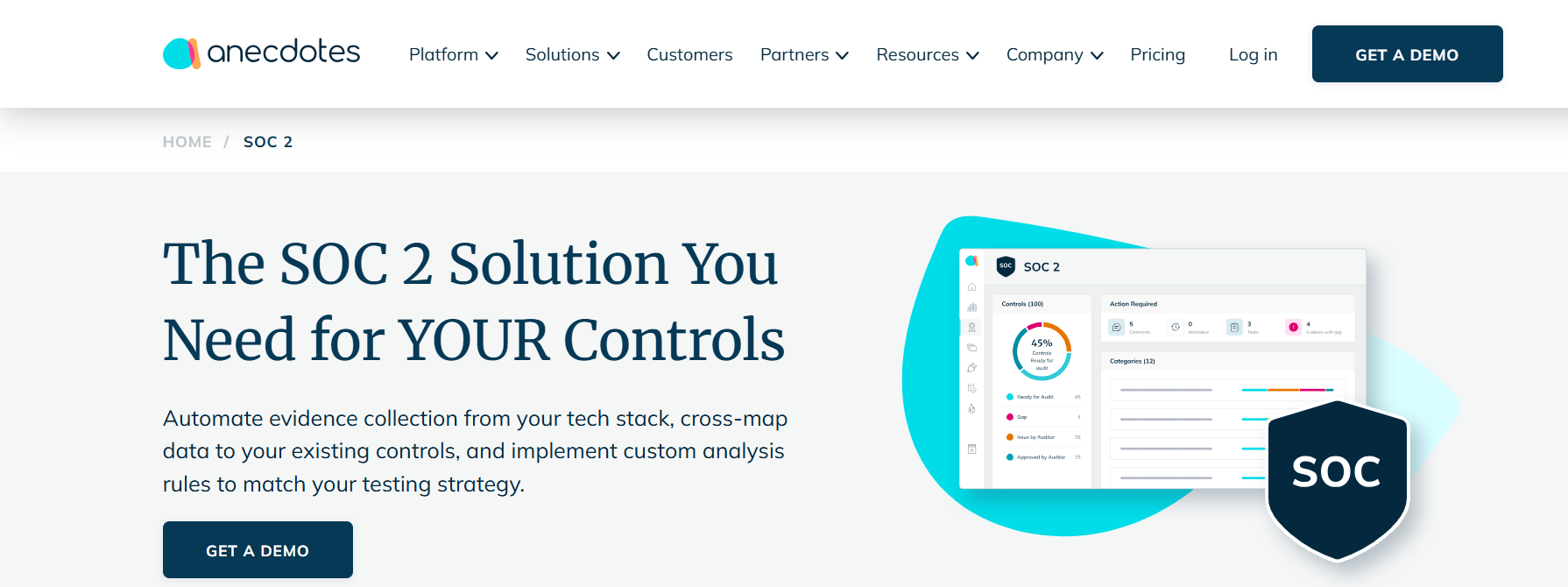
Anecdotes markets itself as a data-centric Compliance OS rather than a simple SOC 2 checklist tool, and it targets exactly the audience this article is written for: compliance-forward mid-market and enterprise teams running multiple frameworks at once. Its Evidence Pool consolidates every piece of collected evidence into a searchable, timestamped, tamper-proof table, while its Agent Studio lets compliance teams build no-code automation agents tailored to their own environment.
Features
- A unified Evidence Pool with timestamped, tamper-proof records that auditors can verify directly.
- Agent Studio and an Agent Library for building and deploying no-code GRC automation.
- ChatGRC, a conversational interface for querying compliance program data.
- Support for 40-plus (and by some counts 60-plus) pre-mapped frameworks, including SOC 2, ISO 27001, HIPAA, and PCI DSS.
- A framework-centric or control-centric view that lets teams see one control mapped across multiple standards.
Pros
- Data-centric architecture reduces duplicate evidence work across overlapping frameworks.
- Clean, modern interface that reviewers consistently compare favorably to legacy GRC tools.
- Rated 4.6 out of 5 on G2, reflecting solid satisfaction among its enterprise-leaning customer base.
Cons
- Firmly enterprise-priced, which can be more platform than a smaller startup needs for a first SOC 2 report.
- Some features, such as audit logs, custom roles, and multi-entity management, are gated behind the Enterprise tier or sold as paid add-ons.
Pricing
Anecdotes uses quote-based enterprise pricing with no fixed published rate.
Final Thought
Anecdotes stands out among SOC 2 Vendors for Series C and Later Companies that are ready to treat compliance as a permanent operating system rather than a one-time audit sprint.
Drata built its reputation on deep automation and an unusually strong ISO 27001 workflow, which makes it a natural fit for Series C and later companies that expect to run several frameworks side by side within eighteen months. The platform supports more than 30 frameworks, including NIST 800-53, CMMC 2.0, ISO 42001, NIS 2, and DORA, and it layers multi-workspace and multi-entity setups on top of that breadth, a detail that matters once a company operates more than one legal entity or brand.
Features
- Unlimited framework support across 30-plus standards, from SOC 2 and ISO 27001 to CMMC 2.0 and DORA.
- Risk Management Pro and Compliance-as-Code Pro modules for teams with mature engineering-driven controls.
- Premium support, dedicated customer success manager, custom roles, and SSO on higher tiers.
- A SafeBase-powered Trust Center, following Drata’s acquisition of SafeBase, sold as its own SKU.
Pros
- Best-in-class ISO 27001 workflow among compliance automation platforms, useful for global sales motions.
- Deep API-driven evidence collection that appeals to engineering-heavy organizations.
- Scales cleanly from a single framework to a sprawling multi-entity, multi-framework program.
Cons
- Pricing is entirely custom and not published, which complicates budget planning for finance teams.
- The Trust Center now sells separately after the SafeBase acquisition, adding another line item to negotiate.
Pricing
Drata’s Foundation plan reportedly starts around $7,500 to $10,000 a year for a single framework at a small company.
Final Thought
Among SOC 2 Vendors for Series C and Later Companies, Drata is the strongest choice for organizations that already know they will stack multiple frameworks and want one platform to manage the growing complexity.
Secureframe pairs automation with genuinely hands-on human guidance, which is why it consistently earns high marks for onboarding and customer support. The platform covers SOC 2, ISO 27001, HIPAA, GDPR, and PCI DSS, and it layers a proactive user access review feature on top of standard evidence collection, continuously flagging excessive or outdated permissions before an auditor ever asks about them.
Features
- Automated evidence collection with real-time monitoring across cloud, identity, and HR systems.
- Continuous, automated user access reviews that uncover excessive or stale permissions.
- A guided policy library that accelerates drafting for teams without an in-house compliance function.
- Broad framework coverage spanning SOC 2, ISO 27001, HIPAA, GDPR, and PCI DSS.
- A responsive support team frequently singled out in reviews for fast, knowledgeable help.
Pros
- Consistently rated between 4.7 and 4.8 out of 5 on major review sites for ease of use and support quality.
- Strong onboarding experience that shortens time-to-readiness for teams without dedicated compliance staff.
- Access-review automation adds real security value beyond simple evidence collection.
Cons
- Some users report integration issues that require additional manual setup.
- AI-assisted features are still maturing and are not always fully reliable, according to user feedback.
Pricing
Secureframe’s published Starter, Pro, and Ultra tiers run roughly $2,700, $4,800, and $8,000 a year respectively at the low end of the market, though enterprise quotes for larger Series C and later companies commonly reach $10,000 to $50,000-plus once multiple frameworks, entities, and support tiers are included.
Final Thought
Secureframe belongs on any list of SOC 2 Vendors for Series C and Later Companies that value white-glove onboarding, since its guided approach shortens the runway to a clean first audit.
Sprinto takes a prescriptive, automation-first approach that appeals to lean compliance teams inside fast-moving Series C organizations. Rather than seat-based or add-on-heavy pricing, Sprinto bundles the full program into a single quote, and its Adaptive Automation layer continuously monitors systems and routes the exact remediation task to the team member responsible, rather than dumping a generic checklist on the whole company.
Features
- Adaptive Automation that continuously monitors controls and assigns fixes to the responsible owner.
- Broad integration coverage paired with flexible custom “compliance zones” for scoping.
- Access to a network of pre-vetted auditors to reduce coordination overhead.
- Support for SOC 2, ISO 27001, HIPAA, GDPR, PCI DSS, and other common frameworks.
Pros
- Transparent, all-in-one pricing that avoids the surprise add-on costs common elsewhere in the category.
- Strong automation depth relative to price, which appeals to budget-conscious growth-stage teams.
- Consistently rated as one of the most competitively priced options among mid-market platforms.
Cons
- Multi-certification depth trails platforms like Scytale or Drata for companies running three-plus frameworks
- Smaller integration library than Vanta or Drata in some specialized enterprise tech stacks.
Pricing
Sprinto’s published pricing starts around $6,000 to $8,000 a year for smaller, simpler cloud environments, with most startups landing between $8,000 and $10,000 annually.
Final Thought
For SOC 2 Vendors for Series C and Later Companies that want predictable, bundled pricing without sacrificing automation depth, Sprinto is a strong contender worth demoing before signing with a bigger-name competitor.
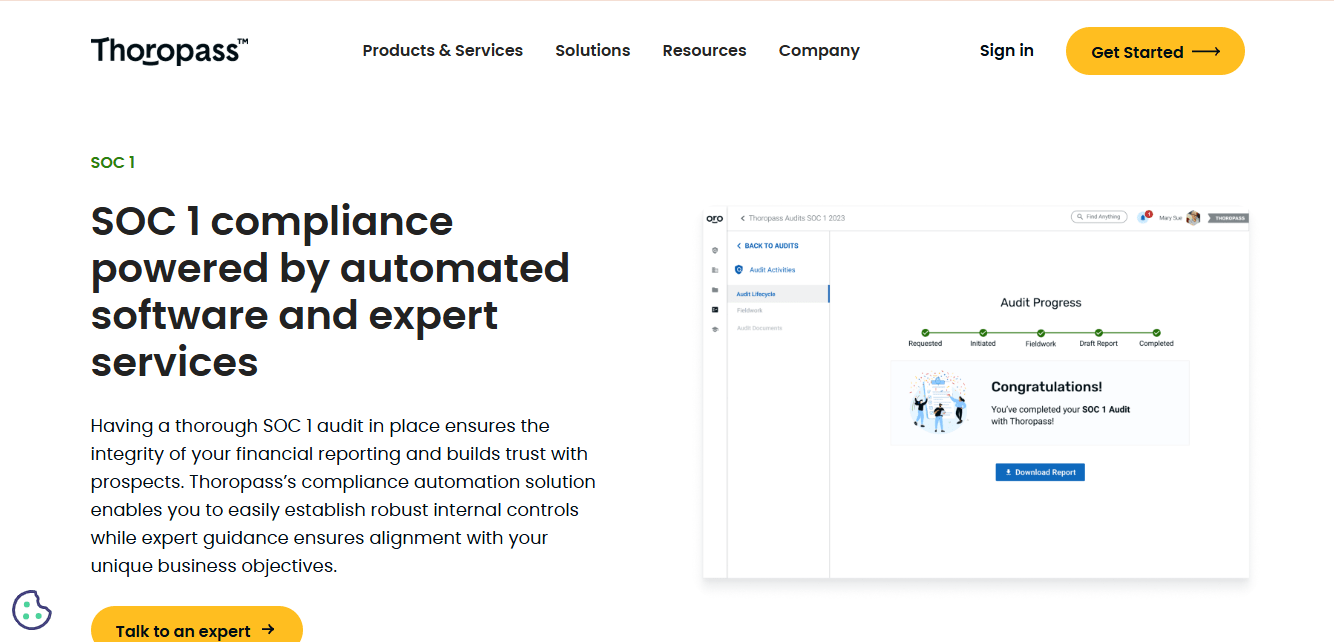
Thoropass differentiates itself by bundling the compliance software and the actual SOC 2 audit into a single purchase, delivered through its affiliated but legally separate CPA practice. That connected-audit model appeals to Series C companies that want one point of contact from readiness through the final report, rather than juggling a software vendor and an independent auditor separately.
Features
- A connected software-plus-audit model that pairs the platform directly with an affiliated CPA firm.
- Detailed audit trail logging of every evidence submission and auditor interaction.
- Support for SOC 2, ISO 27001, HIPAA, and PCI DSS within one workspace.
- Built-in security awareness training modules that some competitors bill as a separate add-on.
- A structured readiness workflow designed to keep less experienced teams on track.
Pros
- Single point of contact for both the software and the audit simplifies vendor management.
- Strong audit-trail transparency, which reduces friction when the auditor asks for supporting context.
- Rated 4.7 out of 5 on G2 across hundreds of reviews, reflecting solid overall satisfaction.
Cons
- Auditor lock-in removes the flexibility to shop for a different CPA firm later.
- Some users report the dashboard is not laid out as intuitively as rival platforms.
Pricing
Thoropass reportedly starts around $8,700 to $14,500 a year for the platform
Final Thought
Thoropass suits SOC 2 Vendors for Series C and Later Companies buyers who would rather purchase software and audit together than manage two separate vendor relationships.
Scrut Automation combines governance, risk, and compliance workflows with cloud security posture management in a single console, which makes it especially attractive to infrastructure-heavy Series C companies that want compliance and cloud hardening addressed together rather than through separate tools.
Features
- Combined GRC and cloud security posture management (CSPM) in one platform.
- Prebuilt controls and automated evidence gathering for SOC 2 Type 1 and Type 2.
- Real-time, transparent dashboards showing overall compliance posture.
- A dedicated team of SOC 2 experts supporting the readiness process.
- Support for common frameworks alongside continuous risk identification and assessment workflows.
Pros
- Combining GRC and CSPM in one console reduces tool sprawl for infrastructure-heavy teams.
- Competitive mid-tier pricing relative to Vanta and Drata for similar automation depth.
- Strong customer support that reportedly flags gaps before auditors do.
Cons
- No public pricing page, so every quote requires a sales conversation.
- Fewer specialized integrations for niche enterprise tech stacks compared to category leaders.
Pricing
Scrut Automation typically starts around $15,000 a year, with custom pricing for enterprise and multi-framework programs.
Final Thought
Scrut Automation deserves a place among SOC 2 Vendors for Series C and Later Companies whose infrastructure footprint is complex enough to justify pairing compliance automation with cloud posture management.

Vanta sits at the top of almost every shortlist of SOC 2 Vendors for Series C and Later Companies, and it earns that spot by combining continuous control monitoring with a genuinely large integration marketplace. Founded to remove the spreadsheet-driven grind from audit prep, Vanta now serves well over 10,000 organizations and continuously tests cloud infrastructure, identity providers, HR systems, and code repositories against SOC 2, ISO 27001, HIPAA, and more than 35 other frameworks. For a Series C company juggling multiple customer security reviews at once, Vanta’s Trust Center and automated questionnaire responses turn a historically manual sales-blocking process into a background task.
Features
- Automated evidence collection across cloud providers, identity providers, HR systems, and security tools.
- Cross-mapped controls spanning more than 35 frameworks, including SOC 2, ISO 27001, HIPAA, and PCI DSS.
- An in-app auditor marketplace that connects companies directly with CPA firms familiar with Vanta evidence exports.
- A public-facing Trust Center that answers buyer security questionnaires automatically.
- Continuous monitoring that flags control drift, such as a laptop with disabled disk encryption, in real time.
Pros
- Fast onboarding and an intuitive interface that reduces the learning curve for compliance owners.
- Strong auditor network, which shortens the search for a CPA firm that already understands the platform’s exports.
- Multi-framework support means a single subscription can later stretch to ISO 27001 or HIPAA.
Cons
- Vanta surfaces failing controls but does not fix them, so a dedicated internal owner is still required.
- Costs climb quickly once a company adds frameworks, seats, or the vendor-risk-management module.
Pricing
Vanta uses custom, quote-based pricing that reportedly starts near $7,500 to $14,000 a year for a single framework
Final Thought
Vanta remains a dependable default among SOC 2 Vendors for Series C and Later Companies, particularly for teams that already run a cloud-native stack and want the broadest possible integration coverage without sacrificing usability.
Scytale pairs AI-driven automation with a dedicated team of human compliance experts, an approach it describes as “compliance on autopilot.” The platform supports more than 80 security and privacy frameworks, including SOC 2, ISO 27001, ISO 42001, PCI DSS, GDPR, HIPAA, and SOX ITGC, and it layers penetration testing, AI-generated security questionnaire responses, and a customizable Trust Center on top of the core automation engine.
Features
- Continuous, 24/7 control monitoring that flags policy lapses, access changes, or configuration drift instantly.
- Support for 80-plus frameworks, including early coverage of ISO 42001, the AI management system standard.
- A multi-agent AI suite covering evidence collection, user access reviews, and vendor risk management.
- Optional virtual compliance expert and managed audit services as add-ons.
- AI-powered security questionnaire automation, reducing the time spent on enterprise customer diligence.
Pros
- Blends automation with real human expert support, which shortens the learning curve for first-time compliance owners.
- Early, genuine ISO 42001 support gives an edge to companies selling AI-powered products to enterprise buyers.
- Flexible add-on model lets companies buy exactly the advisory support they need.
Cons
- Full pricing is not published, so exact costs depend on framework count and advisory scope chosen.
- Add-on pricing for services like virtual compliance experts can add materially to the base subscription.
Pricing
Scytale’s public entry tier reportedly starts around $7,500 to $10,000 a year for the platform plus one framework.
Final Thought
Scytale rounds out this list of SOC 2 Vendors for Series C and Later Companies especially well for organizations that want expert hands available whenever automation alone is not enough, and for AI-driven companies preparing for ISO 42001 alongside SOC 2.