Enterprise buyers who send customer datasets to a data labeling provider increasingly ask for proof of security controls before the first file ever leaves their environment. That proof usually takes the form of a SOC 2 report, and getting one means choosing among a crowded field of SOC 2 compliance vendors for data labeling companies platforms that automate evidence collection, map controls, and prepare an organization for an independent audit.
SOC 2 compliance vendors for data labeling companies are not auditors. Most are software platforms. Some also combine compliance software with audit or readiness services.
These vendors help companies prepare for a CPA examination. They also help teams stay compliant afterward.
In practice, this can include:
- Connecting cloud infrastructure, identity providers, and SaaS tools to collect evidence automatically.
- Mapping controls to the specific Trust Services Criteria included in the SOC 2 scope.
- Identifying compliance gaps before the auditor does.
- Managing policies, employee onboarding and offboarding, and vendor risk reviews.
- Monitoring controls continuously throughout the audit period.
This last point matters for SOC 2 Type II. A Type II report evaluates controls over an observation period. It does not assess controls on just one day. For a data labeling company, choosing a SOC 2 compliance vendor comes down to automation and fit.
The right platform should reduce manual compliance work. It should also work with the company’s cloud infrastructure, annotation tools, and workforce systems.
The goal is simple: less manual work, better visibility, and a smoother path to SOC 2.
Why Data Labeling Companies Need SOC 2 Compliance
Not every data labeling company needs SOC 2 by law. The main driver is often commercial. Enterprise customers may require a SOC 2 report before signing a contract or sharing proprietary datasets.
- Customer Data: Data labeling companies may handle images, video, audio, text, documents, or sensor data. Some datasets may contain proprietary or sensitive information. Customers often expect their vendors to meet similar security standards.
- Enterprise Procurement:Large customers may require a SOC 2 report or security questionnaire before working with an annotation vendor. Without one, a company may be excluded from the process before pricing is even discussed.
- Distributed Workforces: Annotation teams can include employees, contractors, reviewers, and administrators. SOC 2 helps companies control who can access specific datasets. It also supports processes for granting, reviewing, and removing access.
- The Data Lifecycle: Data moves through several stages. These can include ingestion, storage, annotation, review, export, retention, and deletion. SOC 2 considers controls across this lifecycle.
- Third-Party Risk: Data labeling companies rely on tools and services such as cloud providers, identity platforms, APIs, and workforce systems. SOC 2 encourages companies to assess and manage the security risks of these third parties.
SOC 2 is not legally required for every data labeling company. The need depends on the company’s customers, data, contracts, and security requirements.
Top 12 SOC 2 Compliance Vendors for Data Labeling Companies
1. Vanta
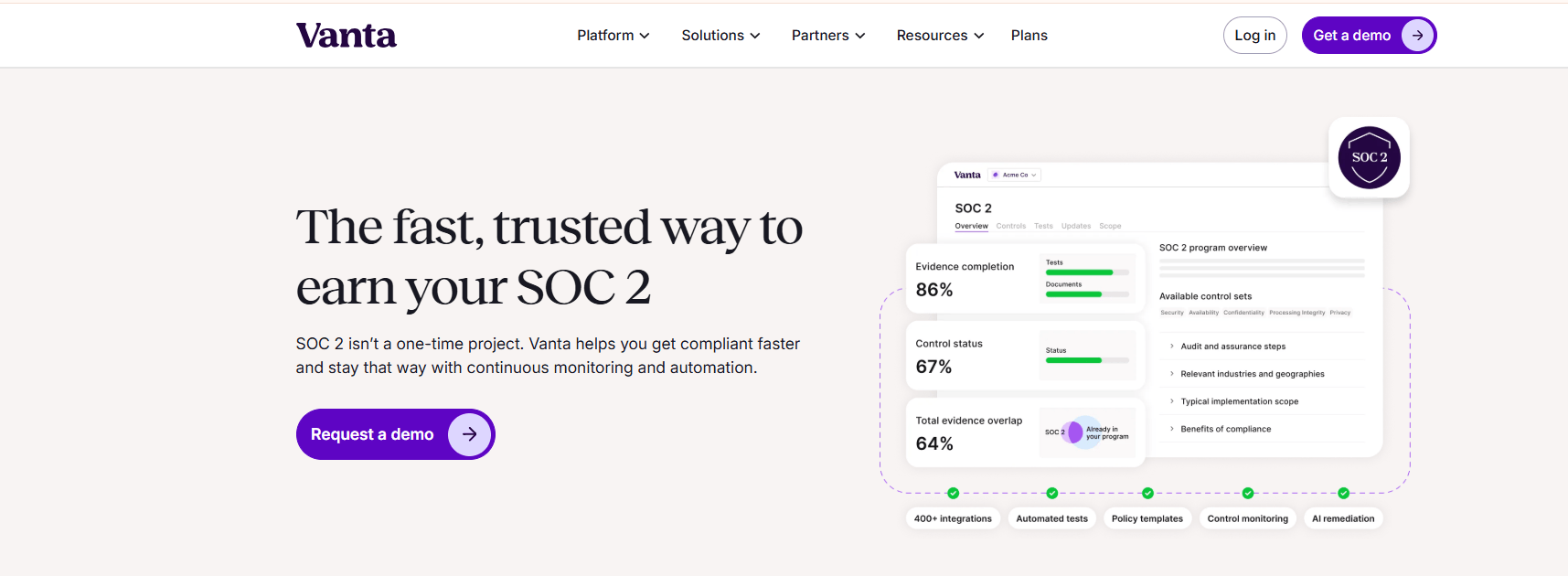
Vanta is one of the best-known compliance automation platforms. It connects with cloud infrastructure, identity providers, and SaaS tools to collect evidence automatically. It supports SOC 2, ISO 27001, HIPAA, and other frameworks.
Why It Fits Data Labeling Companies
Most data labeling companies use cloud platforms such as AWS, GCP, or Azure. They also rely on identity, ticketing, and code-management tools.
Vanta supports many of these systems through its integration library. Its strong recognition among auditors and enterprise buyers can also help during customer security reviews.
Features
- Automated evidence collection across a large integration library
- Continuous control monitoring
- Policy templates
- Trust Center
- Vendor risk management
- Security questionnaire automation
- Support for multiple compliance frameworks
Pricing
- Vanta does not publish a universal price list.
- Its AWS Marketplace listing shows Essentials at $14,000, Plus at $21,500, and Professional at $23,000 for a 12-month term covering 1–20 employees.
- Larger or multi-framework deployments can reach $25,000–$100,000+.
- Additional frameworks and modules can increase the total cost.
Pros
- Broad integration coverage
- Strong recognition among auditors and enterprise buyers
- Mature compliance platform
- Regular product development
- Supports multi-framework compliance
Cons
- No universal public pricing
- Additional frameworks and modules can increase costs
- Buyers may face higher renewal costs
Best For
Data labeling companies that want a mature platform with broad integrations and strong enterprise recognition.
Verdict
Best if: Enterprise customers are a priority and integration coverage matters more than price transparency.
Consider another vendor if: You need predictable pricing or a public price list. Strike Graph or TrustCloud may be worth considering.
2. Drata
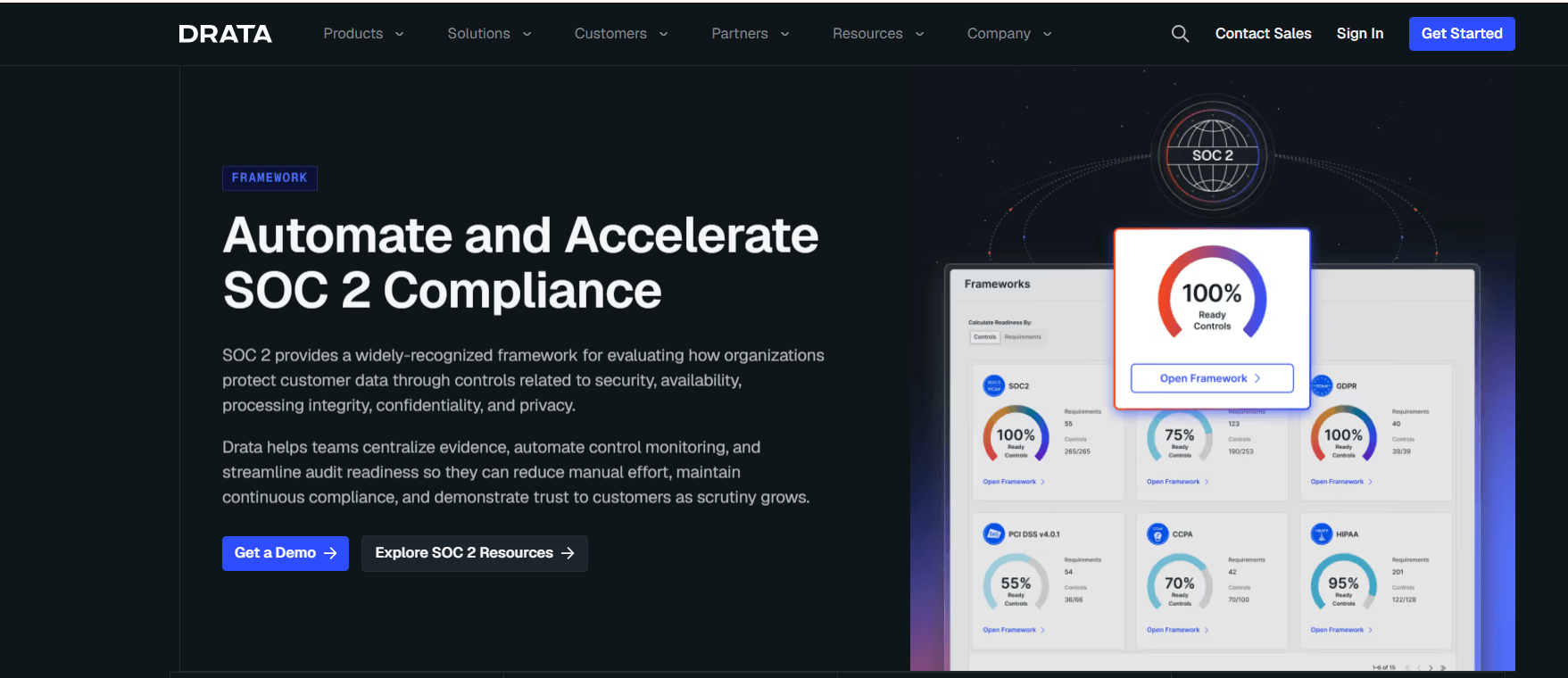
Drata competes closely with Vanta in the compliance automation market. It focuses heavily on continuous control monitoring and automated evidence collection. It also supports custom API connections and compliance-as-code workflows.
Why It Fits Data Labeling Companies
Data labeling platforms often use custom annotation tools, internal APIs, and MLOps pipelines. These systems may not fit standard SaaS integrations.Drata’s custom API capabilities can help technical teams connect these systems and automate evidence collection.
Features
- Pre-mapped SOC 2 controls
- Automated evidence tests
- Continuous control monitoring
- Risk management
- Vendor risk management
- Custom API connections
- Trust Center
- AI-assisted security questionnaire responses
- Support for 30+ frameworks
Pricing
- Its website lists Foundation, Advanced, and Enterprise tiers without dollar amounts.
- AWS Marketplace data places Foundation around $7,500–$10,000 per year for up to 50 employees and one framework.
Pros
- Strong evidence automation
- Supports 30+ frameworks
- Good fit for engineering-led teams
- Supports custom integrations
- Active product development
Cons
- No public standard pricing
- Additional frameworks can increase costs
- Trust Center is now sold separately following the SafeBase acquisition
Best For
Data labeling companies with engineering-heavy teams and custom infrastructure.
Verdict
Best if: Your annotation platform relies heavily on custom APIs and technical infrastructure.
Consider another vendor if: Your team lacks engineering resources for custom integrations. Vanta or Scytale may require less technical setup.
3. Secureframe
Secureframe provides a guided approach to SOC 2 and other compliance frameworks. The platform focuses heavily on connecting people, systems, and access rights to specific controls.
Why It Fits Data Labeling Companies
Data labeling companies may have employees, reviewers, contractors, and administrators accessing customer datasets. Secureframe’s access-management workflows can help companies track who has access to specific systems and when that access changes.
Features
- 300+ integrations
- Automated evidence collection
- Policy templates
- Employee onboarding and offboarding tracking
- User access monitoring
- Vendor risk management
- Cross-framework control mapping
- Security questionnaire support
Pricing
- Secureframe uses quote-based pricing.
- The company does not publish a standard price list.
- Third-party sources report entry pricing of around $7,500–$15,000 per year for teams under 20 employees and one framework.
Pros
- Broad integration coverage
- Guided onboarding
- Strong access-management workflows
- Useful for frequent security questionnaires
- Good customer reviews
Cons
- Feature availability varies by company size and plan
- Additional frameworks can increase costs
- No public standard pricing
Best For
Data labeling companies with larger or distributed teams that need strong access-review workflows.
Verdict
Best if: You need clear records of access across employees, reviewers, and other users.
Consider another vendor if: You’re a very small startup with a tight budget. Sprinto or TrustCloud may offer a lower-cost starting point.
4. Sprinto
Sprinto is a compliance automation platform built for cloud-native companies. Unlike some competitors, it bases pricing around employee headcount rather than the number of platform users.
Why It Fits Data Labeling Companies
Data labeling operations can involve many people. Assigners, reviewers, QA staff, team leads, and administrators may all interact with compliance systems. Sprinto’s user model can make broader internal access more cost-effective.
Features
- Automated evidence collection
- Policy templates
- Vendor risk management
- Security questionnaire workflows
- Continuous monitoring
- Compliance dashboards
- AI-assisted evidence packaging
- Support for multiple frameworks
Pricing
- Sprinto uses sales-led pricing.
- The company does not publish a standard price list.
- Third-party sources report single-framework pricing of around $6,000–$11,000 per year for smaller teams.
Pros
- No additional cost for platform users
- Competitive reported entry pricing
- Good fit for small and mid-sized teams
- Strong focus on cloud-native companies
- Increasing use of AI-assisted compliance workflows
Cons
- No public standard pricing
- Newer AI evidence features are still developing
- Human review remains necessary for audit submissions
- Additional frameworks can increase costs
Best For
Early- and mid-stage data labeling companies with many distributed reviewers.
Verdict
Best if: Many reviewers or QA staff need access to the compliance platform without a per-seat penalty. Consider another vendor if: You have a large organization with complex multi-framework requirements. Hyperproof or Scrut may offer a better fit.
5. Thoropass
Thoropass takes a different approach from most compliance platforms. It combines compliance software with audit services. The company can therefore support both compliance preparation and the SOC 2 examination through one provider.
Why It Fits Data Labeling Companies
First-time compliance teams often have to coordinate between a compliance platform and an external auditor.
Thoropass combines these services. This can reduce the work involved in managing two separate vendors.
Features
- Automated evidence collection
- AI-assisted evidence verification
- In-platform audit support
- Compliance monitoring
- Policy management
- Audit preparation
- Support for 30+ frameworks
- Support for SOC 1, SOC 2, ISO 27001, ISO 42001, HIPAA, HITRUST, GDPR, and CMMC
Pricing
- AWS Marketplace lists a $8,700/year Compliance Platform subscription.
- Marketplace pricing also lists a $5,800/year Platform + SOC 2 Audit subscription add-on.
Pros
- More transparent pricing than many competitors
- Combines compliance software and audit services
- One vendor can manage both sides of the process
- Strong audit credentials
- Supports multiple frameworks
Cons
- Customers have less flexibility when choosing an external auditor
- Switching auditors later may require changing providers
- Some templates focus heavily on U.S. requirements
- Smaller framework catalog than some larger competitors
Best For
First-time data labeling companies that want one provider for compliance preparation and auditing.
Verdict
Best if: You want a simple process with one vendor handling compliance and the SOC 2 audit. Consider another vendor if: You want to choose a specific external CPA firm later or operate mainly outside the U.S.
6. Scytale
Scytale combines compliance automation with hands-on compliance guidance. The platform includes a dedicated compliance expert as part of its service.
Why It Fits Data Labeling Companies
Many data labeling startups pursue enterprise customers before hiring a dedicated compliance lead. Scytale gives these teams direct support with scoping, gap identification, remediation, and audit coordination.
Features
- Automated evidence collection
- Continuous control monitoring
- AI-powered GRC assistance
- AI-assisted questionnaire responses
- Customer-facing Trust Center
- Compliance guidance
- Audit coordination
- Support for 80+ frameworks
Pricing
- Scytale uses quote-based pricing.
- Its AWS Marketplace listing shows a public floor of $7,500 for 12 months.
Pros
- Dedicated compliance expert included
- Strong customer reviews
- Broad framework coverage
- Supports AI-focused frameworks such as ISO 42001
- Useful for first-time compliance teams
Cons
- Smaller integration library than Vanta or Drata
- Custom or less common tools may require more manual work
- Less suited to organizations with large internal GRC teams
Best For
Data labeling startups pursuing their first SOC 2 without an internal compliance hire.
Verdict
Best if: You want hands-on compliance guidance alongside automation. Consider another vendor if: Your annotation stack includes many custom or uncommon tools. Vanta or Drata may offer broader integration coverage.
7. Hyperproof

Hyperproof focuses on compliance operations and broader GRC management. It suits organizations managing several frameworks rather than companies pursuing their first SOC 2 report.
Why It Fits Data Labeling Companies
A data labeling company may eventually need several frameworks as its customer base grows. For example, a company could pursue SOC 2 first and later add ISO 27001 or HIPAA. Hyperproof helps teams manage multiple frameworks through centralized control and evidence management.
Features
- Support for 100+ compliance frameworks
- Automated evidence collection
- Centralized audit evidence management
- Cross-framework control mapping
- AI-assisted compliance workflows
- Gap identification
- Audit coordination
- Compliance reporting
Pricing
- Hyperproof does not publish standard pricing.
- Pricing depends on factors such as users and frameworks.
Pros
- Strong multi-framework capabilities
- Centralized compliance management
- Useful for complex organizations
- Supports 100+ frameworks
- Strong reporting capabilities
Cons
- Steeper learning curve
- Less suited to first-time SOC 2 projects
- Smaller integration footprint than some category leaders
- Can cost more than startup-focused platforms
Best For
Growing data labeling companies managing SOC 2 alongside several other compliance frameworks.
Verdict
Best if: You already manage multiple compliance programs and have a dedicated compliance team. Consider another vendor if: You’re preparing for your first SOC 2. Vanta, Drata, or Sprinto may provide a simpler starting point.
8. Scrut Automation
Scrut Automation is a GRC platform that focuses on risk management, compliance automation, and multiple frameworks. It offers SOC 2 alongside several security and privacy frameworks.
Why It Fits Data Labeling Companies
Data labeling companies may eventually need additional frameworks alongside SOC 2. This can happen when they work with customers in industries with specific security requirements.
Scrut supports frameworks such as ISO 27017 and ISO 27018, which can be relevant to cloud and personal-data security.
Features
- Automated evidence collection
- Continuous control monitoring
- AI-assisted remediation
- Security questionnaire automation
- Policy templates
- Risk management
- Trust posture monitoring
- Customer-facing Trust Center
- Multi-framework support
Pricing
- Scrut does not publish a complete price list.
- Its AWS Marketplace listing shows $15,000 per year for its Compliance Automation module for organizations with up to 20 employees.
Pros
- Strong multi-framework capabilities
- Broad cloud-security coverage
- Useful for companies planning multiple frameworks
- Competitive for multi-framework programs
- Strong compliance automation features
Cons
- No complete public price list
- No self-service free trial
- Some reviewers report delays with certain data-sync processes
Best For
Data labeling companies planning SOC 2 alongside additional security or privacy frameworks.
Verdict
Best if: You already have a multi-framework compliance roadmap. n bConsider another vendor if: SOC 2 is your only near-term goal. A simpler SOC 2-focused platform may be easier to implement.
9. Oneleet
Oneleet takes a security-first approach to compliance. It combines compliance automation with penetration testing, security monitoring, and vCISO support.
Why It Fits Data Labeling Companies
Customer datasets can become valuable targets for attackers. Data labeling companies may therefore want more than an audit-ready compliance program. Oneleet combines SOC 2 preparation with security services. This can help companies strengthen their security posture while preparing for an audit.
Features
- Penetration testing
- Security monitoring
- Code scanning
- Risk scoring
- Mobile device management
- Trust Portal
- vCISO support
- Guided remediation
- SOC 2 support
- ISO 27001 support
- HIPAA support
- GDPR support
Pricing
- Oneleet does not publish standard pricing.
- The company uses custom quotes.
- Third-party sources report SOC 2 Type II pricing of around $15,000–$30,000 per year.
Pros
- Combines compliance and security services
- Includes penetration testing
- Includes vCISO support
- Strong customer reviews
- Reduces the number of separate security vendors
Cons
- Services cannot be fully separated
- Customers may pay for services they already have elsewhere
- Smaller integration footprint than Vanta or Drata
- No public standard pricing
- Less focused on complex multi-framework programs
Best For
Data labeling companies that want their SOC 2 investment to improve their broader security posture.
Verdict
Best if: You want penetration testing and vCISO support alongside SOC 2. Consider another vendor if: You already have separate security testing or vCISO providers and do not want overlapping services.
10. Strike Graph
Strike Graph stands out for its public pricing. It offers a free Launch tier alongside paid Certify, Scale, and Enterprise plans.
Why It Fits Data Labeling Companies
Early-stage data labeling companies often want to compare costs before speaking with sales teams. Strike Graph gives buyers more pricing visibility than many competitors. This can make the initial vendor-shortlisting process easier.
Features
- SOC 2 compliance support
- Support for 25+ frameworks
- SSP builder
- Audit documentation tools
- Auditor-agnostic approach
- Security questionnaire support
- Audit coordination
- ISO support
- HIPAA support
- PCI DSS support
- GDPR support
- CMMC support
- DORA support
- TISAX support
Pricing
- Strike Graph offers a free Launch plan.
- Certify costs roughly $9,000–$10,000 per year.
- Scale costs roughly $18,000–$21,500 per year.
- Enterprise costs roughly $35,000 per year.
- Additional frameworks can cost roughly $2,000–$8,000 each.
Pros
- Public pricing
- Free entry-level plan
- Auditor-agnostic approach
- Broad framework support
- Easier initial price comparison
Cons
- Smaller integration library than Vanta or Drata
- Additional frameworks can increase costs
- Some reviewers consider the interface less modern than newer competitors
Best For
Budget-conscious data labeling startups that want to understand pricing before booking a sales call.
Verdict
Best if: Pricing transparency and auditor flexibility matter most. Consider another vendor if: Your company relies on many SaaS tools and needs extensive prebuilt integrations. Vanta or Drata may provide broader coverage.
11. OneTrust
OneTrust offers SOC 2 compliance through its broader Tech Risk and Compliance platform. The platform also covers privacy, third-party risk, and enterprise GRC. This makes OneTrust different from SOC 2-focused platforms. It can help companies manage compliance and privacy programs from the same ecosystem.
Why It Fits Data Labeling Companies
Large data labeling companies may need to manage SOC 2 alongside privacy requirements. This becomes especially relevant when they process personal data under regulations such as GDPR or CCPA. OneTrust can bring these programs together. That can help teams avoid managing separate tools for compliance and privacy.
Features
- SOC 2 framework support
- Support for 50+ standards and frameworks
- ISO 27001 support
- ISO 27701 support
- PCI DSS 4.0 support
- HIPAA support
- GDPR support
- NIST framework support
- Regulatory intelligence
- Third-party and vendor risk management
- Enterprise audit trails
- Privacy management capabilities
- Data subject rights automation
- Privacy impact assessments
Pricing
- OneTrust does not publish standard pricing for its GRC and Compliance Automation products.
- Third-party estimates place its Compliance Automation offering at around $20,000–$40,000 per year.
Pros
- Combines compliance and privacy management
- Supports a large number of frameworks
- Strong enterprise GRC capabilities
- Extensive third-party risk management
- Useful for companies managing complex compliance programs
Cons
- Higher estimated cost than many SOC 2-focused platforms
- Can require a longer implementation
- Steeper learning curve
- Separate product lines can make budgeting more complicated
Best For
Enterprise-scale data labeling companies that need SOC 2 and privacy compliance at the same time.
Verdict
Best if: Privacy compliance is already a major requirement alongside SOC 2. Consider another vendor if: You only need your first SOC 2 report. OneTrust’s broader platform may add unnecessary cost and complexity.
12. TrustCloud
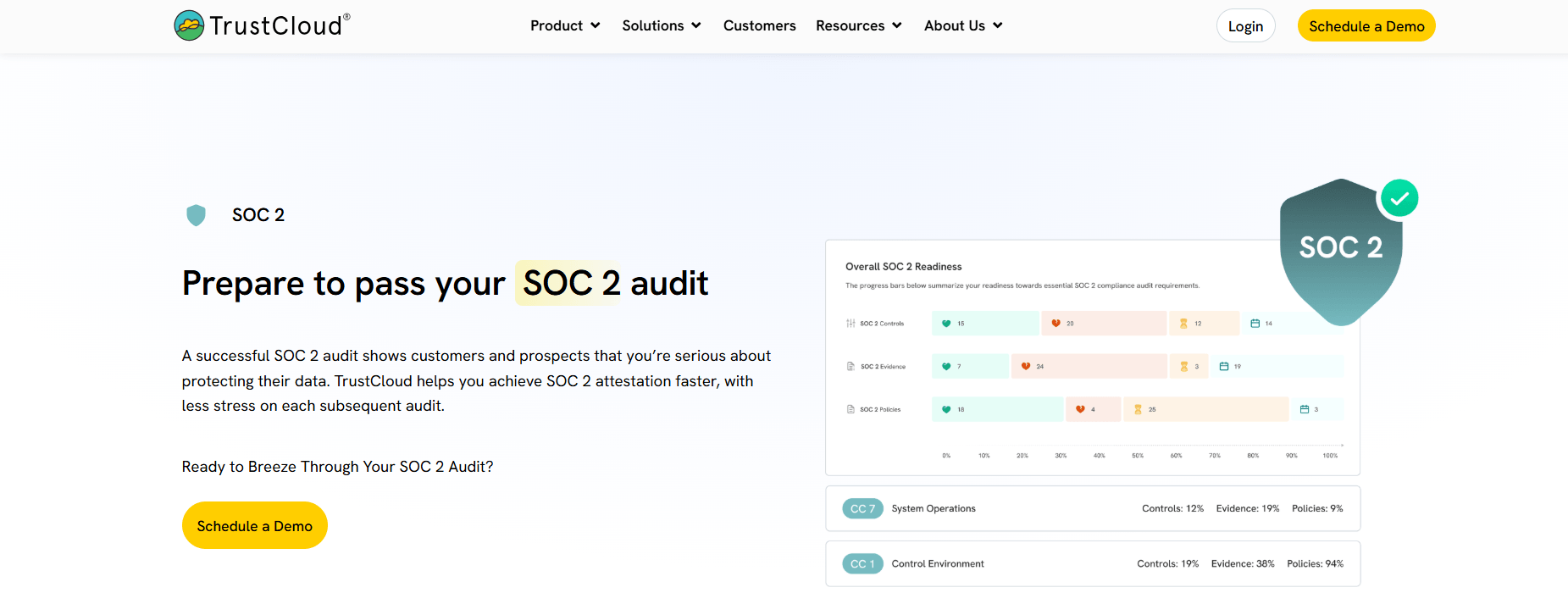
TrustCloud is an AI-focused GRC platform that offers a free tier for smaller companies. The free plan provides SOC 2 readiness tools, automated evidence collection, and a trust portal without platform fees for qualifying companies.
Why It Fits Data Labeling Companies
Many data labeling startups begin with small teams and limited compliance budgets. They may also need SOC 2 readiness before they can expand their enterprise customer base. TrustCloud’s free tier can reduce the software cost of getting started. The company would still need to pay an independent auditor for the SOC 2 examination.
Features
- SOC 2 Type I readiness
- SOC 2 Type II readiness
- Automated evidence collection
- Automated evidence mapping
- Policy management
- Risk assessments
- Trust portal
- Support for ISO 27001
- Support for HIPAA
- Broader GRC tools through its TrustOps, TrustShare, and TrustRegister products
Pricing
- TrustCloud offers a free tier for companies with fewer than approximately 20 employees.
- The free tier covers SOC 2 readiness software at $0 in platform fees.
- The independent CPA audit remains a separate cost.
- Reported audit costs typically range from around $8,000–$28,000, depending on scope.
Pros
- Free SOC 2 readiness software for qualifying small companies
- Low barrier to entry
- Simple interface for first-time compliance teams
- Includes automated evidence collection
- Supports SOC 2 Type I and Type II readiness
Cons
- Smaller independent review footprint than major competitors
- Less public pricing information for larger companies
- Some features become available only on paid plans
- Integration and pricing comparisons become harder once a company moves beyond the free tier
Best For
Very early-stage data labeling startups with fewer than roughly 20 employees and limited compliance budgets.
Verdict
Best if: Your company qualifies for the free tier and wants to minimize software costs while preparing for SOC 2. Consider another vendor if: You’ve already grown beyond the free-tier threshold. Sprinto or Strike Graph may offer easier-to-budget paid options.
What to Look for in a SOC 2 Vendor: Data Labeling Buying Criteria
Choosing a SOC 2 vendor involves more than comparing features. Data labeling companies should focus on how well the platform fits their cloud infrastructure, annotation workflows, and distributed workforce.
Cloud Infrastructure
- Confirm support for the specific cloud providers your annotation infrastructure uses.
- Do not assume every vendor supports every cloud environment.
Identity and Access
- Check support for your identity provider and access-review workflows.
- Make sure the platform can account for employees, reviewers, administrators, and contractors.
Developer Tools
- Confirm integrations with the tools your team actually uses.
- Check support for platforms such as GitHub, GitLab, Jira, and similar systems.
Annotation Infrastructure
- Ask whether the platform connects to your dataset storage and annotation systems.
- Check coverage for task assignment, label review, user management, and data export.
Workforce Security
- Ask how the platform handles contractor and distributed-workforce controls.
- Look for onboarding, offboarding, access reviews, and device-management support.
Evidence Automation
- Ask how much evidence the platform collects automatically.
- Find out what your team must still upload, review, or approve manually.
Continuous Monitoring
- Check how frequently the platform monitors controls.
- Find out how quickly it flags failed or missing controls during the SOC 2 observation period.
Audit Support
- Understand how your auditor accesses evidence.
- Confirm whether you can choose your own CPA firm or must use the vendor’s audit partner.
Multi-Framework Support
- Consider future requirements before choosing a platform.
- If you may need ISO 27001, HIPAA, PCI DSS, or other frameworks, confirm that the vendor supports them today.
Final Verdict
- Best Overall: Vanta
Vanta offers broad integrations and strong recognition among auditors and enterprise buyers. It suits data labeling companies that want a fast, credible first SOC 2 report. - Best for Startups: Sprinto
Sprinto works well for lean teams with large reviewer or QA workforces. Its pricing does not increase with every platform user. TrustCloud also offers a strong option for companies that qualify for its free tier. - Best for Enterprise: OneTrust
OneTrust fits large data labeling companies that need SOC 2 alongside privacy, third-party risk, and other compliance programs. - Best for Automation: Drata
- Drata suits engineering-led companies that want deeper automation and custom integrations.
- Best for Pricing Transparency: Strike Graph
Strike Graph stands out with publicly available pricing, making it easier for smaller companies to estimate costs before speaking with sales.
Which SOC 2 Vendor Should You Choose?
If you’re evaluating SOC 2 compliance vendors for data labeling companies, start with Vanta, Sprinto, and Scytale.
- Choose Vanta for broad integrations and strong enterprise recognition.
- Choose Sprinto for lean teams with large reviewer or QA workforces.
- Choose Scytale if you need hands-on compliance guidance without hiring an internal compliance specialist.
Before signing, request an itemized quote from each vendor. Compare the headcount limits, frameworks, integrations, audit support, and included services. These factors can affect your final cost more than the vendor’s headline price.