CRM software companies sit at the heart of some of the most sensitive customer data in the SaaS world, from contact records to sales pipelines to support histories, which makes trust a non-negotiable part of doing business. Interestingly, many of the same platforms that rank among the Best SOC 2 Providers for CRM Software
Companies also serve CRM providers exceptionally well, since both categories demand strong evidence automation, deep cloud integrations, and fast paths to audit readiness. Indeed, enterprise buyers increasingly refuse to sign a contract until a CRM vendor produces a current SOC 2 report, so delaying compliance can quietly stall revenue growth. Fortunately, today’s compliance automation market offers no shortage of options, ranging from lightweight, startup-friendly platforms to full enterprise GRC suites built for complex, multi-framework programs.
As a result, choosing the right provider early on helps a CRM company avoid wasted engineering hours, unnecessary costs, and drawn-out audit timelines. Furthermore, because CRM platforms often need to expand into adjacent frameworks like GDPR or HIPAA as they scale, the right SOC 2 partner should support that growth without forcing a painful platform switch later. With all of this in mind, this guide walks through the twelve best SOC 2 providers for CRM software companies, comparing their features, strengths, and pricing so every team can find its ideal compliance match.
Top 12 Best SOC 2 Providers for CRM Software Companies

Drata appeals strongly to CRM companies that plan to run several compliance frameworks side by side. The platform’s AI-native trust management engine centralizes governance, risk, compliance, and assurance work, which helps a growing CRM vendor treat compliance as a proactive sales advantage rather than a reactive scramble. Drata connects to cloud providers, identity platforms, code repositories, HR systems, and ticketing tools, so engineering and customer-success teams both stay inside their existing workflows while evidence collects itself in the background. Because CRM companies often juggle SOC 2 alongside ISO 27001 or GDPR for European customers, Drata’s purpose-built control-mapping engine reduces the duplicate work that comes with each new certification.
Features
- Centralizes risk, governance, and compliance data to transform SOC 2 from a checklist into an ongoing program.
- Links to cloud, identity, code, and HR systems for continuous, automated evidence collection.
- Generates shareable posture reports that satisfy enterprise due-diligence requests quickly.
- Purpose-built engine that lets CRM companies run SOC 2 next to ISO 27001 or HIPAA without duplicating effort.
- Tracks and prioritizes risks alongside control implementation.
- Presents compliance data in a way that customer-facing teams can use during security reviews.
Pros
- Delivers a clean, sales-friendly interface that turns compliance data into a trust asset.
- Automates a large share of evidence collection, reducing engineering overhead.
- Provides strong dashboard clarity for tracking audit readiness across teams.
Cons
- Pricing is not published, so buyers must go through a sales process to get a quote.
- Some reviewers note that year-two renewal costs rise once headcount or framework count grows.
Pricing: Drata’s plans generally range from about $7,500 to $50,000 or more per year, depending on company size, the number of frameworks in scope, and add-on modules; exact pricing requires a custom quote from the sales team.
2. Secureframe
Secureframe blends software automation with hands-on advisory support, which makes it a comfortable fit for CRM companies pursuing their first SOC 2 report without an in-house compliance hire. Founded in 2020 and backed by more than $79 million in funding, the platform automates evidence collection and continuous monitoring across more than 20 frameworks, including SOC 2, ISO 27001, HIPAA, and GDPR. Because CRM providers often need to reassure enterprise buyers quickly, Secureframe’s 300-plus integrations and vCISO-curated test library help teams move from zero to audit-ready without building every control from scratch. The platform’s customer-success model also means a CRM company’s compliance lead gets a real point of contact instead of a purely self-serve dashboard.
Features
- Connects to AWS, Azure, GCP, Okta, GitHub, Slack, and other tools common in CRM tech stacks.
- Maps a single control across SOC 2, ISO 27001, HIPAA, and PCI DSS to cut duplicate work..
- Gives a branded, public page that shares compliance status with prospects and shortens sales cycles.
- Auto-updates user permissions as employees join, leave, or change roles.
- Supports FedRAMP, CMMC, and NIST for CRM vendors selling into government accounts.
Pros
- Combines software with advisory guidance, which helps first-time SOC 2 candidates avoid costly missteps.
- Covers more than 20 frameworks, so CRM companies can expand certifications without switching platforms.
- Earns consistently strong reviews for customer support and ease of use.
Cons
- Initial mapping of custom internal processes to standard controls can take real effort.
- Some users report friction when customizing reports or exporting specific data views.
Pricing: Secureframe starts near $7,500 per year on its Fundamentals plan, with the average deal reported around $20,500 per year
3. Sprinto
Sprinto describes itself as an autonomous trust platform, and it consistently ranks among the fastest paths to SOC 2 readiness for engineering-led teams. Rather than locking buyers into rigid tiers, Sprinto lets a CRM company pay for the features its specific framework requires, bundling real-time control monitoring, automated evidence collection, vendor risk management, and employee training by default. This flexible model appeals to smaller or mid-market CRM vendors that want enterprise-grade automation without paying for capabilities they will never use. Sprinto’s dedicated support model also pairs each customer with compliance experts, so a lean CRM team can reach audit-ready status in as little as 60 to 90 days.
Features
- Monitors controls continuously and pulls evidence without manual screenshots.
- Charges based on the frameworks and features a company actually needs.
- Tracks third-party vendor security posture alongside internal controls.
- Delivers security-awareness training as part of the standard package.
- Assigns dedicated guidance to help teams interpret auditor feedback.
- Covers SOC 2, ISO 27001, HIPAA, and GDPR from one dashboard.
Pros
- Avoids the inflated costs of one-size-fits-all tiers by charging for what a company actually uses.
- Provides strong customer support that many reviewers describe as central to their compliance success.
- Suits startups and internationally distributed CRM teams particularly well.
Cons
- Integration depth is somewhat lighter than Vanta’s or Drata’s for unusual or legacy tools.
- Renewal pricing can increase noticeably as a company scales past its original headcount tier.
Pricing: Sprinto uses custom, framework-based pricing rather than published tiers; buyers typically land in the $6,000 to $12,000 range for a first SOC 2 engagement
4. Scrut Automation
Scrut Automation combines governance, risk, and compliance functionality with cloud security posture management, which gives CRM companies deep visibility into the infrastructure that stores customer data. The platform has earned recognition for fast time-to-compliance, including the G2 2026 Best Software Award in the GRC category, and it reports that customers commonly reach SOC 2 Type II audit readiness in under three months. Because CRM platforms frequently run on multi-cloud infrastructure, its technical depth suits engineering-heavy compliance teams that want more than a simple checklist. Non-technical stakeholders such as HR or legal may need extra onboarding time, but the payoff is a single window into both compliance status and cloud security risk.
Features
- Ships customizable, ready-to-use policy templates mapped to SOC 2 criteria.
- Continuously scans cloud infrastructure for misconfigurations alongside compliance controls.
- Reduces manual screenshot work across most common integrations.
- •Unifies SOC 2 tracking with risk registers and vendor risk in one dashboard.
- Allows internal teams and external auditors collaborate inside the same workspace.
- Flags gaps before the auditor does, according to customer reviews.
Pros
- Provides deep cloud visibility that suits technical CRM teams running multi-cloud environments.
- Combines compliance and cloud security posture management in a single platform.
- Earns strong reviewer ratings for support responsiveness and issue detection.
Cons
- Reporting features feel more limited compared to some larger GRC competitors.
- New users report a learning curve when configuring advanced settings.
Pricing: Scrut Automation starts around $15,000 per year
5. Thoropass
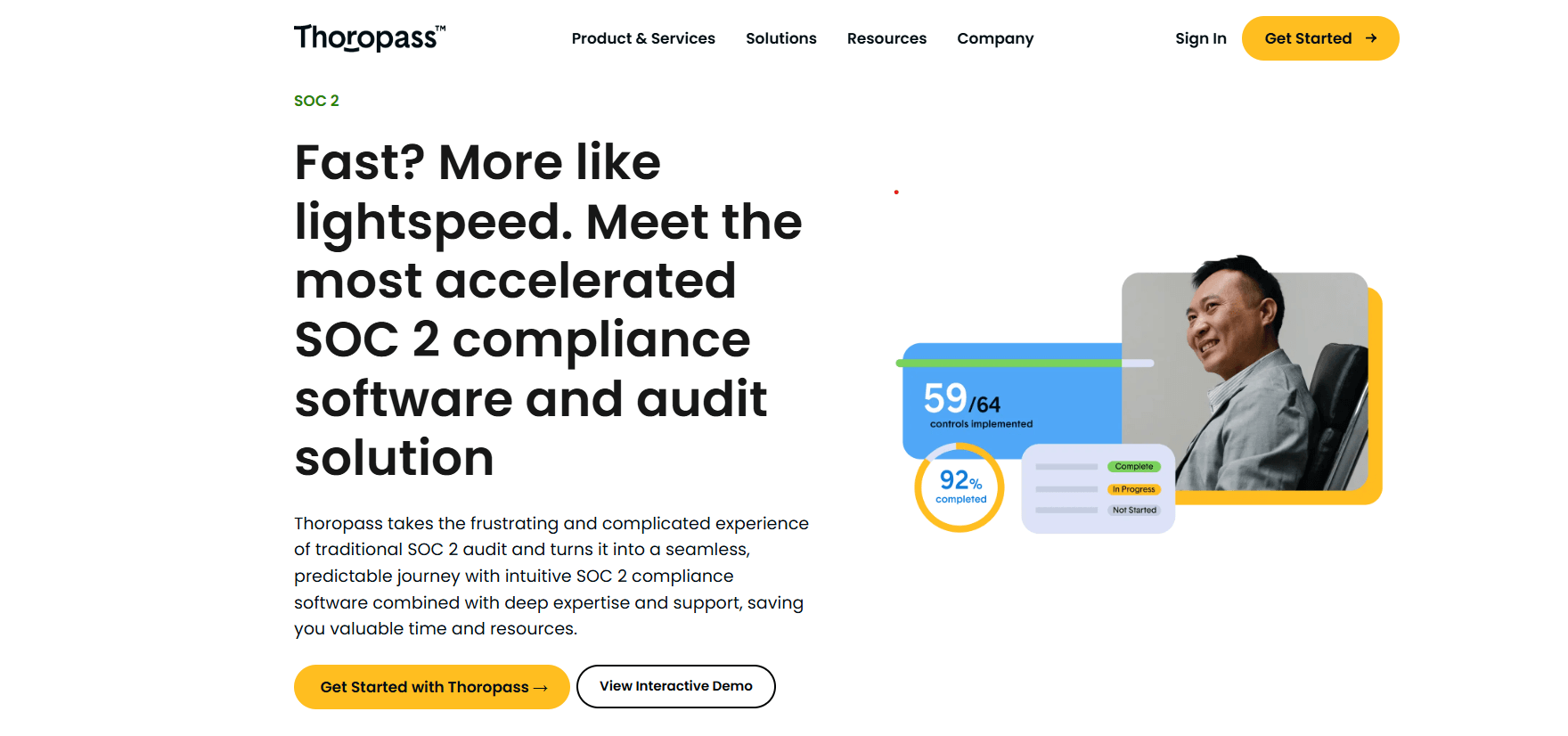
Thoropass, formerly known as Laika, takes a fundamentally different approach by bundling the compliance software and the CPA audit firm into a single vendor relationship. For a CRM company that wants to eliminate the friction of managing separate platform and audit contracts, this closed-loop model means the same auditor sees evidence the moment it lands in the system, flags gaps immediately, and often turns findings around faster than a firm working from a shared folder. Thoropass’s First Pass AI accelerates evidence gathering, and the vendor reports cutting audit cycles from roughly 73 days down to 29. The trade-off, however, is that buyers commit to Thoropass’s in-house auditors and cannot freely switch to an outside firm without leaving the platform entirely.
Features
- Combines the compliance platform with an in-house, PCAOB-registered CPA firm under one contract.
- Lets auditors flag gaps inside the platform in real time as evidence uploads.
- Supports SOC 2, ISO 27001, HIPAA, PCI DSS, HITRUST, and GDPR from one control library.
- Centralizes tasks, risk registers, and people management for compliance owners.
- Maps one piece of evidence across multiple frameworks to reduce duplicate work.
Pros
- Removes the separate audit-procurement process, since the software fee includes the SOC 2 attestation.
- Speeds up fieldwork because the auditor works inside the same system as the compliance team.
- Reportedly saves 25–50% compared with hiring a traditional standalone audit firm.
Cons
- Locks buyers into Thoropass’s own auditors, making it difficult to switch firms later.
- Costs more than software-only competitors when compared against boutique audit firms paired with a cheaper platform.
Pricing: Thoropass typically starts around $8,700 per year
6. Strike Graph
Strike Graph stands out in a crowded field for one simple reason: it publishes its pricing openly, which removes the guesswork that frustrates many CRM buyers evaluating compliance software. The platform takes a right-sized approach to compliance, aiming to get SMB and growth-stage CRM companies to SOC 2 readiness in as little as eight weeks. Because CRM vendors often need budget clarity before they can get sign-off from finance, Strike Graph’s transparent tiers let compliance leads build a business case without waiting on a sales call. The platform focuses on the essentials of evidence collection and control mapping rather than trying to be a full enterprise GRC suite, which keeps it approachable for lean teams.
Features
- Publishes transparent plans online, unlike most competitors in the category.
- Fast readiness timeline: targets SOC 2 readiness in as little as eight weeks for straightforward environments.
- Connects to common cloud and identity tools to reduce manual uploads.
- Connects customers with independent CPA firms rather than bundling a single in-house auditor.
- Provides pre-built, editable policies mapped to the Trust Services Criteria.
Pros
- Offers rare pricing transparency, which simplifies budgeting conversations for CRM finance teams.
- Keeps the platform focused and easy to learn compared with sprawling enterprise GRC suites.
- Preserves auditor choice instead of locking customers into one in-house firm.
Cons
- Feature depth for multi-framework, enterprise-scale programs is more limited.
- Fast timelines assume a relatively clean, cloud-native environment to begin with.
Pricing: Strike Graph publishes tiered pricing on its website, generally starting in the low five figures per year and scaling with company size and framework count; buyers can review exact numbers without a sales call, which is uncommon in this category.
7. Scytale
Scytale pairs AI-driven automation with a dedicated compliance expert, described internally as an AI GRC agent named Scy, to guide CRM companies through SOC 2 from readiness to continuous maintenance. This hybrid model suits founders and CTOs who would rather focus on product development than compliance documentation, since Scytale’s consultants manage complex policy customization and handle auditor queries directly. The platform automates a large share of evidence collection while keeping a human expert in the loop for judgment calls, such as deciding whether a failed control needs remediation or a compensating control instead. For CRM companies based in Europe or working with EU customers, Scytale’s advisory-heavy model and GDPR expertise make it a natural fit.
Features
- Automates up to 90% of evidence collection according to the vendor.
- Connects to core cloud, identity, and code tools common in CRM environments.
- Supports SOC 2, ISO 27001, GDPR, and HIPAA from a shared control library.
- Offers optional penetration testing coordination and security questionnaire automation.
- The vendor markets a 100% audit pass rate across its customer base.
Pros
- Combines software with genuine advisory support, which benefits teams without a dedicated compliance hire.
- Bundles services that would otherwise require an expensive outside consultant.
Cons
- Add-on services such as penetration testing or a dedicated compliance expert add up quickly.
- Not built for pure enterprise GRC needs like large-scale risk registers or board-level reporting.
Pricing: Scytale generally starts around $7,500 to $8,000 per year for a first SOC 2 engagement, with advisory add-ons priced separately.
8. Hyperproof
Hyperproof functions less like a lightweight SOC 2 starter kit and more like a full compliance operations platform, which makes it the right choice once a CRM company is managing several frameworks and audit cycles at once. The platform excels at project management: assigning tasks, tracking evidence, and maintaining a centralized risk register that multiple teams can contribute to. Because CRM vendors selling into enterprise and regulated markets often juggle SOC 2, ISO 27001, and vendor risk assessments simultaneously, Hyperproof’s workflow depth and cross-functional visibility become genuinely valuable at scale. That said, the platform trades some automation for flexibility, so smaller CRM teams may find themselves uploading more evidence manually than they would on a more automation-first competitor.
Features
- Tracks organizational risk alongside control implementation in one place.
- Lets multiple teams contribute evidence to a shared control library.
- Gives compliance leaders and executives visibility into audit readiness across cycles.
- Lets larger CRM organizations add users without a per-seat penalty.
- Pull evidence from common cloud and identity providers, though with more manual configuration than pure-automation rivals.
Pros
- Provides strong project-management tooling and a robust risk register for complex programs.
- Scales well for CRM companies running multiple frameworks and audit cycles concurrently.
- Offers program-level visibility that satisfies board- and executive-level reporting needs.
- Supports unlimited users, which benefits larger compliance and security teams.
Cons
- Automation depth lags behind competitors, so teams may still upload evidence manually.
- Overbuilt, and often overpriced, for a CRM startup pursuing its first, single-framework SOC 2 report.
Pricing: Hyperproof uses custom pricing that commonly runs $25,000 to $100,000 or more per year
OneTrust Certification Automation, the product formerly known as Tugboat Logic, extends SOC 2 readiness into the much broader OneTrust ecosystem of privacy, IT risk, and ethics tooling. This makes it the right choice for a CRM company that already relies on OneTrust for privacy management, consent tracking, or data-mapping and wants SOC 2 evidence collection to live inside the same platform rather than a separate tool. Because CRM platforms handle large volumes of personal data, pairing SOC 2 with OneTrust’s privacy modules can simplify GDPR and CCPA compliance at the same time. The trade-off is that OneTrust is not designed as an entry point for a first-time SOC 2 audit; it shines only once a CRM company already has, or plans to build, a broader enterprise privacy and risk program.
Features
- Combines SOC 2 evidence collection with consent management, data mapping, and privacy impact assessments.
- Connects compliance evidence to the wider OneTrust risk and ethics suite.
- Automates recurring privacy and security assessments across business units.
- Gives executives a single view across privacy, security, and compliance programs.
Pros
- Fits naturally into a CRM company’s stack if OneTrust already handles privacy or consent management.
- Provides enterprise-grade reporting suited to large, multi-team compliance programs.
- Backs a broad ecosystem that reduces the number of separate vendors a company must manage.
Cons
- Overbuilt and expensive for a CRM startup that only needs a first SOC 2 report.
- Pricing sits well above most SOC-2-focused competitors, which can strain smaller budgets.
Pricing: OneTrust Certification Automation typically costs between $20,000 and $40,000 or more per year
10. AuditBoard
AuditBoard serves as the legacy heavyweight in this category, built originally for large enterprises with dedicated internal audit departments rather than for fast-moving SaaS startups. A CRM company that has grown into a large, multi-team organization with an established internal audit function may find AuditBoard’s robustness genuinely useful, since it connects compliance, internal audit, and enterprise risk management in one platform. However, for a smaller or mid-market CRM vendor trying to move quickly toward a first SOC 2 report, AuditBoard often feels like using a sledgehammer to crack a nut: it lacks the lightweight, automation-first workflows that newer entrants offer, and its implementation timelines run longer as a result.
Features
- Connects internal audit, SOC 2 compliance, and enterprise risk management workflows.
- Gives risk, audit, and compliance teams a shared view of controls and findings.
- Supports complex approval chains and control ownership structures.
- Extends beyond SOC 2 into broader financial and operational controls testing.
- Surfaces compliance and risk posture for executive and board reporting.
Pros
- Provides enterprise-grade reporting that satisfies large, sophisticated audit committees.
- Suits CRM companies that already run a mature internal audit function.
- Handles complex, multi-team control ownership better than lighter SOC 2 tools.
Cons
- Costs significantly more than SOC-2-focused competitors built for startups.
- Its interface feels outdated compared with modern, purpose-built compliance tools.
Pricing: AuditBoard does not publish pricing.
11. ComplyJet
ComplyJet takes ownership of the entire compliance program rather than simply handing a CRM company a dashboard, which appeals strongly to first-time SOC 2 candidates who want an outcome, not just software. The vendor manages policies, controls, and evidence collection end-to-end and works alongside customers through both SOC 2 and ISO 27001 audits, effectively acting as an outsourced compliance team. For a CRM startup without a dedicated security hire, this done-for-you approach can shorten the path to a signed SOC 2 report considerably, since ComplyJet’s team drives the process rather than waiting for internal staff to find spare time. The trade-off is that a company hands over more day-to-day control of its compliance program than it would with a self-serve platform.
Features
- Manages policies, controls, and evidence collection on the customer’s behalf.
- Publishes clear cost structures rather than requiring a sales call for every quote.
- Connects to common cloud, identity, and HR tools to automate evidence pulls.
- Matches customers with vetted CPA firms as part of the service.
- Focuses on delivering the certification itself, not just platform access.
Pros
- Removes the burden of running the compliance program internally, which suits lean CRM teams.
- Speeds up first-time SOC 2 timelines by having the vendor drive the process actively.
- Bundles auditor matching, removing a separate procurement step.
Cons
- Hands more control of the compliance process to an outside vendor than a self-serve platform would.
- May not scale as well for large enterprises running many concurrent frameworks and audit cycles.
Pricing: ComplyJet publishes transparent pricing on its website

Vanta has grown into the category-defining trust management platform since its founding in 2018, and CRM software companies gravitate toward it first because of its scale and maturity. More than 14,000 organizations rely on Vanta to manage SOC 2 alongside other frameworks, and the platform connects to over 400 tools including AWS, Azure, Okta, and GitHub to pull compliance evidence automatically. Because CRM vendors sit at the center of customer data flows, Vanta’s read-only integrations and continuous monitoring give prospects immediate confidence that customer records stay protected around the clock. The platform also maps SOC 2 controls to ISO 27001, GDPR, and HIPAA, so a CRM provider that later needs to sell into healthcare or the EU does not have to rebuild its compliance program from scratch.
Features
- Connects to 400+ cloud, identity, HR, and code tools and runs more than 1,200 automated tests every hour.
- Flags misconfigurations and control failures in real time instead of waiting for the annual audit window.
- Reuses SOC 2 evidence across ISO 27001, GDPR, HIPAA, and PCI DSS.
- Connects companies with vetted auditors who review evidence directly inside the platform..
- Publishes a live security posture page that sales teams can share with prospective CRM buyers.
Pros
- Provides a large, auditor-familiar install base, so most CPA firms already know how to work inside Vanta.
- Cuts manual screenshot work substantially through hourly automated testing.
- Extends smoothly into adjacent frameworks as a CRM company grows into new markets.
Cons
- Costs climb quickly for larger companies, sometimes reaching $50,000–$80,000 a year.
- New users face a learning curve when mapping unique internal workflows to Vanta’s control library.
Pricing: Vanta’s pricing starts around $10,000–$12,000 per year for smaller companies