

Selecting the right SOC 2 Providers for Biotech Startups requires more than choosing a GRC platform from a shortlist. Biotech and life sciences companies operate within a complex regulatory landscape that includes HIPAA, FDA 21 CFR Part 11, GDPR for international clinical trials, and emerging AI governance requirements for algorithm-driven diagnostics. The right SOC 2 provider must understand not only the SOC 2 Trust Services Criteria but also the unique security, privacy, and compliance challenges associated with highly sensitive biological and clinical data.
If you’re building a biotech startup, you already understand what’s at stake. Your organization may handle genomic data, clinical trial records, patient information, or proprietary research with the potential to impact millions of lives. As soon as you begin engaging pharmaceutical companies, healthcare providers, research institutions, or enterprise customers, they will evaluate more than your scientific innovation. They will want proof that you can protect the data they entrust to you. One of the first questions they’ll ask is: Are you SOC 2 compliant?
Why SOC 2 Providers for Biotech Startups Are a Non-Negotiable Investment
For biotech startups, SOC 2 is not optional. Here’s why:
- Enterprise pharma and hospital procurement teams require SOC 2 Type II as a baseline vendor qualification.
- Institutional investors and VCs at Series A and beyond expect formal evidence of information security controls.
- SOC 2 overlaps significantly with HIPAA technical safeguards, making it a two-for-one compliance investment for startups handling protected health information (PHI).
- FDA’s 21 CFR Part 11 requirements for electronic records and signatures align with SOC 2’s processing integrity and confidentiality criteria, giving biotech companies dual-use controls.
- International clinical trials increasingly require GDPR compliance, which many SOC 2 platforms can help map simultaneously.
Top 12 Best SOC 2 Providers for Biotech Startups
1. Vanta
Vanta is the most widely adopted SOC 2 provider for biotech startups, offering 400+ integrations, AI-driven evidence collection, and a massive auditor network, making it the fastest route from zero to a credible Type II report.

Features
- 400+ native integrations (AWS, Azure, GCP, Okta, GitHub, Jira, and more)
- Continuous control monitoring with real-time alerts
- SOC 2, ISO 27001, HIPAA, GDPR, PCI DSS, FedRAMP, and 20+ more frameworks
- Automated vendor risk management and security questionnaire responses
- Trust Center for sharing compliance status with partners
- Multi-framework cross-mapping to avoid duplicate control work
- 14,000+ customers as of 2026 — largest compliance platform by customer count
Pros
- Widest integration library in the market, critical for biotech stacks using AWS + Okta + GitHub
- Auditors are highly familiar with Vanta evidence exports, shortening audit timelines
- Startup discounts available via accelerator programs
Cons
- Base-tier support is largely self-serve; response times lag at lower plan levels
- Pricing increases significantly at renewal
Pricing: Starts at $10,000/year for companies under 25 employees. Scales to $25,000–$80,000+ for larger teams or multi-framework programs. Partner network auditor rates as low as $2,500 for Type I (startups).
Verdict: Vanta is the most feature-complete, integration-rich SOC 2 platform available for startups in 2026. For biotech companies running standard cloud infrastructure, it delivers the fastest path to an audited Type II report.
Best For: Seed-to-Series B biotech startups with AWS/GCP-heavy infrastructure pursuing their first enterprise pharma deal.
2. Drata
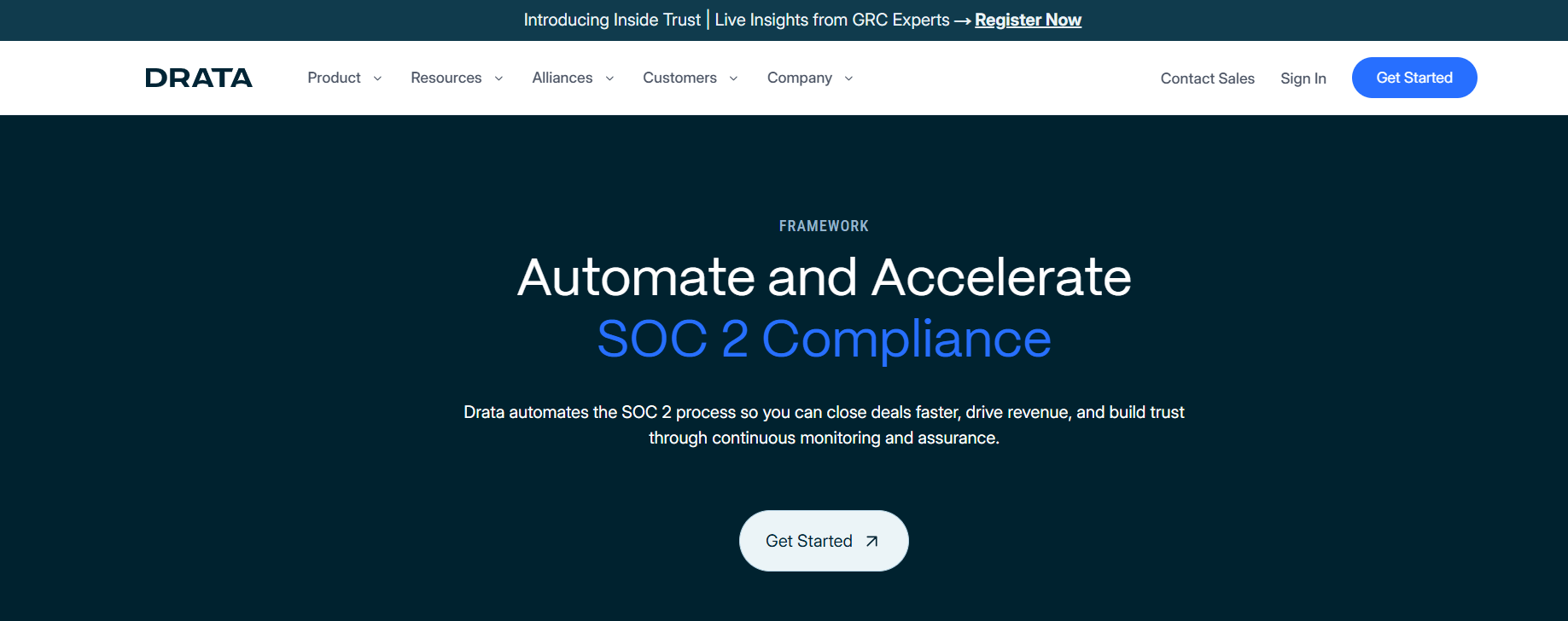
Drata is the preferred SOC 2 provider for biotech startups with engineering-led teams who want deeper automation, more granular control customization, and a compliance program built to scale into enterprise complexity. It supports SOC 2, HIPAA, ISO 27001, GDPR, PCI DSS, CMMC, and FedRAMP, with robust cross-framework control mapping that allows teams to pursue SOC 2 and HIPAA simultaneously without duplicating work. The platform offers 300+ integrations and a highly customizable control library, meaning that even if your biotech stack includes non-standard tools or proprietary infrastructure, you can model controls accurately rather than forcing your environment into a generic template.
Features
- 300+ integrations including AWS, Azure, GCP, GitHub, Okta, BambooHR, and Jira
- Granular control mapping and custom control creation
- SOC 2, ISO 27001, HIPAA, GDPR, PCI DSS, CMMC, FedRAMP supported
- Dedicated compliance experts included in higher-tier plans
- Automated evidence collection with continuous monitoring
- Auditor collaboration portal for streamlined audit cycles
Pros
- Deeper automation and more granular control customization than most competitors
- Particularly strong for multi-framework programs (SOC 2 + HIPAA simultaneously)
- Scalable foundation: works as well at 20 employees as at 500
Cons
- Steeper learning curve; less intuitive for non-technical founders
- Pricing rises at renewal.
Pricing: Foundation tier starts at $7,500–$15,000/year; onboarding adds $10,000–$25,000. Growth teams: $20,000–$50,000+/year.
Verdict: Drata is the strongest choice for biotech startups with engineering-heavy teams who want deep automation and are planning to scale across multiple compliance frameworks.
Best For: Series A biotech and clinical-stage companies with dedicated DevOps/engineering teams pursuing SOC 2 + HIPAA together.
3. Thoropass
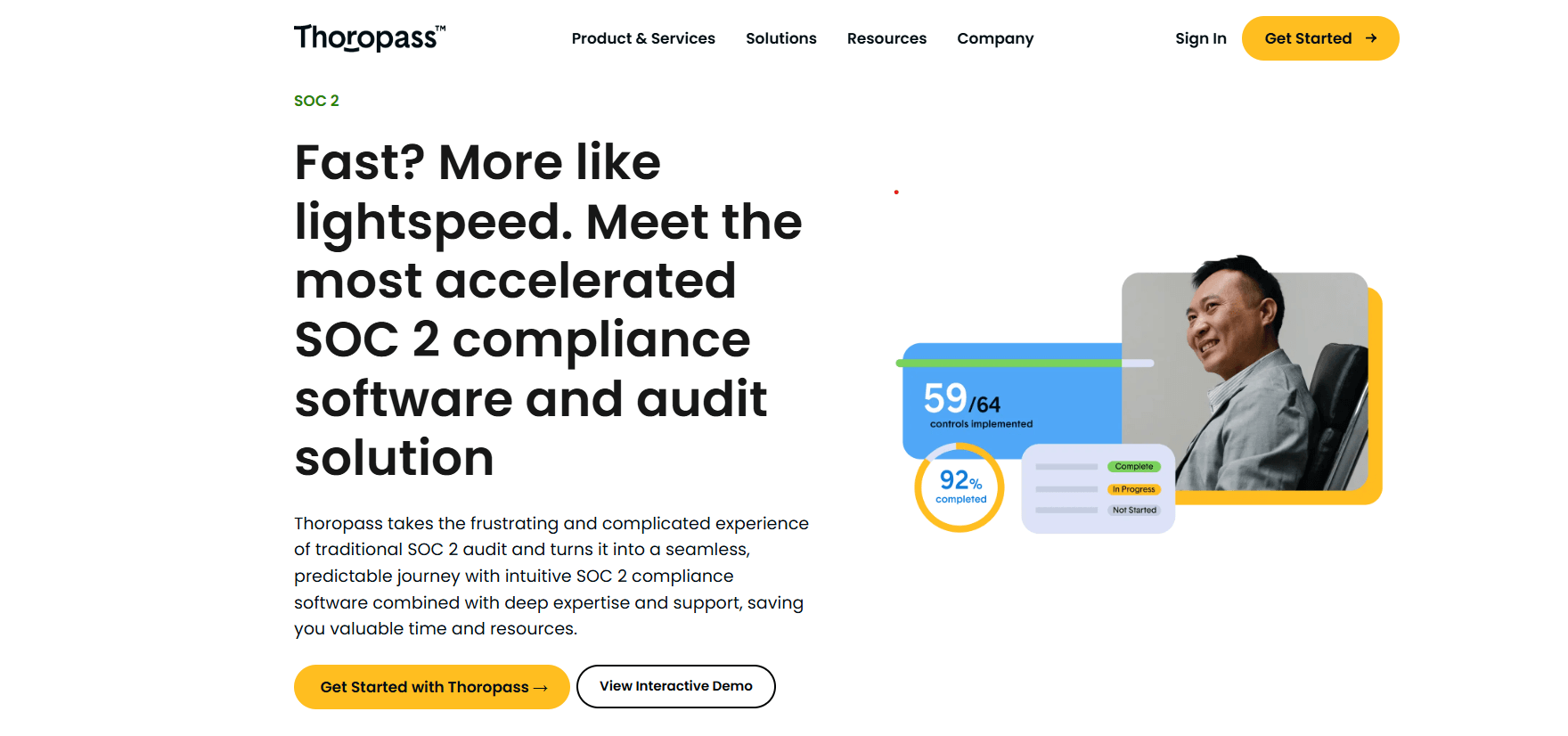
Thoropass is a uniquely positioned SOC 2 provider for biotech startups because it solves one of the most frustrating parts of the compliance process: managing the relationship between your compliance platform and your audit firm. Most startups using tools like Vanta or Drata still have to find, evaluate, and coordinate with a separate AICPA-accredited CPA firm to actually issue the SOC 2 report. Thoropass eliminates that friction entirely by bundling its compliance automation platform with an in-house AICPA peer-reviewed audit firm under a single contract.
Features
- Unique model: compliance platform + AICPA peer-reviewed audit firm in one
- 19 supported frameworks including SOC 2, HIPAA, HITRUST, ISO 27001
- Automated evidence collection + auditor coordination in one workflow
- 75+ integrations with major cloud and SaaS providers
Pros
- Bundled audit + platform eliminates the need to find and coordinate a separate CPA firm
- Average audit cycle is significantly faster than market average
- HITRUST support differentiates Thoropass from most automation-only platforms
- Particularly strong for healthcare-adjacent biotech needing hospital procurement compliance
Cons
- Fewer integrations than Vanta or Drata; custom stacks may require workarounds
- Advisory depth is lower than a dedicated vCISO firm for highly complex environments
Pricing: Starts at $8,700/year for the entry tier (platform only); bundled platform + audit packages typically $20,000–$50,000+ depending on scope.
Verdict: Thoropass is the ideal one-stop solution for biotech founders who want a single vendor to handle the entire compliance and audit lifecycle without managing two separate relationships.
Best For: Pre-revenue to Series A biotech startups preparing for first HIPAA or HITRUST-required hospital or health system partnership.
4. Secureframe
Secureframe has built a strong reputation as a SOC 2 provider for biotech startups that prioritizes the human experience of compliance, not just the automation layer. While it offers solid technical capabilities including 300+ integrations, automated background check integration for new employees, and its Secureframe AI tool for policy generation and gap analysis, what sets it apart is the quality and structure of its onboarding and advisory support. Unlike platforms that leave you to configure everything independently, Secureframe builds compliance expertise into the product experience: pre-built policy templates are reviewed by compliance professionals, controls are mapped with guidance notes that explain what auditors actually look for, and the onboarding process is structured as a guided journey rather than a self-serve setup.
Features
- 300+ integrations covering cloud, HRIS, endpoint, and identity tools
- 150+ pre-built policy templates with compliance expert review
- Automated background check integration for new employees
- Multi-framework: SOC 2, ISO 27001, HIPAA, GDPR, PCI DSS, FedRAMP, CMMC, and AI governance
- User access reviews and vendor risk management built-in
Pros
- Strong multi-framework coverage makes it ideal for biotech companies needing SOC 2 + HIPAA + GDPR
- Advisory component bundled in higher tiers reduces external consulting spend
- Solid regulatory track record in healthcare technology and fintech.
Cons
- Integration library smaller than Vanta’s
- Custom control workflows and complex infrastructure may require additional support hours
Pricing: Starting at $7,500–$10,000/year (Fundamentals tier). Complete plans: $12,000–$20,000/year for companies under 100 employees. Framework add-ons: ~$7,500 each.
Verdict: Secureframe is the strongest fit for biotech founders who are new to compliance and want a high-touch, advisory-heavy onboarding experience alongside solid automation.
Best For: Seed-to-Series A biotech startups with non-technical founders or without in-house compliance staff.
5. Sprinto
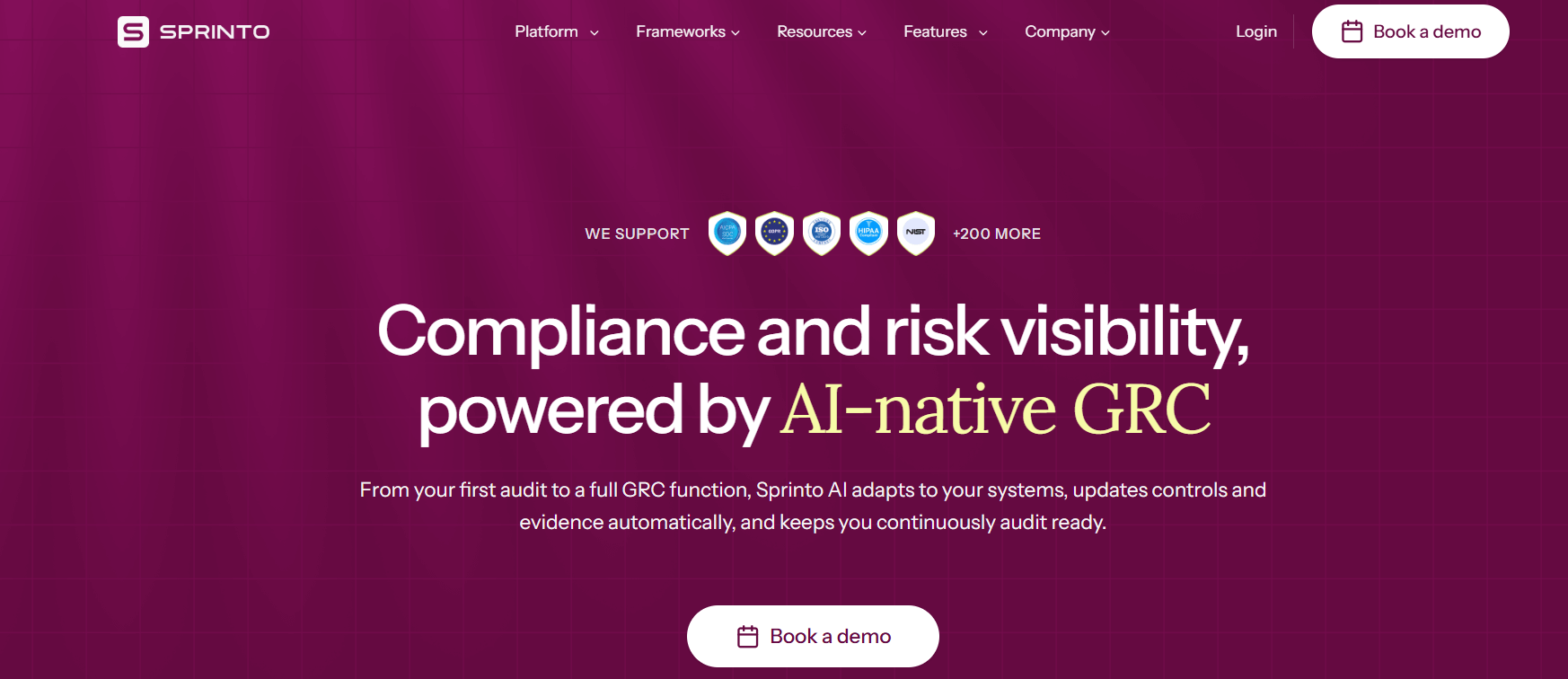
Sprinto is the most budget-accessible SOC 2 provider for biotech startups at the earliest stages of their compliance journey, offering an AI-native compliance automation platform that was designed specifically for fast-moving startups rather than retrofitted from an enterprise GRC tool. The platform offers 200+ integrations covering major cloud providers, identity platforms, HR systems, and developer tools, with pre-approved compliance programs that can be activated immediately upon setup rather than requiring weeks of custom configuration. For biotech startups, the automated employee onboarding compliance checks are particularly useful, ensuring that new hires, contractors, and lab staff complete required security training and policy acknowledgments without manual follow-up.
Features
- 200+ integrations with cloud, HR, identity, and developer tools
- AI-native GRC platform with automated control mapping
- Pre-approved compliance programs for fast activation
- SOC 2, ISO 27001, HIPAA, GDPR, PCI DSS, SOC 1 supported
- Automated employee onboarding compliance checks
- Continuous monitoring with configurable alerts
- Dedicated compliance success manager
Pros
- Lower price point than Vanta or Drata — ideal for pre-revenue and seed-stage startups
- AI-native design speeds up initial program setup significantly
- Strong customer support scores, especially for companies new to SOC 2
Cons
- Integration breadth is narrower than Vanta or Drata.
- Advanced customization for unusual biotech infrastructure may be limited
Pricing: Custom pricing; typically $8,000–$20,000/year depending on company size and frameworks. Often competitive below $10K for single-framework programs under 50 employees.
Verdict: Sprinto is the best value proposition for bootstrapped or seed-stage biotech startups that need to get to SOC 2 Type I quickly without overextending their budget.
Best For: Pre-seed to seed-stage biotech startups with a lean team pursuing their first SOC 2 Type I to unlock initial pharma or investor conversations.
6. Scrut Automation
Scrut Automation is a unified GRC platform and a standout SOC 2 provider for biotech startups that need more than compliance automation, specifically, companies managing complex third-party relationships with CROs, genomics data providers, lab information management vendors, and cloud storage partners. Where most SOC 2 platforms focus primarily on evidence collection and control monitoring, Scrut builds vendor risk management, employee compliance monitoring, and end-to-end risk tracking into the core product rather than offering them as expensive add-ons.
Features
- Unified GRC platform: compliance, risk, and vendor management in one window
- 100+ pre-built policies with customization options
- SOC 2, ISO 27001, HIPAA, GDPR, CCPA, PCI DSS supported
- Real-time automated control monitoring with configurable alerts
- Risk management with end-to-end tracking from detection to resolution
- Employee compliance monitoring and security awareness training
Pros
- Best-in-class real-time visibility dashboard for compliance and risk posture
- 80%+ automation reduces manual evidence work significantly for small teams
- Strong global compliance expert support
- Highly rated for ease of use and customer service.
Cons
- Initial setup can feel complex due to the breadth of features
- Integration count lower than Vanta; verify biotech-specific tool coverage
Pricing: Custom pricing based on company size and frameworks. Competitive with Sprinto for smaller teams; typically $8,000–$20,000/year range.
Verdict: Scrut is an excellent choice for biotech startups that want a comprehensive GRC view — not just SOC 2 but also vendor risk, employee compliance, and real-time risk tracking — in a single platform.
Best For: Biotech startups managing complex vendor relationships (CROs, lab partners, data providers) who need SOC 2 + risk management in one dashboard.
7. Comp AI
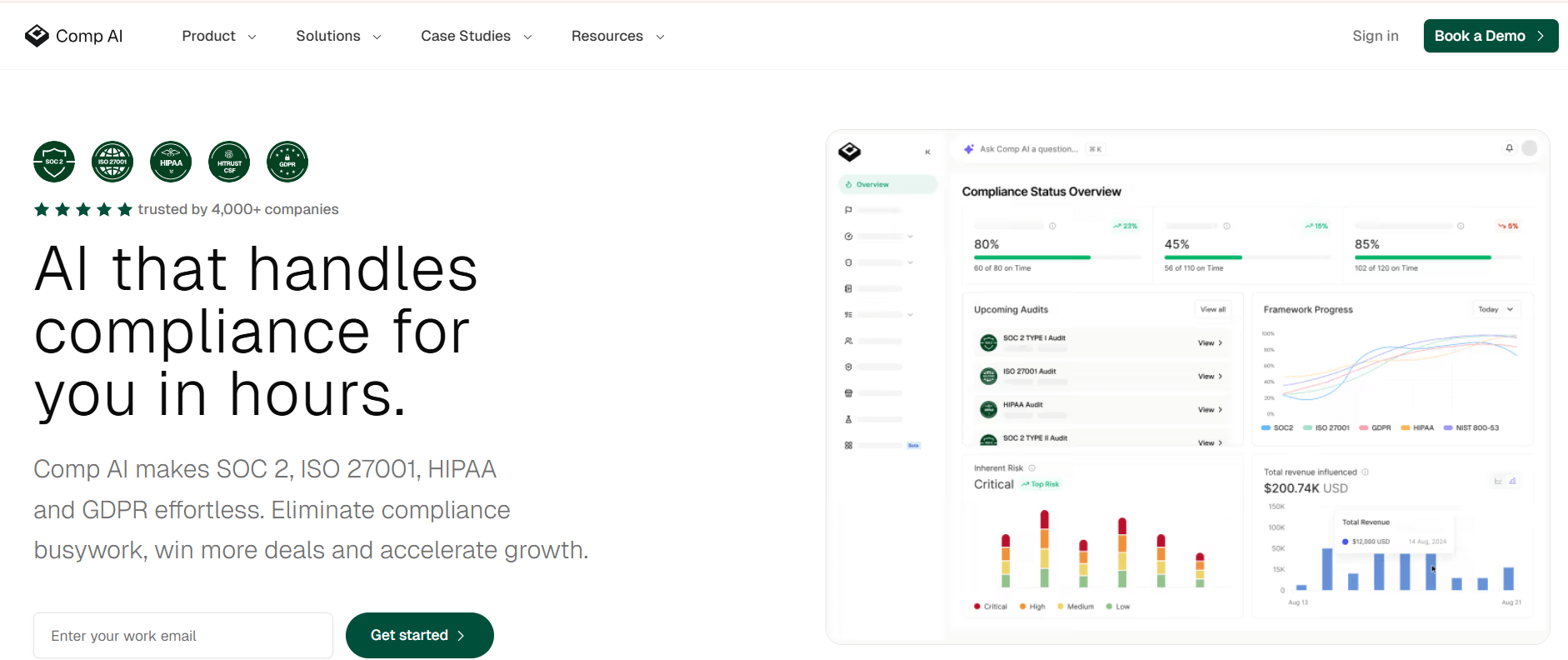
Comp AI is an AI-native SOC 2 provider for biotech startups that puts intelligence at the center of the compliance workflow rather than treating AI as a bolt-on feature. With 580+ integrations rivaling or exceeding Vanta’s library and an open-source endpoint agent that monitors encryption, firewall settings, and device security configurations across your entire team 24/7, Comp AI offers a level of technical depth and transparency that most compliance platforms don’t come close to. The platform’s AI engine learns your specific infrastructure, processes, and risk tolerance to generate policies and control documentation that reflect how your biotech company actually operates not generic templates that auditors can see through immediately.
Features
- 580+ integrations — one of the widest in the market
- AI learns your stack, processes, and risk tolerance to generate custom policies
- Open-source endpoint agent for 24/7 device security monitoring
- SOC 2, ISO 27001, HIPAA, GDPR, FedRAMP, and more
- Automated penetration testing via built-in agent probing of APIs and infrastructure
- AI-powered evidence collection, policy generation, and gap analysis
Pros
- 580+ integrations rival or exceed Vanta’s breadth
- AI policy generation tailored to your actual infrastructure — not generic templates
- Open-source agent approach gives biotech teams transparency and customizability
- Significantly faster implementation than most competitors
Cons
- Newer platform with less established track record vs. Vanta or Drata
- Smaller auditor partner network
- Best suited for engineering-led teams; less ideal for non-technical founders
Pricing: Competitive with Sprinto and Scrut; custom pricing. Frequently quoted as offering faster ROI for early-stage teams compared to larger platforms.
Verdict: Comp AI is an exciting option for biotech startups with strong engineering culture who want maximum AI leverage throughout the compliance process, from policy generation to continuous monitoring.
Best For: Seed-to-Series A biotech startups with technical co-founders who want to move fast and leverage AI throughout the entire compliance lifecycle.
8. Hyperproof
Hyperproof is the enterprise-grade SOC 2 provider for biotech startups that have grown beyond early-stage and are now managing a complex, multi-framework compliance program across multiple regulatory domains simultaneously. While most SOC 2 automation platforms are optimized for getting a single framework done quickly, Hyperproof is built for the harder problem: managing SOC 2, HIPAA, GDPR, NIST CSF, and FDA 21 CFR Part 11 in a unified system without rebuilding your control library from scratch each time you add a new framework.
Features
- Broad GRC platform: SOC 2 + risk management + internal audit in one system
- Multi-framework mapping across SOC 2, ISO 27001, HIPAA, GDPR, NIST, FedRAMP
- Custom control frameworks for biotech-specific regulatory overlaps (FDA 21 CFR Part 11)
- Automated evidence collection and control testing workflows
- Advanced risk register with scoring and treatment planning
- Cross-framework control reuse to reduce duplicative compliance work
- Enterprise-grade audit management with stakeholder collaboration tools
Pros
- Best-in-class for companies managing 3+ compliance frameworks simultaneously
- Custom framework support means biotech-specific controls (like 21 CFR Part 11) can be modeled
- Risk management depth goes well beyond what SOC 2-only platforms offer
- Strong enterprise features for growing teams building out formal security programs
Cons
- Higher price point, overkill for pre-revenue or early-stage startups
- Setup and configuration more complex; requires dedicated compliance ownership
Pricing: Enterprise pricing typically $30,000–$75,000+/year. Best evaluated at Series B+ stage with multiple active compliance frameworks.
Verdict: Hyperproof is the right choice for clinical-stage or Series B+ biotech companies building out a formal, multi-framework compliance program that extends beyond SOC 2 into enterprise risk management.
Best For: Series B+ biotech startups with a dedicated compliance or security team pursuing SOC 2 + HIPAA + FDA 21 CFR Part 11 + GDPR simultaneously.
9. Strike Graph
Strike Graph is a pragmatic and founder-friendly SOC 2 provider for biotech startups that want to build a defensible compliance program without over-engineering it for their current stage. The core philosophy of Strike Graph is risk-based compliance: rather than pushing every company through the same exhaustive control library, the platform helps teams identify their actual risk profile and build controls that map to it reducing audit scope, avoiding unnecessary implementation work, and producing a SOC 2 report that reflects what the company genuinely does rather than what a generic template says it should do. This approach is particularly valuable for biotech startups in the earliest stages, where engineering bandwidth is precious and the risk of burning months on compliance theater is real.
Features
- Risk-based compliance approach tailored to company stage and actual risk profile
- SOC 2, ISO 27001, HIPAA, GDPR, and PCI DSS supported
- Built-in risk scoring and gap prioritization
- Simplified evidence collection with guidance on what actually matters to auditors
- Audit firm coordination built into the platform workflow
- Designed specifically for startups and growth-stage companies
Pros
- Pragmatic, right-sized approach prevents over-engineering compliance for early-stage startups
- Risk-based prioritization helps lean biotech teams focus on what matters most
- Strong founder-friendly UX — accessible without compliance background
- Competitive pricing relative to Vanta and Drata
Cons
- Integration library smaller than top-tier platforms
- Less suited for complex enterprise environments
- Limited presence in the largest auditor networks
Pricing: $15,000–$25,000/year for mid-sized companies. Startup programs available at lower entry points.
Verdict: Strike Graph is an excellent alternative for biotech founders who want a pragmatic, risk-right approach to SOC 2, building controls that are defensible without over-investing in a program beyond their current stage.
Best For: Lean biotech startups that have been warned away from over-engineering compliance and want a provider that helps them build what auditors actually care about.
10. Scytale
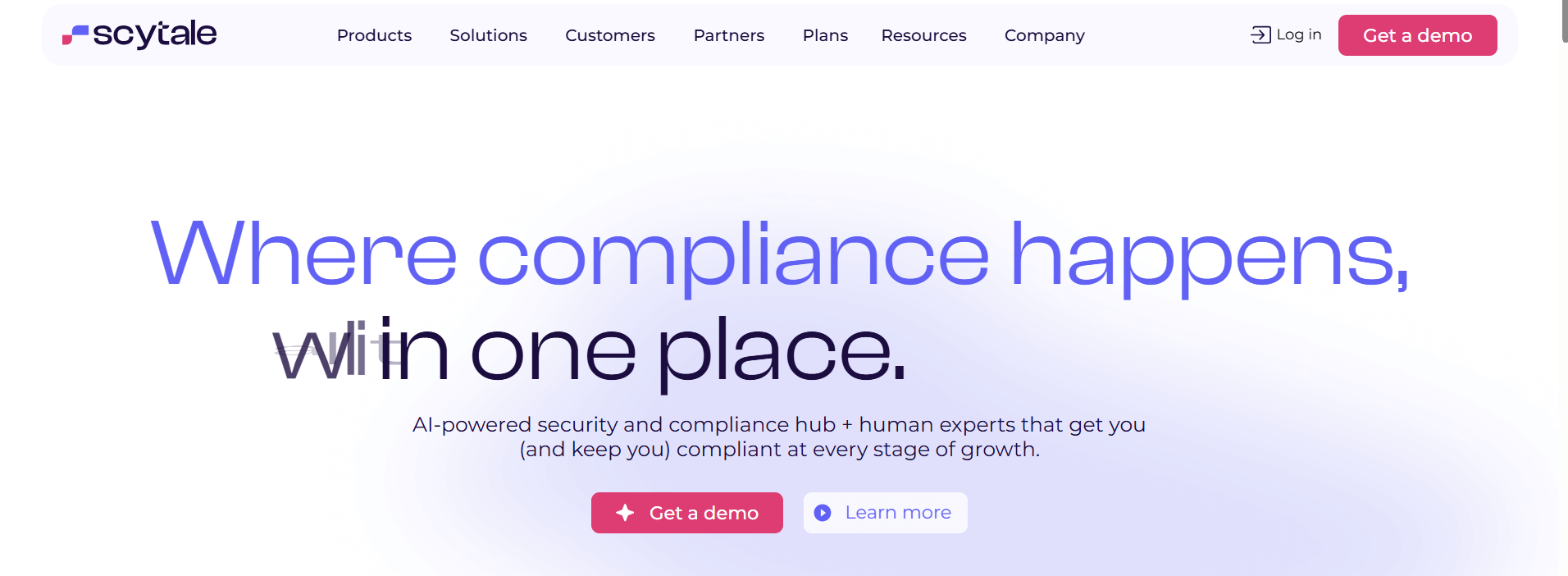
Scytale is a compliance automation platform and SOC 2 provider for biotech startups that differentiates itself through an unusually strong human-advisory layer baked into every plan tier, not reserved for enterprise clients or offered as a premium add-on. From the first day of onboarding, every Scytale customer is assigned a dedicated compliance success manager who provides guidance on control design, evidence requirements, auditor expectations, and remediation prioritization. This matters significantly for biotech startups where the founding team has deep domain expertise in science or engineering but limited exposure to AICPA trust service criteria, auditor workflows, or what actually causes a SOC 2 audit to succeed or fail.
Features
- Hands-on compliance advisory baked into every tier, not just automation
- SOC 2, ISO 27001, HIPAA, GDPR, PCI DSS, CMMC supported
- Dedicated compliance success manager from day one
- Automated evidence collection with AWS, GitHub, Okta, and Google Workspace
- Pre-built controls library mapped to SOC 2 Trust Service Criteria
- Vendor risk management and security questionnaire automation
- Framework add-on pricing among the most competitive: ~$2,100 per additional framework
Pros
- Human-expert advisory is built in from onboarding — not an expensive add-on
- Most affordable framework add-on pricing in the market ($2,100 vs $7,500 competitors)
- Implementation timelines are shortened by expert guidance
- Strong for teams that want a compliance partner, not just compliance software
Cons
- Smaller integration library than Vanta or Drata
- Less automation depth for advanced engineering teams
- Smaller brand recognition with US enterprise auditors
Pricing: Custom pricing; typically competitive with Sprinto and Scrut for small to mid-sized teams. Framework add-ons at ~$2,100 make multi-framework programs significantly more affordable.
Verdict: Scytale delivers an unusually strong human-guidance layer at a competitive price point. For biotech founders who want expert handholding without paying for an external consultant on top of a platform, this is a compelling option.
Best For: Biotech startups without in-house compliance expertise that want an expert-led, advisory-heavy experience at an accessible price point.
11. Oneleet
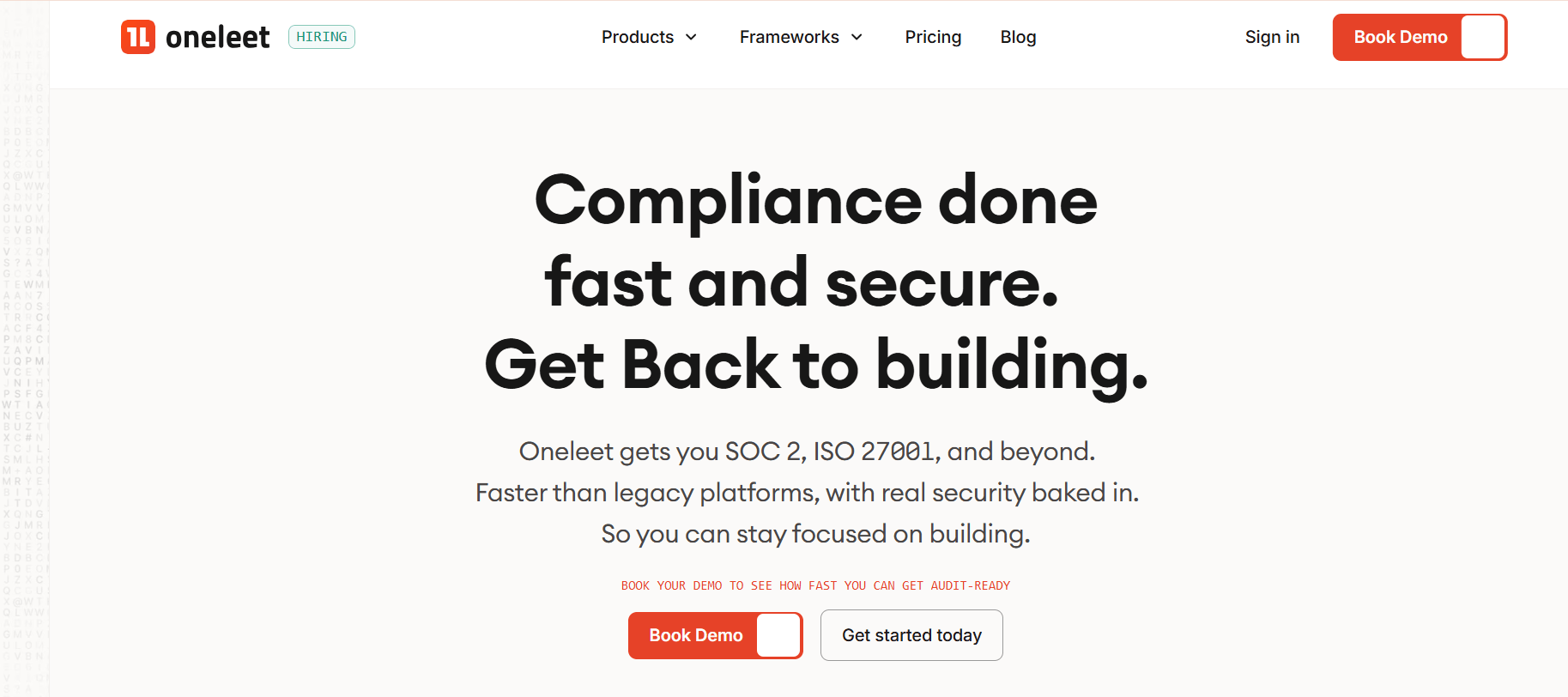
Oneleet takes a fundamentally different approach to compliance than most platforms on this list, and that philosophy makes it one of the most important SOC 2 providers for biotech startups handling highly sensitive data. While the majority of compliance automation platforms are optimized for helping companies pass an audit, collecting the right evidence, mapping controls to criteria, and managing auditor communication Oneleet starts from a different premise: that the point of SOC 2 is to build real security, and the audit report should be the outcome of that work, not the goal in itself. For biotech startups managing genomic sequences, de-identified clinical trial data, proprietary biological research, or any information where a breach would have patient safety, intellectual property, or reputational consequences, this distinction matters enormously.
Features
- Penetration testing and technical security assessments built in
- SOC 2 Type I and Type II automation with continuous monitoring
- Risk-based approach to control prioritization
- Dedicated security engineers, not just compliance managers
- Connects security controls to actual vulnerability identification and remediation
- Audit-ready evidence generation aligned with actual security outcomes
Pros
- Real security outcomes, not just compliance theater — critical for biotech handling genomic/clinical data
- Built-in pen testing eliminates a separate vendor and cost
- Deep technical support from security engineers who understand actual risk
- Strong fit for biotech startups where a data breach would be catastrophic
Cons
- Smaller integration library and automation breadth vs. Vanta/Drata
- May be more expensive than pure automation platforms for teams that just need checkbox compliance
- Less name recognition among procurement teams evaluating vendor security
Pricing: Custom pricing. Typically mid-range; often competitive with Secureframe when pen testing costs are factored in as a bundled service.
Verdict: Oneleet is the right partner for biotech startups, especially those handling highly sensitive genomic, clinical trial, or proprietary research data, where the consequences of a breach are existential rather than merely reputational.
Best For: Biotech startups handling category-A sensitive data (genomic sequences, clinical trial data, patient records) where security posture quality matters as much as audit readiness.
12. A-LIGN
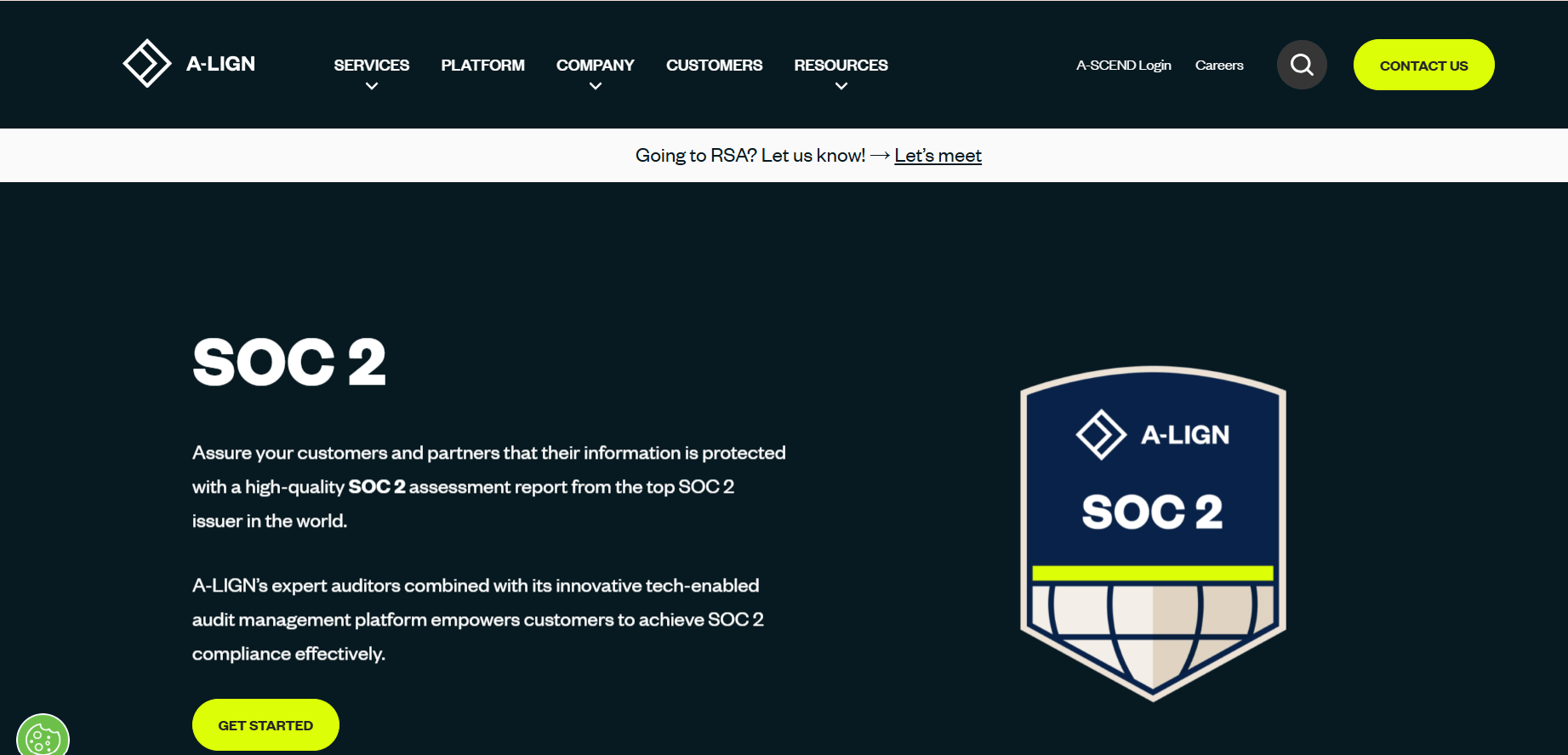
A-LIGN occupies a distinct category among the SOC 2 providers for biotech startups on this list: it is not a compliance automation platform, but rather a technology-enabled AICPA-accredited audit firm that issues the actual SOC 2 report your pharma partners and enterprise customers will review. It is one of the most efficient and high-volume SOC 2 audit firms in the market, with a proprietary compliance management tool called A-SCEND that guides clients through evidence preparation, tracks outstanding items, and keeps the audit process from stalling at any stage.
Features
- Technology-enabled audit firm, not a GRC platform, but a pure-play audit partner
- Proprietary A-SCEND compliance management tool guides evidence preparation
- AICPA-accredited CPA firm with deep SOC 2 audit expertise
- Handles high audit volumes with consistent, predictable timelines
- SOC 2 Type I and Type II, SOC 1, ISO 27001, HIPAA, FedRAMP, and more
- Specialized in healthcare and life sciences organizations
- Works alongside GRC platforms like Vanta or Drata
Pros
- One of the most efficient and predictable audit experiences available
- AICPA peer review credibility with enterprise pharma and hospital procurement teams
- Specialists in life sciences — understands regulatory context of biotech data
- Can be paired with any GRC platform as your audit firm of record
Cons
- Not a compliance automation platform.
- Higher cost than platform-bundled audit options (e.g., Thoropass)
- Best for companies already compliance-ready, not those just beginning their program
Pricing: SOC 2 Type I audits: $5,000–$20,000. Type II: $15,000–$40,000+ depending on scope and criteria. Enterprise/life sciences clients may exceed this range.
Verdict: A-LIGN is not a platform, it’s the audit firm you bring in once you’ve used a GRC tool to build your controls. For biotech startups needing an audit from a credible, enterprise-recognized CPA firm, A-LIGN delivers a consistently professional and efficient process.
Best For: Biotech startups at audit-ready stage using a platform like Vanta or Drata who need a separate, highly credible AICPA-accredited audit firm to issue their SOC 2 report.
Choosing the Best SOC 2 Providers for Biotech Startups
The stakes for biotech startups are uniquely high. Genomic sequences, clinical trial data, and proprietary biological research are not just business assets they represent patients, participants, and potential breakthroughs. Getting your security posture right, and proving it through a credible SOC 2 report, is foundational to building the enterprise partnerships that fuel growth in life sciences.
The best SOC 2 providers for biotech startups are not simply the most popular tools in the SaaS market. They’re the ones that understand your regulatory overlap (HIPAA, GDPR, FDA 21 CFR Part 11), can integrate with your scientific and clinical infrastructure, and can grow with your compliance program from seed to clinical stage.