A conversational AI company doesn’t just store customer records, it stores the conversations themselves. Chat transcripts, voice recordings, prompts, and model outputs can contain PII, financial details, and confidential business information. These data types also create an extra security challenge: third-party foundation-model providers.
When an enterprise buyer asks, “Who else can access our data?”, many conversational AI vendors must account for several subprocessors. These may include an LLM API provider, vector database, or voice-transcription service. Each vendor may follow different rules for data retention, security, and model training.
That makes the choice of SOC 2 consultants for conversational AI companies especially important. A generalist auditor may produce a technically valid SOC 2 report. However, the auditor may lack experience with LLM subprocessors, embeddings, or retrieval-augmented generation (RAG).
Enterprise CISOs often ask more specific questions during due diligence. How does the company manage conversation-data retention and deletion? Does customer data train or evaluate models? What happens when a right-to-erasure request reaches a cached embedding?
The goal of this piece is simple: help you compare providers and make a more informed decision, whether or not you choose any company featured in this guide.
Top 12 SOC 2 Consultants for Conversational AI Companies
1. Vanta
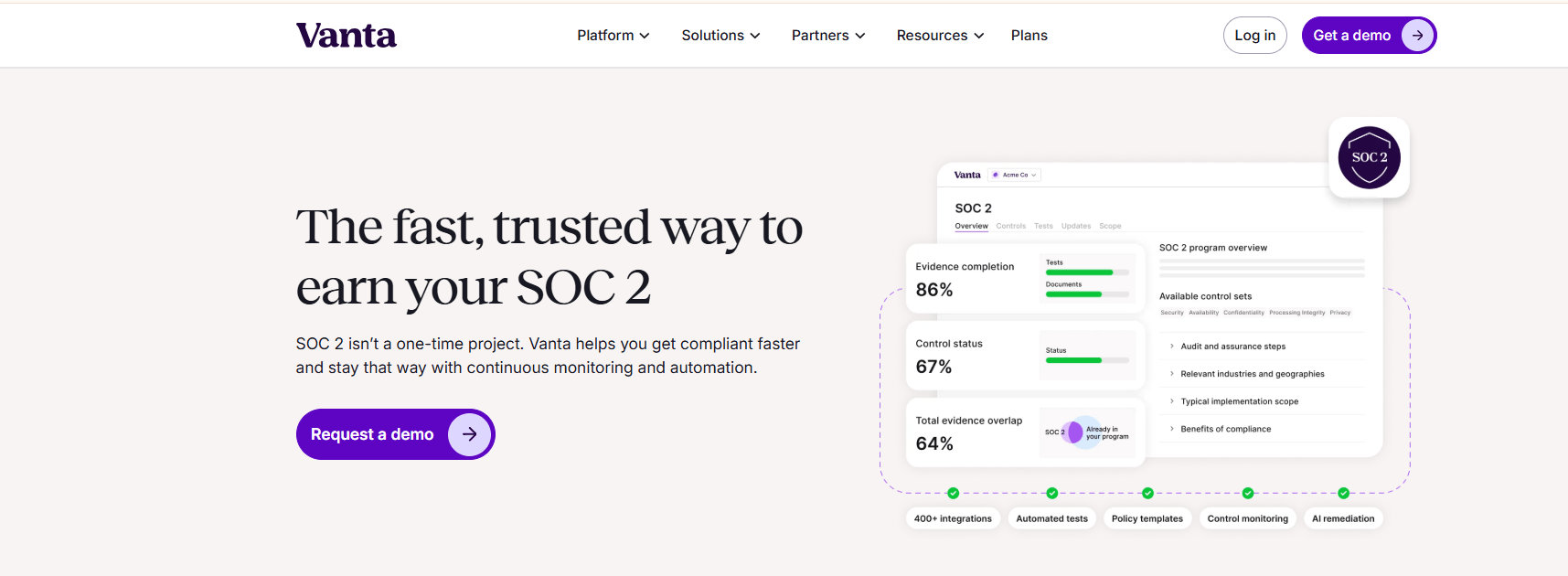
Vanta is a trust-management and compliance-automation platform, not an auditor, it automates evidence collection and continuous control monitoring, then hands the actual examination to an independent CPA firm from its partner network. It’s the most widely recognized name in the category, positioned for companies pursuing SOC 2 alongside ISO 27001, HIPAA, GDPR, and other frameworks under one dashboard.
Features
- Continuous monitoring: Covers 300+ integrations, including AWS, GitHub, Google Workspace, and Okta.
- Policy management: Provides automated policy generation.
- Vendor risk management: Helps track and manage third-party vendors.
- Trust Center: Provides a public-facing Trust Center for sharing security and compliance information.
- SOC 2 examination: The actual SOC 2 examination comes at a separate cost and is performed by a third-party auditor.
Conversational AI Fit
Vanta’s vendor-risk module can track LLM API providers as subprocessors, while its integration library covers most major cloud and identity stacks a conversational AI company would run on. However, Vanta does not have a publicly documented, AI-specific audit methodology. Its AI relevance therefore comes mainly from its scale and integration breadth rather than LLM-specific control design.
Pros
- Large auditor network: Has one of the largest auditor networks among platforms in this category.
- Enterprise recognition: Strong brand recognition can help streamline enterprise procurement reviews.
- Extensive integrations: Offers a broad integration catalog covering many common SaaS, cloud, and identity tools.
Cons
- Limited pricing transparency: Pricing is not publicly published and requires a sales call.
- Generic policy templates: Some users describe the default policy templates as generic.
- Renewal costs: Some users report year-over-year increases in renewal prices.
Pricing
- Public pricing: Not publicly available.
- Estimated annual contracts: Third-party procurement trackers report observed contracts of roughly $10,000–$80,000.
- SOC 2 audit: The audit itself is a separate cost, typically estimated at $8,000–$50,000, depending on scope and auditor.
Best Fit
Growth-stage conversational AI companies pursuing multiple frameworks, such as SOC 2, ISO 27001, and GDPR, that want one dashboard and broad integration coverage.
When It May Not Be the Best Choice
Budget-conscious startups: Pre-seed companies with limited budgets may find the cost harder to justify.
AI-specialist requirements: Teams that need deep LLM or AI-specific audit expertise may prefer a specialist such as Prescient Security or Schellman.
Verdict
Vanta’s biggest strength is its scale and ecosystem. Its biggest limitation for conversational AI companies is the lack of a clearly documented AI-specific audit methodology. It is a strong default choice, but it may not be the most specialized option.
2. Prescient Security
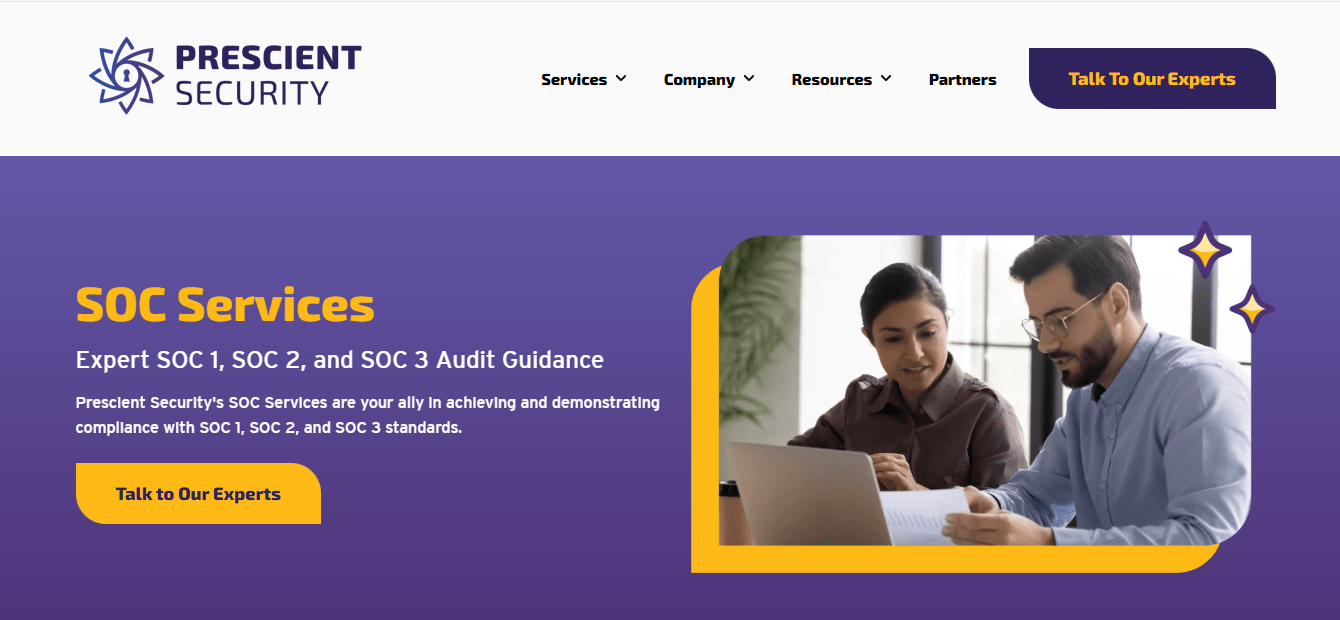
Prescient is a combined cybersecurity and CPA firm, meaning it’s an actual auditor, not just a readiness platform, founded by professionals with a penetration-testing and application-security background rather than a traditional accounting one. The firm states it has grown into one of the larger SOC 2 auditors globally for SaaS and AI companies, citing more than 5,000 client audits per year.
Features
- SOC examinations: Provides in-house SOC 1, SOC 2, and SOC 3 examinations.
- Compliance integrations: Integrates with platforms such as Vanta and Drata to support evidence handoff.
- AI compliance: Offers SOC 2 alongside ISO 42001, the AI management-system standard, as a bundled engagement for AI-first companies.
- Security expertise: Brings penetration-testing and application-security experience into its audit work.
Conversational AI Fit
This is the strongest documented AI/LLM fit on this list. Prescient states that it directly audits AI and large language model providers. That gives it a relevant credential that few compliance firms can claim. For conversational AI companies whose core product depends on LLM interactions, this experience can help address AI-specific risks. These include model versioning as change management and training-data access as evidence.
Pros
- LLM audit experience: Has documented experience auditing LLM providers.
- Fast turnaround: Reports fieldwork timelines of approximately 2–6 weeks.
- Remote process: Does not require on-site visits.
- Vanta integration: Offers deep integration with Vanta for evidence handoff.
- AI compliance: Can combine SOC 2 with ISO 42001 for AI-focused companies.
Cons
- Lower enterprise brand recognition: As a smaller specialist firm than A-LIGN or Schellman, Prescient may have less brand recognition in enterprise procurement reviews.
- Enterprise procurement: Some large enterprises may specifically request a more widely recognized auditor.
Pricing
- Public pricing: Not publicly available.
- Estimated Type II audit cost: Industry cost trackers place Prescient’s Type II audits at roughly $10,000–$30,000.
Best Fit
Series A through growth-stage conversational AI and LLM application companies that already use Vanta or Drata and want an auditor with AI-specific experience without paying Big Four-level fees.
When It May Not Be the Best Choice
Large enterprise procurement: Companies whose procurement process requires a Big Four or globally recognized Top-50 CPA firm may need a different auditor.
Brand-sensitive buyers: Companies whose customers strongly prioritize auditor name recognition may prefer a larger firm.
Verdict
For conversational AI companies, Prescient’s documented LLM audit experience makes it one of the most directly relevant providers on this list. It may not have the biggest brand name, but its AI-specific expertise gives it a strong advantage for companies whose products depend heavily on LLM interactions.
3. Thoropass
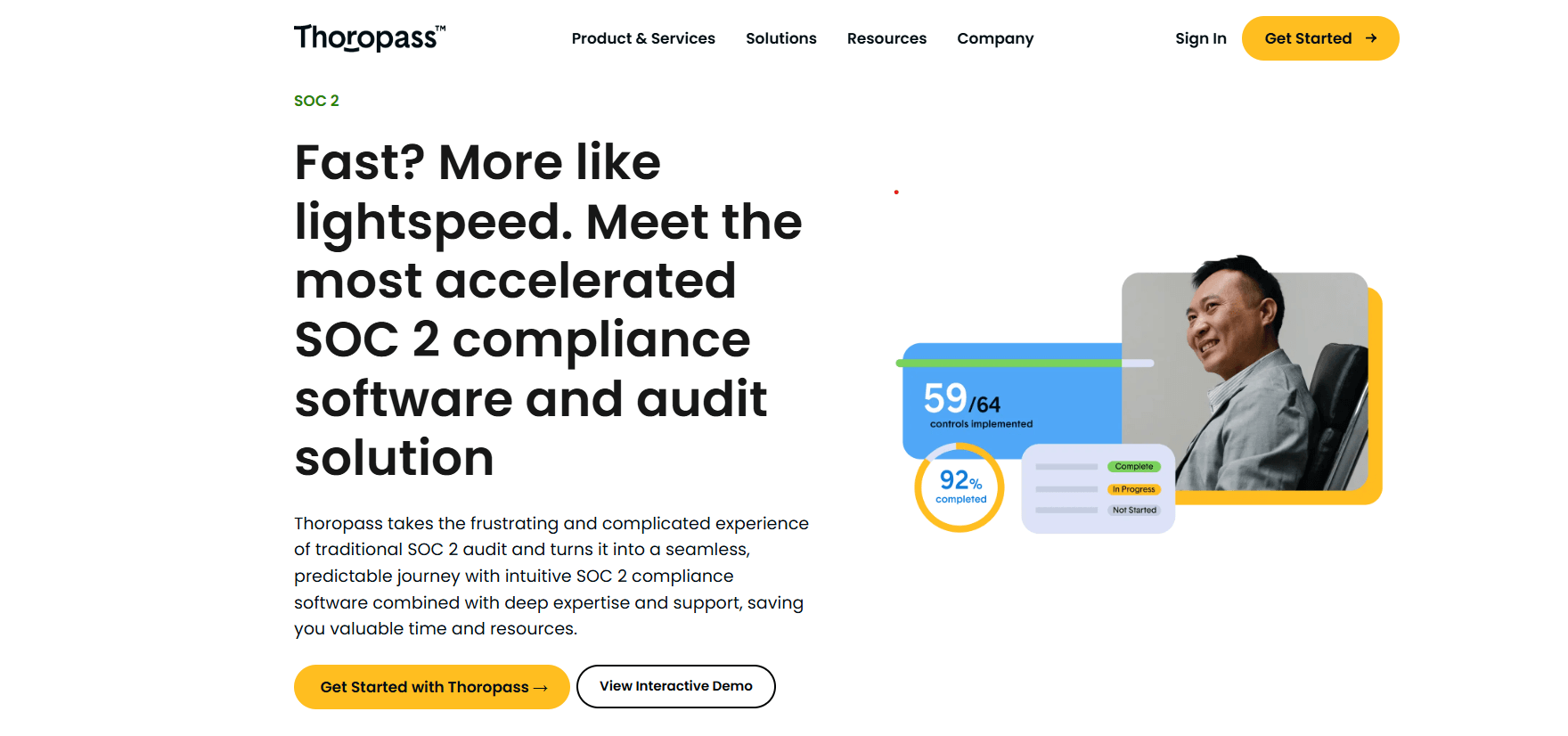
Thoropass is a hybrid provider: Thoropass, Inc. supplies the compliance-automation platform, while Thoropass Assurance (legally Laika Compliance, LLC) is the AICPA peer-reviewed CPA firm that performs the actual audit, both operating under one brand. This is the “single vendor” model: platform and audit under one contract.
Features
- Audit Lifecycle Platform: Provides an end-to-end platform for managing the SOC 2 audit process.
- Integrations: Offers 200+ auditor-approved integrations.
- Audit collaboration: Lets companies collaborate with their audit team directly within the platform.
- Framework support: Supports SOC 1, SOC 2, ISO 27001, ISO 42001, HITRUST, PCI DSS, and CMMC Level 1.
- AI compliance: Its ISO 42001 readiness and control-mapping capabilities can help conversational AI companies address AI-management controls alongside SOC 2.
Conversational AI Fit
Thoropass’s Audit Lifecycle Platform integrates with major cloud and development tools used by AI companies. Its ISO 42001 readiness and control-mapping offering also makes it relevant to conversational AI teams that want AI-management controls alongside SOC 2. However, its publicly documented AI-specific audit expertise is less extensive than Prescient’s.
Pros
- Bundled platform and audit: Combining both services can cost less than purchasing a compliance platform and audit separately.
- Single point of contact: Managing the platform and audit through one provider can reduce coordination work.
- Broad framework support: Companies can address multiple compliance frameworks through one engagement.
- Integrated audit process: In-platform collaboration keeps the company and audit team working in the same environment.
Cons
- Premium pricing: Costs may be higher than those of boutique audit-only firms.
- Less auditor flexibility: Companies that prefer to select their own independent auditor may find the bundled model less flexible.
- Platform commitment: Teams already using Vanta or Drata may have less incentive to switch platforms solely for the bundled offering.
Pricing
Public pricing: Not publicly available as a fixed rate card.
Best Fit
Founders who want a single provider for compliance management and auditing and prefer to avoid managing separate platform and auditor relationships.
When It May Not Be the Best Choice
- Independence-sensitive enterprises: Companies whose customers specifically want assurance that the audit firm operates independently from the compliance platform may prefer separate providers.
- Existing Vanta or Drata users: Teams already committed to another compliance platform may not want to switch systems simply to access a bundled offering.
- Best-of-breed buyers: Companies that want to select their compliance platform and auditor independently may prefer a more flexible setup.
Verdict
Thoropass is a strong all-in-one option for companies that value simplicity. Its combination of compliance technology and audit services reduces vendor coordination and can simplify the SOC 2 process. However, companies that prioritize maximum auditor independence or want to choose separate best-of-breed providers may prefer another approach.
4. Drata
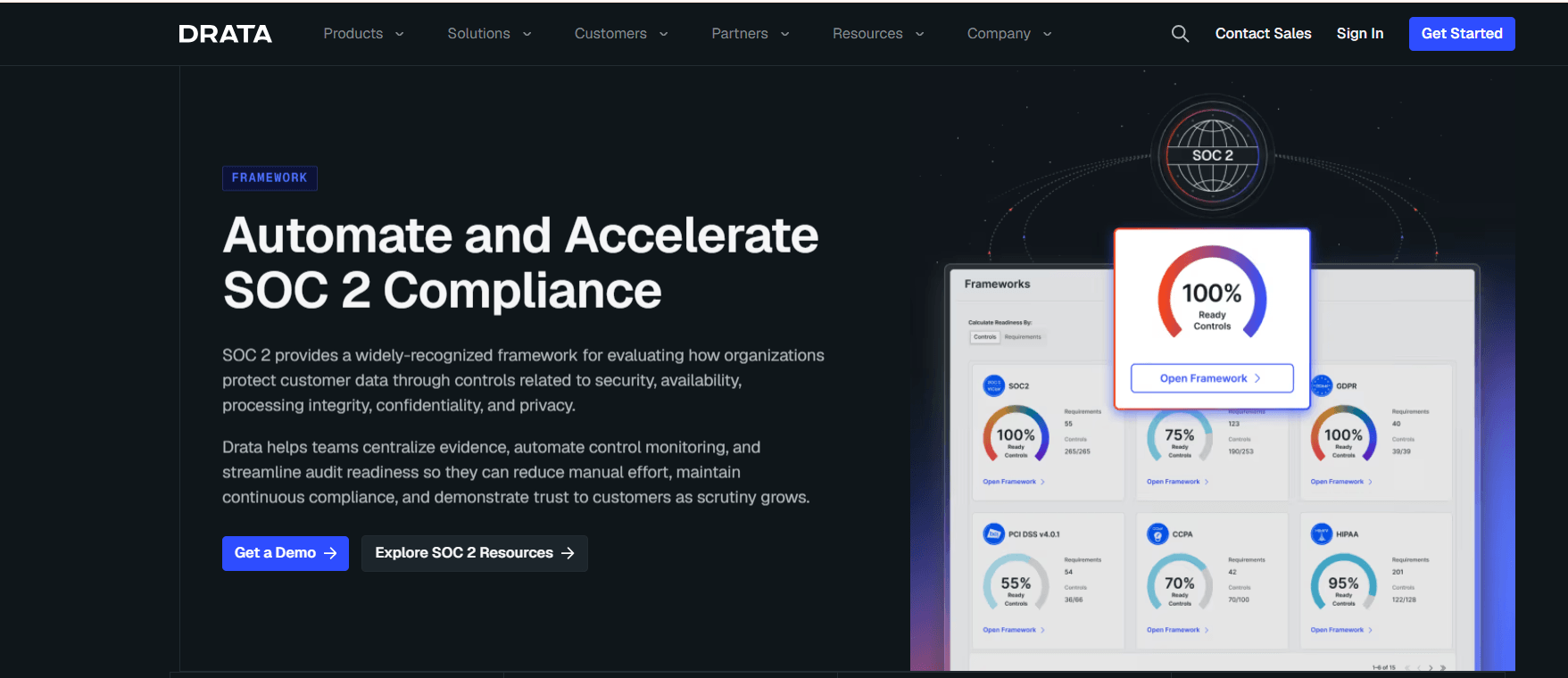
Drata is a compliance-automation platform founded in 2020 and positioned as one of the two dominant players, alongside Vanta, in the mid-market and growth-stage segment. It does not perform audits itself; instead, it prepares evidence for an independent CPA firm. For companies evaluating SOC 2 consultants for conversational AI companies, Drata stands out as a strong automation option, particularly for teams that want continuous monitoring and developer-focused integrations.
Features
- Continuous control monitoring: Continuously monitors controls to help teams identify compliance gaps.
- AI evidence engine: Uses an AI evidence engine built on AWS Bedrock.
- Access reviews: Automates user access reviews.
- Code scanning: Integrates with code-scanning tools.
- AIQA: Provides an AI-powered due-diligence questionnaire responder.
- Developer integrations: Supports tools such as GitHub, GitLab, and CI/CD pipelines.
Conversational AI Fit
Drata’s developer-tool integrations are relevant for AI teams that ship frequent model and application updates. Model deployment and application changes can create change-management requirements that auditors may examine. However, Drata does not publicly document an LLM-specific audit methodology. Its AI capabilities focus mainly on automating its own compliance workflows rather than providing specialized AI-company audit expertise.
Pros
- Customer support: Independent reviews often rate its customer-success support favorably compared with Vanta’s base tier.
- Continuous monitoring: Provides deep continuous-control monitoring capabilities.
- User experience: G2 and Capterra reviewers frequently praise its interface.
- Developer integrations: Its integrations can fit well with engineering-heavy AI teams.
Cons
- Renewal increases: Some users report significant price increases when renewing their contracts.
- Manual work: Independent analyses suggest that roughly 20–45% of SOC 2 controls can still require manual work, even when companies use automation platforms.
- Startup cost: The platform may be less cost-competitive for pre-revenue startups.
- AI specialization: Drata does not position its audit methodology around conversational AI or LLM-specific risks.
Pricing
- Public pricing: Not publicly available.
- Audit cost: The independent CPA firm performing the SOC 2 audit charges separately.
Best Fit
Growth-stage, cloud-native conversational AI companies pursuing SOC 2 alongside a second compliance framework. Drata is particularly suitable for teams with internal resources available to handle remediation and compliance work.
When It May Not Be the Best Choice
- Pre-revenue startups: Companies focused on the lowest possible entry cost may find Drata less suitable.
- Highly customized infrastructure: Companies with significant on-premises or custom infrastructure may prefer alternatives such as Sprinto or Secureframe.
- AI-specialist requirements: Companies that need an auditor with deep LLM-specific experience should consider pairing Drata with an AI-experienced audit firm.
Verdict
Drata is a strong generalist automation platform with genuine continuous-monitoring capabilities. It is not a specialist in conversational AI risk, but it can support these companies effectively when paired with an auditor that understands AI-specific compliance concerns.
5. Schellman
Schellman is an accredited, independent CPA firm not a compliance-automation platform founded in 2002 and now one of the larger specialist assurance firms globally, issuing thousands of SOC reports annually across SOC 1, SOC 2, SOC 3, SOC for Cybersecurity, and other assessment types.
Features
- SOC examinations: Performs in-house SOC examinations.
- Federal compliance: Holds FedRAMP 3PAO and CMMC C3PAO accreditation.
- ISO 42001: Holds status as the world’s first ANAB-accredited ISO 42001 certification body.
- AI governance: Provides a credentialed option for companies addressing AI-management and governance requirements alongside SOC 2.
Conversational AI Fit
Schellman’s ISO 42001 accreditation gives it a strong differentiator in AI governance. Its approach to describing LLM-related risk within SOC 2 reporting has also featured in industry discussions about adapting SOC 2 for AI systems. For conversational AI companies whose enterprise buyers increasingly ask about AI governance alongside security, Schellman offers one of the clearest credentialed options.
Pros
- Enterprise credibility: Its brand carries weight in competitive enterprise evaluations.
- AI governance expertise: Its ISO 42001 accreditation gives it a genuine first-mover advantage in AI governance.
- Client retention: The company reports high client retention.
- Enterprise readiness: Its credentials can help companies facing sophisticated security and compliance reviews.
Cons
Premium pricing: Costs can exceed those of boutique specialist firms.
- No proprietary platform: Schellman does not operate its own compliance technology platform, so evidence collection may feel less automated than with platform-native providers.
- Scale: With more than 900 clients and approximately 500 employees, the experience may feel less hands-on than a boutique firm’s service.
Pricing
- Public pricing: Not publicly available.
Best Fit
Growth-stage to enterprise conversational AI companies facing sophisticated enterprise security reviews that increasingly include AI-governance questions and have the budget for a premium audit engagement.
When It May Not Be the Best Choice
- Early-stage startups: Companies with tight budgets may find boutique firms such as Johanson Group or KirkpatrickPrice more affordable.
- Automation-focused teams: Companies that want a proprietary compliance platform may prefer a platform-based provider.
Verdict
Schellman is the clearest “brand-name plus AI governance” choice on this list. Its ISO 42001 credential gives conversational AI companies a strong answer when enterprise buyers ask about AI risk management alongside SOC 2.
6. Sprinto
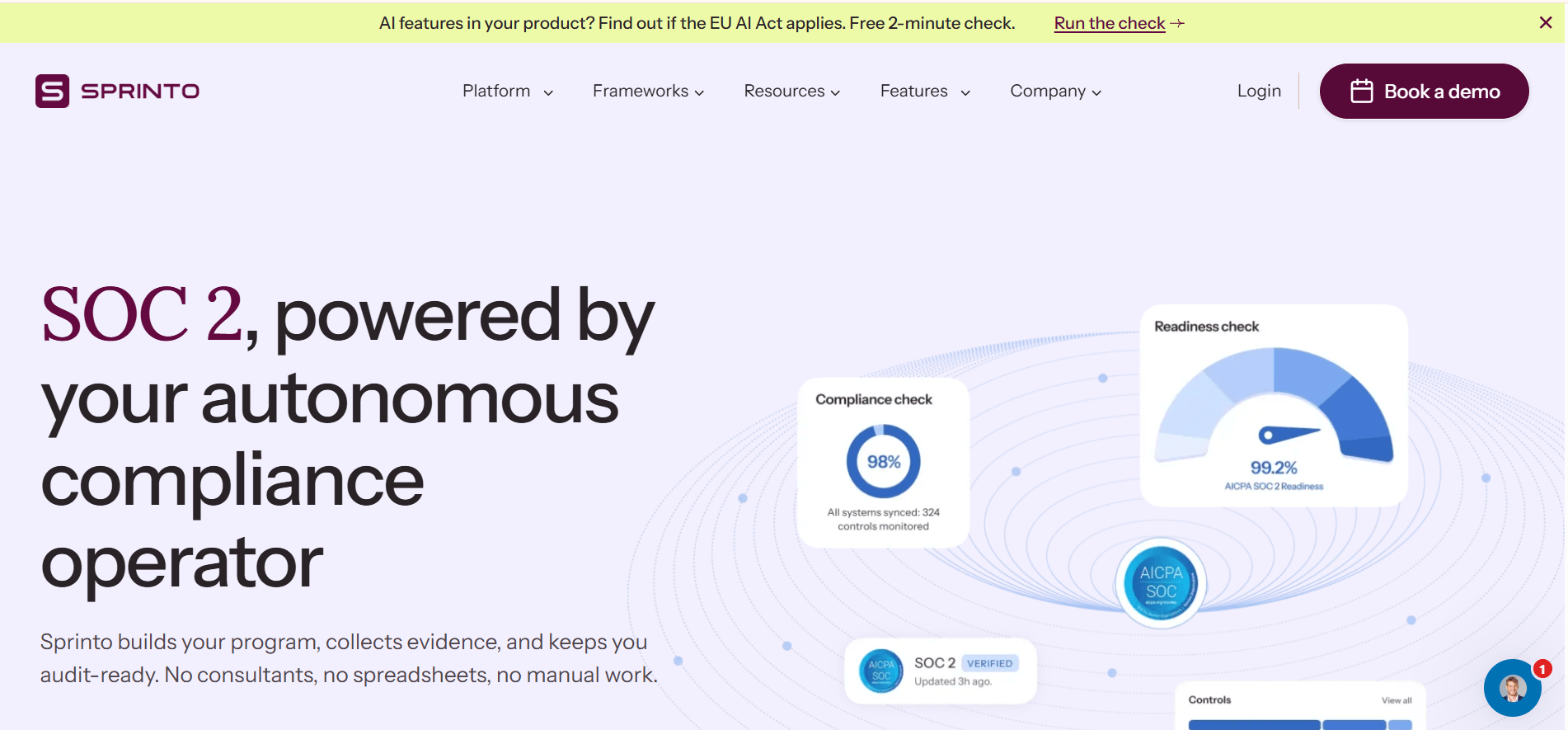
Sprinto is a compliance-automation platform built specifically with SaaS companies in mind. It positions itself as the lowest-cost credible entry point in the automation-platform category. For companies evaluating SOC 2 consultants for conversational AI companies, Sprinto offers a practical option for lean SaaS teams that need to establish compliance without building a large internal compliance function.
Features
- Automated setup: Automates the initial setup of policies, controls, and checks based on a company’s technology stack.
- Integrations: Provides 300+ integrations.
- Onboarding support: Assigns a certified onboarding manager to each customer.
- Gap analysis: Uses intelligent gap analysis to prioritize remediation according to risk severity.
- SaaS focus: Designs its compliance workflows specifically around SaaS companies.
Conversational AI Fit
Sprinto’s prescriptive, engineering-led approach suits lean AI startups without a dedicated compliance hire. For SOC 2 consultants for conversational AI companies, this makes Sprinto particularly relevant when speed and affordability matter more than specialized AI audit expertise.
However, Sprinto does not publicly document an AI- or LLM-specific audit methodology. Its relevance to conversational AI companies comes primarily from its speed, cost, and SaaS focus rather than specialized AI-risk coverage.
Pros
- Transparent starting price: Some listings cite a starting price of approximately $4,000 per year.
- Onboarding support: Includes a certified onboarding manager.
- Customer reviews: Independent review aggregations report a strong G2 rating of approximately 4.7/5.
- SaaS focus: Its workflows are designed specifically with SaaS companies in mind.
- Cost accessibility: Its lower reported starting price can make it attractive to early-stage companies evaluating SOC 2 compliance options.
Cons
- Learning curve: Independent reviews note a steep initial learning curve for first-time users.
- Limited customization: Companies with complex infrastructure may find it less flexible than Drata or Vanta.
- Billing feedback: Some secondary review platforms contain conflicting reports about billing and refund experiences.
- AI specialization: Sprinto does not publicly document a specialized AI or LLM audit methodology.
- Complex infrastructure: Companies with unusual or highly customized environments may need more manual evidence collection.
Pricing
- Estimated single-framework cost: Listings commonly cite approximately $4,000–$8,000 per year.
- Audit costs: Any independent SOC 2 audit fees should be considered separately unless the engagement explicitly bundles them.
Best Fit
Sub-50-employee, pre-Series-A conversational AI startups that need their first SOC 2 Type I report quickly and affordably. Sprinto works best when an internal owner can follow a structured compliance task list.
When It May Not Be the Best Choice
- Complex infrastructure: Companies running multi-cloud or highly customized environments may need broader integration coverage.
- Large technical stacks: Teams using unusual tools may face more manual evidence collection than they would with Vanta or Drata.
- Specialized AI requirements: Companies looking for an auditor with documented LLM-specific expertise may need a specialist alongside their compliance platform.
Verdict
Sprinto is the clearest “startup budget” choice on this list. It does not specialize in AI, but its combination of low entry cost, onboarding support, and SaaS-focused automation makes it a credible route to a first SOC 2 report for lean technical teams. For buyers comparing SOC 2 consultants for conversational AI companies, Sprinto makes the most sense when affordability and implementation simplicity outweigh the need for specialized AI governance expertise.
7. Scytale
Scytale is a compliance-automation platform that differentiates itself by bundling a named, dedicated compliance expert into every subscription. This positions it between pure self-serve automation and traditional consulting. For companies evaluating SOC 2 consultants for conversational AI companies, this model can be useful for founders who need hands-on compliance guidance without hiring a dedicated compliance professional.
Features
- Framework support: Supports 60+ frameworks, giving it one of the broadest libraries in this category.
- AI-assisted workflows: Provides AI-assisted evidence workflows.
- Dedicated expert: Assigns a compliance expert to each customer.
- Gap analysis support: The assigned expert helps interpret gap severity and prioritize remediation.
- Audit coordination: The compliance expert can help coordinate with the auditor.
- Integrations: Provides more than 100 connectors.
Conversational AI Fit
For a conversational AI startup without in-house compliance expertise, Scytale’s dedicated expert can provide practical guidance throughout the SOC 2 process. The expert can help translate control gaps into concrete remediation steps.
This makes Scytale a useful option among SOC 2 consultants for conversational AI companies when the main challenge is understanding what the team needs to fix and how to prepare for an audit.
However, Scytale’s integration library remains smaller than Vanta’s or Drata’s. AI teams with broad or unusual technology stacks may therefore face gaps that require manual evidence collection.
Pros
- Dedicated guidance: Reduces the uncertainty that first-time SOC 2 teams can face with self-serve platforms.
- Human support: Gives companies access to a named compliance expert.
- Framework breadth: Supports 60+ frameworks for companies expecting multiple certifications.
- Audit coordination: Helps teams work through the process with their auditor.
- Practical remediation support: The dedicated expert can help teams understand and address compliance gaps.
Cons
- Smaller integration library: Offers fewer integrations than category leaders such as Vanta and Drata.
- Completion claims: Claims about dramatically faster completion times should be treated as best-case scenarios rather than typical results.
- Potential redundancy: Companies with an experienced internal compliance owner may not need the bundled advisory support.
- AI specialization: Scytale is not positioned as an LLM-specific audit specialist.
Pricing
Public pricing: A complete rate card is not publicly available.
Estimated starting price: Third-party listings commonly cite approximately $7,500 per year.
Best Fit
First-time SOC 2 teams without an in-house compliance manager or CISO that want a human expert included with their compliance software rather than paying separately for consulting.
When It May Not Be the Best Choice
- Experienced compliance teams: Companies with an established compliance owner may not benefit enough from bundled advisory support to justify the additional cost.
- Complex technology stacks: Teams with broad or niche infrastructure may prefer a provider with a larger integration library.
- Specialized AI requirements: Companies seeking deep LLM-specific audit expertise should consider a specialist auditor.
- Highly automated teams: Companies that already have strong internal compliance processes may gain less from the dedicated advisory model.
Verdict
Scytale offers a sensible middle ground between pure automation and traditional consulting. For conversational AI founders without an internal compliance lead, its dedicated expert can provide valuable hands-on guidance without requiring a separate consulting engagement. That makes it a practical option among SOC 2 consultants for conversational AI companies, particularly for first-time compliance teams that need more guidance than a self-serve platform provides.
8. A-LIGN
A-LIGN is a specialist SOC 2 audit firm founded in 2009. The company describes itself as the top issuer of SOC 2 reports globally, citing more than 5,700 clients and over 31,000 completed audits. A-LIGN operates as an actual CPA firm rather than a compliance platform, although it also runs its own audit-management technology, A-SCEND.
Features
- SOC examinations: Performs in-house SOC 1, SOC 2, and SOC 3 examinations.
- Federal compliance: Holds FedRAMP 3PAO and CMMC C3PAO accreditation.
- A-SCEND platform: Provides proprietary audit-management technology.
- AI evidence scoring: A-SCEND includes EvidenceIQ for AI-based evidence scoring.
- Cross-framework evidence: Allows teams to reuse evidence across multiple frameworks.
- Framework breadth: Supports organizations pursuing SOC 2 alongside FedRAMP, HITRUST, ISO, and CMMC.
Conversational AI Fit
A-LIGN’s audit volume and broad framework coverage make it useful for conversational AI companies expanding into regulated industries. This includes healthcare voice AI and government-facing assistants that may need more than SOC 2. However, A-LIGN does not document an LLM-specific audit methodology as explicitly as Prescient or Schellman.
Pros
- High audit volume: A-LIGN reports more SOC 2 reports than any other firm on this list.
- SaaS and AI experience: Its large client base gives the firm extensive exposure to common SaaS and AI infrastructure patterns.
- Evidence reuse: Cross-framework evidence reuse can reduce duplicate evidence requests.
- Enterprise credibility: Its scale and established CPA-firm status can help with enterprise procurement.
- International expansion: Hg acquired A-LIGN in 2025 at a valuation above $1 billion, supporting its expansion plans.
Cons
- Premium pricing: Costs more than many boutique audit firms.
- Standardized experience: Its scale can result in a more standardized engagement than a smaller boutique firm provides.
- Limited AI specialization: It does not document LLM-specific audit methodology as clearly as Prescient or Schellman.
Pricing
- Public pricing: Not publicly available.
- Estimated Type II cost: Independent trackers estimate approximately $15,000–$50,000.
Best Fit
Growth-stage to enterprise conversational AI companies that need SOC 2 plus additional frameworks such as FedRAMP, HITRUST, or CMMC under one coordinated engagement.
When It May Not Be the Best Choice
Pre-seed startups: Companies seeking only a basic first SOC 2 Type I may not need A-LIGN’s broader framework capabilities.
Budget-conscious teams: Smaller companies may find boutique firms more cost-effective.
AI-specialist requirements: Companies specifically seeking documented LLM audit expertise may prefer Prescient or Schellman.
Verdict
A-LIGN leads this list in audit volume and framework breadth among independent audit firms. It becomes a particularly strong choice when a conversational AI company’s compliance needs extend beyond SOC 2.
9. Johanson Group
Johanson Group, LLP is a boutique CPA audit firm that provides SOC 1, SOC 2, SOC 3, ISO 27001, HIPAA, GDPR, and NIST assurance services. The firm differentiates itself through speed, using fixed-fee engagements and a defined process from scoping through final reporting.
Features
- SOC examinations: Performs SOC 1, SOC 2, and SOC 3 examinations in-house.
- Fast reporting: Targets final reports within 4–6 weeks of starting the audit.
- Type I turnaround: Independent industry directories cite Type I turnaround times as fast as 1–3 weeks for startups that already use platforms such as Drata, Vanta, or Secureframe.
- Fixed-fee model: Uses fixed-fee engagements to provide greater budget predictability.
- Platform compatibility: Works alongside major compliance-automation platforms.
Conversational AI Fit
Johanson Group does not position itself as an AI specialist. Its value for conversational AI companies comes from speed and predictable pricing. This can help a company that simply needs a SOC 2 report to unblock an enterprise deal while it continues its Type II observation period.
Pros
- Fast turnaround: Independent directories reference Johanson Group among the fastest boutique audit firms.
- Fixed fees: The pricing model can reduce budget uncertainty.
- Automation compatibility: Works alongside major platforms such as Drata, Vanta, and Secureframe.
- Startup suitability: Its model can work well for companies that already have their controls and evidence in place.
Cons
- Limited framework breadth: Does not offer the same breadth as A-LIGN or Schellman for frameworks such as FedRAMP and HITRUST.
- No AI-specific methodology: Does not document a specialized AI or LLM audit methodology.
- Limited specialization: Companies with complex AI governance requirements may need a more specialized auditor.
Pricing
- Public pricing: Not available as a fixed public rate card.
- Estimated Type II cost: Industry comparisons place boutique firms such as Johanson Group in the range of $15,000–$75,000.
Best Fit
Conversational AI startups that already use a compliance-automation platform and need to move quickly from audit readiness to a signed SOC 2 report.
When It May Not Be the Best Choice
- Multiple-framework requirements: Companies that need FedRAMP, HITRUST, or CMMC may need a broader provider.
- AI-specific requirements: Companies looking for documented AI or LLM audit expertise should consider Prescient or Schellman.
- Complex compliance programs: Larger organizations may benefit from a firm with broader enterprise capabilities.
Verdict
Johanson Group is the speed pick. If the main problem is getting a SOC 2 report quickly rather than addressing complex AI-specific risks, the firm is worth considering.
10. KirkpatrickPrice
KirkpatrickPrice is a licensed CPA firm, PCI QSA, and HITRUST CSF Assessor based in Nashville. The firm provides SOC 1, SOC 2, PCI DSS, HIPAA, HITRUST, ISO 27001, and NIST assurance services, along with penetration testing.
Features
- SOC examinations: Performs SOC 1 and SOC 2 examinations in-house.
- Gap analysis: Offers an optional gap-analysis service before the formal audit.
- Bundled engagement: Provides a Year 1 package that combines gap analysis, Type I, and Type II.
- Renewal pricing: Provides disclosed pricing for subsequent annual renewals.
- Security testing: Offers penetration testing alongside its compliance services.
- Multiple frameworks: Supports PCI DSS, HIPAA, HITRUST, ISO 27001, and NIST.
Conversational AI Fit
KirkpatrickPrice is a general-purpose specialist firm rather than an AI specialist. Its main advantage for conversational AI companies comes from its budget-conscious and relatively transparent pricing structure. This makes it suitable for companies that need strong SaaS-grade audit support without paying premium-firm rates.
Pros
- Pricing transparency: Provides more pricing information than most specialist firms in this category.
- SaaS and MSP reputation: Has a strong reputation among managed-service providers and mid-sized SaaS companies.
- Broad accreditation: Its PCAOB registration, PCI QSA status, and HITRUST Assessor credentials can help companies pursuing additional requirements.
- Bundled services: Its Year 1 package combines multiple stages of the SOC 2 process.
Cons
No proprietary platform: Companies must use their existing compliance platform rather than replacing it with KirkpatrickPrice’s own technology.
No AI-specific methodology: The firm does not document a specialized AI or LLM audit methodology.
Limited federal coverage: Companies seeking FedRAMP or CMMC may need another provider.
Pricing
Public pricing: KirkpatrickPrice does not publish a fixed rate card directly on its website.
Estimated Year 1 package: Independent sources cite approximately $25,000–$30,000 for gap analysis, Type I, and Type II.
Best Fit
Budget-conscious conversational AI companies, particularly those generating approximately $5 million–$100 million in revenue, that want predictable bundled pricing and a long-term audit relationship.
When It May Not Be the Best Choice
AI-specialist requirements: Companies seeking documented AI or LLM audit expertise may prefer Prescient.
Federal compliance: Companies requiring FedRAMP or CMMC may need a provider with those capabilities.
Platform requirements: Teams looking for an all-in-one compliance platform should consider an automation provider.
Verdict
KirkpatrickPrice stands out as one of the more price-transparent specialist auditors in this category. It suits conversational AI companies that prioritize budget predictability and established audit support over specialized AI expertise.
11. Fractional CISO
Fractional CISO is a pure readiness-consulting firm. It does not perform audits or operate as a compliance-automation platform. Instead, it provides a U.S.-based virtual CISO and cybersecurity analyst team that builds and manages a client’s security program toward SOC 2 and other frameworks. The company then hands the program to an independent CPA firm for the actual attestation.
Features
- SOC 2 gap assessment: Evaluates the company’s controls against SOC 2 requirements.
- Policy development: Creates security policies and procedures.
- Ongoing control management: Helps manage recurring controls such as risk assessments, incident-response exercises, and vendor reviews.
- Audit support: Supports clients throughout the Type II audit cycle.
- Virtual CISO support: Provides ongoing security leadership without requiring a full-time internal CISO.
- Program ownership: Helps make and document security decisions rather than simply tracking compliance tasks.
Conversational AI Fit
For conversational AI companies without security leadership, this model provides hands-on ownership that an automation dashboard cannot replace. The team can help determine how to scope conversation-data retention, document an LLM provider as a subprocessor, and handle deletion requests involving cached embeddings.
However, Fractional CISO does not replace the continuous monitoring that compliance-automation platforms provide at scale.
Pros
Hands-on ownership: Provides human expertise rather than simply giving teams a compliance checklist.
SOC 2 sequencing: Typically guides clients through Type I before Type II.
Flexible platform choice: Works alongside the automation platform and auditor the client selects.
Security leadership: Gives early-stage companies access to virtual CISO expertise without hiring a full-time executive.
AI-specific decisions: Can provide practical guidance on security questions involving conversation data and LLM providers.
Cons
- Slower process: The company states a typical timeline of 6–18 months, making the model slower than an automation-led sprint.
- Separate audit required: Fractional CISO does not perform the SOC 2 audit, so clients must select and pay an independent CPA firm.
- Less useful for mature teams: Companies with an established internal compliance or security team may not need the additional consulting support.
- Higher coordination needs: Clients must manage separate consulting, platform, and audit relationships where applicable.
Pricing
- Public pricing: Not publicly available.
- Pricing model: Engagements typically use monthly retainer-based pricing.
Best Fit
Pre-seed to seed-stage conversational AI startups with no internal security leadership that need someone to design and own their security program rather than simply track compliance tasks.
When It May Not Be the Best Choice
- Existing security leadership: Companies with engineering or security leaders who can manage a compliance platform may not need fractional CISO support.
- Enterprise deal pressure: Companies that need a SOC 2 report as quickly as possible may move faster with an automation platform and fixed-fee boutique auditor.
- Mature compliance teams: Companies with an established compliance function may gain less value from external program ownership.
Verdict
Fractional CISO is the only pure human-consulting option on this list. It works best as a complement to compliance platforms and audit firms rather than a replacement for them. For conversational AI companies, its biggest value comes from helping teams make the difficult security decisions that software alone cannot make.
12. Secureframe
Secureframe is a compliance-automation platform serving companies across SOC 2, ISO 27001, HIPAA, and PCI. Its federal-compliance arm, Secureframe Federal, also covers CMMC, FedRAMP, and NIST. This makes Secureframe relevant for conversational AI companies that may eventually sell AI products to government or highly regulated organizations.
Features
- Control Layer: Maps controls across multiple compliance frameworks.
- Framework support: Supports 45+ frameworks.
- Continuous monitoring: Monitors controls and compliance requirements on an ongoing basis.
- Test library: Provides a vCISO-curated library of compliance tests.
- Customer support: Includes a dedicated Customer Success Manager during onboarding.
- Federal compliance: Secureframe Federal supports CMMC, FedRAMP, and NIST requirements.
Conversational AI Fit
Secureframe’s cross-framework control mapping can help conversational AI companies prepare for both SOC 2 and future federal compliance requirements. This matters for companies selling AI assistants or other conversational products into public-sector accounts.
However, Secureframe does not independently document the same level of AI-specific compliance expertise around conversation data, RAG architectures, or LLM subprocessors that Prescient does. Its main advantage for SOC 2 consultants for conversational AI companies comes from framework breadth and structured guidance rather than specialized LLM risk expertise.
Pros
- Hands-on guidance: Customer reviews frequently praise the support provided by dedicated Customer Success Managers.
- Framework breadth: Supports 45+ frameworks.
- Structured onboarding: Provides more guided implementation than a purely self-serve platform.
- Federal compliance: Offers a clear path toward CMMC, FedRAMP, and NIST requirements.
- Cross-framework mapping: Helps companies reuse controls across multiple compliance programs.
Cons
- Pricing: Secureframe does not publish its pricing.
- Early-stage overhead: Some reviewers describe the platform as better suited to larger, more structured teams.
- AI specialization: It does not publicly document deep expertise in conversation-data security, RAG, or LLM subprocessor risk.
- Potential complexity: Very small teams may find its broader compliance capabilities unnecessary for a first SOC 2 engagement.
Pricing
Public pricing: Not publicly available.
Estimated single-framework cost: Market estimates place annual costs for companies with fewer than 200 employees at approximately $10,000–$35,000.
Best Fit
Small-to-mid-sized conversational AI companies that want a structured, CSM-supported compliance process rather than a purely self-serve platform. Secureframe becomes particularly relevant when the company expects to pursue federal or healthcare compliance in addition to SOC 2.
When It May Not Be the Best Choice
- Very early-stage teams: Startups looking for the fastest and leanest route to a first Type I report may find Sprinto more suitable.
- AI-specific requirements: Companies seeking deep LLM or AI governance expertise should consider a specialist auditor.
- Simple compliance needs: Teams pursuing only a basic SOC 2 program may not need Secureframe’s broader framework capabilities.
Verdict
Secureframe is a strong guidance-heavy generalist platform. Its biggest strengths are structured support, continuous monitoring, and broad framework coverage. For SOC 2 consultants for conversational AI companies, choose Secureframe for its compliance breadth and guided implementation rather than documented AI-specific expertise.
Common SOC 2 Mistakes for Conversational AI Companies
- Starting too late: Begin SOC 2 preparation before an enterprise deal makes the report a requirement. Waiting until procurement asks for it can create unnecessary pressure and delay sales.
- Treating SOC 2 as documentation theater: Do not treat SOC 2 as a paperwork exercise. Build controls that your team actually follows and operates consistently.
- Ignoring AI vendor risk: Document your LLM provider as a subprocessor. Confirm its data-retention policies and whether it uses customer data for training or model improvement.
- Leaving data retention unclear: Define how long you keep conversation transcripts, voice recordings, prompts, model outputs, and cached embeddings. Also document how your team handles deletion requests.
- Assuming SOC 2 covers AI governance: SOC 2 does not automatically provide comprehensive AI governance. Companies that need dedicated AI-management controls may need to extend their scope or pursue ISO 42001 alongside SOC 2.
- Confusing compliance automation with an audit: A compliance platform helps collect evidence and manage controls. An independent CPA firm performs the SOC 2 examination and issues the report.
- Choosing a provider based only on price: Compare providers based on cost, SaaS and AI experience, audit capabilities, support, and auditor independence. The cheapest option may not address the risks enterprise buyers care about.
- Failing to involve engineering early: Engineering teams usually handle much of the practical remediation work, including access controls, logging, monitoring, and change management. Involve them from the beginning rather than treating compliance as a separate business function.
Conclusion
There is no single best SOC 2 consultant for every conversational AI company. The right choice depends on your priorities.
Choose Prescient Security or Schellman if you need deeper AI-specific audit expertise. Go for Vanta or Drata if you prioritize broad compliance automation. Choose Thoropass if you want a single provider for both compliance and audit support. For budget-conscious teams, Sprinto, Johanson Group, or KirkpatrickPrice may offer a better fit. If your team lacks someone who can own the compliance program, Fractional CISO provides more hands-on support.
For companies comparing SOC 2 consultants for conversational AI companies, the most important step is to ask each provider about the risks that make AI systems different from traditional SaaS. Ask about LLM subprocessors, conversation-data retention, model providers, deletion requests, and AI governance.
A provider’s claim that it “works with SaaS companies” does not automatically demonstrate experience with conversational AI risk. Look for specific evidence of that experience before you sign.