

5. AuditBoard
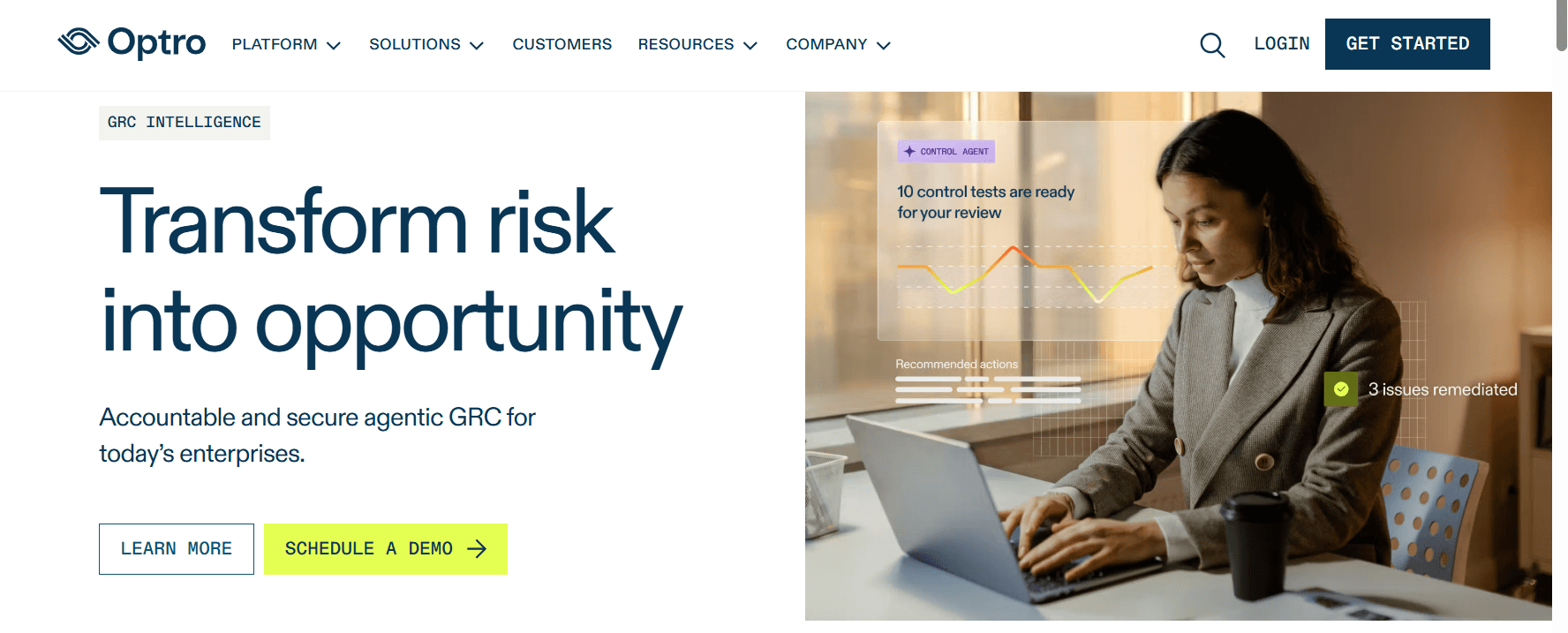
AuditBoard, recently rebranded as Optro, is a cloud-based enterprise risk and compliance platform built for organizations that operate at scale. It serves large enterprises in finance, healthcare, government, and technology. Rather than focusing narrowly on a single certification, the platform connects internal audit, SOX management, IT compliance, ESG reporting, and third-party risk management in one unified system. For enterprise security teams managing overlapping compliance obligations, that kind of integration matters.
Features
- AI-powered gap assessments that proactively flag control deficiencies
- Automated workflows covering risk assessments, policy approvals, control testing, and issue remediation
- Configurable executive dashboards that turn risk data into strategic reporting
- A unified data core linking risks, controls, policies, frameworks, and issues across business entities
- Continuous compliance monitoring templates for common IT controls
- Multi-entity reporting for global organizations managing separate subsidiaries or business units.
Pros
- The most comprehensive audit, risk, and compliance suite available for large enterprises
- Executive and board-level risk reporting comes ready out of the box
- Dominant in finance, healthcare, and government sectors that demand deep audit capabilities
- Low adoption friction auditors and process owners get up to speed quickly
- Multi-entity reporting handles complex global organizational structures.
Cons
- Cloud-only deployment may not work for organizations with strict data residency requirements
- Less developer-friendly for DevOps-centric teams
- Not a fit for startups seeking a fast, lightweight path to a first SOC 2 certification.
Pricing Optro uses enterprise custom pricing. Mid-enterprise deployments typically start around $50,000 per year. Larger organizations often report spending between $100,000 and $200,000+ annually for full-suite rollout.
Best Use Cases
- Large enterprises (1,000+ employees) running SOC 2, ISO 27001, and enterprise risk programs simultaneously
- Financial services, healthcare, and regulated industries that need board-level audit and risk reporting
- Organizations with dedicated internal audit teams looking for a unified GRC and audit management platform.
6. Hyperproof
Hyperproof approaches compliance operations differently from most platforms. Rather than focusing solely on framework coverage, it zeroes in on evidence quality and that distinction matters for enterprise security teams managing multiple audits at once. Its evidence freshness tracking system scores every audit artifact as current, stale, or expired. This stops the most common audit failure before it starts: outdated documentation reaching auditors at year-end. Additionally, Hyperproof supports SOC 2, ISO 27001, NIST 800-53, HIPAA, PCI DSS, GDPR, and custom programs, giving compliance teams real flexibility without forcing them into rigid templates.
Features
- Tags every evidence artifact as current, stale, or expired to keep audit documentation accurate
- Pulls evidence automatically through 100+ integrations, including Slack, AWS, Azure, GCP, GitHub, and Jira
- Adapts to any workflow or framework without locking teams into fixed templates
- Uses AI to power a Trust Center and automate security questionnaire responses
- Ties risk registers and vendor management directly to control and risk mitigation tracking
Pros
- Evidence freshness tracking stops stale documentation from derailing audits
- Flexible, program-based structure fits a wide variety of organizational workflows
- Handles three or more simultaneous frameworks well — reduces multi-compliance fatigue
- Real-time control health monitoring eliminates last-minute compliance scrambles
- AI questionnaire automation speeds up security-related sales cycles
- Works for both enterprise and growing mid-market compliance programs
Cons
- Reporting customization is limited for teams with specific executive analytics requirements
- Integration consistency drops with smaller or niche third-party tools
Pricing Hyperproof offers three pricing tiers, all with fully custom pricing.
Best Use Cases
- Mid-market to enterprise teams managing three or more compliance frameworks simultaneously
- Compliance programs that need proactive evidence freshness tracking to avoid last-minute audit failures
- Organizations that want flexible, program-based compliance management without rigid structural constraints
7. Thoropass
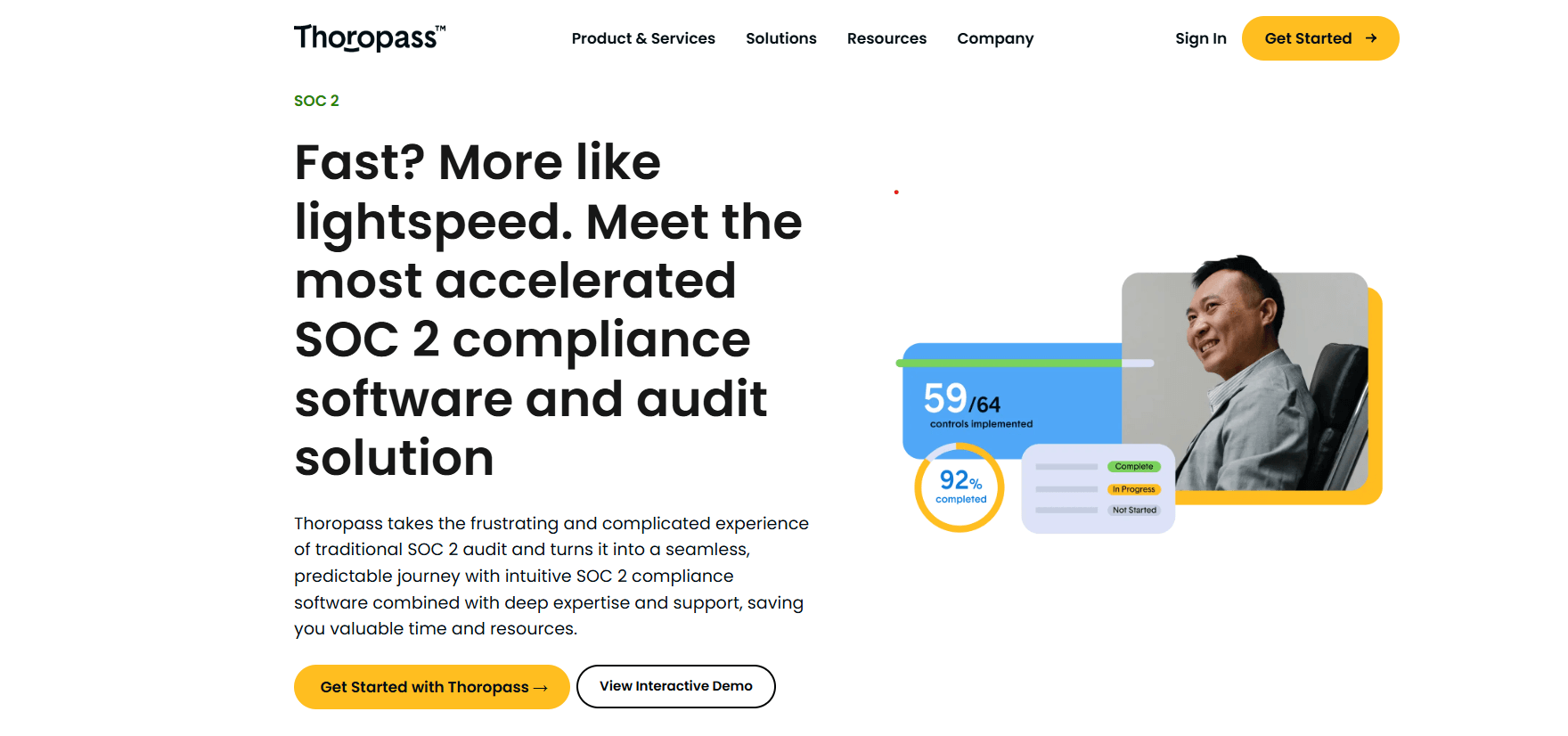
Thoropass, formerly known as Laika, takes a different approach to compliance one that enterprises under tight audit timelines will find particularly appealing. Rather than pairing automation software with a third-party CPA firm, Thoropass operates its own in-house, tech-enabled audit team. Both the platform and the auditors work inside the same system from day one. That closed-loop setup removes the usual coordination delays between compliance tools and external auditors. Thoropass supports 30+ frameworks, including SOC 2, ISO 27001, HIPAA, PCI DSS, and HITRUST, making it a strong fit for organizations that operate across healthcare and general enterprise security standards.
Features
- Bundled in-house audit services — platform and auditor share one system from the start
- 100+ auditor-vetted integrations for automated evidence collection across cloud and DevOps environments
- Unified control dashboard mapping multiple frameworks to a single control set with real-time visibility
- Automated policy management, evidence collection, and continuous compliance monitoring
Pros
- Eliminates auditor coordination: platform and audit happen within one relationship
- Early-to-mid-stage teams consistently praise support and product direction
- HITRUST support sets it apart in healthcare compliance contexts
- In-house auditors already know the platform, so there is no external learning curve
Cons
- Some workflows are rigid and cannot accommodate non-standard compliance programs
- Pre-built templates can feel overwhelming for very small teams new to compliance
- Some users report unclear platform areas that create confusion during audits
- Bundled model does not suit organizations that already have preferred auditor relationships
Pricing Thoropass uses quote-based pricing that varies by framework selection, number of business entities, and bundled services such as audit and penetration testing. Reported starting costs on AWS Marketplace begin at approximately $5,800 per year for the platform component alone. The full bundled package, including audit services, carries a higher total price.
Best Use Cases
- Companies that want platform and audit under one vendor to cut coordination overhead
- Healthcare organizations that need HITRUST alongside SOC 2 and HIPAA compliance
- Mid-market SaaS companies that want predictable, bundled compliance costs
- Teams new to compliance who benefit from auditor-backed workflows and clear milestone guidance
- Organizations under time pressure that need to compress their SOC 2 audit timeline significantly
8. OneTrust
OneTrust operates at a different scale than most compliance platforms. It serves large global enterprises that need to bring security compliance and data privacy obligations together under one governance framework not as separate programs, but as a unified operation. The platform covers SOC 2, ISO 27001, HIPAA, GDPR, CCPA, and dozens of additional privacy and security regulations across more than 180 countries. What truly sets OneTrust apart, though, is its privacy-first architecture. Consent management, data mapping, and DPIA automation are built into the core not bolted on. For organizations where privacy carries equal weight to security certification, OneTrust is the most comprehensive option in the market.
Features
- 200+ integrations that automate more than 90% of evidence collection across developer, HR, and cloud tools
- Dynamic Trust Center that auto-generates a shareable, real-time compliance status page
- Smart control testing that maps system changes to relevant compliance controls automatically
- Full privacy management suite including consent, data mapping, DPIA automation, and breach response
- Vendor and third-party risk management with automated questionnaires and continuous risk scoring
- IT and security risk management integrated into a broader organizational GRC program
- Multi-framework support across 40+ global privacy and security regulations
Pros
- The only platform that unifies GDPR and SOC 2 compliance in a single, connected workflow
- Most comprehensive coverage of global privacy regulations available
- Dynamic Trust Center delivers real-time compliance transparency to enterprise prospects
- Modular architecture lets organizations pay only for what they actually need
Cons
- Platform complexity is significant onboarding requires time and dedicated implementation resources
- Some users report difficulty navigating the platform and inconsistent support responsiveness
- Pricing OneTrust uses modular, custom pricing based on the specific products selected and the geographic scope of the program.
Best Use Cases
- Global enterprises managing complex privacy and data protection obligations across multiple jurisdictions
- Organizations where GDPR, CCPA, and privacy-first compliance carry equal weight to SOC 2
- Fortune 500 companies that need one GRC platform for audit, risk, privacy, and vendor management
- Healthcare and financial services organizations handling regulatory requirements across many geographies
9. Scytale
Scytale approaches compliance differently from most platforms. Rather than handing teams a tool and stepping back, it pairs AI-driven automation with dedicated in-house GRC experts assigned to each customer throughout the entire journey. That combination makes it especially relevant for enterprise security teams that need both speed and human accountability. The platform supports 40+ frameworks including SOC 2, ISO 27001, PCI DSS, GDPR, SOX ITGC, and ISO 42001 for AI compliance making it one of the most comprehensive options available. Its AI GRC Agent, Scy, acts as a real-time compliance co-pilot, answering questions, guiding tasks, and suggesting remediation steps on demand.
Features
- AI GRC Agent (Scy) delivering real-time answers, task guidance, and remediation recommendations
- Dedicated in-house GRC expert assigned to each customer for hands-on support
- 40+ framework coverage including SOC 2, ISO 27001, PCI DSS, GDPR, ISO 42001, and SOX ITGC
- Cross-framework intelligence that automatically reuses controls and evidence across active frameworks
- Integrated asset inventory tracking systems, users, and vendors for full compliance visibility
- AI-powered security questionnaire responses drawing from existing compliance data
Pros
- Only major platform offering ISO 42001 (AI compliance) support alongside traditional security frameworks
- Dedicated GRC expert per customer — the strongest hands-on support model in this category
- All-in-one coverage: penetration testing, questionnaire automation, and Trust Center in a single platform
- Particularly well-suited for fintech and healthcare teams managing overlapping frameworks
Cons
- Setup depth may feel heavy for lean teams pursuing a fast, one-time audit
- Full platform value requires upfront investment in control mapping and integration configuration
Pricing
Scytale uses fully custom pricing. Tiers scale based on organization size, number of frameworks, and service level from startup-focused packages up to a full Enterprise tier that includes on-premise integration support, dedicated SLAs, and advanced configuration options. Contact Scytale directly at scytale.ai for a quote or to schedule a demo with a GRC expert.
Best Use Cases
- Organizations managing AI-related compliance (ISO 42001) alongside traditional security frameworks
- Fintech and healthcare companies running SOC 2, PCI DSS, HIPAA, and GDPR in parallel
- Teams without in-house compliance expertise that benefit from direct GRC expert guidance
- Growing organizations building a long-term, continuous compliance program not just a one-time audit
10. Scrut Automation
Scrut Automation approaches compliance from a governance, risk, and compliance (GRC) angle, and it does so within a single unified interface. Enterprise security teams managing multiple overlapping regulatory requirements will find the platform particularly practical. Scrut holds both ISO 27001 and ISO 42001 certifications, which signals that the company takes the same standards seriously that it helps its customers achieve. Additionally, its single-window setup means compliance, risk, and audit activities all happen in one place, no switching between disconnected tools.
Features
- Manages policy creation, evidence collection, control monitoring, and audit prep within one interface
- Covers 60+ out-of-the-box frameworks with cross-mapped controls to prevent duplicate evidence work
- Connects to 100+ platforms including cloud providers, HR systems, identity tools, and ticketing systems
- Monitors controls in real time with configurable alerts for drift and compliance gaps
- Runs end-to-end risk assessments with vendor due diligence scoring and continuous monitoring.
Pros
- Widest framework library on the market at 60+ ideal for organizations navigating multi-regulatory environments.
- Reduces manual compliance effort by 80% through automated evidence workflows
- Integrates natively with Jira, Trello, and Slack for compliance tracking that fits engineering workflows
- ISO 42001 certification signals responsible, AI-aware operations.
Cons
- Initial setup and control mapping takes meaningful time for large or complex organizations
- The interface can feel busy when managing many frameworks at once
Pricing
Scrut prices on a custom basis, with costs depending on organization size, compliance needs, and selected modules. Independent benchmarks suggest Scrut’s pricing sits in a competitive range alongside Sprinto and Secureframe, making it a strong option for mid-market organizations managing several frameworks at once.
Best Use Cases
- Fast-growing SaaS companies running SOC 2 alongside GDPR, ISO 27001, or HIPAA at the same time
- Organizations operating in India, Southeast Asia, and the APAC region, where Scrut holds strong local presence
- Teams that need 60+ framework coverage due to varied geographic and industry regulations
- Compliance teams that want Jira- and Slack-native tracking built into their existing workflows
- Mid-market enterprises that need multi-framework GRC at a competitive price point.
11. LogicGate Risk Cloud
Most compliance platforms start with SOC 2 and build outward. LogicGate takes the opposite approach, it starts with risk management and builds compliance into that foundation. Its no-code workflow builder lets enterprise teams model risks, controls, assets, and compliance programs without touching a line of code. That flexibility makes it especially well-suited for large organizations where SOC 2 is just one piece of a much larger governance picture.
Features
- No-code workflow builder for modeling risks, controls, assets, and issues with full customization
- Covers SOC 2, ISO 27001, NIST CSF, and fully custom regulatory frameworks
- Collects evidence automatically for audit preparation and ongoing compliance validation
- Manages third-party risk and vendor assessments through integrated questionnaires and risk scoring
- Delivers configurable dashboards with visibility into risk posture across the organization.
Pros
- No-code setup lets compliance teams build exactly the risk and control workflows they need
- Excels in enterprises where ERM carries equal weight alongside audit and certification work
- Modular pricing means teams pay only for what they actually use
- Over 20,000 automated workflows point to proven, mature enterprise deployment
- Ideal where SOC 2 sits within a board-level risk management strategy
Cons
- Steep learning curve, setup and configuration demand dedicated implementation resources
- Not purpose-built for SOC 2 automation; less turnkey than Vanta, Drata, or Secureframe for first-time audits
Pricing
LogicGate uses modular pricing.
Best Use Cases
- Large enterprises where SOC 2 is one component of a board-level GRC program
- Organizations that need a no-code platform to build highly customized workflows without IT involvement
- Regulated industries; finance, insurance, healthcare, that require quantitative risk modeling alongside compliance certification.
12. ZenGRC
ZenGRC is a cloud-based governance, risk, and compliance platform that enterprise security teams often turn to when they manage several frameworks at once. What sets it apart is its visual cross-framework control mapping; it shows exactly how a single SOC 2 control also satisfies ISO 27001, GDPR, or NIST requirements, cutting out redundant documentation work in the process. Additionally, the platform supports SOC 2, ISO 27001, NIST 800-53, HIPAA, PCI DSS, and custom compliance programs. It also tracks risk signals including system access changes, control performance trends, and patch status and triggers alerts before those signals turn into audit failures.
Features
- Maps controls across frameworks visually, showing how one control satisfies multiple standards at once
- Monitors system access, control performance, and patch status continuously in real time
- Centralizes evidence in one configurable repository covering risks, controls, and vendors
- Sends automated alerts before risk signals escalate into compliance failures
- Supports auditor collaboration through shared evidence access and task management workflows
- Covers SOC 2, ISO 27001, NIST 800-53, HIPAA, PCI DSS, and fully custom frameworks
Pros
- Best cross-framework control mapping available particularly useful for teams with overlapping standards
- Visual relationship maps make it clear how one control satisfies several frameworks
- Strong evidence reuse capabilities that reduce audit preparation time
- More intuitive interface than traditional enterprise GRC platforms
- Solid auditor collaboration tools with dedicated evidence sharing and review workflows
- Well-matched for compliance-mature organizations running three or more active frameworks.
Cons
- Native reporting may need external BI tools for deeper compliance analytics
- Integration library is smaller than leading platforms some evidence may need manual handling
- Less continuous automation depth than Drata or Vanta
- Complex multi-entity setups may need additional configuration work
Pricing
ZenGRC uses custom, quote-based enterprise pricing. Final costs vary with user count, framework selection, and chosen compliance modules. It generally targets mid-market to enterprise organizations.
Best Use Cases
- Compliance-mature organizations managing SOC 2 alongside three or more simultaneous frameworks
- Teams that need visual cross-framework mapping to cut redundant control documentation
- Organizations where evidence reuse across frameworks is a top operational priority
- Mid-market companies that have outgrown simpler tools and need a more structured GRC approach
- Organizations with existing auditor relationships that want platform support for evidence organization.
Choosing the Right SOC 2 Compliance Provider for Your Enterprise
Choosing a SOC 2 compliance platform goes beyond selecting software, it directly shapes how your enterprise manages security. Today, security teams face ongoing pressure from customers, partners, and regulators, so they must show that their controls are current and verifiable. Since each platform approaches this challenge differently, the variety helps teams find a better fit.
For example, Vanta and Secureframe support teams that want quick setup with clear guidance. In contrast, Drata and Sprinto suit engineering-driven teams that prefer strong automation. Meanwhile, AuditBoard and OneTrust help large enterprises manage audit, risk, and privacy in one place. At the same time, Thoropass and Scytale add human support to the process, which appeals to teams that want expert involvement. Additionally, Hyperproof and ZenGRC work well for teams handling multiple frameworks, while Scrut Automation and LogicGate provide flexible workflows for broader GRC needs.
Even so, no platform works for every case. Instead, the right choice depends on your team size, the number of frameworks you manage, your ability to handle automation, and your auditor relationships. Furthermore, pricing plays a role, although most vendors require direct discussions before sharing details.
More importantly, every enterprise should prioritize continuous compliance. A one-time audit no longer meets expectations, as stakeholders now expect proof that controls remain active year-round. Therefore, the best platforms support ongoing visibility without adding extra manual work.
To move forward, start by identifying your main gap. If audit readiness is urgent, then focus on speed and guided setup. On the other hand, if multi-framework management is the issue, choose a platform built for control reuse. Finally, if risk management leads your priorities, select a platform that supports that focus. When the tool matches the need, the path forward becomes clearer.