
Choosing among the best SOC 2 auditors for expense management software can feel overwhelming, especially when your platform handles sensitive financial data like corporate card transactions, employee reimbursements, and payroll integrations. Because enterprise buyers increasingly demand proof of airtight security before they sign a contract, SOC 2 compliance has become less of a nice-to-have and more of a baseline requirement for closing deals. Still, not every auditor or compliance platform fits every stage of growth, so picking the right partner requires more than a quick Google search.
Fortunately, this guide simplifies that decision by breaking down twelve leading options, from fast, budget-friendly platforms built for early-stage startups to enterprise-grade firms designed for complex, multi-framework programs. Along the way, you’ll find a detailed overview of each provider, along with its standout features, honest pros and cons, and current pricing, so that you can compare options side by side instead of sifting through vague sales pitches.
Ultimately, whether your expense management platform is chasing its first SOC 2 report or layering PCI DSS on top of an existing program, this list will help you match your specific needs to the right auditor.
Top 12 Best SOC 2 Auditors for Expense Management Software
1. Vanta

Vanta leads the compliance automation market by customer count, and expense management platforms turn to it first because it connects natively to the cloud, identity, and payment infrastructure that most fintech-adjacent products already run on. Rather than performing the audit itself, Vanta automates the evidence-gathering grind that precedes it: the tool links to AWS, GCP, Azure, Okta, GitHub, and hundreds of other systems, then continuously tests those connections against the AICPA Trust Services Criteria. Because expense management tools touch card data, payroll integrations, and reimbursement workflows, Vanta’s broad integration library and built-in auditor marketplace make it a practical starting point for a first SOC 2 Type II engagement. Once evidence collection is underway, Vanta introduces the company to a vetted, independent CPA firm that reviews everything through a dedicated portal, so the audit itself moves faster and with fewer email threads.
Features
- Continuous, automated monitoring across 300+ integrations, including cloud providers, HR systems, and code repositories
- Real-time compliance dashboard that flags failing controls before an auditor ever sees them
- Built-in auditor marketplace that connects companies with independent, vetted CPA firms
- Trust Center for sharing SOC 2 reports and security posture directly with prospective customers
- Support for SOC 2, ISO 27001, HIPAA, PCI DSS, GDPR, and 20-plus additional frameworks
Pros
- Largest integration library in the category, which shortens setup for cloud-native expense platforms
- Strong auditor familiarity, since many CPA firms already know how to read Vanta evidence exports
- AI-assisted policy generation reduces the manual writing burden
Cons
- Pricing rises quickly once a second framework or add-on module, such as vendor risk management, enters the contract
- Renewal increases can catch first-time buyers off guard if a price cap wasn’t negotiated upfront
Pricing
Pricing typically starts around $15,000–$20,000 per year
Drata appeals to expense management companies that expect to add frameworks over time, since ISO 27001, PCI DSS, or SOX-adjacent controls often follow SOC 2 once a fintech product scales. Instead of charging per employee, Drata prices by organizational complexity, so a growing headcount doesn’t automatically trigger a price jump mid-contract. The platform’s control-mapping engine links a single piece of evidence to multiple frameworks at once, which matters for expense tools that must eventually satisfy both SOC 2 and PCI DSS requirements around cardholder data. Drata also gives auditors a dedicated collaboration portal, which keeps evidence review inside the platform rather than scattered across spreadsheets and email threads.
Features
- Unlimited users on every tier, with pricing tied to frameworks and complexity rather than headcount
- Control-mapping engine that reuses one piece of evidence across 30-plus supported frameworks
- 300+ pre-built integrations spanning cloud infrastructure, HRIS, and identity providers
- Dedicated auditor collaboration portal for streamlined evidence review
- SafeBase-powered Trust Center for publishing security posture to prospective customers
Pros
- No per-seat pricing, which benefits fast-growing expense management teams
- Strong multi-framework support once a company needs SOC 2 alongside ISO 27001 or PCI DSS
- Independent research has found audit-prep time reductions of roughly 78% for Drata customers
Cons
- Entry-tier plans cap out quickly for companies that grow past 50 employees
- Renewal pricing has been reported to rise 10% to 50% without proactive negotiation
Pricing
Pricing starts at $10,000–$15,000 per year.
Secureframe positions itself as the guided option for expense management teams that want hands-on advisory support baked into the platform rather than sourced separately. The company built its onboarding around former auditors, so its compliance managers can speak directly to how a payment-adjacent product should scope its SOC 2 boundaries. Secureframe automates evidence collection across cloud and SaaS tools, then layers in AI-assisted review that checks whether submitted evidence actually matches the control it’s meant to satisfy. For finance-facing software handling employee reimbursements and corporate card data, that extra layer of human and AI-assisted review can catch scoping mistakes before an external auditor does.
Features
- 300+ integrations for automated evidence collection and continuous control monitoring
- Guided onboarding workflows staffed by compliance managers with auditor backgrounds
- Employee onboarding automation covering policy acknowledgments, training, and device enrollment
- Support for SOC 2, ISO 27001, HIPAA, PCI DSS, and GDPR from a single workspace
- Evidence expiration tracking to keep proof current across recurring audit cycles
Pros
- Advisory support is included rather than billed as a separate consulting engagement
- Well suited to companies managing SOC 2 alongside HIPAA or PCI DSS at the same time
- Consistently praised for ease of use and responsive customer support
Cons
- Included advisory services can overlap with what a company would already get from an external consultant
- Enterprise-tier pricing climbs quickly for multi-framework, larger-headcount programs
Pricing
Secureframe’s pricing starts at approximately $8,000–$12,000 per year for SOC 2.
Sprinto built its reputation on speed and price, which makes it a frequent shortlist entry for early-stage expense management startups racing to close an enterprise deal that requires SOC 2. The platform runs live monitoring checks against connected systems and updates control status continuously, so teams walk into their audit window with fewer surprises. Sprinto is auditor-agnostic, meaning a company can bring whichever CPA firm it prefers rather than being funneled into a fixed partner network. For a lean finance-tech team without a dedicated security hire, Sprinto’s prescriptive, pre-configured programs compress the path to audit-ready status into weeks rather than months.
Features
- Autonomous, continuous monitoring that updates control status as new signals arrive from connected systems
- Auditor-agnostic model that lets a company work with any CPA firm of its choosing
- Pre-configured compliance programs designed to shorten time-to-audit-ready
- No per-seat pricing, so headcount growth doesn’t automatically raise the subscription cost
- Built-in risk assessment and remediation workflows
Pros
- Among the most affordable entry points in the category for startups and small teams
- Fast, guided onboarding that suits companies without in-house compliance expertise
- Popular with international and remote-first teams
Cons
- Some customization limitations for companies with unusual or highly custom workflows
- Renewal pricing increases have been reported as some of the steepest in the category
Pricing
Sprinto typically starts at around $10,000–$14,000 per year for SOC 2
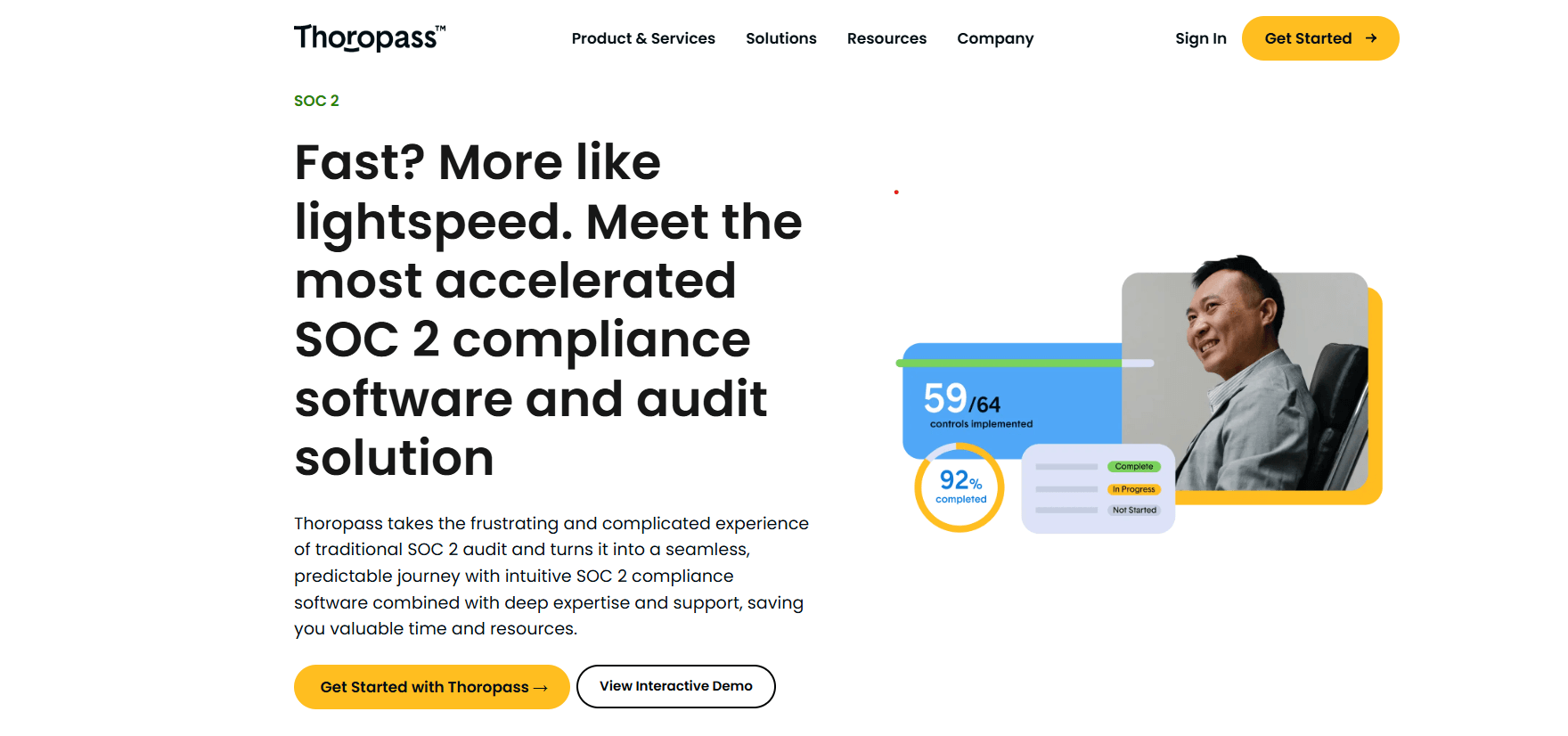
Thoropass (formerly Laika) takes a different approach from most names on this list: it bundles the compliance automation platform with an in-house audit team under one roof, since Thoropass itself operates as an AICPA peer-reviewed CPA firm, a PCI QSAC, and a HITRUST Accredited Assessor. That combination matters for expense management vendors that also need PCI DSS validation for card-linked features, since Thoropass can issue both attestations without handing the engagement to a second, unrelated firm. The platform’s ‘connected audit’ model gives in-house auditors direct access to the evidence workspace, cutting out the coordination overhead that typically comes from working with a completely separate audit firm.
Features
- First Pass AI that flags evidence gaps before the formal audit window opens
- Support for 30-plus frameworks, including SOC 2, ISO 27001, HIPAA, PCI DSS, and HITRUST
- Bundled penetration testing with 90-day free retesting on identified findings
- GenAI-powered responses to inbound security questionnaires from prospective customers
- Single-vendor project management spanning both Type I and Type II milestones
Pros
- One vendor handles both platform and audit, which simplifies procurement and reduces coordination delays
- Particularly attractive for expense management companies that need SOC 2 and PCI DSS in parallel
- Strong customer support and a clear, guided path for first-time compliance teams
Cons
- Interface can feel cluttered once a program scales across multiple frameworks
- Less flexible than dedicated enterprise GRC platforms for very large or complex organizations
Pricing
Thoropass pricing is custom and typically reflects both the software license and the level of professional services engagement.
Scytale markets itself around white-glove guidance, pairing its automation platform with a dedicated compliance expert from day one rather than leaving a company to configure everything alone. That model suits expense management teams without an internal security lead, since Scytale’s advisors can help scope which Trust Services Criteria actually apply to a reimbursement or corporate-card product. The platform runs several hundred automated tests daily and includes an AI-branded GRC agent for early-stage questionnaire support, though its integration count is narrower than the largest platforms in this list, and vendor risk management remains a manual process rather than a continuously monitored one.
Features
- Dedicated compliance expert assigned from the start of onboarding
- Approximately 90 integrations covering common cloud and SaaS tools
- AI-branded GRC agent plus early-access AI questionnaire support
- Support for SOC 2, ISO 27001, HIPAA, GDPR, PCI DSS, and SOX ITGC
- Framework-based pricing that keeps costs predictable as a program adds a second standard
Pros
- Advisory-heavy model works well for non-technical teams tackling their first framework
- Lower starting price than most enterprise-oriented GRC platforms
- Strong fit for EMEA-based expense management companies needing local compliance context
Cons
- Daily (rather than hourly) testing cadence creates a short blind spot for evidence freshness
- Vendor risk management lacks a dedicated portal or continuous monitoring
Pricing
Scytale offers straightforward pricing starting at approximately $7,000–$12,000 per year.
Hyperproof functions less like a startup’s first compliance tool and more like the operating system for a mature GRC program, which makes it a natural fit once an expense management company is running SOC 2 alongside ISO 27001, PCI DSS, and internal risk management simultaneously. Evidence collected for one framework automatically links to matching requirements across every other framework in scope, so a single artifact can satisfy several standards at once. Hyperproof treats controls like tickets, complete with owners, due dates, and reminders, which suits finance-tech organizations that need clear accountability across a growing compliance team rather than a single person tracking everything manually.
Features
- Centralized control library that maps one piece of evidence across multiple frameworks simultaneously
- Deep partner ecosystem of advisory and implementation firms for complex rollouts
- Configurable evidence collection schedules rather than fixed, always-on infrastructure testing
- Support for SOC 2, ISO 27001, PCI DSS, HIPAA, and dozens of additional frameworks
- Program-level reporting suited to boards and cross-functional risk committees
Pros
- Excellent fit for companies running three or more frameworks at once
- Strong workflow depth and configurability for complex, multi-team compliance programs
- Evidence reuse across frameworks saves significant time once a program matures
Cons
- Slower path to a first audit than startup-focused platforms like Sprinto or Scytale
- Custom, modular pricing can make budgeting difficult without a detailed scoping call
Pricing
Hyperproof pricing typically starts around $12,000–$18,000 per year and scales based on frameworks, users, and organizational size. Custom enterprise pricing is available for larger EdTech organizations.
Strike Graph stands out in this category for one specific reason: it publishes its pricing rather than forcing every buyer through a sales call, which appeals to lean expense management startups trying to budget accurately before committing. The platform pitches SOC 2 readiness in as little as eight weeks, built around a policy library, a readiness checklist, and enough core framework coverage to support a first Type 1 or Type 2 engagement. Strike Graph’s integration breadth is lighter than Vanta or Drata’s, so it fits best as a starting point for a 10 to 40-person company rather than as a long-term platform for a rapidly scaling finance-tech organization.
Features
- Readiness checklist and policy library built for a first SOC 2 Type 1 or Type 2 engagement
- Basic automated evidence collection across common cloud and SaaS integrations
- Guided workflow aimed at compressing time-to-audit-ready into roughly eight weeks
- Support for SOC 2 with additional framework options as a program grows
- Auditor coordination tools built into the core workspace
Pros
- The only platform in this list with genuinely public pricing, which simplifies budgeting
- Fast, straightforward path to a first SOC 2 report for small teams
- Lower cost of entry than most competitors covering similar core functionality
Cons
- Best suited to smaller companies; fast-growing programs may need to migrate platforms within 18 to 24 months
- Less depth for multi-framework, enterprise-scale compliance programs
Pricing
Strike Graph offers transparent pricing starting at around $7,500–$10,000 per year
OneTrust absorbed Tugboat Logic in 2021 and folded its SOC 2-focused workflows into a much larger enterprise privacy and governance suite, which makes OneTrust the natural choice for expense management companies that already run privacy, third-party risk, or ethics programs on the platform. Its ‘test once, comply many’ model maps a single piece of evidence across SOC 2, ISO 27001, PCI DSS, and more than 45 other standards at once, using a scoping wizard to narrow which controls actually apply before remediation work begins. For a finance-tech company handling both cardholder data and consumer personal information, consolidating privacy and security compliance onto one system of record can outweigh the added platform complexity.
Features
- Scoping wizard that narrows applicable controls before remediation work starts
- Automated policy generation based on scoped framework requirements
- Integration with OneTrust’s broader privacy, third-party risk, and ethics modules
- Support for SOC 2, ISO 27001, PCI DSS, HIPAA, CMMC, and dozens of additional frameworks
- Enterprise-grade reporting suited to organizations managing multiple concurrent audits
Pros
- Strong option for companies that already use OneTrust for privacy or third-party risk
- Broad framework cross-mapping reduces duplicated evidence work across programs
- Backed by a large, established vendor with deep enterprise GRC experience
Cons
- Some customers report feature friction following the Tugboat Logic to OneTrust transition
- Pricing and contracts are typically modular and enterprise-grade, often reaching six figures for full-suite adoption
Pricing
Entry-level OneTrust compliance automation pricing has been reported starting around $25,000 a year, though the historical Tugboat Logic tiers ranged from roughly $500 to $17,500 a year for smaller teams. Full enterprise adoption across multiple OneTrust modules commonly reaches six figures annually.
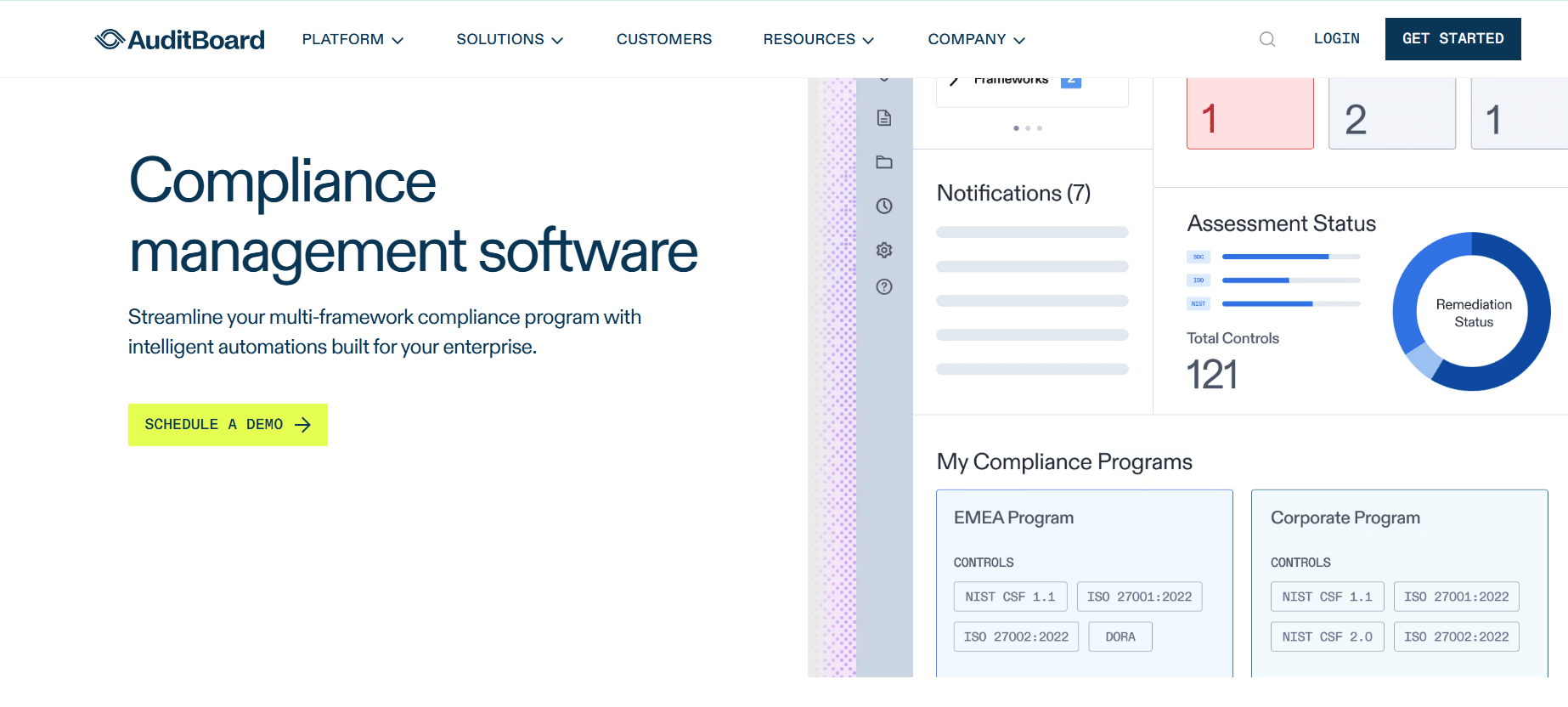
AuditBoard targets organizations where SOC 2 is only one piece of a much larger audit and risk portfolio, rather than the primary reason for buying the platform. It connects internal audit, SOX compliance, and IT risk management into a single connected system, which fits expense management companies that are pre-IPO or already public and therefore managing SOX controls alongside SOC 2. The platform functions more as a process-management system for a mature GRC program than as a plug-and-play automation tool for a first-time compliance team, so it tends to appear on shortlists for larger, more complex finance-tech organizations rather than early-stage startups.
Features
- Connected modules spanning internal audit, SOX compliance, IT risk, and SOC 2
- Centralized risk register shared across audit, compliance, and security teams
- Workflow automation for recurring SOX and SOC 2 control testing cycles
- Integration with common ERP and financial systems relevant to SOX-scoped controls
- Support for SOC 2 alongside broader enterprise risk and compliance frameworks
Pros
- Ideal for companies that need SOC 2 and SOX compliance managed on one connected platform
- Strong fit for pre-IPO or public expense management companies with mature audit functions
- Centralizes risk and controls across audit, compliance, and security teams
Cons
- Not a practical starting point for a first-time SOC 2 program
- Implementation and setup complexity are higher than lighter, startup-focused tools
Pricing
AuditBoard pricing is entirely custom and enterprise-focused. Expect annual contracts starting at $50,000 and scaling significantly based on modules, users, and organizational complexity.
A-LIGN is a licensed audit firm rather than a compliance automation platform, and it earns a place on this list because expense management companies eventually need an actual CPA firm to issue the SOC 2 report, no matter which automation tool prepared the evidence. A-LIGN’s A-SCEND platform bundles readiness software with its own in-house audit team, giving it a similar ‘one vendor for platform and audit’ structure to Thoropass, but backed by a longer-established audit firm track record. Because A-LIGN also performs PCI DSS assessments as a Qualified Security Assessor, it’s a strong option for expense management vendors that need both SOC 2 and PCI validation from a single, established audit partner.
Features
- Licensed CPA firm that issues SOC 2 Type I and Type II reports directly
- A-SCEND platform combining readiness automation with in-house audit delivery
- Support for SOC 1, SOC 2, ISO 27001, HITRUST, and FedRAMP engagements
- Established audit methodology built on decades of assurance-industry experience
- Dedicated audit teams familiar with fintech and payment-adjacent control environments
Pros
- Long-established audit firm reputation, useful when enterprise prospects scrutinize who signed the report
- One vendor for both platform and audit reduces coordination overhead
- Strong PCI DSS credentials, valuable for expense tools handling card data
Cons
- Platform automation and integration depth are narrower than dedicated SaaS-first tools
- Pricing is typically higher than software-only competitors given the bundled audit services
Pricing
A-LIGN’s pricing is quote-based and reflects both the audit engagement and any bundled A-SCEND platform access, generally landing in a comparable range to other bundled platform-plus-audit providers such as Thoropass, with SOC 2 Type II audit fees commonly running $15,000 to $60,000 depending on scope and company size.
Scrut Automation has built particular strength in mid-market compliance programs and includes built-in dynamic application security testing (DAST) alongside its evidence collection, which matters for expense management companies whose product surface includes customer-facing web and mobile applications processing payment data. The platform’s stated sweet spot sits between 100 and 500 employees, a range that captures many growth-stage expense management vendors expanding into new frameworks. Scrut’s combination of compliance automation and built-in security testing reduces the number of separate vendors a finance-tech company needs to stitch together to satisfy both SOC 2 evidentiary requirements and the underlying security testing many enterprise customers expect to see.
Key Features
- Built-in dynamic application security testing (DAST) alongside compliance evidence collection
- Continuous control monitoring across common cloud, identity, and SaaS integrations
- Support for SOC 2, ISO 27001, HIPAA, GDPR, and PCI DSS from one workspace
- Compliance manager support included through onboarding and audit preparation
- Reporting dashboards suited to a dedicated internal compliance function
Pros
- Strong mid-market fit, particularly for 100 to 500 employee expense management companies
- Built-in security testing reduces the need for a separate DAST vendor
- Reported to get customers audit-ready in under three months
Cons
- Custom pricing without a published price list makes early budgeting harder
- Best suited to companies with a dedicated compliance function rather than a first-time solo compliance owner
Pricing
Scrut Automation uses custom, quote-based pricing that generally starts around $12,000 to $15,000 a year