A sales enablement platform sits in one of the most sensitive parts of a customer’s business: the CRM. It handles prospect and customer records, call and email content, revenue data, and increasingly, AI models that process this information. By the time a deal reaches the security review stage, the buyer’s InfoSec team already expects your product to access customer identities, payment information, and sales conversations. That is why enterprise buyers can put a deal on hold when a security questionnaire comes back without a SOC 2 report.
Choosing the right SOC 2 audit firms for sales enablement software matters because the audit firm you work with can affect your audit cost, timeline, credibility with enterprise buyers, and how much work your engineering team has to take on. But “getting SOC 2” is not one decision. One of the biggest decisions is choosing the firm that will perform the actual examination.
This is also where many sales enablement founders and RevOps leaders get it wrong. They confuse a compliance automation platform, which helps collect evidence and prepare for an audit, with the CPA firm that performs the examination and issues the SOC 2 report.
This guide evaluates the SOC 2 audit firms for sales enablement software that are credible options for companies dealing with CRM integrations, prospect and customer data, sales content, AI-assisted recommendations, multi-tenant architecture, and enterprise security reviews. We separate firms that actually perform the SOC 2 examination from those that mainly provide readiness consulting or compliance software, and we explain where each firm fits, where it may fall short, and who should consider it.
The Top 12 SOC 2 Audit Firms for Sales Enablement Software
1. A-LIGN
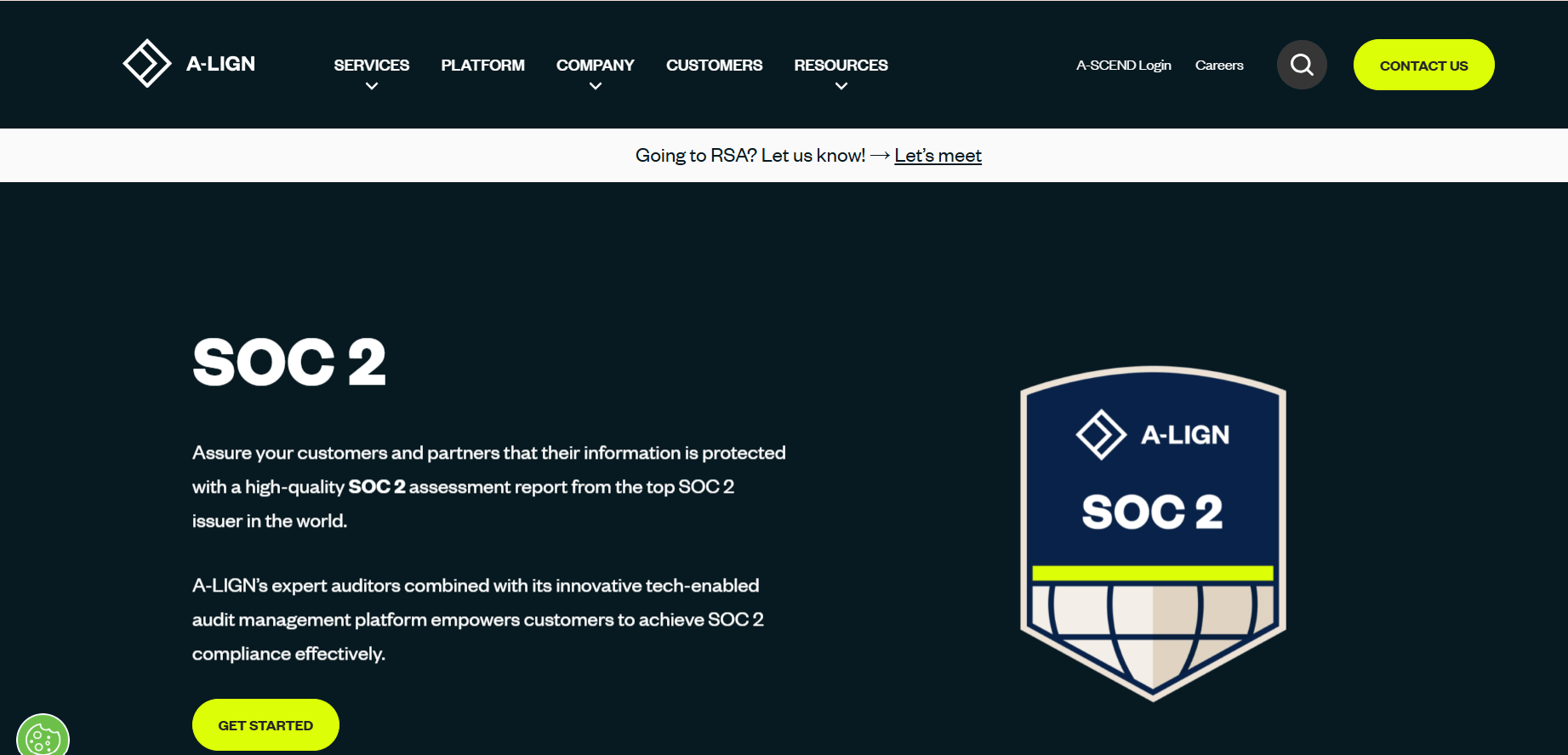
A-LIGN is one of the highest-volume SOC 2 practices in the US, built around its proprietary A-SCEND audit-management platform. For sales enablement platforms targeting large enterprises, A-LIGN’s biggest advantage is its breadth. The firm supports SOC 1, SOC 2, ISO 27001, HITRUST, FedRAMP, PCI DSS, and CMMC. As a result, companies can often manage several compliance requirements under one relationship.
Does it perform the actual audit? Yes. A-LIGN Assurance issues the SOC report through Price and Associates CPAs, LLC. The CPA firm is PCAOB-registered and AICPA-licensed. It also operates separately from A-LIGN’s consulting and technology arm. This separation gives buyers an important independence signal to consider.
Sales enablement fit: A-LIGN works with clients across SaaS, healthtech, and fintech. These industries share many of the risks found in sales enablement software. They handle sensitive customer data, cloud infrastructure, and third-party integrations.
Features
- SOC 2 audits: A-LIGN performs the actual SOC 2 examination.
- Multiple frameworks: It supports SOC 1, SOC 2, ISO 27001, HITRUST, FedRAMP, PCI DSS, and CMMC.
- A-SCEND platform: The proprietary platform helps manage the audit process and evidence.
- Audit management: A-SCEND can help reduce back-and-forth during evidence collection.
- SaaS experience: A-LIGN serves companies across SaaS and other data-sensitive industries.
- Multi-framework support: Companies can work with one provider as their compliance needs expand.
Pros
- Strong multi-framework coverage: This works well for companies planning to pursue more than SOC 2.
- Performs the actual audit: A-LIGN Assurance issues the SOC 2 report.
- Good SaaS fit: Its SaaS experience aligns with the security needs of sales enablement platforms.
- Audit management technology: A-SCEND can make evidence collection more organized.
- Scales with growing companies: Its broad services can support more complex enterprise requirements.
- Useful for enterprise sales: The range of frameworks can help companies respond to changing customer requirements.
Cons
- No public pricing: A-LIGN does not publish standard audit prices.
- May feel less hands-on: Its high-volume model may suit companies that already have strong controls in place.
- Not ideal for every startup: Early-stage teams may prefer a smaller firm with more hands-on support.
Pricing: pricing estimates vary: Estimates of roughly $15,000–$75,000 are market estimates, not official A-LIGN pricing.
Best fit: growth-stage to enterprise sales enablement platforms anticipating multiple framework requirements.
2. Schellman
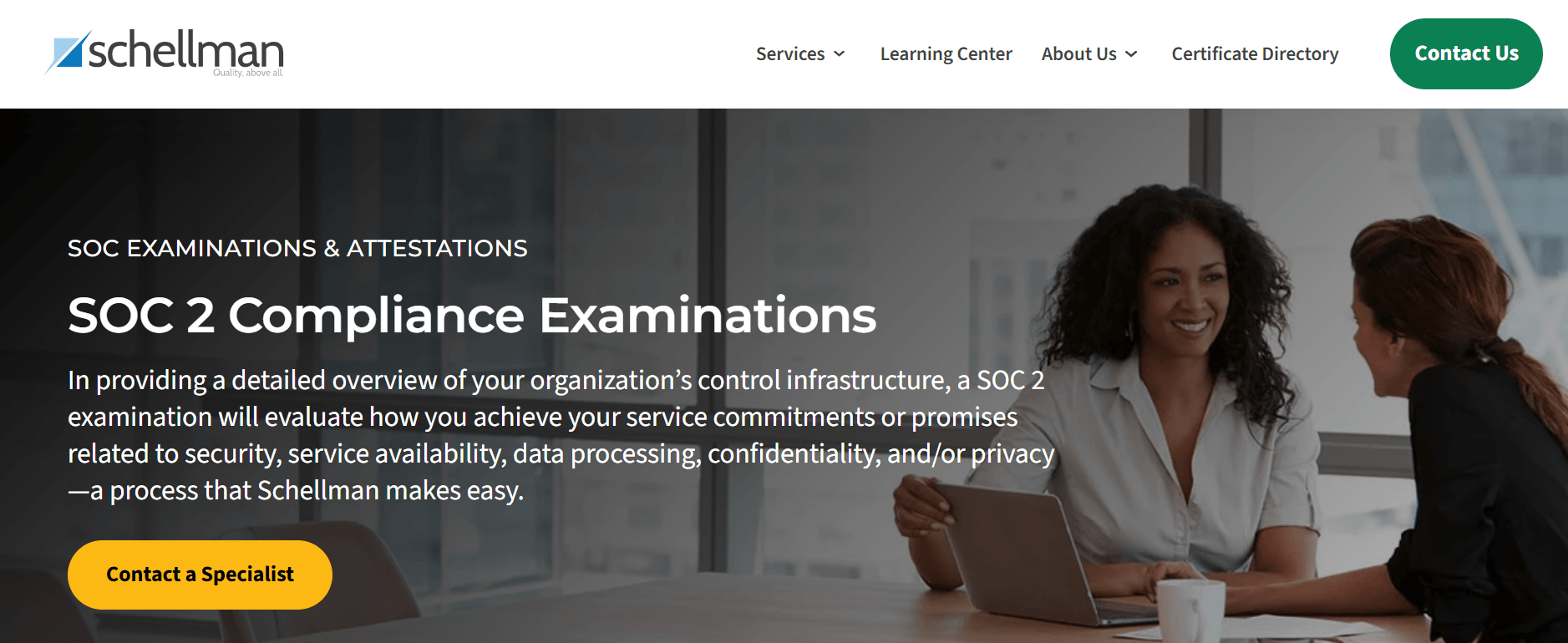
Schellman describes itself as the only Top 100 CPA firm that specializes exclusively in IT audit and cybersecurity. It does not treat SOC work as an add-on to financial-statement auditing.
The firm holds PCAOB registration. It is also the top-ranked FedRAMP 3PAO globally. In addition, Schellman states that it is the only assessor with a DoD Facility Security Clearance.
These credentials matter more for government-adjacent SaaS than pure sales enablement. However, they also point to a strong audit infrastructure.
Does it perform the actual audit? Yes. Schellman & Company is a fully licensed and accredited CPA firm. It also signs the SOC report.
Sales enablement fit: Schellman promotes a “single assessor” model. This allows companies to pursue SOC 2 and ISO 27001 at the same time. That can help sales enablement companies expanding into Europe, where ISO 27001 often carries more weight.
Features
- SOC 2 audit and examination services
- SOC 2 and ISO 27001 under a single assessor
- FedRAMP assessment services
- DoD-related security assessment experience
- IT audit and cybersecurity specialization
- Support for multiple compliance frameworks
- Partnerships with compliance automation platforms
Pros
- Strong enterprise reputation: Schellman has a strong presence among enterprise security teams.
- Broad technical expertise: Its IT audit and cybersecurity focus suits complex SaaS environments.
- AI governance support: The firm offers ISO 42001 and SOC-for-Supply-Chain capabilities.
- Independence focus: Schellman publicly addresses its approach to independence.
- Useful for global expansion: Companies can pursue SOC 2 and ISO 27001 through one assessor.
Cons
- May be too large for early-stage teams: Its enterprise and government experience can be more than a small startup needs.
- Limited price transparency: Schellman does not publish standard pricing.
- Potentially higher cost: Third-party estimates place Type II engagements around $20,000–$100,000.
- Estimated pricing only: The $20,000–$100,000 range is not Schellman’s official rate.
Pricing
- Public pricing: Not publicly available.
- Audit pricing: Custom quote.
Best fit: Growth-stage and enterprise sales enablement companies.
3. Sensiba LLP
Sensiba has one of the strongest AI governance stories on this list. It holds direct ANAB accreditation as a certification body for ISO 42001. It also supports ISO 27001, ISO 27701, ISO 27017, and ISO 27018.
That matters for sales enablement platforms using AI-generated content, call summaries, or recommendations. Sensiba also works with Drata, Vanta, Secureframe, and Sprinto.
Features
- SOC 2 audit services
- ISO 42001 certification
- ISO 27001 certification
- ISO 27701 support
- ISO 27017 and ISO 27018 support
- Direct ANAB accreditation for ISO 42001
- Readiness and compliance support
- Support for Drata, Vanta, Secureframe, and Sprinto
- Global reach through AssuranceLab
Pros
- Strong AI governance: Direct ISO 42001 accreditation is a major differentiator.
- Good fit for AI-enabled sales software: This suits products using AI-generated content and recommendations.
- Broad framework support: Companies can pursue several standards as they grow.
- Multiple automation platforms: Sensiba works across Drata, Vanta, Secureframe, and Sprinto.
- Growing international reach: The AssuranceLab acquisition expands its APAC and EMEA capabilities.
Cons
- No public rate card: Buyers cannot easily compare its pricing upfront.
- Pricing savings are a vendor claim: Sensiba says fixed-fee pricing can be 25–30% below competitors. That claim has not been independently verified.
- Global integration is relatively new: The AssuranceLab acquisition happened recently.
- May be unnecessary for some companies: Businesses without AI features may not need its strongest differentiators.
Pricing
Public pricing: Not publicly available.
Best fit: VC-backed and growth-stage sales enablement SaaS.
4. Coalfire
The firm operates at a scale comparable to A-LIGN and Schellman. It has more than 1,000 staff and completes thousands of assessments each year. Its work spans SOC, FedRAMP, PCI, HITRUST, and other frameworks.
Does it perform the actual audit? Yes. Coalfire Controls is a fully licensed and accredited CPA firm. It issues the SOC report.
Sales enablement fit: Coalfire has deep roots in FedRAMP and PCI DSS. Its SOC 2 practice is part of a much broader cybersecurity assessment business.
That breadth can help sales enablement companies that process payment data. It can also help companies targeting federal or public-sector customers.
Features
- SOC 2 audit services
- PCI DSS assessments
- FedRAMP assessments
- CMMC support
- HITRUST support
- ISO 27001 and ISO 42001
- Large-scale cybersecurity assessment capabilities
- Support for complex SaaS environments
- Cloud security expertise
Pros
- Broad framework coverage: Companies can manage SOC 2 alongside PCI DSS, FedRAMP, CMMC, HITRUST, and ISO.
- Large assessment capacity: Its size suits complex and multi-entity SaaS environments.
- Strong cybersecurity background: Coalfire brings more than traditional accounting expertise.
- Good government fit: FedRAMP and CMMC experience can support public-sector expansion.
- Useful for payment-related products: PCI DSS expertise can help if the platform handles payment data.
Cons
- Higher estimated cost: Third-party estimates put its pricing toward the higher end of the specialist market.
- Estimated pricing only: The published ranges are not confirmed Coalfire quotes.
- Potentially too broad for simple needs: A company pursuing only SOC 2 may not need its wider framework capabilities.
- May be more than a startup needs: Smaller companies may prefer a boutique provider.
Pricing
Public pricing: Not publicly available.
Best fit: Sales enablement platforms that need SOC 2 plus PCI DSS, FedRAMP, or CMMC.
5. BARR Advisory
The firm positions itself as a fully cloud-based cybersecurity and compliance provider. BARR states that it is one of a small number of US firms eligible to audit against ISO 27001, SOC 2, HITRUST, PCI DSS, and CMMC.
Does it perform the actual audit? Yes. BARR Advisory is a licensed CPA firm accredited by the AICPA.
Sales enablement fit: BARR focuses on cloud evidence. Its audit team does not split its attention between cloud-native and legacy on-premises environments. That can help sales enablement platforms running fully on AWS or another major cloud provider. It may also reduce unnecessary evidence requests during the audit.
Features
- SOC 2 audit services
- ISO 27001
- HITRUST
- PCI DSS
- CMMC
- Cloud-based audit methodology
- Cloud evidence management
- AICPA-accredited CPA audit services
Pros
- Cloud-native approach: This fits SaaS companies with fully cloud-based infrastructure.
- Less legacy focus: Teams running on AWS, Okta, and GitHub may benefit from its approach.
- Multi-framework support: Companies can add ISO 27001, HITRUST, PCI DSS, or CMMC later.
- Strong reported satisfaction: BARR reports a net promoter score of 89.
- Good SaaS fit: Its methodology aligns closely with modern cloud environments.
Cons
- Cloud-only focus: This may not suit companies with significant on-premises infrastructure.
- Limited public pricing: Buyers need to request a quote.
- Potentially less suitable for hybrid environments: Companies with legacy systems may need a different audit approach.
Pricing
Public pricing: Not publicly available.
Best fit: Growth-stage sales enablement SaaS running fully on the cloud.
6. Prescient Assurance
Prescient Security was founded in 2018 by CREST-certified penetration testers. The firm now operates with a distributed team of more than 200 people across the US, EMEA, and APAC.
Does it perform the actual audit? Yes. Prescient Assurance LLC issues the SOC 2 report. The firm describes this entity as its licensed and AICPA-accredited CPA division.
Sales enablement fit: Prescient started from a cybersecurity background rather than traditional accounting. That gives it a technical angle. This can help sales enablement platforms with large application-security surfaces. APIs, CRM integrations, and AI features can all require deeper technical review.
Features
- SOC 2 audit services
- ISO 42001 support
- Penetration testing
- Application security expertise
- Vanta integration
- Drata integration
- Secureframe integration
- Slack and Teams communication
- Distributed US, EMEA, and APAC team
Pros
- Strong technical background: Its cybersecurity roots suit engineering-heavy SaaS companies.
- Good API and integration fit: This can help platforms with complex CRM and API environments.
- AI governance support: It can combine SOC 2 with ISO 42001.
- Penetration testing: The firm can combine audit work with security testing.
- Fast communication: Same-day Slack and Teams response is a notable differentiator.
Cons
- Peer-review status needs verification: One independent directory lists its AICPA peer-review status as unknown.
- Limited public timeline information: Prescient does not publish a standard audit timeline.
- Reliance on client reports: Some turnaround information comes from client-reported experiences.
- Buyers should verify credentials: Companies should confirm current accreditation and peer-review status directly.
Pricing
Public pricing: Not publicly available.
Best fit: Engineering-led sales enablement startups.
7. KirkpatrickPrice
KirkpatrickPrice serves around 2,000 clients across SaaS, managed services, fintech, and healthcare technology.The firm uses an “education-forward” audit approach. It also has a proprietary Online Audit Manager. KirkpatrickPrice is an AICPA- and PCAOB-accredited licensed CPA firm.
Sales enablement fit: Its client base overlaps with many of the buyers served by sales enablement software. This includes SaaS and fintech companies selling to mid-market and enterprise customers.
Its pricing transparency also stands out. Third-party sources cite a bundled Year 1 package at around $30,000. They also estimate renewals at around $25,000.
These figures come from a third-party directory, so buyers should confirm them directly.
Features
- SOC 2 audit services
- SOC 1 and other assurance services
- Online Audit Manager
- AICPA accreditation
- PCAOB accreditation
- PCI DSS support
- HITRUST support
- FISMA support
- Experience with SaaS and fintech
Pros
- More predictable pricing: Third-party sources provide useful pricing estimates.
- Strong accreditation: AICPA and PCAOB credentials support its audit credibility.
- Broad framework experience: PCI DSS, HITRUST, and FISMA can support future requirements.
- Strong SaaS experience: Its client base includes SaaS and technology companies.
- Long-term partner potential: Its model can suit companies that want to stay with one auditor.
Cons
- More traditional audit approach: Some engagements may include onsite visits.
- Less remote-first: This may not suit companies that want a fully remote process.
- Smaller enterprise bench: It may have less capacity than A-LIGN, Schellman, or Coalfire.
- Pricing is not officially published: Third-party estimates should be confirmed.
Pricing
Public pricing: Not officially published.
Best fit: Mid-market sales enablement SaaS.
8. Linford & Company LLP
Former Big Four auditors and information security specialists built the firm. Linford emphasizes partner involvement throughout each engagement. Linford & Company LLP is a licensed CPA firm. It issues SOC 1, SOC 2, SOC 3, SOC for Cybersecurity, and SOC for Supply Chain reports directly.
Sales enablement fit: Linford emphasizes the credibility of the enterprises that rely on reports it has issued for vendors. Its materials name companies such as Amazon, Chase, Google, Microsoft, and PayPal.
This can be a useful credibility signal for sales enablement companies selling to large enterprises. However, these companies are described as customers of Linford-audited vendors. They should not be interpreted as Linford’s own client list.
Features
- SOC 1 audits
- SOC 2 audits
- SOC 3 reports
- SOC for Cybersecurity
- SOC for Supply Chain
- HITRUST
- FedRAMP
- ISO 27001
- PCI DSS
- Partner-level audit involvement
Pros
- Experienced audit team: The firm has Big Four experience without operating as a Big Four firm.
- Strong partner involvement: Senior professionals remain involved throughout engagements.
- Broad framework support: Companies can add HITRUST, FedRAMP, ISO 27001, or PCI DSS.
- Strong enterprise credibility: Its reports support vendors serving major enterprises.
- Good fit for mature SaaS: Companies with established controls can benefit from its audit-focused model.
Cons
- Less automation-focused: Its workflow is less centered on modern compliance platforms.
- Limited readiness support: Companies may need a separate readiness partner.
- Not ideal for first-time audits: Teams that need significant remediation support may need more help.
- No public pricing: Buyers must request a quote.
Pricing
Public pricing: Not publicly available.
Best fit: Mid-market and enterprise sales enablement platforms.
9. Thoropass
Thoropass, formerly Laika, combines a compliance automation platform with an in-house CPA firm. Its model aims to remove the handoff between a GRC platform and a separate audit firm.
Does it perform the actual audit? Yes, but its structure needs attention. Laika Compliance, LLC, doing business as Thoropass Assurance, signs the report.
The CPA entity is legally separate from Thoropass, Inc., the software company. However, both entities share common ownership. That means the audit is performed by a real licensed CPA firm. However, the audit firm is commercially affiliated with the software provider.
Sales enablement fit: Thoropass can simplify the process for early-stage sales enablement companies. Instead of choosing a GRC platform and an audit firm separately, companies can use one provider.
Features
- SOC 2 audit services
- Compliance automation platform
- Evidence collection
- SOC 2 and ISO 27001
- HIPAA
- HITRUST
- PCI DSS
- Combined software and audit offering
- Single-vendor compliance workflow
Pros
- Public pricing: Thoropass is one of the more transparent options on this list.
- Single vendor: Companies can manage compliance software and auditing through one provider.
- Simpler first audit: This can reduce the work involved in coordinating multiple vendors.
- Multiple frameworks: Companies can expand beyond SOC 2.
- Good startup fit: The combined model can work well for early-stage teams without a GRC platform.
Cons
- Affiliated audit structure: The CPA firm shares common ownership with the software company.
- Independence may matter: Companies with strict auditor-independence preferences should consider this structure carefully.
- Narrower framework range: Its catalog is not as broad as some larger providers.
- May not suit enterprise buyers: Some companies may prefer a traditional, unaffiliated CPA firm.
Pricing
- Platform: Approximately $8,700 per year.
- SOC 2 audit subscription: Approximately $5,800 per year.
- Estimated combined cost: Approximately $14,500 per year before any scope-related adjustments.
- Important: Pricing may vary. Confirm current pricing and scope directly.
Best fit: Pre-Series A through Series B sales enablement startups.
10. Johanson Group LLP
The firm has roughly 12–20 professionals and operates virtually. Its model centers on helping startups complete compliance audits quickly. Johanson Group LLP is an AICPA member firm. It participates in the Peer Review Program and is a licensed Colorado CPA firm.
It also holds direct IAS accreditation as an ISO 27001 certification body. This means it can issue ISO certificates rather than only provide advisory services.
Sales enablement fit: Johanson targets a common startup problem. An enterprise prospect asks for SOC 2 before signing a contract, and the startup needs to move quickly.
Johanson runs its audits entirely on Drata. Third-party sources report Type I turnaround times as fast as one to three weeks. The Type II observation period can also begin in parallel.
Features
- SOC 2 audits
- SOC 2 Type I
- SOC 2 Type II
- ISO 27001 certification
- Drata-based audit workflow
- Virtual audit process
- AICPA membership
- Peer Review Program participation
- English and Spanish support
Pros
- Fast audit process: The firm focuses on helping technology startups move quickly.
- Startup-friendly model: Its approach suits smaller engineering teams.
- Virtual delivery: The firm operates remotely.
- ISO 27001 capability: Companies can add ISO certification as they grow.
- Simple process: Running audits through Drata can reduce manual work.
Cons
- Boutique capacity: The firm may not suit very large or complex enterprises.
- Limited public evidence: Its public client and pricing information is thinner than larger firms.
- Limited scalability: Multi-entity companies may eventually outgrow the model.
- Pricing is not official: Third-party estimates need to be confirmed directly.
Pricing
- Public pricing: Not publicly available.
- Estimated Type I pricing: Some third-party sources cite around $15,000.
Best fit: Pre-Series A and Series A sales enablement startups.
11. 360 Advanced
The company states that it supports organizations ranging from emerging SaaS companies to Fortune 500 enterprises. Its services include SOC 1, SOC 2, and SOC 3 examinations. It also supports ISO certifications, FedRAMP, PCI DSS, HITRUST, and CMMC. As a licensed CPA firm, 360 Advanced performs SOC examinations directly. It also provides readiness assessments and gap analyses.
Sales enablement fit: 360 Advanced takes a broad approach rather than focusing specifically on sales enablement. It emphasizes data protection and encrypted collaboration across different company sizes and industries.
That broad coverage can work well for sales enablement companies that expect to scale significantly. It also gives them the option to maintain one audit relationship as their needs change.
Features
- SOC 1 audits
- SOC 2 audits
- SOC 3 reports
- ISO certifications
- FedRAMP
- PCI DSS
- HITRUST
- CMMC
- Readiness assessments
- Gap analyses
- Support for startups and Fortune 500 companies
Pros
- Broad framework coverage: Companies can expand beyond SOC 2.
- Wide client range: The firm supports both startups and large enterprises.
- Long operating history: 360 Advanced was founded in 2009.
- Audit and readiness support: Companies can access both services through one firm.
- Good continuity: Companies may not need to switch auditors as they grow.
Cons
- Limited sales-enablement specialization: Public materials do not show a deep focus on sales technology.
- Fewer CRM-specific examples: Public case studies are less sales-enablement-focused than some competitors.
- No public pricing: Buyers need a custom quote.
- Limited public timeline data: Typical engagement timelines are not clearly published.
Pricing
Public pricing: Not publicly available.
Best fit: Sales enablement companies seeking a long-term audit relationship.
12. Zero Day CPA, PC

Zero Day CPA specializes in SOC 1, SOC 2, SOC 3, and HIPAA audits. The firm focuses on B2B SaaS and other service organizations. It is a licensed CPA firm. It performs examinations directly and also provides readiness assessments and gap analyses. The firm can combine Type II with other frameworks, such as HIPAA or PCI DSS.
Zero Day targets pre-revenue and early-stage startups. That makes it relevant for sales enablement founders trying to close their first enterprise customers without a large compliance budget. Third-party sources say its audit managers have experience at Big Four or major national accounting firms. This supports its positioning around enterprise-level audit experience at boutique scale.
Features
- SOC 1 audits
- SOC 2 audits
- SOC 3 reports
- HIPAA audits
- Readiness assessments
- Gap analyses
- Type II audits
- Combined framework engagements
- B2B SaaS focus
- Remote and onsite engagement options
Pros
- Startup-friendly: The firm focuses on early-stage companies.
- Budget-conscious model: Fixed-fee structures can make planning easier.
- Direct communication: Reviewers have highlighted its communication style.
- Flexible delivery: Companies can use remote or onsite engagement options.
- SaaS focus: Its B2B SaaS specialization fits sales enablement companies well.
Cons
- Small firm: Zero Day has a smaller public track record than larger firms.
- Limited enterprise scale: Fast-growing companies may eventually need a larger audit firm.
- Estimated pricing only: Third-party sources cite low entry pricing, but buyers should confirm it directly.
- Potential need to switch later: Companies expecting rapid growth should consider their long-term audit needs.
Pricing
- Public pricing: Not publicly available.
- Estimated Type II entry price: Around $7,000, according to third-party sources.
Best fit: Pre-revenue and early-stage sales enablement startups.