

A robo-advisory startup handles something most software companies never touch directly: another person’s money and the sensitive financial data behind it. Consequently, institutional partners, custodians, and enterprise clients rarely sign a contract with a robo-advisor before confirming that its security controls hold up to independent scrutiny. That is precisely what a SOC 2 report proves, and it is why choosing the right SOC 2 providers for robo-advisory startups has become one of the most consequential early decisions a fintech founder makes.
Unlike a generic SaaS company, a robo-advisory platform typically layers SOC 2 on top of SEC or FINRA registration requirements, and it often needs to demonstrate PCI DSS alignment as well once it starts moving client funds. As a result, picking a compliance partner involves more than comparing dashboards; it requires finding a provider that actually understands the regulatory stack a registered investment adviser operates under. Furthermore, because time-to-audit directly affects how quickly a startup can close its first institutional client or bank partnership, speed and reliability matter just as much as price.
With that context in mind, this article breaks down the twelve best options available today, spanning automation platforms, managed compliance services, and the CPA audit firms that ultimately sign the report. By the end, founders will have a clear, side-by-side view of the top SOC 2 providers for robo-advisory startups and a practical framework for matching the right partner to their team size, budget, and growth stage.
Top 12 Best SOC 2 Providers for Robo-Advisory Startups

Vanta leads the compliance automation market, and it does so by connecting directly to a robo-advisory startup’s cloud stack, HR system, and version control tools to pull evidence automatically instead of forcing a founder to chase screenshots. Because Vanta maintains partnerships with a wide network of CPA audit firms, a robo-advisory startup can move from onboarding to audit-ready evidence in a matter of weeks rather than months.
Features
- Continuous, automated monitoring of security controls across cloud infrastructure
- A large integration marketplace spanning AWS, Google Cloud, GitHub, Okta, and payroll tools
- A built-in trust portal that lets a robo-advisor showcase its security posture to institutional partners
- Risk register and vendor risk management modules tailored to financial services vendors
- Direct auditor collaboration hub that speeds up fieldwork
Pros
- Fastest reported time to first SOC 2 audit among major platforms
- Extensive integration library reduces manual evidence gathering
- Widely recognized by enterprise buyers, which matters when a robo-advisor sells into banks or broker-dealers
Cons
- Pricing is quote-based and can climb quickly as headcount and frameworks grow
- Some advanced modules, such as vendor risk management, cost extra
Pricing. Vanta does not publish flat pricing; mid-market license fees typically run roughly $7,000 to $30,000 per year, with the CPA audit fee added on top.

Drata takes automation a step further than most rivals by running daily automated tests against more than 250 integrations and cross-mapping evidence across more than twenty frameworks. For a robo-advisory startup that expects to add ISO 27001, PCI DSS, or SOC 1 alongside SOC 2 as it scales, that cross-mapping saves a meaningful amount of duplicated work.
Features
- Daily automated control testing rather than periodic spot checks
- Cross-framework evidence mapping across SOC 2, ISO 27001, PCI DSS, and more
- Built-in auditor access so a CPA firm can review evidence without leaving the platform
- Policy template library and employee security-training workflows
- Trust center for sharing real-time compliance status with prospective investors and partners
Pros
- Deep automation reduces the manual burden on a lean founding team
- Strong fit for teams that will eventually pursue multiple frameworks
- Robust reporting that satisfies sophisticated institutional due-diligence teams
Cons
- Costs rise noticeably as a robo-advisor adds frameworks or integrations
- Like every automation platform, Drata still requires a separate CPA audit engagement
Pricing. Drata’s license fees generally sit in the same 7,000–30,000 annual band as its closest competitors, scaled by company size and the number of frameworks pursued.
Secureframe pairs automated evidence collection with an integrated security-awareness training module, which removes one more vendor from a robo-advisor’s stack. With more than 300 integrations and support for over 35 frameworks, Secureframe positions itself as a single home for both SOC 2 readiness and the training documentation auditors expect from every employee.
Features
- Automated daily control monitoring across cloud, identity, and device-management tools
- Built-in security-awareness training so employee attestations live in one place
- Policy creation tools with pre-built templates suited to financial services companies
- Vendor risk management for third-party fintech infrastructure providers
- A public trust portal for sharing audit status with clients and partners
Pros
- Intuitive interface that shortens onboarding for non-technical founders
- Bundled training cuts down on separate compliance-tool spend
- Strong fit for small and mid-sized teams
Cons
- Costs increase at scale, similar to other automation platforms
- A robo-advisor still needs an outside CPA firm to issue the actual report
Pricing. Secureframe’s plans are quote-based, generally landing near the 7,000–20,000 range for early-stage companies, with add-ons priced separately.

Sprinto was built with early-stage companies in mind, and it shows in its prescriptive, step-by-step workflow that walks a first-time founder through every control instead of assuming prior compliance experience. Because so many robo-advisory startups pursue SOC 2 well before Series A, Sprinto’s guided approach often shortens the runway to audit readiness.
Features
- Prescriptive, task-by-task workflows for teams new to compliance
- Entity-level risk assessments suited to regulated financial startups
- Integrations with common cloud, HR, and developer tools
- In-platform audit collaboration with partner CPA firms
- Around-the-clock support channels for founders working outside standard hours
Pros
- One of the fastest platforms to implement for seed-stage teams
- Clear, opinionated guidance reduces decision fatigue for non-security founders
- Competitive pricing relative to Vanta and Drata
Cons
- Less configuration flexibility for complex, multi-entity fintech structures
- Advanced frameworks beyond SOC 2 may require add-on modules
Pricing. Sprinto typically prices in the 7,000–15,000 annual range for startups, making it one of the more accessible SOC 2 providers for robo-advisory startups on a tight budget.
Scytale pairs its automation platform with dedicated compliance experts and an AI-driven assistant named Scy, which reviews evidence and flags gaps before an auditor ever sees them. That combination of software and human guidance appeals to robo-advisory startups that lack an in-house security hire but still need enterprise-grade rigor.
Features
- Automated evidence collection and continuous control monitoring
- AI-powered evidence review through the Scy assistant
- User access reviews and vendor risk management built into the core plan
- Multi-framework cross-mapping across SOC 2 and ISO 27001
- Dedicated compliance experts assigned to each customer account
Pros
- Human expert support reduces the risk of costly missteps for first-time founders
- AI review shortens the time spent chasing incomplete evidence
- Strong customer sentiment on independent review sites
Cons
- Smaller brand footprint than Vanta or Drata among enterprise procurement teams
- Expert support may carry additional cost at higher service tier
Pricing. Scytale offers custom quotes, generally comparable to other mid-market automation platforms, with expert-led packages priced at a premium.
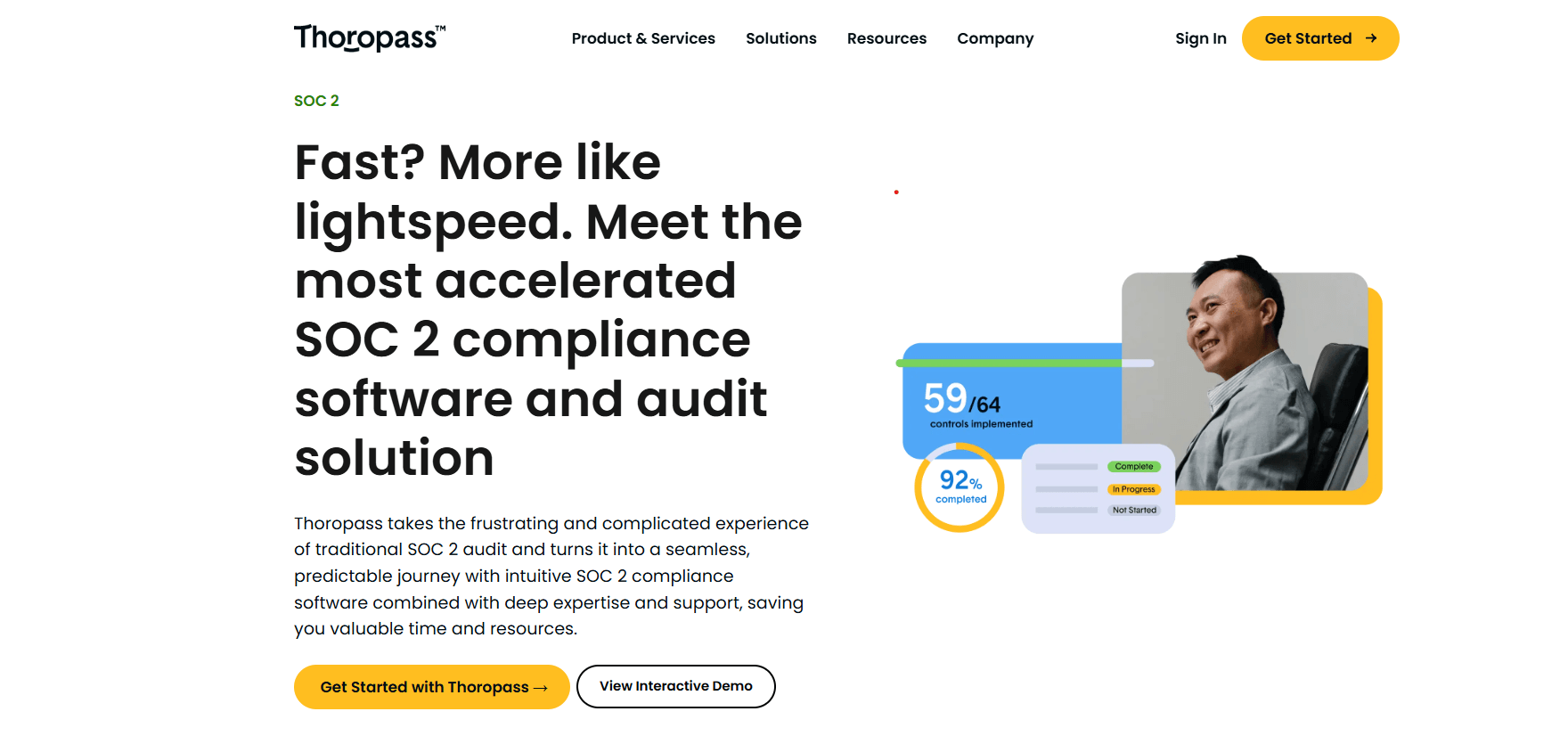
Thoropass distinguishes itself by bundling the compliance automation platform and the audit itself under one roof, so a robo-advisory startup never has to hand evidence off between a GRC vendor and a separate CPA firm. That single-vendor model can matter for a fintech company juggling SOC 2 alongside PCI DSS or SOC 1.
Features
- Compliance automation covering SOC 2, ISO 27001, HIPAA, and PCI DSS
- An in-house audit team that issues the report directly
- Audit-readiness dashboards that show real-time control status
- Support for multiple simultaneous frameworks under one engagement
- Dedicated customer success support through the full audit cycle
Pros
- Removes the handoff friction between software vendor and audit firm
- Single point of accountability simplifies vendor management for lean teams
- Convenient for robo-advisors that need both SOC 2 and PCI DSS
Cons
- The bundled model can cost more upfront than buying software and an audit separately
- Less well known outside the compliance-automation niche
Pricing. Thoropass quotes bundled packages that typically fall between $20,000 and $50,000 for a first-year SOC 2 Type II engagement, software and audit included.
Oneleet, a YC-backed company founded by an offensive-security specialist, treats compliance and real security as the same problem rather than two separate workstreams. Manual penetration testing, continuous monitoring, and even a virtual CISO all feed directly into the evidence a robo-advisory startup needs for its SOC 2 report, instead of leaving security testing as a separate line item.
Features
- Automated evidence collection paired with continuous control monitoring
- Manual penetration testing performed by certified offensive-security experts
- Virtual CISO (vCISO) support and attack-surface management
- AI-assisted responses to enterprise security questionnaires
- Code security scanning integrated into the same platform
Pros
- Genuine security work doubles as audit evidence, which matters when handling client financial data
- vCISO guidance benefits founders without a dedicated security leader
- Backed by credible investors and a security-first founding team
Cons
- Bundled services push the total cost toward the higher end of the startup tier
- Smaller integration ecosystem than the largest automation platforms
Pricing. Oneleet does not publish pricing; market feedback places it among the pricier startup-tier options once penetration testing and vCISO services are included.
ComplyJet takes a fully managed, done-for-you approach that suits seed-to-Series A robo-advisory startups whose founders would rather build their product than learn compliance from scratch. Instead of handing a founder a dashboard and a checklist, ComplyJet effectively owns the compliance outcome on the company’s behalf.
Features
- Fully managed evidence collection handled by a dedicated compliance manager
- Audit coordination from readiness through report delivery
- Policy drafting tailored to early-stage financial technology companies
- Transparent, flat annual pricing rather than opaque quotes
- Ongoing support to keep controls current between audit cycles
Pros
- Founders do not need in-house compliance expertise to get started
- Transparent pricing simplifies early-stage budgeting
- Hands-off model frees engineering time for product work
Cons
- May not scale as smoothly once a robo-advisor needs multiple complex frameworks
- Smaller company with a shorter track record than the category leaders
Pricing. ComplyJet publishes pricing starting near $5,000 per year, making it one of the most transparently priced SOC 2 providers for robo-advisory startups still pre-revenue or pre-Series A.
Workstreet operates as a managed service on top of Vanta, and it markets itself as Vanta’s top-performing implementation partner, serving thousands of fast-growing companies. Rather than replacing the software, Workstreet layers a hands-on compliance team over it, which effectively gives a robo-advisory startup a fractional compliance department without a full-time hire.
Features
- Full Vanta implementation and ongoing program management
- Dedicated fractional compliance staff handling day-to-day evidence work
- Audit preparation and direct coordination with the CPA audit firm
- Policy authorship customized to financial services requirements
- Continuous vendor risk management on the client’s behalf
Pros
- Combines a leading software platform with real human expertise
- Meaningfully reduces the internal workload on a small founding team
- Well suited to robo-advisors without a dedicated security or compliance hire
Cons
- Less appealing to teams that prefer to run compliance entirely in-house
- Ties the customer to Vanta as the underlying platform
Pricing. Workstreet charges a managed-service fee in addition to the Vanta license, with total programs commonly landing in the 15,000–40,000 range depending on scope.
A-LIGN is a licensed CPA firm and PCI Qualified Security Assessor, which means it can run a coordinated SOC 2 and PCI DSS engagement under one roof — a meaningful advantage for a robo-advisor that moves client funds and therefore touches payment-card or bank-transfer data. Its A-SCEND audit-management platform and AI-driven evidence scoring keep fieldwork efficient even for a lean startup team.
Features
- Licensed CPA firm issuing SOC 2 Type I and Type II reports directly
- PCI QSA designation enabling combined SOC 2 and PCI DSS engagements
- ISO 27001 certification body status and FedRAMP 3PAO authorization
- A-SCEND platform with AI-based evidence scoring to speed fieldwork
- Fixed-fee engagement options for predictable budgeting
Pros
- One firm covers both SOC 2 and PCI DSS, avoiding a second vendor relationship
- Deep fintech and healthcare audit experience
- Fixed-fee pricing gives founders budget certainty
Cons
- Best suited once a robo-advisor has real audit scope, not pre-product testing
- Engagement scheduling can be longer than smaller specialist firms
Pricing. A-LIGN typically quotes SOC 2 Type II engagements between $15,000 and $75,000, depending on scope, with fixed-fee packages available.
Final thought. A-LIGN belongs on any shortlist of SOC 2 providers for robo-advisory startups that also need PCI DSS coverage from a single, accredited audit firm.
Schellman operates exclusively as an IT audit and compliance firm, without a software product to sell alongside its opinions, which some robo-advisory founders see as an advantage when it comes to auditor independence. Its accreditation list — SOC 2, ISO 27001, HIPAA, PCI DSS, HITRUST, FedRAMP, and CMMC — covers nearly every framework a growing fintech company is likely to encounter.
Features
- Exclusive focus on IT audit and compliance, with no competing software product
- Broad accreditation spanning SOC 2, ISO 27001, PCI DSS, HITRUST, FedRAMP, and CMMC
- Fixed-fee engagement options
- Deep bench of fintech, SaaS, and cloud-infrastructure audit experience
- Works alongside Vanta, Drata, and Secureframe evidence exports
Pros
- Strong reputation among institutional partners and enterprise buyers
- One-stop shop for a regulatory-heavy fintech framework roadmap
- No conflict of interest between selling software and issuing an opinion
Cons
- Higher fees than boutique or regional CPA firms
- Offers limited pre-audit readiness tooling, so most clients pair it with a GRC platform
Pricing. Schellman’s SOC 2 Type II engagements generally range from $20,000 to $95,000 depending on scope and the number of frameworks bundled together.
Final thought. Schellman is an excellent choice among SOC 2 providers for robo-advisory startups that expect to grow into a multi-framework, enterprise-grade compliance program.
KirkpatrickPrice runs a boutique CPA practice with documented fintech engagement experience and one of the more transparent published pricing ranges in the audit-firm category. For a robo-advisory startup that wants a personal relationship with its auditors rather than a large, impersonal national firm, KirkpatrickPrice offers a smaller, more accessible alternative.
Features
- SOC 1 and SOC 2 Type I and Type II audit services
- PCI DSS, HIPAA, and ISO 27001 audit capability
- Ongoing risk assessment services beyond the audit itself
- A dedicated audit liaison assigned to each engagement
- Published, fintech-specific pricing ranges
Pros
- Transparent pricing simplifies early budgeting decisions
- Boutique service model gives founders direct access to senior auditors
- Documented fintech specialization
Cons
- Smaller brand recognition than national or Big Four firms
- Limited automation tooling of its own, so most clients pair it with a GRC platform
Pricing. KirkpatrickPrice publishes a documented SOC 2 Type II range of roughly $15,000 to $50,000 for fintech engagements.
Final thought. KirkpatrickPrice rounds out this list of SOC 2 providers for robo-advisory startups nicely for founders who want boutique, personalized audit service at a transparent price.