When it comes to protecting sensitive customer data, the best SOC 2 compliance solutions for B2B platforms do far more than check regulatory boxes. They actively build the trust that enterprise clients demand before signing any contract. As data breaches grow more sophisticated, procurement teams now scrutinize vendor security more rigorously than ever. As a result, SOC 2 compliance has shifted from a “nice-to-have” to a non-negotiable business requirement.
Navigating the SOC 2 landscape can feel overwhelming, especially for fast-growing B2B companies. These teams must balance product development with security obligations simultaneously. However, the right compliance solution streamlines the entire process. It covers everything from evidence collection and policy management to continuous monitoring and audit readiness. Consequently, teams spend less time chasing documentation and more time closing deals.
In this article, we break down the top 12 platforms that help B2B companies achieve and maintain SOC 2 compliance with confidence. Whether you are pursuing Type I or Type II certification, each solution brings distinct strengths to the table.
Top 12 Best SOC 2 Compliance Solutions for b2b Platforms

Vanta built its reputation as the go-to SOC 2 automation platform for fast-growing B2B startups. It continues to dominate that segment by combining deep integrations, an intuitive interface, and a network of pre-vetted auditor partners. When you connect Vanta to your cloud infrastructure, it immediately begins collecting evidence automatically. This eliminates the spreadsheet-driven chaos that defined compliance programs before modern tooling existed.
Beyond SOC 2, Vanta also covers ISO 27001, HIPAA, PCI DSS, and more. Therefore, it functions as a true compliance hub rather than a one-trick tool. In addition, its Trust Center feature further differentiates it by giving you a public-facing page. Prospects and customers can use this page to review your security posture in real time, which directly accelerates B2B sales cycles.
Features
- Automated evidence collection across 750+ integrations
- Continuous security monitoring with real-time alerts
- Built-in auditor marketplace with pre-vetted partners
- Public Trust Center for customer-facing security transparency
- Multi-framework support (SOC 2, ISO 27001, HIPAA, GDPR, PCI DSS)
Pros
- Fastest time-to-audit in the market for most startups
- Regular feature releases and responsive product team
- Trust Center directly supports B2B sales cycles
Cons
- Premium pricing that may stretch early-stage startup budgets
- Vendor risk module is less mature than dedicated VRM tools
What Makes It Best: Vanta combines the broadest integration library (750+ connectors), a built-in auditor marketplace, and a public-facing Trust Center into one cohesive platform — giving B2B teams everything they need to earn trust and close deals faste
2. Drata
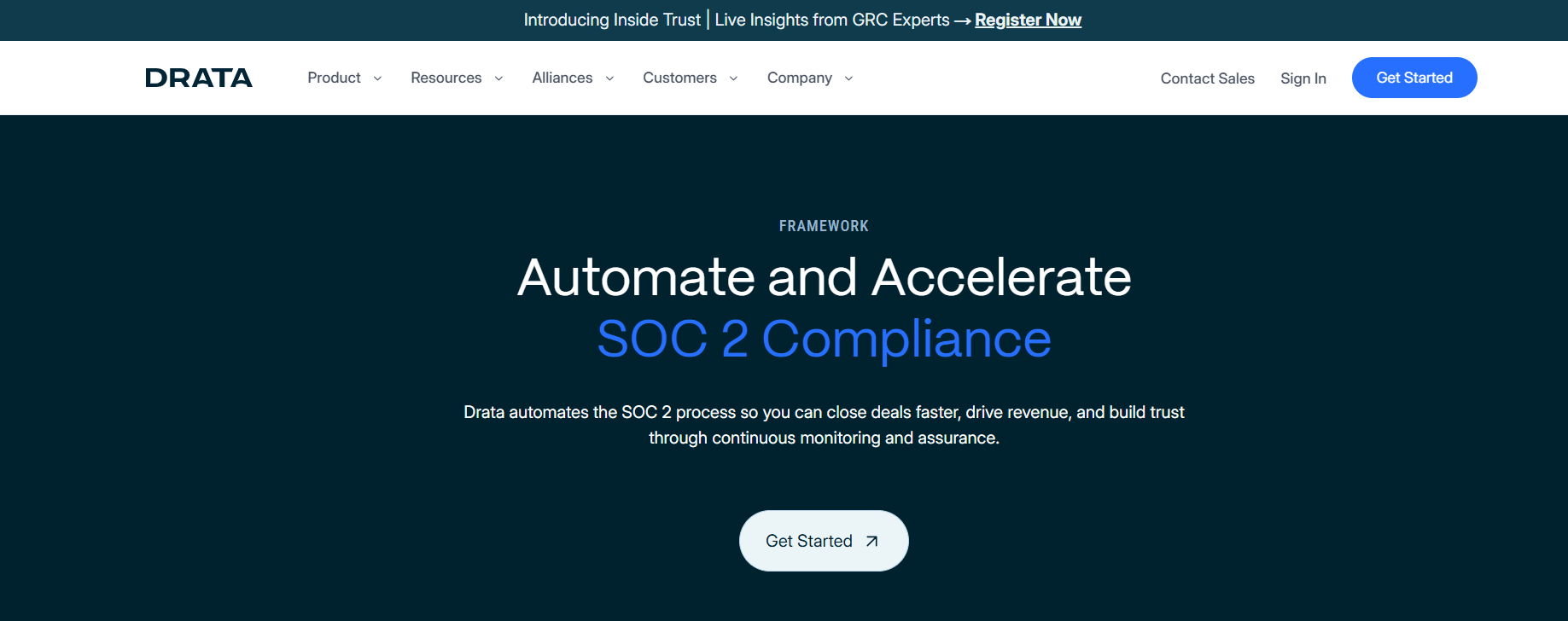
Drata entered the market shortly after Vanta and quickly carved out a strong position by going deeper on automation and broader on compliance frameworks. The platform’s core strength lies in its continuous control monitoring engine, which watches your entire technical environment around the clock and surfaces control failures before they become audit findings.
Drata’s policy library ships with pre-built templates for every SOC 2 control, and its personnel workflows automate the collection of security training acknowledgments, background check verifications, and access reviews — tasks that typically consume significant manual effort. For B2B platforms growing toward enterprise customers, Drata’s robust reporting and audit-ready evidence packages give both your team and your auditor a clear, organized view of your compliance program.
Features
- Continuous 24/7 automated control monitoring
- 200+ native integrations with cloud, SaaS, and dev tool
- Pre-built policy and procedure templates library
- Multi-framework mapping (SOC 2, ISO 27001, HIPAA, PCI, GDPR)
Pros
- Best-in-class continuous monitoring reduces remediation surprises
- Strong personnel compliance automation saves significant admin time
Cons
- Some integrations require additional configuration effort
- Higher price point than some comparable alternatives
What Makes It Best: Drata’s continuous automated monitoring and deeply pre-built control library make it the strongest choice for B2B platforms that want an audit-ready posture maintained year-round, not just during audit season.
3. Secureframe
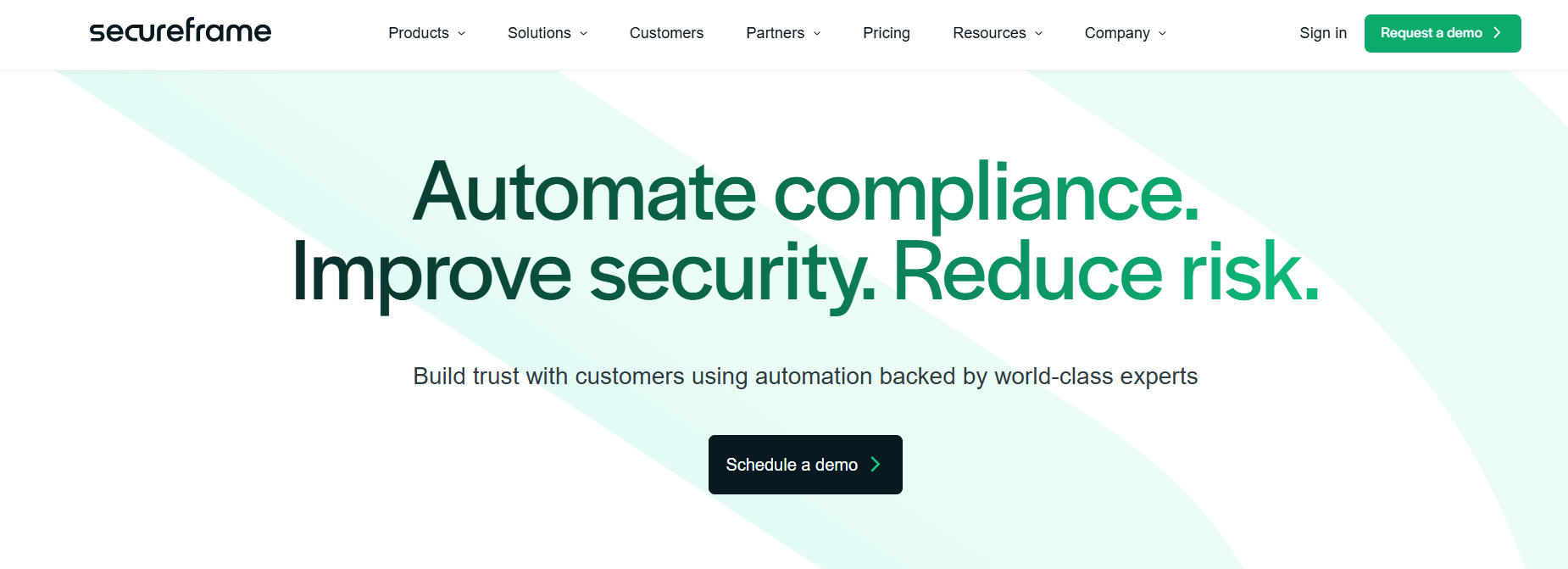
Secureframe positions itself as the compliance platform that gets you to your first audit without requiring an in-house compliance team. It accomplishes this through a highly guided setup experience, a curated integration library that covers the most common B2B tech stacks, and a team of compliance experts who remain available throughout your journey. Moreover, one of Secureframe’s most praised features is its dedicated customer success model, where assigned compliance success managers actively guide customers through readiness assessments and remediation steps rather than leaving teams to navigate documentation alone. Additionally, Secureframe’s continuous monitoring engine flags configuration drift in real time, ensuring that controls you pass during your Type I audit remain in place through your Type II observation period.
Features
- Guided compliance readiness assessment and gap analysis
- 150+ cloud and SaaS integrations for evidence automation
- Dedicated compliance success manager support model
- SOC 2, ISO 27001, HIPAA, PCI DSS multi-framework coverage
Pros
- Excellent customer support widely praised by users
- Onboarding and guided setup significantly reduces time to audit
Cons
- Integration library smaller than Vanta’s 750+ catalog
- Reporting and dashboards less customizable than enterprise GRC tools
What Makes It Best: Secureframe delivers the most supported path to SOC 2 certification for resource-constrained B2B teams by pairing strong automation with hands-on expert guidance at every stage of the compliance journey.
4. One Trust
OneTrust brings an unusually policy-centric approach to SOC 2 compliance. Rather than starting with technical controls, the platform begins by helping organizations build a comprehensive, customized policy framework, then maps controls, evidence, and tests against those policies. Moreover, this approach resonates particularly well with B2B platforms that serve regulated industries or enterprise customers who scrutinize policy depth during vendor assessments. The acquisition by OneTrust has expanded the platform’s capabilities into broader privacy and trust management, and organizations already using OneTrust for GDPR or privacy program management can now layer SOC 2 compliance onto an existing investment without adopting an entirely separate toolset.
Features
- Policy library with 150+ customizable, pre-built templates
- OneTrust integration for unified trust and privacy management
- Policy-to-control mapping across multiple frameworks
- Audit preparation and evidence collection workflows
Pros
- Strongest policy and procedure management in the market
- Unified privacy and security compliance reduces tool sprawl
Cons
- Platform complexity can slow down smaller, less-resourced teams
- Post-acquisition roadmap can feel less startup-agile
What Makes It Best: OneTrust policy-first methodology make it the premier choice for B2B platforms that need to satisfy both privacy regulations and security compliance within a single governance platform.
5. Sprinto
Sprinto has emerged as a compelling alternative for early-stage B2B platforms, particularly those building on AWS, GCP, or Azure and relying on common SaaS stacks like GitHub, Okta, and Slack. Moreover, the platform delivers a highly automated compliance experience with one of the most user-friendly onboarding flows in the category, walking founders and engineering leads through every step needed to get SOC 2 ready in as little as two to four weeks.
Sprinto distinguishes itself further by offering entity-level monitoring, tracking every employee, vendor, and system entity in your compliance environment, rather than limiting monitoring to technical infrastructure alone. Its pricing model makes it especially accessible for seed and Series A companies that need to win enterprise deals but can’t yet justify the top-tier pricing of larger platforms.
Features
- Automated checks across AWS, GCP, Azure, and 100+ SaaS tools
- SOC 2 Type I and Type II readiness tracking
- Pre-built policy templates with customization options
- Employee training module with completion tracking
Pros
- Fastest onboarding experience available for cloud-native startup
- Highly competitive pricing for early-stage B2B companies
Cons
- Less established auditor partnership network
- Advanced GRC features still maturing compared to older platforms
What Makes It Best: Sprinto delivers enterprise-grade SOC 2 automation at startup-friendly pricing, with an entity-level monitoring model that tracks compliance across people, vendors, and systems simultaneously.
6. Laika
Laika occupies a distinctive position in the compliance market by combining software automation with an embedded team of compliance professionals who actively participate in your program. Rather than offering a self-serve tool with support documentation, Laika functions more like a managed compliance service, your team uses the platform while Laika’s compliance experts work alongside you to build policies, manage vendor assessments, and prepare for audits.
Additionally, this model particularly resonates with B2B platforms that lack any compliance expertise internally but need to satisfy enterprise procurement requirements quickly. Laika also manages the entire auditor relationship on behalf of its customers in many cases, reducing the coordination burden that founders and engineering leads typically dread during SOC 2 Type II observation periods.
Features
- Embedded compliance professional team model
- Managed auditor relationships and audit facilitation
- Automated evidence collection integrated with common SaaS tools
- Multi-framework support across SOC 2, ISO 27001, and HIPAA
Pros
- Removes internal compliance workload almost entirely
- Ideal for non-technical founders managing compliance alongside product
Cons
- Higher cost than purely software-driven alternatives
- Managed model means less direct control over compliance program decisions
What Makes It Best: Laika’s managed compliance model removes the need for internal compliance expertise entirely, making it the ideal solution for B2B platforms that want to delegate the compliance program rather than build it themselves.
7. Strike Graph
Strike Graph takes a risk-based approach to SOC 2 compliance, starting the engagement by identifying and prioritizing your organization’s specific risk profile rather than applying a one-size-fits-all control checklist. This methodology is particularly well-suited to B2B platforms with complex or non-standard technical architectures, situations where rigid template-driven tools often generate excessive irrelevant controls or miss nuanced organizational risks. Moreover, the platform then maps your tailored risk responses to the appropriate SOC 2 controls and builds the evidence program around your actual environment. Additionally, Strike Graph’s integrated auditor network allows customers to complete the entire compliance process — from readiness through audit, within a single platform relationship, significantly reducing the friction of managing separate software and auditor engagements.
Features
- Risk-based compliance program design methodology
- Integrated licensed auditors within the platform workflow
- Evidence collection automation for major cloud and SaaS providers
- Collaborative auditor workspace built into the product
Pros
- Risk-based approach produces more precise and relevant control programs
- Built-in auditors eliminate coordination friction between tools and CPA firms
- Flexible enough to accommodate complex or non-standard B2B architectures
Cons
- Smaller integration library limits automation breadth
- Auditor network smaller than Vanta’s established marketplac
What Makes It Best: Strike Graph’s risk-first methodology and integrated auditor relationships create a more precise, less-wasteful compliance program for B2B platforms with non-standard architectures or specialized risk environments.
8. Hyperproof

Hyperproof stands apart from the startup-focused compliance automation tools by operating as a full-featured Governance, Risk, and Compliance (GRC) platform that takes SOC 2 seriously as one of many compliance obligations it manages with equal rigor. B2B platforms scaling into enterprise markets frequently discover that they need to manage SOC 2, ISO 27001, FedRAMP, PCI DSS, and industry-specific regulations simultaneously — and Hyperproof’s cross-framework control harmonization ensures that a single piece of evidence or control test satisfies multiple framework requirements at once. This approach dramatically reduces the compliance overhead of maintaining parallel programs. Furthermore, Hyperproof’s risk management module is among the most mature available in an integrated compliance platform, giving security and compliance teams a unified view of their entire risk and control environment.
Features
- Cross-framework control harmonization reduces duplicated effort
- 100+ pre-built compliance frameworks including FedRAMP and CMMC
- Role-based access for cross-functional compliance collaboration
- Dashboards and reporting for executive and board-level visibility
Pros
- Best-in-class multi-framework management for complex compliance programs
- Mature risk management module rarely matched by compliance-first tools
- FedRAMP and CMMC support serves government-adjacent B2B markets
Cons
- Pricing better suited to mid-market and enterprise than early-stage startups
- Higher implementation time requirement for initial setup
What Makes It Best: Hyperproof’s cross-framework control harmonization and enterprise-grade GRC capabilities make it the definitive choice for B2B platforms managing multiple simultaneous compliance obligations across diverse regulatory environments.
9. Anecdotes
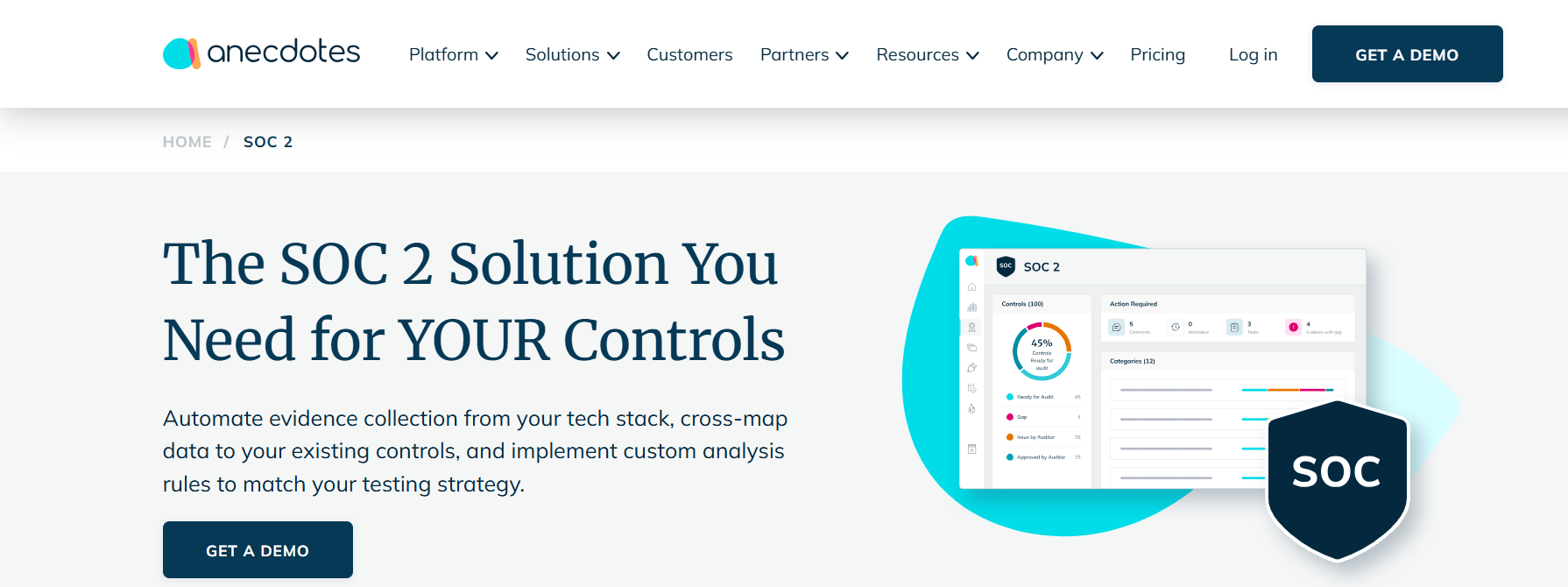
Anecdotes approaches SOC 2 compliance from an angle that resonates powerfully with engineering-led B2B organizations: it treats compliance as code. The platform is built on the concept of a Compliance OS, a programmable compliance engine that lets security and engineering teams define controls, automate evidence collection, and manage compliance workflows using the same systematic thinking they apply to building software. Rather than asking engineering teams to adapt to rigid compliance templates, Anecdotes extends the developer workflow into the compliance domain, with robust API access, custom integration capabilities, and a data-driven compliance layer that sits on top of your existing cloud infrastructure.
Features
- Compliance OS — a programmable, API-first compliance engine
- Custom integration builder for non-standard tech stacks
- Cross-framework control harmonization with single-test multi-framework mapping
- Automated continuous evidence collection from cloud, SaaS, and CI/CD tools
- Data pipeline architecture for high-volume evidence ingestion
Pros
- Unmatched flexibility for engineering teams with custom infrastructure
- API-first design integrates compliance into existing developer workflows
- Cross-framework harmonization dramatically reduces duplicated control work
Con
- Steeper onboarding curve for teams without engineering resources to configure integrations
- Higher setup investment required to unlock full platform value
What Makes It Best: Anecdotes’ Compliance OS architecture gives engineering-led B2B teams the flexibility to model their unique control environment in code, automate evidence at a custom depth, and harmonize every compliance obligation across frameworks, without ever compromising on technical precision.
10. Audit Board
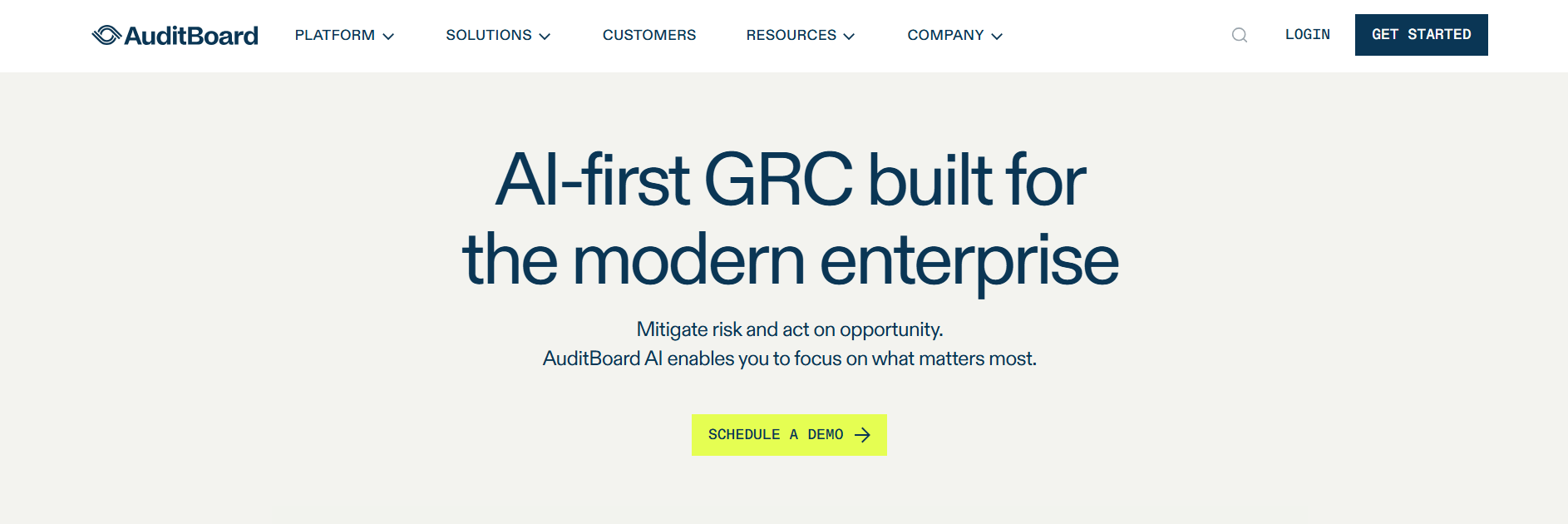
AuditBoard occupies the enterprise end of the compliance and audit management spectrum, serving large B2B organizations that have mature internal audit functions, established risk management programs, and complex regulatory landscapes to navigate. While many of its competitors focus on helping startups achieve their first SOC 2 report, AuditBoard addresses the challenge of managing ongoing, multi-year audit programs across large organizations with dozens of controls owners, multiple business units, and concurrent audit engagements. Its SOC 2 module integrates seamlessly with AuditBoard’s broader suite, which includes internal audit management, risk management, SOX compliance, and ESG reporting. For B2B enterprises whose audit committee and board require a single platform across all assurance functions, AuditBoard provides the most comprehensive answer in the market.
Features
- Enterprise audit management across internal, IT, and external audits
- Workflow automation for controls testing and evidence collection
- Risk management with heat maps, registers, and control linkage
- Advanced reporting for audit committee and board-level stakeholders
Pros
- Board and audit committee reporting capabilities at an enterprise standard
- Proven at scale in Fortune 500 and mid-market enterprise environments
Cons
- Significant overkill for early-stage or mid-market B2B startups
- Implementation and onboarding takes considerably longer than startup tools
What Makes It Best: AuditBoard is the unmatched choice for large B2B enterprises that need to manage SOC 2 alongside internal audit, SOX, and enterprise risk management programs in a single, board-ready governance platform.
11. Scytale
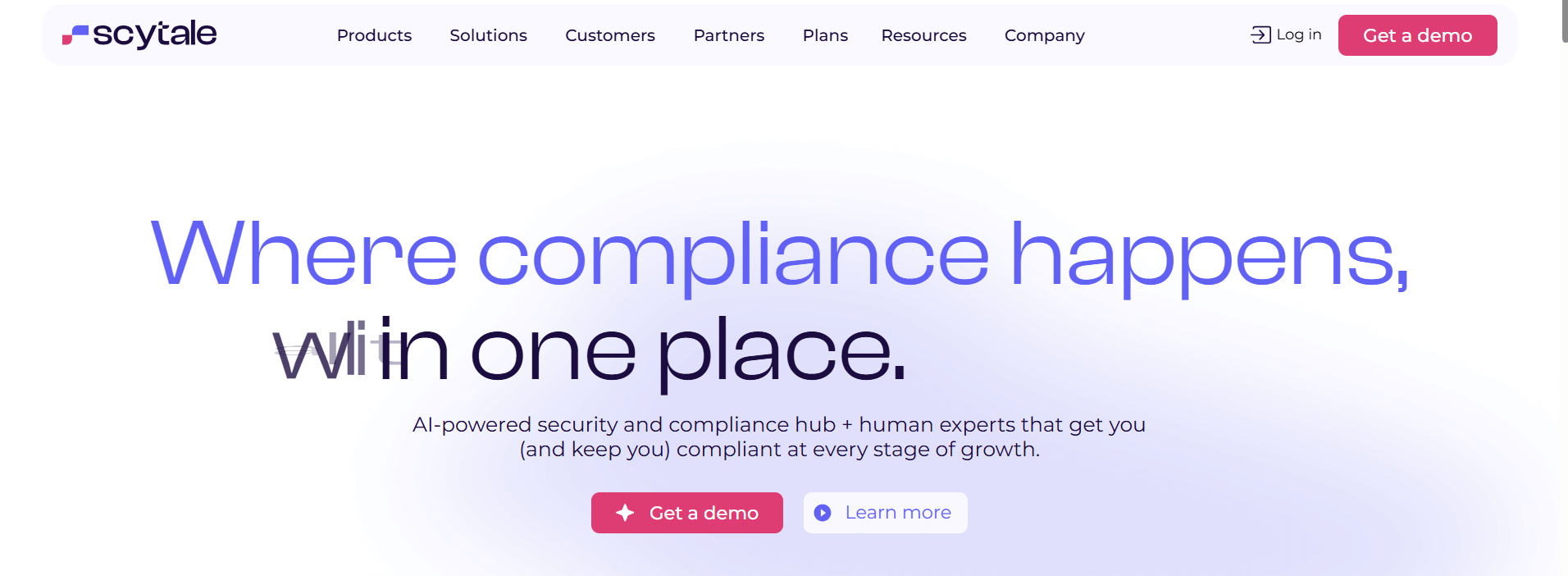
Scytale has built a loyal following among B2B platforms that run lean compliance programs, offering a product experience deliberately designed to minimize the time and effort required from engineering, HR, and operations teams. The platform’s guided compliance workflows break the SOC 2 journey into clear, digestible steps and assign ownership across the right team members automatically based on the control type — ensuring that nothing falls through the cracks even when compliance isn’t anyone’s full-time job. Scytale’s integration with common B2B infrastructure tools works smoothly out of the box, and its compliance experts remain available to answer specific questions throughout the program rather than leaving teams to interpret complex audit language independently. The result is a compliance platform that punches well above its price point for growing B2B teams.
Features
- Guided step-by-step SOC 2 compliance workflow
- Automated task assignment to appropriate control owners
- 100+ integrations for evidence collection automation
Pros
- In-app expert access reduces reliance on external consultants
- Minimal burden on non-compliance team members through smart task routing
Cons
- Less established brand recognition in enterprise procurement evaluations
What Makes It Best: Scytale’s intelligent task assignment and guided workflow model makes SOC 2 achievable for B2B teams where compliance is a shared responsibility across multiple roles rather than a dedicated function.
12. Ostendio
Ostendio differentiates itself through a community-driven approach to compliance, built around its MyVCM platform and an active network of compliance professionals, auditors, and trusted service providers. The platform provides a comprehensive integrated risk management environment that handles SOC 2 alongside a broad array of other healthcare and technology compliance frameworks, making it particularly relevant for B2B health tech and digital health platforms that face the dual challenge of HIPAA and SOC 2 compliance simultaneously. Ostendio’s partner ecosystem connects customers with auditors, vCISOs, and compliance consultants through the platform itself, creating a more open marketplace than the closed auditor networks offered by most competitors. For B2B companies that want flexibility in choosing their compliance service providers while still benefiting from platform automation, Ostendio’s open model is highly attractive.
Features
- HIPAA, SOC 2, ISO 27001, HITRUST, and NIST framework coverage
- Vendor and third-party risk assessment management
- Open partner marketplace with auditors, vCISOs, and consultants
- Compliance intelligence community and peer benchmarking
Pros
- Open ecosystem gives full flexibility to choose preferred auditors and advisors
- HITRUST support serves health tech B2B platforms with unique requirements
- Comprehensive framework coverage for highly regulated B2B verticals
Cons
- Technical automation less sophisticated than leading startup-focused tools
- User interface feels less modern compared to newer entrants
What Makes It Best: Ostendio’s open partner ecosystem and integrated risk management approach make it the top choice for health tech B2B platforms navigating simultaneous HIPAA and SOC 2 compliance obligations with a flexible service provider model.