The best SOC 2 vendors for venture capital portfolio companies are no longer a luxury. They are a necessity.
Enterprise customers demand proof of security controls before signing contracts. Investors scrutinize compliance posture during due diligence. Regulators keep tightening data protection requirements worldwide.
As a result, portfolio companies that delay SOC 2 compliance lose deals. They stall fundraising rounds. They fall behind better-prepared competitors.
Furthermore, the stakes have never been higher for VC-backed startups. The window between Series A and first enterprise contract is shrinking fast.
Buyers move quickly. Their security review teams move even faster. Consequently, a company without a SOC 2 report often cannot enter an evaluation process at all.
However, not every compliance vendor serves the startup context equally well. Some platforms cater to large enterprises. Others overwhelm non-technical founders with jargon-heavy workflows.
Therefore, choosing the right vendor is the most leveraged compliance decision a portfolio company will make. This guide examines twelve of the best options in detail.
Each entry covers what the vendor does best, which features set it apart, and why VC-backed companies trust it. Whether your portfolio is in fintech, healthtech, B2B SaaS, or deep tech, you will find the right fit here.
Top 12 Best SOC 2 Vendors for Venture Capital Portfolio Companies

Vanta leads the automated compliance market for startups. Christina Cacioppo founded it in 2018.
The platform connects directly to cloud infrastructure, code repositories, and HR systems. It monitors hundreds of controls in real time. Vanta automates evidence collection. It surfaces gaps in a clean, intuitive dashboard.
Furthermore, the platform covers SOC 2, ISO 27001, HIPAA, GDPR, and PCI DSS. It serves as a single pane of glass for all frameworks. Hundreds of VC-backed companies trust Vanta. Many come from Sequoia and Y Combinator portfolios.
- Firstly Vanta provides automated continuous monitoring of 300+ cloud, SaaS, and infrastructure integrations
- Real-time control gap detection with actionable remediation guidance
- Built-in vendor risk management and security questionnaire automation
- Native support for SOC 2 Type I, Type II, ISO 27001, HIPAA, PCI DSS, and GDPR
- Integrated auditor partnerships that allow seamless handoff to CPA firms
- Employee security training and policy acceptance tracking
What Makes It Best: Vanta stands out because it compresses the compliance timeline more aggressively than any competitor. The platform’s breadth of integrations means that most startups can connect their entire stack in a single afternoon and immediately see their compliance posture. Moreover, for VC portfolio managers who need consistent, repeatable compliance across dozens of portfolio companies, Vanta’s standardized workflows and portfolio-level visibility make it the obvious anchor choice.
2. Drata
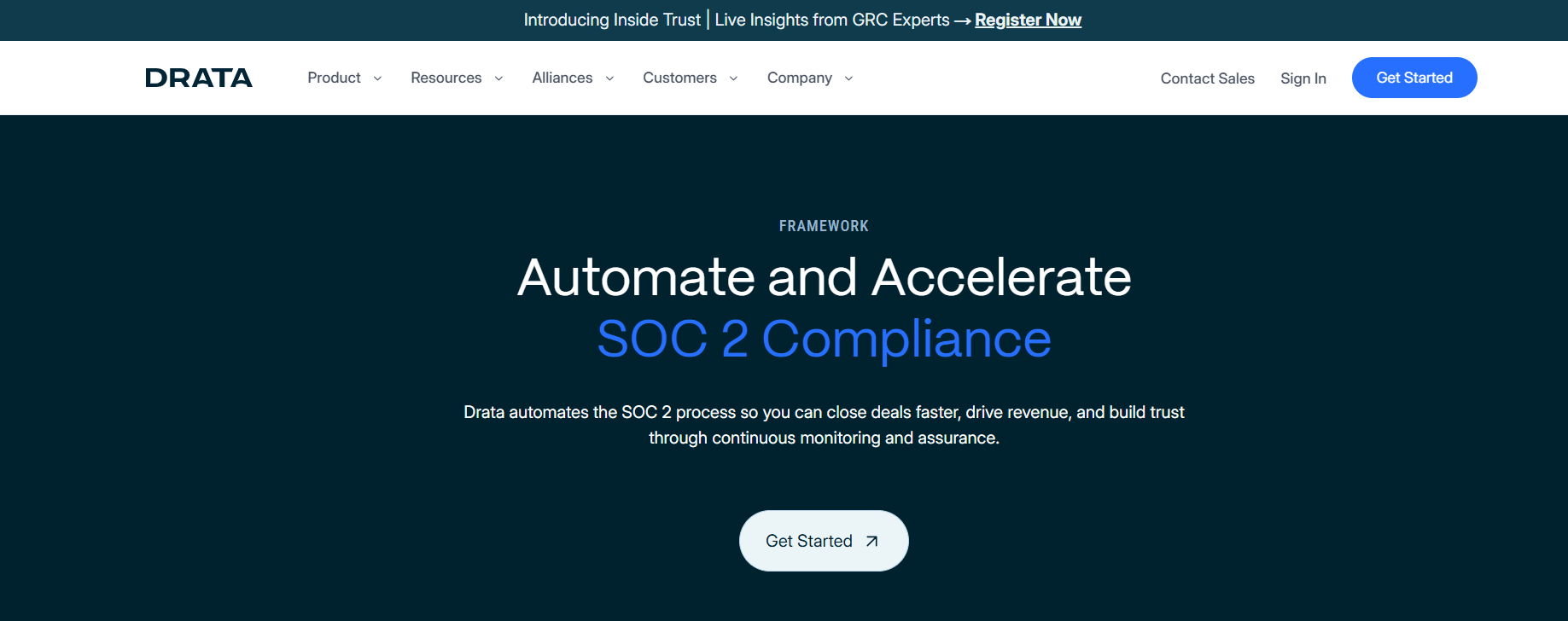
Drata entered the market in 2020 and quickly attracted enterprise-grade customers by doubling down on automation depth. Where some tools automate evidence collection at a surface level, Drata maps every control to specific technical checks, pulls evidence directly from source systems, and updates that evidence continuously — without any human intervention. The platform supports a remarkable range of compliance frameworks simultaneously, allowing growing companies to pursue SOC 2 today while laying infrastructure for FedRAMP or ISO 27001 tomorrow. Furthermore, Drata also invests heavily in the user experience of its audit workflow, providing auditors with a structured evidence room that dramatically reduces back-and-forth during fieldwork. The company has raised over $400 million and partners with a wide network of auditing firms, giving portfolio companies an accelerated path from readiness to report.
Features
- Firstly, Drata has over 200+ native integrations with automatic, continuous evidence collection
- Automated control mapping across SOC 2, ISO 27001, PCI DSS, HIPAA, GDPR, FedRAMP, and NIST
- Structured digital audit room for seamless auditor collaboration
- Custom control builder for bespoke compliance requirements
- Real-time compliance dashboard with board-ready reporting
- Finally, they have a team of dedicated customer success managers for guided onboarding
What Makes It Best: Drata’s automation is categorically deeper than most competitors. The platform continuously polls source systems to verify that controls remain in place, not just at audit time, but every single day. Additionally, this continuous assurance model is particularly valuable for portfolio companies operating in regulated industries or seeking enterprise customers who demand ongoing proof of compliance.
3. Secureframe
Secureframe positions itself as the fastest route from zero to a signed SOC 2 report, and the numbers back up that claim. The platform combines automated evidence collection with a guided, step-by-step compliance program that walks founding engineers through every requirement without assuming any prior compliance knowledge. Secureframe’s onboarding flow is notably opinionated, it makes sensible default decisions that reduce decision fatigue for non-security founders while still allowing deep customization for teams with security professionals on staff. Moreover, the platform also integrates compliance workflows into existing engineering tools like GitHub, Jira, and Slack, ensuring that remediation tasks land where engineers actually work rather than in a separate portal that gets ignored. Secureframe’s competitive pricing and transparent cost structure make it particularly attractive for seed and Series A companies operating under budget constraints.
Features
- Guided compliance program with step-by-step task management for non-experts
- 150+ integrations including AWS, GCP, Azure, GitHub, and Jira
- Automated policy and procedure generation from customizable templates
- Personnel management with background check and training orchestration
- Vendor risk assessment with automated questionnaire distribution
What Makes It Best: Secureframe wins on approachability. Most startups pursuing their first SOC 2 have no dedicated CISO, and Secureframe’s guided experience fills that gap admirably. The platform’s opinionated defaults mean a two-person engineering team can realistically reach a Type I readiness posture in under four weeks. Furthermore, integrating tasks directly into Jira and Linear removes the most common reason compliance projects stall: engineers ignoring a separate compliance portal. For VCs whose portfolio includes a high proportion of technical, product-led companies at early stages, Secureframe delivers a consistent, low-friction compliance experience.
4. One Trust
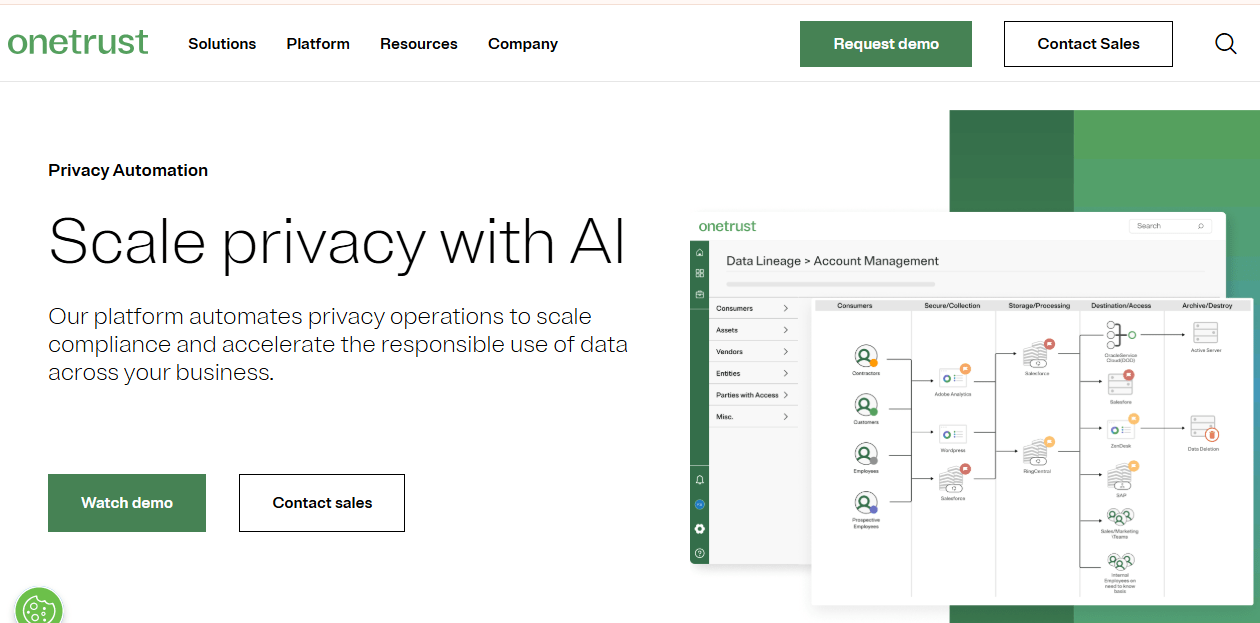
OneTrust acquired Tugboat Logic in 2022, giving the platform the enterprise backing and broad privacy ecosystem integration that it needed to compete at scale. Before the acquisition, Tugboat Logic had carved out a distinctive niche by taking a policy-first approach to compliance: rather than starting with technical controls, it began by building a comprehensive information security program through structured policy frameworks. This philosophy resonates with companies that recognize SOC 2 as a business program, not merely a technical audit. Furthermore, the platform guides security and compliance teams through writing, approving, and distributing policies that align precisely with SOC 2 Trust Service Criteria, then connects those policies to technical evidence as a second step. Consequently, auditors receive a coherent narrative. They can trace every control from policy statement to technical proof.
Features
- Pre-built, audit-ready policy templates for SOC 2, ISO 27001, and NIST CSF
- Policy lifecycle management with version control and approval workflows
- Automated gap analysis mapping existing controls to framework requirements
- Integrated risk register with treatment plan tracking
- OneTrust ecosystem integration for unified privacy and security compliance
- Multi-framework crosswalk to reduce duplicative work across standards
What Makes It Best: Tugboat Logic stands out for portfolio companies that operate in regulated industries where auditors scrutinize the policy program as rigorously as the technical controls. Its policy-first methodology builds a compliance narrative that holds together under deep enterprise due diligence, a scenario increasingly common for VC-backed B2B SaaS companies selling into healthcare, financial services, or government verticals. Moreover, the OneTrust integration unifies SOC 2 with GDPR and CCPA. One governance umbrella covers all major obligations.
5. Laika
Laika occupies a unique position in the SOC 2 market by blending software automation with a managed service layer staffed by former Big Four auditors and security professionals. Rather than simply handing founders a platform and a knowledge base, Laika assigns dedicated compliance advisors who function as fractional CISOs for early-stage companies. These advisors co-own the compliance roadmap, write policies on the company’s behalf, prepare teams for auditor walkthroughs, and manage the audit relationship from start to finish. This model is especially powerful for non-technical founders or companies in highly regulated industries — fintech, healthtech, or legaltech — where compliance missteps carry outsized business risk. Laika’s software platform handles automated evidence collection and control monitoring, but the human layer is what truly differentiates it from purely self-serve alternatives.
Features
- Dedicated compliance advisor assigned to every client account
- Former Big Four auditor expertise embedded in service delivery
- Automated evidence collection across cloud, SaaS, and HR integrations
- Policy drafting and employee security training managed on the client’s behalf
- Audit management from kickoff through report delivery
- Multi-framework coverage: SOC 2, ISO 27001, HIPAA, and PCI DSS
- Fractional CISO advisory services for ongoing security program development
- Due diligence support for fundraising and M&A transactions
What Makes It Best: Laika stands out by treating compliance as a service rather than a software problem. For portfolio companies without a security professional on staff, Laika’s managed model eliminates the most dangerous risk: launching a compliance program incorrectly and discovering the gaps during the audit itself. The platform’s pricing reflects its premium service model, but VCs who factor in the cost of a failed or delayed audit — and the downstream impact on enterprise sales cycles, find that Laika’s white-glove approach delivers a strongly positive ROI.
6. Strike Graph
Strike Graph takes a distinctly risk-driven approach to SOC 2 compliance, making it one of the most intellectually coherent platforms on the market for companies that want to build a security program grounded in actual business risk rather than checkbox compliance. Moreover, the platform begins every engagement with a structured risk identification exercise, then maps the resulting risk register directly to the controls and evidence that SOC 2 auditors require. This methodology means that the compliance program the company builds genuinely reflects its threat model, not a generic template copied from a blog post. Furthermore, Strike Graph also gives companies fine-grained control over their control library. Non-standard tech stacks are no obstacle.
The platform supports a growing network of auditing partners who understand the risk-based workflow.
Features
- Firstly, Strike Graph provides a risk-first onboarding that anchors the entire compliance program in the company’s threat model
- Customizable control library with the ability to add, remove, or modify controls
- Automated evidence collection across 50+ cloud and SaaS integrations
- Support for SOC 2, ISO 27001, and custom frameworks
- Security questionnaire response management and automation
- Furthermore, Compliance program health scoring with trend dashboards
What Makes It Best: Strike Graph stands out because it builds compliance programs that actually reflect how a company operates, rather than forcing every organization into the same mold. This distinction becomes crucial when auditors probe the reasoning behind control selections, a company that can trace every control directly to a documented risk demonstrates security maturity that generic templates cannot replicate. Furthermore, for VC portfolio companies with non-standard architectures, distributed teams, or unusual regulatory contexts, Strike Graph’s flexibility delivers compliance programs that hold up under the most rigorous enterprise scrutiny.
7. AuditBoard
AuditBoard is the most enterprise-grade platform on this list, and it earns its place here because a meaningful subset of VC portfolio companies, particularly those at Series C and beyond, outgrow startup-focused tools and need a Governance, Risk, and Compliance (GRC) platform that matches their organizational complexity. They deliver a comprehensive suite that covers SOC 2 readiness alongside internal audit management, enterprise risk management, ESG reporting, and regulatory compliance. Moreover, the platform is purpose-built for collaboration between security teams, internal audit functions, and executive leadership — a structure that mirrors how compliance operates at companies with 200+ employees. The platform workflow engine, dashboards, and reporting capabilities set the standard for enterprise GRC, and its integrations with leading ERP and ITSM systems make it a natural fit for companies running sophisticated back-office operations.
Features
- Firstly, Unified GRC platform covering internal audit, risk, compliance, and ESG
- SOC 2, SOX, ISO 27001, NIST, and custom framework support
- Advanced workflow engine for cross-functional task coordination
- Moreover, the platform provides real-time executive dashboards with board-level reporting templates
- Integration with Salesforce, ServiceNow, Workday, and major ERP platforms
- AI-powered risk intelligence and anomaly detection
What Makes It Best: The platfofrm stand out as the right choice for portfolio companies that have scaled beyond the startup phase and need compliance infrastructure that integrates with enterprise systems and governance structures. As companies prepare for IPO or major liquidity events, auditors and underwriters expect evidence of mature, board-level risk oversight, precisely what AuditBoard’s reporting and workflow capabilities deliver. VCs stewarding growth-stage or pre-IPO companies will find that they reduces the painful platform migration that often accompanies compliance program maturation.
8. Thoropass
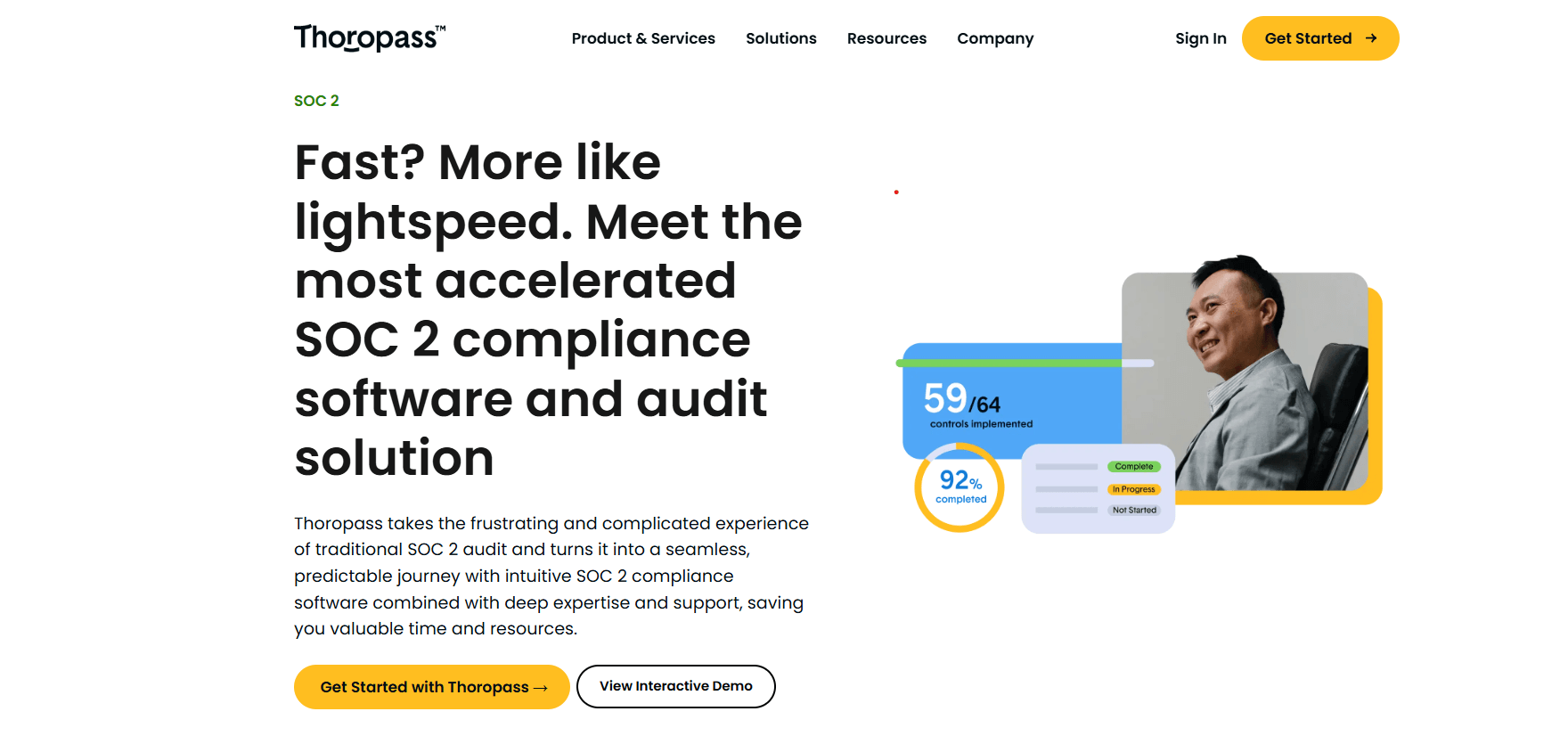
Thoropass, formerly known as Launchway, has built one of the most innovative products in the SOC 2 space by embedding an accredited CPA audit firm directly inside its platform. Rather than treating software readiness and the audit itself as separate engagements, Thoropass unifies them: companies prepare for SOC 2 in the platform and then engage Thoropass’s in-house auditors — licensed CPAs who are already familiar with the platform’s evidence format — to conduct the formal audit. This integration eliminates the translation work that typically occurs between a readiness platform and an independent auditing firm, compressing the overall timeline dramatically. Furthermore, the platform also emphasizes continuous assurance, meaning that after achieving SOC 2 Type II, companies maintain a live view of their compliance posture rather than scrambling for evidence at annual renewal time.
Features
- Firstly, Thoropass has In-house accredited CPA firm integrated directly into the platform
- Continuous assurance model with real-time control monitoring
- Automated evidence collection across cloud, HR, and DevOps integrations
- SOC 2, ISO 27001, HIPAA, PCI DSS, and GDPR framework support
- Pre-built control templates designed for cloud-native architectures
- Furthermore, it Streamlined audit handoff eliminating external auditor onboarding friction
What Makes It Best: Thoropass stands out because it eliminates the biggest source of timeline unpredictability in the SOC 2 process: the handoff to an external auditor. When the audit firm already understands the platform’s evidence format, fieldwork starts faster, evidence requests are fewer, and the path to a signed report is demonstrably shorter. For portfolio companies facing hard deadlines, an enterprise contract contingent on SOC 2, a fundraising timeline, or a competitive RFP, Thoropass’s integrated audit model also delivers a timeline certainty that no purely readiness-focused platform can match.
9. Sprinto
Sprinto has emerged as the compliance platform of choice for globally distributed startups, particularly those headquartered outside the United States or those selling into international markets that demand frameworks beyond SOC 2. Founded in 2020 and based in San Francisco with strong roots in India’s startup ecosystem, Sprinto brings a global-first perspective to compliance automation that purely US-centric platforms lack. Moreover, the platform supports over 20 security frameworks, including region-specific standards like India’s DPDP, Germany’s C5, and Australia’s IRAP, in addition to universally recognized frameworks like SOC 2, ISO 27001, and GDPR. Furthermore, Sprinto connects directly with local auditing partners across multiple geographies, enabling portfolio companies to obtain locally recognized certifications without navigating unfamiliar regulatory landscapes on their own.
Features
- Support for 20+ global security and privacy frameworks
- Coverage of region-specific standards: DPDP, C5, IRAP, and CSA STAR
- Automated evidence collection across 200+ cloud and SaaS integrations
- Auditor network spanning multiple countries and regions
- Real-time control health monitoring with gap alerts
What Makes It Best: Sprinto stands out for VC firms with geographically diverse portfolios. As portfolio companies increasingly sell into European, Asia-Pacific, and Middle Eastern markets, the compliance requirements they face multiply — and a platform built only for SOC 2 becomes a bottleneck rather than an enabler. Moreover, Sprinto’s multi-framework, multi-geography architecture means that a single platform can serve a portfolio company’s compliance needs from its first SOC 2 audit through its eventual ISO 27001 certification and GDPR compliance program, regardless of where the company is incorporated or where its customers operate.
10. Scytale
Scytale has built a reputation for delivering the most approachable SOC 2 experience on the market, particularly for companies that are attempting formal compliance for the very first time. The platform deliberately strips away jargon, complexity, and unnecessary configurability in favor of a clean, guided experience that any technically literate founder can navigate without a compliance background. Scytale’s AI-powered compliance assistant actively coaches teams through each stage of the readiness process, surfacing the right actions at the right time and explaining the rationale behind each control requirement in plain language. The platform’s automated evidence collection covers the most common cloud environments and SaaS tools, and its policy library provides fully customizable templates that eliminate the blank-page problem that paralyzes many first-time compliance programs.
Features
- Firstly, the platform has a fully customizable policy library with plain-language explanations
- SOC 2, ISO 27001, HIPAA, GDPR, and PCI DSS framework support
- Automated vendor risk assessments and security questionnaire responses
- Auditor collaboration portal with structured evidence organization
- Transparent, flat-fee pricing with no per-seat surprises
What Makes It Best: Scytale stands out for its commitment to making compliance genuinely accessible to non-experts. The platform’s AI assistant does not merely surface tasks — it explains why each task matters, connecting the dots between compliance activities and real security outcomes. This educational layer proves invaluable for founding teams who need to understand compliance well enough to defend their program to enterprise security reviewers, not just check boxes for an auditor. For early-stage portfolio companies taking their first serious step toward security maturity, Scytale’s combination of automation and guided learning builds lasting organizational capability alongside the certification itself.
11. Hyperproof
Hyperproof takes a distinctly operations-focused approach to compliance, treating a compliance program the way a product manager treats a product roadmap: with structured workflows, clear ownership, measurable progress, and systematic evidence management. The platform excels when companies need to manage multiple overlapping compliance frameworks simultaneously, a scenario that becomes increasingly common as portfolio companies scale and face concurrent requirements from SOC 2, ISO 27001, FedRAMP, HIPAA, and state-specific data protection laws. Hyperproof’s Hypersync technology automates evidence collection and automatically links artifacts to every applicable control across every active framework, eliminating the duplicative effort of proving the same thing multiple ways. The platform’s robust task management and collaboration features make it particularly well-suited to compliance teams of three or more people with distinct roles and responsibilities.
Features
- Firstyly, Hypersync technology linking a single evidence artifact to multiple framework controls
- Support for SOC 2, ISO 27001, FedRAMP, NIST CSF, HIPAA, CMMC, and GDPR simultaneously
- Structured workflow engine with assignable tasks, due dates, and escalations
- Automated evidence collection via cloud and API integrations
- Risk management module with quantitative and qualitative assessment methods
What Makes It Best: Hyperproof stands out for portfolio companies that have already achieved SOC 2 and are now managing the ongoing complexity of maintaining multiple certifications simultaneously. Also, the platform’s Hypersync capability generates compounding efficiency gains as the number of active frameworks grows, instead of collecting evidence once per framework, teams collect it once and let the platform distribute it everywhere it applies.
12. Anecdotes
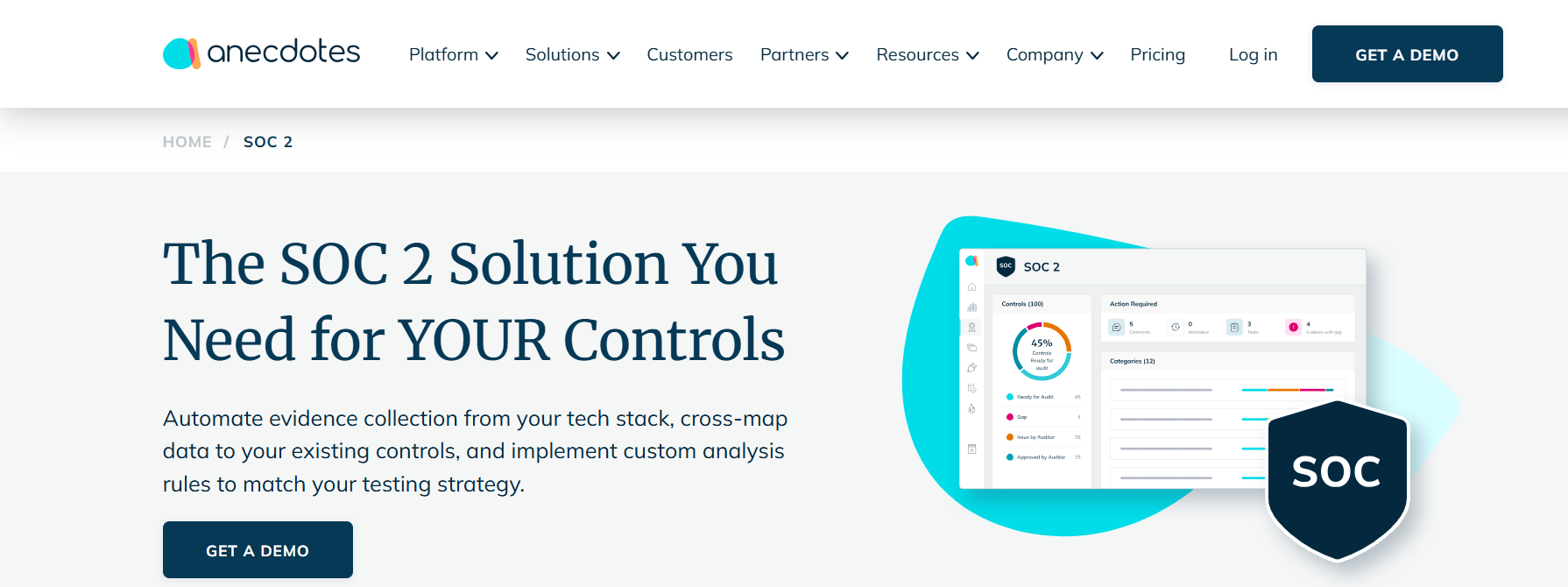
Anecdotes approaches compliance from a fundamentally data-centric perspective, and in doing so it has built one of the most technically sophisticated platforms in the market. Rather than layering a compliance workflow on top of point-in-time evidence collection, Anecdotes ingests raw compliance data directly from source systems, AWS Config, GitHub, Okta, Jira, and hundreds of others, and builds a queryable compliance data model that security engineers can interact with programmatically. This architecture enables the kind of real-time, continuous compliance visibility that engineering-led organizations demand. Teams can write custom compliance queries, build internal dashboards against the compliance data layer, and trigger automated remediation workflows when control violations occur. Anecdotes is the platform of choice for technically sophisticated portfolio companies whose engineering teams want to own the compliance data layer, not just consume a pre-built dashboard.
Features
- Firstly, they provide a compliance data platform with a queryable data model for custom analysis
- 200+ native integrations with automated raw data ingestion
- Programmable compliance queries for custom control detection and monitoring
- Real-time continuous control monitoring with automated alerting
- SOC 2, ISO 27001, NIST CSF, HIPAA, and custom framework support
- Furthermore, they have a developer-friendly API for building internal compliance tooling
What Makes It Best: Anecdotes stands out for engineering-led portfolio companies that treat compliance as a product problem rather than an administrative one. By exposing the underlying compliance data layer, the platform empowers security engineers to build custom detections, write novel compliance queries, and integrate compliance signals into existing observability and alerting stacks. Additionally, for VCs whose portfolio includes deep-tech, infrastructure, or developer-tools companies, Anecdotes delivers a compliance experience that earns the respect of highly technical teams rather than frustrating them with oversimplified workflows.