
Companies that build software for the energy transition increasingly need SOC 2 Audit Services for Energy Tech Companies to win contracts and accelerate growth. If you operate a solar financing marketplace, an EV charging network, a distributed energy resource management system, a battery dispatch platform, or a grid analytics tool, customers expect strong security controls. Utilities, fleet operators, independent power producers, and government-funded energy programs often require a SOC 2 report before they sign contracts or release grant funds. As a result, choosing the right auditor has become a critical business decision for growing energy startups.
Many SOC 2 buying guides focus on generic B2B SaaS companies. They rarely address the unique challenges energy technology companies face. Energy platforms often combine cloud-native software, payment processing, IoT telemetry, and critical infrastructure data. EV charging providers process payments. Solar financing platforms manage sensitive financial information. Battery and grid platforms collect data from meters, inverters, and connected devices.
Some energy companies also serve utilities or organizations connected to the bulk electric system. These companies must navigate security expectations that extend beyond standard SaaS requirements. They may also encounter compliance considerations related to NERC CIP and other critical infrastructure frameworks.
An auditor with experience only in traditional SaaS environments may struggle to understand these complexities. Your team could spend valuable time explaining technical workflows, operational risks, and regulatory requirements. By choosing an auditor with energy-sector experience, you can streamline the audit process and receive more relevant guidance.
Why SOC 2 Audit Services for Energy Tech Companies Look Different
Energy-tech companies face security challenges that most traditional SaaS businesses do not. They often combine cloud software with payment processing, connected devices, and utility-sector requirements. That complexity makes choosing the right SOC 2 auditor especially important.
Many energy-tech platforms handle financial transactions, whether through EV charging payments, solar financing, or incentive programs. Others collect massive amounts of data from smart meters, batteries, inverters, and other connected devices. These systems create security and compliance considerations that auditors need to understand from day one.
As companies grow, many also begin working with utilities and government-backed energy programs. Those customers expect a higher level of security maturity and often ask questions that go beyond a standard SOC 2 assessment.
For energy-tech companies, an auditor with experience in payments, IoT systems, and utility-related security requirements can make the process smoother, faster, and more valuable.
Top 12 Best SOC 2 Audit Services for Energy Tech Companies
1. A-LIGN
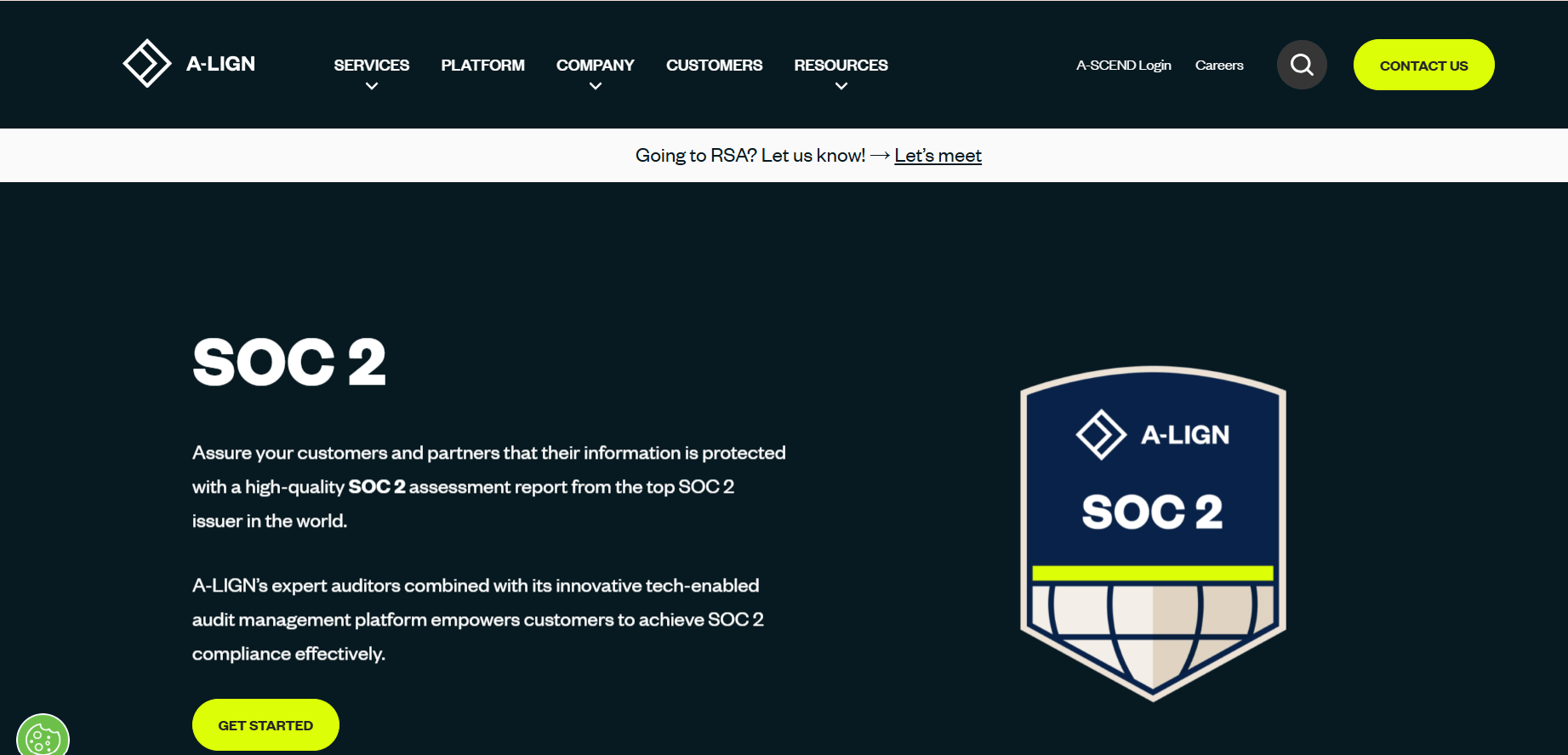
A-LIGN is the highest-volume SOC 2 issuer in the world, and its scale shows up in how comfortably it handles energy tech companies that need more than one framework addressed at once. It has used that capital to push hard on its A-SCEND audit-management platform, which now includes AI-assisted evidence scoring and the ability to reuse evidence across overlapping frameworks.
Features
- A-SCEND platform with AI evidence scoring and cross-framework evidence reuse, so SOC 2, ISO 27001, HITRUST, and PCI DSS evidence isn’t collected from scratch each time.
- Top-three FedRAMP 3PAO status and CMMC C3PAO authorization, useful for energy tech companies pursuing federal or DOE-funded contracts.
- Enormous engagement volume (5,700+ clients, 31,000+ completed audits) means deep institutional familiarity with cloud architectures of every shape.
Pros
- SOC 2, ISO 27001, FedRAMP, HITRUST, and PCI DSS audits under one coordinated engagement
- A-SCEND’s evidence reuse meaningfully shortens year-two and year-three renewal cycles.
- Broad bench of auditors means scheduling flexibility even during the Q4 audit rush.
Cons
- Pricing sits at the upper end of the specialist tier rather than the lowest-cost option.
- Smaller engagements can occasionally feel deprioritized against A-LIGN’s larger enterprise and government clients.
Pricing: Typically $15,000–$75,000 for a Type 2 engagement, scaling up with additional frameworks or larger infrastructure footprints.
Verdict: If your energy tech company is scaling fast and you can already see SOC 2, ISO 27001, and possibly FedRAMP all landing on your roadmap within the next two years, A-LIGN is the best fit on this list for consolidating that work into one relationship.
2. IS Partners (Axiom GRC)
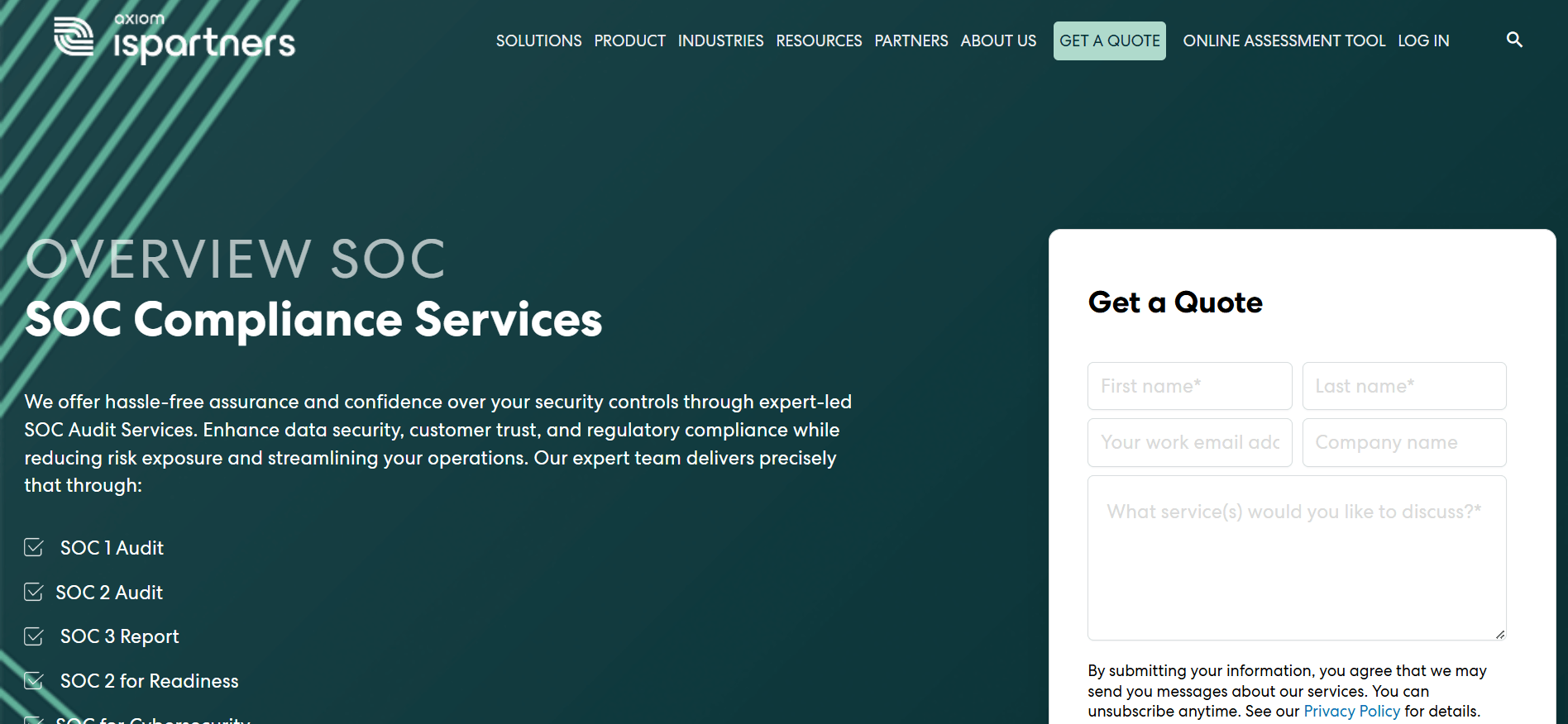
IS Partners is the one firm on this list with an explicit, named “Energy & Utilities” practice, and it shows in its service catalog: SOC 2, SOC 1, ISO 27001, and HITRUST sit alongside dedicated NERC CIP, CMMC, and environmental-health-and-safety GRC offerings built specifically for utilities modernizing their infrastructure. Recently folded into Axiom GRC after an acquisition, the firm has spent two decades building the kind of regulated-industry depth that a typical SaaS-focused boutique simply doesn’t carry.
Features
- Combined SOC 2 plus NERC CIP and CMMC engagement scoping for energy tech companies whose customers are bulk electric system operators.
- Twelve professional accreditations on staff, including CIPP, CRMA, CEH, HCISPP, HITRUST Assessor, and PCI DSS QSA, alongside core CPA/AICPA credentials.
Pros
- Unmatched ability to speak the language of utility procurement and risk teams, since the firm already serves data centers, government contractors, and energy & utilities clients directly.
- One-stop shop if you need SOC 2 plus a NERC CIP-aligned readiness assessment or HITRUST certification in the same cycle.
- Deep accreditation bench reduces the risk of needing a second vendor for adjacent frameworks later.
Cons
- Pricing and timeline (8–16 weeks) reflect the regulated-industry complexity the firm is built for, making it considerably more expensive than boutique SaaS-focused auditors for a company that doesn’t actually need that depth yet.
Pricing: Type 2 engagements typically run $50,000–$150,000, reflecting the firm’s regulated-industry, multi-framework positioning.
Verdict: This is the clearest answer on the list to “which SOC 2 audit service actually understands energy and utilities,” and it’s the right call once your energy tech company’s revenue or roadmap depends on selling into utilities or bulk electric system operators.
3. Schellman
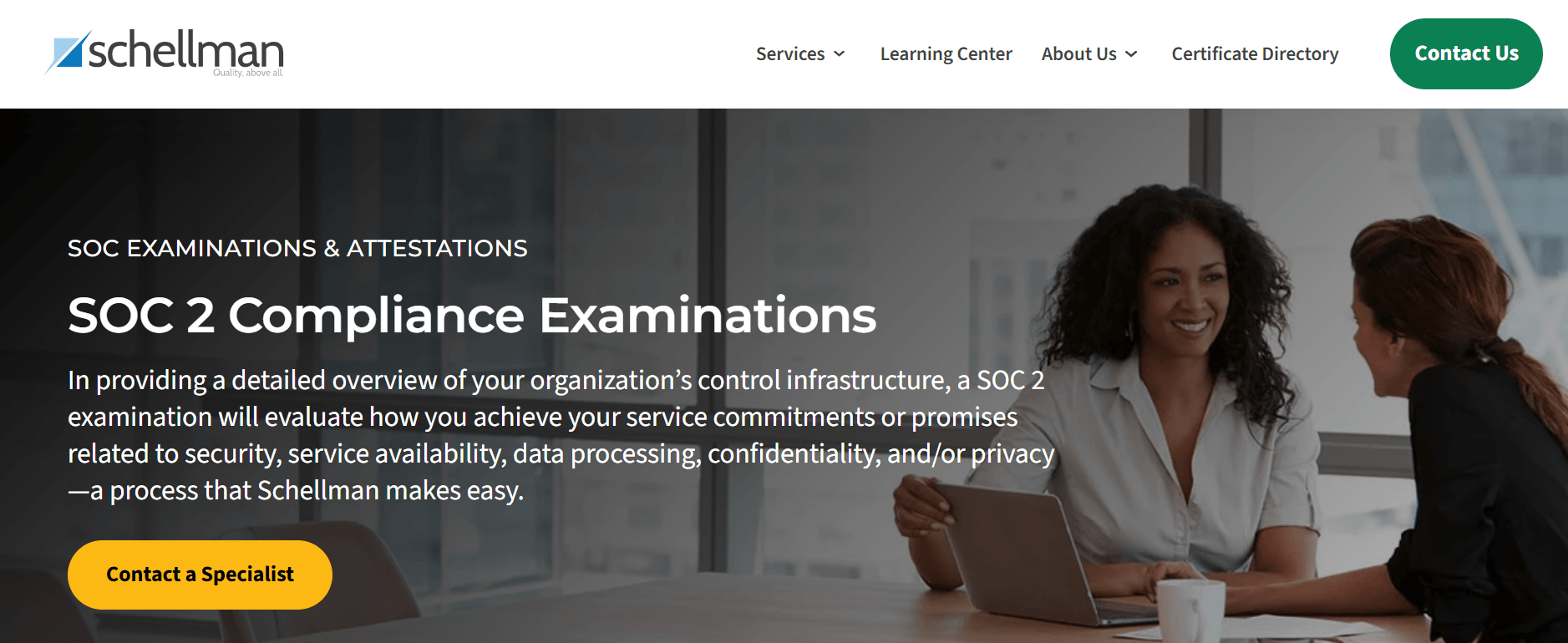
Schellman is one of the most technically respected names in IT attestation, and it holds a credential almost no other firm on this list can match: a Facility Security Clearance that authorizes it to conduct classified DoD assessments.
Features
- The Schellman Secure Portal structures evidence intake with well-defined sampling strategies, reducing back-and-forth during fieldwork.
- FedRAMP 3PAO status plus DoD facility clearance, relevant for energy tech companies building grid-security or microgrid software with federal or defense customers.
- Fourteen accreditations spanning government, healthcare, and financial services compliance.
Pros
- Among the most technically rigorous audit teams in the industry, with auditors who understand cloud-native architecture deeply enough to avoid generic, boilerplate testing.
- The federal and defense credentialing opens doors that smaller specialist firms simply cannot, useful for energy tech companies pursuing DOE or DoD-funded microgrid and resilience programs.
- Strong track record across complex, multi-region infrastructure.
Cons
- Timelines stretch to 3–12 months for more complex scopes, longer than several boutique competitors on this list.
- Pricing sits toward the higher end of the specialist tier, which can be more than an early-stage energy startup needs.
Pricing: Generally $20,000–$100,000 for a Type 2 audit, depending on scope and number of frameworks bundled in.
Verdict: Choose Schellman when your energy tech company’s growth strategy runs through federal agencies, defense-adjacent microgrid work, or any context where “the only firm cleared for classified DoD work” is a meaningful door-opener.
4. Coalfire
Coalfire occupies the federal-adjacent corner of the SOC 2 market. It’s one of the largest FedRAMP 3PAOs in the country and routinely handles CMMC and DoD compliance work that few competitors can match at the same scale, capability that flows through to every engagement, including pure commercial SOC 2 work for non-federal clients.
Features
- Deep technical bench with cleared, federal-credentialed auditors who bring genuinely sophisticated technical assessment to complex hybrid-cloud environments.
- Operationally independent Coalfire Federal entity handles CMMC Level 2 assessments separately from commercial SOC 2 work.
- Strong fit for companies running complex, multi-cloud, or hybrid infrastructure that touches both commercial and government workloads.
Pros
- If your energy tech company has DOE grant funding, a federal grid-modernization contract, or any FedRAMP authorization on the roadmap, Coalfire’s federal fluency translates directly into a smoother SOC 2 scoping conversation.
- Auditors’ technical depth tends to surface real architectural risks rather than checkbox findings.
- Reliable choice for payment processors and energy tech companies operating at PCI DSS Level 1 scale.
Cons
- The federal-capability premium shows up in pricing even on purely commercial engagements.
- That premium is harder to justify for an energy tech company with no federal roadmap at all.
Pricing: Roughly $25,000–$80,000 for a standard Type 2 engagement, trending higher for FedRAMP-adjacent or multi-framework scopes.
Verdict: Coalfire is the right pick when your energy tech company’s customer base already includes or is about to include federal agencies or DOE-funded programs, where its government-grade credentials are worth the premium.
5. BARR Advisory

BARR Advisory built its practice remote-first from day one, with a team drawn heavily from Big Four alumni and a methodology purpose-built for AWS, Azure, and GCP environments rather than retrofitted from traditional financial-audit practices. Its approach maps evidence once and reuses it across ISO 27001, SOC 2, HITRUST, and PCI DSS, and the firm is itself an ANAB-accredited ISO 27001, 27701, and 42001 certification body a detail that matters increasingly for energy tech companies shipping AI-driven forecasting or demand-response models.
Features
- Clear scoping up front, no late-stage surprise findings.
- ISO 42001 (AI management system) accreditation, relevant to energy tech companies building machine-learning models for load forecasting, demand response, or grid optimization.
Pros
- Boutique-sized attentiveness combined with Big Four-caliber technical rigor
- Strong fit for cloud-native climate and energy SaaS companies that want one coordinated audit covering security, AI governance, and privacy together.
- Vanta Managed Service Provider status means tight integration if you’re already running your evidence collection through Vanta.
Cons
- Smaller team size can create capacity constraints
- Less name recognition than the largest firms on this list when a utility’s vendor-risk team is doing a first-pass credibility check.
Pricing: Typically falls in the $20,000–$60,000 range for a Type 2 engagement depending on framework count and scope, in line with the mid-specialist tier.
Verdict: BARR is the strongest choice for a cloud-native solar, carbon-accounting, or grid-forecasting SaaS company that wants a boutique relationship without sacrificing the technical depth a sophisticated buyer might demand, especially if AI governance is part of your product.
6. Thoropass
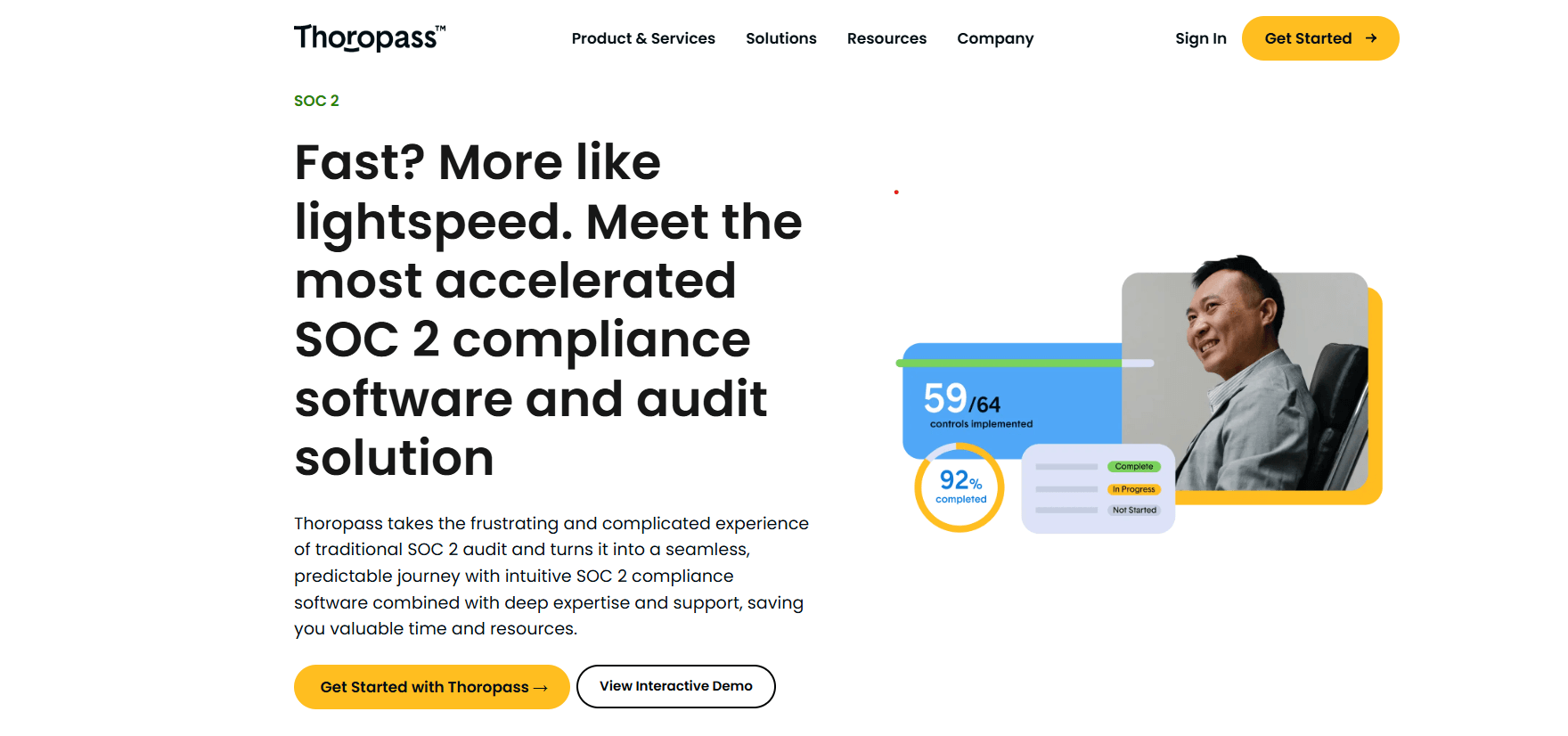
Thoropass (formerly Laika) takes a structurally different approach from every other compliance platform on this list: rather than handing you off to a separate CPA firm, it owns the audit capability in-house through an AICPA peer-review-registered entity, so the software and the attestation come from a single vendor and a single contract.
Features
- Single vendor for both evidence automation and the actual SOC 2 attestation, eliminating the typical hand-off friction between a GRC platform and an outside CPA firm.
- First Pass AI accelerates evidence review and cuts time-to-report significantly versus the industry norm.
- Dedicated Compliance Architect included on every subscription tier to guide first-time buyers through scoping.
Pros
- The fastest realistic audit cycle on this list for companies that want to move quickly toward a first enterprise deal.
- One contract, one renewal date, one team accountable for the whole compliance lifecycle — genuinely useful for a lean energy tech startup without a dedicated compliance hire.
Cons
- Roughly 100 integrations which can matter if your energy tech stack includes less common IoT or telemetry tooling.
- Some customers report advisory-tier upsells appearing at renewal that weren’t itemized clearly in the original quote.
Pricing: Platform-only access starts around $8,700/year; bundled platform-plus-audit packages start near $14,500/year, with the median buyer paying roughly $30,000/year and enterprise multi-framework deals running $78,000+ for 100–300 employee companies.
Verdict: Thoropass is the best fit for an energy tech company between roughly 25 and 300 employees that wants to remove vendor-coordination overhead entirely and get to a first SOC 2 report as fast as possible.
7. Prescient Assurance

Prescient Assurance has quietly built one of the more relevant track records in this list for energy tech specifically: the firm has performed SOC 2 Type 2 audits for AI-powered EV fleet charging software deployed across the US, Europe, Latin America, and Africa, giving it direct, demonstrable experience with the hardware-to-cloud architecture that defines so much of energy tech.
Features
- Risk-based audit methodology that scopes controls to actual risk rather than applying a one-size-fits-all checklist, which tends to lower cost for companies with simpler, well-architected systems.
- Genuine global footprint with senior auditors across the US, EMEA, and APAC — useful for energy tech companies with distributed engineering or operations teams.
- Slack-based audit collaboration and deep integration with major GRC platforms.
Pros
- Demonstrated, real-world experience auditing EV charging and energy hardware-software companies, not just generic SaaS.
- Risk-based scoping genuinely reduces unnecessary control testing and cost for well-run engineering teams.
- Broad framework coverage beyond SOC 2 — HIPAA, GDPR, CCPA, PCI, and ISO — useful as an energy tech company’s compliance needs expand.
Cons
- Rapid growth has occasionally led to scheduling delays.
- Less brand recognition with the most conservative enterprise utility buyers than A-LIGN or Schellman.
Pricing: Generally in the $15,000–$45,000 range for a Type 2 engagement, with flexible payment options available.
Verdict: If your energy tech company builds EV charging, battery, or other hardware-integrated software with an internationally distributed team, Prescient Assurance’s direct sector experience makes it one of the most credible specialist choices on this list.
8. Johanson Group
Johanson Group is built around a deceptively simple value proposition: speed and direct access to senior auditors, without Big Four overhead. Its three-step process ; scoping, fieldwork, and report delivery routinely produces Type 1 reports in one to three weeks and Type 2 reports in four to six weeks, among the fastest credentialed-CPA turnarounds available anywhere in this market.
Features
- Fixed-fee pricing that removes the scope-creep risk of hourly-billed engagements.
- Strong familiarity with companies already running Drata, Vanta, Secureframe, or Rippling for evidence collection.
Pros
- The fastest realistic path to a first SOC 2 report among any credentialed CPA firm on this list.
- Pricing below the specialist-tier average makes it one of the most accessible options for a pre-Series A or Series A energy tech startup.
- Flexible payment terms that smaller startups specifically benefit from.
Cons
- Smaller team size limits capacity for very large, multi-framework, or highly complex engagements.
- Less direct energy-sector or critical-infrastructure experience than IS Partners or Prescient Assurance.
- Lower brand recognition than the larger national firms when an enterprise utility’s procurement team is doing initial vendor screening.
Pricing: Type 2 engagements typically run $15,000–$30,000, below the broader specialist average of roughly $21,000–$61,000.
Verdict: For a pre-Series A or Series A energy tech startup racing toward a first enterprise deal or board-mandated compliance milestone, Johanson Group offers the fastest, most affordable path to a credible report.
9. Vanta

Vanta is the largest pure-play compliance automation platform by customer count, having crossed 16,000 customers in early 2026 on the strength of its 400+ integration library and the January 2026 launch of AI Agent 2.0. It’s important to repeat the distinction from earlier in this guide: Vanta accelerates evidence collection and continuous monitoring, but the actual SOC 2 report still has to be issued by one of the CPA firms above.
Features
- Broadest integration library in the category, covering virtually every major cloud provider, identity tool, and HR system an energy tech company is likely to run.
- AI Agent 2.0 automates a meaningful share of evidence gathering and control monitoring.
- Trust Center feature lets you publish a live security posture page for enterprise and utility procurement teams to review during due diligence.
Pros
- The integration breadth and auditor familiarity make Vanta the smoothest on-ramp for an energy tech company on a fairly standard AWS, GCP, or Azure stack.
- Most CPA firms already know how to work efficiently with Vanta’s evidence exports, which can shorten audit fieldwork.
- Frequent product investment keeps the platform current.
Cons
- You’ll need to budget separately for a CPA firm engagement on top of the platform cost.
Pricing: Platform access generally runs $10,000–$80,000/year depending on company size and framework count, with the first SOC 2 audit itself (billed separately by an independent CPA firm) typically adding $25,000–$50,000 for a Type 2 report.
Verdict: Vanta is the right compliance-automation layer for an energy tech company running a fairly conventional cloud-native stack that wants the widest possible integration coverage and the easiest path to auditor familiarity.
10. Drata
Drata is Vanta’s most direct competitor and delivers a near-identical core experience, with a particular emphasis on letting technical teams manage compliance in code through API-driven configuration rather than manual dashboard clicking. It has built a strong reputation for customer support quality, which shows up consistently in independent G2 satisfaction comparisons against Vanta.
Features
- Continuous, automated evidence collection across cloud infrastructure, identity providers, and code repositories.
- Agentic AI capabilities extending into vendor risk management (VRM), useful for energy tech companies managing a long tail of hardware and telemetry vendors.
- Strong audit-hub functionality for real-time collaboration with whichever CPA firm performs the actual attestation.
Pros
- Particularly well-suited to engineering-heavy teams that want fine-grained, code-level control over how compliance evidence is configured.
- Strong fit for companies managing multiple maturing frameworks simultaneously as they scale.
Con
- Steeper learning without dedicated security or compliance engineering capacity.
- Seat-based pricing can increase meaningfully as headcount grows.
Pricing: Platform access typically runs $7,500–$100,000+/year depending on company size, framework count, and modules selected.
Verdict: Choose Drata when your energy tech company has a technically sophisticated engineering team that wants to own and customize its compliance posture in detail, and values support quality as a deciding factor.
11. Secureframe
Secureframe distinguishes itself with more built-in hand-holding and advisory support than Vanta or Drata typically offer, plus notable depth in CMMC support for companies eyeing defense-adjacent contracts alongside SOC 2, ISO 27001, HIPAA, PCI DSS, and GDPR. That combination tends to suit energy tech companies whose infrastructure doesn’t fit a clean, standard cloud template, think hybrid setups bridging cloud software with on-premises SCADA-adjacent components or custom IoT ingestion pipelines.
Features
- Guided onboarding with more advisory support bundled into standard plans than most competitors.
- CMMC support alongside the standard SOC 2, ISO 27001, HIPAA, PCI DSS, and GDPR framework set.
- Serves customers from small businesses up through enterprise scale.
Pros
- More flexible evidence-collection workflows for hybrid or non-standard architectures than the purely automation-first platforms.
- Faster onboarding experience reported by switchers coming from less-guided platforms.
- CMMC familiarity is a meaningful asset for energy tech companies with defense-microgrid ambitions.
Cons
- Smaller integration roster than Vanta or Drata for purely cloud-native, standard-stack companies.
- Still requires a separate CPA firm engagement for the actual SOC 2 attestation.
Pricing: Platform access generally starts around $7,500/year and can run past $50,000/year depending on scope and framework count.
Verdict: Secureframe is the strongest compliance-automation fit for an energy tech company with a genuinely hybrid or custom architecture that needs more guided hand-holding than a pure self-serve platform provides.
12. Sprinto
Sprinto rounds out this list as the most budget-conscious compliance automation platform, popular specifically with smaller startups and internationally distributed companies thanks to native non-USD billing options. It automates both technical and operational controls end-to-end, with real-time monitoring and tiered alerts that reduce the manual evidence-gathering burden considerably for lean teams.
Features
- End-to-end automation of both technical and operational controls, not just infrastructure evidence.
- Real-time monitoring with tiered alerting that flags control drift before it becomes an audit finding.
- Native local-currency billing for international entities, a genuine advantage for energy tech startups operating outside the US.
Pros
- Generally the most affordable entry point among the compliance automation platforms on this list, well-suited to a pre-Series A team without a dedicated compliance budget.
- Intuitive interface that’s approachable for a small team without a security engineering function.
- Particularly strong fit for internationally headquartered energy tech startups thanks to local billing support.
Cons
- Less integration depth than Vanta or Drata, which can matter as the company’s tech stack grows more complex.
- May need to be outgrown in favor of a more enterprise-capable platform once multi-framework complexity arrives.
Pricing: Generally the lowest-cost entry point in this category, with single-framework SOC 2 plans priced well below Vanta and Drata’s comparable tiers.
Verdict: Sprinto is the right call for an early-stage, budget-constrained, or internationally based energy tech startup that needs a single SOC 2 framework handled efficiently without enterprise-platform overhead.
Final Verdict: The Best SOC 2 Audit Services for Energy Tech Companies
There’s no single best SOC 2 audit service for every energy tech company, but the shortlist narrows quickly once you’re honest about your customer base. A-LIGN is the strongest all-around pick for a multi-framework energy tech scale-up, IS Partners is the clear choice once utility or NERC CIP-adjacent customers enter the picture, Schellman and Coalfire earn their premium pricing for federal and DOE-funded work, and Thoropass, Johanson Group, and the major compliance automation platforms cover everything from the fastest first-time report to the most budget-conscious early-stage option.
What matters most is matching the firm to where your company sits today, your customer base, your funding stage, and how much of your infrastructure looks like a standard SaaS stack versus a hardware-integrated energy platform rather than defaulting to whichever name is most recognizable. Use the comparison table above as your shortlist, request quotes from two or three finalists, and confirm Type 1 versus Type 2 requirements with your customer or investor before signing.