

Businesses generate massive amounts of data every day from sales, marketing, customer interactions, sensors, and apps. When they fail to organize and manage this data effectively, it quickly becomes chaotic, hard to access, and unreliable. Data catalog companies create software that helps businesses organize, find, manage, and control their data assets across different systems. These tools make it easier for teams to locate the right data and understand how to use it effectively.
What Is Data Catalog
A data catalog works like a library index for all the data in an organization. It helps teams identify what data exists, where it is stored, what it means, who owns it, and how to use it correctly. It also provides metadata (information about the data), shows how data moves through systems (data lineage), and includes access controls that ensure users can rely on and locate the right data quickly.
Top 12 Best Data Catalog Companies
1. Alation

Alation’s Data Intelligence Platform includes several components such as Data Catalog, Data Governance, Data Lineage, Compose, and Alation Anywhere. These tools support self-service analytics, cloud transformation, and data governance by promoting collaboration and easy catalog access. The Alation Data Catalog helps users discover, manage, and collaborate on data efficiently. It connects with popular BI tools, APIs, and offers an Open Connector SDK. The catalog features a Behavioral Analysis Engine, guided navigation, collaboration tools, and integrations with multiple data sources.
Features
- Behavioral Intelligence: The AI-powered Behavioral Analysis Engine learns how users interact with data to deliver personalized recommendations and support data governance.
- Guided Navigation: Built-in guidance, flags, and policy indicators help users explore and understand data effectively.
- Collaboration Tools: Automated identification of data stewards, wiki documentation, and customizable reporting make teamwork and data sharing easier.
Pros
- Easy-to-use interface that enhances accessibility for all users
- Built-in connectors simplify integration with key data sources and tools
- Customization options allow teams to combine insights from different business units
- Machine learning capabilities improve data discovery and insights
- Collaboration features boost team efficiency and knowledge sharing
Cons
- Requires significant training due to a steep learning curve
- Cost details are not publicly available
Pricing
Contact the Alation sales team directly for a customized quote.
2. Informatica

Informatica Data Catalog uses artificial intelligence to help organizations locate, understand, and manage their data effectively. It automatically discovers, classifies, and inventories key data across both cloud and on-premises environments. The system identifies data assets, reveals their structure and relationships, and provides a unified view of organizational data. It also adds useful context to data assets through automated classification, association, and recommendations.
Features
- AI-Powered Automation: Uses AI algorithms to automatically scan, ingest, and classify data from multiple sources, including multi-cloud platforms, BI tools, and external metadata catalogs.
- End-to-End Data Lineage: Displays how data moves across systems, allowing users to trace data flow and understand transformation and preparation processes.
- Data Quality Tracking: Monitors data accuracy with profiling statistics, quality rules, scorecards, and metrics to ensure reliability.
Pros
- Suitable for enterprise-level data management.
- Strong metadata intelligence engine supports reliable data quality monitoring.
- Scalable architecture adapts to growing data volumes.
Cons
High cost may limit accessibility for smaller organizations.
Pricing
Pricing information is only available upon request.
3. IBM Knowledge Catalog
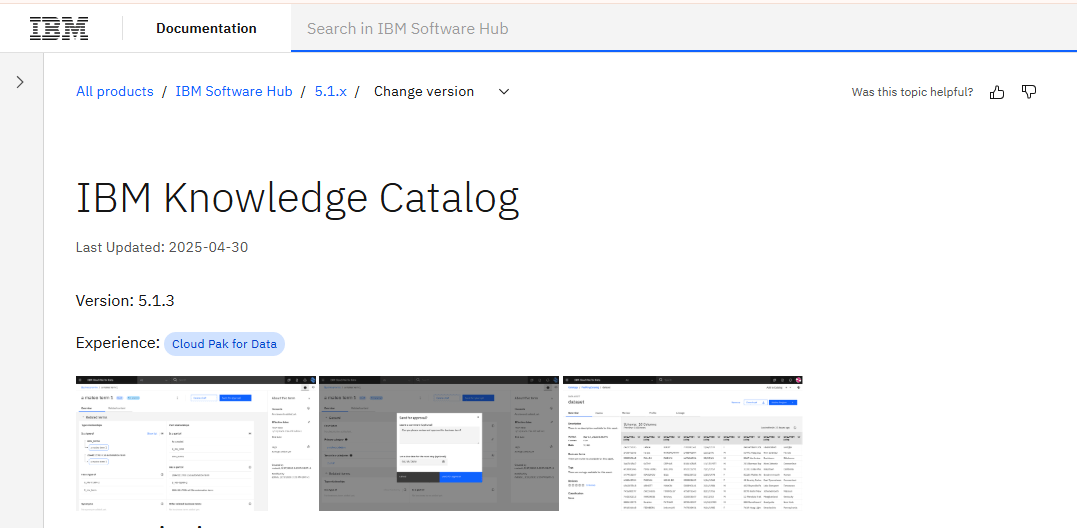
IBM Watson Knowledge Catalog helps organizations discover, manage, and govern their data assets. It supports structured, semi-structured, and unstructured data from both cloud and on-premises environments. The metadata repository enables AI, machine learning, and analytics workflows by organizing data for better accessibility and governance.
Features
- Uses a standardized method to discover IT assets
- Defines a common business language for consistent communication
- Manages and explores data lineage across systems
- Builds trusted information that strengthens data governance and compliance
- Improves communication between business and IT teams
- Adds business context to technical assets
Pros
- Cuts down provisioning and deployment time
- Builds a shared understanding of existing data assets
- Offers collaboration tools that align business and IT teams
- Helps organizations meet regulations that require data traceability
- Enables users to assess the full impact of any data change
Cons
Can be complex to deploy, particularly for users with limited technical knowledge
Pricing
Standard Plan (SaaS): Starts at $200 per month
4. Collibra
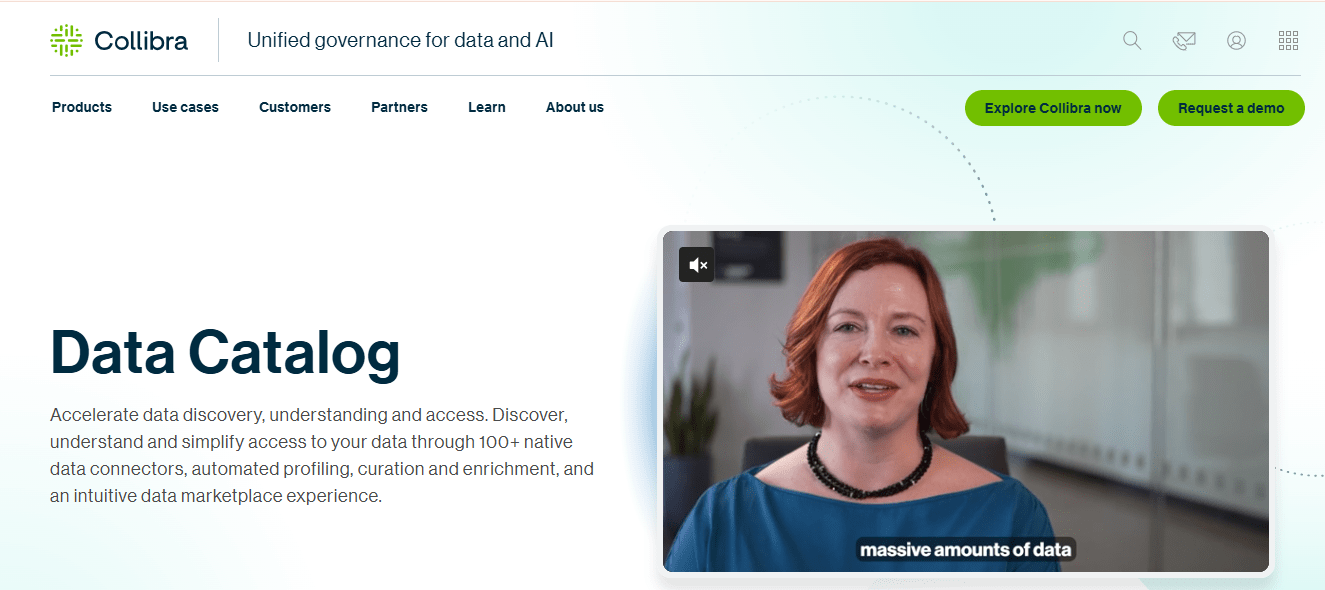
Collibra offers a data intelligence platform that focuses on data governance, stewardship, metadata processing, business glossaries, data dictionaries, and cataloging. It helps business users locate, understand, and trust their data. Collibra processes only metadata information about the data itself serving as a searchable repository for users who want to know where data is stored, how it is structured, and how it can be used. Users can assign roles, define responsibilities, and create workflows to organize and map data. Designed with business users in mind, Collibra stands out for its accessibility and usability beyond IT teams.
Features
- Data Discovery and Classification: Uses machine learning to automatically identify and classify data, offering insights into data quality and lineage.
- Embedded Data Governance: Includes guided stewardship tools and granular controls to manage data security and privacy effectively.
- Business Glossary: Provides a centralized glossary that standardizes terminology and includes automated governance workflows and dashboards.
Pros
- Ensures reports are accurate, meaningful, and trustworthy
- Acts as a single source of truth for data to support sound business decisions
- Makes it easier for teams to interpret data and improve analytics clarity
- Encourages collaboration between departments on data definitions
- Improves efficiency by helping users locate accurate data quickly
- Facilitates quick implementation of GDPR and other regulatory compliance
Cons
The interface can be complex and may require time for new users to learn
Pricing
Pricing information is available only upon request, though a free trial is offered.
5. Alteryx Connect
Overview
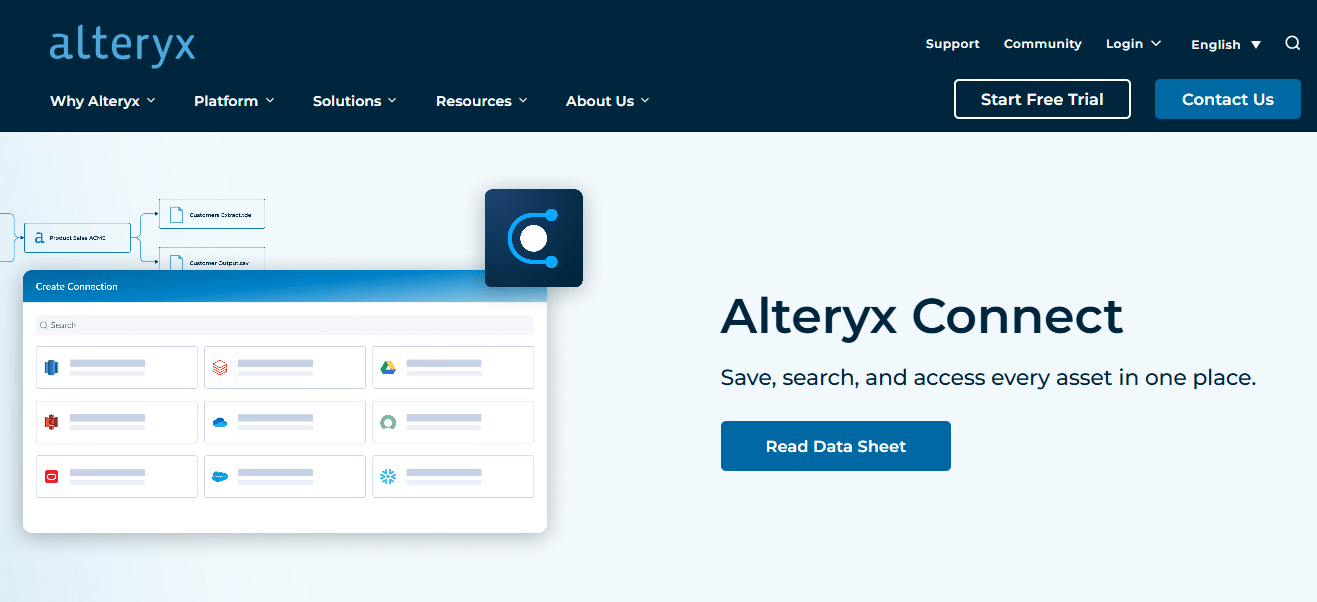
Alteryx offers its data catalog tool through Alteryx Connect, combining data cataloging and advanced analytics. It helps analysts, data engineers, and business users find, manage, understand, and collaborate on data assets across their organization.
Features
- Supports multiple data sources, including Alteryx analytic apps, Alteryx database (YXDB), Alteryx workflows, Amazon Redshift, Azure Data Lake Store, CSV, EXASOL, Hadoop HDFS, SAP HANA, Snowflake, and Tableau Server.
- Asset catalog for quick and organized data access and management.
- Business glossary to define business terms and connect them to data assets.
- Data discovery functionality to locate relevant data easily.
- Data enrichment tools that generate insights from connected assets.
Pros
- Integrates with other Alteryx products such as Alteryx Designer and Alteryx Server.
- Connects with over 80 data sources for flexible data access.
Cons
- Non-technical users may experience a learning curve.
- The software can be costly for small businesses.
Pricing
Contact the sales team for a custom quote. A 30-day free trial is available.
6. Atlan
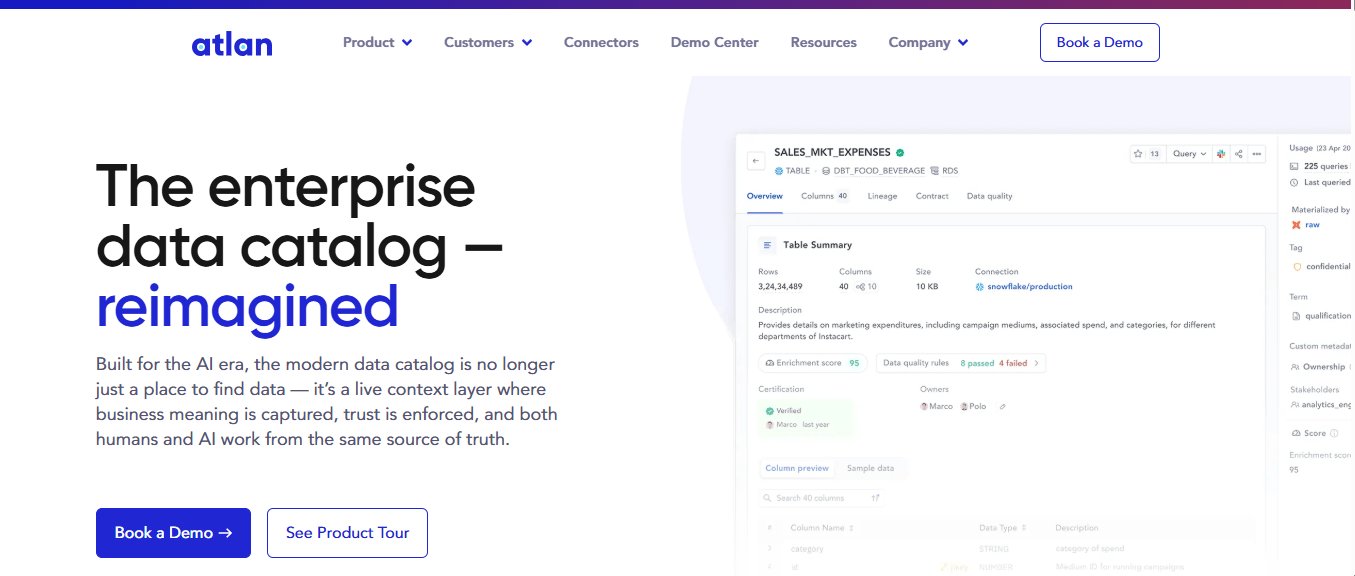
Atlan helps users find data across their entire ecosystem. It searches through various asset types such as tables, columns, dashboards, reports, connections, data sources, workbooks, queries, schemas, and more. The platform connects with multiple data tools to provide a single, unified search experience. Users can personalize their browsing experience with filters based on metadata properties, allowing analysts, engineers, and architects to explore data according to their unique needs like “shopping for data.”
Features
- Natural language and SQL-based search
- Collaborative workflows with a metadata sidebar
- AI copilot for data lineage and documentation
- Open APIs for seamless integrations
Pros
- Simple self-service setup
- Strong collaboration tools and AI-driven productivity
Cons
More expensive than most catalog solutions
Pricing
Custom vendor pricing
7. Ataccama
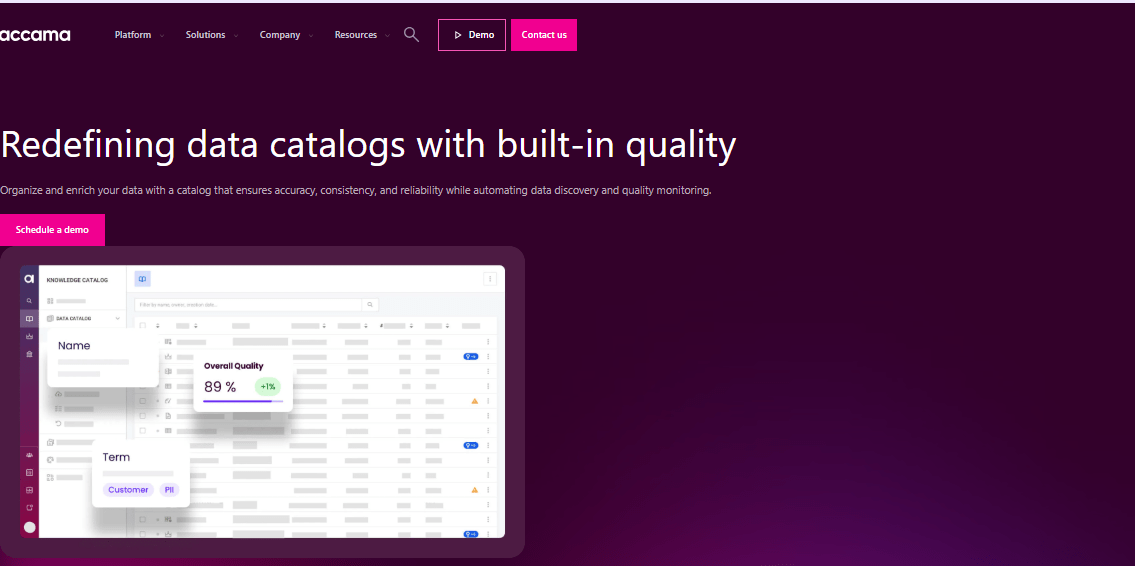
Ataccama Data Catalog is an advanced data management platform that combines data cataloging, data quality monitoring, and AI automation in one system. It helps organizations organize, enrich, and govern their data to maintain accuracy, consistency, and reliability. The platform serves data professionals, engineers, and business analysts, giving them the tools to manage data efficiently and make better business decisions.
Features
- Integrated data quality monitoring and cleansing tools
- AI-powered automation for data management tasks
- Data lineage and access control for governance
- Intuitive data catalog for easy data discovery and collaboration
Pros
- Strong data quality tools that make data cleansing and enrichment efficient
- Comprehensive governance features that enhance data security
- Easy-to-use catalog that encourages collaboration among teams
Cons
- Steep learning curve for new users due to the wide feature set
- High resource usage when managing large datasets
- Complex integration process that requires technical expertise
Pricing
Available through enterprise quotes only
8. Data.world
Data.world is a cloud-based data catalog offered as a SaaS platform. It uses a knowledge graph approach to organize enterprise data assets and metadata across multiple platforms. This structured view helps business and analytics teams easily find relevant data and understand its context. The platform also includes generative AI tools that enhance data discovery. These AI bots assist users with data searches, generate research questions and analytical hypotheses, convert natural language queries into SQL code, and create plain-language descriptions for metadata resources.
Features
- SaaS catalog built on a knowledge graph
- Bots that automate governance tasks
- Chat-style interface for search and discovery
- Semantic mapping of data relationships
Pros
- Easy data discovery using a graph-based model
- Simple and interactive experience with AI helpers
Cons
- Limited information about pricing
- Smaller user base compared to competitors
Pricing
Data.world offers multiple pricing plans. Contact the vendor for detailed information. User reviews indicate the estimated annual cost starts at around $90,000.
9. Alex Augmented
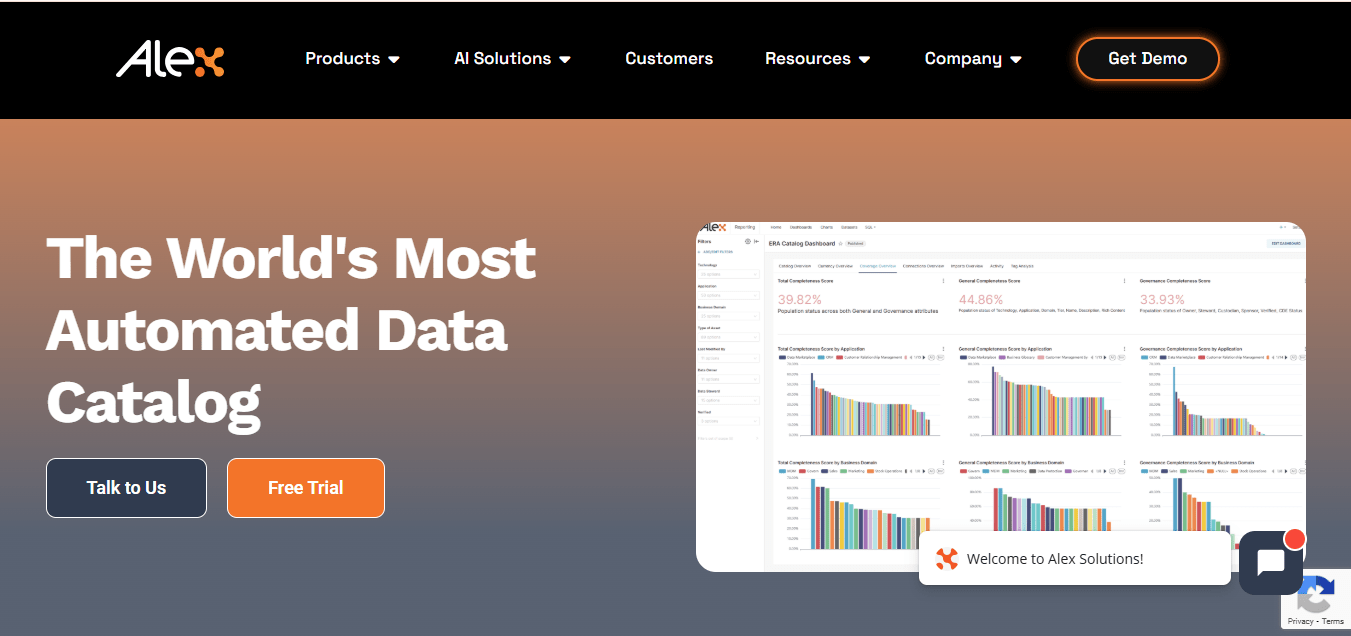
Alex Augmented uses artificial intelligence (AI) and machine learning to automate the discovery of data assets and organize them into a unified catalog. It supports structured, semi-structured, and unstructured data, helping organizations maintain a clear overview of their information assets. The platform also automates data governance and quality management, enabling managers to set policies, assign data stewards, and monitor data pipelines from a single console.
Features
- AI-powered metadata automation
- Supports structured, semi-structured, and unstructured data
- Policy creation and enforcement for governance
- Centralized catalog repository for easy management
Pros
- Automated metadata management through AI
- Helpful onboarding process and customer support
Cons
Few public reviews and limited user feedback
Pricing
Contact vendor for pricing details
10. Erwin
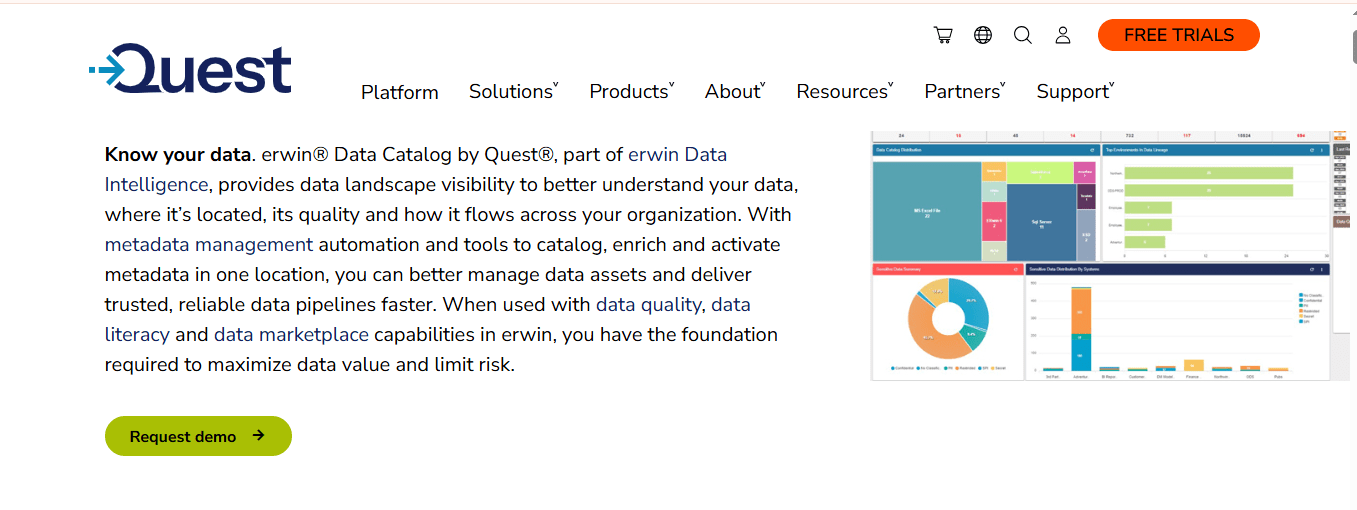
erwin Data Catalog by Quest helps enterprises manage and govern their data by automating metadata management. It gives organizations complete visibility into their data assets, supporting key functions such as data and AI governance, data platform modernization, and data pipeline management. The platform combines three main components data catalog automation, data modeling, and a data marketplace allowing businesses to move efficiently from data modeling to delivering data products.
Features
- Metadata harvesting and curation
- Mapping and lineage tracking
- Reference data management
- Sensitive data classification
- Lifecycle tracking
Pros
- Strong lineage and lifecycle management
- Well-suited for governance-focused organizations
Cons
- Less cloud-native than newer catalog solutions
- Requires more effort during setup
Pricing
Custom enterprise pricing
11. BigID
BigID Catalog helps organizations gain complete visibility into their data assets across physical, logical, and semantic layers. It identifies and tracks data from various sources, including tables, files, applications, schemas, collections, streaming data, and AI models—all in one platform. The software uses machine learning to locate data assets, extract technical and business metadata, and automate classification, profiling, and tagging. It also detects unsecured or ungoverned data to strengthen data governance and compliance.
Features
- Machine learning–based data discovery and classification
- Automated metadata tagging and profiling
- Sensitive data detection and privacy monitoring
- Policy enforcement and governance tools
Pros
- Strong at identifying sensitive data and supporting compliance requirements
- Automation minimizes manual cataloging tasks
Cons
Expensive for smaller organizations
Pricing details are not publicly available
Pricing
Contact the vendor for an enterprise quote. Pricing varies depending on your team size and data requirements.
12. Hygraph
Hygraph helps organizations catalog, track, and manage their data assets like an inventory. It organizes data in an intuitive way, making data management more structured and efficient. Designed with an inventory-based approach, Hygraph offers a unified data catalog and product management experience through a single orchestration layer.
Although it isn’t a dedicated data catalog software, Hygraph serves as a strong solution for managing both data and digital assets. Its decoupled architecture unifies all services into one GraphQL API, allowing organizations to deliver complex applications and digital experiences seamlessly.
Features
- Scalability: Handles over 10 million entries efficiently, suitable for large datasets.
- Headless Architecture: Uses a single GraphQL API for improved flexibility and system integration.
- Multi-Tenancy: Supports multiple users or departments within one instance, ideal for large organizations.
Pros
- Visually engaging inventory dashboard
- Detailed tracking of data assets
- Treats data like tangible inventory items, improving clarity and control
Cons
- Some tools may be unnecessary for simple setups
- Requires training to fully utilize features
- May be too advanced for smaller organizations
Pricing
- Hobby: Free
- Growth: Starts at $199 per month
- Enterprise: Custom pricing.
Modern organizations face massive data growth across different systems and platforms. Data catalog solutions now play a critical role in helping them manage, organize, and control this data effectively. The 12 companies here lead in data cataloging technology, offering distinct ways to help businesses discover, organize, govern, and gain value from their data.
The right data catalog depends on each organization’s specific goals, budget, and resources. Most providers offer free trials or demos, allowing businesses to compare options before choosing. As data becomes more central to operations, adopting a strong cataloging solution is no longer optional, it’s essential for maintaining efficiency and staying competitive.