

Enrollment management software covers a broad set of tools. These include admissions CRMs, application platforms, K-12 enrollment and lottery systems, international recruitment networks, and student information systems (SIS) with built-in admissions features. Institutions use these platforms to manage recruitment, applications, communications, admissions decisions, and the move from accepted applicant to enrolled student.
The category has become more important as institutions manage larger prospect pools and higher expectations for personalized communication. At the same time, enrollment teams face growing pressure to identify which recruitment channels and campaigns lead to enrolled students. By moving these processes out of spreadsheets, shared inboxes, and disconnected systems, institutions can give enrollment teams one central place to manage student journeys and measure results.
Several changes stand out in enrollment management software in 2026. First, AI-assisted outreach is now common across many higher education CRM platforms. These features include chat, predictive scoring, and automated communications.
Second, vendors continue to bring more products under unified platforms. For example, Liaison now operates TargetX and Othot alongside its CAS and EMP products. Similarly, Anthology has brought several legacy CRM and SIS products into a more unified platform.
Finally, K-12 enrollment technology has developed into a distinct category. These platforms support needs that higher education admissions CRMs generally do not. For example, they can manage enrollment lotteries, school-choice rules, waitlists, and family portals.
This guide compares 30 providers across higher education, K-12, and international recruitment. Each review explains what the product does, who it serves, and its main enrollment capabilities. We also cover the key advantages, limitations, and pricing where reliable information is available.
What Is Enrollment Management Software?
Enrollment management software is a platform that supports some or all of the journey from prospective student to enrolled student. Depending on the product, that journey can include recruitment and lead capture, CRM and communications, application collection, application review, admissions decisions, yield management, financial aid strategy, registration, and onboarding.
The category includes several types of software. Slate, TargetX, and Element451 focus heavily on recruitment and admissions CRM functionality. Banner and Workday Student operate primarily as SIS platforms with enrollment and admissions capabilities. SchoolMint focuses on K-12 enrollment and lottery management, while ApplyBoard and IDP Connect operate primarily as international recruitment channels.
Some products therefore cover the entire enrollment lifecycle, while others solve one specific part of it. This distinction matters when comparing products because an institution may need a complete system or simply an additional tool that works alongside its existing CRM or SIS.
Top 30 Enrollment Management Software in 2026
1. Technolutions Slate
Technolutions Slate is a higher-education CRM built around the actual processes admissions teams manage every day. Instead of forcing institutions to recreate admissions concepts inside generic CRM objects, Slate provides native structures for applications, application rounds, reader assignments, decisions, events, communications, and enrollment workflows.
That admissions-specific architecture explains why Slate remains deeply embedded in higher education. Technolutions reports more than 2,000 colleges and universities using the platform. Institutions can use the same underlying database across recruitment, admissions, student success, and advancement, allowing teams to carry a student record beyond the initial application.
Slate also gives institutions extensive control over forms, portals, workflows, communications, and reporting. Admissions teams can build customized processes around their own policies rather than adapting every workflow to a fixed vendor template.
That flexibility comes with an operational requirement: institutions generally need someone who understands Slate’s configuration, workflow rules, permissions, integrations, and communications environment. A small admissions office without dedicated technical capacity may find the platform harder to manage than a simpler CRM.
Key features
- Native application and admissions objects
- Reader queues and decision-release workflows
- Configurable forms and applicant portals
- PURL-based personalized communications
- Event and travel management
- Query and reporting tools
- Student success and advancement modules
- SIS and third-party integrations
Pros
- Purpose-built admissions architecture
- Application-volume licensing rather than per-seat licensing
- Extensive workflow and communication customization
- Large user and consultant ecosystem
Cons
- Steep learning curve
- Often requires a dedicated administrator
- Less visually modern than some newer CRM platforms
- Costs increase with application volume
Pricing
- Starts at $30,000/year
- Typical institutions may pay around $50,000/year
- Large-volume institutions can reach approximately $175,000/year
- Confirm current licensing bands with Technolutions
Best for: Mid-sized and large colleges and universities with dedicated CRM administration capacity.
2. Element451
Element451 focuses on recruitment engagement and marketing automation rather than simply providing a highly configurable CRM database. Its platform combines AI-assisted engagement, predictive scoring, automated campaigns, application management, and event tools to help admissions teams move prospects through the enrollment funnel with less manual intervention.
The platform divides its functionality across products such as App451, Event451, and Campaigns451. Institutions can therefore build a broader enrollment stack without adopting a traditional enterprise CRM with extensive configuration requirements.
AI sits prominently within the platform. Institutions can use AI chat and predictive capabilities to respond to prospective students, identify promising leads, and automate parts of their communication strategy. This approach makes Element451 particularly relevant to admissions and marketing teams that want automation built into their daily workflows rather than added through separate tools.
The tradeoff is cost and packaging. Institutions purchasing multiple modules can see annual costs rise significantly, while some advanced capabilities can involve additional usage-based charges. Prospective customers should therefore evaluate the full package rather than comparing only the starting price.
Key features
- AI chatbots
- Predictive lead scoring
- Email and SMS campaign automation
- Application management through App451
- Event management through Event451
- Document and recommendation collection
- Audience segmentation
- Reporting and analytics
- Third-party integrations
Pros
- Strong AI and automation capabilities
- Modern admissions and marketing workflows
- Modular product structure
- Generally easier to approach than highly customized legacy CRM environments
Cons
- Full-suite costs can become significant
- Some AI capabilities may involve usage-based pricing
- Public pricing remains limited
- Institutions need a quote for accurate budgeting
Pricing
- Quote-based
- Third-party pricing information has placed entry packages around $20,000/year
- Broader deployments have been reported in the $50,000–$80,000+/year range
- Confirm current pricing directly with Element451
Best for: Mid-sized institutions wanting AI-assisted recruitment and marketing automation without building a heavily customized enterprise CRM.
3. Liaison TargetX
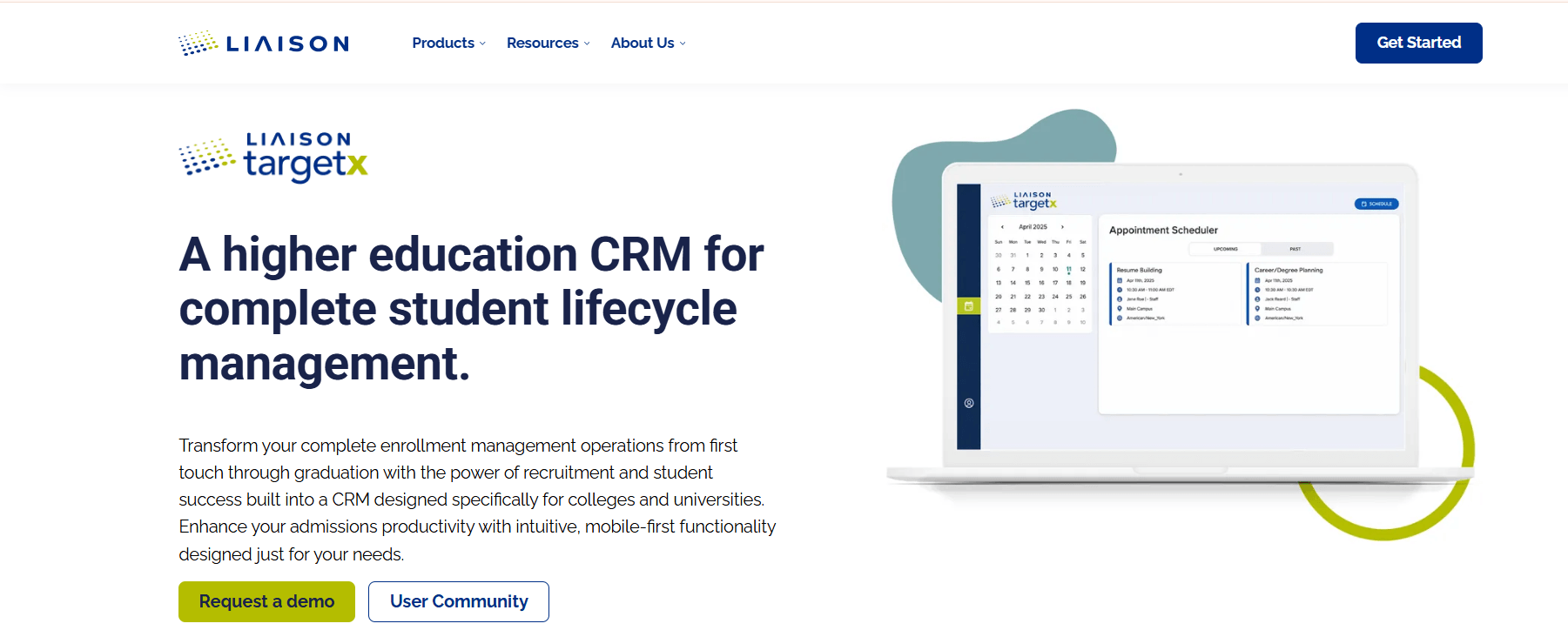
TargetX provides higher-education recruitment and retention functionality on Salesforce. Liaison acquired TargetX and has continued positioning it as a higher-ed-specific CRM for institutions that want Salesforce infrastructure without having to build every admissions workflow themselves.
The platform emphasizes mobile recruitment and applicant engagement. Admissions teams can review applications, communicate with prospects, manage recruitment activity, and use the Schools App to create a branded admitted-student community. Its texting and live-chat capabilities also support the faster communication prospective students increasingly expect.
TargetX benefits most from Salesforce’s underlying ecosystem. Institutions already using Salesforce can connect TargetX to their existing environment and use common data structures and integrations. The platform also supports connections with SIS platforms such as Banner, Colleague, PeopleSoft, PowerCampus, and Jenzabar.
However, TargetX does not eliminate the cost or complexity associated with Salesforce. Institutions should account for the underlying Salesforce environment, implementation, configuration, and any additional modules when calculating the total investment.
Key features
- Mobile-first application review
- Applicant scoring
- Schools App admitted-student community
- Roommate matching
- SMS and personalized email
- Live website chat
- Retention and student-success tools
- SIS integrations through EDA
Pros
- Strong fit for Salesforce environments
- Mobile-focused recruitment tools
- Recruitment and retention functionality
- Access to Liaison’s broader ecosystem
Cons
- Requires Salesforce infrastructure
- Total cost can extend beyond the CRM license
- Reporting may require additional tools
- Public pricing is unavailable
Pricing
- Contact vendor for pricing
- Pricing depends on institution size, modules, implementation, and Salesforce licensing
Best for: Institutions using or planning to use Salesforce that need higher-education recruitment and retention functionality.
4. Salesforce Education Cloud
Salesforce Education Cloud combines Salesforce’s CRM infrastructure with education-specific data structures and applications. The platform covers recruitment and admissions, student success, advancement, academic operations, and other institutional processes, giving institutions the option to build a broader student lifecycle environment on the same platform.
Recruitment and Admissions functionality handles prospect engagement and admissions workflows, while Salesforce’s broader platform provides automation, reporting, integrations, and customization. Education Cloud also incorporates Agentforce, Salesforce’s AI-agent technology, which institutions can use to automate parts of prospective-student engagement and other service workflows.
The platform’s breadth creates both its biggest advantage and its biggest implementation consideration. Institutions can customize the environment extensively, but they also need to configure it around their own processes. Many organizations may therefore require internal technical resources or an implementation partner.
Education Cloud fits institutions that want enrollment functionality as part of a larger CRM strategy. It is less attractive to organizations looking for a narrowly focused admissions application that works with minimal configuration.
Key features
- Recruitment and Admissions
- Prospect scoring
- Agentforce AI agents
- Student Success Hub
- Scheduling and program management
- Salesforce reporting and automation
- AppExchange integrations
- Advancement functionality
- Academic and financial modules
Pros
- Extensive customization
- Native AI-agent capabilities
- Supports multiple institutional functions
- Large integration ecosystem
Cons
- Significant configuration requirements
- Implementation can require specialist partners
- Total costs can rise with customization and additional modules
- Some admissions-specific workflows require configuration
Pricing
- Education Cloud Enterprise Edition starts at $87/user/month
- Annual billing applies
- Additional editions and modules have separate pricing
- Confirm current pricing directly with Salesforce
Best for: Institutions that want flexible CRM infrastructure across recruitment, student success, and advancement.
5. Ellucian CRM Recruit & Advise
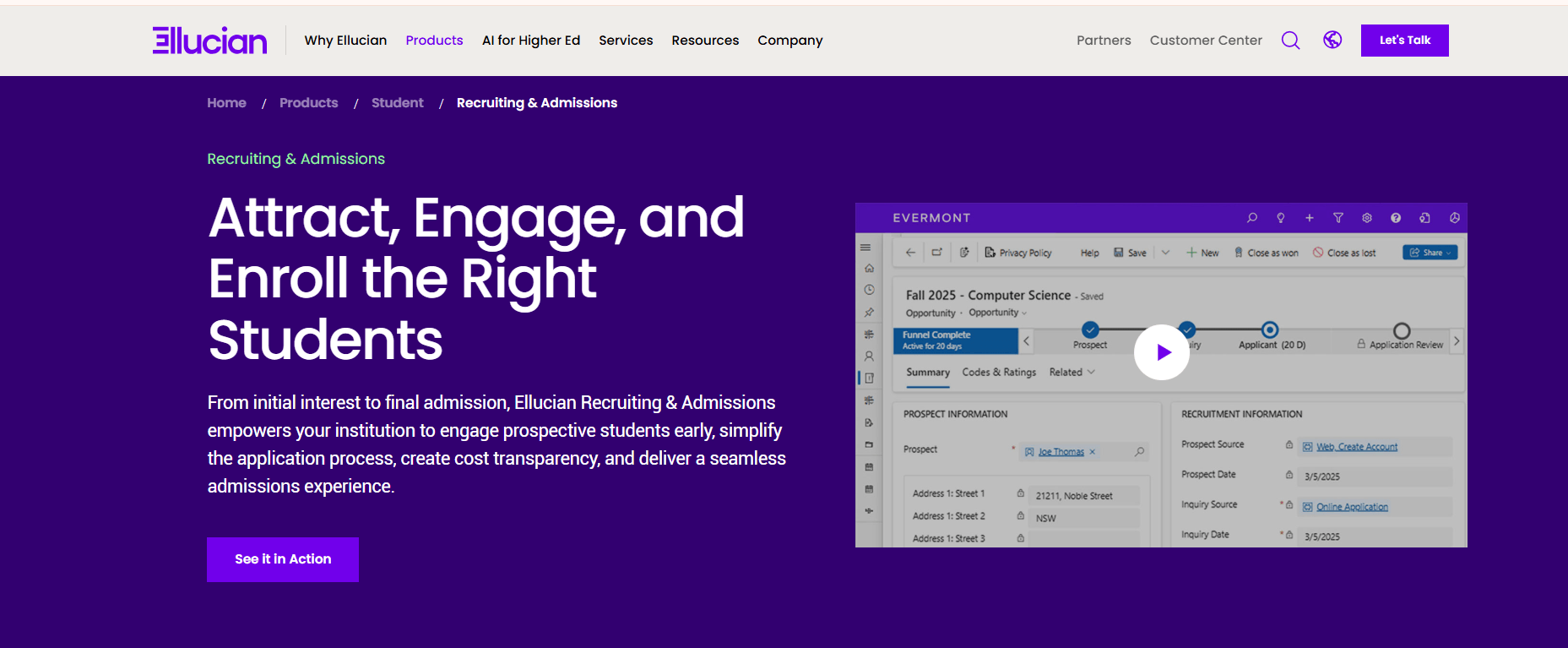
Ellucian CRM Recruit and CRM Advise work particularly well for institutions already using Banner or Colleague. Recruit manages the prospective-student and admissions funnel, while Advise uses academic and financial information to help institutions identify students who may need intervention.
The strongest part of the offering is its connection to Ellucian’s SIS ecosystem. Institutions do not have to create the same degree of integration between their CRM and SIS that they might need with a completely separate vendor.
CRM Recruit supports recruitment pipelines, communications, and admissions activity. CRM Advise shifts the focus after enrollment by helping advisors manage caseloads and identify risk indicators.
That makes the combined offering broader than a recruitment CRM alone. However, institutions that do not already operate Ellucian systems may have fewer reasons to choose it over an independent admissions CRM.
Key features
- Recruitment pipeline management
- Admissions workflows
- Predictive risk scoring
- Advisor caseload management
- Academic and financial student views
- Automated communications
- Banner integration
- Colleague integration
Pros
- Strong Banner and Colleague integration
- Combines recruitment and advising
- Uses SIS-level academic and financial data
- Single-vendor relationship
Cons
- Setup can be complex
- Large datasets can affect performance
- Public pricing is unavailable
- Less compelling as a standalone CRM for non-Ellucian institutions
Pricing
Contact vendor for pricing
Pricing depends on institution size and implementation scope
Best for: Banner and Colleague institutions wanting recruitment and advising tools that connect directly to their SIS.
6. Liaison EMP + CAS
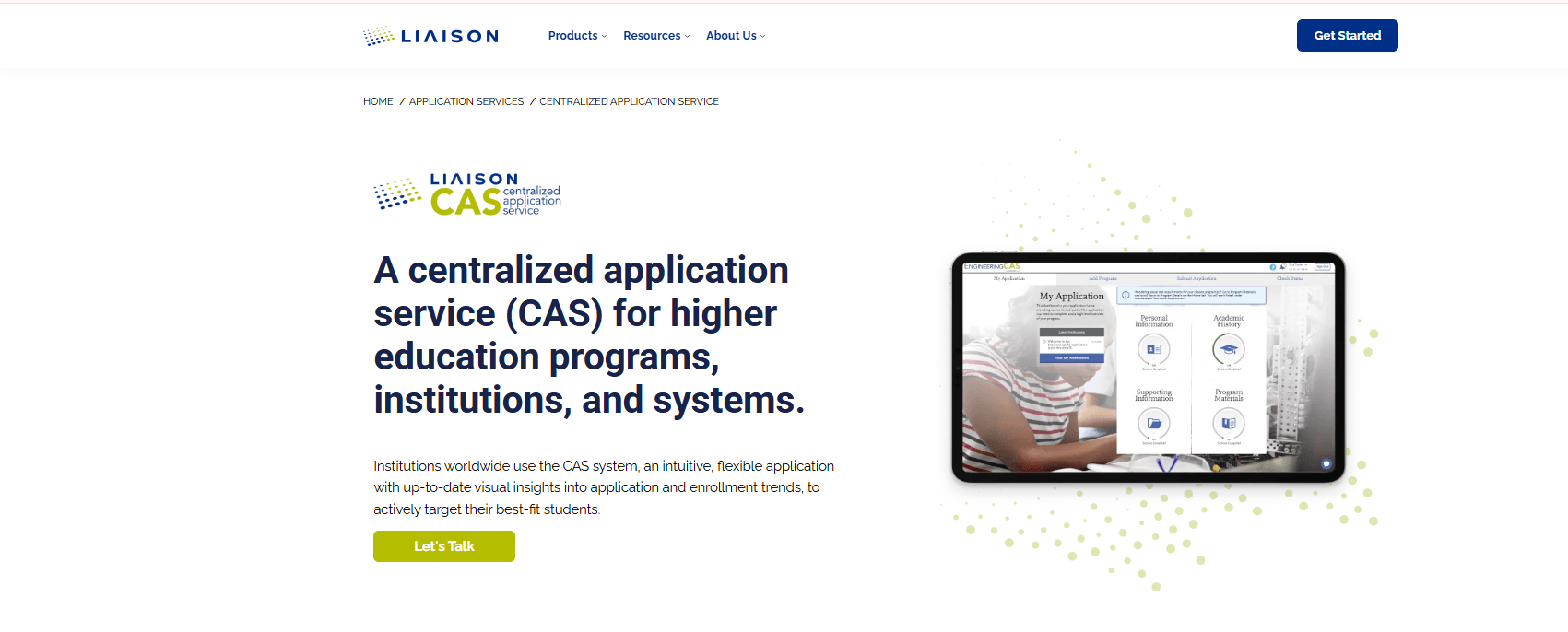
Liaison’s Enrollment Marketing Platform (EMP) and Centralized Application Service (CAS) address two connected parts of enrollment management: application processing and recruitment marketing.
CAS supports centralized application processing across discipline-specific services, while EMP helps institutions communicate with prospective students through email, SMS, print, voice, personalized microsites, and other channels. Liaison reports that its CAS network supports more than 31,000 programs across more than 1,000 campuses.
EMP also works alongside other CRMs rather than forcing institutions to replace their existing system. A school using Slate or TargetX, for example, can use EMP as an additional marketing layer.
This makes the platform particularly relevant to institutions and associations managing high-volume or program-specific applications. It is less suitable as a standalone replacement for a full admissions CRM.
Key features
- Centralized Application Service
- Email, SMS, print, and voice campaigns
- Personalized microsites
- PURL communications
- Automated counselor task lists
- Prospect behavior analytics
- CRM integrations
Pros
- High-volume application infrastructure
- CRM-agnostic design
- Long history in centralized application processing
- Software and marketing services can be combined
Cons
- Often requires another CRM
- Public pricing is unavailable
- Less useful as a standalone enrollment platform
Pricing
Contact vendor for pricing
Pricing depends on program volume and services
Best for: Institutions and associations managing high-volume applications that need centralized processing and enrollment marketing.
7. EAB Enroll360 / Navigate360
EAB combines recruitment services, enrollment technology, predictive analytics, and advisory support through Enroll360 and Navigate360. Instead of selling software as an isolated product, EAB connects technology with its enrollment research and managed services.
Enroll360 includes access to Appily for prospect generation, while Navigate360 supports enrollment and student-success workflows. EAB also applies predictive models across recruitment and enrollment, helping institutions identify prospective students and understand funnel behavior.
This managed-service approach distinguishes EAB from platforms that expect institutions to configure and operate every part of the system themselves. Institutions can receive migration and onboarding support while using EAB’s research and predictive capabilities alongside the technology.
The model can require a broader relationship with EAB, however, so institutions should evaluate the overall service package rather than looking only at the CRM functionality.
Key features
- Direct-admission tools
- Scholarship-offer automation
- Global Match
- Predictive enrollment analytics
- Enrollment CRM
- Student-success functionality
- Migration and onboarding support
Pros
- Combines technology and enrollment expertise
- Lead generation and CRM in one offering
- Strong onboarding support
- Extensive predictive modeling
Cons
- Managed-service model provides less platform independence
- Pricing is not public
- Broader EAB relationship may be part of the overall cost
Pricing
Contact vendor for pricing
Best for: Institutions wanting recruitment leads, CRM technology, predictive analytics, and enrollment support in one broader service model.
8. Othot
Othot focuses on predictive analytics rather than CRM functionality. The platform analyzes institutional data to help enrollment teams understand which prospects may enroll, how financial aid can affect yield, and which enrolled students may be at risk of leaving.
Because Othot works with CRM and SIS data, it fits into an existing enrollment technology stack rather than replacing it. Its models can support enrollment forecasting, aid strategy, retention planning, and other strategic enrollment management decisions.
Data quality plays an important role in the implementation. Institutions with well-integrated and reliable CRM and SIS data can provide the platform with stronger inputs, while organizations with fragmented data may need additional preparation before predictive models become useful.
Liaison’s ownership of Othot also gives institutions considering Liaison’s broader technology portfolio a connection between predictive analytics, CRM, and application services.
Key features
- Enrollment predictive modeling
- Yield prediction
- Financial aid optimization
- Tuition discounting analysis
- Retention risk scoring
- Custom institutional models
Pros
- Specialized enrollment analytics
- Supports aid and yield strategy
- Works with existing institutional data
- Connected to Liaison’s broader ecosystem
Cons
- Not a full CRM
- Requires strong underlying data
- Limited public review coverage
- Pricing is not transparent
Pricing
Contact vendor for pricing
Best for: Enrollment teams with established CRM/SIS data that need predictive modeling for yield, aid, and retention decisions.
9. Workday Student
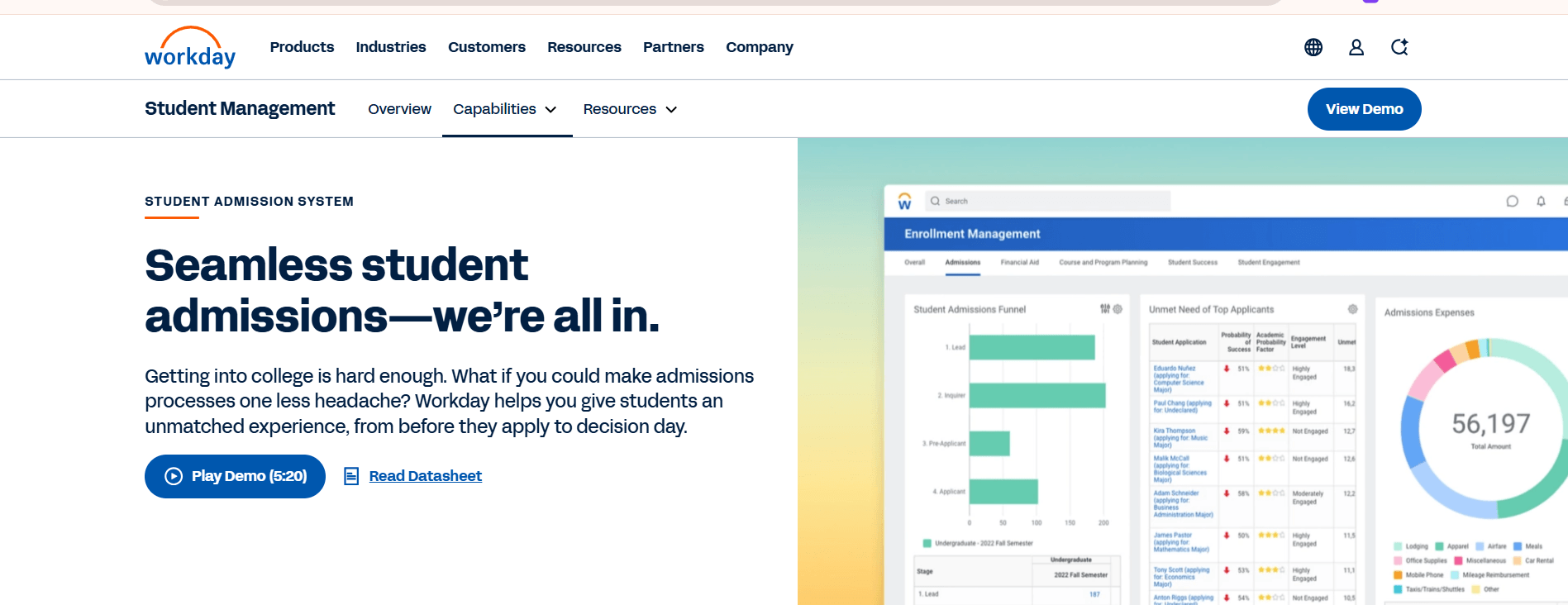
Workday Student extends Workday’s enterprise platform into the student lifecycle. Its primary value comes from connecting student data with the same broader environment used for financial management, human resources, payroll, and other institutional operations.
For enrollment teams, Workday Student provides configurable admissions and enrollment rules and maintains student information within Workday’s broader data model. Institutions can therefore connect information across students, employees, finance, and administration without maintaining completely separate enterprise platforms.
Workday Student operates more like a system of record than a recruitment CRM. Institutions that need extensive prospect marketing, lead nurturing, or admissions campaign management will generally need to connect a front-end recruitment platform.
Migration also represents a major consideration. Moving from an established SIS into Workday can affect admissions, registration, academic records, finance, integrations, and reporting across the institution.
Key features
- Configurable admissions rules
- Enrollment workflows
- Unified student and financial data
- HR and finance integration
- Cloud-native architecture
- Enterprise reporting
- Continuous platform updates
Pros
- Strong fit for existing Workday customers
- Unified data model
- Connects student, finance, and HR information
- Cloud delivery
Cons
- Not a recruitment CRM
- SIS migration can take years
- Implementation requires substantial institutional resources
- Pricing is not public
Pricing
- Contact vendor for pricing
- Pricing depends on institutional scope and the broader Workday deployment
Best for: Institutions already using Workday Financial Management and HCM that want to extend the platform into student administration.
10. Jenzabar One
Jenzabar serves small and mid-sized institutions with two related products that take different approaches to student management. It combines SIS, recruitment, and administrative functionality, while SONIS provides a lighter SaaS student information system with per-student pricing.
This positioning makes Jenzabar relevant to private institutions that need connected enrollment and student-record functionality without the scale of an enterprise platform such as Banner or Workday. Jenzabar One provides recruitment and application functionality, while SONIS focuses on the core student information system.
The per-student SaaS model makes SONIS comparatively straightforward to understand from a budgeting perspective, although institutions still need to confirm the current rate directly with Jenzabar.
The platform is less suited to very large universities with complex multi-campus requirements or institutions seeking the depth of a specialized admissions CRM.
Key features
- Recruitment CRM
- Application management
- Communications
- SIS System
- Financial aid functionality
- SONIS student information system
- Academic administration
Pros
- Lower entry point than large enterprise SIS platforms
- Per-student SaaS pricing for SONIS
- Strong fit for private institutions
- Connects recruitment and SIS functionality
Cons
- Smaller market presence in admissions CRM
- Less recruitment automation than specialist CRMs
- Not designed for very large university systems
Pricing
- SONIS uses monthly per-student SaaS pricing
- Current rate requires vendor confirmation
- Uses quote-based pricing
Best for: Small and mid-sized private institutions wanting connected SIS and recruitment functionality.
11. Symplicity Recruit
Symplicity Recruit brings the company’s career-services and employer-recruitment experience into admissions. Its strongest use case involves structured recruitment processes that rely heavily on events, interviews, scheduling, and applicant pipelines.
That makes the platform particularly relevant to graduate, professional, and specialized programs where applicants may move through interviews, events, assessments, and multiple recruitment stages. Its workflow resembles a structured recruiting pipeline more closely than the broad undergraduate marketing funnel managed by platforms such as Slate or Element451.
Institutions already using Symplicity for career services may also benefit from operating related workflows within the same vendor ecosystem.
However, institutions running large undergraduate recruitment operations may require more extensive marketing automation, lead generation, and admissions-specific functionality than Symplicity Recruit provides.
Key features
- Event scheduling
- Interview scheduling
- Applicant pipeline tracking
- Candidate communications
- Recruitment workflow management
- Symplicity ecosystem integrations
Pros
- Strong interview and event workflows
- Useful for graduate and professional programs
- Can complement existing Symplicity products
- Structured pipeline management
Cons
- Less suited to broad undergraduate recruitment
- Smaller admissions footprint than major CRM vendors
- Pricing is not public
Pricing
Contact vendor for pricing
Best for: Graduate, professional, and specialized programs with interview- and event-heavy admissions workflows.
12. Mongoose
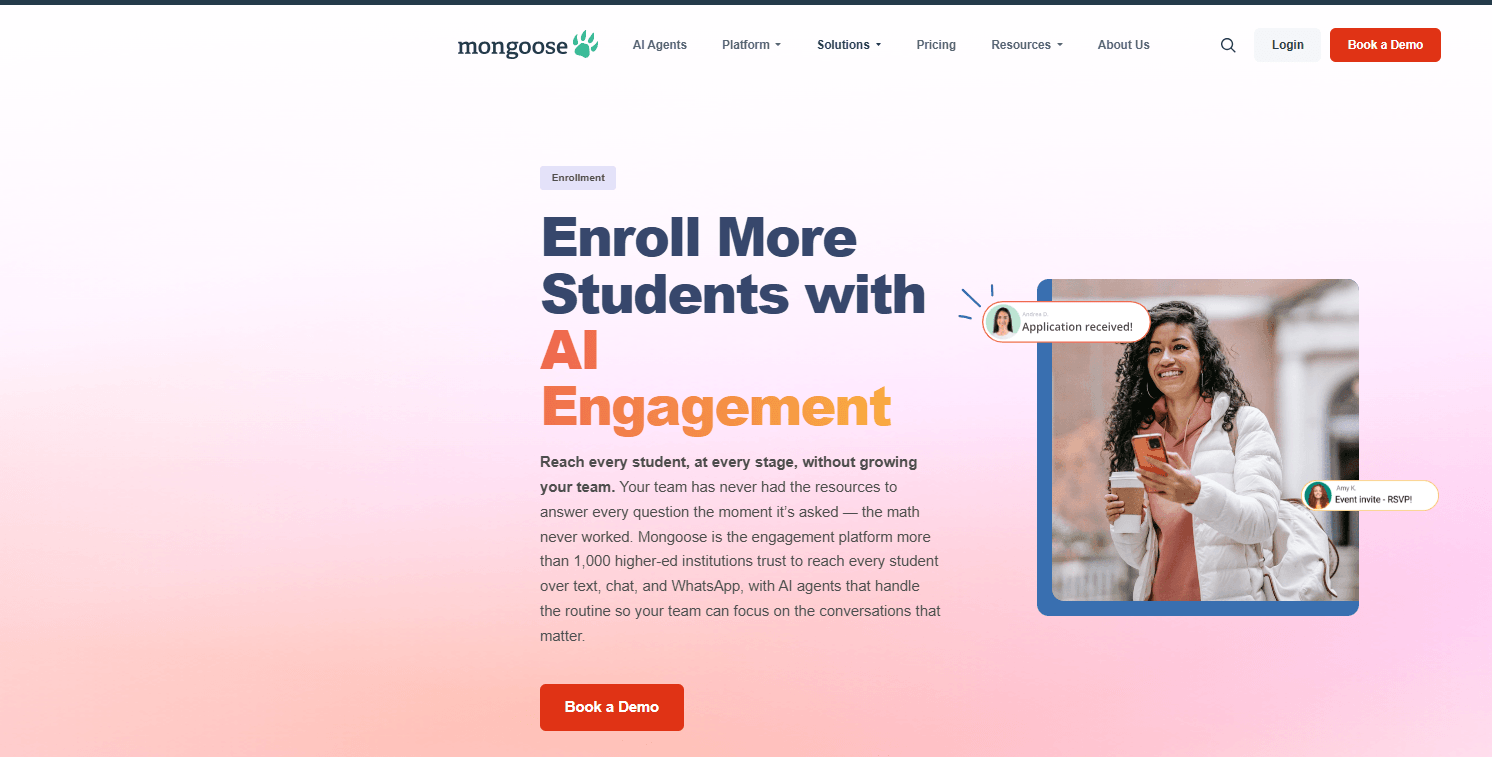
Mongoose focuses on two-way communication rather than replacing an institution’s CRM. Its platform adds SMS and WhatsApp conversations to existing enrollment, retention, and alumni workflows, allowing staff to communicate directly with students through channels they already use.
Unlike a traditional bulk messaging tool, Mongoose emphasizes conversations. Staff can respond to students, collaborate on conversations, and use AI-driven analysis to identify topics and sentiment across interactions.
This makes Mongoose useful as an additional communication layer for institutions that already have a CRM or SIS but want stronger conversational engagement. Admissions teams can use it for prospective-student questions and follow-up, while other departments can use it for retention and alumni communication.
Its narrower scope is also its main limitation. Institutions looking for applications, admissions decisions, marketing automation, and student records need another system.
Key features
- Two-way SMS
- WhatsApp messaging
- AI topic analysis
- Sentiment analysis
- Staff collaboration
- CRM and SIS integrations
- Admissions, retention, and alumni communication
Pros
- Published starting price
- Focused two-way communication
- Works alongside existing systems
- Extends beyond admissions
Cons
- Not a complete CRM
- Per-user pricing can increase for larger teams
- Narrower feature set than all-in-one platforms
Pricing
- Starts at $2,500/user/year
- Price listed through Capterra’s vendor-verified information
- Confirm current pricing with Mongoose
Best for: Institutions that want to add two-way texting to an existing enrollment CRM or SIS.
13. ZeeMee
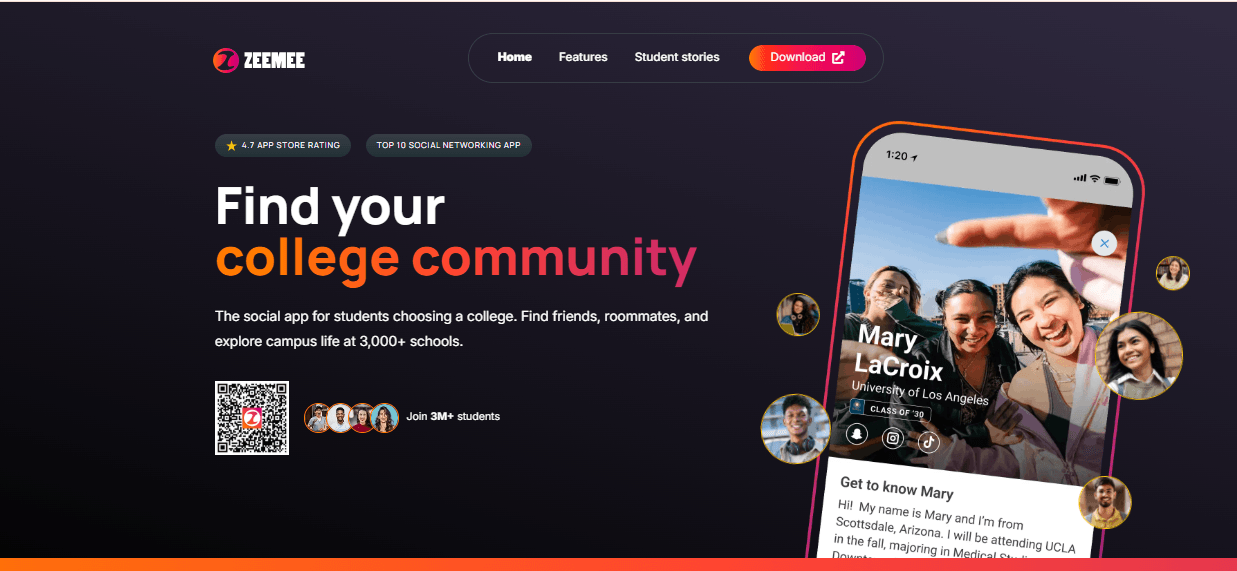
ZeeMee approaches enrollment from the student-community side rather than the admissions-operations side. The platform gives admitted students a place to connect with future classmates, explore their incoming community, find roommates, and interact with an institution before they arrive on campus.
That makes ZeeMee particularly relevant to the yield stage. While a traditional CRM focuses on generating and nurturing prospects, ZeeMee focuses on helping admitted students develop a connection with their future institution and peers.
The platform does not replace an admissions CRM, application system, or SIS. Institutions typically use it as a complementary engagement channel after or during the admissions process.
Its effectiveness also depends on student participation. A community platform requires enough admitted students to actively use it to create the network effects that make peer interaction valuable.
Key features
- Admitted-student communities
- Student messaging
- Roommate matching
- Video profiles
- Engagement dashboards
Pros
- Focuses specifically on admitted-student engagement
- Complements existing CRMs
- Familiar social format for students
- Supports roommate discovery
Cons
- Covers only part of the enrollment funnel
- Student adoption affects its value
- Institutional pricing is not public
Pricing
Free for students
Contact vendor for institutional partnership pricing
Best for: Institutions looking to strengthen admitted-student engagement alongside their existing enrollment CRM.
14. ApplyBoard
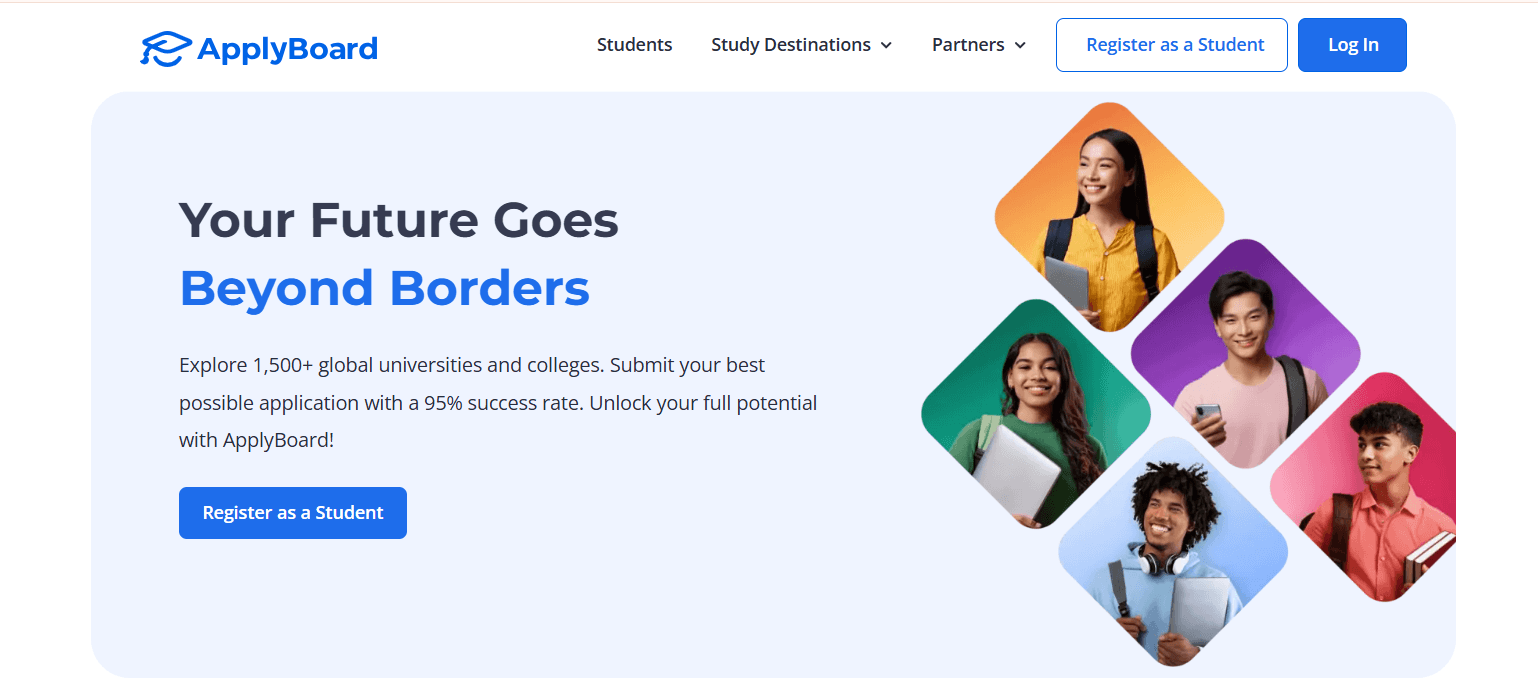
ApplyBoard operates as an international education marketplace rather than a traditional CRM. It connects prospective international students and education agents with partner institutions and provides tools for application routing and student support.
For institutions, the platform functions primarily as a recruitment channel. It can provide access to international students and agents without requiring an institution to build its own global agent network from scratch.
ApplyBoard also offers services around financing, investment requirements, testing, and other parts of the international student journey. Its business model differs from conventional enrollment software because partner institutions generally do not pay a standard SaaS subscription for access to the marketplace.
The tradeoff is control. Institutions using an external recruitment marketplace depend on the platform’s agent network, student traffic, and processes rather than owning every recruitment relationship directly.
Key features
- International recruitment marketplace
- Agent network
- Application tracking
- Application-success screening
- Student support services
- Loan and GIC services
- Test-preparation and voucher services
Pros
- Access to an established international agent network
- No direct software subscription for partner institutions
- Combines recruitment and student services
- Can expand international reach
Cons
- Not a CRM or SIS
- Institutions have less direct control over agent relationships
- Creates dependence on an external recruitment marketplace
Pricing
- Free for partner institutions to join
- ApplyBoard generates revenue through commissions and additional services
Best for: Institutions expanding international recruitment without building a global agent network internally.
15. IDP Connect
IDP Connect connects international recruitment with IDP Education’s wider student and IELTS ecosystem. Its position in the market gives institutions access to prospective students who already interact with IDP through English-language testing and international education services.
The platform supports agent recruitment, AI-assisted lead handling, and services such as FastLane, which can help participating institutions accelerate certain offer processes. IDP also provides student-community tools that help institutions engage prospects and applicants.
Like ApplyBoard, IDP Connect should not be treated as a replacement for an institution’s CRM or SIS. Instead, it provides an external recruitment and lead-generation channel that feeds into the institution’s own admissions processes.
Its strongest differentiation comes from the relationship between international recruitment and the broader IDP ecosystem.
Key features
- Global recruitment agent network
- AI-assisted lead tools
- FastLane offer-in-principle service
- Student Community
- IELTS-linked prospect reach
Pros
- Access to an established international student audience
- Large agent network
- Long operating history
- FastLane can accelerate selected admissions processes
Cons
- Does not replace a CRM or SIS
- Institutions remain dependent on external recruitment channels
- Commercial terms are not publicly detailed
Pricing
- Free to partner institutions
- Commercial terms use partnership and commission arrangements
- Confirm current terms with IDP
Best for: Institutions seeking international recruitment reach connected to IELTS and IDP’s global student ecosystem.
16. Keystone Academic Solutions
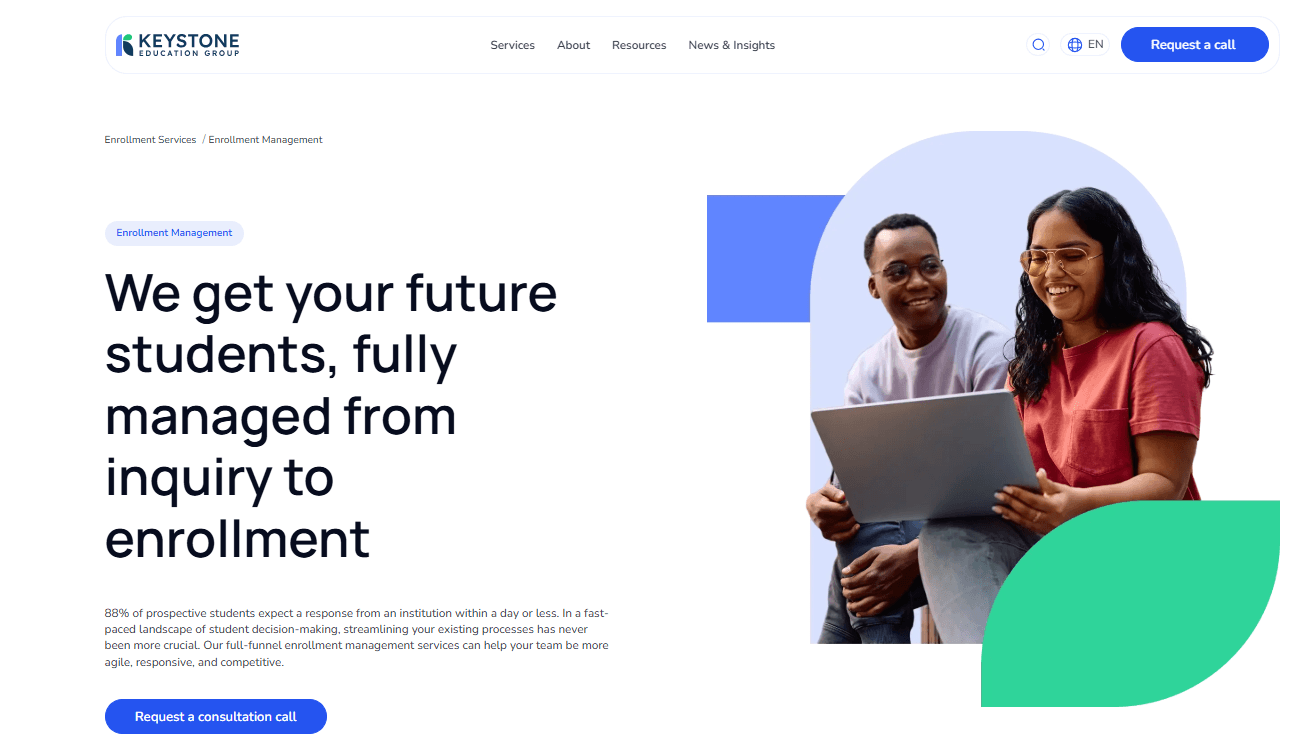
Keystone Academic Solutions takes a digital marketing approach to international student recruitment. Rather than building an agent marketplace, Keystone uses program-listing websites, search visibility, multilingual content, and lead generation to connect prospective students with institutions.
The model works as a marketing layer around an institution’s existing admissions operation. Prospective students discover programs through search-oriented websites and listings, then submit interest that the institution can follow up through its own CRM and admissions process.
Keystone works with institutions and agencies across multiple countries and uses geographic and language targeting to reach prospective students in different markets.
The platform therefore suits institutions that want to expand international visibility through digital channels rather than relying primarily on traditional recruitment agents.
Key features
- Program-listing websites
- SEO-driven lead generation
- Multilingual marketing
- Geographic targeting
- International student lead capture
- Global institutional network
Pros
- Strong international search focus
- Multilingual and geographic targeting
- Large institutional network
- Provides an alternative to agent-led recruitment
Cons
- Not a CRM
- Not an application-management platform
- Results vary by program and market
- Pricing is not public
Pricing
Contact vendor for pricing
Best for: Institutions seeking SEO-driven international program marketing and lead generation.
17. Populi
Populi combines an SIS, LMS, and CRM in one hosted platform designed primarily for smaller colleges, Bible colleges, and seminaries. Instead of requiring a small institution to purchase separate systems for student records, learning management, and enrollment-related activities, Populi brings these functions together.
Its enrollment functionality emphasizes simplicity and integration rather than the deep marketing automation found in specialist admissions CRMs. Admissions information can connect directly with the student’s academic record, reducing the need for separate systems and manual data transfers.
Populi’s pricing model also differs from most enterprise platforms because it uses per-student monthly pricing. That structure can make costs easier for smaller institutions to understand and budget.
The platform is less suitable for large, complex universities that need extensive multi-campus workflows, sophisticated recruitment marketing, or highly customized enterprise processes.
Key features
- SIS
- LMS
- CRM
- Admissions tracking
- Enrollment management
- Academic records
- Per-student pricing
Pros
- All-in-one platform
- Straightforward pricing model
- Designed for smaller institutions
- Reduces system integration requirements
Cons
- Limited scalability for large universities
- Lighter recruitment automation
- Less customization than enterprise systems
Pricing
- Monthly, per-student SaaS pricing
- $199/mo + $9/mo per billable student
Best for: Small colleges, Bible colleges, and seminaries wanting one integrated SIS, LMS, and CRM.
18. Full Fabric
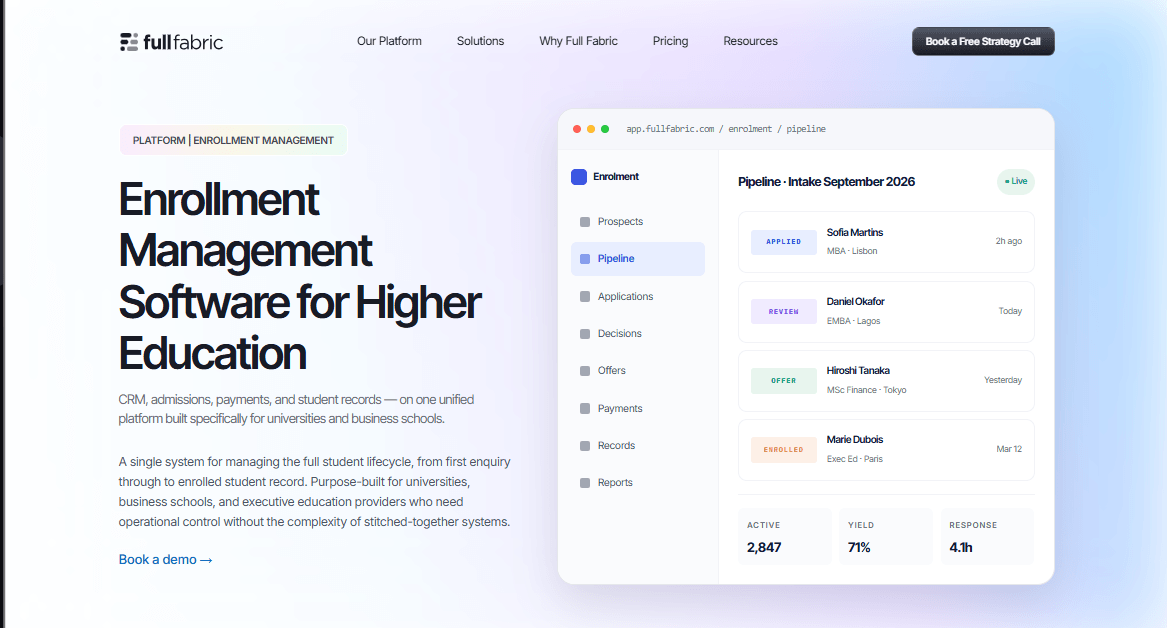
Full Fabric focuses on business schools, executive education providers, lifelong-learning organizations, and institutions with students who may enroll in multiple programs over time. Its core proposition is a unified student record that covers CRM, admissions, enrollment, payments, and communication.
This model addresses a specific problem in traditional higher education: students who move between certificates, executive programs, short courses, and degree programs can create fragmented records when each program operates through a separate system.
Full Fabric instead keeps the student relationship in one environment. That architecture makes it particularly relevant to institutions where enrollment is not a single event but an ongoing relationship across multiple learning opportunities.
Its narrower institutional focus also limits its relevance to traditional large-scale university operations where enterprise SIS requirements dominate.
Key features
- CRM
- Admissions
- Enrollment management
- Payment processing
- Unified student record
- Repeat-enrollment workflows
- Cloud-based architecture
Pros
- Strong fit for lifelong learning
- Supports repeat enrollment
- Reduces CRM/SIS reconciliation
- Modern architecture
Cons
- Smaller market footprint
- Less proven for very large institutions
- Pricing is not public
Pricing
Contact vendor for pricing
Best for: Business schools, executive education providers, and lifelong-learning organizations managing repeat enrollment.
19. PowerSchool Enrollment Express
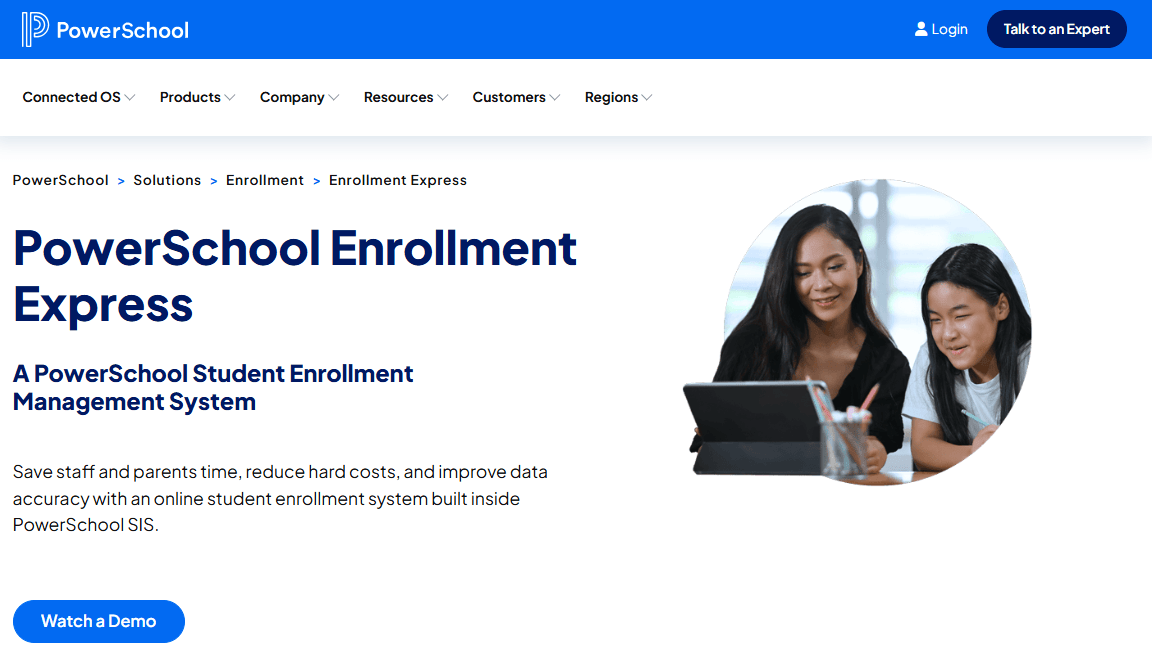
PowerSchool Enrollment Express focuses on K-12 registration and enrollment for districts using PowerSchool SIS. Its main advantage comes from direct integration with the PowerSchool environment.
Families can complete registration and enrollment forms through the PowerSchool Parent Portal, while submitted information can flow directly into the SIS. This reduces the need for district staff to re-enter information from paper forms or separate enrollment systems.
The platform supports configurable forms, payment integration, reporting, and approval workflows. Because it works inside the PowerSchool ecosystem, districts already using the SIS can avoid adding another system that requires continuous synchronization.
The product has a narrower purpose than K-12 platforms designed for school choice and lottery management.
Key features
- Online registration
- Configurable enrollment forms
- Parent Portal integration
- Fee payment
- Real-time SIS write-back
- Submission reporting
- Data approval workflows
Pros
- Native PowerSchool integration
- Reduces manual data entry
- Familiar family interface
- Configurable enrollment forms
Cons
- Primarily useful for PowerSchool customers
- Less capable for complex lotteries
- Narrower than dedicated K-12 admissions platforms
- Pricing is not public
Pricing
Contact vendor for pricing
Best for: K-12 districts already using PowerSchool SIS.
20. Finalsite Enroll / SchoolAdmin
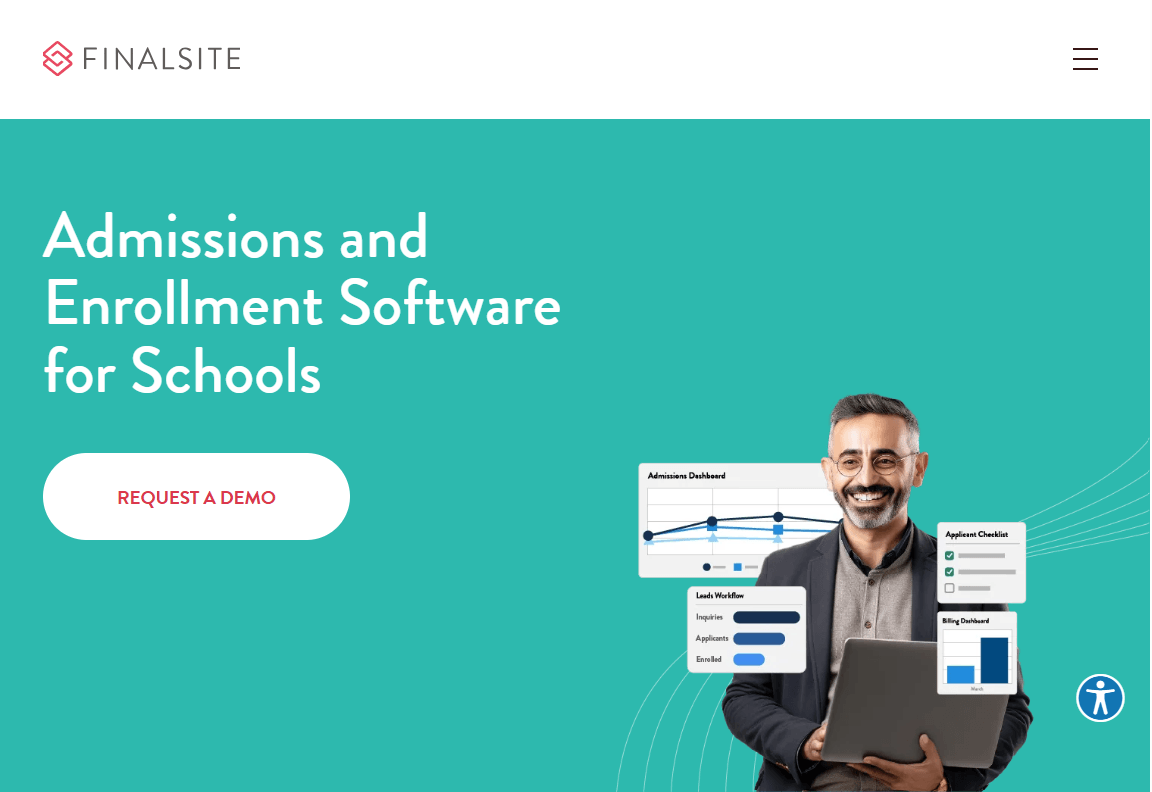
Finalsite Enroll, formerly associated with SchoolAdmin, combines private-school admissions and enrollment workflows with Finalsite’s wider website and communications ecosystem. The platform targets independent and private K-12 schools that want admissions activity connected to their broader family communications and digital presence.
Admissions teams can manage applications, enrollment contracts, re-enrollment, and family communication from the same environment. Integration with Finalsite’s website and content tools can also help schools connect marketing activity with admissions engagement.
The product does not attempt to replace a complete SIS. Instead, it concentrates on the admissions and enrollment relationship while connecting with other school systems.
This makes the platform particularly relevant to schools already using Finalsite, although schools outside that ecosystem can still evaluate the admissions functionality on its own merits.
Key features
- Admissions CRM
- Application management
- Enrollment contracts
- Re-enrollment
- Family communications
- Finalsite website integration
- Enrollment-linked billing
Pros
- Strong Finalsite ecosystem integration
- Personalized family communication
- Connects marketing and admissions activity
- Supports enrollment contracts
Cons
- Greater value for existing Finalsite customers
- Not a full SIS
- Pricing is not public
Pricing
Contact vendor for pricing
Best for: Private and independent K-12 schools wanting connected admissions, enrollment, website, and family communication tools.
21. SchoolMint Enroll
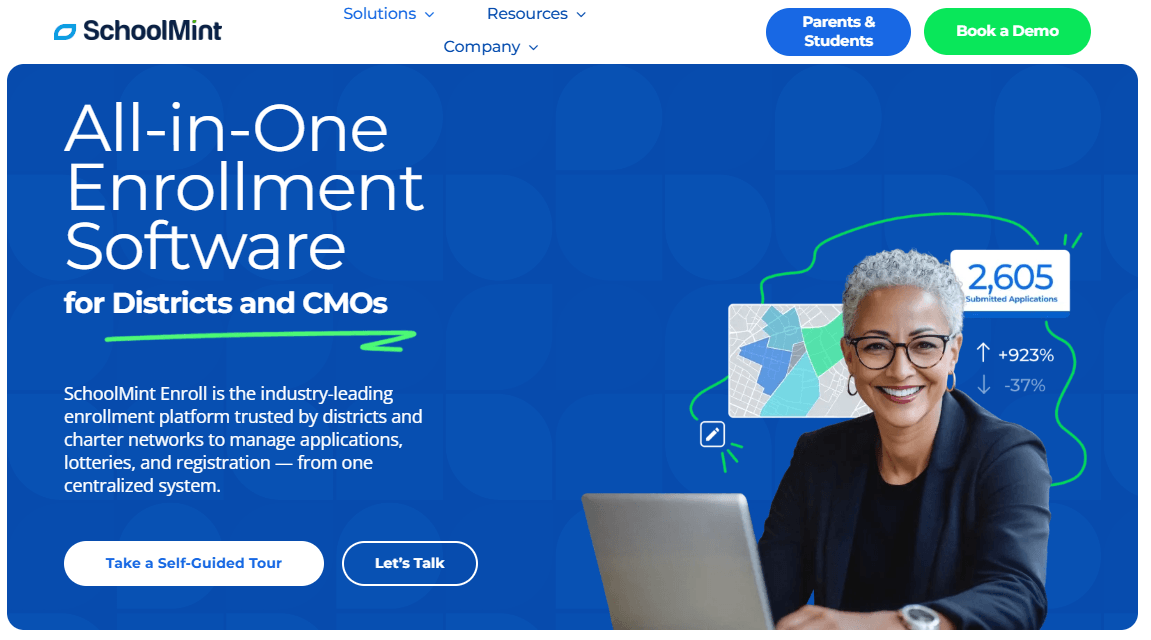
SchoolMint Enroll focuses on one of the most complex K-12 enrollment problems: managing open enrollment, school choice, lotteries, and waitlists across multiple schools.
Unlike higher-education admissions systems that typically move applicants through an application-review-decision funnel, K-12 districts and charter networks may need to apply different priority rules, capacity limits, sibling preferences, and lottery processes across campuses. SchoolMint’s platform is designed around those requirements.
The system also supports open-seat tracking and family access through a multilingual portal. SchoolMint emphasizes mobile access, including scenarios where families may not havetraditional computer or email access.
This specialization makes SchoolMint particularly relevant to charter networks, magnet programs, and districts operating school-choice programs.
Key features
- Multi-campus lottery management
- Waitlist automation
- Open-seat tracking
- Application management
- Registration
- Multilingual family portal
- Mobile access
- Configurable priority rules
Pros
- Purpose-built for K-12 lotteries
- Supports multiple campuses
- Strong multilingual access
- Mobile-friendly family experience
Cons
- Limited relevance for non-lottery schools
- Narrower use case than full SIS platforms
- Pricing is not public
Pricing
Contact vendor for pricing
Best for: Charter networks, districts, and school-choice programs running open-enrollment lotteries.
22. Ravenna by VenturEd Solutions
Ravenna is an admissions platform built specifically for private and independent K-12 schools. Its main differentiator is how broadly it integrates with the systems schools already use, including SIS, financial aid, and tuition-management platforms.
Schools can collect applications and documents, manage admissions workflows, track their funnel, and monitor yield without replacing their existing core systems. Ravenna supports integrations with platforms including Veracross, Blackbaud, FACTS, and PowerSchool.
This approach makes Ravenna particularly useful for schools that want to improve their admissions process without committing to an entirely new school-management ecosystem.
Its focus remains admissions, however. Schools still need separate systems for academic records, billing, and other operational functions unless those capabilities come from an integrated partner platform.
Key features
- Online applications
- Document collection
- Parent portal
- Single sign-on
- Funnel analytics
- Yield tracking
- SIS integrations
- Financial aid and tuition integrations
- Configurable forms and events
Pros
- Broad integration ecosystem
- Built specifically for independent-school admissions
- Supports existing school systems
- Configurable workflows
Cons
- Admissions-focused rather than full school management
- Pricing is not public
- Not designed for public-school lotteries
Pricing
Contact vendor for pricing
Best for: Private and independent K-12 schools that want dedicated admissions software without replacing their existing SIS or tuition systems.
23. Blackbaud Enrollment Management Software
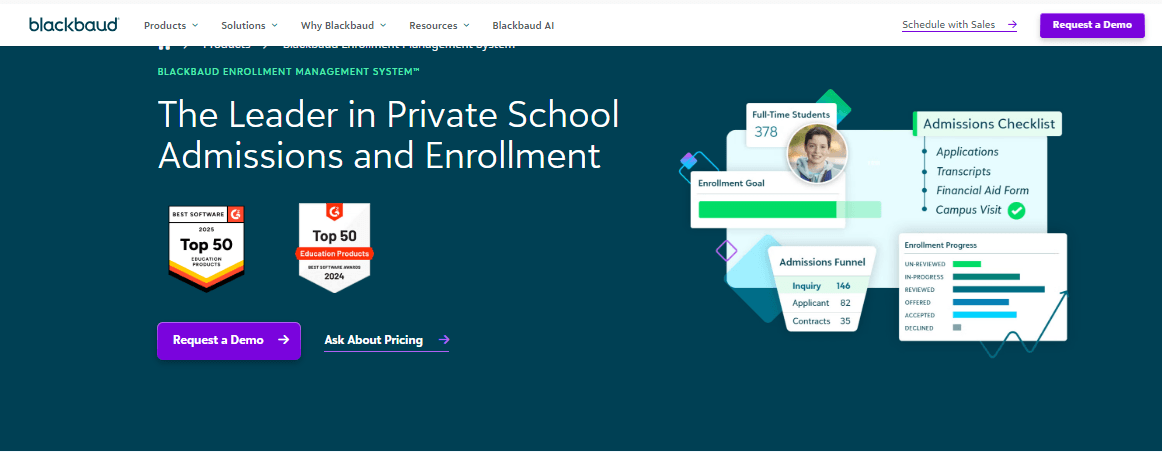
Blackbaud Enrollment Management System (EMS) provides admissions functionality within Blackbaud’s broader K-12 ecosystem. Its strongest appeal comes from connecting admissions with the other systems a private school may already use for finance, fundraising, student information, and administration.
Schools can manage applications, admissions workflows, communications, and reporting while keeping those activities within the broader Blackbaud environment.
This integrated approach can reduce the number of vendor relationships and system integrations an institution needs to manage. It can also make the platform more attractive to schools already committed to Blackbaud.
For schools that only need an admissions platform and do not use other Blackbaud products, specialized alternatives may offer a more focused admissions experience.
Key features
- Application management
- Admissions workflows
- Family communications
- Admissions reporting
- Analytics
- Blackbaud K-12 integrations
Pros
- Strong fit for existing Blackbaud customers
- Connects admissions with broader school operations
- Reduces cross-vendor integrations
- Established education software ecosystem
Cons
- Less compelling outside the Blackbaud ecosystem
- More suite-oriented than admissions-specialist platforms
- Pricing is not public
Pricing
Contact vendor for pricing
Best for: Private K-12 schools already using Blackbaud’s finance, fundraising, or SIS products.
24. Blackbaud Tuition Management
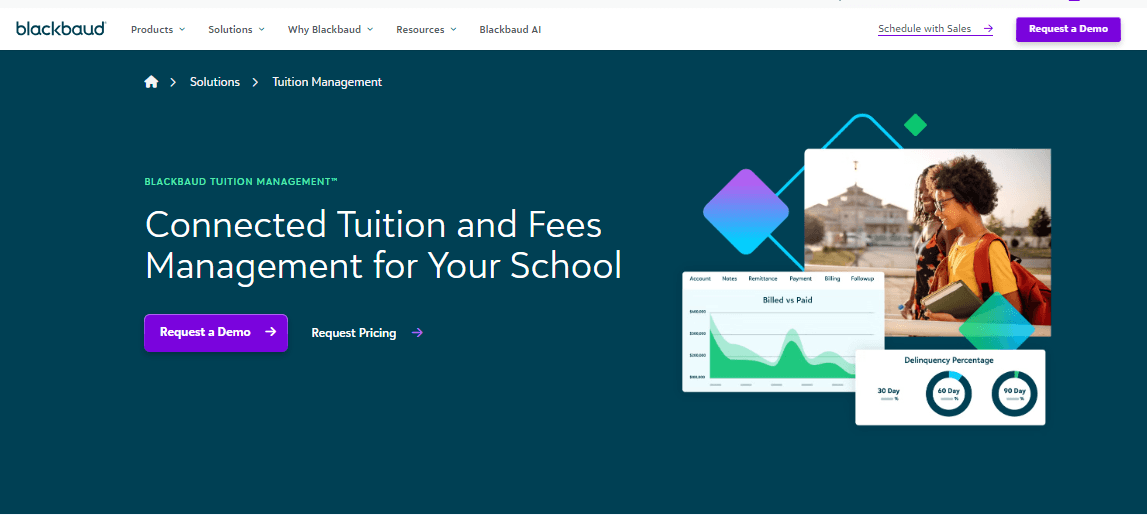
Blackbaud Tuition Management handles tuition billing and accounts receivable rather than admissions. It belongs in an enrollment management comparison because the financial relationship with a family continues after admission and enrollment.
The platform manages tuition and fee billing, payment plans, family payments, and delinquency follow-up. It also supports optional charges through a shopping-cart model, allowing schools to collect payments for items such as activities, events, and school-related purchases.
Its integration with enrollment and financial-aid information can reduce duplicate data entry. Schools using other Blackbaud products can also keep billing within the broader Blackbaud ecosystem.
However, institutions should not mistake the platform for an admissions CRM. It addresses the financial side of the enrolled-student relationship.
Key features
- Tuition billing
- Fee billing
- Payment plans
- Family payment portal
- Shopping cart for optional charges
- Delinquency follow-up
- Enrollment and financial-aid integration
Pros
- Handles tuition and additional family charges
- Payment-plan support
- Optional delinquency services
- Integrates with enrollment data
Cons
- Not an admissions CRM
- Does not manage the full enrollment funnel
- Pricing is not public
- Works most naturally within a broader Blackbaud environment
Pricing
Contact vendor for pricing
Best for: Private K-12 schools that need enrollment-linked tuition and fee billing.
25. Veracross
Veracross uses a shared-database architecture across admissions, academics, finance, communications, and advancement. Instead of moving a student from one admissions database into another student database after acceptance, the same underlying record continues through the student lifecycle.
This architecture reduces the need for departments to reconcile separate records. Once an applicant becomes an enrolled student, admissions data remains connected to academic and financial information.
For private K-12 schools, that can simplify the transition between admissions and enrollment while also giving families a unified portal experience.
The single-database model also means institutions need strong data governance. When multiple departments rely on the same record, inaccurate data can affect more parts of the institution.
Key features
- Shared student database
- Admissions management
- Enrollment tracking
- Academic records
- Tuition and billing
- Parent portal
- Advancement
- Communications
Pros
- Single-record architecture
- Strong admissions-to-enrollment continuity
- Connects multiple departments
- Unified family experience
Cons
- Financial functionality may not match specialist systems for advanced needs
- Shared data requires strong governance
- Pricing is not public
Pricing
- Contact vendor for pricing
- Pricing depends on school size and selected modules
Best for: Private K-12 schools wanting one shared record across admissions, academics, billing, and advancement.
26. OpenApply
OpenApply focuses specifically on the admissions funnel for international and independent schools. It helps schools move applications, documents, communications, and applicant status information into a paperless online process.
The platform does not attempt to become the school’s entire management system. Instead, it concentrates on the point where prospective families apply and move through admissions, while the school can use another SIS for academic and operational records after enrollment.
This focused approach can work particularly well for international schools that manage applicants from different countries and often need to collect transcripts, recommendations, translated documents, and other admissions materials.
OpenApply also sits within Faria Education Group’s wider ecosystem, allowing schools to connect the admissions process with other education-management products.
Key features
- Online applications
- Paperless document collection
- Applicant status tracking
- Family communications
- International-school workflows
- Faria integrations
- Admissions funnel management
Pros
- Focused admissions functionality
- Strong fit for international schools
- Paperless application process
- Can connect with broader Faria products
Cons
- Not a complete school-management system
- Less useful for institutions outside its target market
- Pricing is not public
Pricing
Contact vendor for pricing
Best for: International and independent schools needing a dedicated online admissions funnel.
27. HubSpot CRM
HubSpot is a general-purpose CRM rather than an education-specific enrollment platform. Smaller institutions, individual departments, graduate programs, and continuing-education teams can use its marketing, email, landing-page, automation, and pipeline features to manage prospective students.
The main attraction is accessibility. HubSpot offers a free CRM tier and relatively inexpensive entry-level plans compared with enterprise admissions platforms. Teams can build a prospect pipeline using HubSpot’s standard CRM objects, workflows, forms, and marketing tools.
The limitation is that HubSpot does not natively understand many higher-education admissions concepts. Application review queues, reader assignments, decision releases, SIS-specific workflows, and other education processes generally require configuration or integrations.
That makes HubSpot more appropriate for simpler enrollment funnels than for a university attempting to replace a dedicated admissions CRM.
Key features
- Marketing automation
- Email sequences
- Landing pages
- CRM pipelines
- Lead management
- Workflow automation
- Reporting
- Third-party integrations
- Free CRM tier
Pros
- Free entry-level CRM
- Lower starting cost
- Extensive documentation
- Large integration ecosystem
- Relatively quick to implement
Cons
- Not education-specific
- No native admissions objects
- Requires custom workflows for admissions processes
- Costs can rise with contacts and advanced features
Pricing
- Free CRM tier available
- Paid plans start around $45+/month
- Pricing varies by contacts, seats, and feature tier
- Confirm current pricing directly with HubSpot
Best for: Small institutions, individual departments, and continuing-education teams with straightforward recruitment funnels.
28. CollegeNET ApplyWeb
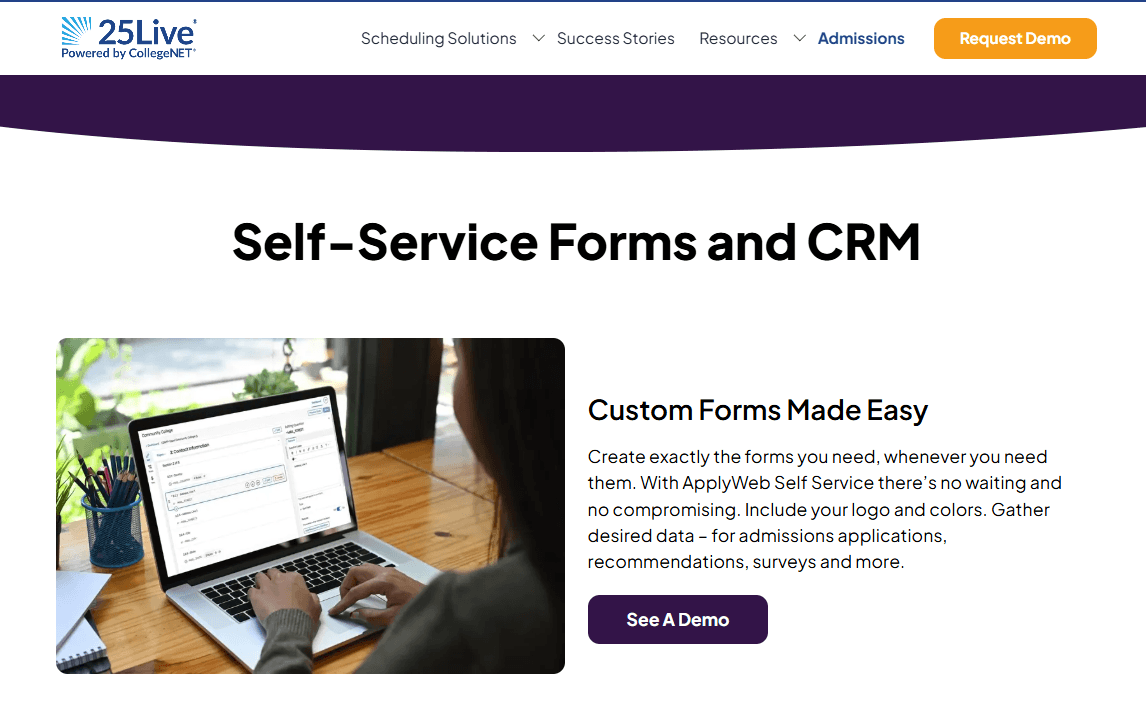
CollegeNET ApplyWeb focuses on online application collection rather than full enrollment management. Institutions and consortia can use it to build configurable applications, collect documents and fees, and manage application review workflows.
The platform’s narrow scope can be useful when an institution already has a CRM and SIS but needs a configurable application layer. Instead of replacing the entire admissions technology stack, ApplyWeb handles the application-collection stage and passes information into other institutional systems.
ApplyWeb also supports institution-specific and consortium-wide configurations, making it relevant to organizations that need shared application infrastructure across multiple programs or institutions.
Because it concentrates on applications, institutions should not expect the same recruitment marketing, yield analytics, or communication capabilities available in a full admissions CRM.
Key features
- Online application builder
- Configurable application forms
- Document upload
- Application-fee payment
- Application review workflows
- Institution-specific configurations
- Consortium application support
Pros
- Strong application-form configurability
- Useful for consortium environments
- Focused application infrastructure
- Can complement existing CRM/SIS systems
Cons
- Limited marketing automation
- Does not provide a complete enrollment CRM
- Less broad than full admissions platforms
- Pricing is not public
Pricing
Contact vendor for pricing
Best for: Institutions and consortia that need a configurable online application platform alongside an existing CRM or SIS.
29. Enrollment Rx
Enrollment Rx is a Salesforce-native enrollment management platform built specifically for higher education. It connects recruitment, applications, admissions decisions, communications, events, and enrollment operations within Salesforce.
The platform is designed for institutions that want the flexibility of Salesforce without building an enrollment CRM from scratch. Its Core Rx product provides an enrollment-focused data model and workflows, while additional applications handle forms, events, application review, data imports, and integrations.
Enrollment Rx can manage the student journey from initial inquiry through application and final decision. Institutions can configure application forms, checklists, review workflows, communications, and decision processes while keeping enrollment data in Salesforce.
Its modular approach also allows institutions to adopt specific capabilities instead of replacing their entire enrollment technology stack. The platform integrates with SIS platforms, application services, testing providers, and other sources of student data.
The main limitation is its dependence on Salesforce. Institutions that do not already use Salesforce may face a larger implementation decision than they would with a standalone enrollment platform. Pricing is also not publicly listed.
Key features
- Enrollment CRM
- Recruitment management
- Application management
- Configurable application forms
- Applicant checklists
- Application review workflows
- Decision management
- Event management
- Email and communication tracking
- Salesforce integrations
- SIS integrations
- Data imports and reporting
Pros
- Built specifically for higher education
- Native Salesforce platform
- Covers recruitment through admissions decisions
- Modular application suite
- Configurable workflows
- Strong integration capabilities
Cons
- Requires Salesforce
- May require implementation and configuration work
- Less suitable for institutions seeking a standalone SIS
- Pricing is not public
Pricing
Contact vendor for pricing
Best for: Higher education institutions that want a Salesforce-based enrollment CRM for recruitment, applications, admissions, and enrollment operations.
30. Tribal SITS
Tribal SITS is a student management system used by universities and higher education providers, particularly across the UK. It covers the student lifecycle from admissions and enrolment through retention, finance, progression, and graduation.
The platform’s admissions capabilities include an online admissions portal, application processing, applicant ranking, communications, and decision management. Institutions can manage applications from submission through outcome while connecting admissions data with other student records.
SITS also extends beyond enrollment management into the wider student lifecycle. Universities can use it for student finance, self-service, curriculum management, retention, progression, assessment, reporting, and statutory compliance.
For institutions looking for a single system across the student journey, this breadth is one of SITS’s main advantages. The platform is particularly relevant to UK universities because it supports reporting and compliance requirements involving organizations such as HESA, the Office for Students, the Student Loans Company, and Graduate Outcomes.
SITS Accelerate provides a more standardized implementation designed for institutions that want a faster deployment of the student management system. Tribal also offers cloud and subscription-based options as part of its move toward a SaaS model.
The main limitation is that SITS is primarily a student management system rather than a marketing-focused enrollment CRM. Institutions looking for advanced recruitment marketing, CRM automation, or U.S.-style admissions campaign management may need additional technology.
Key features
- Online admissions
- Online enrolment
- Application processing
- Applicant ranking
- Campaign and communications management
- Student self-service
- Student finance
- Fees and payments
- Scholarships and funds
- Retention management
- Curriculum management
- Progression and awards
- Assessment and graduation
- Reporting and dashboards
- Regulatory and compliance reporting
Pros
- Covers the complete student lifecycle
- Strong admissions and enrolment capabilities
- Established UK higher education platform
- Extensive student management functionality
- Cloud and subscription options available
- Supports regulatory reporting
Cons
- Primarily focused on student management rather than recruitment marketing
- UK-focused compliance capabilities may be less relevant to U.S. institutions
- Broad functionality can require significant implementation
- Pricing is not public
Pricing
Contact vendor for pricing
Best for: UK universities and higher education providers that need a student management system covering admissions, enrolment, student administration, and the wider student lifecycle.
Conclusion
Enrollment management software is no longer a single category with a standard set of features. The right platform depends on where an institution needs the most support, whether that is recruitment and admissions, application processing, predictive enrollment, international student recruitment, K-12 school choice, or the broader student lifecycle.
Higher education institutions looking for a dedicated admissions CRM can consider platforms such as Slate, Element451, TargetX, and Enrollment Rx. Institutions that need an SIS-led approach may look more closely at Workday Student, Ellucian, Jenzabar, or Tribal SITS. K-12 schools have a different set of requirements, with platforms such as SchoolMint, Ravenna, Finalsite, Blackbaud, and Veracross addressing applications, lotteries, enrollment, and family engagement. International recruitment providers such as ApplyBoard, IDP Connect, and Keystone serve a different role by helping institutions reach prospective students across global markets.
AI and automation are also becoming more common across the category, but they should not be the only factors in a buying decision. Institutions should evaluate how well a platform fits their existing CRM and SIS environment, the amount of configuration and technical support it requires, how easily it integrates with other systems, and the total cost of implementation and ongoing use.
Pricing also varies considerably. Some vendors publish starting prices, while others use institution-specific quotes based on enrollment volume, modules, users, integrations, and implementation requirements. Confirm current pricing and contract terms directly with the vendor before making a purchasing decision.
Ultimately, enrollment management software should fit the institution’s enrollment model rather than the other way around. A smaller school with a straightforward admissions process may need only a focused platform, while a large university may require several connected systems working across recruitment, admissions, enrollment, and student success.