

Production plans can look perfect on paper and still fall apart on the shop floor. A schedule might assume machines are always available, overlook changeover time, or ignore how many workers are actually available. It may work in a spreadsheet, but once production starts, the problems quickly show up. That’s where Advanced Planning and Scheduling (APS) software comes in. It helps planners build schedules around real production limits and test different scenarios before making changes on the shop floor.
What Is Advanced Planning & Scheduling (APS) Software?
APS software helps manufacturers create production plans and schedules that match what the factory can actually handle. It considers machine and labour capacity, available materials, changeover times, and delivery deadlines.
APS sits between ERP or MRP systems and the shop floor. ERP and MRP systems determine what materials and resources production needs, while the shop floor carries out the work. APS turns those requirements into a practical production schedule.
Three terms often get mixed up:
- Production planning decides what to make, how much to make, and roughly when to make it.
Production scheduling sets the order, timing, machines, workers, and tools for each job.
APS connects planning and scheduling. It considers capacity, demand, materials, constraints, and other production factors to create a schedule the factory can actually follow.
Why Do Manufacturers Use APS?
Basic MRP systems often plan with simplified capacity assumptions. This can create schedules that look good on paper but do not work on the shop floor.
APS takes real production constraints into account. It helps planners identify bottlenecks, adjust schedules quickly, and test “what if” scenarios before making changes.
What Should You Look For in APS Software?
- Finite-capacity scheduling
- Sequence-dependent changeovers
- What-if scenario planning
- Fast rescheduling when disruptions occur
- ERP and MES integrations
- Clear ownership of the planning model after implementation.
Top 30 Advanced Planning & Scheduling (APS) Software in 2026
1. Siemens Opcenter APS
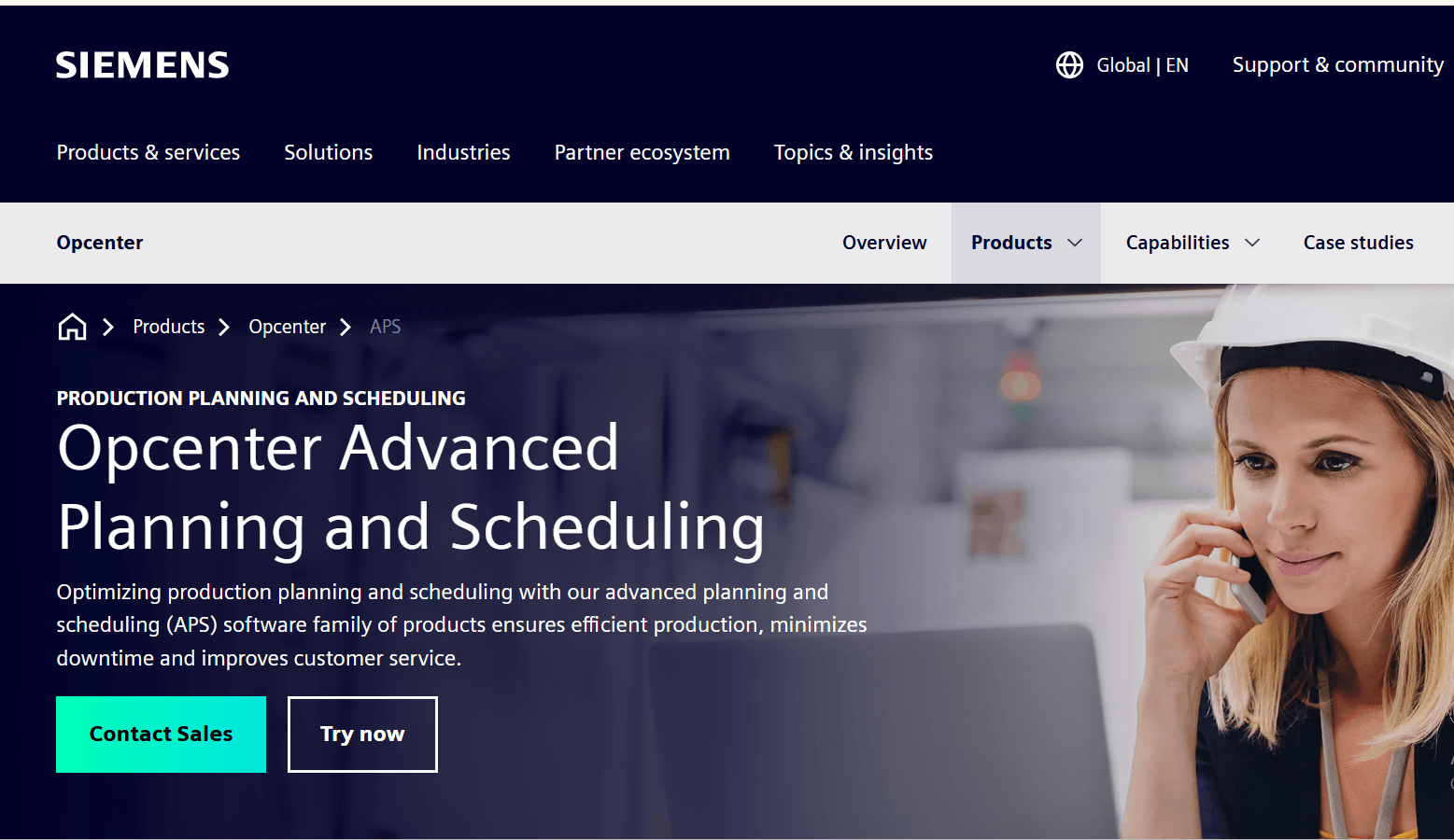
Siemens Opcenter APS is Siemens’ planning and scheduling family, which includes Opcenter Planning, Opcenter Scheduling, and Opcenter Scheduling SMT. The software uses interactive, multi-constraint scheduling to model resource availability, inter-operation constraints, and custom material-consumption rules. It works particularly well for plants dealing with complex routings, frequent changeovers, and tight production constraints. Its main strength comes from combining detailed scheduling with Siemens’ wider manufacturing operations portfolio.
Key APS Features
- Multi-constraint finite-capacity scheduling
- Sequence-dependent changeover planning based on operation attributes
- Optimisation rules for reducing changeovers and creating production campaigns
- Real-time schedule adjustments based on demand and resource changes
- Capable-to-promise in Opcenter Scheduling Standard
- ERP and MES synchronisation through the Opcenter portfolio
Pros
- Provides deep constraint and changeover modelling
- Integrates with existing ERP and MES environments
- Separates planning and scheduling functions
Cons
- Siemens does not publish pricing
- The available materials do not clearly explain batch-equipment modelling, so buyers should test this capability during a demo
Pricing
- Custom pricing
- Contact Siemens for a quote
- No public price was confirmed
Best For
Complex discrete manufacturers managing changeover-heavy production schedules.
2. SAP S/4HANA PP/DS with SAP IBP
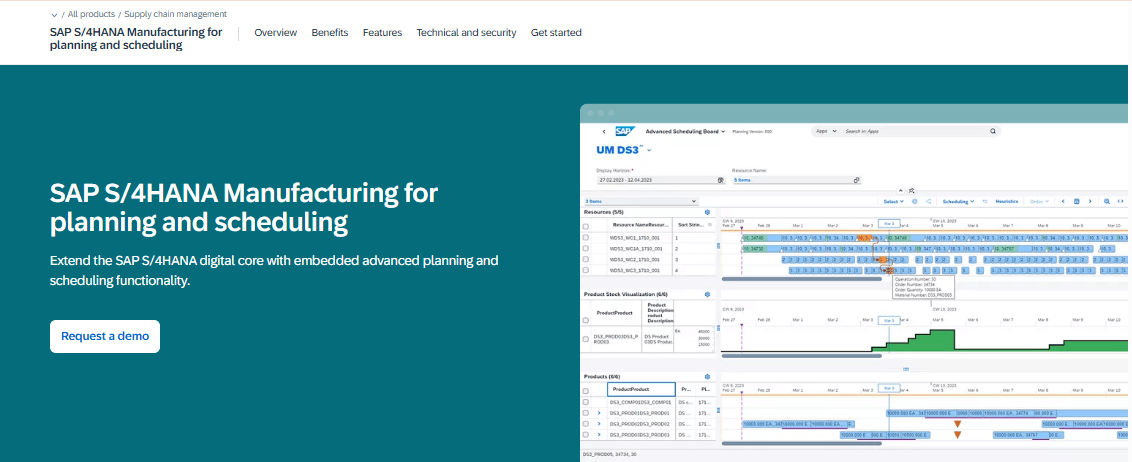
SAP S/4HANA Production Planning and Detailed Scheduling (PP/DS) runs inside the S/4HANA environment and builds on core MRP and capacity planning. The system first generates production orders from stock and requirements, then uses detailed scheduling to sequence those orders against available constraints. SAP Integrated Business Planning (IBP) adds higher-level demand and supply planning. This approach works particularly well for manufacturers that already use SAP and want planning and detailed scheduling within the same ERP environment.
Key APS Features
- Detailed scheduling through heuristics or the PP/DS Optimizer
- Detailed Scheduling Planning Board
- Setup matrices and sequence constraints
- Minimum and maximum distance rules
- Constrained planning for machine capacity, labour, and tools
- Exception-based planning
- Integration with SAP IBP
Pros
- Keeps planning and execution within one ERP data environment
- Provides mature scheduling heuristics and optimisation
- Fits naturally into existing SAP environments
Cons
- Requires S/4HANA and often requires consulting support
- SAP does not publish standard list pricing
Pricing
Custom pricing
PP/DS is technically included within S/4HANA but requires configuration
Confirm licensing terms directly with SAP
Best For
Manufacturers already running SAP S/4HANA.
3. CAI PlanetTogether
CAI PlanetTogether provides APS software for process and discrete manufacturers. The platform combines constraint-based scheduling, what-if simulation, and ERP integration for multi-plant and multi-resource environments. It serves industries including food and beverage, consumer packaged goods, chemicals, and industrial manufacturing. The software can also model specialised production resources such as tanks, ovens, and cleanrooms.
Key APS Features
- Constraint-based scheduling across capacity, materials, labour, and due dates
- What-if simulation before planners implement changes
- Multi-plant capacity optimisation
- Modelling for tanks, ovens, and cleanrooms
- Capable-to-promise what-if analysis
- Integrations for SAP, NetSuite, Kinaxis Maestro, and AVEVA
Pros
- Focuses specifically on production scheduling
- Supports multi-plant manufacturing
- Works alongside an existing ERP
Cons
- Recent ownership change makes roadmap and product direction worth confirming
- Uses quote-based pricing
Pricing
- Custom pricing
- Contact CAI for a quote
- No public price was confirmed
Best For
Multi-plant food, CPG, and chemical manufacturers that need a dedicated scheduling layer.
4. Kinaxis Maestro
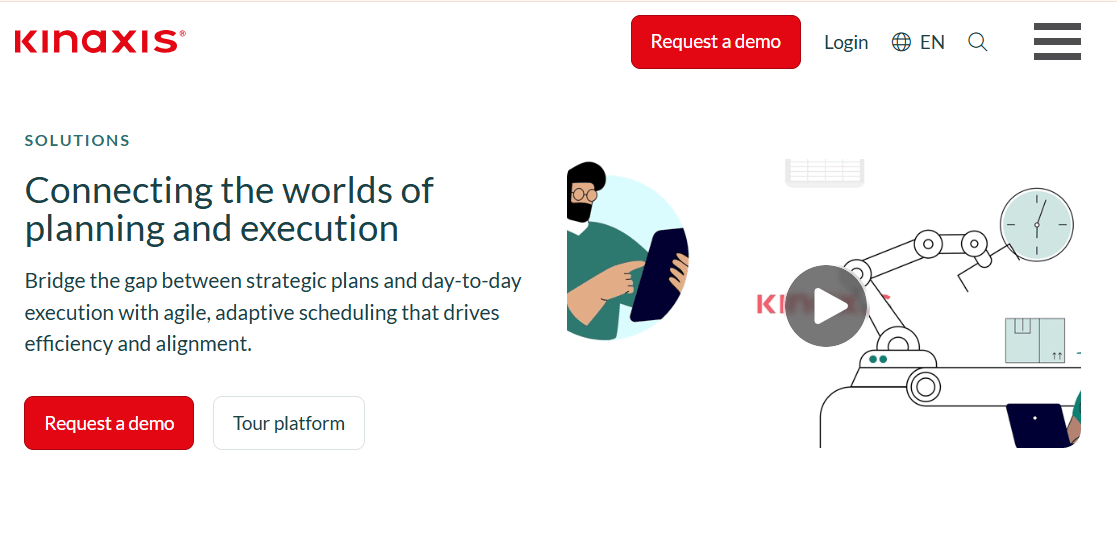
Kinaxis Maestro, formerly known as RapidResponse, combines S&OP, demand planning, supply planning, inventory planning, production planning, and scheduling within one concurrent planning model. When a planner changes an input, the platform recalculates the plan across the network. This approach helps large manufacturers coordinate production, suppliers, inventory, and capacity across multiple locations. Kinaxis also offers a production scheduling extension built on PlanetTogether.
Key APS Features
- Concurrent planning across demand, supply, and capacity
- Scenario modelling and what-if analysis
- Production planning and scheduling
- Kinaxis Production Scheduling by PlanetTogether
- Connectors for SAP, Oracle, and Microsoft Dynamics
- AI agents described by Kinaxis
Pros
- Supports rapid scenario analysis across the supply network
- Uses a single planning data model
- Can operate as a planning layer over existing ERP systems
Cons
- Primarily targets large enterprises
- Advanced configuration can require significant effort
Pricing
- Custom pricing
- Subscription-based and quote-based
- Contact Kinaxis for pricing
Best For
Enterprise manufacturers that need network-wide planning alongside production scheduling.
5. DELMIA Ortems
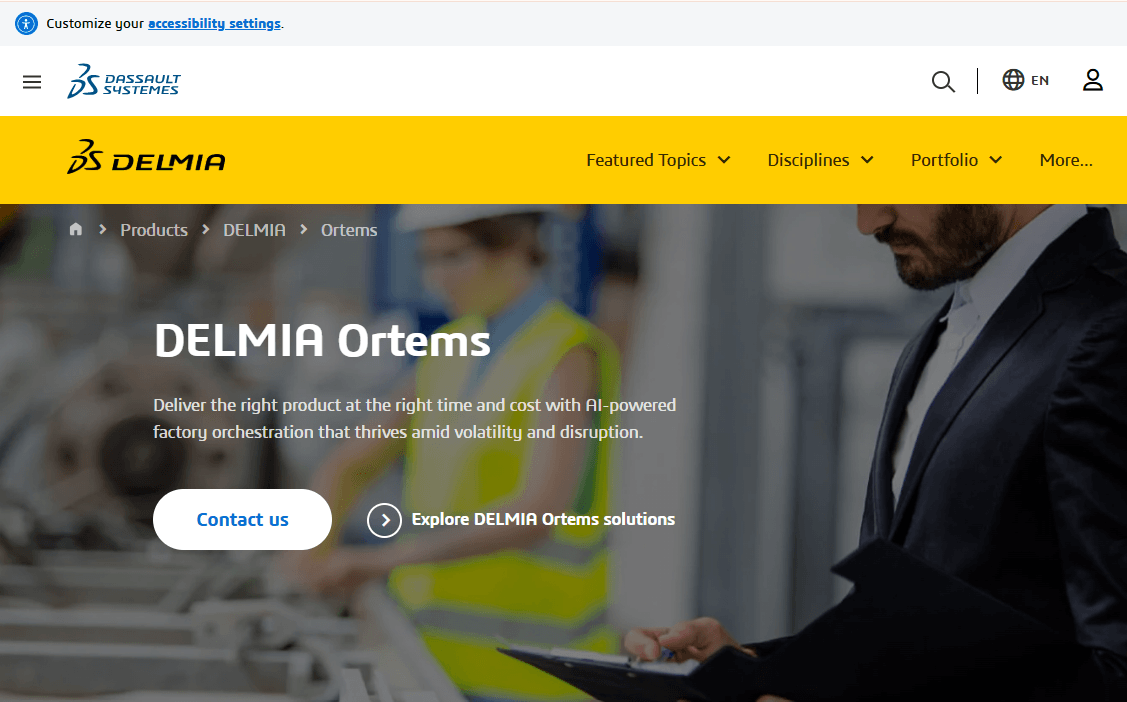
DELMIA Ortems is Dassault Systèmes’ factory-level scheduling software. The platform focuses on operational and tactical scheduling within the factory, covering planning horizons from days to months. It applies constraint-based, finite-capacity optimisation to production environments and can work alongside ERP and supply chain systems. Manufacturers use it to manage complex production sequences, bottlenecks, and frequent shop-floor changes.
Key APS Features
- Constraint-based finite-capacity scheduling
- Detailed production sequencing
- Bottleneck management
- Synchronised Requirements Planner for aligning material flow and capacity
- Integration with DELMIA Apriso and the 3DEXPERIENCE platform
- AI-driven decision support described by DELMIA
- Integration with ERP and SCM systems
Pros
- Focuses specifically on finite-capacity scheduling
- Provides a clear factory scheduling layer
- Has a long history as a scheduling product
Cons
- Uses custom pricing
- Works most naturally within the Dassault ecosystem
Pricing
- Custom pricing
- Contact Dassault Systèmes for a quote
- No public price was confirmed
Best For
Plant managers and production planners that need dedicated finite-capacity scheduling alongside an ERP.
6. Asprova
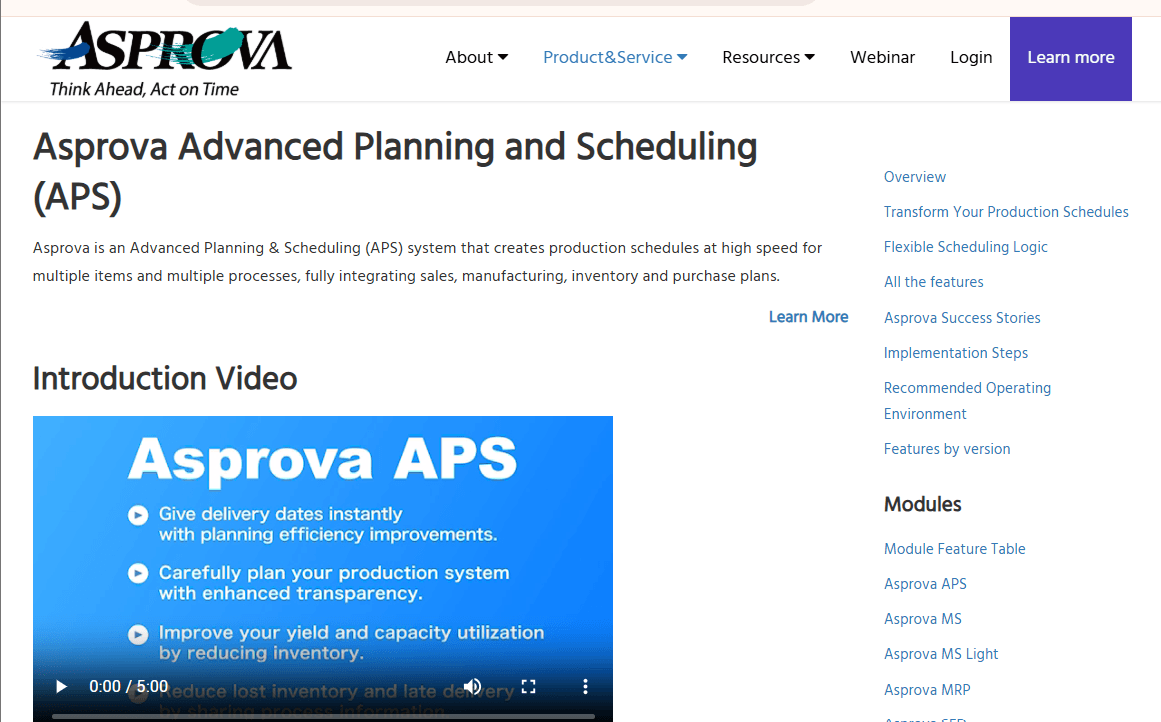
Asprova provides Advanced Planning and Scheduling and Supply Chain Planning software. The company reports more than 3,600 customers worldwide and a significant presence in Japan. These figures come from Asprova. The software uses finite-capacity scheduling and typically operates alongside an existing ERP system. Asprova lists integrations with SAP, Microsoft Dynamics, and Oracle EBS. Its scheduling approach suits high-mix production environments where manufacturers must manage complex sequences, resource constraints, and frequent changes.
Key APS Features
- Finite-capacity scheduling
- Production sequencing rules
- Setup and changeover considerations
- What-if simulation
- Rapid rescheduling after breakdowns or rush orders
- Gantt and load visualisation
- APS and supply chain planning modules
Pros
- Focuses heavily on detailed scheduling
- Asprova says users can implement it without programming
- Has a large reported customer base
Cons
- No public pricing
- Configuration still requires production modelling
Pricing
Custom pricing
Contact Asprova for a quote
No public price was confirmed
Best For
Manufacturers with complex, high-variety production schedules and an existing ERP.
7. DELMIA Quintiq
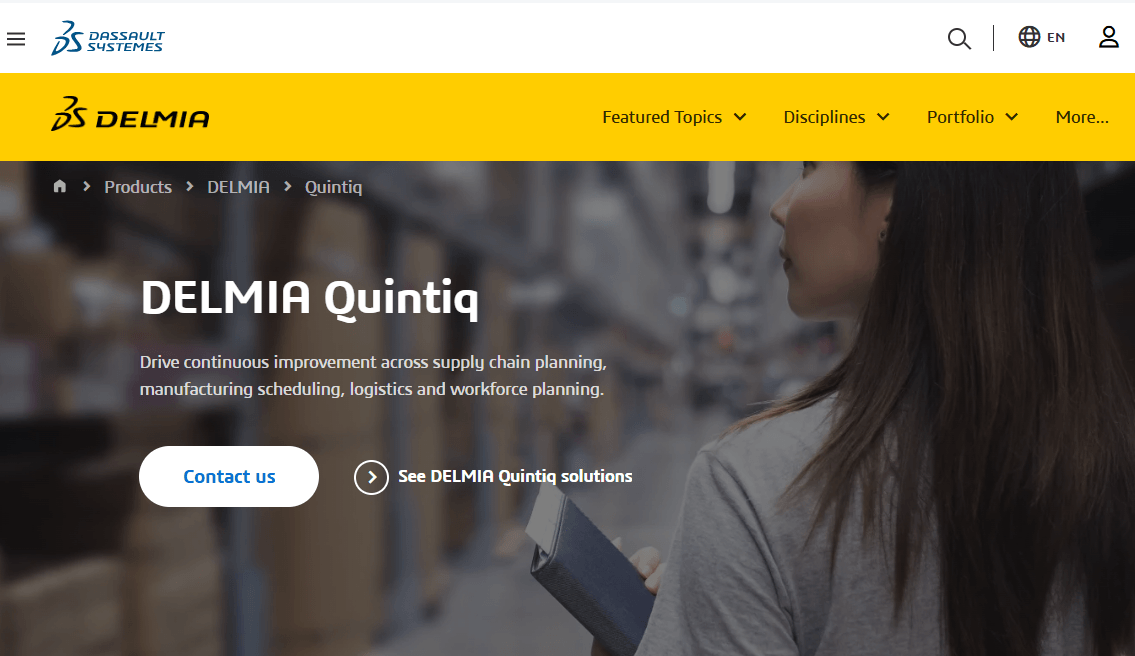
DELMIA Quintiq provides supply chain planning and optimisation for enterprise-wide manufacturing and value-network problems. Dassault Systèmes positions Quintiq at the network planning level, while Ortems focuses more closely on factory scheduling. Quintiq helps organisations plan across plants, suppliers, production networks, and logistics operations. Manufacturers can combine it with Ortems when they need both network-level planning and detailed factory scheduling.
Key APS Features
- Supply chain planning and optimisation across the value network
- Configurable planning models
- Integration with Ortems for factory scheduling
- Integration with the wider DELMIA portfolio
- Enterprise-scale scenario planning
Pros
- Handles enterprise-wide optimisation
- Can connect with factory-level scheduling
- Backed by a large software vendor
Cons
- Custom pricing
- Requires a larger implementation than scheduling-only tools
Pricing
- Custom pricing
- Contact Dassault Systèmes for a quote
- No public price was confirmed
Best For
Large manufacturers that need to optimise an end-to-end supply network.
8. Blue Yonder
Blue Yonder provides production planning within its broader supply chain planning platform. The platform plans production across plants, labour, materials, and tools while allowing manufacturers to configure production constraints. It also supports rapid order resequencing during disruptions. This makes it suitable for large manufacturers that want production planning and scheduling alongside demand, supply, and inventory planning.
Key APS Features
- Configurable plant, labour, material, and tool constraints
- Balancing of fill rates against changeovers
- Rapid order resequencing during disruptions
- Executable promises based on inventory, capacity, and supply
- Plan-versus-actual comparison using digital-twin models
- Standard sequencing-rule library
Pros
- Combines production planning and scheduling with broader supply chain planning
- Provides a sequencing-rule library
- Supports large manufacturing networks
Cons
- Targets enterprise-scale organisations
- Product packaging has changed following acquisitions
Pricing
- Custom pricing
- Contact Blue Yonder for a quote
- No public price was confirmed
Best For
Large manufacturers that want production scheduling within a broader supply chain planning suite.
9. OMP Unison Planning
OMP Unison Planning provides supply chain planning and optimisation across manufacturing, inventory, and distribution constraints. The platform uses mathematical programming, linear and mixed-integer programming, and meta-heuristics to solve complex planning problems. It can model fixed-wheel and flexible-wheel changeovers, batch production, blends, shelf-life constraints, and production campaigns. These capabilities make it particularly relevant to process manufacturers managing products with strict production and shelf-life requirements.
Key APS Features
- Concurrent optimisation using mathematical programming and heuristics
- Changeover minimisation
- Batch, blend, shelf-life, and campaign modelling
- Automated Order Promiser with capable-to-promise
- Always-on decision agents
- OMP Integrator for SAP
Pros
- Provides strong process-industry modelling
- Combines planning and scheduling logic
- Offers direct SAP integration
Cons
- Custom pricing
- Discrete-only manufacturers may find some capabilities less relevant
Pricing
- Custom pricing
- Contact OMP for a quote
- No public price was confirmed
Best For
Chemical, food, and other process manufacturers managing campaigns and shelf-life limits.
10. Simio
Simio combines production scheduling with discrete-event simulation and digital-twin modelling. Its patented Risk-based Planning and Scheduling approach adds probabilistic analysis to production schedules, allowing teams to examine how variability could affect planned outcomes. Users can represent physical constraints and business rules directly within the model. This approach suits organisations that want to test schedule behaviour under different operating conditions rather than simply generate a single production plan.
Key APS Features
- Simulation-based finite scheduling
- Risk-based and probabilistic schedule analysis
- Sequence-dependent setup modelling
- Attribute-based production campaigns
- Real-time rescheduling
- Database connectors and web APIs
Pros
- Shows schedule risk rather than only producing one schedule
- Supports flexible modelling with C#, Python, and SQL
- Connects with ERP, MES, and WMS systems
Cons
- Requires modelling expertise and implementation time
- No public pricing
Pricing
- Custom pricing
- Contact Simio for a quote
- No public price was confirmed
Best For
Engineering-led manufacturing teams that want simulation and risk analysis alongside scheduling.
11. Synchrono SyncManufacturing
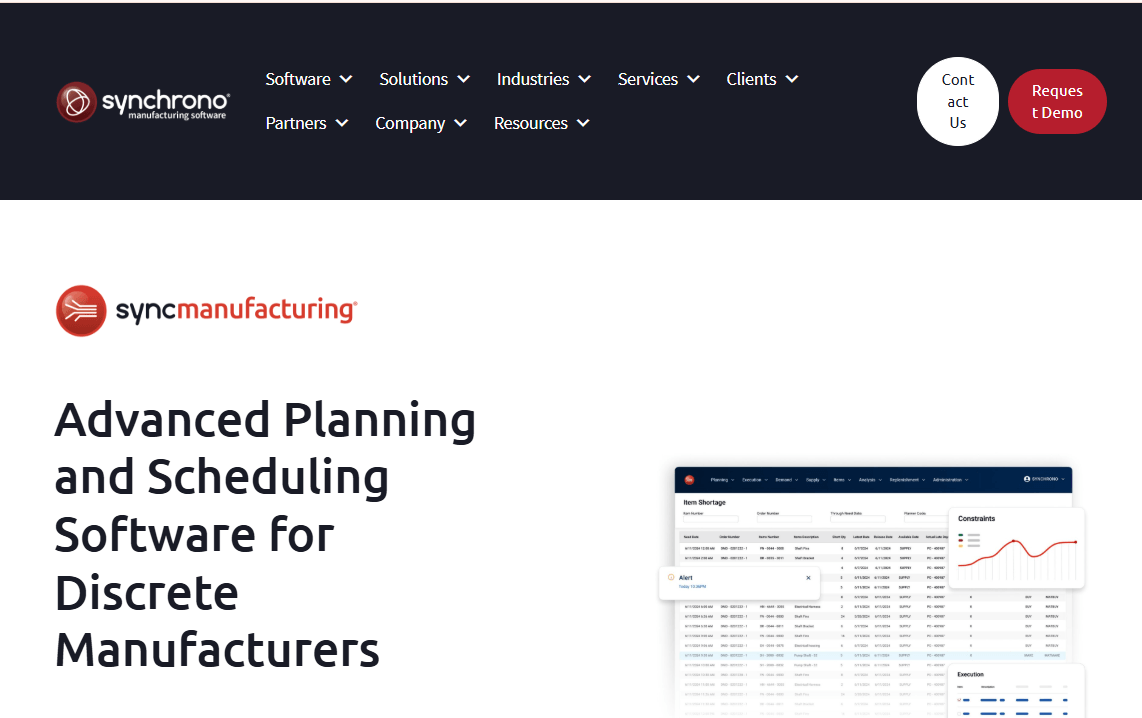
Synchrono SyncManufacturing combines constraint-based planning, scheduling, and execution synchronisation for discrete manufacturers. The platform sequences production across labour, machines, tooling, and materials simultaneously. Its patented CONLOAD methodology controls how manufacturers release work to the shop floor. The software also recalculates schedules when priorities, downtime, or other production conditions change.
Key APS Features
- Constraint-based sequencing across labour, machines, tooling, and materials
- Automatic schedule recalculation when priorities or downtime change
- Capable-to-promise dates based on finite capacity and material availability
- CONLOAD work-release methodology
- Event-based API integrations
Pros
- Focuses on discrete manufacturing
- Connects scheduling with work release
- Provides API-based integration
Cons
- The reviewed materials do not clearly explain setup-matrix capabilities
- Pricing is not public
Pricing
- Custom pricing
- Contact Synchrono for a quote
- No public price was confirmed
Best For
Discrete manufacturers that want scheduling closely connected to shop-floor work release.
12. Plex Finite Scheduler
Plex Finite Scheduler provides production scheduling within the Plex Smart Manufacturing Platform. Rockwell Automation acquired Plex in 2021. The scheduler models constraints across equipment, tooling, storage devices, labour pools, and certified employees. It can also use real-time production data to generate schedules and track downtime that affects schedule achievability. This makes it particularly relevant to manufacturers already using the Plex platform.
Key APS Features
- Resource-constraint modelling
- Setup, cycle, and teardown step modelling
- Attribute-based production sequencing
- Scenario analysis for resource availability
- Downtime tracking that feeds into scheduling
- Schedule generation using real-time production data
Pros
- Connects planning and execution on one platform
- Models labour and employee certification constraints
- Automates schedule generation
Cons
- Provides the most value within the Plex ecosystem
- Uses custom pricing
Pricing
- Custom pricing
- Contact Rockwell Automation for a quote
- No public price was confirmed
Best For
Manufacturers already using Plex.
13. Logility
Aptean acquired Logility, with the deal completed in April 2025. The platform combines capacity planning and detailed scheduling, while its Python-based Flexible Scripts allow users to configure constraints for individual resources. Aptean also acquired OpsVeda in January 2026 to expand the platform’s execution capabilities. Logility suits planning-led manufacturers, particularly in consumer goods, food, and chemical industries.
Key APS Features
- Integrated capacity planning and detailed scheduling
- Flexible Scripts for resource-specific constraints
- Synchronous Scheduling for shared resources such as baking and curing equipment
- Demand and inventory planning
- ERP, big data, and IoT integration
Pros
- Connects demand, supply, and production scheduling
- Provides a low-code configuration option
- Has backing from a larger software group
Cons
The ownership transition makes the product roadmap worth reviewing
Uses custom pricing
Pricing
- Custom pricing
- Contact Aptean for a quote
- No public price was confirmed
Best For
Consumer goods and process manufacturers that want demand planning and scheduling in one platform.
14. Eyelit APS
Eyelit APS uses the same data model as Eyelit MES, allowing shop-floor changes to feed back into production schedules. The platform models constraints such as feature combinations, sequence-dependent setups, and batch resources including ovens and autoclaves. Eyelit targets industries such as automotive, semiconductor, medical device, and aerospace manufacturing. Most of the capability claims reviewed for this product come from Eyelit’s own published materials.
Key APS Features
- Sequence-dependent setup modelling with changeover matrices
- Batch resources with one-, two-, and three-dimensional capacity
- Tools, dies, and operators with skill-matrix constraints
- Replanning designed to minimise disruption to existing schedules
- Available-to-promise and capable-to-promise
- Shared data model with Eyelit MES
Pros
- Handles batch resources
- Supports configurable replanning
- Connects planning and MES data
Cons
- Most available evidence comes from vendor-published materials
- Uses custom pricing
Pricing
- Custom pricing
- Contact Eyelit for a quote
- No public price was confirmed
Best For
Regulated or sequence-driven manufacturers that also need an MES.
15. CyberPlan
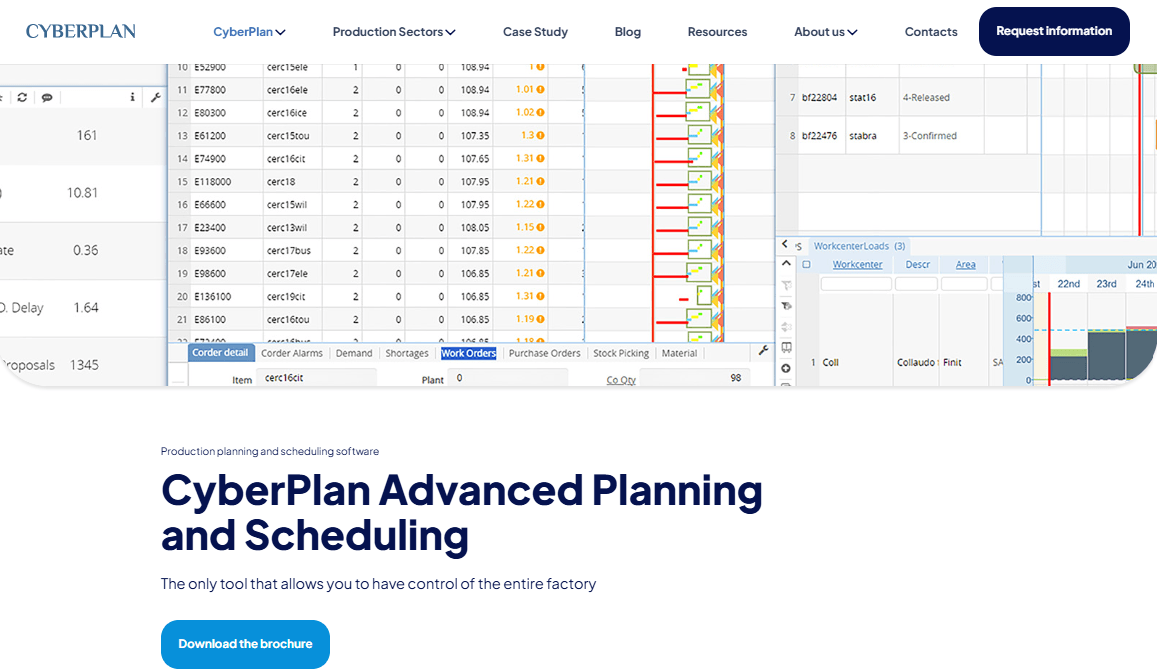
CyberPlan, developed by Italian software company Cybertec, combines APS with Demand Planning and S&OP modules. The platform uses a Demand Driven methodology and supports finite-capacity planning, detailed scheduling, and alternative scenario simulation. Partner sources list compatibility with SAP, Oracle, and Microsoft Dynamics. CyberPlan targets mid-sized and large manufacturers that want to connect demand planning, production scheduling, and scenario analysis.
Key APS Features
- Finite-capacity planning and detailed scheduling
- What-if scenario simulation
- Multi-level BOM management
- Demand Planning and S&OP modules
- Demand Driven methodology
- ERP compatibility
Pros
- Combines forecasting, S&OP, and scheduling
- Makes scenario simulation a core capability
- Supports multi-site manufacturing
Cons
- Has lower visibility outside Europe
- Pricing is not public
Pricing
- Custom pricing
- Contact Cybertec for a quote
- No public price was confirmed
Best For
Mid-sized and large manufacturers that want APS with demand planning.
16. Infor CloudSuite Industrial (SyteLine)
Infor CloudSuite Industrial, formerly known as SyteLine, provides ERP capabilities for discrete manufacturers and includes an Advanced Planning & Scheduling module. It’s partner Godlan describes order-by-order planning that generates promise dates at order entry while planning material and capacity simultaneously. The platform also connects with Infor OS, MES, and IoT tools. It suits manufacturers that want to manage constrained scheduling within an ERP environment.
Key APS Features
- Constraint-based scheduling
- Simultaneous material and capacity planning
- Promise dates at order entry
- Integration with Infor OS, MES, and IoT tools
- Multi-site cloud deployment on AWS
Pros
- Embeds scheduling within the ERP
- Provides industry capabilities for aerospace, defence, and medical devices
- Offers cloud deployment
Cons
- Much of the detailed APS information comes from a partner source
- Uses custom pricing
Pricing
- Custom pricing
- Contact Infor for a quote
- No public price was confirmed
Best For
Discrete manufacturers already using or considering SyteLine.
17. Microsoft Dynamics 365 Supply Chain Management
Microsoft Dynamics 365 Supply Chain Management combines planning, production, inventory, and warehouse management within Microsoft’s ERP ecosystem. Microsoft’s pricing structure includes demand planning and advanced planning capabilities in the Premium tier. The platform suits Microsoft-focused manufacturers that want demand and master planning inside their ERP. Manufacturers that need deeper finite-capacity scheduling may need additional extensions or specialised scheduling tools.
Key APS Features
- Master planning
- Demand planning
- Capacity management
- AI and machine-learning capabilities
- Premium-tier advanced planning
- Analytics and planning insights
Pros
- Provides public list pricing
- Fits within the Microsoft ecosystem
- Covers a broad range of supply chain functions
Cons
- Deep finite-capacity scheduling may require extensions
- Premium demand planning increases the subscription cost
Pricing
- $210/user/month for Supply Chain Management, paid yearly
- $300/user/month for Supply Chain Management Premium, paid yearly
- Prices are in USD and exclude tax
- Regional pricing can vary
- Implementation and scheduling add-ons cost extra
Best For
Microsoft-centred manufacturers that want ERP-based planning.
18. frePPLe
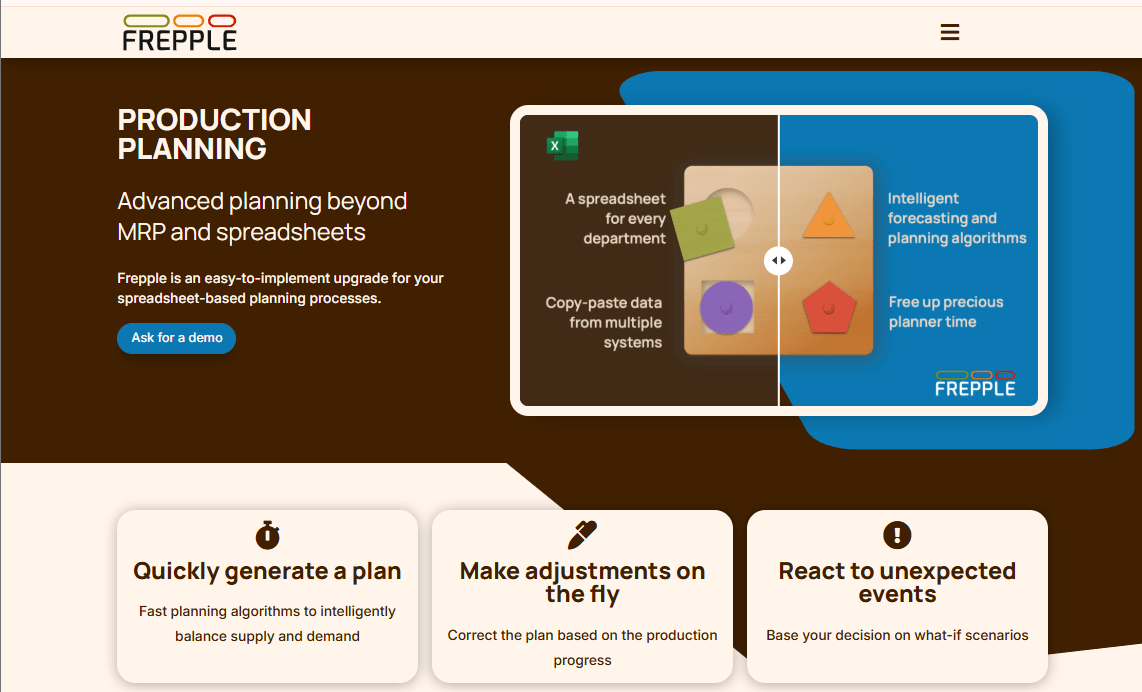
frePPLe provides open-source production planning and scheduling software. Its Community Edition is available for free under the AGPLv3 licence. The platform generates finite-material and finite-capacity production plans, statistical forecasts, and what-if scenarios. It also provides two-way integration with Odoo. Its paid Cloud and Enterprise editions add features such as inventory planning, interactive Gantt charts, due-date quoting, setup-matrix optimisation, and shelf-life planning.
Key APS Features
- Finite-material production planning
- Finite-capacity production planning
- What-if scenarios
- Demand forecasting
- Setup-matrix optimisation in paid editions
- Due-date quoting in paid editions
- CSV, Excel, and REST API integrations
Pros
- Offers a free open-source edition
- Provides an extensible codebase
- Integrates with Odoo
Cons
- Community Edition support requires users to handle technical issues themselves
- Extending the platform requires technical resources
Pricing
- Community Edition: Free
- Cloud and Enterprise editions use subscription pricing
- Paid plans calculate pricing based on active item-by-location pairs
- Exact paid pricing was not confirmed here
Best For
Technical teams and Odoo users that want low-cost finite-capacity planning.
19. Tactic by Waterloo Manufacturing Software
Tactic provides production scheduling software for job shops and custom manufacturers. According to partner-published information, the software generates shop-floor dispatch lists using real-time capacity and material availability. It can operate alongside an existing MRP or ERP system, allowing manufacturers to add scheduling without replacing their existing business system. Its focus on job-shop environments makes it relevant to manufacturers managing custom orders and changing production priorities.
Key APS Features
- Event-based scheduling
- Resource optimisation
- Shop-floor dispatch list generation
- Integration with existing ERP systems
- Customisable workflows
Pros
- Focuses on scheduling instead of replacing the ERP
- Targets job-shop environments
- Works alongside existing ERP systems
Cons
- Limited independent product information is available
- Pricing was not confirmed
Pricing
- Custom pricing
- Contact Waterloo Manufacturing Software for a quote
- No public price was confirmed
Best For
Job shops that need production scheduling on top of an existing ERP.
20. SYSPRO
SYSPRO is an ERP platform for manufacturers and distributors. Its manufacturing capabilities include MRP and capacity management supported by demand forecasting. The platform serves both process and discrete manufacturers across industries such as automotive and food production. SYSPRO embeds its planning capabilities within the ERP rather than positioning APS as a separate scheduling product. Manufacturers should therefore test its finite scheduling capabilities against their specific production constraints.
Key APS Features
- MRP with capacity management
- Demand forecasting
- Production control
- Support for process and discrete manufacturing
- Mid-market and enterprise scalability
Pros
Built specifically for manufacturing
Provides a global partner network
Scales across different company sizes
Cons
- Specialist APS scheduling depth requires further validation
- Uses custom pricing
Pricing
- Custom pricing
- Contact SYSPRO for a quote
- No public price was confirmed
Best For
Mid-market manufacturers that want integrated ERP-based planning.
21. Global Shop Solutions
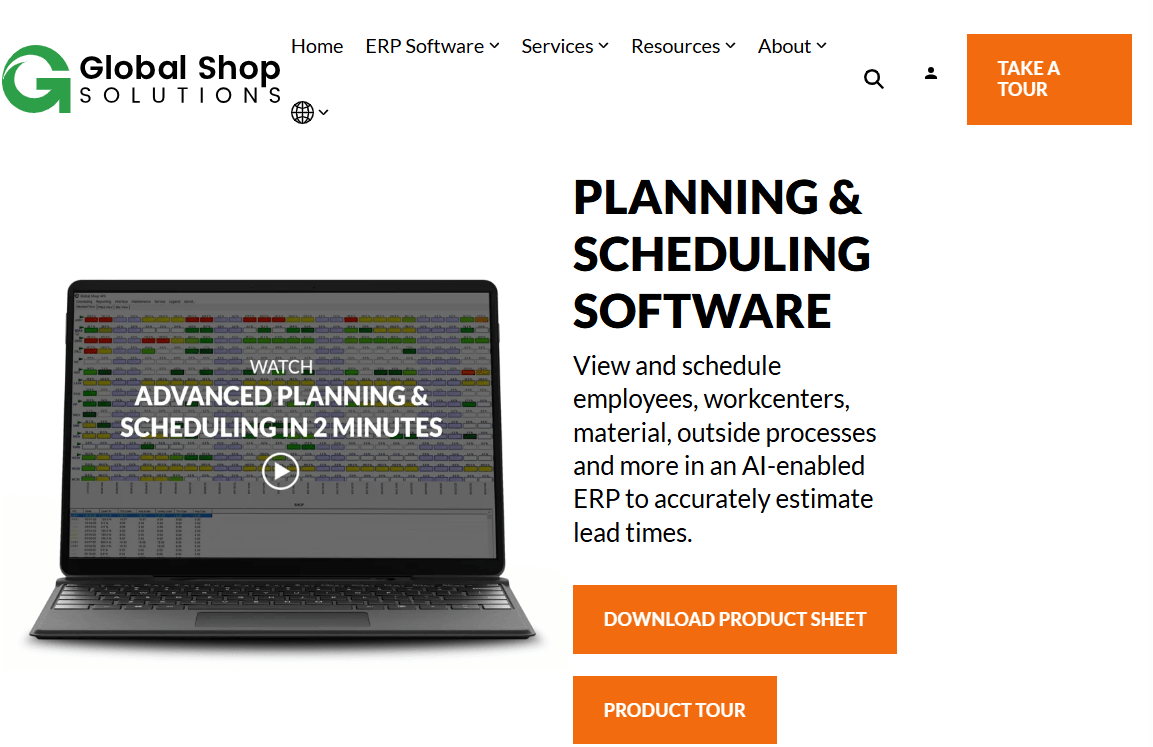
Global Shop Solutions provides an all-in-one ERP platform designed specifically for manufacturers. Its production capabilities include advanced scheduling and capacity management, while the system can use real-time inventory data as an input for scheduling. It supports both discrete and process manufacturing and offers cloud and on-premise deployment. Manufacturers that want ERP, production planning, inventory, and scheduling within one system can consider it as an integrated option.
Key APS Features
- Advanced production scheduling
- Capacity management
- Real-time inventory inputs for scheduling
- Discrete and process manufacturing support
- Cloud and on-premise deployment
Pros
- Focuses exclusively on manufacturing ERP
- Includes scheduling within the ERP
- Provides deployment flexibility
Cons
- Independent verification of scheduling depth is limited
- Uses custom pricing
Pricing
- Custom pricing
- Contact Global Shop Solutions for a quote
- No public price was confirmed
Best For
Job shops and discrete manufacturers that want one integrated system.
22. DELMIAWorks
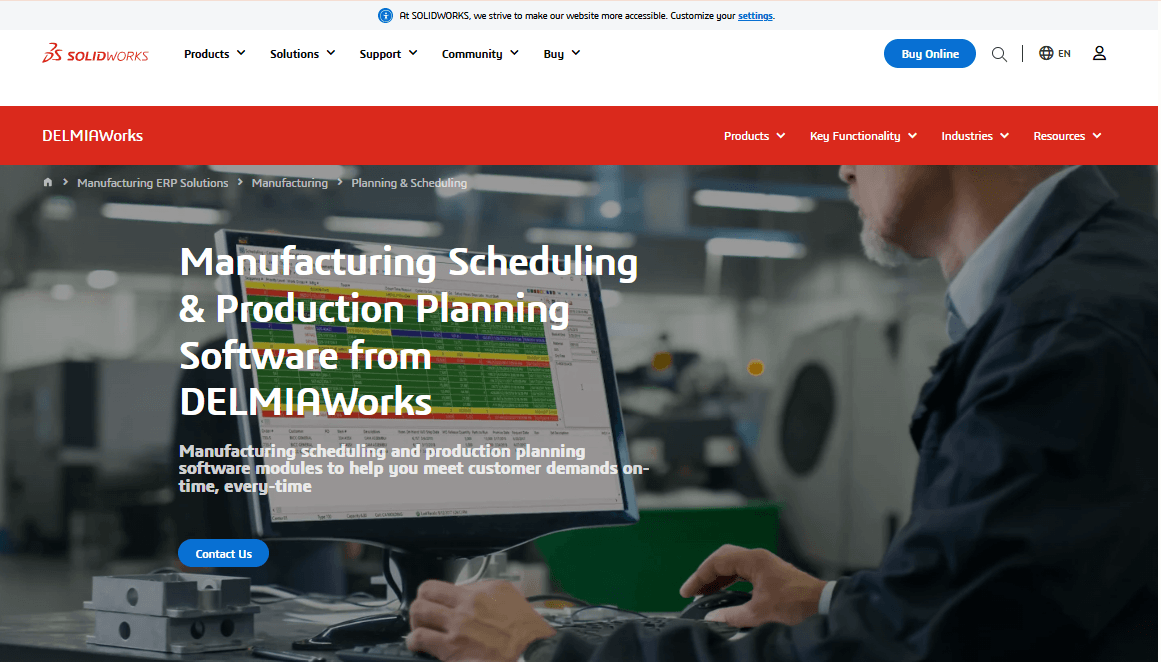
DELMIAWorks is a cloud ERP platform designed for mid-market manufacturers. The system includes scheduling and supply chain management capabilities and connects with the wider DELMIA portfolio. However, the available independent information on its underlying scheduling engine remains limited. Manufacturers considering the platform should request a live demonstration that covers their actual scheduling constraints and production scenarios.
Key APS Features
- ERP-based production scheduling
- Supply chain management
- Manufacturing-focused ERP
- Mid-market capabilities
- Cloud deployment
Pros
- Designed specifically for manufacturers
- Provides cloud delivery
- Connects with the wider DELMIA portfolio
Cons
- Official sources provide limited detail on the scheduling engine
- Uses custom pricing
Pricing
- Custom pricing
- Contact DELMIAWorks for a quote
- No public price was confirmed
Best For
Mid-market manufacturers that want ERP with integrated scheduling.
23. JobBOSS²
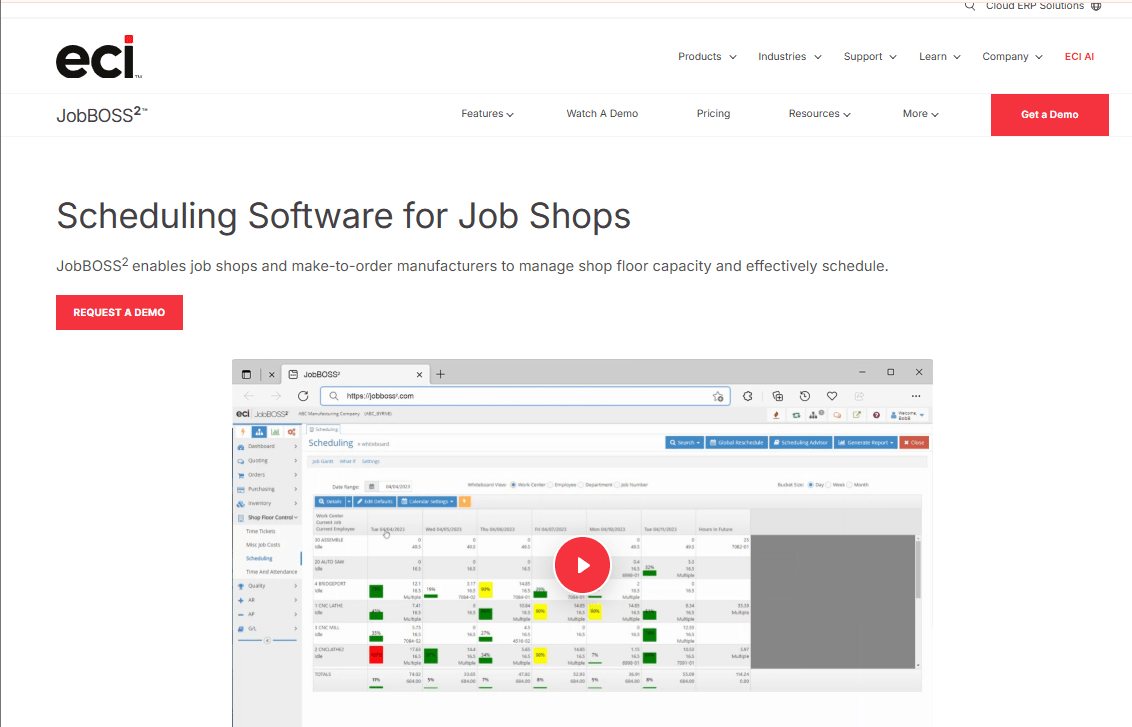
JobBOSS², developed by ECI Software Solutions, targets small and mid-sized job shops. The platform combines quoting, scheduling, financial management, capacity planning, and shop-floor visibility. Its capacity tools help manufacturers identify bottlenecks and manage production workloads. It focuses on connecting the quoting process with production and financial operations rather than providing the same depth of constraint optimisation as specialist APS platforms.
Key APS Features
- Capacity planning
- Bottleneck identification
- Integrated quoting and scheduling
- Shop-floor visibility
- Cloud and on-premise deployment
Pros
- Built specifically for job shops
- Connects quoting through financial operations
- Provides an accessible setup
Cons
- Does not provide the same depth as specialist constraint-based schedulers
- Pricing was not confirmed
Pricing
- Custom pricing
- Contact ECI Software Solutions for a quote
- No public price was confirmed
Best For
Small job shops that need integrated quoting, production, and scheduling.
24. Cetec ERP
Cetec ERP is a cloud-based ERP platform for small and mid-sized manufacturers and distributors. Its production scheduling capabilities connect production requirements with demand visibility and material availability. The platform provides an integrated environment for manufacturing, inventory, and business operations. It suits smaller manufacturers that want to manage production planning without introducing a separate scheduling platform.
Key APS Features
- Integrated production scheduling
- Live demand visibility
- Material-driven production adjustments
- Unified manufacturing platform
Pros
- Combines ERP and production planning
- Uses a cloud-based platform
- Avoids the need for multiple separate systems
Cons
- Independent information about APS capabilities is limited
- Pricing was not confirmed
Pricing
- Custom pricing
- Contact Cetec ERP for a quote
- No public price was confirmed
Best For
Small manufacturers that want an integrated ERP and production planning system.
25. Skyplanner
Skyplanner describes its platform as AI-based production planning and scheduling software with finite-capacity scheduling and built-in optimisation. The vendor says its optimisation engine can generate production schedules quickly and targets smaller manufacturing operations. The platform focuses specifically on production scheduling rather than providing a broad ERP suite. Buyers should validate the vendor’s performance claims with real production scenarios and customer references.
Key APS Features
- Finite-capacity scheduling
- Production planning
- AI-based schedule optimisation, according to the vendor
- Rapid schedule generation, according to the vendor
Pros
- Focuses on production scheduling
- Targets smaller manufacturing plants
- Vendor emphasises quick setup
Cons
- Independent verification remains limited
- Pricing was not confirmed
Pricing
- Custom pricing
- Contact Skyplanner for a quote
- No public price was confirmed
Best For
Smaller factories that need a lightweight production scheduling tool.
26. Schedlyzer
Schedlyzer provides production scheduling software for small and mid-sized job shops. The platform targets high-mix, low-volume production as well as make-to-order and engineer-to-order environments. Its scheduling-first approach makes it relevant to manufacturers managing custom jobs, changing priorities, and varied production requirements. Buyers should use a demonstration to test how the software handles their specific resource and sequencing constraints.
Key APS Features
- Job-shop scheduling
- High-mix, low-volume production support
- Make-to-order manufacturing support
- Engineer-to-order manufacturing support
- Custom production units
Pros
- Provides a clear job-shop focus
- Supports custom manufacturing
- Focuses specifically on scheduling
Cons
- Limited independent product information
- Pricing was not confirmed
Pricing
Custom pricing
Contact Schedlyzer for a quote
No public price was confirmed
Best For
Small and mid-sized job shops with custom production requirements.
27. Acumatica Cloud ERP
Acumatica Cloud ERP combines demand forecasting and MRP with order and resource management for growing manufacturers. Its manufacturing capabilities include bills of material and production planning, while its platform also includes AI Copilot features. Acumatica focuses on providing planning within a broader cloud ERP rather than operating as a specialist finite-capacity scheduling system. Manufacturers with complex scheduling requirements may need partner solutions or additional APS functionality.
Key APS Features
- Demand forecasting
- Material requirements planning
- Order and resource management
- Bills of material
- AI Copilot capabilities
Pros
- Provides planning within a cloud ERP
- Includes demand forecasting
- Can scale with business growth
Cons
- Finite-capacity scheduling depth was not confirmed
- Uses custom pricing
Pricing
- Custom pricing
- Contact Acumatica for a quote
- No public price was confirmed
Best For
Growing manufacturers that want ERP-level planning.
28. MRPeasy
MRPeasy provides cloud-based manufacturing software for small manufacturers. Its production capabilities include production planning, reporting, drag-and-drop rescheduling, workforce planning, and BOM management. Higher plans add overlap, special sequencing, and parallel execution of operations. The platform targets manufacturers moving away from spreadsheets and manual production planning rather than large enterprises requiring advanced mathematical optimisation.
Key APS Features
- Production planning and reporting
- Drag-and-drop schedule changes
- Workforce planning
- Overlap and parallel operation execution on Professional and higher plans
- Supply chain and warehouse management
Pros
- Provides transparent per-user pricing
- Offers a relatively accessible setup
- Provides a free trial
Cons
- Does not function as a full constraint-based optimiser
- Some scheduling features depend on the subscription tier
Pricing
- Starter: $49/user/month
- Professional: $69/user/month
- Unlimited: $149/user/month
- Plans require a minimum of two users
- Additional users beyond ten cost $79 per block of ten
- Free trial available
- Currency display can vary by region
Best For
Small manufacturers replacing spreadsheet-based production planning.
29. Odoo Manufacturing
Odoo provides a modular ERP platform with a Manufacturing app that manages work orders and production planning. Manufacturers can also connect Odoo with frePPLe for finite-capacity planning and scheduling. This combination gives businesses a flexible foundation that they can expand with additional applications or an APS layer. Odoo suits cost-conscious manufacturers that have the technical or implementation resources to configure the platform around their production processes.
Key APS Features
- Work-order planning
- Modular ERP architecture
- frePPLe integration for finite-capacity planning
- Cloud and on-premise deployment options
Pros
- Offers a free one-app option
- Provides extensive customisation
- Has a large partner ecosystem
Cons
- Constraint-based scheduling usually requires an add-on
- Implementation quality can vary by partner
Pricing
- Free plan for one app with unlimited users
- Paid plans use per-user monthly pricing
- Pricing varies by country and billing term
- Confirm current pricing directly with Odoo
Best For
Cost-conscious manufacturers that can configure Odoo or add a dedicated APS layer.
30. Katana
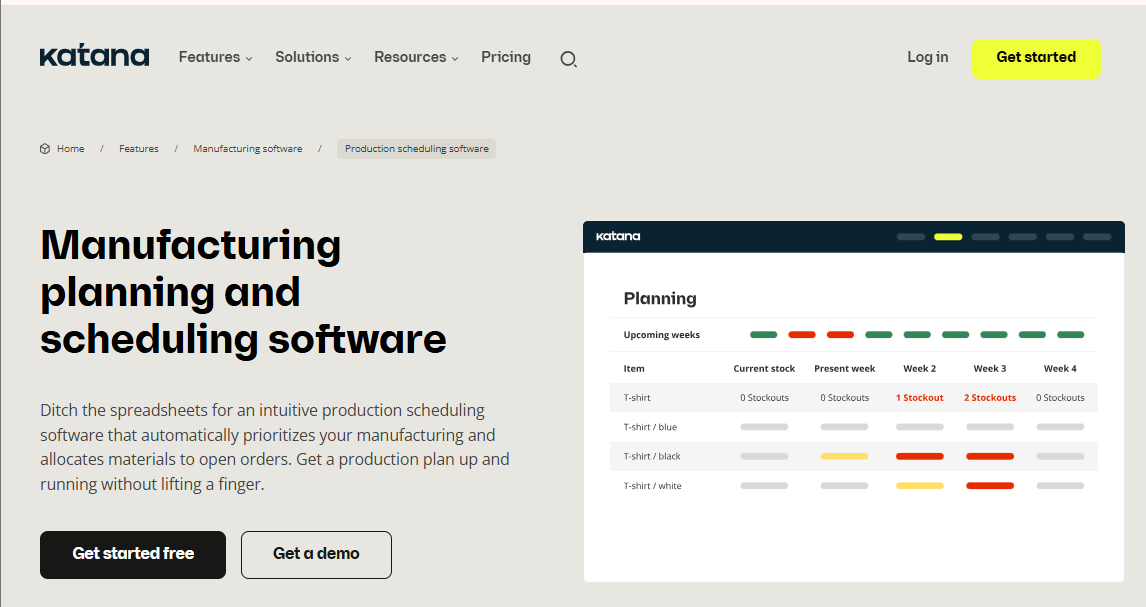
Katana provides cloud-based inventory and manufacturing software for small production teams. Its core capabilities focus on inventory, production, and order management rather than advanced finite-capacity scheduling. The available official materials do not provide enough evidence to classify Katana as a specialist APS platform. For that reason, manufacturers should view it as lightweight production planning software rather than a solution for highly complex scheduling constraints.
Key APS Features
- Inventory management
- Production management
- Cloud-based manufacturing tools
- Add-ons for additional functionality
Pros
- Provides public pricing
- Offers a free plan
- Does not charge per user
Cons
- Finite-capacity scheduling depth is not confirmed
- Does not target complex scheduling constraints
Pricing
- Free plan supports up to 30 SKUs and unlimited users
- Core plan starts at $299/month
- No per-user fees
Best For
Very small production teams that need basic production and inventory planning.
Conclusion
APS matters because plans that ignore capacity fail on the shop floor. The leading platforms differ in constraint depth, planning scope, and how much engineering they need. Specialists like Opcenter, PlanetTogether, Ortems, and Asprova focus on scheduling. Suites like SAP, Kinaxis, and Blue Yonder cover wider planning. ERP-based and entry-level tools trade depth for simplicity. The right choice depends on manufacturing complexity, integrations, planning needs, and budget. Compare functionality and implementation effort, not brand or price alone.