

Choosing the best AI Agents for Customer Support in 2026 has become one of the most important decisions a support leader can make. Only a couple of years ago, most support chatbots answered simple questions from a help center and then passed everything else to a human. Today, autonomous AI agents read a customer’s history, follow company policy, call back-end systems, issue refunds, rebook flights, and close tickets without a person touching them. Consequently, vendors, investors, and enterprise buyers now treat AI agents as the core of the support stack instead of an optional add-on.
In this guide, we comapred twelve leading platforms. Highlighting key features, honest pros and cons, and current pricing models so you can predict your costs before you commit. Read on to find the agent that fits your team, your tech stack, and your budget.
What to Consider Before Choosing an AI Customer Support Agent
The Best AI Agents for Customer Support in 2026 should fit your existing support setup, handle the types of customer issues you receive, and provide enough control and visibility for your team to monitor its performance. Here are some factors to consider before choosing an AI agent for customer support.
- Resolution depth: Does the agent take actions, or does it only answer questions?
- Channel coverage: Can it support customers across chat, email, voice, messaging, and other channels your business uses?
- Ecosystem fit: How well does it work with the helpdesk or CRM that you already use?
- Governance: Does it offer guardrails, analytics, testing, and smooth human handoff?
- Pricing clarity: Is the pricing structure transparent enough for you to estimate costs as your support volume grows?
- Market evidence: Do customers, funding, or analyst recognition back the claims?
Top 12 best AI Agents for Customer Support in 2026
1. Fin (Formerly Intercom)
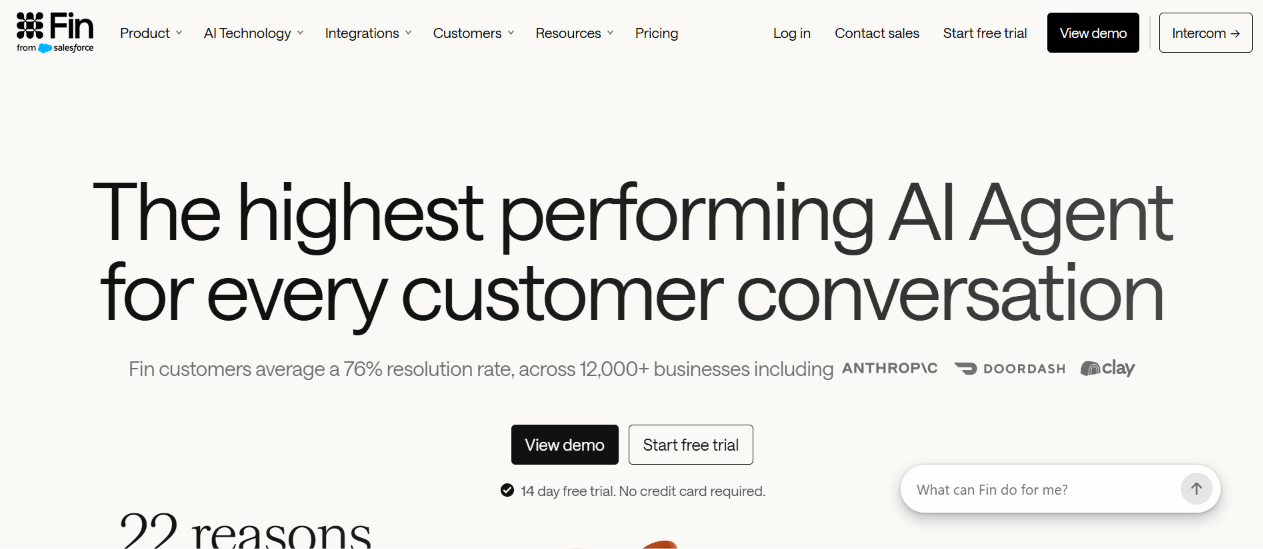
Fin began as the AI agent inside Intercom, and it grew so successful that the entire company renamed itself Fin in May 2026. Today, Fin resolves customer conversations end to end across chat, email, WhatsApp, SMS, phone, and Slack, and it serves more than 30,000 businesses.
Features
- Firstly, Fin answers questions and completes tasks across chat, email, phone, WhatsApp, SMS, and Slack.
- Fin runs natively inside Intercom, and it also plugs into other helpdesks, including Zendesk, Salesforce, and HubSpot.
- Teams define multi-step workflows so Fin can carry out tasks rather than merely answer questions.
- Also, Fin charges $0.99 per outcome, which its pricing defines as a resolution, a procedure handoff, or a disqualification.
- Intercom sells an in-box assistant for about $35 per agent per month.
Pros
- Fin has proven itself at scale, with more than 30,000 customers and a reputation for deep autonomous resolution.
- Outcome pricing links your spend to results, so you avoid buying AI licenses for every seat.
- Salesforce’s resources will back the product once the acquisition closes.
Cons
- Roadmap and pricing may shift after Salesforce absorbs the company, so ask about contract protections.
- The outcome definition covers more than clean resolutions, so read the contract language closely.
Best for: SaaS and digital-first teams that want a proven, fast-to-deploy autonomous agent.
Pricing model: $0.99 per outcome, with a 50-outcome monthly minimum outside the Intercom helpdesk. Intercom seats add roughly $29 to $139 per month each
2. Sierra

Bret Taylor, the former Salesforce co-CEO and current OpenAI board chair, and Clay Bavor, a former Google executive, founded Sierra in 2023. In May 2026, the company raised a $950 million Series E at a $15.8 billion valuation, and Tiger Global and Google’s GV led the round, according to CNBC. Sierra also says more than 40 percent of the Fortune 50 use its platform, and it reported $150 million in annual recurring revenue by early February 2026.
Unlike first-generation bots that only track orders or reset passwords, Sierra agents handle whole workflows, such as mortgage refinancing, insurance claims, and retail returns making it one of the Best AI Agents for Customer Support in 2026.
Features
- Sierra deploys agents across chat, voice, email, SMS, and WhatsApp.
- The Agent SDK and Agent Studio give teams control, while Ghostwriter, launched in March 2026, builds agents through conversation.
- Supervisory agents and deterministic rules keep responses on-brand and compliant.
- Agents complete actions inside back-end systems instead of just answering questions.
Pros
- Sierra serves an impressive roster of large brands and operates at very high interaction volume.
- Its voice agents make it a credible option for phone-heavy support.
- Deep funding gives the vendor long-term staying power.
Cons
- Sierra offers no self-serve plan and no public price list.
- Small and mid-sized teams will find the platform excessive for their needs.
Best for: Large enterprises and regulated brands that want a brand-safe agent across chat and voice.
Pricing model: Sales-led and not publicly listed. Industry reports describe an outcome-based commercial model.
3. Zendesk
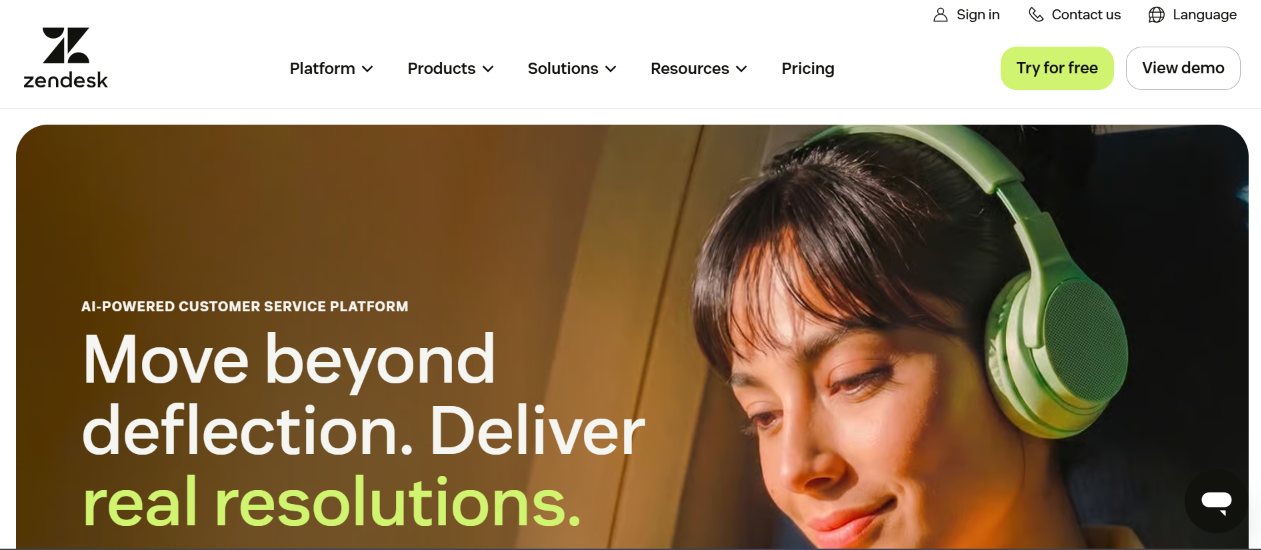
Zendesk has served support teams for years, and in 2026 it repositioned the company around a Resolution Platform in which AI agents take the front line. To speed that plan up, Zendesk announced on March 11, 2026 that it would buy Forethought, and it completed the acquisition on March 26, 2026. Forethought’s product reached general availability as Forethought AI Agents by Zendesk on June 4, 2026, and Zendesk says it remains available to companies that use other help desks.
Zendesk also claims that its AI agents routinely resolve more than 80 percent of interactions end to end across a broad customer base. In addition, Zendesk reported that Forrester named it a Strong Performer in the Q1 2026 Wave for Customer Service Solutions.
Features
- Firstly, essential agents ship with Suite plans, while Advanced agents bill per automated resolution.
- Solve resolves issues, Triage routes tickets, Assist supports human agents, Discover finds knowledge gaps, and Agent QA reviews quality. Zendesk labels several of these as add-ons.
- Moreover, Zendesk says its agents learn from conversations without manual retraining.
- The Forethought deal brings native voice capabilities to the platform.
- Human agents get drafting help, and admins track usage in an Automated Resolutions dashboard.
Pros
- Zendesk combines ticketing, knowledge, and AI agents in one mature platform.
- Forethought adds specialized agents for B2B, consumer, and employee service.
- Existing Zendesk customers can adopt AI without a migration.
Cons
- Costs layer quickly: seats, Copilot, and per-resolution fees all add up.
- Per-resolution rates run higher than those of Fin, HubSpot, and Gorgias.
Best for: Teams that already run Zendesk and want autonomous agents inside their existing ticketing backbone.
Pricing model: Suite plans start near $55 per agent per month on annual billing. Automated resolutions cost $1.50 (committed) or $2.00 (pay-as-you-go), and each seat includes a small monthly allowance. Copilot adds about $50 per agent.
4. Salesforce
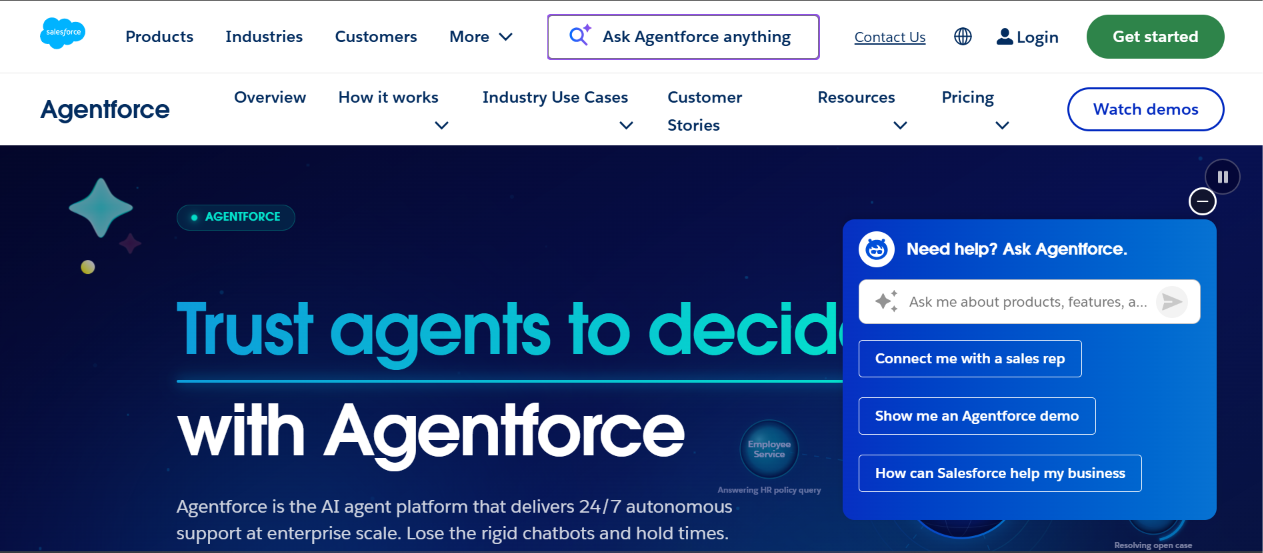
Salesforce built Agentforce to put autonomous agents on top of Service Cloud and the customer data that already lives in Salesforce. Momentum looks strong: Salesforce says Agentforce reached $1.2 billion in annual recurring revenue in its quarter ending in May 2026, up 205 percent from a year earlier.
Furthermore, the pending Fin acquisition signals that Salesforce wants to pair Agentforce’s deep customization with Fin’s packaged, fast-to-value agents. Once the deal closes, customers should see options for everything from rapid deployment to enterprise-scale builds.
Features
- Agentforce agents update records, run workflows, and resolve cases inside Salesforce.
- Agents draw on customer data through Data Cloud, so answers reflect each customer’s history.
- In addition, you can choose Flex Credits per action, per-conversation pricing, or per-user licenses.
- Agentforce Voice extends agents to phone interactions at a higher credit cost.
- Moreover, Salesforce says Enterprise Edition customers and above can receive 100,000 Flex Credits through Salesforce Foundations.
Pros
- Salesforce offers enormous scale, an extensive partner network, and financial staying power.
- Teams can customize deeply for complex service processes.
Cons
- Implementation can be complex and usually requires skilled admins or partners.
- Bills are hard to forecast because multi-step tasks consume several actions.
Best for: Enterprises that run Salesforce Service Cloud and want agents grounded in CRM data.
Pricing model: Flex Credits cost $500 per 100,000. A standard action uses 20 credits (0.10), and a voice action uses 30 credits ($0.15). Salesforce also sells per-conversation pricing (about $2) and per-user licenses.
5. Decagon
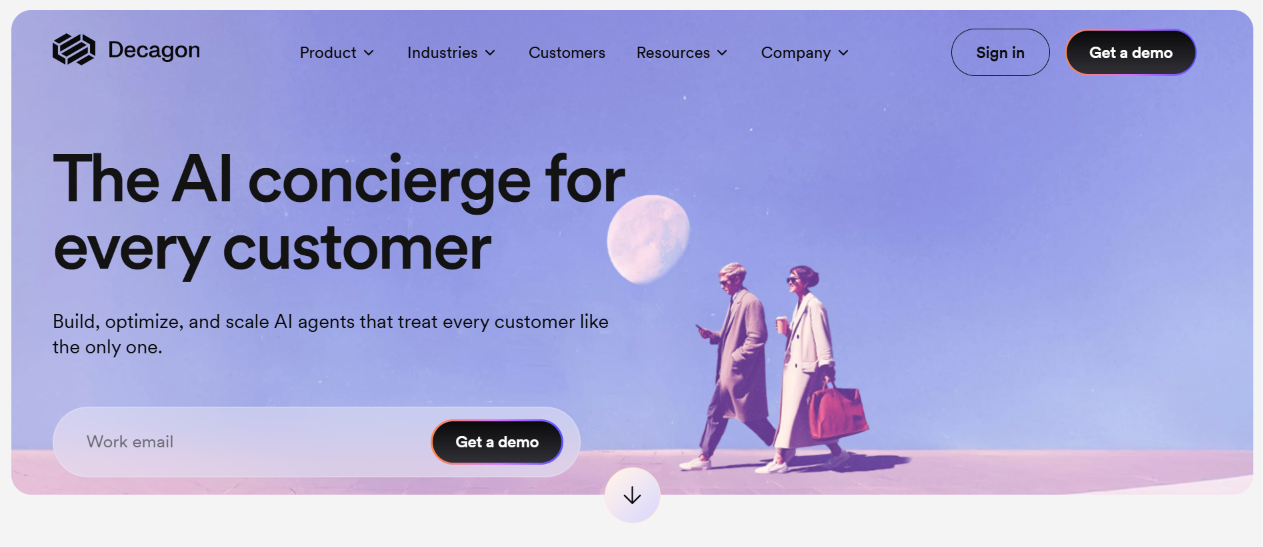
Jesse Zhang and Ashwin Sreenivas founded Decagon in 2023 to build AI agents that resolve customer conversations across chat, email, voice, and SMS. Bloomberg reported in January 2026 that Decagon raised $250 million at a $4.5 billion valuation, which tripled its previous mark, and Coatue and Index Ventures led the round.
Customers include Notion, Duolingo, Chime, Block, Avis Budget Group, and Deutsche Telekom. In June 2026, Decagon also launched Duet Autopilot, which it describes as the first self-improving AI agent for customer experience. Decagon’s published case studies report results such as 70 percent chat and voice resolution at Chime and an 80 percent deflection rate at Duolingo.
Features
- Teams describe workflows in natural language, and the agent follows them.
- Agents work with tools such as Salesforce and Zendesk to complete tasks.
- A single agent definition covers chat, email, voice, and SMS.
- Built-in testing and QA tools help teams review and improve agent behavior.
- Decagon’s self-improving layer aims to raise performance with less manual tuning.
Pros
- Decagon delivers strong end-to-end resolution and an enviable customer list.
- The platform iterates quickly and offers some of the best QA tooling in this group.
- Voice support arrived alongside chat and email, giving teams one vendor for all three.
Cons
- The vendor offers no public pricing, no free trial, and no self-serve signup.
- G2 reviewers report an average implementation time of about two months.
Best for: Fast-moving, high-volume brands that want an AI-native platform and can invest in tuning.
Pricing model: Decagon publishes no prices. Third-party estimates suggest a platform fee near $50,000 a year plus per-conversation or per-resolution charges.
6. Ada
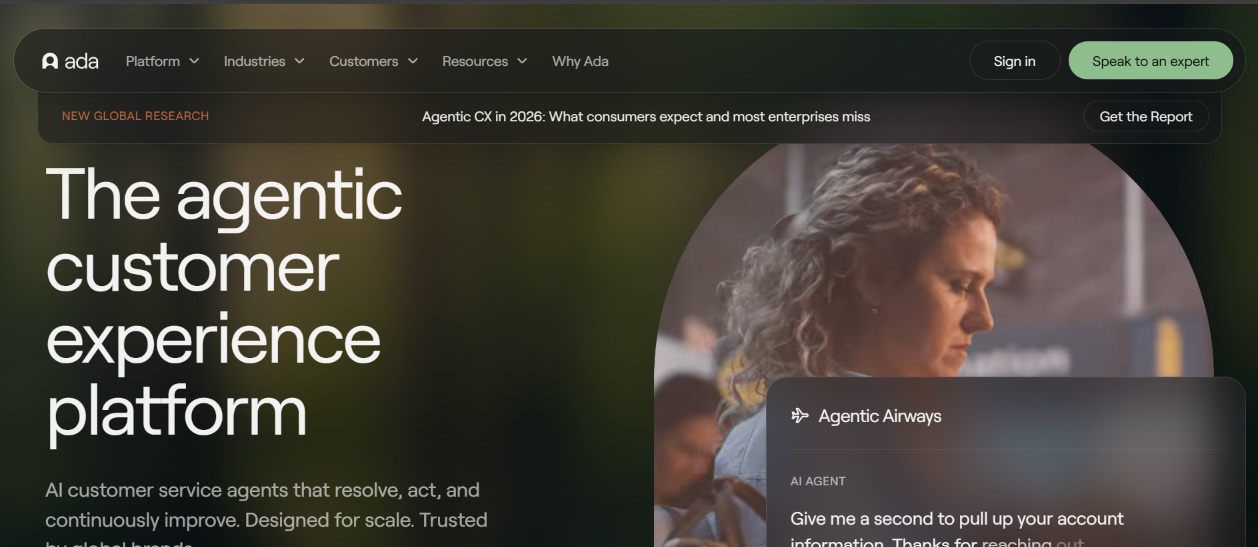
Ada, a Toronto-based company, has automated customer service since 2016, and it launched its generative AI agent in November 2023. It now works with more than 350 enterprises and brands its approach Agentic Customer Experience, or ACX. Ada says customers routinely report automated resolution rates above 80 percent, and it cites results of up to 83 percent.
Public examples include Cebu Pacific, which reported a 34 percent increase in resolution rate, and Philippine Airlines, which runs an Ada-powered agent in multiple languages. As always, treat vendor-reported rates as claims until your own pilot confirms them.
Features
- Ada’s engine drives the agent’s decisions and responses.
- The new tooling lets an agent use API, code, and MCP tools to complete a customer’s task under your controls.
- Dashboards track automated resolution, CSAT, transcripts, and coaching opportunities.
- Support leads coach the AI much as they would coach a human agent.
- Ada supports chat, voice, email, social, and SMS across languages and regions.
Pros
- Ada separates true automated resolution from simple containment, which gives you honest metrics.
- The no-code builder lets non-engineers design and refine flows.
- The platform has years of enterprise deployments behind it.
Cons
- Results depend on playbook coverage, so expect to invest time before you reach the higher resolution rates.
- Smaller teams will likely find the platform out of reach.
Best for: Global enterprises that want measurable resolution depth and hands-on control over AI behavior.
Pricing model: Custom quotes. Independent reviews report per-resolution pricing and enterprise-scale minimums.
7. HubSpot Breeze Customer Agent
HubSpot’s Breeze Customer Agent answers support conversations using your knowledge base and the customer data inside HubSpot’s Smart CRM. On April 14, 2026, HubSpot cut its price from $1.00 per conversation to $0.50 per resolved conversation, which moved the product into the outcome-pricing camp.
HubSpot says the agent resolves 65 percent of conversations and reduces resolution time by 39 percent across more than 8,000 activations. HubSpot counts a conversation as resolved when no human rep takes over within 72 hours.
Features
- The agent sees contact history, deals, and past tickets without extra integration work.
- It draws on help content and connected sources to reply.
- Conversations transfer to reps in Service Hub when the agent cannot resolve them.
- Professional plans include about 3,000 credits (roughly 60 resolved conversations), and Enterprise plans include about 5,000.
- HubSpot also sells a Prospecting Agent at $1 per recommended lead and a Data Agent at $0.10 per answer.
Pros
- At $0.50 per resolution, Breeze carries one of the lowest published outcome prices among the major platforms.
- Setup stays simple for existing HubSpot customers.
- The credit model makes costs easy to predict.
Cons
- The agent works best when HubSpot is your only system of record.
- The 65 percent resolution rate sits below the figures that Ada and Zendesk advertise.
Best for: Teams that already use HubSpot CRM and Service Hub and want a simple, low-cost agent.
Pricing model: $0.50 per resolved conversation (50 HubSpot Credits at about $10 per 1,000 credits). The agent requires a Service Hub Professional or Enterprise subscription
8. Kore.ai
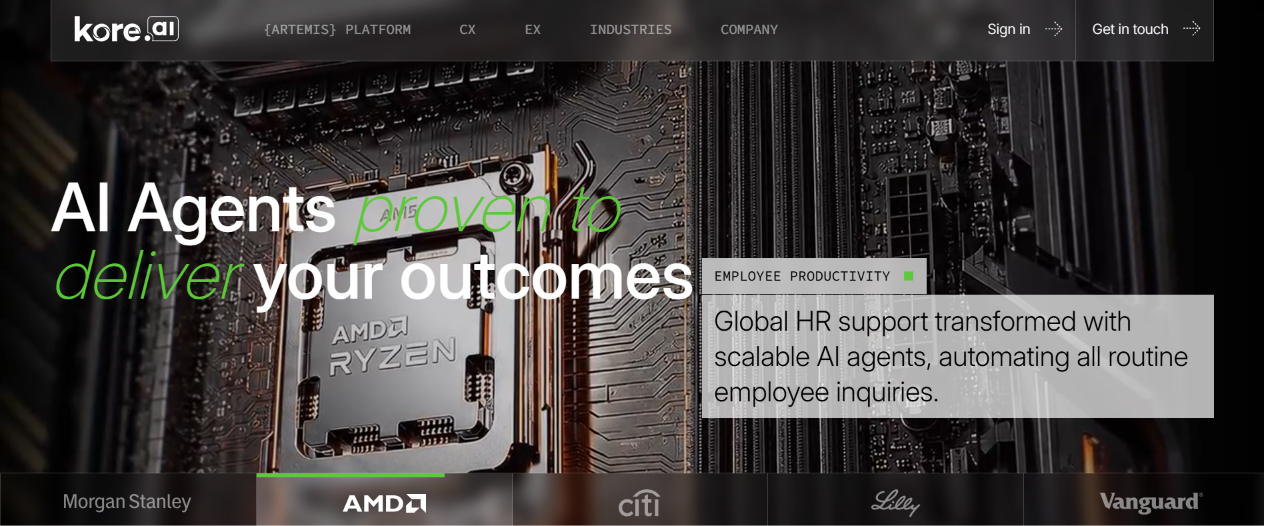
Kore.ai sells an enterprise platform for building, deploying, and governing AI agents across customer service, employee experience, and process automation. Its Agent Platform, Artemis edition, serves more than 500 enterprise customers. Gartner named Kore.ai a Leader in its July 2026 Magic Quadrant for Conversational AI Platforms, the company’s fourth consecutive Leader placement, and Forrester named it a Leader in its Q2 2026 Wave for Conversational AI Platforms for Customer Service.
Additionally, Kore.ai also launched an Agent Management Platform in March 2026 that governs and monitors agents built on frameworks such as LangGraph, CrewAI, and AutoGen.
Features
- Kore.ai coordinates several specialized agents inside one workflow.
- Gartner cited Arch and the Agent Blueprint Language as distinctive tools.
- The suite covers AI agents, real-time agent assist, an agentic contact center, automated quality scoring, and proactive outreach.
- Teams can use proprietary, third-party, or open-source LLMs.
- Prebuilt solutions serve banking, healthcare, and retail.
Pros
- Analyst recognition from Gartner, Forrester, and Everest Group signals maturity.
- The platform covers self-service, agent assist, and QA in one place..
Cons
- The platform’s breadth brings complexity, so most buyers need an implementation partner.
- Pricing sits at enterprise levels, which excludes small teams.
Best for: Enterprises that need governance, multi-agent orchestration, and flexible LLM choices.
Pricing model: Custom enterprise contracts. A competitor’s review estimates that buyers should expect six-figure deals.
9. NiCE Cognigy
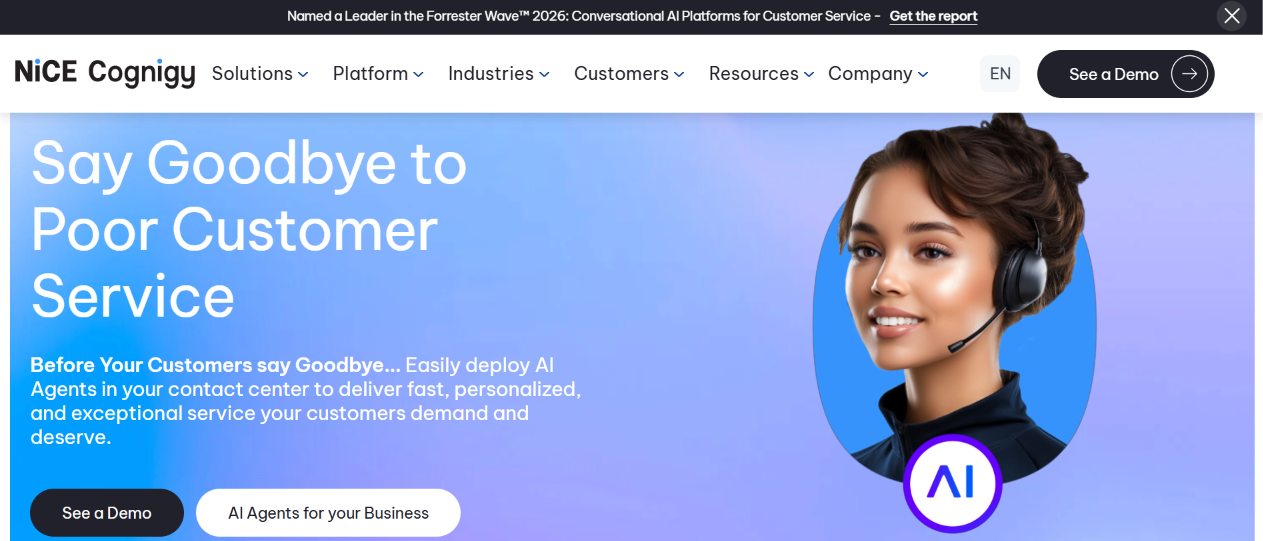
Cognigy started in Düsseldorf in 2016 and grew into one of the best-known conversational AI platforms for contact centers. NiCE closed its acquisition of Cognigy on September 8, 2025, in a deal reported at $955 million, and the product now operates as NiCE Cognigy inside the CXone Mpower platform. NiCE says more than 1,000 brands use Cognigy to create AI customer service agents. Co-founder Philipp Heltewig stayed on as general manager of NiCE Cognigy and NiCE’s Chief AI Officer.
Features
- Firstly, Cognigy’s Voice Gateway, IVR support, and modular speech components make phone automation a core capability.
- The platform supports 100+ languages and 30+ channel connectors.
- Thirdly, Teams design agents in a graphical editor and reuse 100+ prebuilt integrations.
- Cognigy can route work across several LLMs.
- An 8×8 integration page lists SOC 2 and ISO certification, plus GDPR and HIPAA compliance.
- Additionally, agent Copilot and Knowledge AI extend the platform for human agents.
Pros
- Voice automation sits at the center of the product rather than as an afterthought.
- Deep contact-center integrations, including 8×8, reduce rip-and-replace projects.
- NiCE’s scale supports large global deployments.
Cons
- NiCE ownership ties the roadmap more closely to CXone, which reduces vendor neutrality.
- Integration into NiCE’s product line continues through 2026, so expect some roadmap movement.
Best for: Voice-heavy contact centers, especially those that already run NiCE CXone or a compatible CCaaS platform.
Pricing model: Custom enterprise contracts through NiCE and its partners.
10. Freshworks Freddy AI Agent
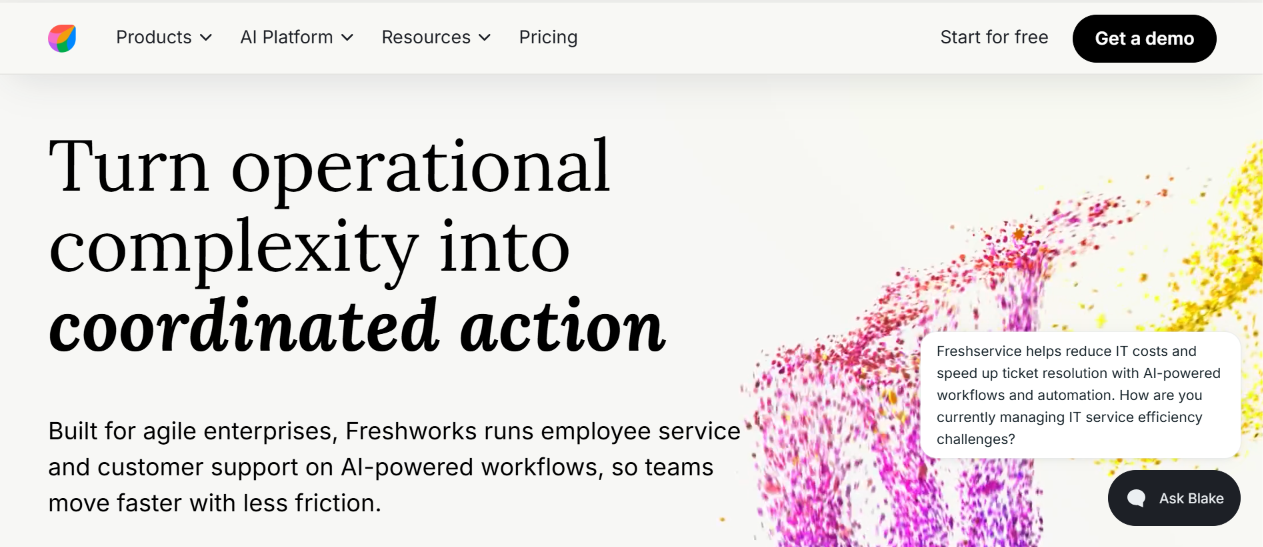
Freddy AI is the AI layer inside Freshworks products, and it splits into three parts: Freddy AI Agent for autonomous customer conversations, Freddy Copilot for human agents, and Freddy AI Insights for analytics. Freshworks lists Freddy AI Agent on the Growth, Pro, and Enterprise plans, and every paid plan receives the first 500 sessions once per account.
Notably, Freshworks bills by session instead of by resolution. For email, one session equals a 72-hour window from the customer’s first message. Freshdesk earns a 4.4 out of 5 rating on G2 from roughly 3,700 reviews, according to a June 2026 comparison.
Features
- Firstly, the agent answers customers on email and chat using your articles, files, and URLs.
- Growth, Pro, and Enterprise plans include the builder.
- Also, human agents draft replies, summarize tickets, translate, and refine tone with AI help.
- Managers analyze support trends, although the feature needs a Copilot license.
- Lastly, Freshdesk Omni adds messaging and web chat.
Pros
- Seat pricing remains predictable for the human side of the team.
- Freshworks suits small and mid-sized teams that want a simple rollout.
Cons
- Session billing charges for every interaction, so a low resolution rate raises your effective cost per solved ticket.
- Session packs expire monthly, and the AI stops answering when you run out.
Best for: Budget-conscious support teams that already use Freshdesk or want an affordable all-in-one helpdesk.
Pricing model: Freddy AI Agent costs $49 per 100 sessions after 500 free sessions (one time). Freshdesk seats run from $19 to $89 per agent per month, and Freddy Copilot adds about $29 per agent per month.
11. Gorgias AI Agent
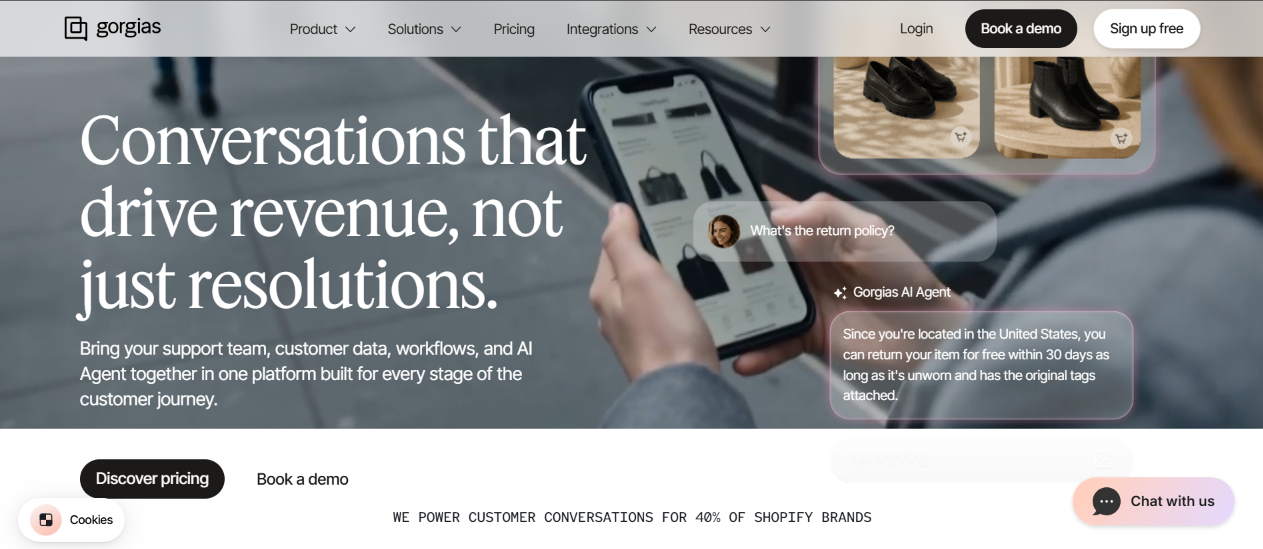
Gorgias built its helpdesk for ecommerce, and its AI Agent (formerly sold as Automate) ties directly into Shopify store data. The agent handles chat and email, and it performs actions such as refunds, cancellations, order edits, address changes before fulfillment, and return starts.
In addition, Gorgias prices its helpdesk by ticket volume instead of by seat. The AI Agent adds a separate charge only when it resolves a conversation without a human touching it within 72 hours.
Features
- The agent changes orders, issues refunds, and starts returns without human help.
- SMS is available as an add-on.
- A pre-sale option helps shoppers choose products.
- Additionally, unresolved conversations pass to your team, and Gorgias does not charge an automated interaction for handed-over tickets.
- Plans include from 90 to 2,500+ automated interactions per month.
Pros
- The product speaks ecommerce fluently, from order status to returns.
- Pricing per resolved interaction is easy to understand, and there are no seat fees.
Cons
- AI Agent on chat supports Shopify stores only.
- Each automated interaction also counts as a billable helpdesk ticket, so one automated chat can hit your bill twice.
Best for: Shopify and ecommerce brands that want a helpdesk and AI agent built around orders and returns.
Pricing model: $0.90 per automated interaction on annual plans and $1.00 on monthly plans, plus a helpdesk plan from $10 a month. Overage costs $1.50 per interaction past your plan bundle.
12. Tidio Lyro
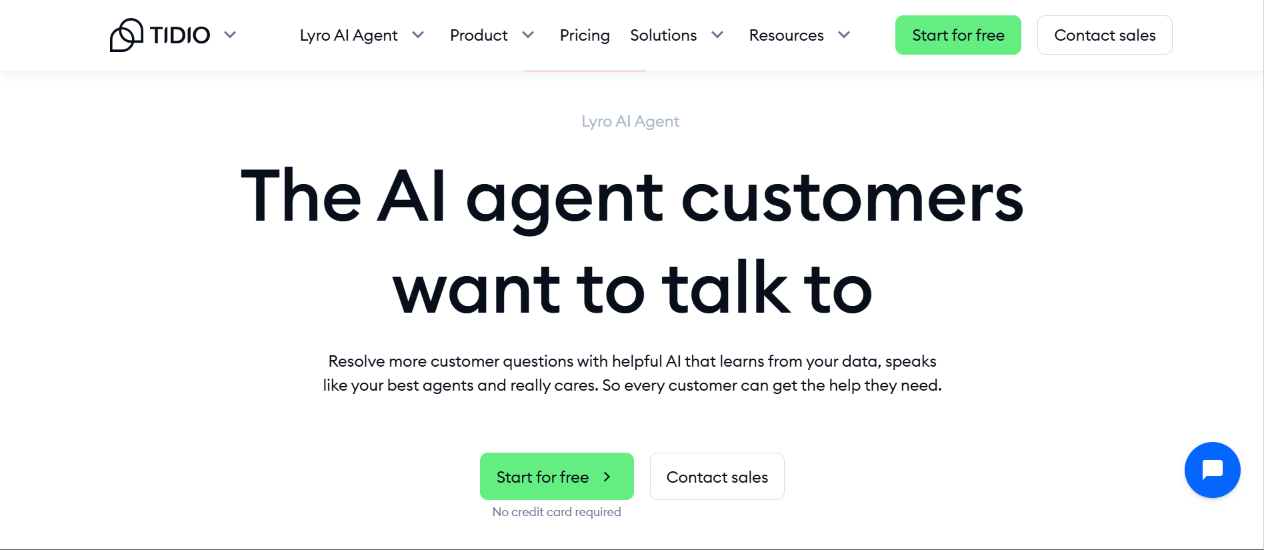
Lyro is the AI agent from Tidio, a live chat and support platform popular with small businesses. Moreover, Lyro answers questions only from the content you provide, and it escalates everything else to a human. Tidio’s website says Lyro resolves up to 64 percent of customer questions instantly.
In addition, Lyro Connect lets Lyro run inside other helpdesks, including Zendesk, Intercom, and Salesforce. Tidio bills that option separately, from $0.50 per conversation, and limits it to the Plus and Premium plans.
Features
- Firstly, Lyro learns from your help center, website, and documents, which limits made-up replies.
- The agent hands off questions that fall outside its knowledge.
- A separate rule-based builder handles lead qualification and cart reminders.
- In addition, Teams add Lyro to an existing helpdesk without migrating.
- Lastly, growth plans add Shopify actions and advanced analytics.
Pros
- Lyro offers the lowest entry price on this list, and setup takes little time.
- Answering only from your content reduces hallucination risk.
- The free allowance lets you test with real customers first.
Cons
- Tidio measures three things separately: customer service plans, Lyro conversations, and Flows.
- The free Lyro allowance is a one-time grant, not a monthly quota.
Best for: Small businesses, solo founders, and lean teams that want AI support without enterprise pricing.
Pricing model: Lyro starts at $39 a month for 50 conversations (32.50 on annual billing). Every Tidio plan includes 50 Lyro conversations as a one-time allowance.