

Choosing the best aerospace manufacturing software in 2026 has become one of the most important decisions an aerospace company can make. Aircraft and defense programs now involve millions of parts, strict regulations, and supply chains that span continents. Therefore, manufacturers need software that controls every design revision, production step, and inspection record.
Meanwhile, the market keeps changing. Vendors merge, artificial intelligence reaches the shop floor, and standards such as AS9100, ITAR, and CMMC keep raising the bar for traceability and cybersecurity. As a result, a system that worked well five years ago may now slow your team down or leave compliance gaps.
To help you cut through the noise, we researched vendor documentation, press releases, and independent industry reviews. Then we selected 25 platforms that cover the full path from design to delivery, including PLM, MES, ERP, CAM, and simulation tools. Each entry gives you a direct link to the vendor’s website, an overview, key features, pros and cons, and a final thought.
Whether you run a global aerospace program or a small machine shop, this guide will help you build a confident shortlist. Let’s explore the top 25 options.
Top 25 best Aerospace Manufacturing Software in 2026
1. CATIA (Dassault Systèmes)

CATIA is a 3D design and engineering platform that aerospace and defense teams use to develop complex products and systems. It runs on the 3DEXPERIENCE platform, so design, analysis, and simulation live in a single environment. Dassault Systèmes positions CATIA as the design core of its aerospace offering, and it links directly to the company’s DELMIA manufacturing tools.
Features
- Advanced surface modeling and systems engineering in one environment
- Real-time co-design across engineering teams and supply chains
- Integrated design, analysis, and simulation on the 3DEXPERIENCE platform
- Aerospace-specific solution experiences, including machined parts, composites, sheet metal, and installations
- Data continuity between design and manufacturing through the virtual twin
Pros
- Reviewers widely describe it as an industry standard in aerospace
- Provides a continuous data model from design through simulation to production
- Scales from a single part to a full aircraft program
Cons
- Demands significant training because of a steep learning curve
- Requires careful platform planning to avoid over-buying
Final Thought
CATIA remains a top-tier choice when your program needs deep surface modeling and full-platform continuity. However, smaller suppliers should weigh its cost and complexity before committing.
2. DELMIA
DELMIA delivers end-to-end digital solutions for planning, managing, and optimizing manufacturing and operations. Engineers simulate production virtually, plan the workforce, and orchestrate the supply chain. Because DELMIA belongs to the 3DEXPERIENCE platform, it connects naturally to CATIA design data.
Features
- Virtual production simulation and digital twins of production systems
- Workforce planning and supply chain orchestration
- Manufacturing execution and operations management
- Compliance and traceability modules for regulated production
- Tight integration with CATIA and other CAD/CAE tools
Pros
- Detects and resolves production issues before physical implementation
- Keeps design and manufacturing aligned through shared data
- Covers planning, execution, and operations in one family
Cons
- Delivers the most value inside the wider Dassault ecosystem
- Needs a long implementation and skilled administrators
- Carries enterprise-level pricing
Final Thought
DELMIA suits organizations that want to prove their factory in software first. Consequently, it fits large programs better than small job shops.
3. Siemens NX
Siemens NX is a high-end CAD, CAM, and CAE suite that engineers use to design, simulate, and produce complex aircraft components such as fuselage structures, wings, and engine parts. It pairs tightly with Teamcenter for data management. In one published example, Bye Aerospace used Teamcenter and NX and reported a 66 percent reduction in the engineering resources it needed for design and certification.
Features
- Parametric and synchronous 3D modeling for complex assemblies
- Integrated CAM for multi-axis machining
- Simulation and analysis inside the design environment
- Composites and additive manufacturing workflows
- Native integration with Teamcenter PLM
Pros
- Covers the full design-to-machining chain in one product line
- Handles very large, complex assemblies well
- Connects seamlessly to Siemens PLM and MES tools
Cons
- Requires substantial training for advanced modules
- Costs increase quickly as you add modules
- Works best when the rest of your stack also comes from Siemens
Final Thought
NX earns its place among the best aerospace manufacturing software in 2026 because it removes hand-offs between design and machining. Teams already using Teamcenter will find the fit especially strong.
4. Tulip
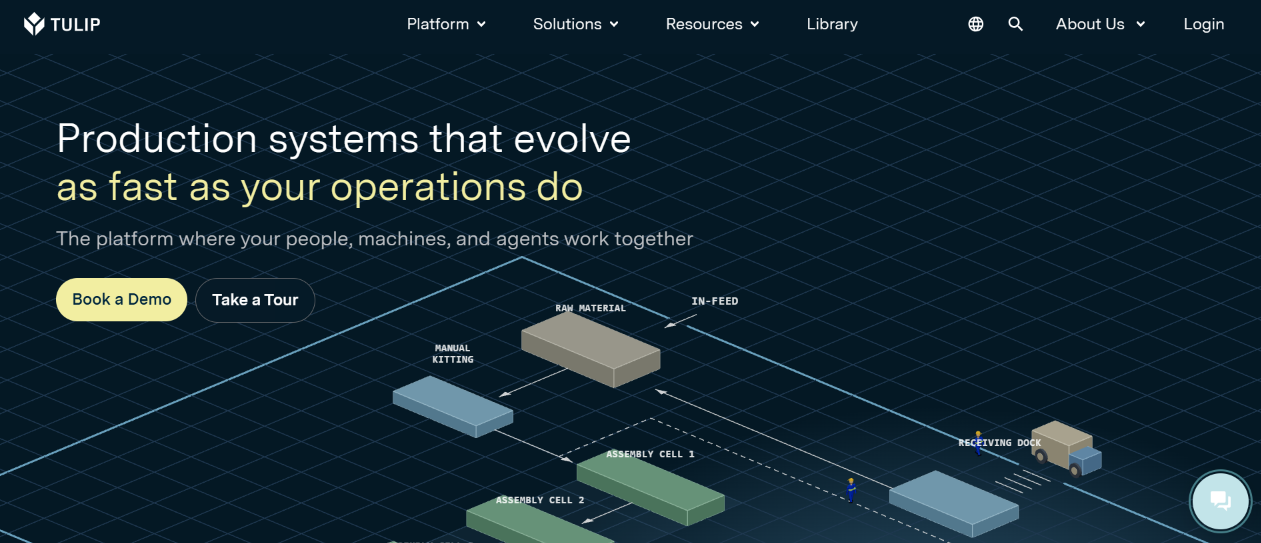
Tulip is a cloud-native, no-code frontline operations platform that lets manufacturers build connected apps for workers. The company spun out of MIT and now actively builds an aerospace and defense practice with partners. Tulip reports an average deployment time near three months, and its apps guide operators with media-rich instructions while capturing traceability data.
Features
- No-code app builder for operator workflows
- Error-proofed, step-by-step digital work instructions
- Automated data capture from machines and devices
- Work order and equipment status visibility
- AI features for app generation and performance analysis
Pros
- Lets non-programmers build and change apps quickly
- Improves quality through error-proofing
- Connects easily with existing ERP and machines
Cons
- Requires app-design discipline to avoid sprawl
- Needs validation against ITAR, DFARS, and CMMC requirements
Final Thought
Tulip suits teams that want to digitize workflows fast without heavy IT projects. It complements, rather than replaces, your core systems.
5. PTC Windchill
PTC Windchill is a PLM platform that centralizes product data management for aerospace and defense organizations. BAE Systems chose Windchill as its enterprise standard for product development. PTC also offers an optional Windchill Aerospace & Defense module, which adds configuration items and design solutions to support large and complex product structures.
Features
- Document control, CAD integration, BOM management, and audit trails
- Aerospace & Defense module with configuration items and a dedicated change model
- Automated change approval workflows
- Role-based access control for secure collaboration
- Digital thread links to manufacturing, quality, and service data
Pros
- Delivers strong configuration management for complex products
- Supports traceability that helps audits and compliance
- Integrates well with PTC’s CAD tools such as Creo
Cons
- Requires experienced implementers for complex rollouts
- Feels heavy for small teams
- Costs rise with modules and users
Final Thought
Windchill fits companies where configuration control is the top priority. As a result, defense-heavy programs often shortlist it early.
6. Aras Innovator
Aras Innovator is an open, low-code PLM platform that connects requirements, design, manufacturing, quality, and service data into one traceable digital thread. Aerospace and defense customers include BAE Systems, SAIC, Insitu, Aeronamic, and Northrop Grumman. Aras also holds a Leader position in a Forrester Wave for PLM for discrete manufacturers (Q3 2025), according to the company.
Features
- Low-code development environment for custom applications
- Application library covering product engineering, process planning, quality, and technical documentation
- Managed upgrade service that preserves customizations
- Aras Cloud deployment and InnovatorEdge for governed data access
- Open APIs for ERP, MES, and ALM integration
Pros
- Adapts to unusual processes without heavy code rewrites
- Includes managed upgrades in the subscription
- Avoids costly module-by-module licensing
Cons
- Needs skilled configuration partners for best results
- Offers fewer built-in CAD tools than the large suites
- Requires clear internal ownership of the data model
Final Thought
Aras stands out when flexibility matters more than an out-of-the-box process. Nevertheless, buyers should budget for a strong implementation partner.
7. Ansys

Ansys is a multiphysics simulation platform that aerospace engineers use for structural, aerodynamic, and thermal analysis. It also includes an additive suite that simulates metal 3D printing, including distortion and residual stress. Synopsys completed its acquisition of Ansys on July 17, 2025, and it planned the first combined capabilities for the first half of 2026.
Features
- Structural, fluid, thermal, and electromagnetic simulation
- Composite modeling with ply-based workflows
- Additive manufacturing process simulation
- Virtual prototyping and design optimization
- Broad integration with CAD and PLM systems
Pros
- Reduces physical testing through accurate virtual prototypes
- Covers many physics in one platform
- Enjoys deep adoption across aerospace engineering
Cons
- Requires specialist analysts to use well
- Carries high license costs
- Faces roadmap changes while Synopsys integrates it
Final Thought
Ansys remains a benchmark for simulation-driven manufacturing decisions. Buyers should, however, confirm product packaging and support terms under Synopsys.
8. Solumina (iBase-t)
Solumina is a manufacturing operations platform that iBase-t built specifically for aerospace and defense. It combines MES, MRO, supplier quality, and embedded quality management to create a paperless shop floor. According to a June 2025 announcement, Gartner named iBase-t a Representative Vendor in its 2025 MES Market Guide and noted that A&D makes up more than half of its customer base. Customers include Northrop Grumman, GE Aerospace, Rolls-Royce, Pratt & Whitney, and Textron.
Features
- Model-based MES with MBE Pro, introduced in the Solumina i120 release (April 2025)
- Digital work instructions and integrated discrepancy reporting
- Embedded quality management and supplier quality
- Solumina AI, which supports ITAR and NIST requirements with self-hosted or on-premises options
- Solumina SDK and integrations to connect ERP, PLM, and machines
Pros
- Works out of the box for A&D processes
- Enforces procedures and improves first-time quality
- Supports the digital thread and model-based enterprise mandates
Cons
- Targets complex manufacturers, so small shops may find it heavy
- Requires a structured implementation and change program
- Publishes pricing only through vendor quotes
Final Thought
Solumina is one of the strongest purpose-built MES options among the best aerospace manufacturing software in 2026. It suits primes and tier suppliers with complex work instructions and heavy compliance duties.
9. Siemens Opcenter
Opcenter is Siemens’ manufacturing operations management portfolio. It covers execution, advanced planning and scheduling, quality, and analytics. Because it shares data models with Teamcenter and the Siemens digital twin, it closes the loop between engineering intent and shop floor reality.
Features
- Discrete manufacturing execution and work order control
- Advanced planning and scheduling for constrained resources
- Quality management and inspection workflows
- Production analytics and performance dashboards
- Integration with Teamcenter, NX, and ERP systems
Pros
- Connects PLM data to production without re-keying
- Scales across multi-site operations
- Offers modular deployment
Cons
- Requires significant integration effort outside the Siemens stack
- Needs experienced consultants for aerospace configuration
- Carries enterprise pricing
Final Thought
Opcenter makes the most sense when Siemens already anchors your engineering stack. In that case, it turns the digital thread into working shop floor execution.
10. SAP Cloud ERP (SAP S/4HANA)

SAP Cloud ERP, formerly marketed as SAP S/4HANA, manages complex assemblies through a multi-level bill of materials tool. Software Connect rates it as a strong fit for Tier 1 suppliers, particularly those that produce jet engine components such as turbines, casings, and compressors.
Features
- Multi-level BOM management with version tracking
- Automated engineering change approvals
- BOM comparison that highlights differences between versions
- Impact analysis for material substitutions and schedule effects
- Strong business intelligence tools
Pros
- Maintains full traceability across complex assemblies
- Benefits from a large network of partners and resellers
- Provides deep analytics and reporting
Cons
- Involves a difficult setup and long rollout
- Lacks pricing transparency
- Costs more than mid-market ERP options
Final Thought
SAP delivers scale and control for large programs. Smaller suppliers, however, should compare it with lighter mid-market systems.
11. Oracle Fusion Cloud Manufacturing

Oracle Fusion Cloud Manufacturing supports all production modes with integrated work orders and resource management for shop floor tasks. It belongs to Oracle’s wider supply chain and ERP suite. Oracle also highlights connected equipment that triggers rule-driven business processes, and AI that drafts operator shift notes and production summaries.
Features
- Work order execution with integrated resource management
- Support for discrete, process, and mixed-mode production
- Rule-driven automation from connected equipment events
- AI-generated shift notes and production reports
- Integrated inventory, costing, maintenance, and quality
Pros
- Unifies finance, supply chain, and manufacturing in one cloud
- Offers real-time supervisor visibility
- Reduces reporting effort through built-in AI
Cons
- Needs careful configuration for AS9100 and ITAR requirements
- Requires enterprise-level pricing through custom quotes
- Involves complex data migration and integration
Final Thought
Oracle fits large enterprises that want one cloud across finance and operations. Aerospace-specific compliance, however, needs deliberate configuration and a capable partner.
12. Infor CloudSuite Industrial (SyteLine)

Infor CloudSuite Industrial handles complex agreements such as time-and-materials, firm-fixed-price, and cost-plus contracts. Software Connect names it the best pick for large OEMs and gives it an 8.9 editor’s rating. Its contract module tracks costs at the contract line item number level and supports DCAA-aligned accounting practices.
Features
- Contract management with milestone tracking and work breakdown structures
- CLIN-level cost tracking and invoicing
- Borrowed load payback and co-mingled costing for DCAA compliance
- Contract flow-down that pushes AS9100, ITAR, and DFARS requirements to suppliers
- Multi-site, multi-company support with built-in business intelligence
Pros
- Handles government contract structures well
- Supports multi-site operations
- Includes comprehensive supply chain management
Cons
- Offers a limited quality management module
- Makes upgrades difficult
- Presents a steep learning curve for new users
Final Thought
Infor is a strong choice when contracts and cost accounting drive your decisions. Plan a supplemental QMS if your quality needs run deep.
13. Epicor Kinetic
Epicor Kinetic is a manufacturing-focused ERP that collects real-time shop floor data and includes AI support. Software Connect highlights its quality tools, which track non-conformances, inspections, and discrepant material reviews so that defects do not reach Tier 1 or Tier 2 customers. Starting prices from that roundup begin near $2,100 per month.
Features
- Non-conformance tracking with lot and serial traceability
- Inspection routing and discrepant material review
- Shop floor interface and job scheduling board
- Supplier relationship management
- Built-in AI support features
Pros
- Designed specifically for manufacturers
- Captures real-time shop floor data
- Documents supplier communication for rejected material
Cons
- Suits multinational organizations less well
- Presents a high learning curve
- Requires careful scoping to control cost
Final Thought
Epicor Kinetic works well for suppliers that want quality control tied directly to production. Consequently, it remains a popular mid-market option.
14. IFS Cloud

IFS Cloud provides a project-oriented ERP solution tailored to aerospace and defense. It combines ERP, enterprise asset management, and field service management on one platform. As a result, a manufacturer can follow a component from production through installation and service without switching systems.
Features
- Production scheduling and assembly management
- MRO, maintenance planning, and technician scheduling
- Support for outcome-based service agreements
- Compliance checkpoints for FAA, ITAR, and AS9100 with audit trails and digital sign-offs
- Project-based cost and program control
Pros
- Covers manufacturing and sustainment in one database
- Supports service contracts and lifecycle tracking
- Offers modular, customizable deployment
Cons
- Costs more than a pure manufacturing ERP
- Requires a consultation to receive pricing
- Presents a steep learning curve because of its breadth
Final Thought
IFS shines for companies whose revenue includes service and support. If you only need shop-floor manufacturing, however, a lighter system may serve you better.
15. Plex (Rockwell Automation)

Plex is a cloud-native smart manufacturing platform that Rockwell Automation acquired in 2021. It unites ERP, manufacturing execution, quality, and supply chain functions in a single system. Manufacturers value it for real-time shop floor visibility and tight links to automation equipment.
Features
- Cloud ERP with integrated MES functions
- Quality management and traceability
- Real-time production monitoring
- Supply chain and inventory management
- Connection to Rockwell’s industrial automation portfolio
Pros
- Combines business and shop floor systems in one cloud
- Delivers strong real-time production visibility
- Benefits from Rockwell’s automation ecosystem
Cons
- Requires validation against ITAR and cloud data-residency needs
- Involves a substantial implementation effort
Final Thought
Plex suits multi-industry manufacturers that also serve aerospace customers. Buyers should confirm compliance and hosting requirements before signing.
16. Deltek Costpoint

Deltek Costpoint is an ERP that Deltek built specifically for government contractors. Its project manufacturing modules cover work orders, materials, shop floor time tracking, and supply chain management. Production data flows directly into DCAA-compliant accounting, and larger primes can report performance with earned value management.
Features
- DCAA-compliant cost accounting
- Project manufacturing with work order management
- Earned value management for multi-year programs
- Shop-floor time tracking and inventory control
- Deltek Essentials package from about $800 per month for up to 10 users, per Software Connect
Pros
- Brings more than 40 years of federal compliance experience
- Allocates direct and indirect costs to contracts automatically
- Serves both small contractors and large primes
Cons
- Requires a consultation for most pricing
- Offers more than commercial-only manufacturers usually need
Final Thought
Costpoint is a top pick for defense-heavy businesses. Commercial aerospace suppliers should, however, compare it with manufacturing-first ERP options.
17. ProShop ERP
ProShop ERP is a cloud-hosted ERP and QMS that its makers built inside an AS9100 and ITAR-regulated aerospace job shop. It replaces paper travelers and forms with digital workflows. Software Connect names it the best fit for aerospace job shops.
Features
- Audit-ready document control and revision tracking
- Export control and ITAR access control
- NCRs, CARs, FAIs, and training records in one system
- Visual scheduling board with dynamic work cells
- Visual work instructions with photos and CAM simulations
Pros
- Supports AS9100, ITAR, and NADCAP workflows out of the box
- Cuts audit preparation effort through digital records
- Stores historical run data, BOMs, and quality specs in one place
Cons
- Limits customization in areas such as part labels
- May feel small for very large, multi-site operations
Final Thought
ProShop is a leading option for job shops that want compliance built in from day one. It also publishes CMMC Level 2 resources for defense suppliers.
18. Fulcrum Pro
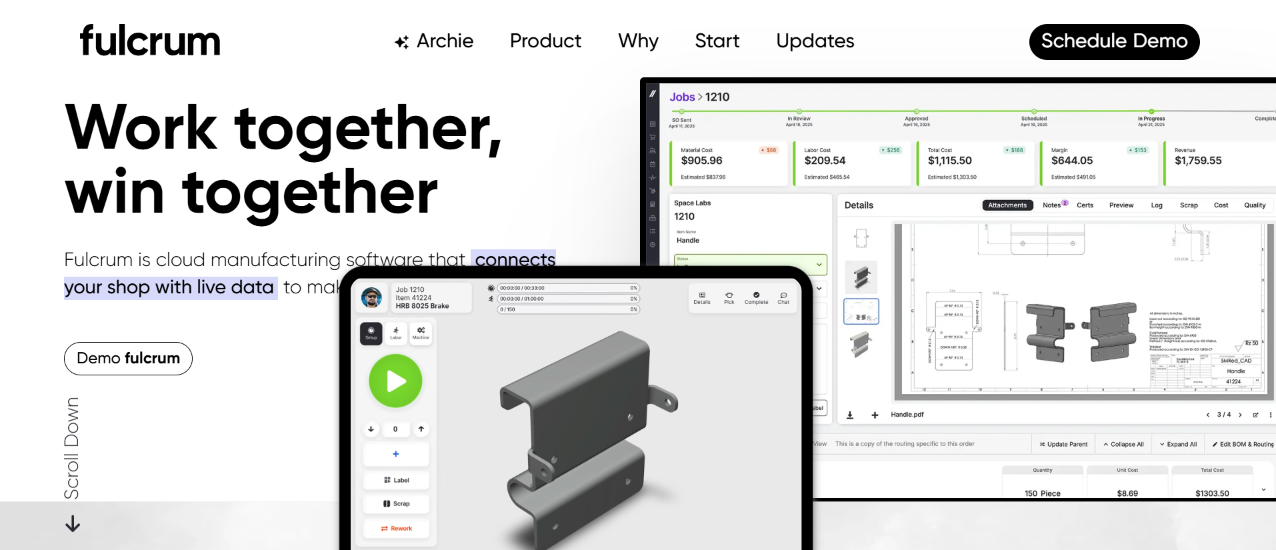
Fulcrum is a cloud-native platform that replaces separate ERP, MRP, and MES tools. Its Control module links inspection to production, moving from ballooned drawings through in-process inspection to AS9100D evidence in one workflow. Fulcrum says it supports shops from 15 to 500 people.
Features
- Autoschedule that updates capacity and priorities continuously
- Integrated QMS (Control) for AS9100D evidence
- Quoting, purchasing, and inventory management
- Real-time production tracking from tablets or terminals
- Weekly software updates through a cloud-native architecture
Pros
- Offers an intuitive, modern interface that speeds adoption
- Removes version-upgrade projects
- Unifies quoting, scheduling, and quality
Cons
- Requires configuration time for advanced workflows
- Provides fewer enterprise-scale references than large ERPs
Final Thought
Fulcrum appeals to shops that want speed and simplicity. Larger, multi-site manufacturers should, nevertheless, test its depth against their needs.
19. ECI M1
ECI M1 is a manufacturing ERP that Software Connect ranks as the best production planning module for aerospace. Its MRP automates job scheduling from demand forecasts and material availability. It also accounts for lead times on high-value materials such as titanium, specialty alloys, and composites.
Features
- MRP that filters jobs by facility, deadline, and component requirements
- Automated job creation with review before bulk release
- Barcode scanning and digital shop floor tracking
- Inventory control for raw materials, assemblies, and finished goods
- Configurable dashboards and built-in payroll
Pros
- Prevents waste and stockouts on expensive materials
- Tracks labor, material, and machine costs
- Supports multi-tier BOMs and compliance-aware jobs
Cons
- Requires a steep learning curve
- Suits batch manufacturing less well
Final Thought
M1 rewards teams that plan carefully and want detailed MRP control. Software Connect lists starting prices near $3,000 per month.
20. Acumatica Cloud ERP
Acumatica is a cloud ERP with an open architecture. Its engineering change control lets suppliers combine multiple design adjustments into a single engineering change order. Software Connect names it the best fit for Tier 2 suppliers and lists starting prices near $1,800 per month.
Features
- Consolidated engineering change orders
- Multi-level BOM tree view with cost breakdowns
- BOM comparison with color-coded change indicators
- Open architecture for rapid integrations
- Multi-entity support and mobile access
Pros
- Reduces repetitive approvals on change-heavy parts
- Integrates easily with other systems
- Runs on any device
Cons
- Requires a scheduled consultation for pricing
- Involves a tedious initial setup
Final Thought
Acumatica helps suppliers that live with constant design revisions. Its open architecture also makes it a flexible base for add-on aerospace tools.
21. Global Shop Solutions
Global Shop Solutions is an all-in-one ERP for small and mid-sized manufacturers. An independent ERPResearch comparison rates its manufacturing and quality management capabilities as strong. It provides deep shop floor control through real-time dashboards and tracks quality with SPC tools.
Features
- Real-time shop floor control and dashboards
- Quality management and SPC tracking
- Production scheduling and inventory control
- Purchasing and job costing
- Cloud and on-premises deployment options
Pros
- Combines many modules in one platform
- Delivers strong shop floor visibility
- Costs less than enterprise suites
Cons
- Scales less well beyond about 250 users
- Offers basic CRM and ecommerce tools
Final Thought
Global Shop Solutions fits established shops that want breadth without enterprise complexity. Growing companies should, however, check its scalability ceiling.
22. VERICUT (CGTech)
VERICUT is CNC machine simulation, verification, and optimization software from CGTech. It lets programmers prove out NC programs virtually instead of on the machine. Aerospace manufacturers use it widely, and it integrates with leading CAM systems such as CATIA, Siemens NX, PowerMill, and hyperMILL.
Features
- Simulation of multi-axis milling, mill-turn, waterjet, and robotic machining
- Composite programming and simulation for fiber placement and tape laying machines
- Drilling and fastening simulation for large aero-structures
- Measurement, inspection, and analysis of the virtually machined part
- Optional optimization to cut machining time and extend tool life
Pros
- Removes manual prove-outs and prevents costly collisions
- Works with many CAM and machine brands
- Covers metal cutting, composites, and additive processes
Cons
- Requires accurate machine and controller models
- Does not replace CAM programming itself
Final Thought
VERICUT protects high-value workpieces and machine time. For aerospace machining, it often pays for itself through avoided scrap alone.
23. Mastercam (Sandvik)
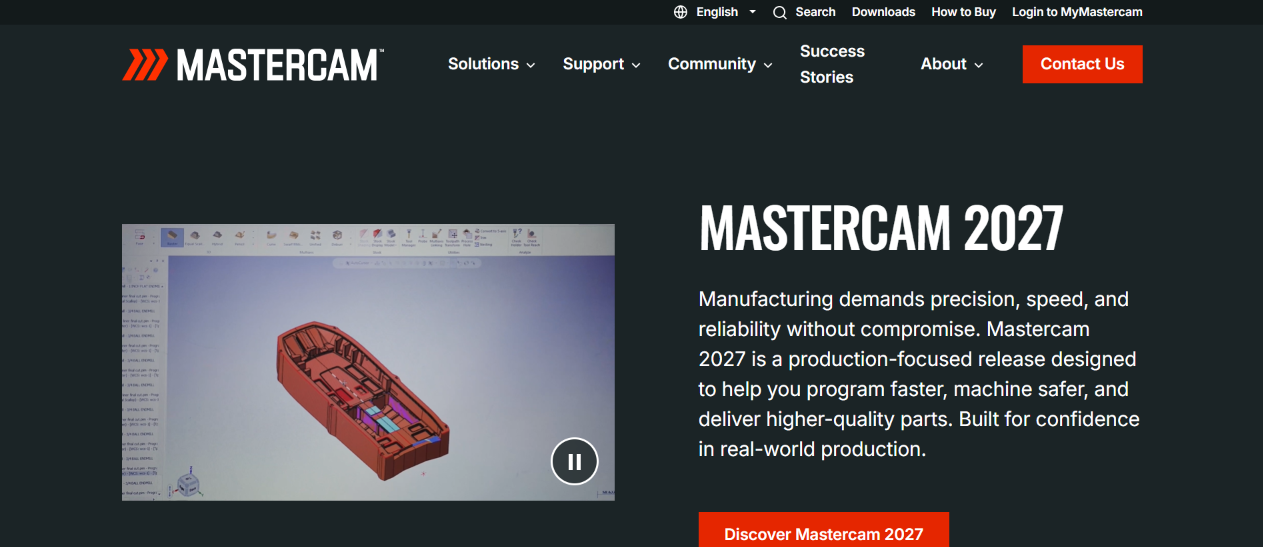
Mastercam is a widely used CAM system that programs CNC machines for milling, turning, mill-turn, and multi-axis operations. Sandvik completed its acquisition of Mastercam’s developer, CNC Software, on September 30, 2021. At announcement, Sandvik cited an installed base of roughly 270,000 licenses and users.
Features
- Toolpath generation for milling, turning, and multi-axis machining
- Model preparation, simulation, and verification
- Deburring and finishing toolpaths
- Hole-creation tools and machining parameter control
- Large reseller network and machine-maker partnerships
Pros
- Benefits from a very large user base and talent pool
- Supports a wide range of machines and controls
- Backs its roadmap with Sandvik’s machining expertise
Cons
- Focuses on programming rather than enterprise data management
- Depends on resellers for local support quality
- Requires experienced programmers for complex 5-axis work
Final Thought
Mastercam gives shops a proven, flexible programming tool. Pair it with simulation and shop management software for a complete aerospace workflow.
24. Hexagon ESPRIT EDGE, EDGECAM, and NCSIMUL
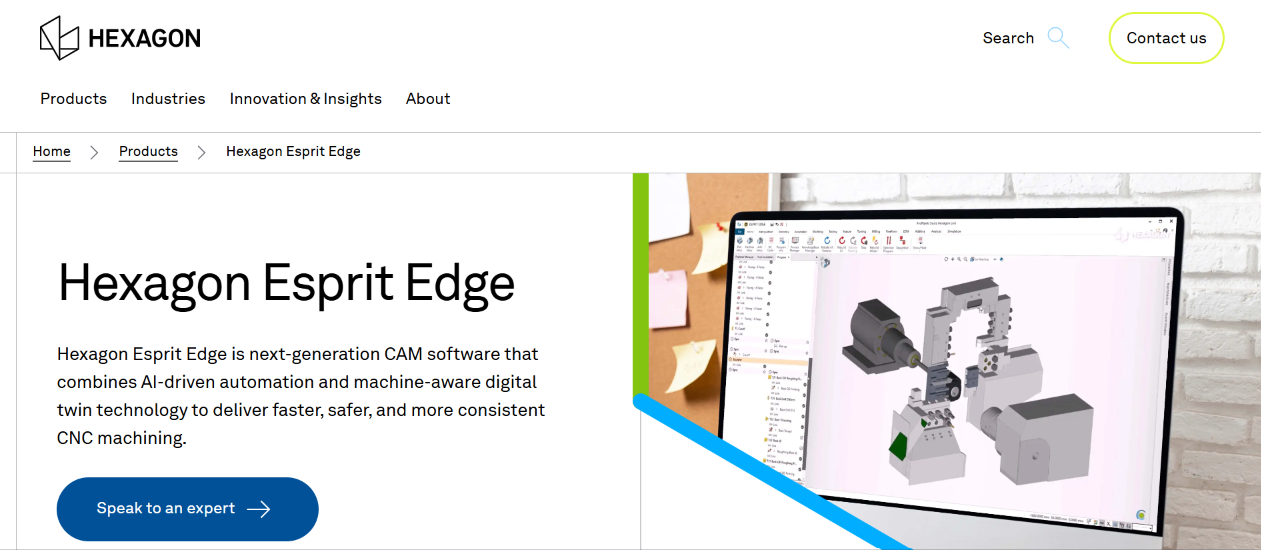
Hexagon’s production software portfolio includes ESPRIT EDGE, EDGECAM, and NCSIMUL. In April 2026, Hexagon announced ESPRIT EDGE enhancements for turning and Swiss machining, and an EDGECAM release with up to 30 times faster simulation rewind and an AI assistant called Hexagon Copilot. NCSIMUL 2026.2 supports interfaces to CATIA, Siemens NX, Mastercam, and other CAM systems.
Features
- ProPlanAI that learns from existing programs and suggests strategies
- Full digital-twin simulation of machine kinematics and controller behavior
- Interactive 3D simulation recordings shared through Live Job Reports
- NCSIMUL verification across many CAM platforms
- Regular 2026 release cadence with automation updates
Pros
- Speeds programming with embedded AI
- Verifies programs before the first cut
- Works with several third-party CAM systems through NCSIMUL
Cons
- Uses cloud services for some AI features, so defense buyers must review data controls
- Relies on vendor-reported productivity claims that you should test on your own parts
Final Thought
Hexagon offers a compelling mix of CAM, AI, and simulation. Test it on your most complex part before committing.
25. Siemens Teamcenter
Teamcenter is Siemens’ product lifecycle management platform. It connects requirements, configurations, product structures, manufacturing information, and lifecycle processes into one digital thread, so program teams see the impact of a change before it becomes a costly risk. The U.S. Air Force selected Teamcenter as its enterprise PLM standard after an earlier $24.6 million contract for licensing, maintenance, and support.
Features
- Managed BOMs, engineering changes, and configuration control
- Digital thread linking requirements to manufacturing and service
- Support for mechanical, electrical, software, and systems data
- Open architecture for integration with other tools
- AI capabilities built for PLM workflows
Pros
- Proven at the largest defense and aerospace programs
- Creates a single source of truth across disciplines
- Offers an open, interoperable architecture
Cons
- Takes months, not weeks, to implement well
- Requires strong governance and process discipline
- Costs more than lightweight PDM systems
Final Thought
Teamcenter is a natural pick for programs that span decades and many suppliers. It rewards organizations that invest in clean data and process governance.