

Finding the Best Predictive Dialer Software in 2026 can transform how your sales and support teams connect with customers. Predictive dialers automate outbound calling, so your agents spend less time waiting and more time talking. Moreover, these tools skip busy signals, voicemails, and disconnected numbers, which boosts productivity and lifts conversion rates.
However, the market has grown crowded, and every vendor claims to offer the fastest, smartest solution. As a result, many businesses struggle to separate genuine value from marketing hype. Some platforms excel at call routing, while others shine in CRM integration, compliance features, or AI-driven analytics.
In this guide, we review the top 13 predictive dialer platforms, and we break down their key features, pricing, strengths, and limitations. Read on to find the dialer that fits your goals, budget, and workflow.
Top 13 Best Predictive Dialer Software in 2026
1. Convoso
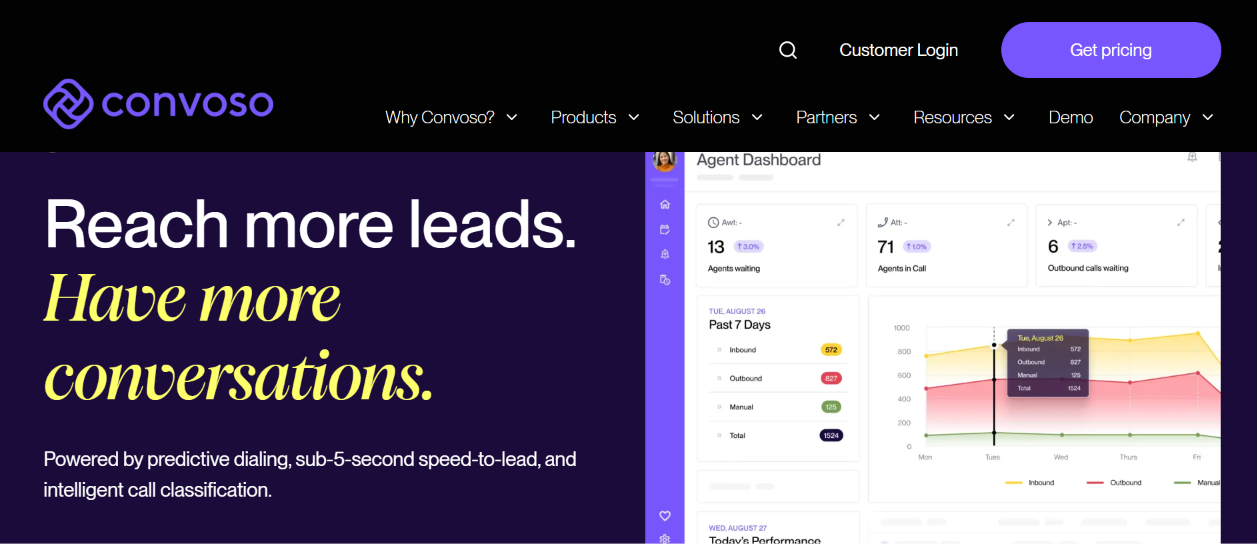
Convoso builds its platform around outbound calling rather than treating the dialer as an add-on. The product centers on predictive and power dialing, lead management, caller ID reputation management, and compliance tooling. As a result, insurance, solar, home-services, and lead-generation call centers often shortlist it first.
Moreover, Convoso now sells a Voice AI Agent that can handle the opening portion of a call before a human joins. Independent reviewers rate the platform around 4.5 out of 5 on G2, and they usually praise its dialing performance and campaign efficiency.
Features
- AI-driven pacing algorithm that adjusts dialing speed using agent availability, abandonment rates, and average call length.
- Abandonment controls built around the 3% TCPA threshold, plus Do Not Call (DNC) management.
- Caller ID reputation management that helps protect outbound numbers from spam labels.
- Lead management and routing designed for floors that receive fresh leads daily.
- Dynamic scripting and real-time reporting with customizable dashboards.
- Voice AI Agent for automated first-touch conversations.
Pros
- Purpose-built for dialing speed and speed-to-lead
- Strong compliance and caller ID tooling
- Highly rated for ease of navigation and CRM connectivity
Cons
- No public pricing and no free trial
- Costs can climb because some features carry per-license charges
Pricing
Convoso does not publish its prices, so every quote starts with a sales conversation. One third-party comparison estimates entry pricing near $90 per seat per month with a 10-seat minimum and a 12-month contract; however, treat that figure as an estimate, not a quote. The vendor reportedly offers a 20% discount on annual terms, and it does not offer a free trial, so ask for a written pilot before you sign.
Best for: Outbound-only teams of 20+ agents that live or die by contact rate.
2. Five9

Five9 is a cloud contact center suite in which the dialer sits beside inbound routing, quality management, and workforce scheduling. Therefore, it fits organizations whose agents take inbound calls in the morning and work outbound lists in the afternoon, because one set of reports covers both.
Five9 supports four outbound modes, so managers can run aged lists on predictive pacing while placing high-value accounts on preview.
Features
- Predictive, progressive, power, and preview dialing modes in one platform.
- Answering machine detection to keep voicemails away from agents.
- Certified Caller, Five9’s program that helps keep outbound numbers from being labeled as spam.
- Blended inbound and outbound routing with unified reporting.
- Enterprise CRM integrations and an extensive partner ecosystem.
Pros
- ature, enterprise-grade pacing and reporting
- One platform for inbound, outbound, and digital channels
- Spam-labeling protection through Certified Caller
Cons
- Reported 50 concurrent-seat minimum raises the entry cost
- Services-led rollout adds weeks before the first campaign
Pricing
Published figures place the Core tier, the first with voice, near $159 per concurrent user per month, while the Digital tier at about $119 covers non-voice channels only. A separate 2026 comparison lists roughly $175 for a mid-tier seat, so pricing clearly varies by plan and contract. With a 50-seat minimum, expect a floor of roughly $7,950 per month before setup, telephony usage, and add-ons. Contracts typically run 12 to 36 months.
Best for: Contact centers above 50 agents that blend inbound and outbound work.
3. ReadyMode

ReadyMode positions itself as a dialer-first platform for dedicated outbound teams. Unlike most enterprise suites, it publishes its prices, which makes budgeting simple for a 5-to-30-seat floor.
In addition, ReadyMode earns a 4.6 out of 5 on G2, and users often highlight call quality and fast connection speeds.
Features
- Predictive dialing up to 20+ concurrent lines per agent for aggressive campaigns.
- Preview and progressive modes for sensitive or high-value lists.
- Outbound minutes included in each license, which removes per-minute surprises.
- Number reputation monitoring on the iQ plan.
- Live monitoring and local presence tools for connect-rate optimization.
Pros
- ransparent, easy-to-forecast pricing
- Very high dialing intensity
- Fast, intuitive agent experience
Cons
- Reputation monitoring is limited to the iQ plan
- CRM syncing is lighter than in sales-focused tools
Pricing
The Starter plan costs $199 per license per month for 1 to 4 licenses, and the iQ plan costs $249 per license per month for 5 or more. Outbound minutes are included, whereas inbound minutes run about $0.02 each. Free-trial terms are not clearly published, so request a demo account.
Best for: Outbound telemarketing teams of 5 to 30 agents that want a known monthly bill.
4. CallTools
CallTools is a cloud dialer built specifically for outbound calling, not a sprawling contact center suite. Consequently, it occupies the middle ground between simple SMB tools and heavy enterprise platforms.
Features
- Preview, progressive, and predictive dialing in a cloud-native platform.
- Multi-line dialing to raise live-connect volume.
- Whisper coaching and live agent monitoring for supervisors.
- Fast setup and a focus on unlimited calling minutes.
- Campaign and list management tailored to outbound operations.
Pros
- Outbound-first design with quick deployment
- Highly rated predictive dialer and coaching tools
- A good middle path between SMB tools and large CCaaS suites
Cons
- Quote-only pricing with no public rate card• Some users report extra SMS and integration fees
Pricing
CallTools uses custom pricing. You can request an estimate by sharing your agent count and average weekly call volume. The vendor emphasizes unlimited minutes, but buyers should confirm in writing what the quote includes for SMS, integrations, and support. No free-trial information is published.
Best for: Outbound teams that want a focused predictive dialer without a full CX suite.
5. JustCall

JustCall pairs a cloud phone system with a Sales Dialer that includes power, dynamic, and multi-line parallel modes. Importantly, managers set the number of lines per agent rather than leaving the decision entirely to an algorithm, which suits smaller floors where one long call can distort a forecast.
The platform also layers SMS, WhatsApp, AI call scoring, and CRM logging onto the same seat. Its predictive page is at justcall.io/product/predictive-dialer.
Features
- Multi-line parallel dialer that rings up to 10 numbers at once.
- Power Dialer and Dynamic Dialer for one-line and shared-list campaigns.
- Answering machine detection (JustCall cites roughly 75% accuracy) plus one-click voicemail drop.
- Local presence and timezone-based calling to lift answer rates and respect calling hours.
- 70+ native CRM integrations, including HubSpot, Salesforce, and Pipedrive.
Pros
- Easy for sales teams to adopt
- Manager-controlled line ratios reduce abandonment risk
- Texting, AI scoring, and CRM logging included
Cons
- Predictive packaging and pricing are less transparent than they could be
- Some reviewers report dropped calls and unpredictable invoices
Pricing
Public plans list Team at $29, Pro at $49, and Pro Plus at $89 per user per month, with a custom Business tier. The Power Dialer arrives with Pro, whereas the multi-line parallel and Dynamic dialers sit on SalesPro, which JustCall quotes around $249 per user per month on monthly billing. A 14-day free trial is available.
Best for: Sales teams that want one tool for dialing, texting, and AI coaching.
6. DialedIn CCaaS
DialedIn, previously known as ChaseData, delivers a call-center-as-a-service platform for inbound, outbound, and blended teams with at least five seats. According to TrustRadius, it offers seven automated dialing modes, including predictive, progressive, and a TCPA-compliant preview mode, plus skills-based ACD and IVR.
Furthermore, one reviewer who migrated from open-source VICIdial said DialedIn was easier to manage for a team with limited IT resources.
Features
- Predictive, progressive, preview, and power dialing.
- CleanCallerID, which swaps out phone numbers flagged as spam or scam with fresh ones.
- Call filtering that screens busy signals, disconnects, and voicemail.
- Skills-based ACD and IVR for blended campaigns.
- Real-time analytics and CRM integration.
Pros
- Volume-based pricing rewards growth
- Automatic replacement of flagged numbers
- Users praise ease of use and call quality
Cons
- Some users report lag and occasional dialer downtime
- Fewer preset workflows and call templates
Pricing
DialedIn prices per user and discounts as the team grows. Sources disagree on exact rates, which is a warning sign worth noting: TrustRadius lists $99 per user for 5 to 49 users, falling to $35 for 200+ users; CloudTalk lists $79 falling to $25; and Capterra and GetApp list $69 falling to $25 in some regions. TrustRadius also cites a $495 monthly minimum for five users and a free trial. Confirm the current rate card directly with the vendor.
Best for: Teams of 5 to 200+ agents that want predictable per-seat pricing and a simpler alternative to self-hosting.
7. Genesys Cloud CX
Genesys Cloud CX sells outbound campaigns as part of a full contact center suite that includes routing, quality monitoring, and workforce management. Its strength lies in depth of rules, such as calling windows, contact limits per list, and exportable audit trails that compliance teams value.
However, Genesys states plainly that customers carry the responsibility for compliance, so your team must configure and defend abandonment settings, calling windows, and consent records.
Features
- Outbound campaigns included from the CX 1 tier.
- Predictive, power, and preview dialing with campaign rules.
- Workforce management and analytics on higher tiers.
- Omnichannel routing across voice and digital channels.
- Global reach suited to multi-country operations.
Pros
- No separate dialer fee on the first tier
- Deep rules engine and audit trails
- Scales across countries and channels
Cons
- Rollouts often take months
- Voice minutes and regional spend minimums add cost
Pricing
Published annual-contract prices run $75 (CX 1), $115 (CX 2), $155 (CX 3), and $240 (CX 4) per user per month. Voice minutes are metered on top, and some regions carry monthly spend minimums.
Best for: Enterprise floors with an internal admin team and multi-country requirements.
8. NICE CXone

NICE CXone gives experienced administrators more pacing controls than most peers, including ratio caps, list priorities, and per-skill dialing rules. Consequently, it rewards teams that have a full-time dialer owner and frustrates teams that do not.
Its documentation recommends keeping abandoned calls under 3%, which is the right default to see in writing.
Features
- Predictive and progressive campaigns with tunable pacing.
- Per-skill dialing rules and list priorities.
- Deep reporting for workforce analysts.
- Omnichannel contact center suite with AI and analytics.
- Enterprise security and compliance features.
Pros
- Granular pacing control for experts
- Strong analytics and workforce tools
- Scales to very large operations
Cons
- No dedicated power-dialer mode
- Outbound is an add-on on lower tiers
Pricing
Recent comparisons cite agent plans from about $110 to $249 per month plus roughly $0.25 per session, with outbound as an add-on on lower tiers. An earlier 2026 comparison listed entry pricing near $71 per seat with a 25-seat minimum, so quotes vary by contract. Price the dialer add-on and session fees together before you compare.
Best for: Centers of 50+ seats with a skilled dialer admin.
9. Talkdesk

Talkdesk is an inbound-first enterprise contact center platform that adds outbound campaigns for renewals, surveys, and collections. It rolls out faster than the heaviest suites, and its agent screen is easy to learn.
G2 reviewers give it 4.4 out of 5, and they praise ease of use, call recording, and its Salesforce integration.
Features
- Preview, progressive, predictive, and agentless outbound campaigns.
- Patented answering machine detection and branded caller ID.
- Deep Salesforce integration.
- AI tooling, workflow design, and analytics around the dialer.
- Omnichannel engagement across voice and digital.
Pros
- Intuitive interface and quick setup
- Public pricing is more visible than at many rivals
- Strong AI and CX depth
Cons
- Outbound can feel secondary to inbound queues
- Buyers must confirm which plan includes predictive features
Pricing
One 2026 comparison lists $85 (Digital Essentials), $105 (Voice Essentials), $165 (Elite), and $225 (Industry Experience Clouds) per user per month, and it reports a 15-day free trial. Another source says the trial applies only to the Express plan, so verify before you plan a pilot.
Best for: Support centers on Salesforce that want to add a structured outbound program.
10. RingCentral RingCX
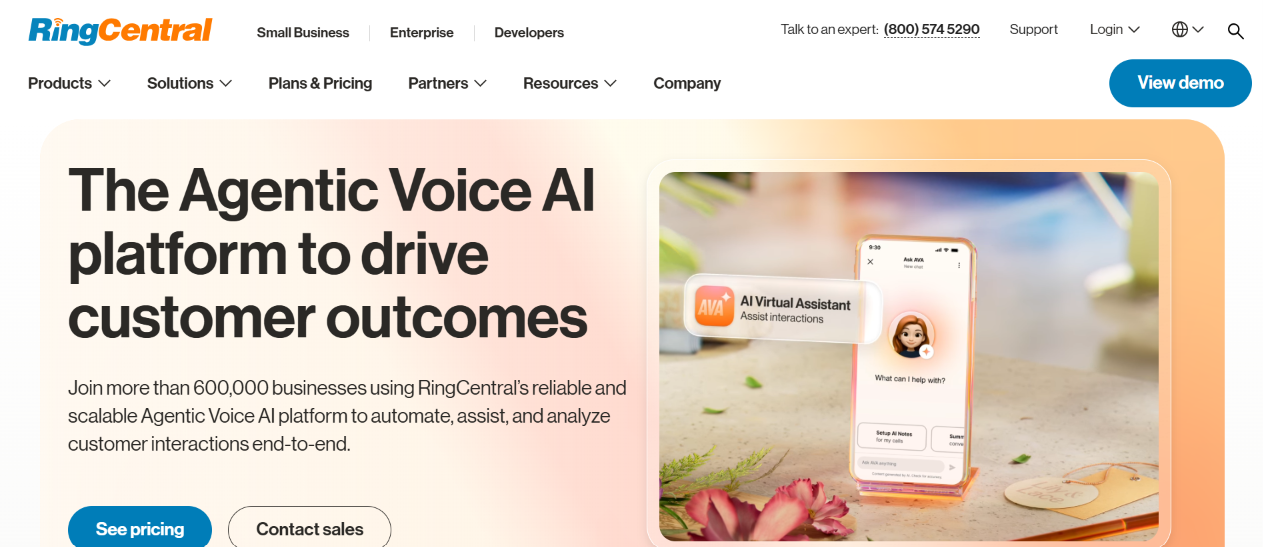
RingCX is RingCentral’s AI-powered contact center product, and it bundles predictive dialing with omnichannel routing, automation, and agent management. It delivers the most value to larger CX teams rather than to groups who only want a lightweight sales dialer.
G2 reviewers rate RingCentral’s contact center about 4.1 out of 5, and they appreciate its broad feature set and reliability.
Features
- Preview, progressive, and predictive modes, plus click-to-dial and voice broadcast.
- Multi-line, ratio-based pacing.
- RingSense AI for call summaries and insights.
- Local presence and live call monitoring.
- Omnichannel routing and workflow automation.
Pros
- Dialer modes included from the Standard plan
- Combines communications and contact center in one ecosystem
- Good fit for larger CX operations
Cons
- Can feel heavy and costly for standalone dialing
- Admin side takes longer to learn
Pricing
Published tiers are Standard at $75, Professional at $110, and Elite at $165 per user per month, with custom Enterprise Contact Center pricing. Another 2026 guide lists a starting price near $65 per user, so confirm the current rate card. It is unclear whether a free trial covers RingCX.
Best for: Mid-size and large teams that already use RingCentral for communications.
11. MightyCall

MightyCall delivers a simple cloud phone system and call center toolkit that grows into predictive dialing. Predictive mode lives on the Enterprise tier, while lower plans cover standard business calling and auto-dialer workflows.
As a result, small teams can start with lighter outbound motions and graduate to multi-line dialing later. MightyCall holds a G2 rating of roughly 4.4 to 4.5 out of 5.
Features
- Predictive mode with up to 10 lines per agent and manual pace control.
- Preview, progressive, and click-to-dial options.
- AI answering machine detection and voicemail drop.
- Local presence, call summaries, and live monitoring.
- Free white-glove setup for new accounts.
Pros
- Low entry price for SMB teams
- Easy setup and clear upgrade path
- Manual pace control keeps small teams safe
Cons
- Better for small teams than large-scale operations
- Reviewers mention occasional mobile app lag and CRM limits
Pricing
Plans cost $20 (Core), $38 (Pro), $54 (Power), and $65 (Enterprise) per agent per month. Because predictive mode requires the Enterprise tier, budget at least $65 per agent. A 7-day free trial is available.
Best for: Small and mid-sized outbound teams that value simplicity and low cost.
12. VoiceSpin
VoiceSpin offers an AI-powered omnichannel contact center that spans voice, SMS, email, chat, and social channels. Its predictive dialer matches leads to the agents most likely to convert, and it targets sales teams with large call volumes.
In practice, VoiceSpin needs at least three agents to operate effectively, so it is not a fit for solo users.
Features
- AI lead-agent matching that scores leads and pairs them with suitable agents.
- Local caller ID with numbers in 160+ countries.
- Voicemail automation for unanswered calls.
- AI speech analytics with keyword spotting and real-time alerts.
- 50+ CRM integrations, including Salesforce and HubSpot.
Pros
- Intelligent lead-to-agent matching
- Wide international number coverage
- Straightforward flat monthly plans
Cons
- Predictive pacing can still cause abandoned calls or pauses
- Some reviewers report customization limits
Pricing
Reported plans start at $300 per month for Basic, which excludes the AI auto dialer; Advanced costs $525 per month and adds the AI auto dialer, local caller ID, and call queues; and Enterprise costs $1,000 per month with AI Voice Bot and workflow automation. Confirm seat limits and per-minute charges with the vendor.
Best for: High-velocity sales teams that want AI matching and international reach.
13. VICIdial
VICIdial is open-source dialer software released under the AGPLv2 license, and many long-running call centers still depend on it. It gives you adaptive predictive pacing, recording, list management, and blended inbound and outbound dialing without a software license fee.
However, you take on the servers, carrier contracts, upgrades, and security yourself. Therefore, the real cost depends on the engineer who runs it.
Features
- Adaptive predictive dialing that steers pacing toward a target drop rate.
- Safe-harbor message playback for abandoned calls.
- Inbound ACD, outbound, and blended campaigns.
- Detailed reporting and an active support community.
- Full code access so you can customize behavior.
Pros
- No license fee and no seat minimums
- Deep control over dialing and infrastructure
- Excellent reporting and scalability
Cons
- The interface looks dated
- A misconfigured server creates compliance risk that no vendor shares
Pricing
The software costs nothing, but hosting, SIP carrier minutes, and administration do. Managed-hosting providers advertise roughly $35 to $60 per seat per month, and one comparison warns that all-in maintenance can climb much higher. There is no free trial because the software is free to install.
Best for: Teams with an in-house engineer, tight software budgets, and a need for maximum flexibility.