

Agriculture technology companies face a unique compliance challenge, and finding the best SOC 2 firms for agriculture tech companies has become essential for any founder who wants to win contracts with cooperatives, equipment manufacturers, and food-supply-chain partners. As precision farming platforms, connected irrigation systems, and farm management software collect increasingly sensitive data, from grower financials to proprietary crop genetics, buyers no longer take security claims at face value. Instead, they demand proof, and a SOC 2 report delivers exactly that.
Consequently, choosing the right compliance partner matters just as much as pursuing the certification itself. Some firms specialize in fast, automated evidence collection for lean engineering teams, while others bundle the audit directly into the platform so founders avoid managing two separate vendor relationships. Meanwhile, AgTech companies bring their own set of complications to the table: seasonal workforces that expand sharply at planting and harvest, IoT sensor fleets spread across remote fields, and grower data that often crosses international borders, triggering privacy obligations well beyond SOC 2 alone.
This guide breaks down the top twelve options on the market today, comparing each firm’s overview, key features, pros, cons, and pricing side by side. Whether your company needs a budget-friendly platform for a first SOC 2 report or an enterprise-grade solution that scales across multiple business units, the right fit ultimately depends on your infrastructure, your growth stage, and how quickly you need to close your next enterprise deal.
Top 12 Best SOC 2 Firms for Agriculture Tech Companies

Vanta leads the compliance automation market by share, and that scale shows up clearly for AgTech buyers who need broad integration coverage across AWS, GCP, Azure, and the device-management consoles many precision agriculture companies use to monitor soil sensors, irrigation controllers, and yield-mapping hardware. The platform continuously checks security controls, automatically pulls evidence from connected systems, and uses an AI Agent to draft policies and answer auditor questions, which shortens the runway between kickoff and a clean report.
Because large agribusiness conglomerates frequently run their own vendor security reviews before approving a new AgTech supplier, Vanta’s brand recognition often works in a founder’s favor: procurement teams already know the platform and trust the rigor behind a Vanta-backed report.
Features
- 200+ native integrations spanning cloud, identity, HR, and device management tools
- AI Agent for policy generation, evidence checks, and auditor question answering
- Public-facing Trust Center for sharing live compliance status with ag buyers
- Continuous control monitoring across SOC 2, ISO 27001, HIPAA, GDPR, and PCI DSS
- Vendor risk management and AI-powered security questionnaire automation
Pros
- Broadest integration library and largest network of partner audit firms in the category
- Fast implementation thanks to prebuilt policy templates and automated evidence pulls
- Strong brand recognition that reassures enterprise agribusiness buyers during diligence
- AI Agent meaningfully reduces manual screenshot-and-spreadsheet evidence work
Cons
- Premium pricing that climbs quickly as headcount and frameworks grow
- Advanced modules such as Vendor Risk Management Pro and extra AI questionnaire volume cost extra
Pricing
Vanta does not publish list prices. The entry-level Core tier typically starts around $10,000 to $12,000 per year
2. Drata
Drata appeals strongly to engineering-heavy AgTech teams that manage IoT device fleets, edge computing on farm equipment, and proprietary telemetry pipelines, since the platform was built with API-driven evidence collection and infrastructure-as-code workflows in mind. Its Custom Tests builder lets technical teams write evidence checks that reflect the actual architecture behind a connected-equipment platform rather than forcing data into a generic template.
Drata also stands out for unlimited, flat-rate user pricing, a detail that matters more in agriculture technology than almost any other vertical given how sharply headcount can swing between planting season hiring and the off-season.
Features
- 300+ native integrations with unlimited users and no per-seat pricing
- Custom Tests builder for writing evidence checks against proprietary systems
- Audit Hub, a shared workspace where auditors review evidence inside the platform
- Support for 30+ frameworks, including ISO 27001, ISO 42001, CMMC, NIS2, and DORA
- Access to a network of 29 vetted independent audit firms
Pros
- Flat, unlimited-user pricing protects budgets through seasonal workforce swings
- Deepest independent auditor network of any platform in this list
- Strong API flexibility supports custom evidence from proprietary farm equipment systems
- Polished Audit Hub experience that auditors consistently rate highly
Cons
- Steeper learning curve than guided competitors, so it suits teams with technical depth
- Configuration work may require dedicated internal time during initial setup
Pricing
Drata’s Foundation tier generally starts around $7,500 per year.
3. Sprinto
Sprinto has built a strong following among budget-conscious and internationally distributed AgTech startups, which fits naturally with how many precision farming and agricultural marketplace companies operate today, serving growers across multiple countries and therefore juggling SOC 2 alongside GDPR for European customer and grower data. The platform pairs automation with hands-on, white-glove support, reusing controls across frameworks so that a company adding ISO 27001 or HIPAA later does not start from zero.
For early-stage AgTech founders without an internal security hire, Sprinto’s dedicated compliance manager support often substitutes for the headcount they don’t yet have.
Features
- Support for SOC 2, ISO 27001, GDPR, HIPAA, NIST, and PCI DSS from one dashboard
- Control reuse across frameworks to reduce duplicated audit prep work
- Dedicated compliance manager support included for guided onboarding
- Auditor-friendly, pre-built compliance programs designed around real audit workflows
Pros
- Among the most affordable entry points in the major-platform tier
- Strong guided support suits teams without dedicated internal security expertise
- Particularly well suited to globally distributed AgTech operations
- Generally fast time to audit readiness, per user-reported timelines
Cons
- Less flexibility for customizing unique or non-standard workflows
- Some user reviews cite interface stability issues and pricing-structure frustration
Pricing
Sprinto uses custom quoting, but it consistently lands as the most affordable of the major platform.
4. Secureframe
Secureframe targets the common reality at many early-stage AgTech companies: there is no dedicated security team, and a single operations or engineering leader is expected to own compliance alongside everything else. The platform leans into guided setup, templated policies, and bundled advisory support, which gives that lone owner someone to call when a control or evidence requirement is unclear.
Secureframe also supports the multi-framework combinations common in AgTech, such as pairing SOC 2 with HIPAA when a platform touches farmworker health benefits data, or with ISO 27001 when selling into European cooperatives.
Features
- 100+ integrations with automated evidence collection and continuous monitoring
- Support for SOC 2, ISO 27001, PCI DSS, HIPAA, GDPR, CCPA, and NIST
- Built-in advisory support and auditor introductions
- AI-assisted workflows that streamline evidence review and remediation
Pros
- Easiest onboarding experience among the major platforms for non-technical teams
- Included advisory support reduces the need to hire an outside consultant
- Well suited to companies managing two or more frameworks simultaneously
- Consistently praised for responsive customer support
Cons
- Bundled advisory may overlap with services a company already pays a consultant for
- Pricing is not published, which complicates early budgeting
Pricing
Secureframe pricing typically starts around $7,500 per year.
5. Thoropass
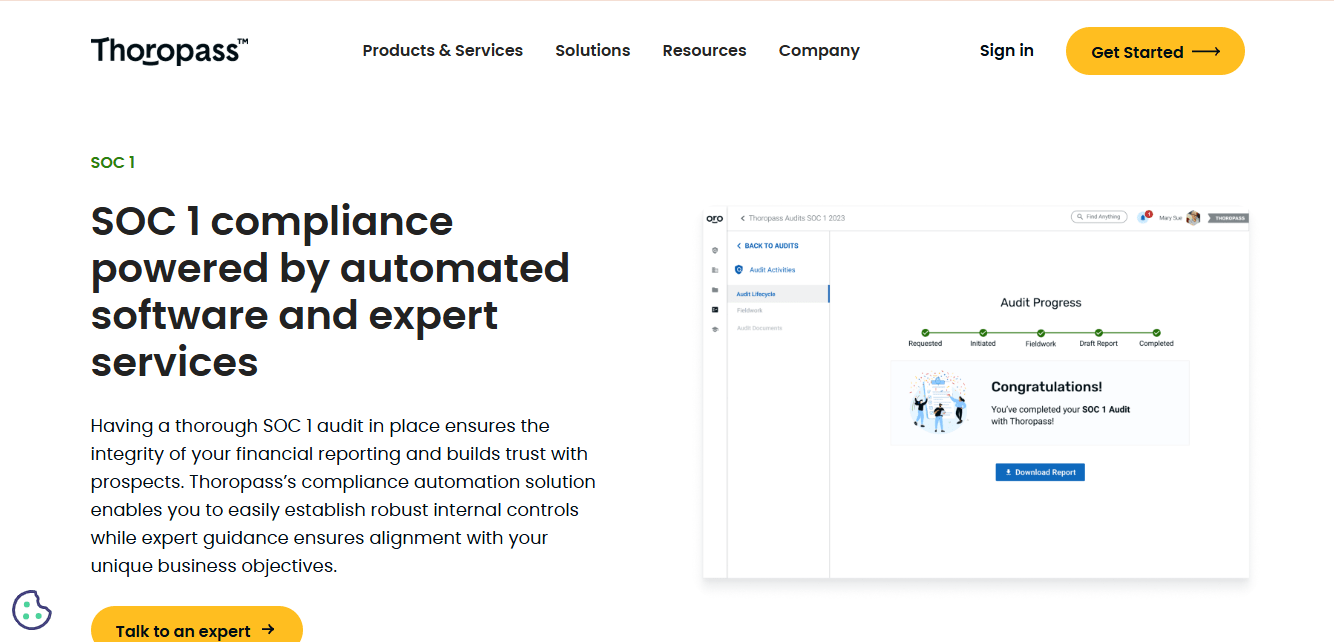
Thoropass, formerly known as Laika, takes a different approach by bundling its compliance platform with an in-house CPA audit practice, Thoropass Assurance, under a single contract. For an AgTech team racing to close an enterprise deal before harvest season, that single-vendor model removes an entire workstream: there is no need to separately source, vet, and contract with an independent CPA firm, because the audit team is already built into the relationship.
Thoropass supports 19 or more frameworks and applies AI automation to evidence collection, while giving customers direct access to its own auditors throughout the process rather than handing them off to a third party.
Features
- In-house CPA audit practice bundled with the compliance automation platform
- Support for 19+ frameworks including SOC 2, ISO 27001, HIPAA, and PCI DSS
- AI-assisted evidence collection and verification
- Single contract and single project team covering both software and attestation
Pros
- One vendor relationship for both compliance software and the formal audit
- Removes the time cost of separately vetting and onboarding an auditor
- Particularly useful for lean teams during a seasonal product launch crunch
- Transparent, bundled pricing that simplifies budgeting compared with two separate invoices
Cons
- Locked into a single audit provider, which limits price negotiation and auditor choice
- Fewer customization options for unusual or highly bespoke workflows
Pricing
The Thoropass platform alone generally starts between $5,800 and $8,700 per year.
6. Scytale
Scytale stands out for sheer framework breadth, supporting more than 60 compliance templates, which suits AgTech companies that expect their certification roadmap to expand well beyond a single SOC 2 report. A precision agriculture company might start with SOC 2 to win its first enterprise deal, add ISO 27001 to serve European cooperatives, layer in GDPR for grower data, and eventually pursue additional standards as it sells into government-adjacent agricultural programs.
Scytale pairs that framework breadth with hands-on customer success support and audit-ready dashboards that give a lean compliance team visibility into open gaps at any point in the process.
Features
- 60+ supported framework templates for long-term, multi-standard roadmaps
- Automated evidence collection with audit-ready dashboards
- Optional CISO-as-a-service add-on for teams without in-house security leadership
- Dedicated customer success support throughout the compliance journey
Pros
- Framework breadth ideal for companies planning several certifications over time
- Hands-on support helps smaller AgTech teams move efficiently toward audit readiness
- Generally positioned at competitive mid-market pricing
Cons
- Smaller integration ecosystem than the top three platforms in this category
- Less customization flexibility for unusual technical architectures
Pricing
Scytale uses custom quoting and is generally positioned in the mid-market range.
7. Hyperproof
Hyperproof functions as a broader governance, risk, and compliance (GRC) platform rather than a pure SOC 2 speedrun tool, which makes it a strong fit for larger or multi-entity agribusiness organizations. A holding company that owns an irrigation technology brand, a farm data analytics subsidiary, and an agricultural marketplace, for example, can manage risk registers and multiple overlapping frameworks for every business unit inside one consolidated workspace rather than juggling separate point tools.
The platform’s reporting and dashboard capabilities are built with leadership and board audiences in mind, which matters as an AgTech company matures from a single-product startup into a multi-brand enterprise.
Features
- Centralized risk register with controls mapping across multiple frameworks
- Workflow automation tied to evidence collection and remediation tracking
- Integrations with cloud infrastructure, HR systems, and ticketing tools
- Audit management module with leadership- and board-ready reporting
Pros
- Strong fit for multi-entity agribusiness groups managing several frameworks at once
- Reporting depth supports board and investor conversations about risk posture
- Scales well as an AgTech company grows from startup into enterprise GRC needs
Cons
- Can be overkill, both in cost and complexity, for a single-product early-stage startup
- Initial setup and configuration take longer than point-solution competitors
Pricing
Hyperproof uses enterprise custom pricing and is generally positioned above entry-tier SOC 2 specialists. AgTech buyers typically see quotes in the $20,000 to $50,000-plus range annually.
8. Strike Graph
Strike Graph organizes its entire platform around a risk-first methodology, tying every security control back to a specific business risk rather than treating compliance as a checkbox exercise. That framing resonates with AgTech companies handling sensitive data such as field-level yield numbers, grower financial records, or proprietary crop genetics, where enterprise buyers increasingly want to see an explicit risk rationale behind each control rather than a generic policy template.
The platform also doubles as a sales enablement tool: the same risk register that supports the audit can be repurposed to answer enterprise security questionnaires faster when a large agribusiness buyer requests one mid-deal.
Features
- Risk-based control framework that links each control to a documented business risk
- Automated evidence collection paired with customizable control sets
- Security questionnaire automation that reuses existing risk and control data
- Audit liaison support throughout the certification process
Pros
- Risk register doubles as a sales enablement asset for enterprise security reviews
- Flexible control customization for non-standard AgTech architectures
- Responsive, hands-on customer support reported by users
Cons
- Less brand recognition, which can matter during enterprise vendor diligence
- Multi-framework support is comparatively newer and less mature
Pricing
Strike Graph offers custom pricing generally competitive with Sprinto and Scytale, with typical AgTech engagements falling between $10,000 and $30,000 per year depending on scope and the number of frameworks pursued.
9. AuditBoard
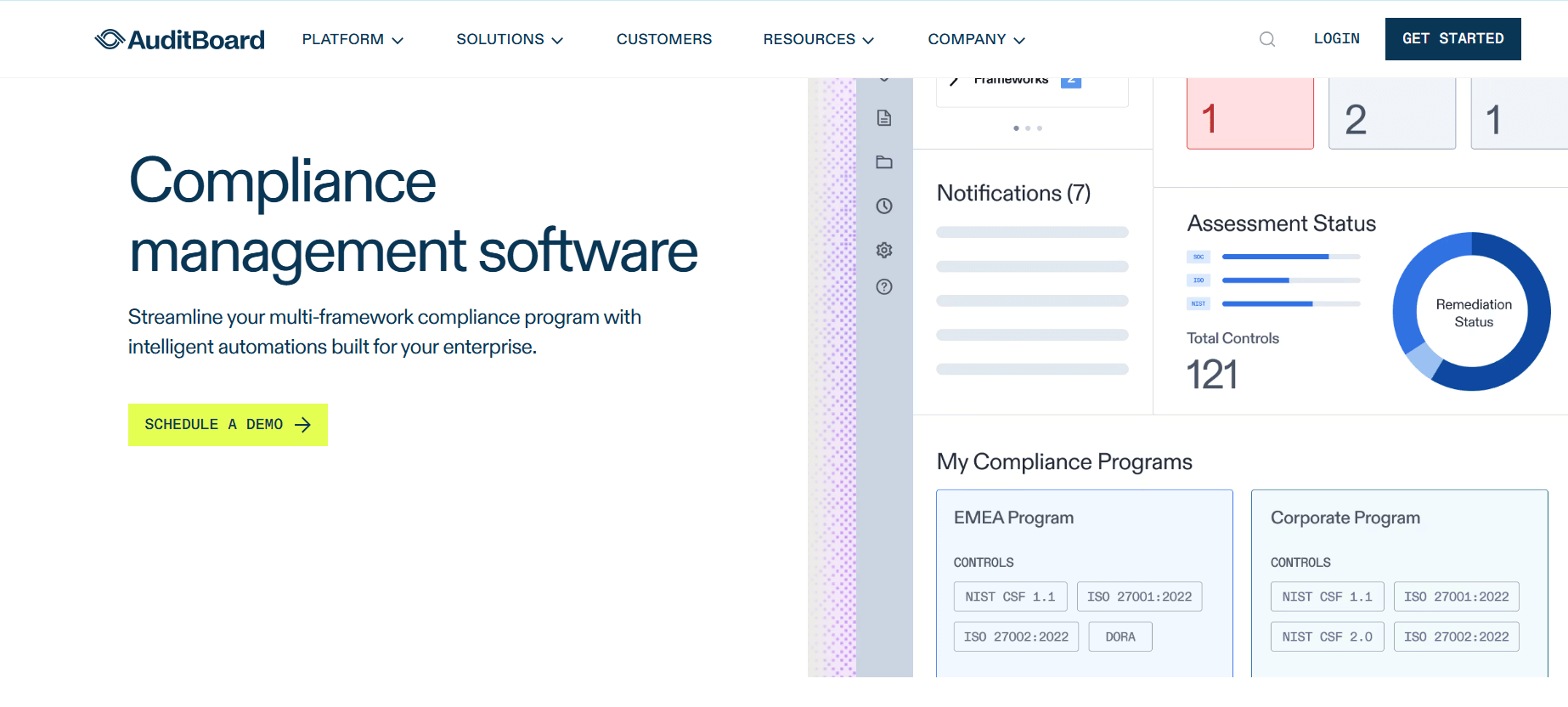
AuditBoard serves the enterprise end of this list, built for large agribusiness companies that already run internal audit, SOX compliance, and enterprise risk management (ERM) programs and want to fold SOC 2 readiness into the same connected risk platform rather than bolt on a separate point solution. This fits AgTech companies that have scaled into public or soon-to-be-public agribusiness enterprises managing equipment manufacturing, supply chain logistics, and farm data simultaneously.
Because AuditBoard’s CrossComply and CrossCheck modules connect compliance work to broader enterprise risk and internal audit functions, it suits organizations where SOC 2 is one compliance regime among several rather than the only one.
Features
- CrossComply and CrossCheck modules connecting SOC 2 to broader enterprise risk programs
- Internal audit and SOX compliance management built into the same platform
- Workflow automation across risk, audit, and compliance teams
- Board-level and executive reporting capabilities
Pros
- Best fit for large or soon-to-be-public agribusiness enterprises with mature risk functions
- Strong reporting suited to board and investor-facing risk conversations
- Scales effectively across large, distributed farm-equipment or supply-chain organizations
Cons
- Significant cost and implementation overhead relative to point-solution platforms
- Generally overkill for early-stage or single-product AgTech startups
Pricing
AuditBoard uses enterprise custom pricing.
10. OneTrust
OneTrust absorbed Tugboat Logic’s SOC 2 automation capabilities into its much broader trust and privacy management platform, making it a natural fit for AgTech companies where privacy compliance matters just as much as SOC 2. Plenty of agricultural technology platforms collect grower personal data, farmworker information, or consumer-facing app data subject to GDPR and CCPA, and OneTrust handles consent management and data mapping alongside SOC 2 and ISO 27001 automation in one consolidated suite.
For AgTech companies expanding into the European Union or operating consumer-facing apps tied to retail produce brands, that combined privacy-and-security scope can replace what would otherwise be two separate vendor relationships.
Features
- Combined privacy management, consent management, and SOC 2/ISO 27001 automation
- Data mapping tools that integrate directly with trust and security assessments
- Vendor risk management across both security and privacy dimensions
- Broad framework support spanning security, privacy, and data governance regimes
Pros
- Best choice when GDPR or CCPA compliance matters as much as SOC 2 itself
- Comprehensive data governance suite beyond what point-solution SOC 2 tools offer
- Strong fit for AgTech companies operating across the United States and European Union
Cons
- Steeper learning curve given the breadth of the overall platform
- Can be considerably more than a single-product, early-stage AgTech startup needs
Pricing
OneTrust uses enterprise custom pricing positioned at the high end of this category, generally alongside AuditBoard. Quotes commonly start in the tens of thousands of dollars annually and scale upward based on the number of modules and frameworks an AgTech company activates.
11. Scrut Automation
Scrut Automation has gained meaningful traction among fast-growing, cost-conscious AgTech startups, particularly those operating across international supply chains that span multiple continents. The platform pairs continuous control monitoring with built-in cloud security posture management (CSPM), which helps an AgTech company that runs sensor data pipelines on cloud infrastructure avoid purchasing a separate cloud security tool altogether.
Scrut also assigns each customer a dedicated compliance manager, a detail that consistently shows up in user reviews as a reason teams reach audit readiness faster than they expected.
Features
- Continuous control monitoring paired with built-in CSPM for cloud infrastructure
- Multi-framework mapping across SOC 2, ISO 27001, and related standards
- Dedicated compliance manager assigned to every customer account
- Strong G2 user ratings for support responsiveness and time-to-audit-ready outcomes
Pros
- Fast reported time to audit readiness, often under three months
- Built-in CSPM reduces the need for a separate cloud security monitoring tool
- Competitive pricing relative to Vanta, Drata, and Secureframe
Cons
- Smaller integration footprint than the category’s top two platforms
- Fewer advanced customization options for complex, multi-entity organizational structures
Pricing
Scrut Automation typically starts around $15,000 per year.
12. A-LIGN
A-LIGN differs from every other entry on this list in one critical respect: it is a licensed CPA firm and accredited ISO certification body that performs the actual SOC 2 examination, rather than a software platform that prepares evidence for someone else to audit. Every compliance automation tool covered above still requires an independent auditor to issue the final report, and A-LIGN works directly with AgTech companies to fill that role, including those layering SOC 2 with ISO 27001 or pursuing FedRAMP-adjacent requirements to sell into USDA-backed or government-affiliated agricultural programs.
A-LIGN also offers its own evidence management platform, A-SCEND, so a company can manage readiness and the audit engagement through a single provider if it prefers not to run a separate compliance automation subscription alongside the audit.
Features
- Licensed CPA firm and accredited ISO 27001 certification body
- A-SCEND platform for managing evidence alongside the live audit engagement
- Support for SOC 1, SOC 2, ISO 27001, FedRAMP, and HITRUST examinations
- Industry-aligned audit teams with experience across regulated and government-adjacent sectors
Pros
- Removes the need to separately source a CPA firm once readiness work is complete
- Deep multi-framework audit experience, including government-adjacent standards relevant to USDA-funded agricultural programs
- Single point of accountability for the formal attestation itself
Cons
- Pricing reflects traditional audit-firm fees rather than lightweight SaaS subscription pricing
- Generally represents a bigger upfront commitment than a startup might need on day one
Pricing
A-LIGN prices audit engagements individually based on scope, with typical SOC 2 Type I or Type II engagements running roughly $15,000 to $60,000 or more depending on company size and the number of frameworks examined.