
If you run a telehealth platform, you already know the stakes. Patient data is sensitive, regulators are watching, and enterprise clients won’t sign a contract without seeing your SOC 2 report. The challenge? Choosing the right compliance partner from a crowded market full of platforms that all sound the same. We cut through the noise. We’ve researched and compared the top 12 SOC 2 providers for telehealth platforms, looking at real pricing, healthcare-specific features, honest pros and cons, and which one is actually the best fit for your stage and budget.
Whether you’re a startup launching your first telehealth app or a growth-stage company managing thousands of patient sessions, there’s a provider on this list for you.
Why SOC 2 Matters Specifically for Telehealth
Before we get into the list, it is important to understand why telehealth platforms face stricter compliance requirements than most SaaS companies.
Telehealth platforms handle Protected Health Information (PHI) under HIPAA. Many also process payment data under PCI DSS. On top of that, enterprise healthcare clients often require independent security verification before signing contracts.
That is why many healthcare organizations ask for SOC 2 Type 2 reports. Unlike SOC 2 Type 1, which reviews controls at a single point in time, SOC 2 Type 2 proves your controls worked consistently over a 6–12 month period.
The business benefits also go beyond compliance. A SOC 2 report can help your company close enterprise healthcare deals faster. It can also help you pass vendor security reviews from hospitals and large health systems. Most importantly, it lowers the risk of a costly data breach that could damage your reputation and lead to major fines.
The best SOC 2 providers for telehealth platforms do more than provide a readiness checklist. They understand how SOC 2 overlaps with HIPAA requirements. They also automate evidence collection and simplify the audit process. This helps your engineering team avoid spending months preparing for compliance.
.The Top 12 SOC 2 Providers for Telehealth Platforms
1. Vanta

Vanta is the most widely adopted SOC 2 compliance platform on the market, and for good reason. It automates evidence collection by pulling data directly from your cloud infrastructure, identity providers, HR tools, and code repositories. For telehealth teams, this means fewer hours pulling audit screenshots and more time shipping features.
Vanta covers SOC 2 Type 1 and Type 2, HIPAA, ISO 27001, PCI DSS, GDPR, and more making it a natural fit for telehealth platforms that need to layer compliance frameworks as they grow.
Features
- 300+ integrations (AWS, GCP, Azure, Okta, Google Workspace, GitHub, Slack, and more)
- Continuous control monitoring with real-time alerts
- Built-in HIPAA compliance module, critical for telehealth
- Auditor collaboration portal to streamline the final audit
- Trust Center to share your compliance posture with prospects and clients
- Policy management with pre-built templates
Pricing
- Starts at approximately $10,000/year for the Core plan.
- Mid-market deals typically land between $15,000–$40,000/year.
- Custom enterprise pricing available.
Pros
- Largest integration library in the market
- Strong HIPAA module — directly relevant to telehealth
- Excellent onboarding speed; many teams are operational within days
- Large auditor network means you can find a qualified CPA firm quickly
- Scales from startup to enterprise without switching platforms
Cons
- Pricing jumps significantly with headcount growth (seat-based model)
Overall Verdict: Vanta is the safest choice for telehealth platforms that want a platform they won’t outgrow. If you’re closing deals with health systems and need a recognizable compliance brand behind your SOC 2 report, Vanta is hard to beat.
2. Drata
Drata built its reputation on doing more than just handing you a dashboard. Customers consistently praise Drata for strong customer success support, a clean auditor collaboration workspace, and deep automation that genuinely reduces manual effort. For telehealth founders going through their first SOC 2 audit, this level of guidance can be the difference between a smooth experience and months of frustration.
Drata covers SOC 2, HIPAA, ISO 27001, PCI DSS, GDPR, and over 20 other frameworks. Its evidence collection automation is among the best in the market.
Features
- 100+ deep integrations with continuous, automated evidence collection
- Dedicated compliance success manager (on mid and upper-tier plans)
- Auditor workspaces described by auditors as the cleanest experience in the market
- Multi-framework support with cross-mapped controls (do SOC 2 and HIPAA simultaneously)
- Risk management workflows built in
- Employee security training integrations
Pricing
- Starts at approximately $7,500/year (Foundation plan, under 25 employees).
- Growth-stage plans typically run $15,000–$50,000/year.
- Enterprise can exceed $100,000/year.
- Pricing is negotiable, especially with competing quotes from Vanta or Secureframe.
Pros
- Best-in-class auditor collaboration experience
- Personalized support is stronger than most competitors at the same price point
- Flexible pricing — Foundation plan makes it accessible for smaller telehealth startups
- HIPAA framework included, not an expensive add-on
- Transparent-ish pricing compared to many competitors
Cons
- Can feel expensive as headcount grows
- Some users report the UI has a learning curve at first
- Best features require upper-tier plans
Overall Verdict: Drata is the top pick for telehealth teams that want a true compliance partner not just software. If your team is doing SOC 2 for the first time, Drata’s support model will save you significant time and stress.
3. Sprinto
Sprinto is the strongest sub-$10K option for small teams, and it’s particularly popular with startups in regulated industries, including healthcare and telehealth. With over 200 integrations and a guided workflow that walks you through each step of the SOC 2 process, Sprinto punches well above its price point. It’s not as deep as Vanta or Drata on enterprise features, but for a telehealth startup chasing its first SOC 2 Type 1 or Type 2, Sprinto gets you there efficiently.
Features
- 200+ integrations covering most standard telehealth tech stacks
- Guided, step-by-step compliance workflows
- Role-based task assignment so non-technical team members can contribute
- Multi-framework support (SOC 2, HIPAA, ISO 27001, GDPR)
- Policy library with pre-built templates
- Risk management dashboard
Pricing: Startup plans start under $7,500/year for companies under 25 employees. Growth-stage pricing typically runs $10,000–$25,000/year. Custom pricing for larger organizations. Sprinto is known for startup discounts and flexible negotiation.
Pros
- Best value for small telehealth startups
- Guided workflows are genuinely helpful for first-timers
- HIPAA support included
- Doesn’t use per-seat pricing — costs don’t spike as you hire
- Fast time to audit readiness
Cons
- Less integration depth than Vanta or Drata at the enterprise level
- Auditor collaboration workspace less polished than Drata
- Better suited for simpler compliance environments
Overall Verdict: If your telehealth startup needs SOC 2 to close your first enterprise deal and budget is a real constraint, Sprinto is the smart choice. You can always migrate to a more enterprise-grade platform later.
4. Secureframe
Secureframe sits in an interesting middle ground between a self-serve platform and a fully managed service. Its guided workflows and strong customer success team make it feel like having a compliance manager on call. It’s particularly strong on onboarding speed and is well-suited for telehealth companies that don’t have a dedicated security team in-house.
Features:
- Large integration library with automated evidence collection
- Guided implementation with strong customer success support
- Built-in security awareness training
- Supports SOC 2, HIPAA, PCI DSS, ISO 27001, GDPR, and more
- Vulnerability management integrations
- Automated employee onboarding/offboarding compliance checks
Pricing
- Typically starts at $7,500–$10,000/year for smaller teams.
- Scales to $20,000–$80,000+/year for larger organizations.
- Custom pricing — contact sales for a quote. Often competitive with Vanta and Drata on entry-level pricing.
Pros
- Guided, managed feel reduces burden on small engineering teams
- Strong HIPAA support for telehealth use cases
- Good auditor relationships and structured audit prep
- Well-organized evidence library
Cons
- Software and audit fees are separate (not bundled)
- Costs scale quickly for larger organizations
- Less self-serve flexibility for technically advanced teams
Overall Verdict: Secureframe is a great fit for telehealth companies that want their compliance process managed rather than self-directed. If your team lacks a dedicated compliance resource, Secureframe fills that gap effectively.
5. Thoropass
Thoropass is unique in the market: it’s both a licensed CPA firm and a compliance software platform. This means you can get your SOC 2 audit and the software to prepare for it from a single vendor, fewer contracts, fewer handoffs, and often faster timelines. For telehealth platforms that are time-constrained, this bundled model is a serious advantage.
Thoropass supports SOC 2, ISO 27001, HIPAA, HITRUST, GDPR, PCI DSS, CMMC, and over 30 other frameworks.
Features
- Combined compliance platform + in-house licensed audit services
- Connected audit model — auditors work inside the platform
- First Pass AI for intelligent evidence review and remediation guidance
- Supports 30+ frameworks including HIPAA and HITRUST (critical for healthcare)
- Penetration testing, risk assessments, and access reviews in one platform
- Questionnaire automation for vendor assessments
Pricing
- Starts at approximately $5,800–$8,700/year for the platform.
- Bundled audit packages typically bring the median annual deal to around $30,000–$35,000 (platform + audit combined).
- Additional frameworks increase cost. Compared to using separate software and an audit firm, Thoropass often saves 25–50%.
Pros
- One vendor for everything, massive coordination savings
- HIPAA and HITRUST support in the same platform (huge for telehealth)
- Faster time-to-audit when software and auditors work together
- Strong advisory and expert guidance model
- CREST-accredited and licensed CPA firm
Cons
- Can create dependencies on a single vendor
- Less flexible for teams with customized infrastructure
- Slower at scale compared to pure-automation platforms
- Higher upfront cost than platform-only options
Overall Verdict: Thoropass is the best choice for telehealth companies that want to simplify their compliance stack to a single relationship. If managing multiple vendors is a headache for your team, this bundled model solves it.
6. Scytale
Scytale combines solid compliance automation with a heavy emphasis on hands-on expert support. Users consistently describe the experience as having a compliance manager in their corner, not just a platform to figure out on their own. This makes Scytale particularly valuable for telehealth companies whose founders are running compliance alongside everything else.
Features
- End-to-end SOC 2 compliance automation
- Expert compliance managers assigned to each customer
- Trust Center module for sharing compliance posture with prospects
- AI agent for questionnaire automation and remediation guidance
- Policy management with employee sign-off tracking
- Supports SOC 2, ISO 27001, HIPAA, GDPR, PCI DSS, and others
Pricing: Scytale does not publish fixed list pricing. Contact sales for a quote. Generally competitive with Drata and Secureframe at the mid-market level.
Pros
- Expert-led model is ideal for teams without internal compliance knowledge
- Strong first-time audit support
- AI-powered questionnaire automation saves hours on vendor assessments
- Clean, intuitive user interface
Cons
- No transparent public pricing
- May be more expensive than self-serve alternatives for teams with strong internal capability
- Fewer public integrations listed than Vanta or Drata
Overall Verdict: If your telehealth startup’s CEO is also functioning as the CISO, Scytale’s expert-led model will feel like a relief. They take significant compliance burden off your plate.
7. Hyperproof
Hyperproof is an AI-powered GRC (governance, risk, and compliance) platform built for organizations that have moved beyond basic SOC 2 into a full compliance program. It supports 140+ frameworks including SOC 2, HIPAA, ISO 27001, NIST 800-53, HITRUST, and custom programs, making it a strong fit for large telehealth enterprises and health systems that need enterprise-grade compliance infrastructure.
Features
- 140+ supported frameworks including HIPAA and HITRUST
- AI-powered compliance workflows and risk management
- Advanced risk assessment and treatment tracking
- Proactive vulnerability and control monitoring
- Third-party risk management (important for telehealth vendor ecosystems)
- Robust reporting for executive and board-level stakeholders
Pricing: Custom pricing based on organization size and GRC requirements. Typically in the $50,000–$100,000+/year range for enterprise deployments. Contact Hyperproof for a tailored quote.
Pros
- Best framework breadth of any platform on this list
- Enterprise-grade risk management and reporting
- Strong for organizations managing vendor risk across a telehealth ecosystem
- AI capabilities improving rapidly
Cons
- Overkill and overpriced for smaller telehealth startups
- Integration with some third-party and custom applications can be challenging
- Requires a dedicated compliance team to get full value
- Limited customization in certain workflow areas
Overall Verdict: Hyperproof is designed for large telehealth enterprises and health systems with complex, multi-framework compliance requirements. If you’re a 500+ person organization, it’s worth a serious look.
8. Scrut Automation
Scrut Automation has built a strong reputation as an AI-powered compliance platform that handles multiple frameworks without redundant work. Its ability to automatically map evidence collected for SOC 2 to HIPAA and other frameworks simultaneously is a major time-saver for telehealth platforms that need to maintain multiple certifications.
Features
- 60+ frameworks supported with automated cross-framework evidence mapping
- Continuous compliance monitoring with a unified dashboard
- Risk management with treatment plans and remediation tracking
- Integrations with major cloud, identity, and DevOps tools
- Task assignment and accountability tracking across teams
- AI-powered insights and compliance recommendations
Pricing: Custom pricing based on organization size and requirements. Generally competitive with mid-market players like Drata and Secureframe. Contact sales for a specific quote.
Pros
- Excellent at eliminating redundant evidence collection across frameworks
- Strong for companies managing SOC 2 + HIPAA + ISO 27001 simultaneously
- Clean, consolidated dashboard for compliance status
- Good value at the mid-market level
Cons
- Pricing may be expensive relative to budget-focused startups
- Limited customization in certain areas
- Less brand recognition than Vanta or Drata (though that doesn’t affect the product quality)
Overall Verdict: Scrut is a smart pick for telehealth companies that are growing fast and need to manage several frameworks without doubling their compliance workload. The cross-framework mapping alone can save dozens of hours per audit cycle.
9. Censinet RiskOps
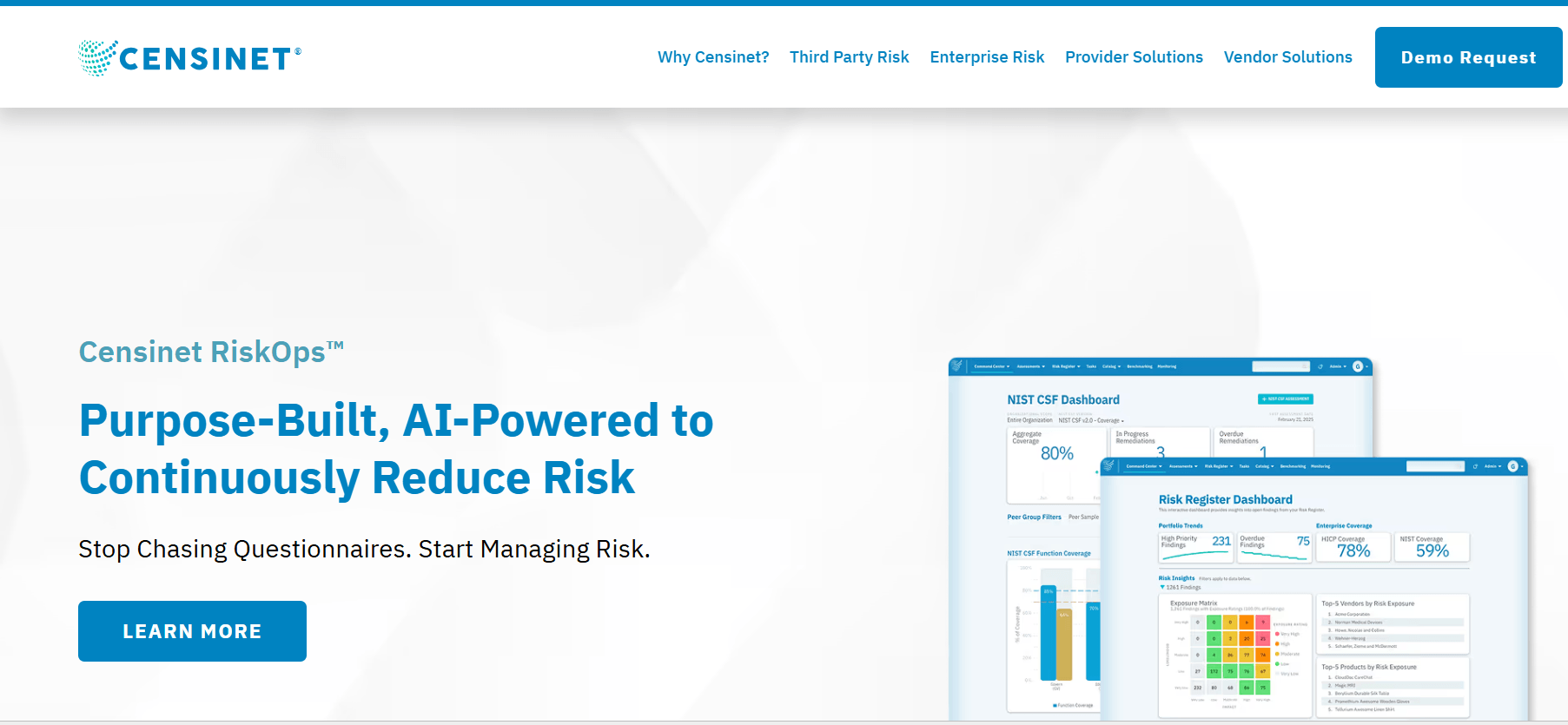
Censinet is built specifically for healthcare organizations not a generic compliance platform adapted for healthcare, but purpose-built for health systems, telehealth platforms, and digital health companies. Its RiskOps platform automates evidence collection and offers continuous monitoring, and it sits within a network of over 50,000 healthcare vendors and products.
Features
- Purpose-built for healthcare and telehealth compliance
- Automated SOC 2 evidence collection and monitoring
- Integrated third-party risk management for your vendor ecosystem
- HIPAA, SOC 2, and healthcare-specific framework support
- Continuous monitoring with alerts for control failures
Pricing: Custom pricing based on organization size and requirements. Contact Censinet for a quote. Generally positioned for mid-to-enterprise health systems.
Pros
- Healthcare-native platform — understands telehealth compliance needs deeply
- Vendor network eliminates significant third-party risk assessment work
- Strong for health systems evaluating telehealth vendors
- Deep HIPAA + SOC 2 integration
Cons
- Less relevant for very early-stage telehealth startups
- Pricing not publicly available
- Narrower focus than general-purpose GRC platforms
Overall Verdict: If your telehealth organization manages a large vendor ecosystem or you’re a health system evaluating telehealth vendors, Censinet’s healthcare-native approach and vendor network are genuinely differentiated.
10. MedTrainer
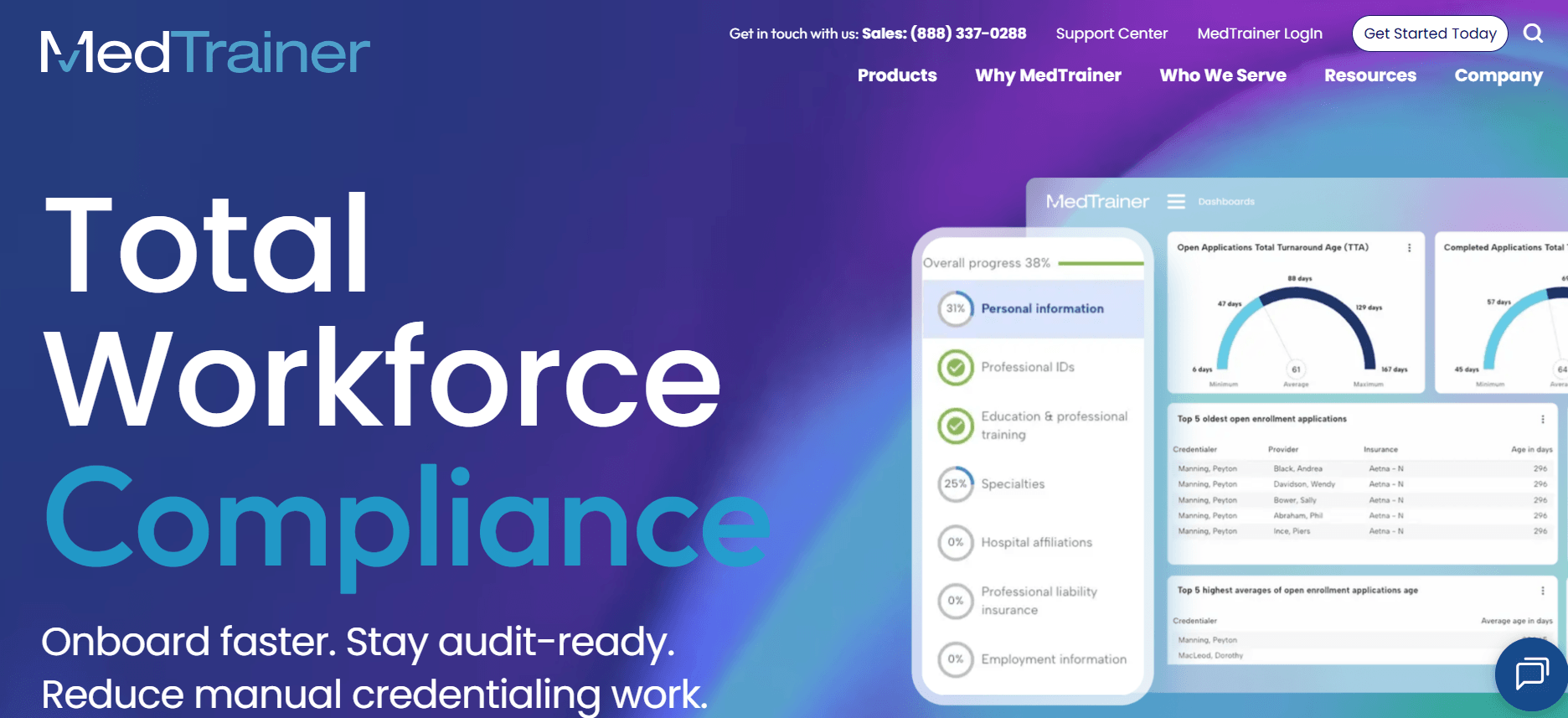
Rather than a pure SOC 2 automation play, it combines compliance management with credentialing, policy management, learning management, and incident tracking, making it a true all-in-one compliance platform for healthcare organizations.
Features
- SOC 2 Type 2 certified platform
- Credentialing and privileging management
- Policy management with automated distribution and attestation
- Incident reporting and management
- Supports 3,000+ healthcare providers across 15,000+ facilities
Pricing: Custom pricing based on organization size and modules required. Contact MedTrainer for a quote. Generally positioned for mid-to-enterprise healthcare organizations.
Pros
- All-in-one for healthcare-specific compliance needs
- Customers average 40 hours saved per week on compliance work
- Strong G2 ratings and recognition
- Purpose-built for healthcare workflows
Cons
- Better suited as a compliance management platform than a pure SOC 2 automation tool
- Primarily focused on healthcare organizations, not general SaaS telehealth startups
Overall Verdict: MedTrainer is the right choice if your telehealth organization needs a compliance platform that goes far beyond SOC 2 covering credentialing, training, and incident management in a single system.
11. OneTrust
OneTrust is a massive enterprise GRC platform known primarily for privacy management (GDPR, CCPA) but increasingly powerful for SOC 2 and security compliance. For large telehealth companies operating across multiple jurisdictions with complex privacy obligations alongside their SOC 2 program, OneTrust offers unmatched breadth.
Features
- Enterprise-grade privacy management (GDPR, CCPA, HIPAA) integrated with SOC 2
- Third-party risk management at scale
- Data mapping and discovery tools (valuable for HIPAA data governance)
- Incident response and breach notification workflows
- Vendor assessment automation
- Custom compliance program building for unique regulatory environments
Pricing: Enterprise pricing, typically $75,000–$200,000+/year. OneTrust is a serious investment and only makes sense for large organizations with dedicated compliance teams. Contact sales for a custom quote.
Pros
- Broadest privacy + security compliance coverage of any platform
- Cross-jurisdictional support for telehealth companies operating globally
- Data discovery tools help identify PHI across your environment
- Strong incident response capabilities
Cons
- Significant overkill for startups and growth-stage companies
- Very high price point
- Requires a dedicated compliance team to implement and maintain
- Complex to configure for smaller organizations
Overall Verdict: OneTrust is the right call for large, publicly-traded or enterprise telehealth companies that need an integrated privacy, security, and GRC platform. For everyone else, the price and complexity outweigh the benefits.
12. Anecdotes
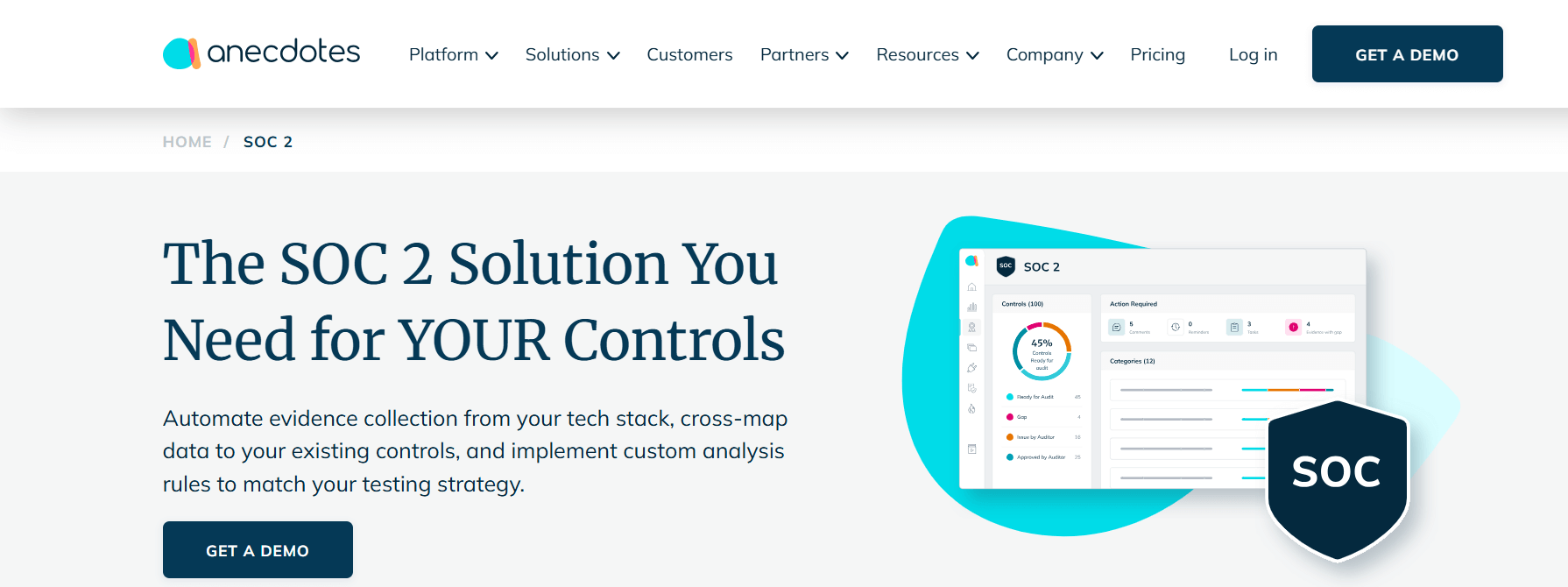
Anecdotes takes a different approach from most platforms on this list. Rather than starting with controls and frameworks, it starts with risk, helping organizations identify their most critical compliance gaps first and build their SOC 2 program around what actually matters. For telehealth platforms with mature security thinking, this risk-first model resonates deeply.
Features
- Risk-based compliance methodology (not just checklist-driven)
- Continuous monitoring and proactive risk management
- Evidence collection automation integrated with risk tracking
- SOC 2, ISO 27001, HIPAA, and other framework support
- Custom compliance programs beyond standard frameworks
- Executive-level risk reporting and dashboards
Pricing: Custom pricing tailored to organization size and compliance needs. Generally positioned at the mid-to-enterprise level. Contact Anecdotes for a quote.
Pros
- Risk-first approach produces more meaningful security outcomes
- Strong for organizations that want compliance to reflect real security posture
- Executive-friendly risk reporting
- Good for mature security teams that find checkbox-driven compliance insufficient
Cons
- No transparent public pricing
- Smaller market presence than Vanta, Drata, or Secureframe
Overall Verdict: Anecdotes is the right pick if your telehealth platform has a mature security mindset and wants SOC 2 to reflect genuine risk management rather than just audit readiness. It’s not the best starting point for a first-time SOC 2 program.