When investors consider backing a company, their security teams often ask a key question: “Are you SOC 2 compliant?” This question comes up early, whether you are raising a Series A, preparing for a strategic acquisition, or trying to win your first enterprise client. In today’s market, a SOC 2 report has moved from a nice-to-have to a basic requirement. For founders evaluating soc 2 vendors for companies seeking funding, this expectation shapes how they prepare for growth and investor scrutiny.
For companies at the funding stage, a SOC 2 Type II report shows that your security practices work consistently over time and have undergone independent review. Investors look for this proof, since it reduces perceived risk and builds confidence in your operations. Therefore, choosing the right partner from the pool of soc 2 vendors for companies seeking funding becomes an important step. We have highlighted 12 leading SOC 2 vendors, covering their features, pricing, strengths, and limitations, while also explaining how each option fits companies preparing for funding.
Top 12 Best SOC 2 Vendors for Companies Seeking Funding.
1. Vanta

Vanta leads the SOC 2 compliance automation market, holding about 35% of the share. For companies seeking funding, its Trust Center transforms SOC 2 status into a live, shareable asset. Instead of sending a static PDF, you can give investors and prospects a real-time view of your security posture. With over 1,200 automated hourly control tests and 375+ native integrations, Vanta covers more systems than any other platform.
Features
- Collect evidence automatically across 375+ integrations including cloud, identity, endpoint, ticketing, and HR systems
- Use pre-built policy templates and conduct security awareness training and user access reviews
- Share audit status publicly through Trust Center
- Manage vendor risks, maintain risk registers, and perform background checks
- Automate questionnaire responses and gap analysis with Vanta AI Agent
- Schedule and manage audits via the built-in auditor network
- Support multiple frameworks: SOC 2, ISO 27001, HIPAA, PCI DSS, GDPR, FedRAMP, CCPA, SOC 1, and more
Pros
- Largest integration library in the market
- Quick onboarding for enterprise platforms
- Built-in auditor scheduling simplifies audits
- Trust Center acts as a strong asset for investors and sales
- Multi-framework support avoids redundant work
- IDC 2025 report shows 526% three-year ROI with a three-month payback
Cons
- Pricing is opaque and requires a demo to learn more
- Some modules, like Trust Center and Vendor Risk, cost extra
- Support quality can vary for mid-tier accounts
- Customers report 10–20% renewal price increases
- Costs rise quickly as you add frameworks or employees
Pricing
- Custom quotes available at vanta.com
Best Use Cases
- SaaS startups preparing for Series A or B funding who need fast SOC 2 compliance and a polished Trust Center
- Companies managing multiple frameworks at once
- Teams seeking the largest integration library and strongest continuous monitoring.
2. Drata
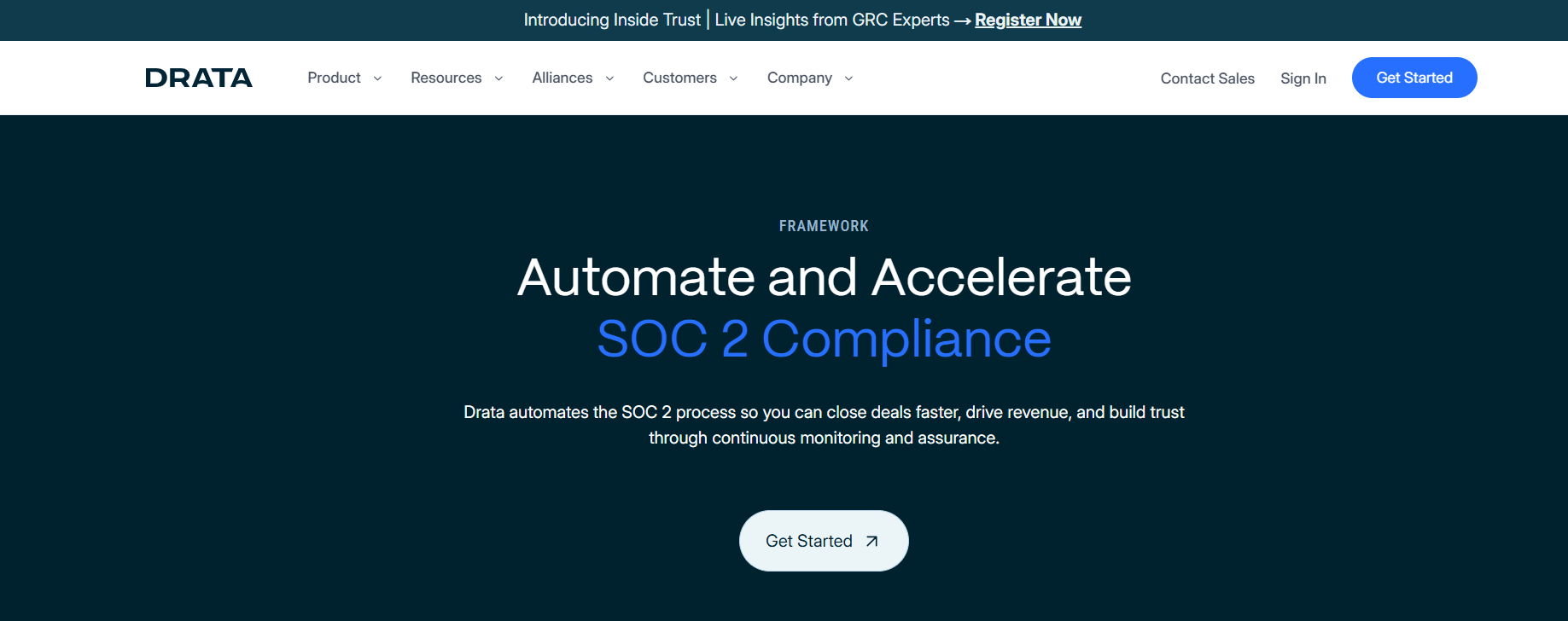
Drata is an AI-native GRC platform designed for engineering teams that want tight control over compliance without sacrificing automation. Its Trust Center transforms compliance into a business asset, allowing investors to start technical due diligence before the first meeting. The Audit Hub facilitates real-time collaboration with auditors, cutting out the email chains that often slow down SOC 2 audits.
Features
- Automate controls across 100+ native integrations with CI/CD pipelines, cloud platforms, and identity systems
- Collect evidence continuously and generate auditor-ready outputs
- Use Audit Hub for live auditor collaboration
- Automate security questionnaire responses with AI-driven trust management
- Manage risk, vendors, and policy lifecycles
- Run automated user access reviews and background checks
- Support multiple frameworks including SOC 2, ISO 27001, HIPAA, PCI DSS, GDPR, SOC 1, FedRAMP, and CCPA
Pros
- Deep automation tailored for engineering teams
- Strong continuous monitoring with alerts
- Audit Hub speeds up audits with live collaboration
- Multi-framework support with shared controls
- Customer support receives consistent praise
Cons
- Steeper learning curve than Vanta or Secureframe
- Higher initial cost than budget-friendly options like Sprinto
- Smaller auditor network than Vanta, though it is growing
- Additional modules add extra cost
Pricing
- Entry (1 framework, small team): $7,000–$9,000/year
- Mid-tier: $15,000/year
- Larger deployments: $40,000+/year
- Including audit fees, first-year SOC 2 costs usually range $12,000–$50,000+
- Custom quotes available
Best Use Cases
- Engineering-heavy SaaS companies with strong DevOps practices
- Mid-market companies scaling compliance across multiple frameworks
- Series B+ companies needing deeply automated, highly customized compliance programs.
3. Secureframe
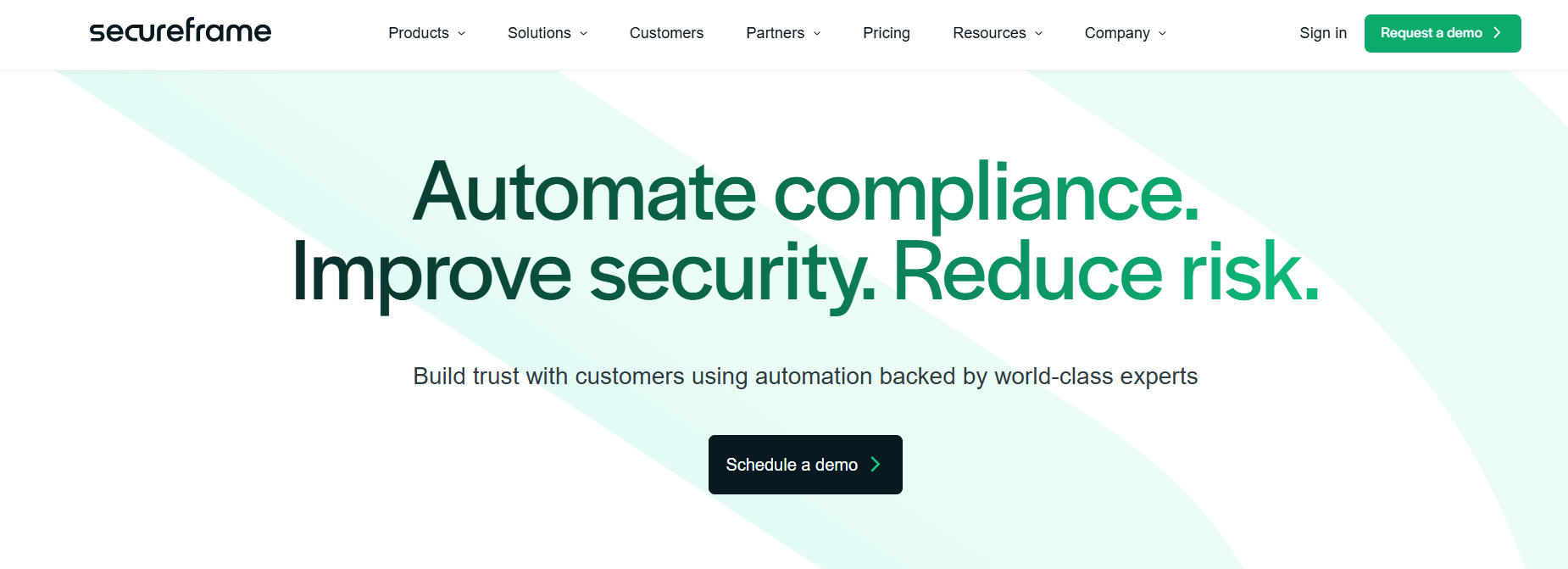
Secureframe excels at simplifying SOC 2 compliance. It condenses more than 200 controls into a clear, guided checklist that even non-technical founders can follow without feeling overwhelmed. This approach helps funding-stage startups achieve compliance faster while freeing engineering teams from tedious compliance tasks.
Features
- Converts 200+ SOC 2 controls into clear action steps
- Collects evidence automatically across 150+ integrations including cloud, HR, and ticketing systems
- Monitors cloud infrastructure and controls continuously in real time
- Comply AI fixes failing controls, updates policies, and performs risk assessments automatically
- Provides auditor introductions, audit-ready documentation, and coordination support
- Supports SOC 2, ISO 27001, HIPAA, PCI DSS, GDPR, FedRAMP, and custom frameworks.
Pros
- Fastest onboarding and first-time audit readiness
- AI tools reduce manual remediation work
- In-house compliance experts and former auditors guide the process
- Guided workflow prevents common gaps in compliance
- Cross-framework control mapping saves time
Cons
- Limited auditor network; confirm compatibility before audits
- Advisory services may overlap with external consultants
- Minor integration sync issues reported by some users
Pricing
- Fundamentals (small teams, single framework): $7,000–$10,000/year
- Get a custom quote at secureframe.com
Best Use Cases
- Early to mid-stage startups pursuing their first SOC 2 without an in-house security team
- Companies needing compliance to secure initial enterprise contracts or satisfy investor security checks
- Teams that value guided, high-touch support over heavy technical automation.
4. Sprinto
Sprinto focuses on “autonomous trust,” letting teams maintain compliance quickly and continuously without overloading engineers. It uses adaptive automation to guide your team through tasks, capture corrective actions, and ensure nothing slips through the cracks. Startups preparing for pre-Series A funding benefit from Sprinto’s strong functionality at a cost lower than most market leaders.
Features
- Pre-approved, auditor-ready compliance programs
- Adaptive automation that organizes tasks and nudges your team toward corrective actions
- 200+ integrations across cloud, identity, HR, and DevOps tools
- Continuous control testing, vulnerability assessment, and proactive threat detection
- User access reviews, vendor risk management, and policy documentation
- Dedicated compliance and audit experts available throughout
- Supports SOC 2, ISO 27001, PCI DSS, HIPAA, GDPR, NIST, and more
Pros
- More affordable than most full-featured platforms
- Adaptive automation reduces manual coordination
- Fast setup with audit readiness in 4–8 weeks
- Expert support included
- Scales across multiple frameworks without large cost increases
Cons
- Integration library smaller than Vanta or Drata
- Some startups need to switch platforms as they grow
- Limited auditor adoption—verify compatibility
- Certain niche integrations require manual evidence collection
Pricing
- Starter: ~$4,000–$5,000/year
- Professional: Adds reporting and customizations (custom pricing)
- Contact Sprinto for a personalized quote
Verdict
Sprinto suits lean startups that need fast, affordable, and continuously maintained compliance. Teams that want guided automation and expert support without paying enterprise-level fees will find it especially effective.
Best Use Cases: Pre-Series A and early-stage SaaS startups with tight budgets. Cloud-native companies that need SOC 2 quickly to unblock enterprise deals. International SaaS companies (particularly APAC-based) looking for cost-effective compliance automation with expert guidance.
5. Thoropass
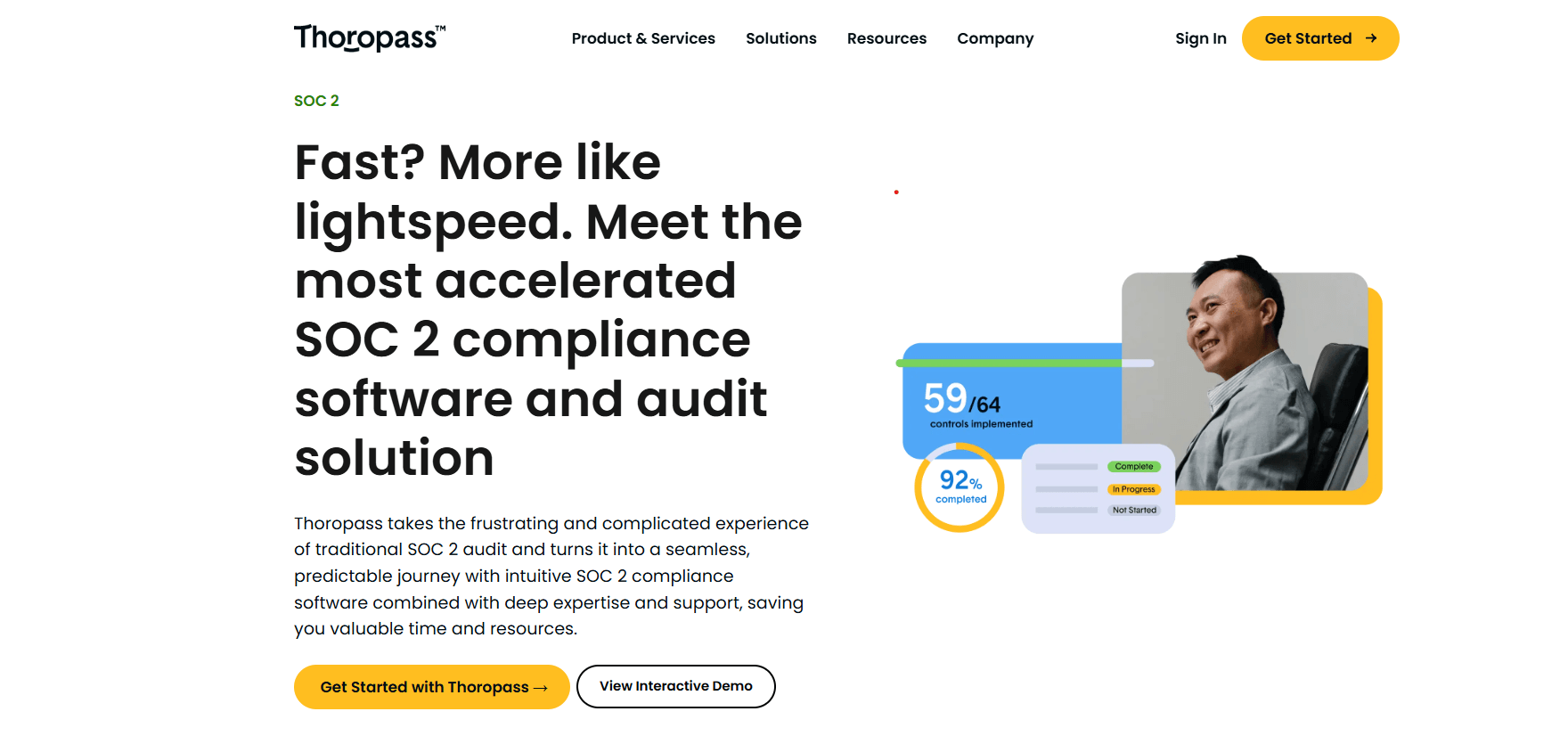
Thoropass, formerly Laika, combines compliance automation with an in-house audit team, serving as both a preparation platform and an audit partner. This setup allows customers to reach audit readiness faster, saving over 950 manual work hours compared to traditional methods. For companies that want compliance handled without juggling multiple tools and auditors, Thoropass provides a predictable, guided path to SOC 2.
Features
- Conducts full audits internally and delivers the final SOC 2 report
- Uses auditor-vetted integrations for automated evidence collection
- Supports SOC 2, HIPAA, ISO 27001, PCI DSS, GDPR, CCPA, and other frameworks
- Monitors controls continuously with real-time dashboards
- Offers risk registers, vendor risk management, and ready-to-use policy templates
Pros
- Combines software and audit in a single vendor
- Intuitive, task-oriented interface simplifies compliance steps
- Reliable customer support consistently receives high praise
Cons
- Bundled audits make the upfront cost higher than software-only options
- Less suitable if you already work with a preferred auditor
- Pre-built templates may feel complex for very small teams
Pricing
- Platform-only: starts around $5,800/year
- Bundled software + SOC 2 Type I audit: approximately $10,000–$20,000/year
- Type II and multi-framework packages cost more; contact Thoropass for details
- Full quotes available at thoropass.com
Best Use Cases
- Startups and mid-market companies needing a single vendor for preparation and audit
- Teams without in-house compliance experience
- Companies seeking a fast, guided path to SOC 2 for investors or enterprise clients:
6. Scytale
What sets Scytale apart is its blend of automation and human support. Each customer works with a dedicated GRC expert from the very beginning. In addition, its AI agent, “Scy,” guides users throughout the compliance process. Therefore, even non-technical teams or early-stage startups can handle compliance without confusion.
Features
- Scy AI agent offers real-time guidance and suggestions
- Dedicated compliance expert assigned from day one
- Automated evidence collection across major tools
- Supports 40+ frameworks (SOC 2, ISO 27001, HIPAA, GDPR, PCI DSS)
- Reuses controls and evidence across frameworks
- Tracks assets, users, and vendors.
Pros
- Includes a human expert in every plan
- Quick setup and implementation
- Reduces repeated compliance work
- AI guidance feels practical and easy to follow
- Entry price remains relatively accessible
Cons
- Smaller presence compared to competitors like Vanta or Drata
- No public pricing details available
- Fewer integrations than some competitors
Pricing
- Three pricing tiers (custom pricing)
- Starts at about $8,000 per year
- Cost increases with company size and frameworks
- Requires contacting Scytale for a quote and demo
Best Use Case
Scytale works especially well for startups handling compliance for the first time. It combines automation with hands-on human support, which makes the process easier to manage. Moreover, companies that need to meet compliance requirements quickly, especially during fundraising or enterprise sales, will find it useful.
7. Scrut Automation
Scrut Automation launched in 2021 as an intelligent GRC platform. It brings compliance and risk management into one system instead of keeping them separate. In addition, the platform uses an all-inclusive pricing model, so it includes Trust Center, risk modules, and vendor risk assessments without extra charges. This approach sets it apart from competitors that charge for add-ons.
Features
- Manage all SOC 2 tasks from one dashboard
- Collect evidence automatically through 80+ integrations
- Monitor controls in real time with alerts and dashboards
- Handle risk scoring, vendor checks, and ongoing monitoring
- Collaborate with auditors through a shared audit workspace
Pros
- Includes all features in one price with no extra fees
- Receives strong feedback for customer support
- Offers solid risk management capabilities
- Delivers good value for the price
Cons
- Feels complex for early-stage startups new to compliance
- Offers fewer integrations than some competitors
- Shows occasional bugs and slow loading times
- Requires users to find their own auditor
Pricing
- Starter: 14-day free trial
- Advanced & Premium: Custom pricing based on company size and needs
Besr Use Case
Scrut Automation works best for mid-stage and growing companies that want compliance and risk management in one place. It also suits teams managing multiple frameworks such as SOC 2, ISO 27001, GDPR, and HIPAA. Moreover, it appeals to startups that prefer clear, all-in-one pricing instead of paying for separate modules.
8. Hyperproof
Hyperproof is an AI-powered GRC platform that helps compliance teams manage multiple regulatory frameworks, coordinate across departments, and stay audit-ready at all times. It brings everything into one system, so teams do not have to jump between tools. In addition, it works well for funded companies that deal with complex and overlapping compliance needs across different units.
Features
- Risk registers and vendor management linked to compliance controls
- Natural-language search for controls and evidence
- Role-based dashboards and proof export options
- Integrations with tools like Jira, Slack, Microsoft Teams, AWS, Azure, GitHub, and ServiceNow
- Reuse of controls across multiple frameworks
- Control health tracking and auditor access portals
Pros
- Covers over 118 compliance frameworks
- Clean and easy-to-use interface
- AI reduces time spent on questionnaires and evidence checks
- Handles multiple compliance programs effectively
- Strong audit workflows and team tracking
Cons
- No public pricing available
- Setup takes time and effort for new users
- Not ideal for early-stage startups
- Reported efficiency gains come from internal data
Pricing
- Estimated starting cost: around $12,000 per year
- You need to contact Hyperproof directly for a quote
Best Use Cases
- Mid-sized companies managing three or more compliance frameworks
- Security and compliance teams in post-Series B companies
- Organizations in regulated industries such as finance, healthcare, and tech
- Teams that need enterprise-level GRC without using larger systems like AuditBoard
Best Use Case
Hyperproof offers a strong option for companies that handle complex compliance work across several frameworks. It simplifies coordination and keeps everything organized in one place. However, smaller teams may find the setup process demanding, and the lack of clear pricing can slow down decision-making.
9. AuditBoard
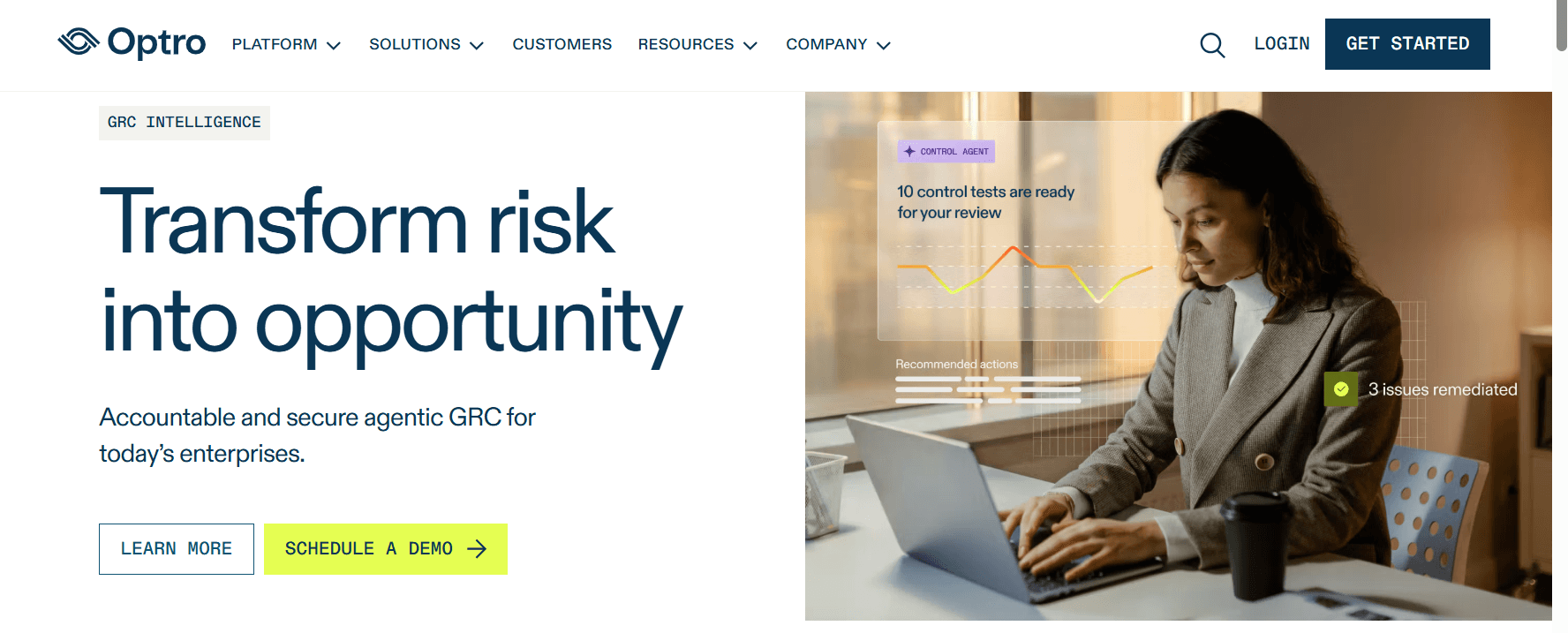
AuditBoard, now called Optro, offers a product suite that includes CrossComply for multi-framework compliance, SOXHUB for SOX management, and RiskOversight for enterprise risk. As companies grow, especially those preparing for IPO or already attracting institutional investors, expectations increase. Therefore, teams need stronger compliance processes and clearer reporting. In this context, AuditBoard delivers detailed compliance support and board-level reporting that auditors and CFOs expect.
Features
- CrossComply: supports multiple frameworks (SOC 2, ISO 27001, NIST, PCI DSS, etc.)
- AI tools for gap checks and control mapping
- Automated evidence collection
- Ready-to-use reporting dashboards
- Continuous compliance monitoring templates
- Real-time risk visibility and alerts
Pros
- Widely trusted by large enterprises
- Strong connection between risk and compliance
- Clear executive and board reporting
- Works well for regulated industries
- Backed by Hg’s $3B acquisition
Cons
- Too complex for early-stage startups
- Very expensive compared to alternatives
- Setup can take 3–6 months
- Requires a dedicated compliance team
Pricing
- Enterprise pricing based on custom quotes
- SOC 2 Type I audits: $10,000–$60,000
- SOC 2 Type II audits: $30,000–$100,000
- Companies must contact AuditBoard for full pricing details
Best Use Cases
- Late-stage (Series C+) and pre-IPO companies
- Large enterprises and Fortune 500 subsidiaries
- Regulated industries like finance, healthcare, and government contracting
10. Strike Graph
Unlike platforms that rely on rigid, one-size-fits-all checklists, Strike Graph evaluates your specific business risks first and then generates controls that match your actual risk exposure. Investors increasingly focus on whether SOC 2 controls are meaningful, not just whether a company has them, and Strike Graph’s approach addresses this concern directly.
Features
- Risk assessment engine that creates controls based on your business profile
- Library of audit-tested controls covering the full SOC 2 standard
- Integrations via API with cloud services and common business systems
- Dedicated Audit Success Managers who guide compliance
- Support for multiple frameworks.
Pros
- Generates controls that match your actual risk level
- Access to experienced compliance consultants throughout the process
- Competitive pricing compared with similar platforms
- Well-suited for startups aiming for a real security posture, not just a checkbox
Cons
- Automation is less extensive than platforms like Vanta or Drata
- Limited native integrations compared with market leaders
- Some evidence workflows require manual configuration
- Interface feels outdated to some users
Pricing
- Starts around $10,000/year for a single framework
- Additional frameworks increase cost, but less aggressively than larger competitors
- Request a custom quote at strikegraph.com
Best Use Cases
- Early-stage startups seeking risk-based SOC 2 compliance instead of generic checklists
- Founders preparing defensible security programs ahead of Series A due diligence
- Small teams preferring human guidance over fully automated compliance
11. OneTrust
OneTrust helps companies prepare for SOC 2 audits while managing privacy compliance. Thousands of global enterprises use it, especially in sectors where privacy laws like GDPR, CCPA, and LGPD are critical alongside security standards. Companies seeking investment or operating in privacy-sensitive industries, such as healthtech, fintech, legaltech, and edtech, can handle both privacy and security requirements on a single platform instead of juggling separate tools.
Features
- Unified platform for IT risk, security risk, vendor risk, incident management, and audits
- SOC 2 readiness automation
- Over 300 integrations with cloud, HR, and DevOps systems
- Built-in privacy management for GDPR, CCPA, and LGPD
- AI-powered policy management and risk assessments
Pros
- Combines privacy compliance with SOC 2, rare in the market
- Large integration library and stable enterprise platform
- Fits companies facing both privacy and security audits
- Strong for privacy-heavy industries like healthtech, fintech, and legaltech
Cons
- SOC 2 is secondary to privacy features
- Costs more than startup-focused solutions
- Setup can take time and effort
- Best for scaling companies rather than pre-seed startups
Pricing
- Enterprise-level custom pricing
- Estimated $20,000–$100,000+ per year depending on modules, company size, and frameworks
- Contact OneTrust at onetrust.com for a quote
Best Use Cases
- Post-Series A companies in privacy-sensitive industries
- Enterprises operating under GDPR and SOC 2 requirements
- Companies managing extensive third-party vendors needing both privacy and security compliance
12. LogicGate Risk Cloud
LogicGate Risk Cloud is a no-code, modular GRC platform designed for enterprises that want compliance to fit their workflows. Unlike other platforms offering pre-built SOC 2 programs, LogicGate provides 40+ GRC applications in a single graph-database system. It supports enterprise risk, third-party risk, audit, and cyber programs all at once. Its drag-and-drop workflow builder, low-code customization, and AI-powered compliance suggestions make it highly adaptable for complex GRC needs.
Features
- 40+ GRC applications in one graph-database platform
- Drag-and-drop workflow builder for any compliance process
- AI-powered compliance guidance and risk scoring
- Scenario forecasting to simulate risks before they occur
- Automated evidence collection through third-party integrations
- Centralized dashboards for risk, audit, and compliance metrics
Pros
- Adapts to complex, multi-layered enterprise programs
- Strong AI-driven risk analysis and scenario modeling
- Flexible user licensing keeps costs lower for large teams
- Suitable for teams managing multiple risk and compliance areas
Cons
- Steep learning curve for teams without dedicated GRC staff
- Implementation can take time and be costly
- Not ideal for organizations seeking quick SOC 2 certification
- Pricing can be difficult to estimate upfront
Pricing
- Custom modular pricing; only administrators need power-user licenses
Best Use Cases
LogicGate suits post-Series B and enterprise organizations that need fully customizable GRC programs. It works well for heavily regulated industries and teams managing multiple frameworks or complex risk portfolios across business units.
Key Questions to Ask Every Vendor Before You Sign
- Does this platform connect directly with our current tools such as AWS, Okta, GitHub, and Jira?
- How often does the platform test controls, hourly, daily, or only when triggered manually?
- Does the platform provide a Trust Center that shares compliance status with investors and potential clients?
- Are audit fees included in the package, or will we need to hire a separate CPA firm?
- What will the total cost of ownership look like over three years instead of just the first year?
- Can the platform expand from SOC 2 to ISO 27001 and HIPAA without requiring a platform change?
- If we switch platforms or the vendor is acquired, what happens to our existing evidence and reports?
- How does the renewal pricing work, and is there a limit on yearly price increases for business units?
Achieving SOC 2 compliance has become an essential milestone for startups seeking funding. The right SOC 2 vendor accelerates the process, keeps it transparent, and reduces the resources needed, transforming compliance from a burdensome task into a meaningful advantage that builds investor confidence. Options like Vanta and Drata offer fully automated platforms, while Thoropass and Scytale provide more hands-on approaches. Each solution serves different team sizes, technical skills, budgets, and stages of growth. Careful evaluation of integrations, automation features, audit support, and multi-framework capabilities helps founders choose a vendor that not only meets compliance requirements but also strengthens credibility and improves chances for fundraising and enterprise partnerships. SOC 2 compliance signals more than regulatory adherence, it reflects operational maturity and a security posture ready for investor scrutiny.