Cybersecurity startups face a uniquely high-stakes challenge. They must prove their own security credibility before they can sell security to anyone else. Enterprise buyers are tightening vendor requirements. Investors are demanding greater accountability. As a result, finding the best SOC 2 providers for cybersecurity startups has become one of the most consequential decisions a founder can make. A SOC 2 report does more than satisfy a compliance checkbox. It actively signals to customers, partners, and regulators that your startup takes data protection seriously.
Furthermore, the compliance landscape has never been more competitive or complex. Cybersecurity startups must prove their systems are secure. They must also demonstrate that their security posture meets internationally recognized standards. All of this happens while running lean teams, tight budgets, and aggressive growth timelines. Fortunately, a new generation of SOC 2 platforms has emerged to meet this challenge. These providers automate evidence collection and monitor controls in real time. They compress what used to be a six-to-twelve-month marathon into a focused, manageable sprint.
As a result, this guide breaks down the top 12 SOC 2 providers for cybersecurity startups. It covers what each platform does best, where each one falls short, and which type of startup each one serves most powerfully. Whether you are a pre-seed founder chasing your first enterprise contract or a Series B company building a multi-framework compliance program, the right SOC 2 partner is on this list.
Top 12 Best SOC 2 Providers for Cybersecurity Start ups
1. Vanta

Vanta stands as one of the most widely adopted SOC 2 compliance platforms in the world. Notably, the company won the 2025 TechForward Award for Security Tech GRC. It also ranked #94 on G2’s Best Software Companies list and appeared on the 2024 Fortune Cyber 60. Vanta takes the chaos out of compliance by connecting directly to your existing tech stack. It then runs continuous automated tests across your controls. Its massive integration library and polished user experience make it the go-to choice for founders who need to move quickly. Furthermore, the platform runs over 1,200 automated tests and integrates with 400+ tools including AWS, Azure, Okta, and GitHub.
Features
- Integrates with over 375 cloud, identity, endpoint, and ticketing systems to automate evidence collection
- Runs more than 1,200 automated hourly tests across frameworks to provide ongoing assurance
- Offers pre-built policy templates, user access reviews, security awareness training, and risk assessments
- Provides vendor security reviews, vulnerability management tools, and background checks
- Displays real-time security status for customers and stakeholders and includes an AI chatbot for quick response
Pros
- Vanta integrates with 400+ tools like AWS, Azure, Okta, and GitHub via API to streamline compliance, giving it the widest connector catalog of any SOC 2 platform on the market.
- In addition, Vanta is often preferred for its ease of use and faster onboarding, making it great for first-time compliance, a critical advantage for startups under investor or deal pressure.
- Moreover, Vanta runs more than 1,200 automated hourly tests across frameworks to provide ongoing assurance meaning your security posture stays monitored around the clock without manual effort.
Cons
- Although SOC 2 is where it shines most. For ISO 27001 or HIPAA, the tooling feels less mature. Controls can feel too generic, and the audit paths aren’t as polished as competitors like Drata or Sprinto.
- Vanta was built for startups, not rapid scaling.
What Makes it Best: Vanta is best for first-time SOC 2 certifications at startups that need speed, simplicity, and broad SaaS integrations. If your priority is to close an enterprise deal fast, get investor-ready, or earn your first SOC 2 report without a dedicated compliance team, Vanta delivers
2. Drata
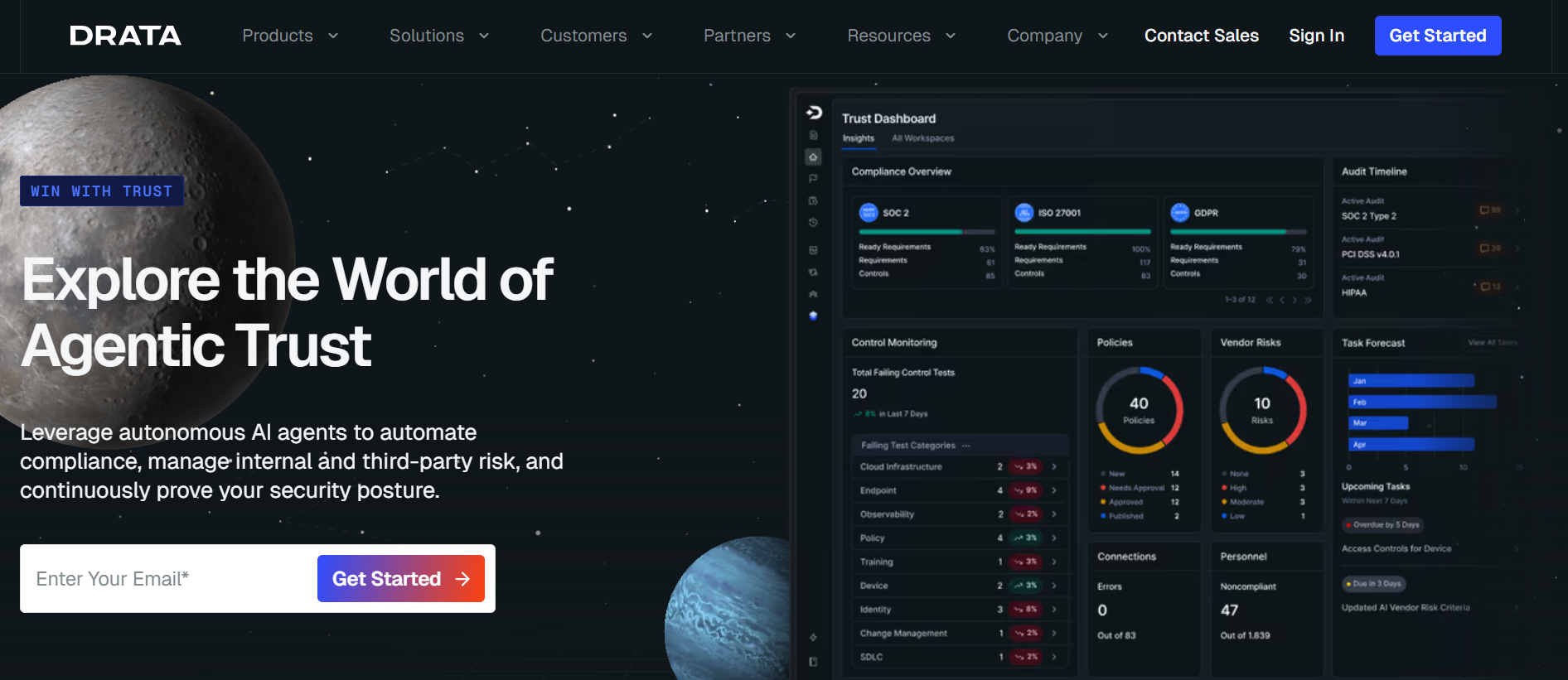
Drata is another titan in the SOC 2 space. It is specifically built for fast-growing startups that take an automation-first approach to compliance. According to G2’s Winter 2025 report, Drata earned eleven Momentum Leader badges and more than 250 other badges. The company serves over 7,500 customers worldwide. Its AI-driven trust management platform supports organizations from startups to global enterprises. What ultimately distinguishes Drata is its deeply developer-friendly environment. Compliance fits naturally into engineering workflows rather than fighting against them.
Features
- Comprehensive Compliance Frameworks: Provides pre-built control mappings for a wide range of frameworks, including SOC 2, ISO 27001, PCI DSS, and HIPAA
- Automated Evidence Collection: Automates the process of gathering screenshots, logs, and configurations, saving hundreds of hours of manual work
- Auditor-Focused Experience: Features a dedicated portal for auditors to access evidence directly, which dramatically streamlines the audit process
- AI-powered trust management that proactively surfaces compliance gaps before auditors do
- Deep developer integrations that allow engineering teams to embed SOC 2 controls into daily workflows
Pros
- Above all, Drata offers deeper automation and more granular control, appealing to more tech-savvy teams with complex environments.
- In addition, Drata supports over 20 compliance frameworks
- Consequently, Its dedicated auditor portal centralizes evidence access, dramatically reducing back-and-forth and shortening the audit timeline.
Cons
- Customization gaps like exception tagging can limit flexibility.
- Pricing is customized and quote-based
What Makes it Best: Drata is best for engineering-driven SaaS startups that want the deepest automation available and plan to manage multiple compliance frameworks as they scale
3. Sprinto
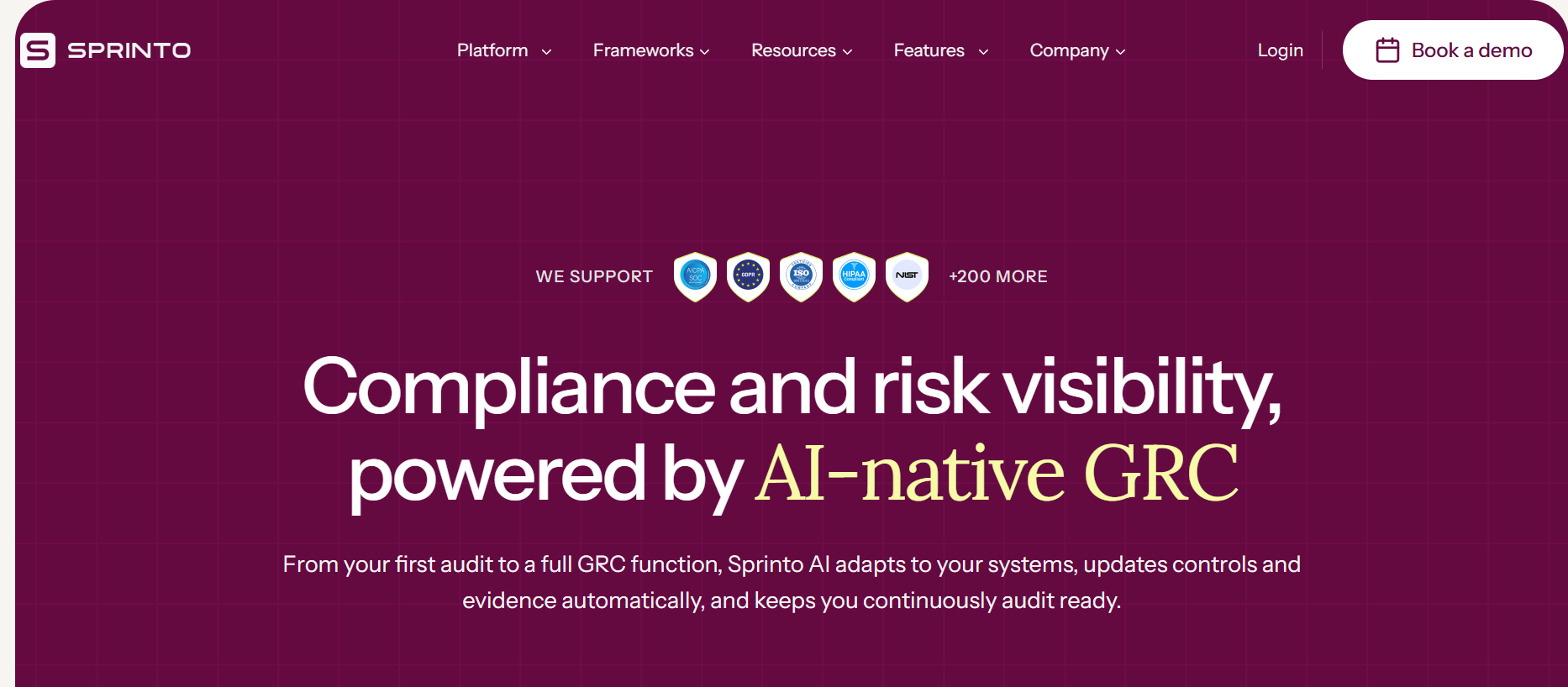
Sprinto earns its place among the best SOC 2 providers for cybersecurity startups by taking a guided, sprint-based approach to compliance. Rather than overwhelming teams with requirements on day one, Sprinto guides you step by step. It walks you through employee onboarding, security training, and policy acknowledgments. It ensures that the people-centric parts of compliance are handled correctly. Sprinto is an AI-native GRC platform. It adapts to your system size, making it equally effective at the seed stage and at Series B scale. Importantly, Sprinto starts at around $6,000 for small teams.
Features
- Firstly, Sprinto provides step-by-step setup with pre-configured SOC 2 and ISO 27001 controls
- Also, they track system configurations and employee access across cloud platforms
- Furthermore, the platform flags non-compliant changes and assigns corrective actions automatically
- Remediation tracking: Assigns tasks, sets deadlines, and verifies fixes in one dashboard
- Visual progress tracker: Displays audit readiness by control and department
Pros
- Firstly, Sprinto excels in continuous compliance monitoring, with many highlighting its ability to automate evidence collection, significantly reducing the manual workload during audits.
- Furthermore, Sprinto starts at around $6,000 for small teams, which keeps it within reach for startups and growing SaaS companies
- Additionally, Sprinto provides excellent guidance during the certification process
Cons
- May require migration to a more robust platform.
- Sprinto’s automated tests is less frequent than other trusted platforms
What Makes it Best: Sprinto is best for price-sensitive, cloud-native startups pursuing their first SOC 2 audit who want guided, automated workflows without the enterprise price tag.
4. Scytale
Scytale is rapidly carving out a reputation as the go-to SOC 2 partner for small and medium-sized cybersecurity startups. It delivers enterprise-grade compliance without the enterprise-grade complexity. The platform combines automated evidence collection, continuous control monitoring, and auditor-approved policy templates. It pairs all of that with dedicated compliance experts who guide teams through the entire certification process. What makes Scytale especially compelling is the addition of “Scy” its AI GRC agent — which provides real-time compliance guidance throughout your journey.
Features
- Scytale’s AI GRC assistant gives real-time answers, explanations, task guidance, and remediation suggestions throughout your compliance journey
- Cross-framework intelligence: Automatically reuses evidence and controls between SOC 2, ISO 27001, PCI DSS, and HIPAA
- Integrated asset inventory: Tracks systems, users, and vendors to ensure complete visibility
- Live compliance status: Real-time dashboards flag non-compliant controls and pending evidence uploads Automated policy builder: Creates policies aligned with SOC 2 and ISO 27001 based on your integrations
Pros
- First Scytale provides dedicated onboarding and support for every customer
- In addition, its built-in AI assistant delivers real-time remediation guidance, task suggestions, and compliance explanations throughout the entire certification journey.
- Furthermore, real-time gap analysis that surfaces blockers before they become audit issues, letting teams remediate proactively rather than reactively.
Cons
- However, the platform still lacks support for private policies, and relies too heavily on manual configuration in certain workflows which can slow progress for lean teams.
- Additionally, Scytale is still maturing in terms of product stability and depth, reviewers report occasional bugs and inconsistencies in basic functionality
What Makes it Best: Scytale is best for AWS-native cybersecurity startups that want a compliance partner, not just a compliance platform. Its dedicated compliance manager model means your team is never alone during the certification process.
5. Thoropass
Thoropass (formerly Laika) takes a fundamentally different approach to SOC 2. It acts as both your compliance platform and your audit partner. The platform blends compliance software with auditor services. Launched in 2019 and rebranded in 2023, its mission is to reduce the burden of both audit preparation and the audit itself. For cybersecurity startups that dread managing a software vendor and an external auditor separately, Thoropass collapses those two relationships into one. It integrates auditors, automation, and infosec workflows in a single closed-loop system.
Features
- Closed-loop SOC 2 path for audit execution, allowing in-house auditors to handle it, diminishing the need to collaborate with a separate audit firm
- Continuous Control Monitoring: Like others, Thoropass continuously checks your systems for compliance, supporting frameworks like SOC 2, ISO 27001, HIPAA, GDPR, CCPA, and others. It uses AI-based evidence verification to double-check collected evidence for completeness
- Risk Management: Thoropass includes a risk management module to track risks and treatments, which ties into your compliance controls
- Audit-in-platform functionality: Complete end-to-end audits within Thoropass via integrated, in-house auditor partnerships
- Customizable policy templates: Generate audit-ready policy documentation tailored to specific frameworks
Pros
- Most importantly,Thoropass can serve as your actual audit partner, not just a prep tool
- Additionally, Audit-ready timelines are typically available within 2–4 weeks with support making Thoropass one of the fastest full-service certification paths available
- Moreover, Thoropass’s First Pass AI double-checks collected evidence for completeness and accuracy before auditors review it.
Cons
- Unfortunately, the platform supports a limited range of compliance frameworks
- Furthermore, Some users report inconsistencies in the auditing experience
What Makes it Best: Thoropass is best for funded startups that want a single vendor to handle the entire SOC 2 journey, from readiness through to the final audit report
6. Secureframe
Secureframe has built its reputation on one core promise: getting cybersecurity startups to SOC 2 certification faster than the competition. It is widely known for its speed-to-compliance approach. Its platform prioritizes ease of use, automation, and seamless onboarding. For founders facing investor pressure or a looming enterprise deal, Secureframe delivers results without sacrificing depth or accuracy. It is one of the most structured paths to certification available for startup teams.
Features
- Rapid onboarding with pre-configured controls that get you audit-ready within weeks, not months
- Deep integration library connecting with hundreds of cloud services, identity providers, and DevOps tools
- Purpose-built for risk, audit, and internal controls with strong automation depth
- Secureframe goes deeper into security infrastructure and integrations, making it better if you’ve got a security-first mindset and multiple frameworks in flight
- Automated gap analysis that continuously identifies control weaknesses and assigns remediation tasks
- Multi-framework support covering SOC 2, ISO 27001, HIPAA, PCI DSS, GDPR, and CCPA
Pros
- Notably, Secureframe supports more than 35 frameworks, giving growing startups the flexibility they need as compliance obligations evolve
- Additionally, the platform goes deeper into security infrastructure and integrations than many of its competitors
- Above all, for teams without internal security expertise, the included advisory support means you always have someone to call when you encounter a difficult compliance decision
Cons
- Nevertheless, Secureframe has a smaller integration library and auditor network than Vanta, which can limit coverage for startups with niche or specialized tool stacks
- Moreover, remediation remains primarily the customer’s responsibility, the platform identifies gaps but does not fix them, which requires additional internal effort
What Makes it Best: It is best for security-first cybersecurity startups that want a fast, structured, multi-framework compliance path with built-in human guidance.
7. Scrut Automation
Scrut Automation has quickly grown into one of the most recognized names in the GRC compliance space. It is particularly strong for startups outside the US that need global coverage. The platform is a unified GRC automation solution that simplifies compliance management for businesses of all sizes. It supports frameworks including SOC 2, ISO 27001, CCPA, GDPR, and HIPAA. Furthermore, Scrut serves over 1,700 customers globally and holds a 4.9/5 rating on G2 — one of the highest in its category.
Features
- Over 80% of automated evidence collection against pre-mapped SOC 2 controls
- Real-time automated control monitoring with configurable alerts
- Automated evidence collection: Automatically collect evidence for SOC 2 audit with 75+ integrations, reducing efforts by 80%, and become audit-ready in under six weeks
- Scrut Automation performs end-to-end risk management with round-the-clock risk and compliance monitoring, from spotting issues and assessing their severity to suggesting fixes
Pros
- Scrut provides transparent, single-point pricing
- The platform supports 60+ compliance regulations out of the box
Cons
- Teams without compliance experience may find the configurability overwhelming
- Scrut faces occasional performance issues
What Makes it Best: Scrut is best for globally minded, risk-focused cybersecurity startups that want the widest framework coverage at a transparent, all-in price. Its risk-first GRC approach means compliance is never superficial.
8. Strike Graph

Strike Graph is a Y Combinator-backed SOC 2 platform that approaches compliance from a fundamentally different angle, starting with risk rather than checklists. This SOC 2 and security compliance platform differentiates itself with a risk-driven approach and developer-friendly tools. It’s a Y Combinator startup (W20) that started by focusing on simplifying SOC 2 for startups. This philosophy resonates deeply with cybersecurity startups whose founders often come from security engineering backgrounds and already think in terms of risk prioritization.
Features
- Firstly, unlike a one-size-fits-all checklist, Strike Graph begins by helping you perform a risk assessment of your business and then generate a customized set of controls
- AI-powered compliance mapping that surfaces the most relevant SOC 2 controls for your specific business model
- Support for multiple frameworks including SOC 2, HIPAA, ISO 27001, NIST, and CMMC
- A structured way to manage compliance tasks without getting stuck in repetitive manual processes
- Developer-friendly tooling designed to integrate compliance into engineering workflows naturally
Pros
- Most importantly, Strike Graph ensures your SOC 2 program maps to actual threats, not just regulatory boxes — a distinction that matters deeply for security-minded founders
- Furthermore, its developer-friendly architecture integrates compliance into engineering workflows naturally, reducing the resistance that technical teams typically have toward compliance initiatives
Cons
- However, Automation is less comprehensive than the market’s deepest players
- Additionally, Strike Graph offers no bundled audit offering, meaning customers still need to manage a separate auditor relationship independently.
What Makes it Best: Strike Graph is best for technical founders and security engineers who want to build a risk-grounded SOC 2 program from the ground up rather than follow a generic checklist
9. Hyperproof

Whereas most SOC 2 platforms focus on getting start ups certified and then leaving them to figure out ongoing compliance, Hyperproof takes a long-term, operationalized view. Hyperproof goes beyond just IT audits like SOC 2, it’s a full GRC management solution. While other tools were built for rapid SOC 2 for start ups, Hyperproof was built with the vision of helping companies manage multiple compliance programs and risks continuously. For cybersecurity start ups that are quickly scaling and expect to face multiple regulatory frameworks simultaneously, Hyperproof provides a compliance infrastructure that grows with you.
Features
- Firstly, Hyperproof provides a real-time dashboard that shows the health of all your compliance programs at a glance
- A big strength is Hyperproof’s ability to map one control to many frameworks easily
- Furthermore, the platform helps track evidence lifecycle — it can version-control documents, remind you when evidence needs an update, and let you reuse evidence across audits
- The platform has strong task assignment and collaboration features with integrations to Slack or Teams for notification
Pros
- Notably, Hyperproof supports over 50 frameworks, including SOC 2, ISO 27001, NIST, FedRAMP, and custom ones — ideal for teams managing overlapping standards across departments
- Furthermore, it excels at bringing compliance management into the day-to-day workflows of security and operations teams without requiring them to leave their existing tools
- In addition, AI agent-style workflows allow teams to summarize evidence and draft questionnaire responses far more efficiently than traditional manual approaches
Cons
- Nevertheless, Hyperproof can feel overwhelming, particularly for teams without a dedicated GRC function, new users often struggle to determine where to begin structuring their program
- Moreover, it requires you to manage your own external auditor relationship, adding a layer of vendor coordination complexity that some startup teams prefer to avoid
What Makes it Best: The platform is best for rapidly scaling cybersecurity start ups that have moved beyond their first SOC 2 audit and need to operationalize compliance across multiple frameworks, departments, and geographies simultaneously.
10. Anecdotes
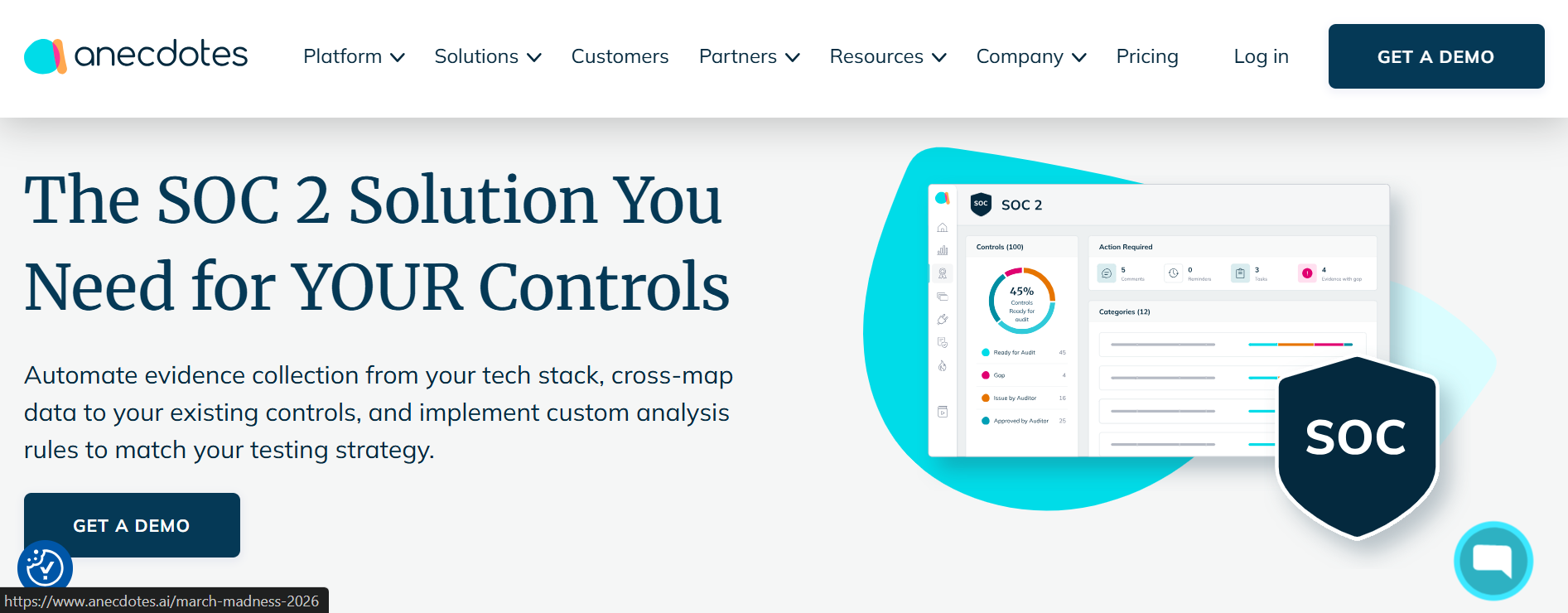
Anecdotes takes a distinctly modern, data-driven approach to SOC 2 compliance that sets it apart from platforms focused primarily on automation. Rather than simply collecting evidence and ticking controls, Anecdotes builds a compliance data mesh across your organization, giving security and compliance teams continuous, real-time visibility into their posture. Anecdotes takes a risk-based approach to SOC 2 compliance, helping organizations identify and prioritize the most critical compliance gaps. The platform focuses on continuous monitoring and proactive risk management. This approach suits cybersecurity startups that treat their own security posture as a product and want deep analytical visibility into compliance performance.
Features
- Firstly, compliance data mesh architecture that aggregates security data from across your entire cloud and SaaS environment
- Continuous, real-time evidence collection that eliminates the annual scramble to gather point-in-time proof
- Furthermore, risk prioritization engine that scores compliance gaps by impact so teams know exactly where to focus first
- Moreover, they provide multi-framework support covering SOC 2, ISO 27001, GDPR, HIPAA, and more from a unified data layer
- Automated reporting that generates board-level compliance summaries and auditor-ready documentation simultaneously
Pros
- Above all, Anecdotes provides continuous, real-time evidence collection, which eliminates the painful annual evidence-gathering scramble that consumes countless engineering hours
- Additionally, the platform is purpose-built for organizations that treat their security posture as a product and need deep analytical visibility into compliance performance over time
Cons
- However, Anecdotes does not publish pricing and uses custom pricing only, making early-stage budget planning difficult without entering a full sales conversation
- Furthermore, Anecdotes assumes your team has foundational GRC knowledge, making it less suitable for founders encountering SOC 2 compliance for the very first time
What Makes it Best: Anecdotes is best for sophisticated, data-driven cybersecurity start ups that want to treat compliance as an intelligence function rather than a reporting obligation.
11. COMP AI
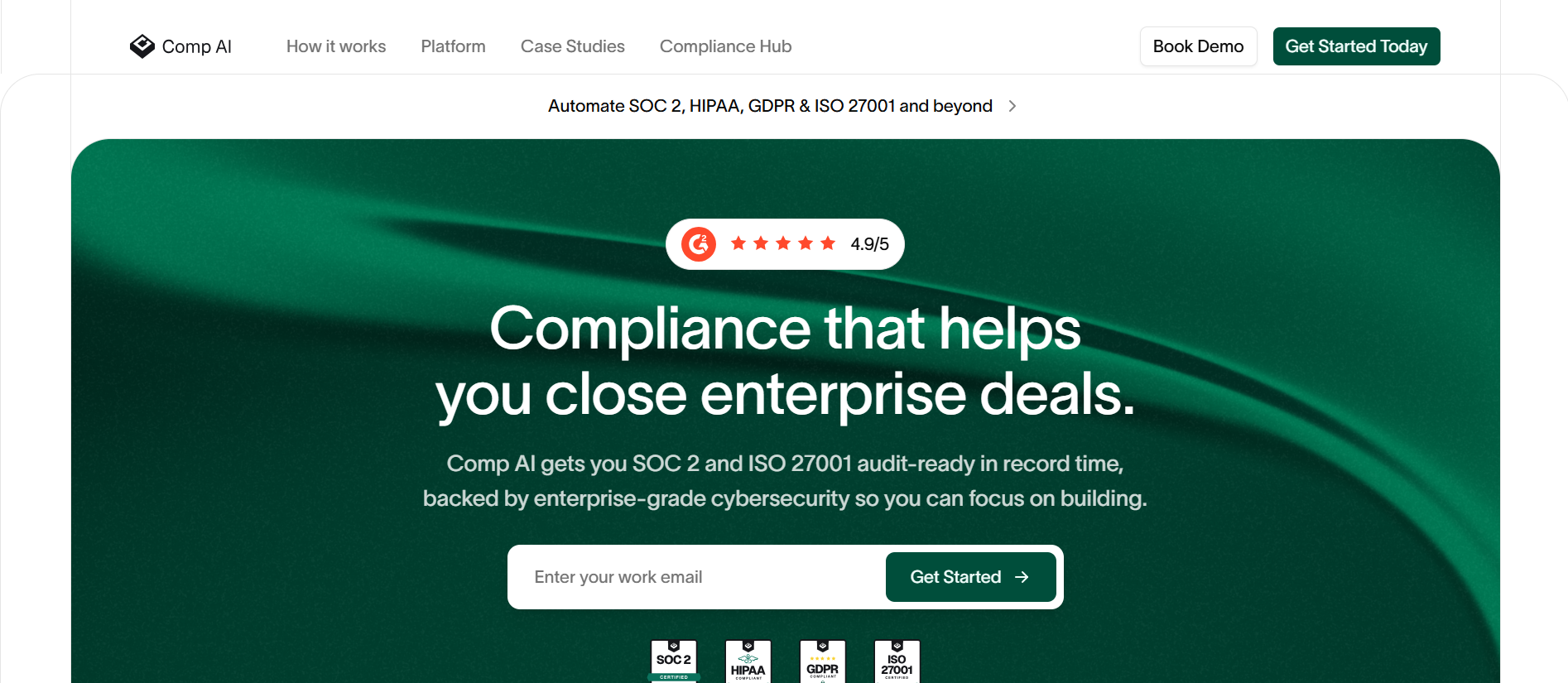
For seed-stage and pre-Series A cybersecurity start ups operating on tight budgets, Comp AI represents a genuinely disruptive entry in the SOC 2 space. Comp AI is an open-source compliance platform built to make SOC 2 affordable for lean start ups. Launched in 2025, it ranks among the most cost-effective SOC 2 certification providers, offering a transparent pricing model with no hidden fees or forced contracts. Its open-source foundation means technical founders can inspect, customize, and extend the platform, a rare transparency in an industry otherwise defined by black-box SaaS tools.
Features
- Fully open-source codebase giving technical teams complete transparency and customization ability
- Also, it is ideal for seed-stage or pre-Series A SaaS startups without a compliance team, needing SOC 2 quickly and affordably — also suits bootstrapped founders who want full transparency
- Moreover, among the lowest base prices in the SOC 2 compliance market with no forced contracts
- Pre-built SOC 2 policy templates mapped to all five Trust Services Criteria
- Automated evidence collection workflows designed to work without a dedicated compliance officer
- Integration capabilities with major cloud providers and development tools
Pros
- First and foremost, Comp AI offers the lowest base price among SOC 2 certification providers, making credible certification accessible to bootstrapped startups
- Moreover, its fully open-source codebase gives technical founders complete transparency and full customization ability that no proprietary competitor can match
- Additionally, Comp AI is ideal for seed-stage or pre-Series A startups without a compliance team that need SOC 2 quickly and affordably
Cons
- However, the platform offers limited enterprise-grade features, which means teams will likely outgrow its capabilities as they scale beyond the early stage
- Additionally, Comp AI may require a platform migration as the startup grows, making it a strong starting point but potentially not a long-term home for growth-stage companies
What Makes it Best: Comp AI is best for bootstrapped or pre-Series A cybersecurity start ups that need a credible, affordable SOC 2 program and value radical transparency in both pricing and code.
12. Apptega
Apptega rounds out this list as a powerful choice for cybersecurity start ups that also serve Managed Security Service Provider (MSSP) clients or operate within complex multi-client environments. It is a compliance software platform tailored to streamline SOC 2 compliance processes. It serves both in-house teams and managed security service providers (MSSPs). This dual focus gives Apptega a unique edge, it doesn’t just help you achieve your own SOC 2 compliance, it also helps you manage compliance on behalf of your clients, making it an extraordinary tool for cybersecurity start ups whose products include compliance services.
Features
- Streamlines SOC 2 assessments with questionnaires, identifying compliance gaps swiftly
- Links evidence to audit requirements, reducing preparation time significantly
- Tools for identifying, ranking, and remediating risks, easing compliance management
- Centralizes vendor cybersecurity evaluations, crucial for third-party reliant organizations
- Manages multiple compliance frameworks, consolidating controls to reduce redundancy
Pros
- First, Apptega serves both in-house teams and managed security service providers (MSSPs)
- Additionally, users report up to a 75% reduction in compliance time
- Furthermore, the platform allows a single compliance team to manage and monitor SOC 2 programs across multiple client organizations from one centralized dashboard
Cons
- Unforttunately, Apptega requires a sales conversation before revealing pricing, making budget planning difficult for early-stage founders.
- Its market positioning leans heavily toward MSSPs and enterprise compliance,
What Makes it Best: Apptega is best for cybersecurity startups that sell compliance-as-a-service, manage security programs on behalf of clients, or operate as MSSPs.