Rippling brings HR, payroll, IT, and finance tasks together in one system. On the HR side, it manages onboarding, time off, documents, and reporting. For payroll, it supports multi-state and international payroll, handles tax submissions, and can run payroll automatically. Even with these strengths, some businesses decide Rippling doesn’t meet their needs or they just want to compare other options. Many companies look for tools that cost less while still offering dependable HR, payroll, and benefits management. If you’re one looking to explore more choices, we have complied the top 11 affordable Rippling alternatives worth considering.
Why Consider Affordable Rippling Alternatives?
While Rippling covers a wide set of tasks, some teams find that its pricing structure, add-on costs, or learning curve doesn’t match what they need. In particular, smaller businesses often want tools that focus on the essentials without the extra complexities or higher monthly fees. Meanwhile, others prefer platforms with more predictable pricing or support that feels closer and more accessible. These realities push many companies to explore affordable Rippling alternatives that still handle HR, payroll, and employee management effectively.
Top 11 Best Affordable Rippling Alternatives
1. Deel
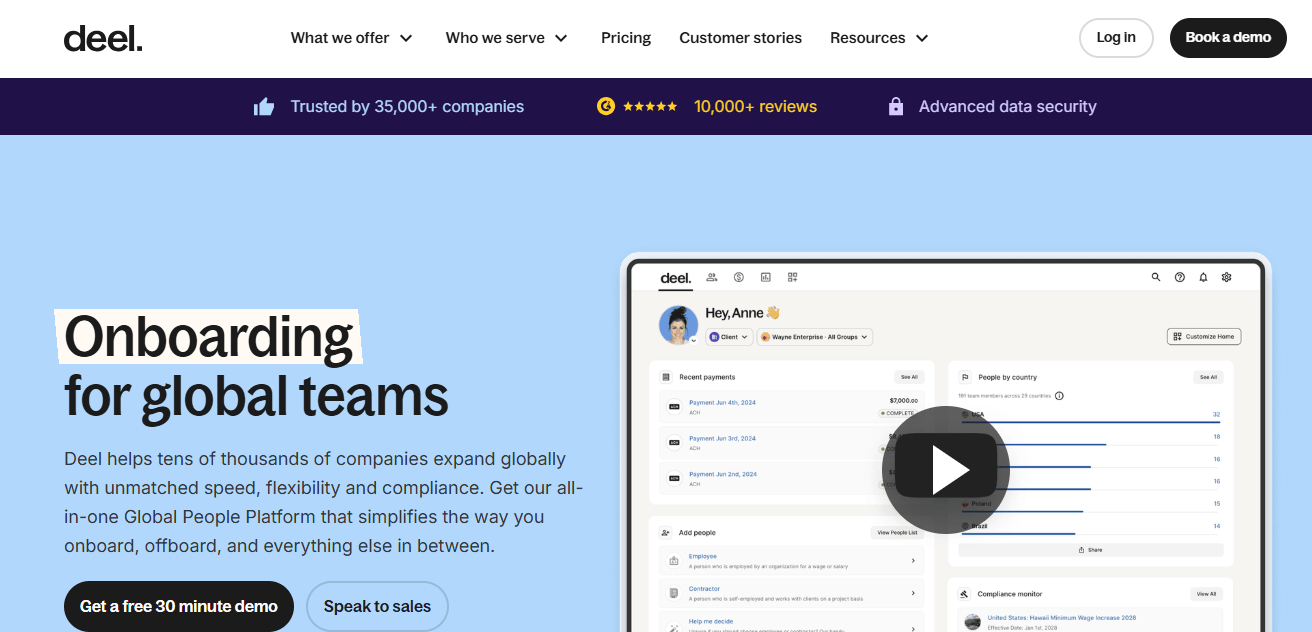
Deel is a global HR and payroll platform that helps companies hire, pay, and manage remote or international employees and contractors. Specifically, HR teams use it to handle onboarding, contracts, payments, and compliance through a single system, which minimizes manual work and reduces legal risks. Furthermore, it works especially well for organizations growing into new countries without creating local entities.
Deel’s EOR service and international payroll tools allow companies to hire and pay workers worldwide while meeting local labor requirements. As a result, HR managers can set up international employees quickly, with contracts automatically adjusted to each country’s laws. Additionally, its compliance engine oversees documentation, taxes, and benefits, helping businesses scale global teams safely and efficiently.
Features
- Global Payroll Management: Handles payments for employees and contractors in more than 90 countries, manages multi-currency payouts, and calculates taxes according to local rules.
- Lets companies hire full-time employees internationally without creating local entities, while also managing legal employment obligations.
- Automated Compliance Tools: Monitors changing labor laws, creates required documents such as tax forms, and alerts HR teams about important compliance deadlines.
- Contract and Onboarding Management: Supports smooth hiring with automated document collection and customizable onboarding steps.
- Benefits Administration: Provides country-specific benefits packages such as health insurance, retirement plans, and professional development options.
Pros
- Wide global coverage across 150+ countries with automatic compliance updates.
- Single platform for managing both employees and contractors.
- Quick start for onboarding, although full completion may take several days.
- Strong integrations with major HR and accounting tools.
- Automated payroll with multi-currency support and local tax handling.
Cons
- The platform may feel overwhelming for businesses operating only in one country.
- Benefits offerings differ greatly depending on the location.
Pricing
- Payroll: $29 per employee
- Employer of Record: $599 per employee
- Contractor Management: $49 per contractor
Best For
Companies that want to hire internationally without the high cost and complexity of setting up legal entities in multiple countries.
2. Gusto
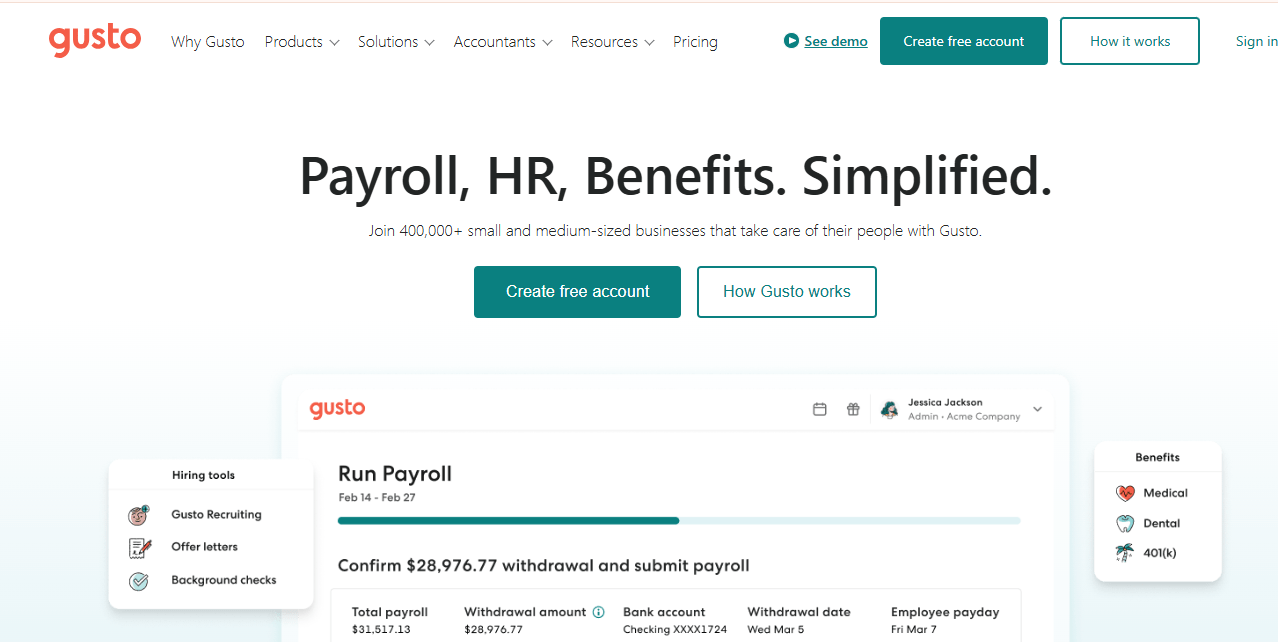
Gusto serves small businesses by providing an easy-to-use payroll and HR platform. In addition to handling essential tasks such as benefits administration, time tracking, and employee self-service, it simplifies complex payroll duties like tax calculations, accounting integrations, and report generation. Moreover, its mobile app encourages employee independence by giving staff access to pay stubs, tax documents, and other personal records.
Features
- Employee Management: Organizes staff details, benefits, and reimbursements, making HR tasks more manageable.
- Time Tracking: Allows employees to record their hours through multiple channels, which improves accuracy and accountability.
- Payroll Processing: Automatically calculates taxes and pays employees via direct deposit, reducing manual effort.
- Integrations: Connects easily with popular accounting and business tools, ensuring smooth data flow across systems.
Pros
- User-friendly interface that is easy to navigate
- Simple and accurate employee time tracking
- Automatic tax calculations and payments reduce errors
- Responsive customer support that addresses issues quickly
Cons
- Dashboard lacks a search bar, which can slow navigation
- No biometric security on desktop devices, limiting advanced security options
Pricing
- Simple: $24.50/month
- Plus: $40/month
- Premium: $90/month
Best For
Gusto works well for small businesses that want clear, predictable pricing and essential HR tools in one place. In particular, the Simple plan includes full-service payroll, onboarding features, health insurance administration, and time tracking, making it ideal for teams with up to 100 employees. Meanwhile, the Plus plan adds hiring tools, benefits administration, and project tracking, which supports companies preparing to grow. Overall, Gusto offers transparent pricing and practical features that deliver strong value for small businesses.
3. BambooHR

BambooHR focuses on improving the employee experience with tools that handle key HR activities such as onboarding, attendance tracking, benefits administration, and performance management. Indeed, it functions as an HRIS and is widely recognized for its simple, easy-to-navigate interface. Additionally, the platform supports quick setup and helps new hires settle in faster through clear workflows and helpful onboarding features.
Features
- Employee data management: Stores employee details in one place for quick updates and easy access.
- Applicant tracking system (ATS): Helps manage job postings, applications, and candidate communication.
- Time-off management: Tracks leave requests, automates approvals, and maintains accurate attendance logs.
- Performance management: Supports reviews, goal-setting, and ongoing feedback.
- Onboarding tools: Automates paperwork and guides new hires through their first steps.
Pros
- Easy-to-use interface
- Full set of essential HR tools
- Strong employee self-service options
- Flexible reporting and analytics
Cons
- Payroll features remain limited unless you add third-party options
Pricing
- Plans start from $10 per user per month
- Companies with fewer than 25 employees pay a flat rate starting at $250 per month
Best For
Businesses that want applicant tracking, onboarding, time-off tracking, performance tools, and detailed reporting in one system without paying separately for each component.
4. Multiplier
Multiplier acts as a global employment platform that helps companies hire, pay, and support international workers. Businesses use it when they manage freelancers, full-time staff in multiple countries, or want access to talent outside their home market. The platform makes it easier to run payroll, handle employee insurance, and stay compliant with local labor rules. It removes the stress of multi-currency payments, country-specific employment laws, and complicated payroll obligations.
Features
- One-click payroll and compliance: Automatically runs payroll and keeps companies aligned with labor laws in 150+ countries, making international operations smoother.
- Benefits administration: Allows employers to offer region-specific benefits that help attract and retain skilled workers.
- Employee management dashboard: Centralizes employee information so teams can manage global staff more easily.
- Automated tax handling: Submits tax filings correctly and on schedule, which helps companies avoid penalties and compliance issues.
Pros
- Easy hiring and payment process for workers in 150+ countries
- Combines HR, payroll, and compliance in one platform
- Onboarding takes only a few days, making setup faster
Cons
- Setup may feel confusing for people using an EOR platform for the first time
- Workflow customization options are limited
Pricing
- Employer of Record: From $400 per month
- Contractors: From $40 per month
Best For
Multiplier works well for teams that want dependable international payroll, clear compliance support, and straightforward benefits management. Additionally, it suits companies expanding into multiple countries and those looking for a simpler way to work with global talent.
5. Workday

Workday delivers an all-in-one payroll and workforce management system that automates complicated pay calculations, tracks labor activity accurately, and helps businesses maintain compliance. Its payroll engine handles wages, taxes, garnishments, and special payments like bonuses or off-cycle runs. While Workday focuses on enterprise-level HR demands, Rippling appeals to companies of different sizes because it offers a simpler, less overwhelming setup. Consequently, teams that want a more straightforward experience may prefer Rippling.
Features
- Automated Payroll Processing: Pulls employee information directly from HR records to cut down on manual input and improve accuracy.
- Multi-Jurisdictional Payroll Support: Handles payroll for employees across multiple states and countries in one system.
- Configurable Payroll Calculations: Applies various pay rules, including overtime, bonuses, deductions, and benefit adjustments.
- Payroll Reporting and Analytics: Provides immediate insights into payroll spending, tax obligations, and compensation patterns.
- Automated Tax Filing and Compliance: Manages federal, state, and local tax submissions to help reduce penalties and audit risks.
Pros
- The interface remains easy to navigate, so teams can manage HR tasks without confusion.
- It includes advanced talent management tools that support workforce development.
- The high level of configurability allows companies to adjust HR processes as needed.
Cons
Mid-market businesses may struggle with the cost, which can be steep.
Pricing
Starting price: Available upon request
Best For
Large organizations with complex HR and payroll structures.
6. Trinet
Trinet is a cloud-based HR platform that helps small and medium-sized businesses manage employee information, daily HR tasks, and workforce processes in one place. It keeps employee records updated, organizes job and compensation details, and stores essential documents securely.
The platform also allows companies to handle onboarding and offboarding digitally so new hires can complete forms quickly while exits stay compliant and well-documented. Moreover, it brings several HR functions together, making it easier for teams to monitor staff activity, track hours, and oversee benefits enrollment.
Features
- Helps businesses build clear reporting structures, set up departments, and assign roles across the workforce.
- Tracks employee work hours, absences, and time-off requests while also supporting quick approval workflows.
- Benefits Administration: Manages employee benefits enrollment and keeps all related information organized for easier compliance.
- Gives administrators precise control over who can view, edit, or manage specific HR data.
- Facilitates goal-setting, employee evaluations, and continuous feedback to promote development.
- Displays HR metrics, including attendance patterns, performance activity, and benefits usage.
Pros
- Simple onboarding experience
- All-in-one HR system
- Central location for employee files
- Supports digital document signing
Cons
- Customer support may respond slowly
- Limited room for personalization.
Pricing
- Essentials Plan: $10 per employee per month
- Growth Plan: $18 per employee per month
- Zen Plan: $27 per employee per month
Best For
Businesses with limited budgets seeking comprehensive HR functionality.
7. Namely
Namely HR helps mid-sized businesses handle payroll, benefits, time tracking, and talent management in one system. It covers everyday HR responsibilities and compliance needs, allowing teams to hire, onboard, pay, and support employees without switching tools. Additionally, companies can move all employee data into Namely through its open API, so information from tools like an ATS or a 401(k) provider stays in one location.
Features
- Unified HR and Payroll Platform: Namely reduces the stress of managing several disconnected systems and improves overall administrative accuracy.
- Customizable Automation: Companies set up workflows that match their internal processes and automate routine tasks such as onboarding and performance reviews. This saves time and cuts down on manual mistakes.
- Employee Self-Service Access: Staff members can update their personal details, review pay stubs, request time off, and manage benefits. As a result, HR teams experience fewer repetitive requests.
Pros
- Easy-to-navigate interface
- Offers managed payroll and benefits services
- Includes a social-style newsfeed that boosts internal communication
Cons
- No free trial
- Limited integration and communication options
Pricing
Starts at $9 per employee per month
Best For
Companies that want a flexible HR system that connects smoothly with other workplace tools and supports different industry needs.
8. Remote
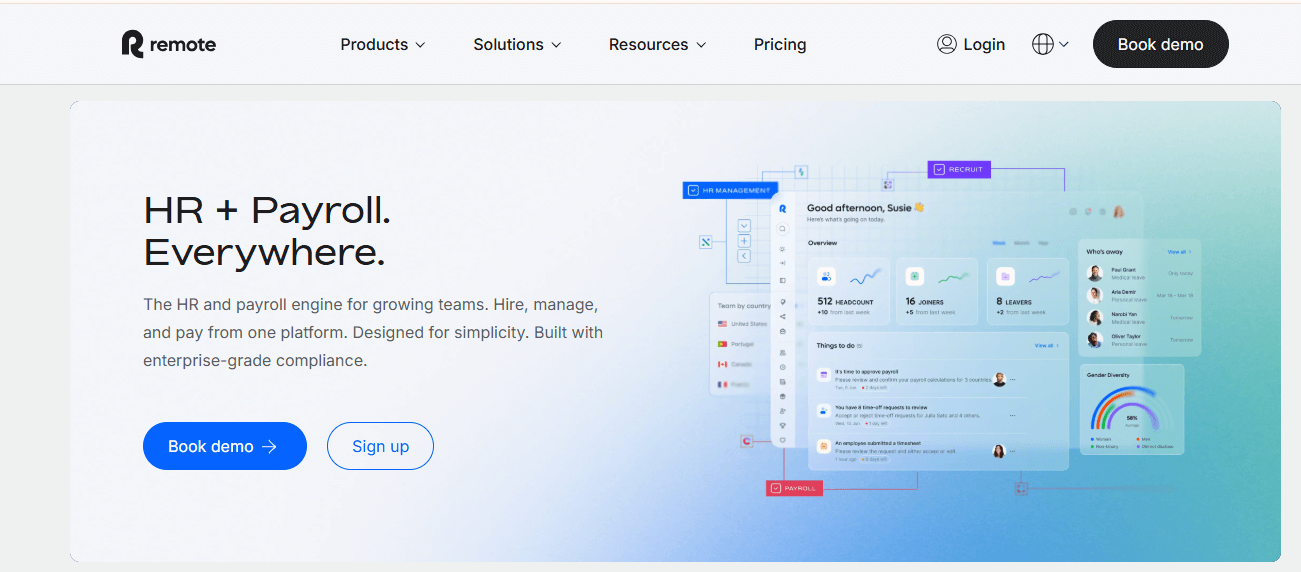
Remote provides international payroll, benefits, and compliance solutions for companies that want to hire employees or contractors across borders. It functions as a single platform that supports distributed teams and keeps processes simple and transparent. Because of this, businesses can manage large teams across different countries while accessing tools such as an applicant tracking system, global payroll, and centralized dashboards that show key information in one place.
Features
- Remote EOR: Allows businesses to hire in new countries within days. It includes compliance support, payroll, and HR assistance.
- Equity Essentials: Helps companies manage equity for all international employees, regardless of location.
- Global Payroll Enhancements: Remote now operates like an internal payroll partner and delivers more accurate payroll processing across multiple countries.
- Self-Serve Payroll Setup: Users can set up payroll within minutes through simplified onboarding and clear configuration tools.
- Transparent Pricing: The platform maintains upfront pricing without hidden charges.
- One Platform for All: Companies can manage employees in more than 150 countries through a single system.
Pros
- Allows businesses to hire globally with less friction
- Supports fast and compliant onboarding
- Offers an all-in-one HR platform for international operations
Cons
- Costs may be high for smaller teams
- New users may need time to understand all features
Pricing
- Employer of Record: $699 per employee/month
- Payroll: $29 per employee/month
Best For
Remote fits companies that want a truly global-first solution. The company operates without physical offices and embraces a fully remote structure. It enables businesses to hire internationally without establishing local entities, while also providing payroll and HR support that stays compliant with local regulations.
9. Paylocity
Paylocity is an HCM platform that handles payroll, HR administration, talent acquisition, employee development, and workforce management. It supports onboarding, time and attendance, benefits enrollment, learning, compliance, reporting, and analytics. Because these tools sit in one system, teams work more efficiently, stay aligned, and have clearer insight into their workforce. The talent management component also helps companies improve how they attract, evaluate, and grow employees, which ultimately supports retention.
Features
- Benefits Administration: Helps employees review and select benefit plans easily with mobile access, alerts, and guided enrollment.
- Time and Attendance: Tracks work hours automatically to reduce errors, support compliance, and manage complex schedules.
- Payroll Processes: Automates payroll, taxes, deductions, and direct deposits while giving employees visibility into upcoming paychecks.
- Automated Workflows: Allows users to build or customize workflows for tasks like onboarding, offboarding, and role or pay changes.
- Employee Self-Service: Lets employees access pay details, benefits info, and time-off tools directly through a portal or mobile app.
Pros
- Dedicated support reps assist with payroll, taxes, and garnishments
- Employees can update personal info, check pay data, and request time off independently
- Automated payroll processes cut down on repetitive work
Cons
- New users may need time to understand the full system
- Some customers reported slow support response times
- Implementation may take longer than expected
Pricing
Pricing is available upon request
Best For
Organizations that want an all-in-one payroll and HR system with strong talent management tools
10. Playroll
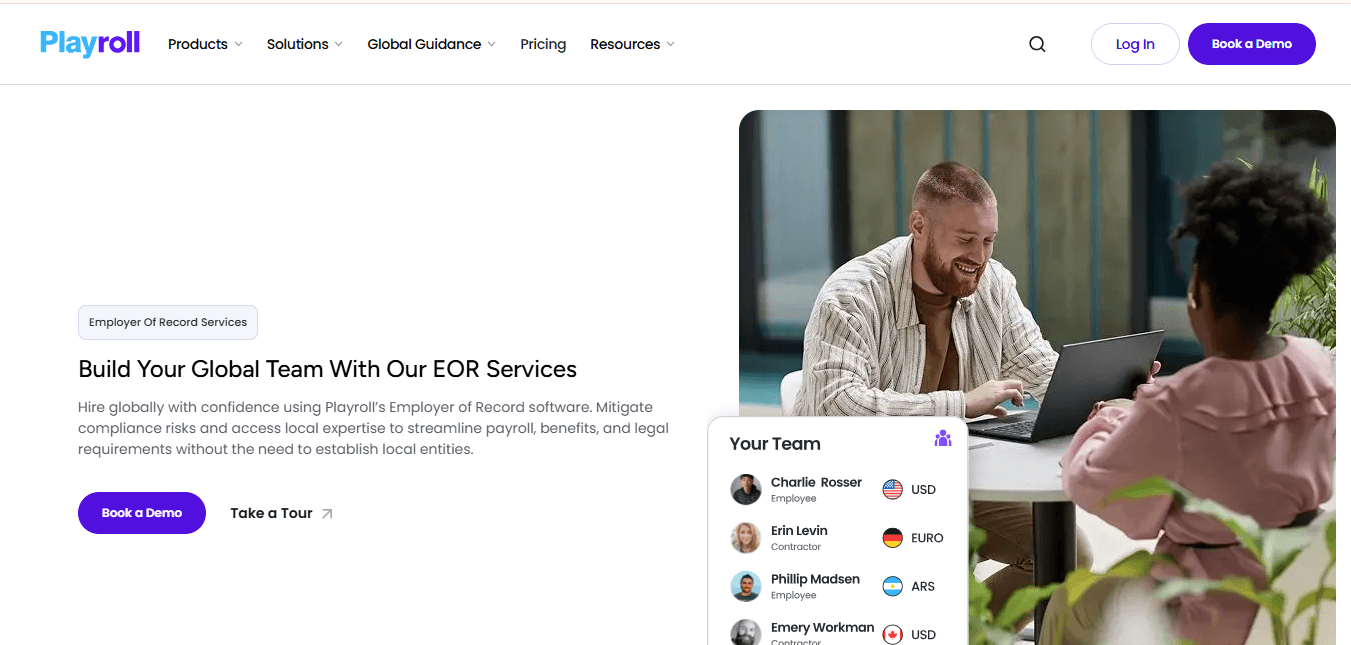
Playroll helps companies hire, onboard, and pay international employees in a compliant and efficient manner. It supports businesses of different sizes and adapts well to their operational needs. The interface is easy to navigate, so users can handle cross-border payroll tasks with less friction. In addition, Playroll offers dependable customer support for both employers and employees, ensuring quick and helpful responses whenever issues arise.
Features
- Compliant global hiring and payroll coverage in 180+ countries through a wide network of owned entities
- Payroll management tools that combine data from multiple vendors across borders
- Dedicated support teams for both employers and employees
- Legally compliant contracts that protect intellectual property and meet local labor requirements
- Localized benefits with automated compliance and a broad set of optional perks
- Unified dashboard to manage global teams, payroll, and compliance
Pros
- Enables international hiring without creating local entities
- Covers payroll, taxes, and compliance obligations
- Offers localized benefit options
- Keeps data in a secure, centralized system
- Speeds up onboarding in multiple countries
- Lowers legal exposure and HR-related risks
Cons
- Limits control over country-specific HR rules
- Monthly service charges may increase overall costs
- Less suitable for companies with existing in-house HR teams in certain regions
Pricing
Pricing begins at $399 per employee each month.
Best For
Businesses that want compliant global hiring and payroll support without establishing local entities.
11. Native Teams

Native Teams helps companies hire and pay employees or contractors in more than 85 countries without creating local entities. It handles employer-of-record services, global payroll, tax optimization, compliance support, and localized benefits. Because it keeps costs low and focuses heavily on compliance, many small and mid-sized businesses use it to expand internationally. Although platforms like Rippling offer broader functionality, Native Teams concentrates on affordable EOR services that simplify global hiring.
Features
- Global payroll management for international employees
- Contractor payment tools with automated processing
- Localized benefits packages based on each country’s requirements
- Tax optimization and support for cross-border workers
- Multi-currency digital wallets
- Physical and virtual cards for business expenses
- Visa support and relocation assistance for global hires
Pros
- Uses localized payroll calculators for precise salary and tax estimates
- Provides compliant contracts and employment documents
- Allows companies to hire internationally without setting up a legal entity
- Offers country-specific guidance that reduces hiring risks
Cons
- Supports fewer countries than some competing EOR platforms
- Does not include many advanced HR tools outside essential employment functions
Pricing
Employer of Record: €99 per user, per month
Best For
Companies that want an affordable, compliance-focused way to hire internationally without building out multiple legal entities.
Conclusion
Choosing the right HR and payroll system starts with understanding your company’s needs, growth plans, and budget. Rippling covers many functions in one place; however, the options highlighted here show that you can still get strong capability at a lower cost. For teams hiring across borders, tools like Deel, Multiplier, Remote, Playroll, and Native Teams offer features that support international recruitment and compliance, and they often help companies avoid the expense of opening entities in multiple countries.
Even though these EOR tools can cost more per employee, they still make sense for global hiring. Meanwhile, small and mid-sized businesses that operate mainly within one country may get better value from Gusto, BambooHR, or Trinet. Gusto appeals to many organizations because of its clear pricing and easy setup, while BambooHR helps teams manage hiring and overall employee experience. Trinet, supports companies that want hands-on HR assistance without enterprise-level overhead.
In the end, the most budget-friendly choice is the one that covers your essential needs without adding layers you won’t use. Because of this, it’s wise to define your must-haves, compare two or three options, test them through demos, and negotiate costs especially when signing up a large team or agreeing to a yearly plan.