

A yoga studio may look calm from the outside, but keeping the schedule running can tell a different story. Classes need regular updates, instructors have changing availability, students cancel and waitlists need attention. As the studio grows, managing all of this through calendars, spreadsheets and messages can quickly become difficult.
Yoga scheduling software brings these tasks into one place. Depending on the platform, you can manage class bookings, recurring schedules, instructor availability, attendance, payments, memberships, class packs and waitlists. Some platforms also provide reports that show which classes fill up, how instructors perform and where your studio generates revenue.
However, the best yoga scheduling software for a solo instructor may not work for a busy studio with multiple instructors and rooms. Pricing, features and booking options also vary, with some platforms supporting online and on-demand classes alongside in-person sessions.
In this guide, we compare 10 of the best yoga scheduling software options in 2026. We look at their key features, verified pricing, strengths and limitations, and the type of yoga business each platform suits best.
Top 10 Best Yoga Scheduling Software in 2026
1. WellnessLiving: Best overall top yoga scheduling software
WellnessLiving covers the main operational needs of a yoga business, from class booking and waitlists to memberships, staff scheduling, and reporting. Students can book through the client app, website widgets, or a branded web portal. Teachers can use the staff app to check schedules, cancel classes, and update their availability from their phones.
The platform works particularly well for studios that run recurring classes with several teachers. Its reports show revenue by instructor and client attendance, giving owners a clearer view of which classes and teachers generate revenue. However, the Starter plan supports only one staff member, so studios with two or more teachers need a higher plan.
Features
- Online booking for classes and appointments
- Configurable waitlists for full classes
- Memberships with automatic billing
- Automated email and text reminders
- Staff profiles, roles, payroll tracking, and commissions
- Client app and staff app
- Reports on sales, client attendance, and revenue by instructor
- Rewards and loyalty program on Business and higher plans
Pros
- Business and higher plans support unlimited staff, so adding teachers does not increase the subscription cost.
- Waitlists, reminders, and memberships come with the base plan, so studios can manage a full timetable without buying separate tools.
- Revenue-by-instructor reporting helps owners evaluate class and teacher performance.
- Free data migration makes switching from another system easier.
Cons
- Starter supports only one staff member, which limits studios with several teachers.
- The white-label app, custom website, and some messaging features cost extra.
Pricing
- Starter: $69/month billed monthly
- Business: $199/month billed monthly
- BusinessPro: $349/month billed monthly
- Enterprise: Contact the provider for pricing
Best fit
Best for studios with two or more teachers that want waitlists, memberships, and instructor reporting in one system. Independent teachers can start with Starter but may outgrow it as they add staff.
2. Mindbody: A top yoga scheduling software for marketplace exposure
Mindbody gives yoga studios access to a built-in discovery channel through its app. The company says more than 3 million people use the Mindbody app each month, giving studios a way to reach potential students beyond their own website and social channels.
The platform also supports unlimited users per location, so adding teachers does not increase the subscription based on staff numbers. The Accelerate plan adds Pick-a-Spot, which allows students to select their place in the room during booking. Ultimate adds automated email and text campaigns, a lead dashboard, and an AI front desk for missed calls.
Features
- Class scheduling and online booking
- Unlimited users per location
- Pick-a-Spot and room or resource management (Accelerate and higher)
- Integrated payments and point of sale with no monthly fees or minimums
- Branded website widgets and a business website on every plan
- Advanced reporting and analytics (Accelerate and higher)
- Automated email and text marketing (Ultimate)
- Branded mobile app as an add-on
Pros
- The Mindbody app gives studios a discovery channel for new students.
- Unlimited users per location prevent staff numbers from directly increasing subscription costs.
- Pick-a-Spot works well for studios where students choose their mat position.
- Mindbody does not charge a setup fee on its plans.
Cons
- Accelerate and Ultimate do not show public prices, so studios must speak with sales to compare costs.
- Mindbody charges a 20% fee, capped at $30, on the first purchase from a new client who finds the studio through the Mindbody app.
- Marketing automation sits on the highest plan.
Pricing
- Contact for pricing
- Note: Mindbody says its sales team can discuss discounts, while regional sites may show prices in local currencies.
Best fit
Best for studios that want marketplace exposure and can speak with sales before choosing a plan. Larger teaching teams also benefit from unlimited users per location.
3. Arketa: A top yoga scheduling software for live and on-demand classes
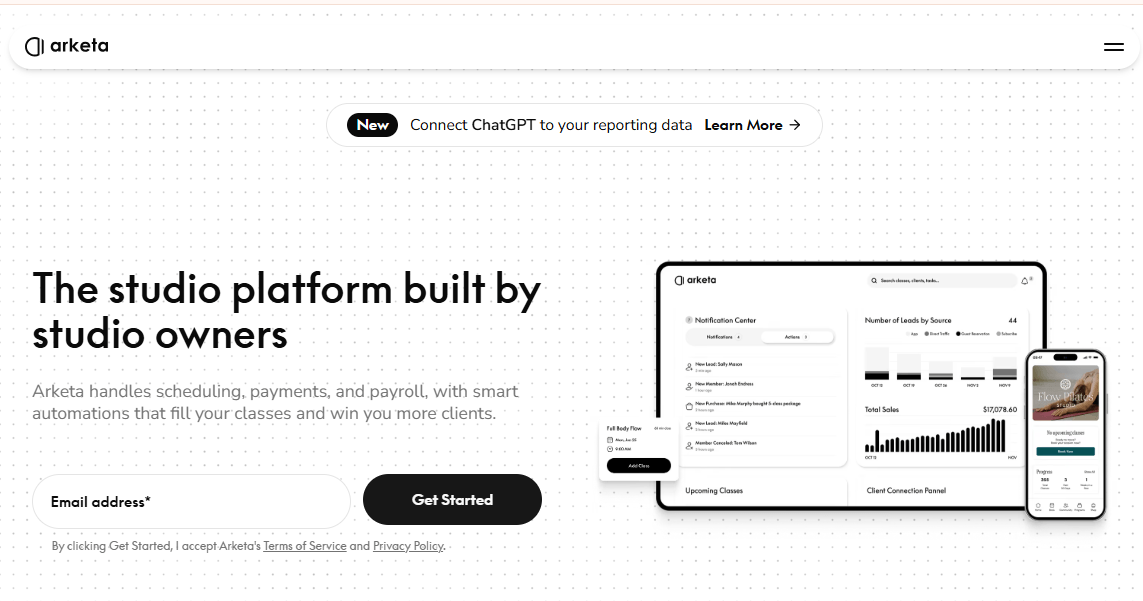
Arketa targets yoga, Pilates, and wellness studios and puts on-demand video alongside live classes. Every plan includes an unlimited on-demand library, allowing studios to sell recorded sessions alongside their regular timetable. The platform also schedules classes, private sessions, workshops, and events, while waitlists and guest passes help studios manage capacity.
Arketa offers an Individual plan for solo teachers and Studio plans for teams. Studios need to request a demo to receive Studio pricing. Higher Studio tiers add email and text campaigns, a lead pipeline, and a custom branded app.
Features
- Class, private session, and event scheduling
- Waitlists and guest passes
- Class packages and memberships
- Unlimited on-demand video library
- Client CRM
- Multiple rooms and locations on Studio plans
- Staff management and payroll reporting on Studio plans
- Embeddable booking widgets
Pros
- Every plan includes on-demand video, which suits studios that combine in-person and online teaching.
- Studio plans include unlimited team members, so the number of teachers does not directly determine the subscription cost.
- Arketa transfers clients, packages, and stored payment cards during migration and says most studios go live within four weeks.
Cons
- Studio plan prices require a demo.
- The Individual plan includes only one team login and adds a 3% transaction fee on top of Stripe fees.
Pricing
- Individual: $49/month billed annually
- Studio Core: Contact the provider for pricing
- Studio Growth: Contact the provider for pricing
- Studio Suite: Contact the provider for pricing
Best fit
Best for studios that teach both live and on-demand classes and want to manage both from one platform. Solo teachers can start with Individual, while larger teams should request a Studio quote.
4. Momence: A top yoga scheduling software for classes, workshops, and retreats
Momence puts classes, workshops, events, retreats, space rentals, and on-demand content on one calendar. This setup suits yoga studios that earn revenue from more than weekly classes, including teacher trainings, retreats, workshops, and recorded content. Studios can also sell memberships, class packs, intro offers, drop-ins, and subscriptions.
The platform connects marketing activity to booking behavior. Studios can capture leads, automate follow-up, and create campaigns based on attendance and purchases. Customers can book through the Momence app or through an app built around the studio’s brand.
Features
- Classes, appointments, workshops, events, retreats, spaces, and on-demand content on one schedule
- Memberships, class packs, intro offers, drop-ins, and subscriptions
- Lead capture and automated follow-up
- Campaigns based on booking, attendance, and purchase behavior
- Reports on attendance, customers, memberships, marketing, and revenue
- Payment and billing tools
- Momence app or a branded app
- AI inbox for customer messages
Pros
- One calendar for classes, workshops, and retreats suits studios with multiple revenue streams.
- Marketing campaigns use attendance and purchase data, allowing studios to base follow-up on actual student behavior.
- Studios can offer different pricing models, including drop-ins, packs, memberships, and subscriptions.
Cons
- The pricing page does not list subscription prices and directs studios to contact the team.
- Studios need to compare a quote to understand the full monthly cost.
Pricing
- Pricing: Contact the provider for pricing
- Free trial: Available through the sign-up link on the Momence site
Best fit
Best for studios that sell workshops, retreats, teacher trainings, and recorded classes alongside weekly sessions and want marketing tools connected to booking activity.
5. Punchpass: A top yoga scheduling software for class passes

Punchpass focuses on class passes, making it a strong option for yoga studios and teachers that sell classes through packs. Students buy a pass online and use it to book classes. Standing reservations also let regular students reserve the same class every week, which works well for studios with consistent schedules.
Every plan includes unlimited classes, passes, and instructors. Waitlists, private sessions, online waivers, and live online classes through Zoom or another video platform also come with every plan. Recurring memberships and family accounts start with Flow.
Features
- Online reservations and standing reservations for repeat students
- Waitlists for full classes
- Passes and class packages, with recurring memberships on Flow and Pro
- Private session booking
- Live online classes and a video content library
- Online waivers and self check-in
- Tools for managing no-shows and late cancellations
- Full reporting and three staff access levels
Pros
- Standing reservations work well for students who attend the same class every week.
- Every plan includes unlimited classes, passes, and instructors, keeping pricing predictable.
- Punchpass charges no add-on processing fees and uses Stripe for payments.
- The platform does not require long-term contracts.
Cons
- Recurring memberships, class series, and family accounts require Flow or higher.
- The lowest plan limits automations to three.
Pricing
- Grow: $59/month billed monthly
- Flow: $99/month billed monthly (annual billing carries a 12% discount)
- Pro: $149/month billed monthly
Best fit
Best for independent teachers and small studios that sell class passes and want waitlists and standing reservations without a long-term contract.
6. Walla: A top yoga scheduling software for established boutique studios
Walla serves fitness studios and separates its plans by scheduling, reporting, payroll, and marketing capabilities. Lite covers core scheduling, payments, and member management. Core adds class management, payroll and staff pay rates, equipment management, a video library, and KPI reports. Pro adds marketing automation, lead tracking, and automated subscription management.
Walla supports unlimited and limited class plans and intro offers for new students. Every plan includes free data migration. Its higher starting price makes it a better fit for established studios with steady revenue rather than solo teachers just starting out.
Features
- Core scheduling and online payments
- Unlimited and limited class plans, plus intro offers
- Credit bundles and promo codes (Core and Pro)
- Payroll and staff pay rates (Core and Pro)
- Equipment management and sub management (Core and Pro)
- Video library and courses (Core and Pro)
- Marketing automations, lead tracking, and lead forms (Pro)
- Client, class, and appointment reports
Pros
- Core includes payroll and staff pay rates, which helps studios that pay teachers per class.
- Free data migration reduces the work involved in switching platforms.
- The tiered plans allow studios to add marketing tools as their needs grow.
Cons
- Lite costs more than most entry-level options on this list.
- Walla targets fitness studios generally rather than yoga studios specifically.
- Reporting, promo codes, and several class management tools require higher plans.
Pricing
- Core: $299/month
- Pro: $599/month
- Custom
Best fit
Best for established boutique studios with several teachers that need reporting, payroll tools, and marketing automation and can support a higher monthly subscription.
7. Zen Planner: A top yoga scheduling software for membership-based studios
Zen Planner focuses on memberships, attendance, and recurring billing. It bases its pricing on active members rather than staff or prospects. A studio pays based on people who hold a membership or attended an event during the previous month. As a result, adding teachers does not automatically increase the subscription.
The platform originally targets gyms and martial arts schools, so yoga studios will find some features they may not need, including belt and skill tracking. However, it also provides online scheduling and booking, attendance tracking, staff payroll, and mobile apps for staff and members. Zen Planner operates month to month, with annual contracts available on request.
Features
- Membership management with automated billing
- Online scheduling and booking
- Attendance tracking
- Staff payroll and staff mobile app
- Member mobile app
- Reporting and dashboards
- Done-for-you data migration and a dedicated onboarding specialist
- Add-ons for a branded app, website, and marketing automation
Pros
- Active-member pricing means teachers and prospects do not increase the subscription cost.
- Month-to-month terms give studios more flexibility than long-term contracts.
- Onboarding includes done-for-you data migration.
Cons
- The platform targets gyms and martial arts schools, so some features do not apply to yoga studios.
- Payment processing fees may apply in addition to the subscription.
- The branded app, card readers, website, and marketing automation cost extra.
Pricing
- Studio: Starting at $99/month, scaled by active members
- Essentials: Starting at $198/month (adds a custom website)
- Ultimate: Starting at $348/month (adds marketing automation and CRM)
- New Business Bundle: Starting at $199/month
- Add-ons: Branded mobile app $39/month, card readers $39/month, Zen Planner Engage from $249/month
Best fit
Best for yoga studios that generate most of their revenue from recurring memberships and want subscription costs to depend on active members rather than the size of their teaching team.
8. Glofox: A top yoga scheduling software for branded member apps
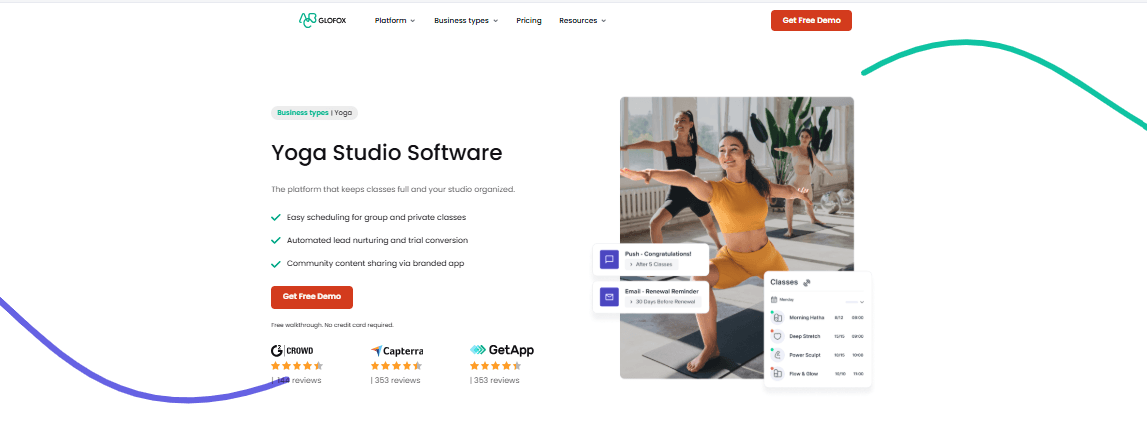
Glofox, part of ABC Fitness, focuses on branded member apps and automated billing. Students can book classes, purchase credit packs and memberships, and manage their accounts through an app that carries the studio’s name. The scheduling tools also include waitlists and automated reminders.
Glofox automatically handles failed payments, which can help studios reduce interruptions to recurring memberships. It supports yoga, Pilates, boxing, and other fitness businesses and provides centralized reporting for studios that operate multiple locations.
Features
- Class and appointment booking with waitlists
- Automated reminders
- Recurring memberships and credit packs
- Branded member app and web portal
- Automated handling of failed payments
- Email, SMS, and push messaging
- Staff management with a staff mobile app
- Reporting on revenue, retention, and class and instructor performance
Pros
- A branded app gives students a dedicated booking experience.
- Credit packs and memberships support different ways of selling classes.
- Multi-location tools and centralized reporting support studios planning to expand.
Cons
- The pricing page uses a quote form, so studios cannot compare subscription costs without contacting the provider.
- The platform serves gyms and fitness studios broadly, so studios should confirm that its class setup matches their yoga timetable.
Pricing
- Pricing: Contact the provider for pricing
Best fit
Best for yoga studios that want a branded app as their primary booking channel and plan to expand to multiple locations.
9. Vagaro: A top yoga scheduling software for budget-minded studios

Vagaro serves beauty, wellness, and fitness businesses, so yoga businesses can manage additional services such as massage, workshops, or private sessions from the same account. Its yoga offering includes renewable memberships, class packages, mat-spot booking, and a branded app. Its CRM also tracks attendance, member status, and class history.
Studios also receive a free listing on the Vagaro marketplace, a loyalty and rewards program, and a check-in app. Its relatively low starting price makes it worth considering for studios working with a tight budget.
Features
- Online booking with mat-spot reservations
- Renewable memberships and class packages
- CRM with attendance, member status, and class history
- Loyalty and rewards program
- Branded check-in app
- Free marketplace listing
- Payment processing
- Branded app option
Pros
- The low listed price suits solo teachers and small studios.
- The free marketplace listing can help studios reach local students.
- Businesses that offer classes and appointments can manage both from one account.
Cons
- Vagaro serves salons, spas, and fitness businesses, so yoga represents only one of its target industries.
- The site does not clearly state how pricing changes as a studio adds team members or classes.
Pricing
- Listed price: $30/month, shown at $23.99/month in a current promotion
- Payment processing: Rates as low as 2.2%
- Free trial: Available through the sign-up link on the Vagaro site
Best fit
Best for budget-conscious yoga businesses that also offer services such as massage or private appointments and want to manage them through one platform.
10. Acuity Scheduling: A top yoga scheduling software for private sessions
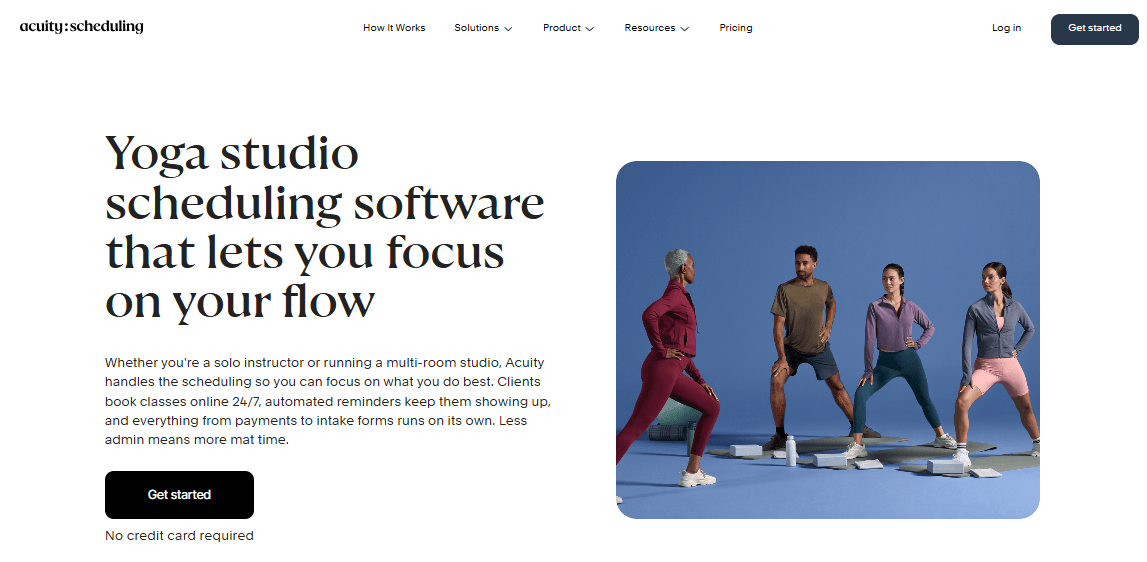
Acuity Scheduling focuses on appointments rather than full studio timetables. Yoga teachers can use it to sell private sessions and small groups, collect payments during booking, and gather student information through intake forms. The Standard plan adds packages, memberships, and a waitlist, allowing teachers to sell bundles of private sessions.
Acuity works less like a full studio management platform and more like an appointment booking system. Each teacher or location uses a calendar, with the plans supporting one, six, or 36 calendars. Although Acuity includes class scheduling, its design centers on appointments rather than a full recurring class timetable.
Features
- Online appointment booking with branded booking pages
- Payments and deposits through Stripe, Square, PayPal, or Venmo
- Custom intake forms for new students
- Email reminders, with text reminders on Standard and Premium
- Appointment waitlist (Standard and Premium)
- Packages, memberships, and gift certificates (Standard and Premium)
- Zoom and Google Meet integrations for online sessions
- Automatic time zone conversion
Pros
- The low entry price suits teachers who mainly book private sessions.
- Intake forms let teachers collect student information and consent before a first session.
- Automatic time zone conversion helps teachers work with students in different countries.
Cons
- Packages, memberships, waitlists, and text reminders require Standard or higher.
- Each teacher or location uses a calendar, so growing teams can reach the calendar limits.
- The platform focuses on appointments rather than full class timetables.
Pricing
- Starter: $16/month
- Standard: $27/month
- Premium: $49/month
Best fit
Best for independent yoga teachers who sell private sessions and small groups and do not need a full studio timetable.
How to choose the top yoga scheduling software
Start with how your studio makes money. If you rely on monthly memberships, compare each platform’s billing tools and how it handles member growth. Or you sell class packs, check how passes work and whether regular students can reserve the same class each week. If you combine live and recorded classes, check whether on-demand video comes with your plan or costs extra.
Then look beyond the monthly subscription. Compare transaction fees, paid add-ons for apps and websites, and pricing models that increase with staff, locations, or active members. Ask for a demo when necessary and test a real week of your timetable before you commit.
Independent teachers can start with a simple option such as Punchpass or Acuity Scheduling. Growing studios should compare staff limits, reporting, memberships, and marketing tools. Multi-location studios should check how each provider charges per location.
The top yoga scheduling software is not necessarily the platform with the most features. It is the one that fits your timetable, team size, business model, and budget without forcing you to pay for tools you will not use.