
Even a small oversight can cause delays, financial losses, or serious risks. Aviation professionals need to track inspections, manage compliance, control inventory, and document every detail while keeping aircraft airworthy and operational. People need aviation maintenance software because aircraft safety depends on precision. This software makes maintenance work clearer, faster, and more reliable. It keeps teams on the same page, ensures every task is logged properly, and reduces the chances of human error. It also helps organizations meet aviation regulations, which are strict and constantly updated. Instead of scrambling for records or guessing when an aircraft is due for inspection, the system alerts you automatically.
What is Aviation Maintenance Software
Aviation maintenance software helps aviation organizations track and manage aircraft maintenance, repairs, and overhaul operations in one central system. It automates maintenance scheduling, inspection tracking, inventory management, and compliance documentation, reducing manual work and errors. The software also supports work order management, parts procurement, regulatory reporting, and cost tracking. Overall, it helps maintenance teams make efficient, compliant, and informed decisions about aircraft airworthiness.
However, choosing the right aviation maintenance software can be challenging, especially when every option promises something different. Even so, you can make a confident decision when you know what features to look for and how each platform supports your goals. That’s we have put together the 10 best aviation maintenance software solutions of 2025.
Top 10 Best Aviation Maintenance Software
1. Veryon Tracking

Veryon Tracking (formerly Flightdocs) offers aircraft maintenance management software for business aviation, general aviation, and helicopter operators. The cloud-based platform brings maintenance tracking, work order handling, inventory updates, and flight operations into one system. Many operators use it to stay compliant, cut downtime, and keep accurate digital records. Because the system supports mobile use and automated processes, teams make quicker decisions, while the 24/7/365 support keeps operations steady.
Features
- Maintenance Tracking: Tracks scheduled tasks, inspections, airworthiness directives, and service bulletins while giving teams real-time visibility.
- Work Order Management: Creates digital work orders that include electronic signatures, photo uploads, and mobile access for technicians.
- Inventory Management: Monitors parts inventory through barcode scanning, automatic reorder triggers, and connections to purchase orders and shipping updates.
- Electronic Logbooks: Digitizes aircraft logbooks with customizable templates, electronic signatures, and a searchable history that helps technicians find information faster.
Pros
- User-friendly interface with clear navigation
- Helpful mobile app that supports technicians during field work
- Reliable customer support available at all hours
- Quick compliance insights that lower regulatory risks
- Smooth integrations with major aviation systems
Cons
- Adding a new aircraft to the platform may take several weeks
- Annual subscription fees often rise
- Some users say customer service dipped after recent acquisitions
Pricing
Starts at $1,750 per aircraft each year, plus a one-time enrollment fee that varies depending on aircraft type. Pricing reflects the number of aircraft, not the number of users.
Best For
Business aviation teams, general aviation operators, helicopter fleets, and MRO organizations that want maintenance tracking with mobile access and strong compliance support.
2. WinAir

WinAir has aviation maintenance software that helps organizations manage maintenance, inventory control, purchasing, and production activities. The system brings together key MRO functions with CAMO tools for forecasting and compliance. HR and technical teams use it to organize maintenance schedules, follow inspections, produce invoices, and keep full audit trails. It also connects smoothly with accounting systems and flight operations tools, which makes information move easily across departments.
Features
- Maintenance Tracking: Handles airframe and component maintenance while offering automated forecasting and compliance monitoring for FAA, EASA, and Transport Canada rules.
- Inventory Control: Supports real-time inventory management with barcoding, parts traceability, and multi-location tracking.
- Work Order Management: Builds clear work orders with labor tracking, parts assignment, and customizable workflows for maintenance teams.
- Production Planning: Predicts upcoming maintenance events and assigns resources according to aircraft schedules and component life limits.
Pros
- Simple to navigate with clear workflow structure
- Smooth connection between maintenance and inventory modules
- High data accuracy and dependable performance
- Helpful and responsive support team
- Modular setup allows the platform to grow with business needs
Cons
- New users may face a steep learning curve
- Interface design looks dated when compared with newer platforms
- Support hours are limited in some time zones
Pricing
WinAir price is available on request. But sources note a $1,500 per month subscription plan. Costs vary based on the number of modules chosen and company size.
Best For
Mid-sized and large aviation operators, MRO facilities, and CAMO organizations that want a complete maintenance and inventory system with strong compliance tools and multi-currency support.
3. Quantum MX

Quantum MX simplifies daily aircraft maintenance tasks by giving teams cloud-based tools for work orders, inventory control, compliance tracking, and documentation. It supports A&P shops and repair stations that want accuracy and faster turnaround times. Although users sometimes find it tricky to move through very large work orders, many still appreciate its affordability and QuickBooks connection. The system also helps users create essential documents like weight and balance reports, release forms, invoices, and 8130s. Because it stores data in an HTTPS-secured data center with nightly backups, users can work confidently and export their information whenever needed. Additionally, it offers a searchable history of work performed, installed parts, and logbook notes, which helps teams monitor maintenance events more easily.
Features
- Work Order Management: Handles the entire work order process from estimate to completion, and includes templates for repeating tasks.
- Parts Inventory: Monitors parts from purchase to installation and supports low-stock alerts and expiration tracking.
- Customer Portal: Gives customers online access to view aircraft status, approve estimates, and update flight times, while also supporting automated updates.
- Timesheet Tracking: Records technician hours for accurate billing and payroll, and offers mobile access for convenience.
Pros
- Affordable pricing for small and midsize shops
- Easy-to-learn interface
- Fast and helpful customer support
- QuickBooks connection for accounting
Cons
- QuickBooks setup may require extra effort
- Not ideal for large airline operations
Pricing
- Small A&P Shops at $79/month
- Medium A&P Shops at $109/month
- Medium to Large Repair Stations at $189/month
There are no setup fees or long-term commitments, and users can start with a 30-day free trial.
Best For
General aviation A&P maintenance shops, independent A&P/IA mechanics, Part 145 repair stations, and mobile AOG teams that want an affordable and easy-to-use maintenance management tool.
4. AvPro Software

AvPro Software gives small and midsize aviation businesses a modern way to handle maintenance and component tracking. It helps teams oversee inventory, repairs, and fleets in one place. Additionally, it supports MROs, repair stations, and fleet operators by combining maintenance tasks, work orders, component tracking, and accounting into a single system. Companies can deploy it either on-premise or in the cloud, and they can also generate FAA and EASA forms. The platform supports barcoded inventory, parts sales, full GAAP accounting, and component tracking from installation to retirement.
Features
- Barcoded Inventory: Tracks parts using barcode scanning, batch and serial numbers, and automatic reorder prompts.
- Component Tracking: Monitors each component through inspections, maintenance events, airworthiness directives, and service bulletins.
- Work Order Management: Creates work orders, assigns task cards, records labor time, allocates parts, and generates custom documents.
- Parts Sales Module: Supports quoting, sales orders, invoicing, and purchase orders while offering flexible pricing options.
Pros
- Offers deep customization for different aviation operations
- Provides cloud and on-premise deployment choices
- Ensures strong audit and traceability support
- Gives users direct access to a responsive support team
- Adapts easily to company documentation formats
Cons
- Interface looks somewhat old-fashioned
- Setup takes time during the initial implementation phase
Pricing
Starts at a one-time license fee of $2,995. You can also pick and pay for only the modules you want.
Best For
Aircraft MRO teams, FAA-certified repair stations, aircraft operators, parts brokers, and component repair facilities that want flexible aviation maintenance and inventory management.
5. EBIS
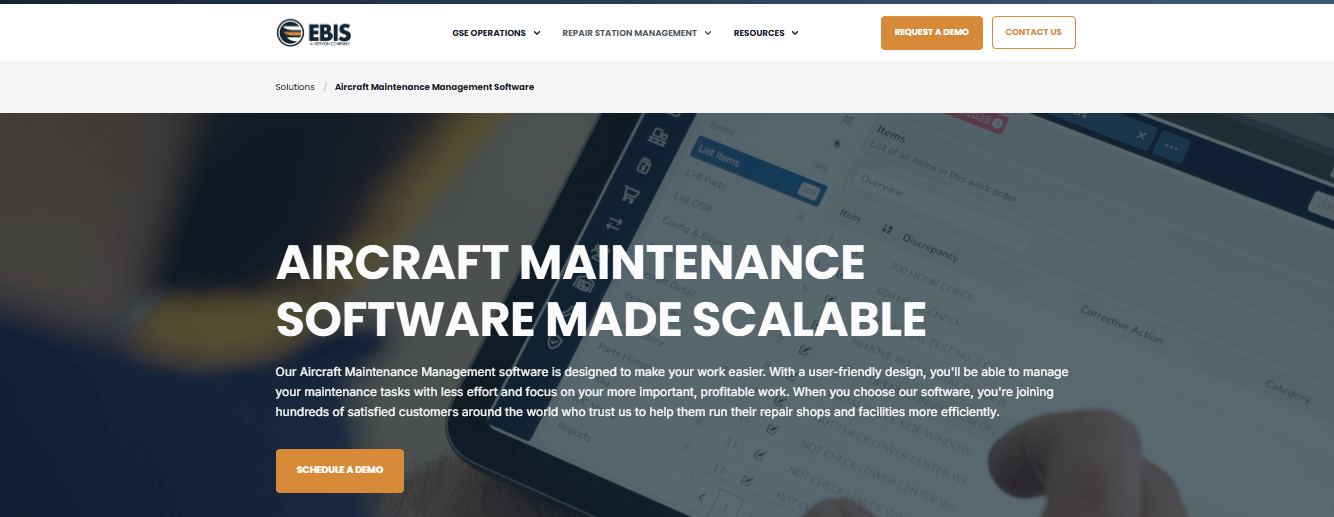
EBIS software supports repair stations by digitizing aviation maintenance activities, including ground support equipment (GSE). It helps teams manage daily tasks more efficiently, and it also improves how technicians, managers, and operators organize their work. Because the platform runs in the cloud, users can work from anywhere, which adds convenience for both commercial and general aviation operations. Many airside operators already use EBIS to cut ownership costs and gain clearer oversight of their maintenance environment. Additionally, the system brings together work order tools, parts control, mobile access for technicians, reporting, telemetry, and supply chain connections.
Features
- Work Order Management: Creates and tracks repair work orders with mobile access, component requests, and hour logging, helping teams stay productive even during busy periods.
- GSE Asset Management: Offers a complete database for ground support equipment and gives insights on usage, wear, depreciation, and preventive maintenance.
- Inventory Management: Monitors parts, generates purchase orders, and invoices customers while still supporting supply chain connections for part updates.
- Compliance Tracking: Manages compliance needs for aircraft, engines, and inspections with automated reminders and reports that help meet regulatory expectations.
Pros
- Very flexible with many configuration choices
- Strong implementation support
- Works for both aircraft and GSE maintenance teams
- Multi-tab setup encourages smoother multitasking
Cons
- First-time setup may feel overwhelming due to the many configuration choices
Pricing
Starts at $4,500 per year. EBIS offers custom quotes based on team size and required features.
Best For
Ground support equipment operators, FBOs, commercial aviation maintenance teams, general aviation repair shops, and Part 145 organizations that need flexible maintenance and asset management capabilities.
6. SAM

SAM Aviation is an aviation maintenance software that helps airline businesses manage aircraft upkeep, track components, and plan maintenance activities. It operates in the cloud and brings different maintenance functions into one system, so teams can monitor fleet health, act on issues early, and keep aircraft in service for longer. It also improves how maintenance teams communicate, since everyone works from the same real-time data. Because the software updates automatically, users stay aware of potential problems and can address them before they escalate.
Features
- Data and insights: The software delivers up-to-date information that supports quick and accurate decision-making. It also helps teams detect and resolve maintenance concerns sooner, which improves safety and reduces downtime.
- Task automation: It automates routine maintenance tasks, which cuts down on errors and allows teams to focus on high-priority work.
- Customizable dashboards: Users can adjust their dashboards to match their preferred workflow, making the system easier to use and more aligned with daily maintenance needs.
- Detailed reporting and analytics: It provides maintenance reports and analytical tools that help users discover patterns, track performance, and improve long-term planning.
Pros
- Fast and supportive customer service
- Cloud-based setup with no local servers required
- Quick setup that takes only a few weeks
- Modular structure that supports gradual expansion
Cons
• Some features require a bit of learning for new users
Pricing
Starting from €300 per month
Best For
CAMO operators, Part 145 MRO providers, aircraft operators of different sizes, and organizations that need complete maintenance tracking with strong compliance tools and EFB connectivity.
7. IQSMS