

Data warehouse companies face a higher level of risk than most SaaS vendors. A support tool may access a customer’s name and email address. A data warehouse platform can access the customer’s entire business. This may include revenue tables, user records, product telemetry, and sensitive health or financial data. The data can flow directly from Snowflake, BigQuery, Redshift, or Databricks. Enterprise security teams understand this risk and scrutinize data infrastructure vendors during procurement. This makes choosing the right SOC 2 Consultants for Data Warehouse Companies especially important.
A generalist consultant can help write policies and collect screenshots. However, data warehouse companies need deeper technical expertise. The right provider should understand role-based access control, data masking, row-level security, customer-responsibility matrices, cloud infrastructure, and multi-cloud data pipelines. It should also know how to document these controls and explain them to auditors.
What Should Data Warehouse Companies Look for in a SOC 2 Consultant?
- Relevant Technical Expertise: Choose a consultant that understands IAM, RBAC, VPCs, encryption, APIs, and modern data stacks. Experience with AWS, GCP, Azure, Salesforce, and HubSpot is also valuable.
- Hands-On SOC 2 Readiness Support: Look for providers that help identify and close control gaps, rather than only providing templates. Hands-on remediation can reduce the workload on engineering and security teams.
- Type I and Type II Support: The consultant should support both SOC 2 Type I and Type II and provide a clear path between them. This is important because enterprise buyers often expect Type II reports.
- Evidence Collection: Data warehouses generate extensive audit evidence, including query logs, access records, and infrastructure events. Providers that automate evidence collection and map it to controls can reduce manual work.
- Security and Compliance Expertise: The consultant should cover access control, encryption, vendor risk, incident response, change management, and monitoring. These controls need to reflect the company’s actual infrastructure and data flows.
- Enterprise Readiness: SOC 2 should help the company handle enterprise security reviews, not just complete an audit. The consultant should prepare teams for questions about subprocessors, data residency, encryption, access controls, and infrastructure.
- Data Stack Integrations: Choose a provider familiar with Snowflake, BigQuery, Redshift, Databricks, AWS, GCP, and Azure. They should understand the specific security controls within each environment.
- Pricing and Scalability: The provider should offer an affordable entry point for smaller data startups while supporting future growth. This includes adding frameworks such as ISO 27001 and expanding into enterprise markets.
Top 12 Best SOC 2 Consultants for Data Warehouse Companies
1. BARR Advisory
BARR Advisory is a licensed CPA firm that focuses on cloud-based companies and describes its practice around cybersecurity, compliance, and high-value information stored in environments such as AWS, Microsoft Azure, and Google Cloud Platform. That focus gives BARR a natural fit for data warehouse companies because many of the controls auditors test, including encryption, network segmentation, identity management, and logging, sit inside these cloud environments.
BARR performs SOC 1, SOC 2, and SOC 3 examinations and evaluates controls against the Security, Availability, Confidentiality, Processing Integrity, and Privacy Trust Services Criteria when they apply to an engagement. The firm has also automated parts of its audit workflow through a partnership with an evidence-automation platform. This approach can shorten audit cycles while keeping human review in the process.
For data warehouse companies, BARR’s cloud-first approach can reduce the amount of time spent explaining basic cloud architecture and allow the engagement to focus more directly on the controls that affect customer data.
Key features
- SOC 1, SOC 2, and SOC 3 examinations performed as a licensed CPA firm
- Dedicated focus on AWS, Azure, and GCP cloud infrastructure
- Multi-framework coordination covering ISO 27001, HITRUST, and PCI DSS
- Compliance automation partnership for evidence review
- Client-specific audit scoping rather than generic templates
Pros
- Strong cloud specialization rather than a generalist audit approach
- Works alongside compliance automation platforms such as Drata
- Experience with growth-stage SaaS and data infrastructure companies
- Multi-framework coordination can reduce duplicate evidence requests
Cons
- Does not publicly disclose pricing
- Works best when the client already has some internal security ownership
- Smaller than the largest national audit firms, which may matter to very large enterprises
Pricing
- Pricing: Custom quote
- BARR does not publish standard rates.
Best fit
Best fit: Growth-stage data platforms running primarily on AWS, Azure, or GCP that want an auditor with strong cloud infrastructure expertise.
SOC 2 fit for data warehouse companies
Cloud configuration often creates some of the biggest audit risks for a data warehouse company. IAM policies, encryption key rotation, network access controls, and logging can directly affect customer data. BARR’s cloud-first practice allows the team to spend more time examining those controls instead of explaining basic cloud architecture.
2. Prescient Security
Prescient Security approaches SOC 2 from a security engineering background rather than from traditional accounting alone. Its team includes penetration testers and security engineers who moved into auditing, which gives the firm a practitioner-level understanding of cloud architecture and application security.
That background can make a difference for data warehouse companies. Instead of simply identifying a control gap, a technically experienced auditor can better explain the underlying security issue and point the company toward a practical fix. The firm also holds recognition from the Cloud Security Alliance as one of its top 20 CSA STAR auditors globally.
Prescient can combine SOC 2 auditing with penetration testing and ISO 27001 certification. This model suits data infrastructure companies whose enterprise customers want both a formal compliance report and evidence that the company actively tests its security controls.
Key features
- SOC 1, SOC 2, and SOC 3 audits
- CSA STAR-recognized cloud security assessment capability
- In-house penetration testing through its Cacilian platform
- Continuous, AI-assisted penetration testing option
- Combined SOC 2, ISO 27001, and penetration testing engagements
- Global delivery across the U.S., Europe, and APAC
Pros
- Strong technical security background beyond standard audit checklists
- Useful for data companies facing demanding enterprise security reviews
- Can coordinate SOC 2, ISO 27001, and penetration testing
- Strong fit for SaaS and cloud-native companies
Cons
- Does not publicly disclose SOC 2 audit pricing
- Pentest-focused services can increase costs for companies that only need SOC 2
- May suit technically mature teams better than startups without any security function
Pricing
- Pricing: Custom quote
- Prescient does not publicly publish full SOC 2 audit engagement pricing.
Best fit
Best fit: Data infrastructure companies whose enterprise customers expect both a SOC 2 report and credible penetration-testing evidence.
SOC 2 fit for data warehouse companies
A breach of a data warehouse platform can expose large volumes of customer information, making penetration testing particularly important during enterprise procurement. Prescient’s security engineering and offensive-security background gives its team a practical understanding of how attackers could target cloud environments and warehouse infrastructure.
3. A-LIGN
A-LIGN is a large assurance provider that serves more than 6,400 organizations worldwide across frameworks including SOC 2, ISO 27001, FedRAMP, CMMC, ISO 42001, PCI, and HITRUST. Its scale and framework coverage make it particularly useful for data companies planning to enter regulated industries or expand into enterprise markets.
A data warehouse company may start with SOC 2 but later need HITRUST for healthcare customers, additional controls for government contracts, or ISO 27001 for international expansion. A-LIGN can support those requirements within a broader compliance roadmap.
The firm also operates A-SCEND, its proprietary compliance platform. The platform helps teams centralize evidence and map shared requirements across SOC 2, SOC 1, ISO 27001, and HIPAA. That can allow companies to reuse evidence instead of collecting the same access-control, encryption, and monitoring information repeatedly.
A-LIGN also uses a consultative scoping process to determine which Trust Services Criteria apply before testing begins.
Key features
- A-SCEND platform for centralized evidence submission
- Evidence de-duplication across multiple frameworks
- SOC 2, ISO 27001, ISO 42001, FedRAMP, CMMC, PCI, and HITRUST support
- Consultative SOC 2 scoping
- Dedicated FedRAMP practice
- Large delivery capacity across multiple engagements
Pros
- Broad framework coverage supports long-term compliance plans
- Technology-enabled evidence management reduces duplicate work
- Established reputation can support enterprise procurement
- Consultative scoping prevents unnecessary control testing
Cons
- Large-firm structure can provide less personal attention than boutique providers
- Does not publicly disclose pricing
- May feel less personalized than smaller specialist firms
Pricing
- Pricing: Custom quote
- A-LIGN does not publish standard SOC 2 rates.
- Third-party sources sometimes estimate comparable Type II engagements at $15,000–$50,000, but A-LIGN does not confirm this range as its own pricing.
Best fit
Best fit: Data companies that expect to add ISO 27001, HITRUST, FedRAMP, or other frameworks as they move into regulated and enterprise markets.
SOC 2 fit for data warehouse companies
Data warehouse companies serving healthcare, financial services, or government-related customers may eventually need more than SOC 2. A-LIGN’s cross-framework evidence approach can help companies reuse access-control, encryption, and monitoring evidence instead of rebuilding the same documentation for every new certification.
4. Schellman
Schellman is a licensed CPA firm that focuses on attestation and cybersecurity assessments rather than traditional accounting. The firm’s accreditation portfolio includes CPA firm status, PCAOB registration, ISO 27001 and ISO 42001 certification body status, FedRAMP 3PAO, CMMC C3PAO, StateRAMP, HITRUST assessor, PCI DSS QSA, and TISAX credentials.
That breadth makes Schellman particularly relevant to data warehouse and cloud infrastructure companies that expect their compliance requirements to expand. The firm works with SaaS, technology, and financial services organizations and can work alongside compliance automation platforms such as Drata and Vanta.
Schellman’s cloud and data center practice covers SOC 2, ISO 27001, CSA STAR, FedRAMP, and penetration testing. This gives cloud service providers a path to address several related security requirements through one assurance partner.
Key features
- SOC 1, SOC 2, and SOC 3 attestation
- FedRAMP 3PAO and CMMC C3PAO capabilities
- CSA STAR certification services
- ISO 27001 and ISO 42001 certification capabilities
- Compatibility with Drata and Vanta evidence workflows
- Dedicated cloud computing and data center audit practice
Pros
- One of the broadest accreditation portfolios among independent assurance firms
- Supports mid-market and enterprise data infrastructure companies
- Strong fit for security-sensitive technology buyers
- Works with existing compliance automation platforms
Cons
- Does not publicly disclose pricing
- Works best for companies with some internal security maturity
- Provides less hand-holding than platform-heavy compliance providers
Pricing
- Pricing: Custom quote
- Schellman does not publish standard Type II pricing.
Best fit
Best fit: Data infrastructure and cloud service providers preparing for enterprise or government-adjacent customers that may require FedRAMP, CMMC, CSA STAR, or other assessments alongside SOC 2.
SOC 2 fit for data warehouse companies
Enterprise vendor reviews increasingly examine cloud security maturity beyond SOC 2. Schellman’s accreditation portfolio gives data warehouse companies the option to expand into adjacent assessments without rebuilding their relationship with an assurance provider.
5. Thoropass

Thoropass combines compliance automation software with an in-house, AICPA-peer-reviewed CPA firm. Instead of asking a company to use one platform for preparation and then find a separate auditor, Thoropass keeps both functions within one provider.
That model can simplify compliance for data warehouse companies that manage complex cloud environments. The same provider can help collect evidence, monitor controls, and perform the audit, reducing the handoff between a compliance platform and an external CPA firm.
Thoropass supports more than 30 frameworks, including SOC 2, HIPAA, and PCI DSS. It also provides security control monitors and integrations based on the scope of the customer’s audit.
Thoropass stands out because AWS Marketplace listings provide relatively transparent starting prices compared with most providers in this category.
Key features
- In-house AICPA-peer-reviewed CPA firm
- Compliance automation platform
- Auditor-approved control monitors
- Pre-built integrations for evidence collection
- Shared control mapping for multiple frameworks
- AI-assisted evidence review
- AWS Marketplace pricing visibility
Pros
- Removes the software-to-auditor handoff
- One provider handles compliance automation and auditing
- Published AWS Marketplace pricing gives buyers a starting point
- In-house auditors participate from the beginning
Cons
- Smaller framework catalog than some larger automation platforms
- Less useful for companies that already have a preferred external auditor
- Less suitable for teams that specifically want auditor-independent automation
Pricing
- Pricing: Approximately $8,700/year for the platform subscription
- SOC 2 audit subscription: Approximately $5,800/year
- These figures come from AWS Marketplace listings.
- Final pricing varies according to company size, audit scope, and additional frameworks.
Best fit
Best fit: Data companies that want one provider to manage both compliance automation and the SOC 2 audit.
SOC 2 fit for data warehouse companies
Evidence collection for access reviews, encryption controls, and cloud infrastructure can create friction when separate vendors handle compliance preparation and auditing. Thoropass removes that handoff and keeps the process under one provider, which can make technical evidence reviews easier to coordinate.
6. Scytale
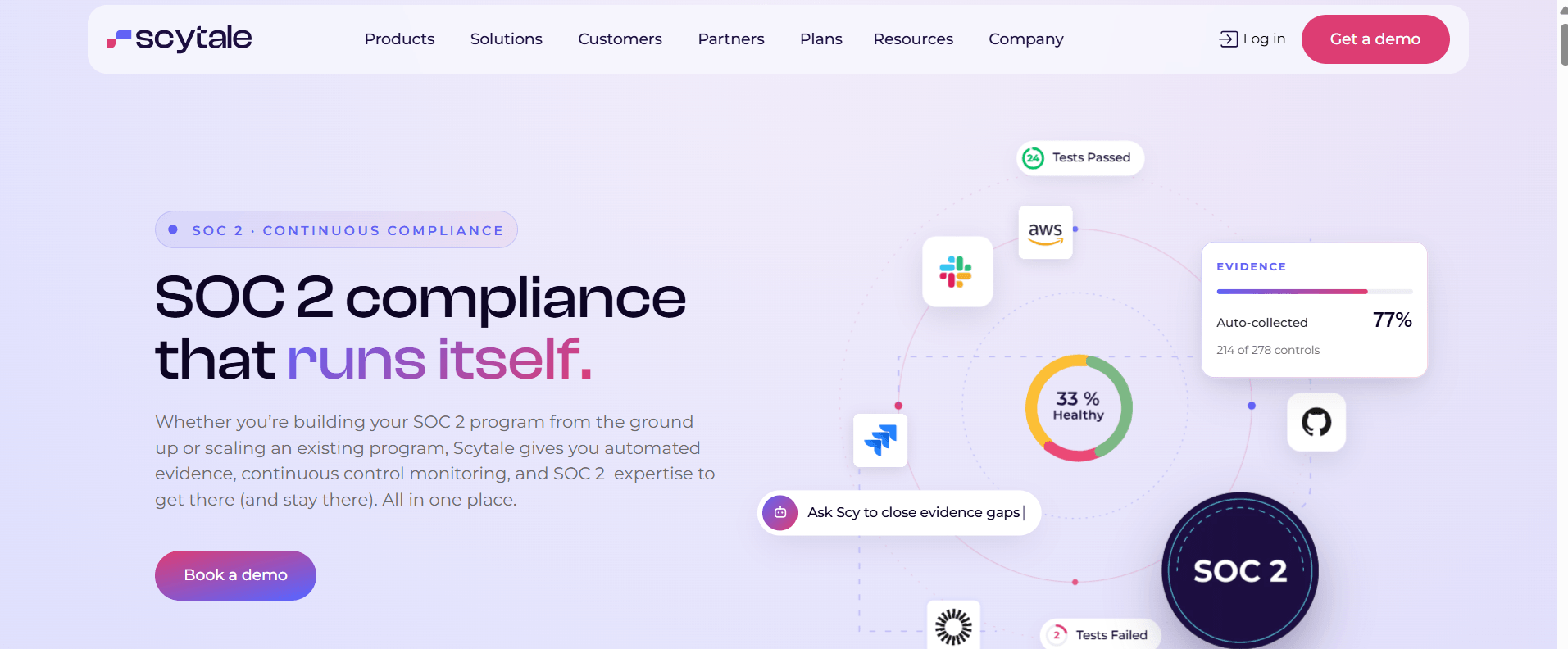
Scytale combines compliance automation with dedicated human GRC support. Instead of relying entirely on software, the company gives customers access to GRC experts who can help interpret requirements, close gaps, and prepare for audits.
This advisory model can benefit data warehouse startups that have strong engineering teams but no dedicated compliance leader. The company supports more than 80 security and privacy frameworks, including SOC 2, ISO 27001, ISO 42001, PCI DSS, GDPR, HIPAA, and SOX ITGC.
Its platform automates evidence collection, continuous control monitoring, user access reviews, vendor risk management, policy management, and audit preparation. For a data warehouse company, these capabilities can help turn technical activities such as production access reviews and cloud vendor monitoring into documented compliance evidence.
Key features
- AI-driven evidence collection
- Continuous control monitoring
- Automated user access reviews
- Vendor risk management
- Dedicated GRC expert support
- Policy management
- Customer-facing Trust Center
- Support for 80+ frameworks
Pros
- Strong option for teams without an internal compliance function
- Broad framework coverage supports future expansion
- Dedicated advisory support helps resolve compliance questions
- AI-assisted evidence review and policy generation reduce manual work
Cons
- Smaller native integration library than the largest platforms
- Does not publish standard pricing
- Advisory support may exceed the needs of technically mature teams
Pricing
- Pricing: Custom quote
- Scytale does not publish standard dollar figures on its pricing page.
- Third-party sources have reported entry pricing around $7,500/year for a single framework, but Scytale does not directly confirm that figure.
Best fit
Best fit: Data companies preparing for their first SOC 2 without a dedicated compliance or security leader.
SOC 2 fit for data warehouse companies
Many data warehouse startups build sophisticated technical products before they build formal compliance teams. Scytale’s GRC support can help translate technical realities, such as production query access and warehouse permissions, into the policies and evidence an auditor expects.
7. Vanta
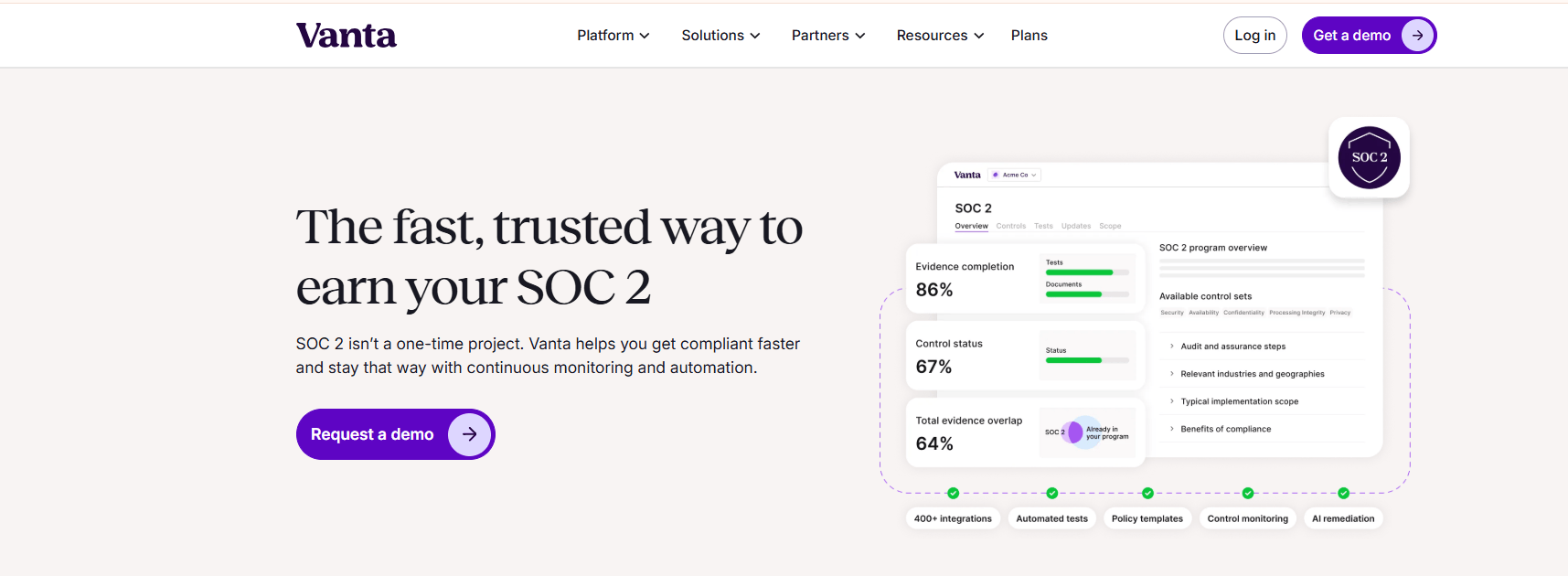
Vanta is one of the most established compliance automation platforms, and its direct work with Snowflake makes it particularly relevant to data warehouse companies.
The platformand Snowflake have created a joint compliance program for Snowflake Native App developers. The program allows eligible developers to inherit a meaningful portion of technical controls from Snowflake and use Vanta to streamline the remaining compliance work. This gives Vanta a concrete data-platform-specific advantage rather than relying solely on a general cloud integration.
Vanta supports SOC 2 Type I and Type II preparation, automates evidence collection, monitors controls, and helps companies work with independent auditors. Vanta does not issue the SOC 2 report itself. An independent CPA firm performs the audit and issues the final report.
Key features
- Direct Snowflake integration
- Snowflake compliance acceleration program
- Automated evidence collection
- Cloud, identity, and SaaS integrations
- Continuous control monitoring
- Real-time drift alerts
- Customer-facing Trust Center
- SOC 2, ISO 27001, HIPAA, and other framework support
Pros
- Named Snowflake partnership directly relevant to data warehouse companies
- Large integration ecosystem
- Strong brand recognition among enterprise buyers
- Continuous monitoring can identify configuration drift
Cons
- Does not publish standard pricing
- Still requires an independent CPA firm for the audit
- Complex multi-account AWS environments may require additional integration maintenance
Pricing
- Pricing: Custom quote
- Vanta does not publish standard pricing on its website.
- AWS Marketplace listings provide tiered starting costs, but Vanta’s primary pricing process remains quote-based.
Best fit
Best fit: Data companies using Snowflake or similar cloud data platforms that want broad automation and direct data-stack integrations.
SOC 2 fit for data warehouse companies
Vanta’s Snowflake relationship gives it one of the clearest data-warehouse-specific advantages among compliance automation providers. Companies already using Snowflake may be able to reduce part of the technical control burden instead of building their compliance program from scratch.
8. Drata
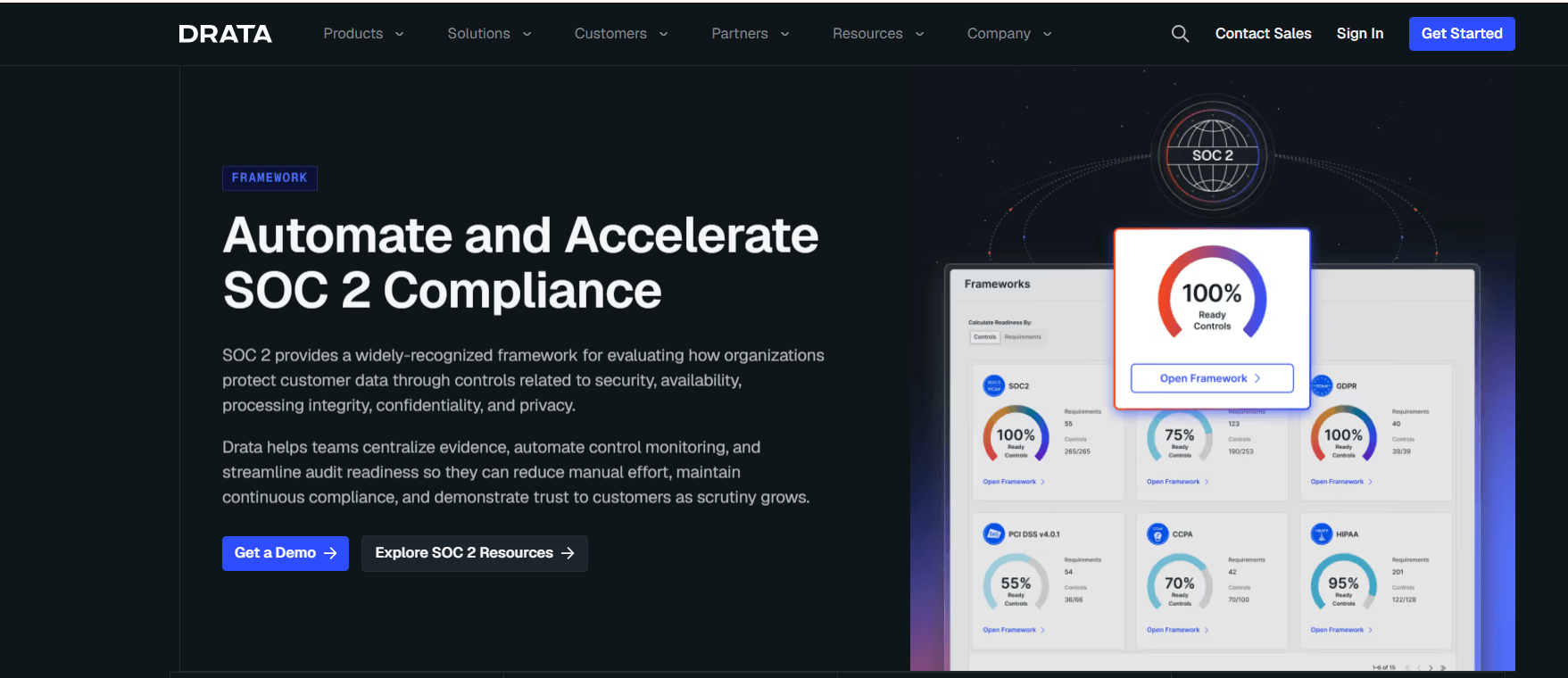
Drata provides GRC automation for more than 20 frameworks, including SOC 2, ISO 27001, HIPAA, PCI DSS, and GDPR. The platform combines automated monitoring, evidence collection, user access reviews, vendor risk management, and centralized security workflows across more than 200 integrations.
Drata’s control-mapping approach can help data warehouse companies that expect to pursue multiple certifications. A single access-control or encryption configuration may satisfy requirements across SOC 2, ISO 27001, and other frameworks. Mapping those requirements centrally reduces the need to document the same control repeatedly.
Drata does not issue SOC 2 reports. Instead, it prepares evidence and connects customers with independent CPA audit firms through its audit partner network.
Key features
- 200+ integrations
- Automated continuous control monitoring
- Compliance-as-code workflows
- Automated user access reviews
- Vendor risk management
- Multi-framework control mapping
- Audit partner network
Pros
- Broad integration library supports complex cloud environments
- Compliance-as-code works well for engineering-led teams
- Strong multi-framework control mapping
- Established network of audit partners
Cons
- Does not publish standard pricing
- Implementation can require more work than lighter-weight platforms
- Some users describe newer features as still developing
- Renewal pricing can be a concern according to some user reviews
Pricing
- Pricing: Custom quote
- Drata publicly identifies Foundation, Advanced, and Enterprise tiers.
Best fit
Best fit: Growth-stage data companies with engineering-led security teams that want compliance-as-code and a platform that can support multiple frameworks.
SOC 2 fit for data warehouse companies
Data warehouse companies often need to demonstrate the same access-control, encryption, and monitoring practices across several frameworks. Drata’s control mapping can reduce duplicate evidence work when companies move from SOC 2 into ISO 27001, HIPAA, or other compliance programs.
9. Secureframe
Secureframe focuses on agentless cloud scanning, which can appeal to data infrastructure companies that do not want to install monitoring agents inside production environments.
The platform connects to cloud infrastructure using read-only access rather than installed agents. Secureframe says it supports more than 150 cloud services across AWS, Google Cloud, Azure, and other environments. It also supports more than 45 pre-built compliance frameworks, including SOC 2, ISO 27001, CMMC, FedRAMP, HIPAA, PCI DSS, and NIST.
The company combines its software with in-house compliance experts and former auditors. This gives teams access to human guidance while the platform handles much of the technical evidence collection.
Key features
- Agentless, read-only cloud scanning
- Support for 150+ cloud services
- 300+ named integrations
- In-house compliance experts and former auditors
- Compliance policy library
- Personnel risk management
- Vendor risk management
- 45+ compliance frameworks
Pros
- Read-only scanning reduces the need to install agents in production
- Large integration library supports multi-cloud environments
- In-house experts can help first-time compliance teams
- Clear control-to-integration mapping
Cons
- Does not publish standard pricing
- Some users report integration synchronization issues
- Independent reviews position it above budget-focused competitors on price
Pricing
- Pricing: Custom quote
- Secureframe does not publish standard pricing tiers on its website.
Best fit
Best fit: Data companies running production workloads across multiple clouds that want technical compliance scanning without installing agents in sensitive environments.
SOC 2 fit for data warehouse companies
Data warehouse companies often take extra precautions around anything that touches production environments containing customer data. Secureframe’s read-only scanning model addresses some of that concern while automating a significant portion of the technical evidence collection required for SOC 2.
10. Sprinto
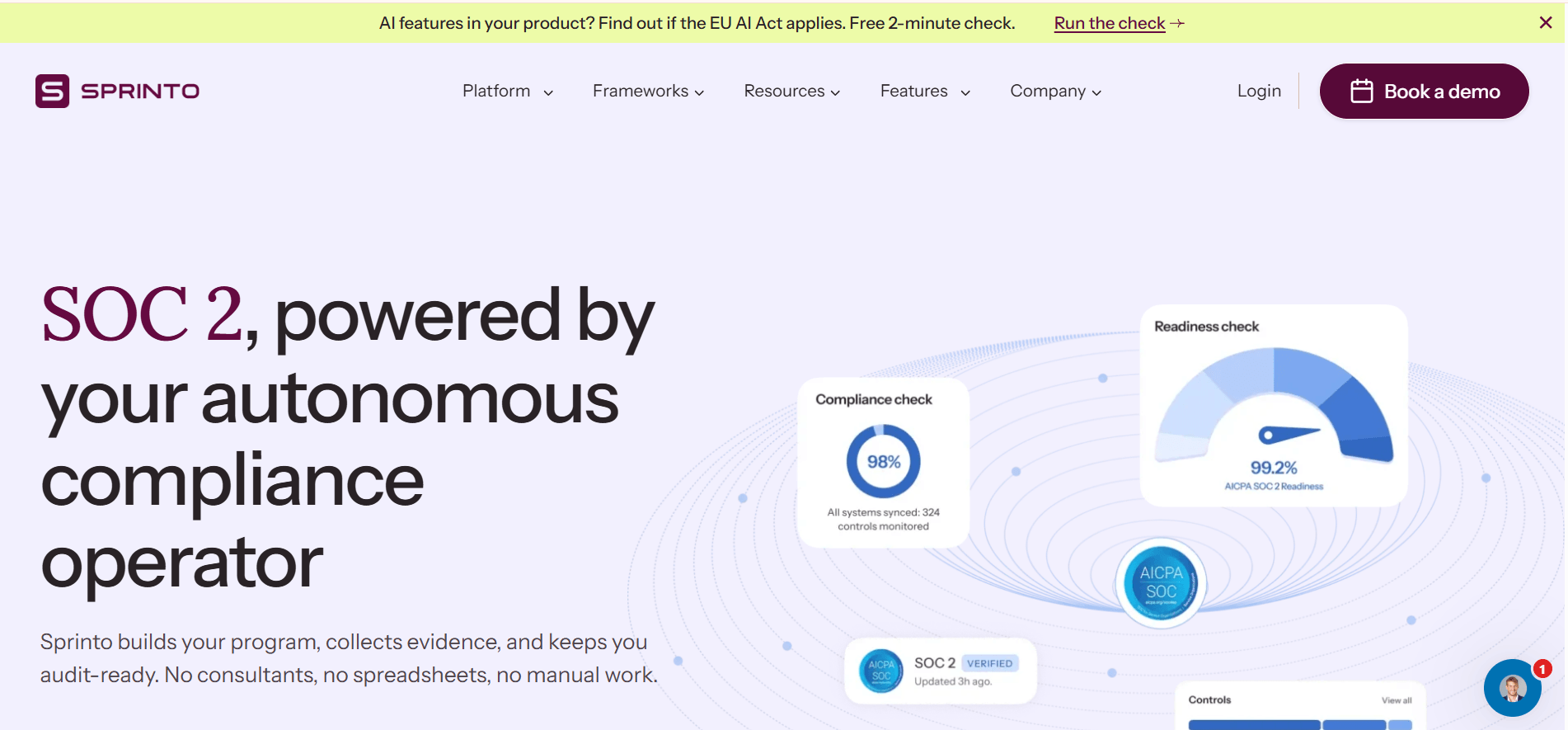
Sprinto targets fast-growing technology companies that need a structured path through compliance without committing to the cost or complexity of a large enterprise platform.
The company says its platform automates a significant portion of compliance work and uses continuous monitoring across more than 200 integrations. It also provides a guided implementation process designed for teams going through compliance for the first time.
Sprinto operates from India while maintaining a U.S. sales presence and works with U.S.-based audit firms for SOC 2 attestation. Its structured approach can help young data infrastructure companies establish the access controls, encryption practices, policies, and monitoring needed to satisfy enterprise security reviews without pulling engineering teams too deeply into manual compliance work.
Key features
- Guided, session-based implementation
- 200+ integrations
- Continuous control monitoring
- Real-time compliance alerts
- Shared control mapping across SOC 2, ISO 27001, and HIPAA
- Relationships with multiple U.S.-based audit firms
Pros
- Generally positioned as a lower-cost option than major automation platforms
- Structured onboarding suits first-time compliance teams
- Shared controls support future framework expansion
- Works with recognized external audit firms
Cons
- Does not publish binding pricing
- Structured implementation may feel restrictive to teams that prefer self-service
- Smaller integration footprint than some larger competitors
Pricing
- Pricing: Custom quote
- Final pricing depends on factors such as team size, framework count, and infrastructure complexity.
Best fit
Best fit: Early-stage data startups that need to complete their first SOC 2 and enterprise security review without a large compliance budget.
SOC 2 fit for data warehouse companies
A young data infrastructure company often needs to demonstrate basic warehouse access controls, encryption, monitoring, and security policies before it can close enterprise deals. Sprinto’s guided implementation can help the company establish those controls without dedicating a large internal team to compliance.
11. Oneleet
Oneleet approaches compliance from an offensive-security perspective. Its founder came from penetration testing and built the company around the idea that compliance reports alone do not necessarily demonstrate strong real-world security.
The platform combines penetration testing, risk assessments, evidence review, continuous environment monitoring, and compliance management. It also provides customers with a dedicated virtual CISO who helps design and implement the security program.
Oneleet can also manage communication with third-party auditors on behalf of customers. This bundled model makes it particularly relevant to security-conscious data infrastructure companies whose enterprise customers ask for penetration testing alongside SOC 2 certification.
Key features
- In-house certified penetration testing
- Dedicated virtual CISO
- AI-assisted risk assessments
- AI-assisted security questionnaire responses with human review
- Continuous environment monitoring
- Direct auditor coordination
- Cross-framework control mapping
Pros
- Combines penetration testing with compliance rather than treating them separately
- vCISO support helps companies without an internal security leader
- Strong fit for enterprise customers that request pentest evidence
- Technical roots in offensive security
Cons
- Smaller native integration library than major automation platforms
- Quote-based pricing can exceed automation-only providers
- One-framework-at-a-time approach may slow companies pursuing several certifications simultaneously
Pricing
- Pricing: Custom quote
- Independent reviews report SOC 2 Type II engagements commonly ranging from $15,000 to $30,000.
- Oneleet does not publish or directly confirm this range.
Best fit
Best fit: Security-conscious data startups whose enterprise customers require penetration testing alongside SOC 2.
SOC 2 fit for data warehouse companies
A data warehouse breach can expose a customer’s business data at scale. Enterprise buyers therefore often want evidence of active security testing rather than a compliance report alone. Oneleet’s bundled penetration-testing model addresses that requirement as part of the broader security program.
12. Linford & Company
Linford & Company is a boutique CPA firm based in Denver that focuses on SOC audits and information security assessments. The firm brings together former Big Four auditors and information security specialists and performs SOC 1, SOC 2, HITRUST, HIPAA, and FedRAMP assessments for organizations worldwide.
The firm’s technical approach combines knowledge of AICPA audit guidance and NIST standards with practical experience across information and software technologies. Unlike high-volume national auditors, Linford deliberately maintains a smaller structure and emphasizes partner involvement throughout engagements.
That model can appeal to data warehouse companies that want direct access to experienced auditors rather than routing technical questions through a large support structure. The firm can also provide penetration testing alongside audit services.
Key features
- SOC 1, SOC 2, and SOC 3 audits
- SOC for Cybersecurity and SOC for Supply Chain
- HITRUST, ISO 27001, ISO 42001, and FedRAMP capabilities
- Partner-level involvement throughout engagements
- Former Big Four auditors and information security specialists
- Penetration testing services
Pros
- Direct partner involvement throughout the engagement
- Strong technical expertise across information technologies
- Reputation for efficient and minimally intrusive fieldwork
- Serves small, mid-sized, and larger organizations
Cons
- Smaller capacity than the largest national audit firms
- Does not publicly disclose pricing
- Less automation-focused than platform-based competitors
Pricing
- Pricing: Custom quote
- Linford & Company does not publish standard audit fees.
- The firm positions its pricing as reasonable and fair relative to its experience but does not provide a public rate card.
Best fit
Best fit: Data companies that want a boutique, partner-led CPA relationship rather than a large automated compliance ecosystem.
SOC 2 fit for data warehouse companies
Some data warehouse companies may prefer direct access to experienced auditors over a platform-led process. Linford’s partner-involved model allows teams to discuss warehouse-specific technical questions directly with experienced professionals instead of relying primarily on automated workflows or support queues.
Final Verdict
SOC 2 carries extra weight for data warehouse companies because their products often provide direct access to sensitive customer data. Enterprise buyers understand that risk, so they scrutinize warehouse access controls, encryption, cloud infrastructure, and security practices closely during procurement. Choosing among SOC 2 Consultants for Data Warehouse Companies therefore requires more than comparing price or brand recognition. Technical understanding of cloud and warehouse architecture matters just as much.
There is no single best provider for every company. BARR Advisory and Prescient Security stand out for companies that want deep technical expertise built into the audit. Thoropass suits teams that want one provider to manage both compliance software and the audit, reducing coordination between separate vendors. Sprinto can work well for early-stage data startups that need a structured and more budget-conscious path to their first enterprise security review. Companies planning multiple frameworks may prefer A-LIGN or Schellman, while engineering-led teams may find Vanta, Drata, or Secureframe a better fit for ongoing automated compliance.
The right choice depends on your company’s size, technical maturity, budget, existing security resources, and how quickly you expect enterprise buyers to scrutinize your infrastructure.
Whatever provider you choose, treat your SOC 2 report as the floor, not the ceiling, of your security program. The companies that get the most value from SOC 2 use the process to build controls that work in practice, not simply to produce a report for the next sales questionnaire. For a data warehouse company, that means using the audit to strengthen how you protect customer data, manage access, monitor infrastructure, and respond to security risks long after the audit ends.