A lakehouse startup’s security setup is more complex than a typical SaaS environment. Data may move between Snowflake, Databricks, cloud storage, and other tools. Teams also manage warehouse access, IAM roles, service accounts, and pipelines that handle customer data. This is where SOC 2 compliance providers for lakehouse platform startups comes in.
When an enterprise buyer asks for a SOC 2 report, they are not just checking if you have a security policy. They want to know how you control access, protect customer data, manage changes, and monitor your environment.
That is why the best SOC 2 compliance providers for lakehouse platform startups need to understand more than standard SaaS controls. They should work with cloud infrastructure and data platforms, automate evidence collection, and fit into an engineering team’s existing workflow.
There is also an important difference between compliance platforms and SOC 2 audit firms. Compliance software can help you prepare for an audit and collect the evidence you need. But a licensed CPA firm is responsible for issuing the SOC 2 report.
Some providers focus on compliance automation. Others are CPA firms that conduct the audit. A few offer both. We have identified which one each provider offers so you can compare them based on what your startup actually needs.
Top 12 Best SOC 2 Compliance Providers for Lakehouse Platform Startups
1. Secureframe
Secureframe provides compliance automation rather than the SOC 2 audit itself. An independent partner CPA firm performs the examination and issues the report. Secureframe stands out for how deeply it integrates with data infrastructure. Its native Snowflake integration pulls user accounts, roles, grants, and network policies directly through Snowflake’s API. It also connects with MongoDB Atlas, AWS, GCP, Azure, DigitalOcean, Heroku, and Vercel.
For lakehouse startups, this matters because data warehouses and cloud infrastructure contain some of the most important security controls in the environment. Rather than treating Snowflake like another generic SaaS application, Secureframe makes it a first-class evidence source. This makes it one of the Best SOC 2 Compliance Providers for Lakehouse Platform Startups that rely heavily on Snowflake or MongoDB Atlas.
Key Features
- Native Snowflake API integration
- MongoDB Atlas, AWS, GCP, Azure, DigitalOcean, Heroku, and Vercel integrations
- Automated evidence collection
- Vendor risk management
- SOC 2, ISO 27001, HIPAA, PCI DSS, and GDPR support
Pros
- Monitors Snowflake grants directly instead of relying on a generic connector
- Broad modern-stack coverage, including Vercel and Supabase
- Extensive pre-built framework mappings
Cons
- No published pricing
- Setup can feel dense until integrations are configured
- Broad framework coverage may mean paying for capabilities a startup does not need yet
Pricing
- Custom pricing; Secureframe does not publicly disclose its rates
- Third-party procurement trackers report contracts commonly ranging from $7,500–$50,000 per year
- These third-party figures have not been confirmed by Secureframe
Best Fit
Lakehouse and data infrastructure startups using Snowflake or MongoDB Atlas that want to automate access-governance evidence collection.
2. Vanta
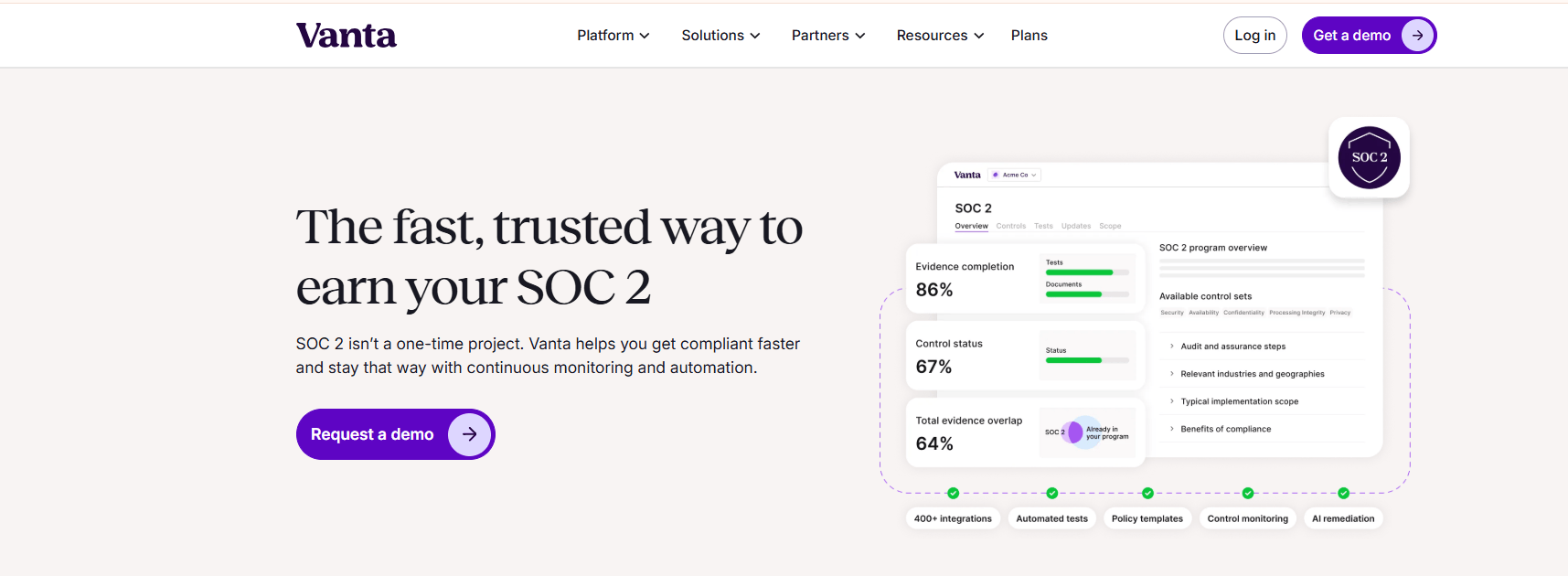
Vanta is one of the most recognizable compliance automation platforms for startups and growing technology companies. It manages compliance and readiness rather than performing the SOC 2 examination itself, so an approved CPA firm handles the attestation.
Vanta has built a dedicated Snowflake integration that monitors account access, MFA, and database inventory. Its large integration catalog also helps startups connect security controls across development, cloud, identity, and data systems without stitching together several monitoring tools.
For lakehouse startups selling to enterprise customers, Vanta’s brand recognition can also matter. Security teams at larger companies are more likely to recognize the platform, which can make the compliance review easier to navigate. This makes Vanta one of the Best SOC 2 Compliance Providers for Lakehouse Platform Startups focused on enterprise sales.
Key Features
- Native Snowflake integration
- 580+ integrations across AWS, GCP, Azure, development tools, and other systems
- AI-assisted continuous monitoring
- Public Trust Center
- Vendor risk management
- Security questionnaire management
Pros
- Strong brand recognition among enterprise security teams
- Active Snowflake partnership and continued investment in data-platform compliance
- Large integration catalog reduces monitoring gaps
Cons
- Fully quote-based pricing
- Vendor risk, Trust Center, and other modules can increase the total cost
- Reported pricing varies significantly by company size and scope
- Contract renewal terms require careful negotiation
Pricing
- Custom pricing; Vanta does not publicly disclose standard rates
- Third-party reports place contracts roughly between $10,000–$80,000+ per year
- The SOC 2 audit fee is separate and comes from the CPA firm performing the examination
Best Fit
Growth-stage lakehouse startups selling to enterprise customers where buyer familiarity with Vanta can help shorten security reviews.
3. Drata
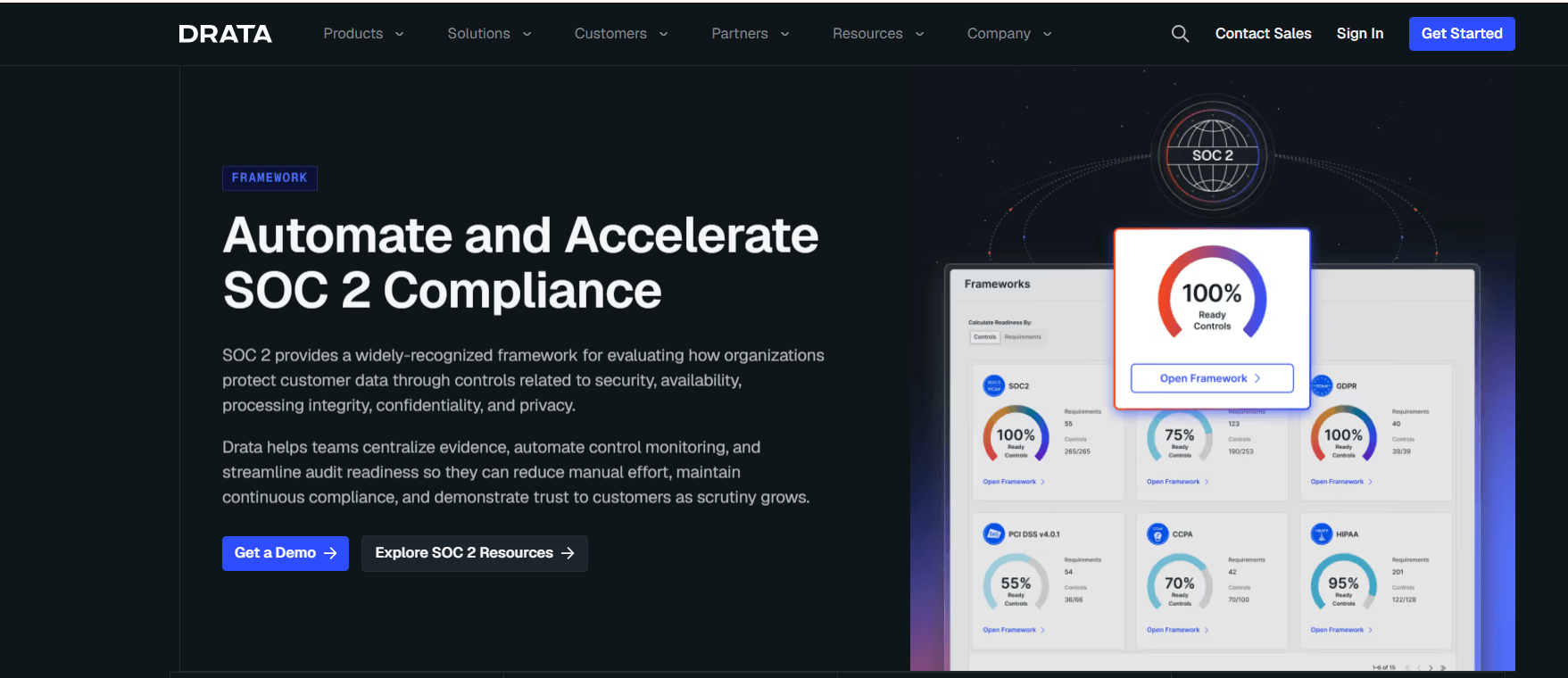
Drata combines automated compliance monitoring with infrastructure and security controls designed for engineering-heavy companies. It does not perform the SOC 2 audit itself; an independent partner CPA firm conducts the examination.
Drata expanded its technical capabilities through its acquisition of oak9, bringing infrastructure-as-code security scanning into the compliance workflow. It also acquired SafeBase to strengthen Trust Center and security questionnaire workflows.
This combination allows engineering teams to address infrastructure issues earlier while keeping evidence collection and customer-facing security documentation in the same environment. For startups that manage their cloud environment through Terraform or similar infrastructure-as-code tools, Drata can provide more technical depth than a basic evidence-collection platform.
Key Features
- 300+ integrations across AWS, GCP, Azure, GitHub, GitLab, and identity providers
- Infrastructure-as-code security scanning through oak9
- SafeBase-powered Trust Center
- Continuous monitoring across 30+ frameworks
- Automated evidence collection and control monitoring
Pros
- Infrastructure-as-code scanning can catch misconfigurations during development instead of at audit time
- SafeBase brings security questionnaires and Trust Center management into the same workflow
- Strong code repository and identity integrations
Cons
- No published pricing
- Reported pricing ranges from approximately $7,500–$50,000+ per year
- Integrating multiple acquired products can create some rough edges
- IaC scanning offers less value to teams that do not use Terraform or similar tools
Pricing
- Custom pricing
- Drata does not publicly disclose standard pricing
Best Fit
Engineering-heavy lakehouse startups that provision cloud infrastructure through infrastructure-as-code.
4. Sprinto
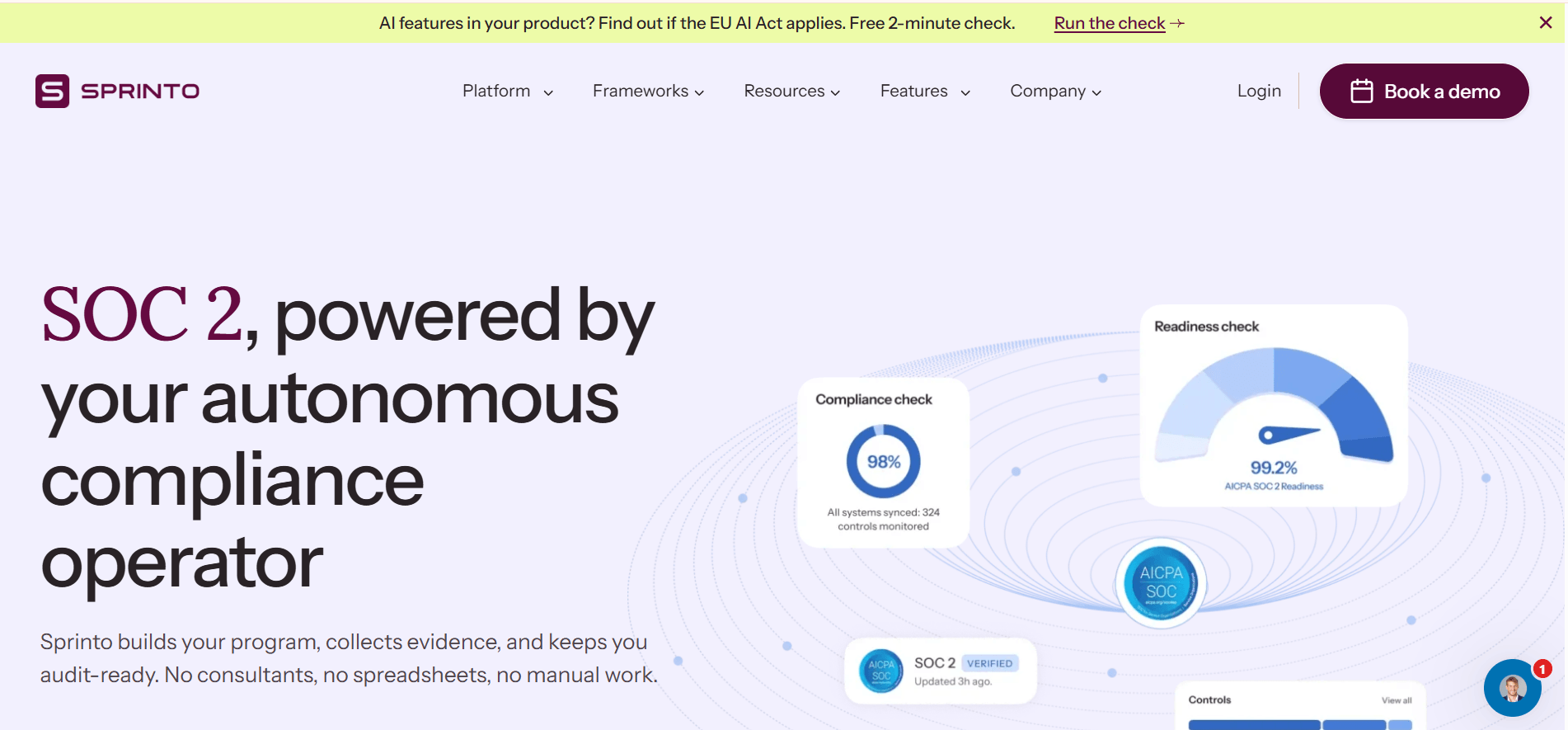
Sprinto focuses on compliance for cloud-based companies and combines automated monitoring with hands-on remediation guidance. A vetted auditor from Sprinto’s network performs the SOC 2 examination.
The platform connects directly with AWS, GCP, Azure, and more than 300 other tools. Its guided remediation feature goes beyond identifying a control failure. It helps engineers understand how to fix the issue inside the relevant cloud environment.
That approach makes Sprinto particularly useful for smaller lakehouse startups where the engineering team may also own security and compliance. Instead of handing engineers a long list of audit findings, Sprinto gives them practical steps they can use to resolve issues.
Key Features
- Native AWS, GCP, and Azure integrations
- 300+ connected tools
- In-console guided remediation
- Automated risk-register generation
- Continuous entity-level monitoring
- Vetted auditor network
Pros
- Gives engineers actionable remediation steps instead of simply reporting findings
- AWS Activate partnership can provide startup platform credits
- Reported fast time-to-certification
- SOC 2 Type I readiness has been reported to start at around 10 hours of setup
Cons
- No public rate card
- Pricing varies based on setup and scope
- AI questionnaire functionality reportedly struggles with complex spreadsheet formats
Pricing
- Custom pricing based on setup and scope
- Sprinto does not publicly disclose standard pricing
Best Fit
Small lakehouse startups without a dedicated security hire that need practical remediation guidance their engineers can act on.
5. Scrut Automation
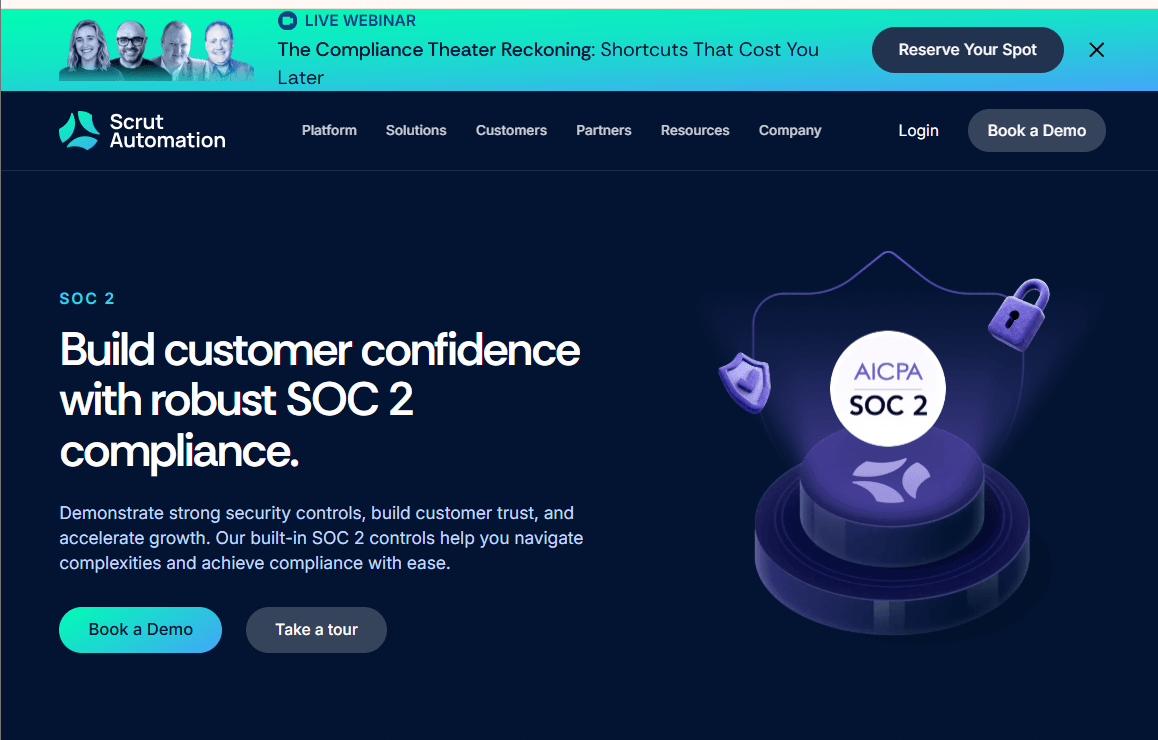
Scrut Automation takes a risk-first approach to compliance and GRC. Instead of focusing only on collecting audit evidence, it combines compliance automation with risk management, vendor management, policy management, and continuous security monitoring.
The platform supports more than 50 frameworks and monitors more than 230 CIS benchmarks. Scrut also bundles multiple frameworks into its subscription. This can make it attractive to lakehouse startups that expect to pursue additional certifications after SOC 2 instead of treating every framework as a separate purchase.
For startups planning to expand their compliance requirements over the next 12 to 18 months, Scrut can offer broader coverage from the beginning. This makes it one of the Best SOC 2 Compliance Providers for Lakehouse Platform Startups that expects compliance needs to grow beyond SOC 2.
Key Features
- 70–75+ integrations, including AWS, Azure, and GCP
- Continuous CIS benchmark monitoring
- Unified risk register
- Policy builder
- Real-time cross-framework dashboard
- Support for 50+ frameworks
Pros
- Framework-inclusive pricing avoids paying separately for every certification
- CIS benchmark monitoring provides deeper infrastructure-hardening visibility
- Strong audit-readiness support
Cons
- Initial setup can be more complex than lighter competitors
- No published pricing
- Smaller integration catalog for less common developer tools
Pricing
- Custom pricing
- Scrut does not publicly disclose standard rates
Best Fit
Lakehouse startups that expect to pursue multiple compliance frameworks within the next 12–18 months.
6. Thoropass

Thoropass combines compliance software with an in-house CPA firm, so it controls both sides of the SOC 2 process. Unlike platforms such as Vanta, Drata, and Secureframe, Thoropass does not need to coordinate the examination with an external audit firm.
Its CPA firm, Thoropass Assurance, performs the audit and signs the report. The platform also combines SOC 2 with ISO 27001, HIPAA, PCI DSS, and HITRUST.
This model reduces coordination between software and audit teams. It can also make sense for companies that expect their compliance requirements to expand beyond SOC 2. However, startups that prefer a completely independent relationship between their compliance platform and auditor may prefer another provider.
Key Features
- In-house CPA firm performs the SOC 2 audit
- 200+ integrations
- SOC 2, ISO 27001, HIPAA, PCI DSS, and HITRUST support
- AI-assisted evidence review
- Security questionnaire automation
- Compliance software and audit under one provider
Pros
- Removes the coordination gap between a compliance software provider and external auditor
- Bundles software and audit services
- Supports HITRUST alongside SOC 2
- Simplifies vendor management for companies pursuing multiple frameworks
Cons
- Software and audit services come from the same provider
- No fixed public pricing tiers
- Reported renewal increases of 5–10%
Pricing
- Custom pricing; Thoropass does not publish fixed tiers
- Vendr reports a median annual contract near $30,000
- Reported contract range is approximately $20,900–$53,300
- AWS Marketplace bundles reportedly start around $14,500 for platform plus audit
- These figures come from third-party sources and do not represent an official Thoropass rate card
Best Fit
Startups that want one provider for both SOC 2 compliance software and the audit, particularly companies also pursuing HITRUST.
7. A-LIGN
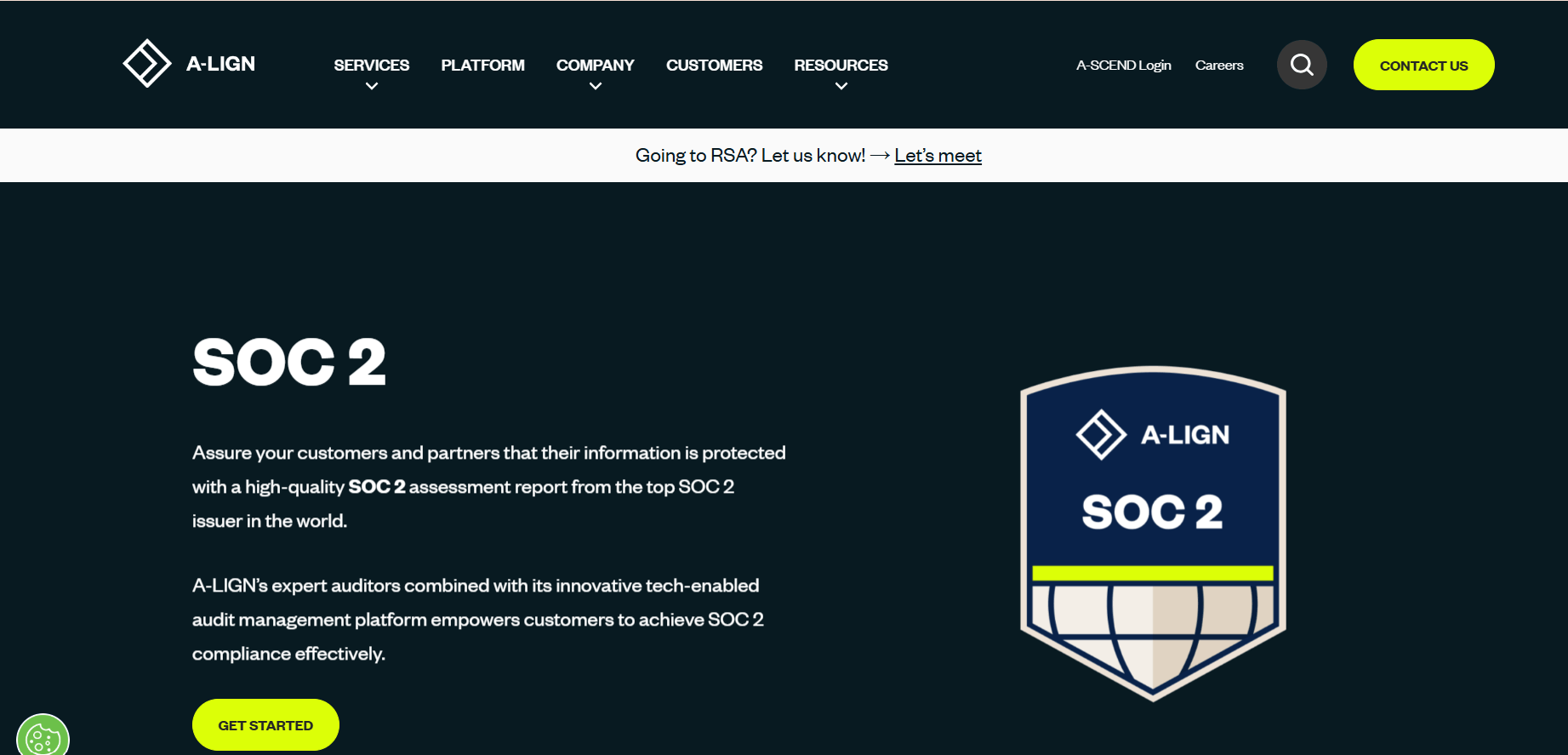
A-LIGN combines its A-SCEND compliance automation platform with an in-house licensed CPA firm. Its own audit team performs the SOC 2 examination and signs the report rather than handing the audit to a third-party partner.
Its scale gives A-LIGN experience across cloud-native and data infrastructure environments. For startups, its Startup Partnership Program stands out because eligible accelerator- and VC-backed companies can receive A-SCEND for a year and access discounted SOC 2 Type II audit pricing.
This combination makes A-LIGN particularly relevant to funded lakehouse startups that want both compliance software and auditing from one provider. Companies that do not qualify for the startup program will need to request a custom quote.
Key Features
- A-SCEND compliance automation software
- In-house SOC 2 audit team
- Cross-framework control mapping
- Continuous readiness tracking
- Startup Partnership Program
- ISO, healthcare, federal, and PCI audit capabilities
Pros
- Combines compliance software and audit services under one provider
- Startup Partnership Program reduces first-year costs for eligible companies
- Deep institutional audit experience
- Broad accreditation portfolio supports future compliance needs
Cons
- Standard pricing is not publicly disclosed
- Large-firm structure may offer less flexibility than smaller providers
- Startup discounts require accelerator or fund affiliation
Pricing
- Startup Partnership Program includes one free year of A-SCEND, normally $6,000 per year
- Type II SOC 2 security-only audit costs $15,000 through the program
- The stated standard price for the Type II audit is $24,000
- Standard pricing outside the program is not publicly disclosed
Best Fit
VC- or accelerator-backed lakehouse startups that qualify for startup pricing and want software and auditing from one provider.
8. Oneleet
Oneleet takes a security-first approach by combining compliance with penetration testing, attack-surface management, code scanning, device management, and virtual CISO support.
It coordinates the SOC 2 examination with an independent AICPA-accredited CPA partner rather than conducting the audit itself. This gives engineering-heavy startups more than an evidence-collection platform. They can also use the same provider for security testing and ongoing security support.
The main trade-off is cost. A startup looking only for SOC 2 readiness may pay for security services it does not currently need. For companies that already need penetration testing, vCISO support, and attack-surface monitoring, however, the bundled approach can reduce the number of vendors they manage.
Key Features
- SOC 2, ISO 27001, and HIPAA compliance automation
- Manual greybox penetration testing with retesting
- Attack Surface Management
- SAST/DAST code scanning
- Mobile device management
- vCISO support
Pros
- Combines pentesting, compliance, ASM, and vCISO services under one contract
- Strong reported customer satisfaction, with G2 ratings near 4.9
- Agentless attack-surface mapping
- Reduces the number of security vendors an engineering team needs to manage
Cons
- Costs more than a compliance-only platform if you do not need pentesting or vCISO support
- Smaller integration catalog than the largest compliance platforms
- Dashboard reportedly offers limited advanced report customization
Pricing
- Compliance package pricing is not publicly disclosed
- Standalone penetration testing is listed at $6,000
- Vendr reports a list price near $24,000 per year for the SOC 2 All-In-One package
- The reported bundle includes the platform, pentest, audit coordination, TrustPage, MDM, and vCISO support
Best Fit
Engineering-heavy lakehouse startups that want SOC 2 readiness alongside penetration testing and continuous attack-surface monitoring.
9. Hyperproof

Hyperproof takes a more enterprise-oriented GRC approach than many startup-focused SOC 2 platforms. Partnered CPA firms perform the audits, while Hyperproof handles compliance management, evidence collection, and control mapping.
Its pricing model stands out because it provides unlimited named users instead of charging per seat. This structure can work well for data infrastructure companies with large engineering teams, where adding more developers to the compliance process would otherwise increase software costs.
Hyperproof also provides common-control mapping, which helps companies reuse evidence across multiple frameworks. For growing lakehouse startups that expect to add more compliance requirements, this can reduce duplicate work.
Key Features
- Unlimited named users across tiers
- 60+ integrations
- Automated evidence collection
- Common-control mapping across frameworks
- Azure-hosted platform
- FedRAMP Moderate-authorized government environment through Hyperproof Gov
Pros
- Unlimited users prevent compliance costs from increasing with engineering headcount
- FedRAMP Moderate authorization demonstrates experience with regulated environments
- Common-control mapping reduces duplicate compliance work
- Stronger fit for multi-framework GRC than lightweight SOC 2-only tools
Cons
- Reported entry pricing of around $12,000 per year is higher than some startup-focused alternatives
- 60+ integrations is smaller than the largest platforms
- Enterprise-oriented positioning may mean more setup than startups seeking maximum speed
Pricing
- No official public pricing
- Third-party trackers report Professional pricing starting near $12,000 per year
- Reported median pricing sits around $40,000–$44,000 per year
- High-end contracts reportedly reach approximately $99,700 per year
- These figures are third-party estimates rather than official Hyperproof pricing
Best Fit
Growing lakehouse companies with large engineering teams where per-user pricing would become expensive.
10. Delve

Delve is an AI-native compliance automation platform designed to move companies from little or no compliance infrastructure to SOC 2 readiness quickly. It does not perform the audit itself; a partner CPA firm conducts the examination.
Delve uses AI agents to customize compliance workflows around a company’s technology stack and automate evidence collection and security questionnaire responses. It also includes manual greybox penetration testing with its audited frameworks and supports AI-focused frameworks such as ISO 42001 and NIST AI RMF.
These features make Delve particularly relevant to newer data and AI infrastructure companies facing enterprise security requirements on a short timeline.
Key Features
- AI agents that customize compliance workflows
- Automated evidence collection
- AI-powered security questionnaire autofill
- Complimentary manual greybox penetration testing
- Slack and Teams-based support
- ISO 42001 and NIST AI RMF support
Pros
- Reports average time-to-readiness of under seven days
- Slack support reportedly provides responses in under five minutes
- Includes penetration testing with audited frameworks
- AI-focused framework support suits AI and data infrastructure startups
Cons
- Founded in 2023, giving it a shorter track record than established competitors
- No published pricing
- Smaller framework-mapping library than more established platforms
Pricing
- Custom pricing based on company size, frameworks, and support requirements
- Delve does not publicly disclose standard pricing
Best Fit
Early-stage lakehouse and AI-data startups that need to reach SOC 2 readiness quickly to support an enterprise deal.
11. Schellman
Schellman takes a different position from most providers on this list. It is a licensed CPA and IT audit firm, not a compliance automation platform.
Instead of selling evidence-collection software, Schellman performs SOC 1, SOC 2, and SOC 3 examinations and supports a broad range of other assessments. It can also issue accredited ISO 27001 and ISO 27701 certificates and holds credentials across FedRAMP, CMMC, and PCI.
This makes Schellman particularly useful for startups that already use a platform such as Vanta, Drata, or Secureframe and need an experienced audit firm as their compliance requirements grow. Among the Best SOC 2 Compliance Providers for Lakehouse Platform Startups, Schellman is the clearest choice for companies that need the auditor rather than another automation platform.
Key Features
- Independent SOC 1, SOC 2, and SOC 3 examinations
- Authority to issue ISO 27001 and ISO 27701 certificates
- FedRAMP 3PAO status
- CMMC C3PAO authorization
- PCI QSAC/ASV capabilities
- Works with Vanta, Drata, Secureframe, and other compliance platforms
Pros
- Supports SOC, ISO, FedRAMP, CMMC, and PCI requirements through one audit firm
- Published baseline audit pricing provides more transparency than many competitors
- Works with the automation platform a startup already uses
- Strong fit for companies expecting more complex compliance requirements
Cons
- Does not provide its own compliance automation software
- Requires a separate platform for ongoing evidence collection and monitoring
- Larger firm structure may provide less of a boutique experience
- FedRAMP and CMMC assessments can become significantly more expensive
Pricing
- SOC 2 Readiness: $18,000–$25,000
- SOC 2 Type I: $25,000–$39,000
- SOC 2 Type II: $30,000–$55,000
- Vendr reports a median contract near $52,000, reflecting larger or multi-framework engagements
Best Fit
Lakehouse startups that already have a compliance automation platform and want an experienced audit firm with broad multi-framework accreditation.
12. Conveyor

Conveyor does not help companies become SOC 2 compliant or perform the audit. Instead, it helps companies use their completed compliance work during enterprise sales.
The platform automates security questionnaires, manages a customer-facing Trust Center, and helps sales and security teams respond to buyer requests. Its AI generates questionnaire answers from existing documentation, while its browser extension can populate questionnaires inside portals such as OneTrust and ServiceNow.
For a lakehouse startup that already has SOC 2 but spends significant time answering repetitive security questions, Conveyor addresses the next bottleneck in the enterprise sales process. It therefore works best as a complement to one of the other providers rather than as a replacement.
Key Features
- AI-generated questionnaire responses based on company documentation
- Self-service, NDA-gated Trust Center
- Browser extension for security questionnaire portals
- Support for portals such as OneTrust and ServiceNow
- Credit-based usage
- Unlimited seats
Pros
- Publishes transparent pricing
- Reduces time spent answering repetitive security questionnaires
- Unlimited seats allow sales, security, legal, and other teams to collaborate without per-user charges
- Helps companies get more commercial value from their existing SOC 2 work
Cons
- Does not help companies obtain SOC 2
- Works as a complement to the other providers rather than a replacement
- Complex spreadsheet questionnaires may still require manual cleanup
Pricing
- Free tier with a limited Trust Center and no questionnaire automation
- Business: $9,600 per year with unlimited seats and defined credit allowances
- Enterprise: Custom pricing for higher-volume usage
Best Fit
Lakehouse startups that already have SOC 2 and now spend significant sales-team time answering repetitive enterprise security questionnaires.
How to Choose the Best SOC 2 Compliance Provider for a Lakehouse Platform Startup
Look Beyond SOC 2 Certification
Choosing the right SOC 2 compliance provider for a lakehouse platform startup comes down to more than getting a report. The right provider should fit your technology stack, reduce the work compliance creates for your engineering team, and support the security requirements your customers will expect as you grow.
Start with technical integrations. Check that the platform can connect directly to your cloud provider, data warehouse or lakehouse platform, identity provider, and code repositories. Native integrations matter because every system that requires manual evidence uploads creates more work for engineers. A platform that can automatically monitor Snowflake permissions, cloud configurations, or identity controls can save significant time throughout the audit cycle.
Next, look at the engineering workload. Compare how much evidence the platform collects automatically with how often engineers need to provide screenshots or manually explain configurations. Features such as Sprinto’s guided remediation and Drata’s infrastructure-as-code scanning can help engineering teams fix issues as they arise instead of dealing with them during an audit.
Type II readiness should also influence the decision. Type I evaluates whether controls are appropriately designed at a point in time, while Type II evaluates whether those controls operated effectively over a period, typically three to twelve months. Since enterprise customers increasingly ask for Type II reports, startups should prioritize providers that support continuous monitoring rather than treating compliance as a one-time project.
Consider Growth, Sales and Total Cost
Consider your sales process as well. SOC 2 can help answer customer security questions, but it will not eliminate security questionnaires altogether. If your startup sells to enterprise customers, you may eventually need a tool such as Conveyor to manage questionnaires, Trust Center requests, and other security reviews that continue after certification.
Finally, think beyond your first audit. Your employee count, infrastructure, customer base, vendors, and compliance requirements will change as the company grows. Per-seat pricing can become expensive as engineering teams expand, while unlimited-user or framework-inclusive models can provide more predictable costs.
Pricing also varies widely, and many providers do not publish their rates. Where public pricing exists, use it as a benchmark. For providers with custom pricing, compare quotes from at least two or three vendors before making a decision.
The best SOC 2 compliance provider for a lakehouse platform startup is ultimately the one that understands your technical environment, minimizes engineering overhead, supports the level of assurance your customers require, and can grow with the company. A cheaper platform is not necessarily the better choice if it creates more manual work, while the most feature-heavy platform may be unnecessary if your immediate goal is simply to achieve and maintain SOC 2 Type II.