Mergers and acquisitions move fast, and security due diligence has to keep pace. As a result, deal teams increasingly search for the best SOC 2 vendors for companies going through M&A before a term sheet is even signed, because a target’s compliance posture can make or break a deal timeline. Indeed, choosing the right platform early gives both the acquirer and the target a shared, verifiable record of security controls, which speeds up diligence and reduces the risk of last-minute surprises. Furthermore, once a deal closes, that same platform often becomes the backbone for consolidating two companies’ compliance programs into one.
Consequently, picking a vendor that scales smoothly across multiple entities, frameworks, and audit cycles matters just as much as picking one that gets a first SOC 2 report over the finish line. In this guide, we break down the twelve strongest options on the market today, so your team can move through diligence and integration with confidence rather than guesswork.
Top 12 Best SOC 2 vendors for Companies going through M&A

Vanta anchors nearly every shortlist of SOC 2 vendors for Companies going through M&A, and for good reason: the platform connects directly to AWS Lambda, Google Cloud Functions, and Azure Functions accounts alongside traditional infrastructure, then continuously tests those resources against SOC 2 criteria. Because M&A due diligence teams must verify security posture across every subsidiary quickly, Vanta’s broad integration library lets buy-side and sell-side teams pull evidence within days rather than months.
Founded to remove the spreadsheet-driven grind of manual audits, Vanta now serves well over sixteen thousand organizations and maintains one of the largest integration catalogs in the category. During a merger, that breadth matters: an acquiring company can connect a target’s AWS, GCP, Okta, and GitHub accounts in a single afternoon and immediately see where the target’s controls fall short of the acquirer’s own compliance baseline.
Features
- Continuous, automated evidence collection across 400+ cloud, identity, and DevOps integrations
- Cross-mapped controls spanning 35+ frameworks, including SOC 2, ISO 27001, HIPAA, and GDPR
- Real-time monitoring with hourly control tests and instant drift alerts
- AI-assisted policy generation and remediation guidance
- A public-facing Trust Center that lets acquirers self-serve a target’s compliance documentation during diligence
Pros
- Fastest onboarding in the category, which suits compressed M&A timelines
- Deep coverage of cloud-native and serverless stacks, so newly acquired engineering teams rarely need to rip out tooling
- Large auditor marketplace that speeds up the selection of a CPA firm familiar with Vanta’s evidence exports
Cons
- Surfaces failing controls but does not remediate them automatically
- Costs climb quickly once a buyer adds multiple frameworks or multiple acquired entities as separate workspaces
Pricing
Vanta does not publish list prices. Observed annual contracts run from roughly $10,000 for an early-stage company on a single framework to $80,000 or more for multi-entity enterprises layering SOC 2, ISO 27001, and HIPAA.

Drata built its reputation on depth of automation, and that depth is exactly what an acquiring company needs when it inherits a target’s compliance program mid-deal. Because Drata maps a single control across dozens of frameworks simultaneously, integration teams can consolidate two companies’ overlapping SOC 2, ISO 27001, and HIPAA programs into one workspace rather than running duplicate audits.
Drata supports 30-plus frameworks and connects to the same serverless-friendly stack that most cloud-native acquisition targets already run, which is why it consistently appears among the SOC 2 vendors for Companies going through M&A that due diligence teams shortlist first. Its customer-success model, which reviewers repeatedly praise, also helps when an M&A integration team needs a responsive point of contact rather than a ticket queue during a tight closing window.
Features
- Continuous control monitoring across AWS, GCP, Azure, GitHub, and identity providers
- Support for 30+ frameworks with cross-framework control mapping to avoid duplicate evidence work
- Automated user access reviews, useful for reconciling access after a workforce merges
- A Trust Center (via the SafeBase acquisition) for sharing compliance posture with an acquirer or acquired entity
- Multi-workspace and multi-entity support for holding companies managing several subsidiaries
Pros
- Highly rated customer success team, frequently cited as the platform’s biggest differentiator
- Strong multi-framework reuse, which shortens the time needed to harmonize two companies’ compliance programs post-close
- Multi-entity workspace support fits carve-outs, roll-ups, and holding-company structures common in M&A
Cons
- Advanced modules such as Compliance-as-Code Pro and Risk Management Pro cost extra
- The Trust Center is now a separate SKU rather than a bundled feature
Pricing
Drata offers Foundation, Advanced, and Enterprise tiers, none of which are publicly priced. Third-party procurement data shows observed annual contracts ranging from about $7,500 for a small single-framework program up to $100,000 or more for enterprise buyers running unlimited frameworks across multiple entities. Expect each additional framework to add $1,500–$7,500 per year, with audit fees and Trust Center access billed separately.
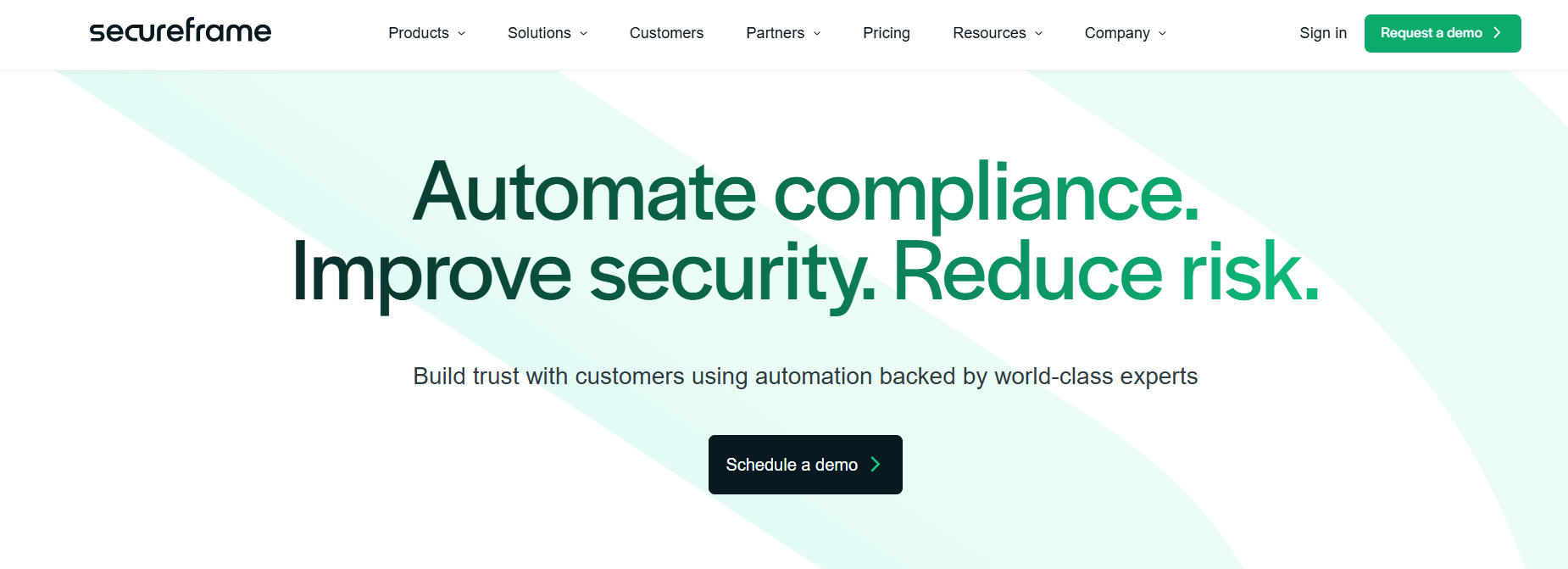
Secureframe pairs automated evidence collection with a genuinely hands-on customer success motion, which makes it a strong option when an M&A integration team lacks in-house compliance staff. The platform covers SOC 2, ISO 27001, HIPAA, PCI DSS, GDPR, and increasingly FedRAMP and CMMC, so it scales well when an acquirer needs the target to meet a broader regulatory bar than the target originally pursued on its own.
Secureframe’s roughly 300 integrations reach deep into custom and less common infrastructure, not just the standard AWS-GitHub-Okta trio, which is valuable when a legacy target’s environment does not look like a typical modern stack. That flexibility is one reason Secureframe keeps appearing on lists of-_- alongside more cloud-native-first competitors.
Features
- 300+ integrations spanning cloud infrastructure, identity, HR, and ticketing systems
- AI-assisted remediation guidance and automated security-questionnaire responses
- Cross-framework control mapping across SOC 2, ISO 27001, HIPAA, PCI DSS, and GDPR
- Dedicated compliance support for regulated industries pursuing FedRAMP or CMMC
- Employee security-training modules bundled into the base platform
Pros
- Genuinely strong hand-holding for teams navigating their first or second audit, a common scenario after an acquisition brings on a less mature target
- Broad framework depth beyond SOC 2, useful when acquirers need to lift a target up to enterprise-grade compliance quickly
- Competitive entry pricing relative to Vanta and Drata for simple, single-framework programs
Cons
- Feature gating behind the higher Complete tier can frustrate teams that expected everything in the base plan
- Not the cheapest option for straightforward, cloud-native stacks; Sprinto or Strike Graph often undercut it there
Pricing
Secureframe’s Fundamentals plan generally runs $7,500–$20,000 per year for small teams on a single framework.
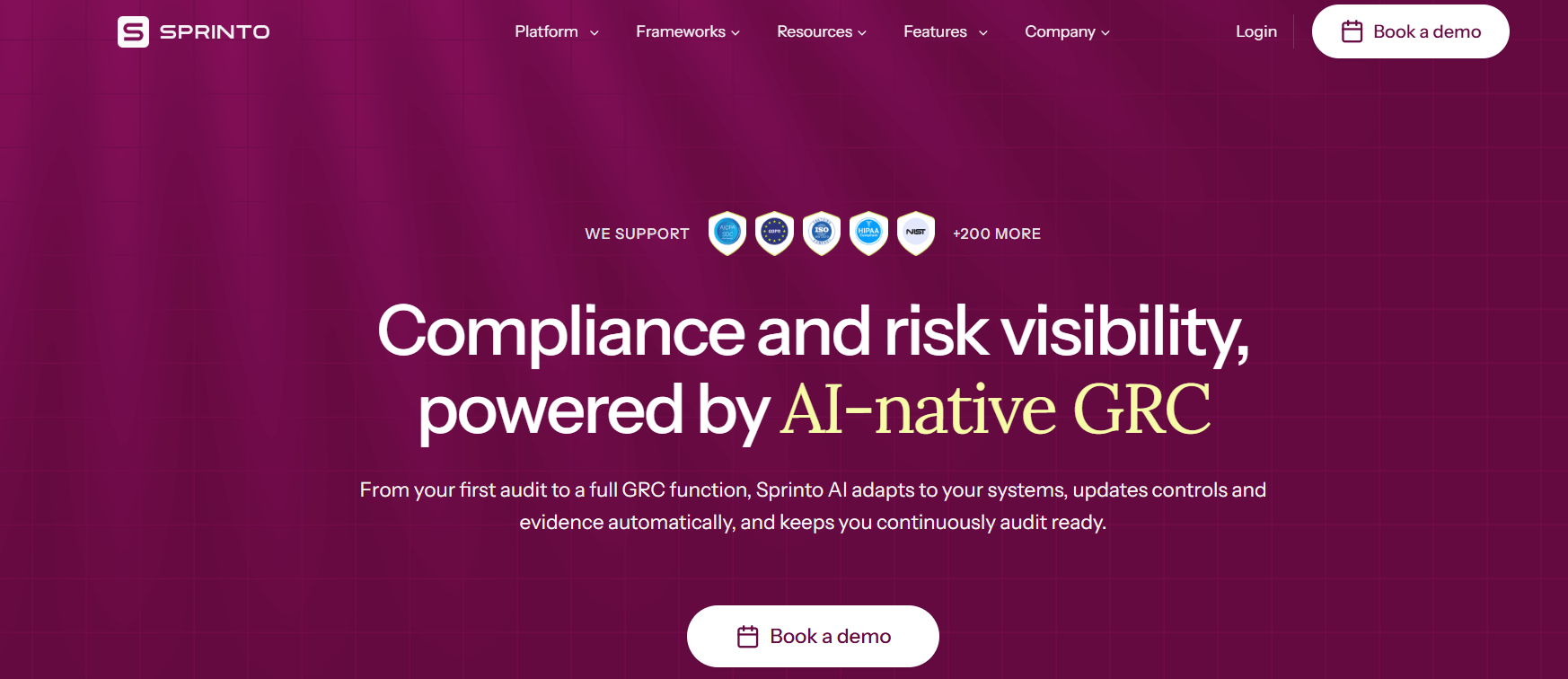
Sprinto positions itself as an autonomous, AI-native trust platform built specifically for cloud-native SaaS companies, and its prescriptive task-queue approach suits acquisition targets that have never run a formal compliance program before. Rather than handing a target’s team an open-ended checklist, Sprinto tells them exactly what to do next, which shortens the runway needed to bring a newly acquired subsidiary up to the acquirer’s security bar.
Because Sprinto is engineered around cloud-hosted and serverless-first architectures from the ground up, it has become one of the go-to SOC 2 vendors for Companies going through M&A among lean engineering teams that an acquirer inherits through a tuck-in deal. Its lower entry price point also makes it attractive when an M&A budget needs to stretch across several newly acquired business units at once.
Features
- AI agents that automate control mapping, evidence collection, and audit-readiness scoring
- A prescriptive task queue that replaces an open-ended control list with step-by-step guidance
- Zones that let a buyer separate entities or business units while reusing shared controls
- Enterprise tier with private-cloud deployment and full API access for complex, multi-entity infrastructures
- A live Trust Posture dashboard for real-time visibility across an acquired company’s controls
Pros
- One of the fastest routes to a first SOC 2 Type 2 report, with some customers completing audits in under two months
- Strong value at the entry tier, which matters when an M&A integration budget is already stretched across legal, HR, and IT workstreams
- Zones feature maps cleanly onto multi-entity holding structures created by an acquisition
Cons
- Offshore-heavy delivery model may not suit buyers who require onshore-only support contractually
- SCIM support and coverage of uncommon systems lag behind Vanta and Drata
Pricing
Sprinto’s SOC 2-only programs typically start around $6,000–$10,000 per year for a single framework.
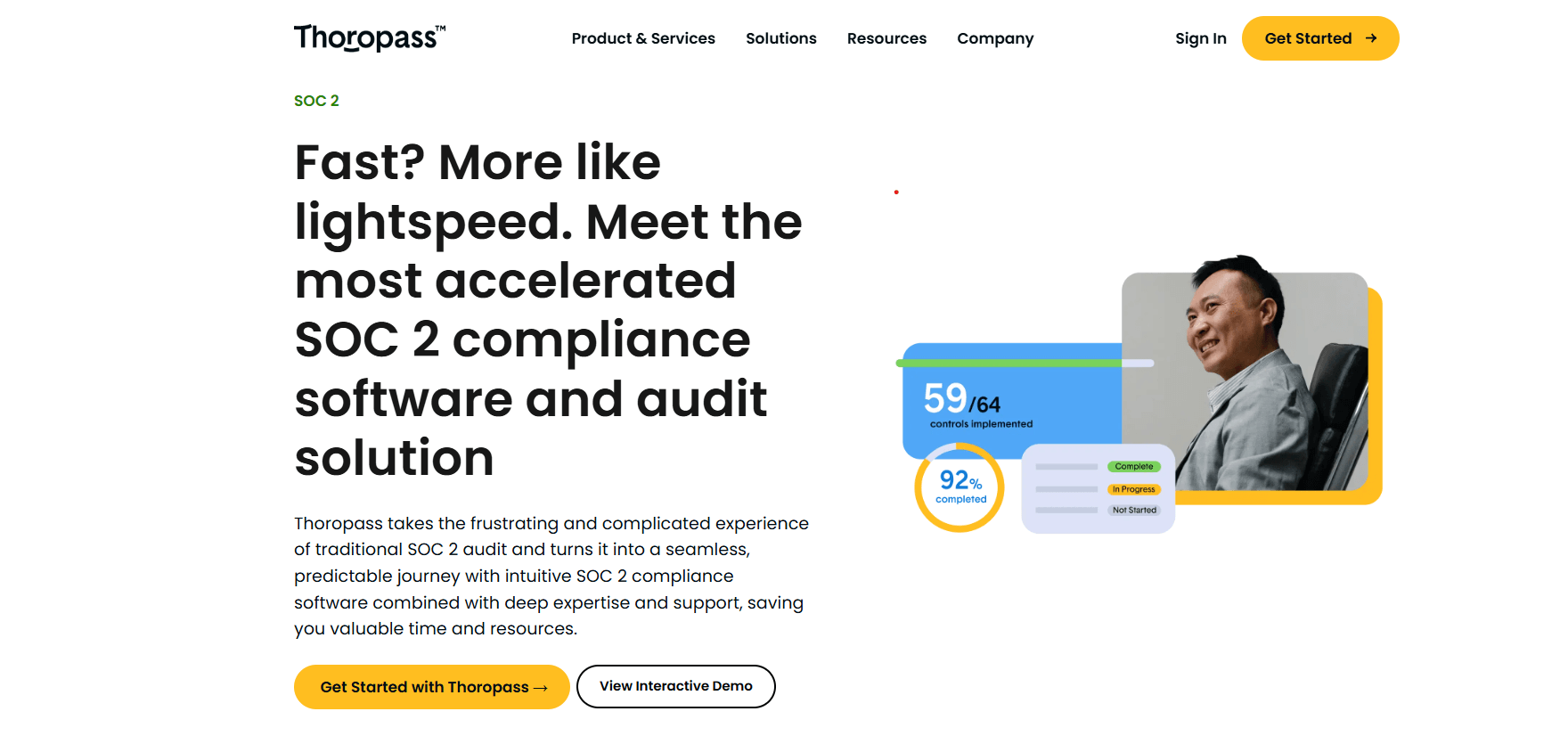
Thoropass takes a structurally different approach from the rest of this list: it bundles compliance automation software with an in-house CPA audit practice, so the same vendor that collects evidence also issues the SOC 2 report. For an M&A team racing against a closing date, collapsing the platform and the audit into a single contract removes a coordination step that otherwise eats weeks.
Thoropass claims its customers reach audit readiness roughly 62% faster than traditional manual approaches, cutting hundreds of hours of manual evidence work. That speed advantage is particularly relevant in a carve-out or roll-up scenario, where a buyer needs a target’s SOC 2 report finalized on an accelerated timeline tied to deal milestones rather than a standard annual cycle.
Features
- Bundled compliance software and in-house CPA-led audit under a single contract and vendor relationship
- Support for 30+ frameworks, including SOC 2, HIPAA, PCI DSS, and ISO 27001
- Automated evidence collection integrated directly with the audit workflow
- Compliance consulting services layered on top of the software for teams without dedicated staff
- A unified auditor-facing workspace that removes the handoff between platform and CPA firm
Pros
- Single point of accountability for both software and audit, which simplifies vendor management during a merger
- Faster time-to-report than software-only platforms that require sourcing a separate auditor
- User-friendly interface with responsive customer support, according to reviewers
Cons
- Bundling the audit and the software into one contract can complicate cost separation for M&A budgeting, since the two line items are not always itemized the way a standalone platform would present them
- Initial setup can feel overwhelming for teams new to compliance
Pricing
Thoropass starts around $5,800 per year.
Scytale pairs AI-driven automation with dedicated human compliance experts, an approach it markets as compliance on autopilot. For M&A situations where an acquired company’s founders or CTO need to stay focused on product integration rather than compliance paperwork, Scytale’s model of pairing software with an assigned expert reduces the burden on the target’s existing team.
The platform automates up to 90% of evidence collection while its consultants handle policy customization and field auditor queries directly, which is useful when a newly combined security team is still forming and nobody has full-time bandwidth to own the SOC 2 program end to end during the first post-close quarter.
Features
- AI GRC agent (branded Scy) that guides users through the SOC 2 process step by step
- Automated evidence collection covering roughly 90% of standard audit requirements
- Dedicated compliance experts who manage policy customization and auditor communication
- Support for SOC 2, ISO 27001, and HIPAA, with additional frameworks available
- Continuous compliance monitoring designed to catch drift between audit cycles
Pros
- Strong fit for founder-led or CTO-led teams that an acquirer wants to keep focused on the product roadmap, not compliance admin
- Combines AI automation with real human expertise rather than leaving customers to self-serve entirely
- Reasonable entry price relative to the automation depth on offer
Cons
- Smaller integration and customer base than Vanta, Drata, or Secureframe, so enterprise-scale M&A buyers may find fewer reference customers at their size
- Less brand recognition among large-enterprise security teams evaluating a target’s tooling during diligence
Pricing
Scytale’s Build tier starts at roughly $7,500 per year.
Strike Graph stands out in this category for one simple reason: it is one of the only vendors that publishes real prices without a sales call, which matters enormously when an M&A team needs to budget quickly rather than wait on a negotiation cycle. Its no-per-seat pricing model also avoids the surprise cost escalation that can hit an acquirer consolidating a target’s headcount into a shared compliance workspace.
Strike Graph offers a free Launch tier for initial scoping and policy generation, which gives a newly acquired company a starting point even before the deal formally closes. That transparency and low barrier to entry make it a practical option when due diligence needs a quick compliance baseline on a target that has never pursued SOC 2 before.
Features
- Published, no-per-seat pricing across Launch (free), Certify, Scale, and Enterprise tiers
- Automated control mapping and policy generation
- Risk-based approach to control prioritization
- Multi-framework support that scales from a single SOC 2 program to broader GRC coverage
- Straightforward onboarding designed for teams without a dedicated compliance function
Pros
- The only vendor in this list with a genuinely public price list, which speeds up vendor comparison during time-pressured M&A due diligence
- No per-seat fees, so pricing does not spike simply because two companies’ headcounts combine after a merger
- Free Launch tier gives a pre-revenue or newly carved-out entity a real starting point at no cost
Cons
- Less name recognition among large enterprise auditors and acquirers compared to the category leaders
- Time to first Type 1 report (roughly 8–12 weeks) runs slightly longer than Drata or Sprinto
Pricing
Strike Graph publishes three paid tiers:
- Certify at $10,000/year,
- Scale at $21,500/year, and
- Enterprise at $35,000/year,
Scrut Automation takes a risk-first, all-in-one approach that bundles every framework, module, and user into a single subscription rather than charging per framework. For a company absorbing multiple acquisitions over time, that bundled pricing model avoids the compounding framework fees that other vendors charge each time a new subsidiary needs SOC 2, ISO 27001, or another certification added to the program.
Because Scrut consolidates compliance and risk management in one workspace, it appeals to organizations that have outgrown a single-purpose SOC 2 tool and need a platform that can absorb an acquired company’s entire risk register, vendor list, and control set without standing up a second system.
Features
- All frameworks, modules, and users bundled into one subscription with no per-framework surcharge
- Unified risk register alongside compliance automation
- Automated evidence gathering with real-time compliance-posture dashboards
- Vendor risk management built into the core platform rather than sold as an add-on
- Broad framework library spanning SOC 2, ISO 27001, HIPAA, PCI DSS, and more
Pros
- Bundled, framework-agnostic pricing is genuinely useful for a serial acquirer adding new entities and frameworks over time
- Risk management depth exceeds most SOC 2-only competitors
- Backed by a team of compliance experts for ongoing support
Cons
- Breadth of modules can feel like more than a company needs if it only wants a fast, narrow SOC 2 Type 2
- Less mainstream brand recognition than Vanta or Drata among enterprise auditors
Pricing
Scrut’s AWS Marketplace listing shows pricing starting near $15,000 per year for teams under 20 employees, with typical mid-market and multi-framework programs running $15,000–$40,000 per year.
Hyperproof is built for mature GRC operations rather than a company’s very first SOC 2 audit, which makes it a natural fit for the acquiring side of an M&A transaction. Large enterprises that already run SOC 2, SOX, NIST, and FedRAMP programs use Hyperproof to fold a newly acquired subsidiary’s controls into an existing multi-framework structure rather than standing up a parallel compliance stack.
With a library of more than 100 frameworks and dedicated risk and vendor management modules, Hyperproof shines at program-level visibility: an integration team can see, in one dashboard, exactly where a newly acquired company’s controls overlap with the parent organization’s and where gaps remain before the combined entity’s next audit cycle.
Features
- 100+ pre-built framework templates, including SOC 2, SOX, NIST 800-53, and FedRAMP
- Control reuse across frameworks to avoid duplicate evidence collection post-merger
- Dedicated risk management and vendor management modules
- Unlimited-user pricing model that scales without per-seat penalties as teams combine
- AI-assisted evidence review and program-level reporting for compliance leadership
Pros
- Purpose-built for standing GRC teams managing several frameworks simultaneously, exactly the scenario a large acquirer faces post-close
- Unlimited users avoids the per-seat cost spike that occurs when two companies’ compliance teams merge
- Strong program-level visibility and control-reuse capability across a portfolio of entities
Cons
- Feels heavy for a small, standalone target pursuing its first SOC 2; better suited to the acquiring parent’s compliance function
- Pricing sits toward the higher end of the category for smaller buyers
Pricing
Hyperproof is typically quoted between roughly $12,000 and $100,000 per year
Formerly known as Tugboat Logic, OneTrust Certification Automation now sits inside OneTrust’s broader privacy, security, and GRC suite. For an acquirer that already runs OneTrust for privacy management, consent, or third-party risk, adding SOC 2 certification automation inside the same platform avoids introducing an entirely new vendor relationship during an already complex integration.
This option suits large, regulated buyers more than it suits a lean target company pursuing its first audit. When a due diligence team is evaluating whether to fold an acquired company’s compliance program into an existing enterprise GRC platform, OneTrust’s certification module gives them a path to do exactly that without abandoning their existing privacy and risk tooling.
Features
- SOC 2 certification automation integrated with OneTrust’s privacy, consent, and third-party risk modules
- Enterprise-grade workflow and approval chains suited to large, multi-subsidiary organizations
- Centralized policy management across privacy and security compliance functions
- Broad framework support beyond SOC 2, including privacy regulations relevant to cross-border M&A
- Deep third-party and vendor risk management, useful for reviewing an acquisition target’s own vendor footprint
Pros
- Strong fit for acquirers who already run OneTrust for privacy or third-party risk and want one vendor relationship, not several
- Enterprise workflow depth suits complex, multi-entity organizational structures created by M&A
- Combines security certification with privacy compliance, which matters for cross-border deals subject to GDPR or similar regimes
Cons
- Materially more expensive than startup-focused SOC 2 platforms, and often more than a lean target’s program actually needs
- Better suited to buyers standardizing an acquired company onto existing OneTrust infrastructure than to a target evaluating its first standalone SOC 2 platform
Pricing
OneTrust Certification Automation typically runs $20,000–$40,000 or more per year.
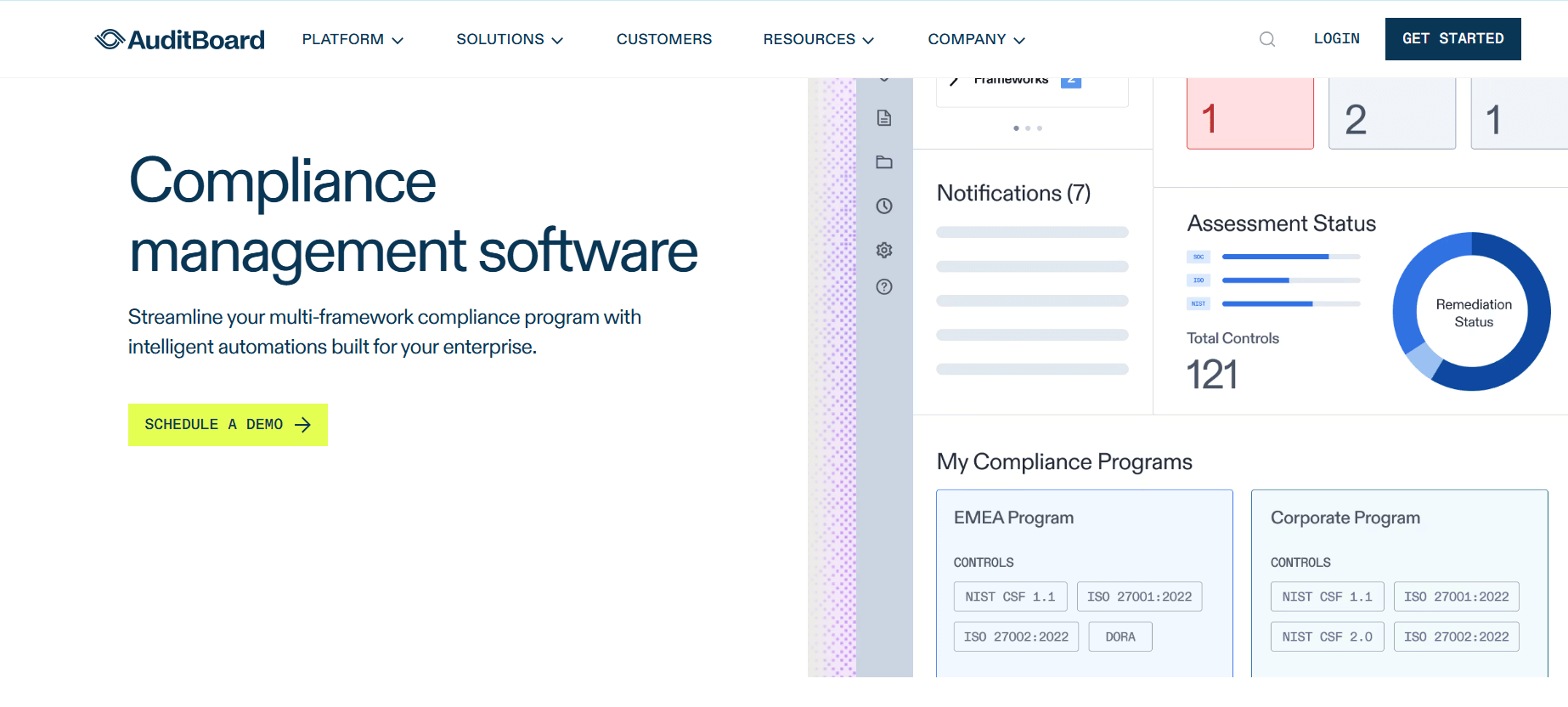
AuditBoard, now rebranded in part as Optro for compliance automation, targets large enterprises running connected risk, audit, and compliance programs rather than a single SOC 2 certification. In an M&A context, AuditBoard is most relevant to the acquiring company’s internal audit and risk function, which needs to fold a target’s control environment into an existing enterprise risk framework spanning SOX, internal audit, and IT risk alongside SOC 2.
Because large acquirers frequently already run AuditBoard for SOX compliance or internal audit management, extending that same platform to cover a newly acquired subsidiary’s SOC 2 program keeps risk reporting centralized for the board and audit committee during and after the integration.
Features
- Connected risk platform spanning SOC 2, SOX, internal audit, and IT risk management
- Enterprise-grade workflow, evidence, and issue-tracking capabilities
- Board- and audit-committee-ready reporting across the full risk and compliance portfolio
- Integration with existing internal audit and SOX programs common at large acquirers
- Configurable workflows suited to complex, multi-subsidiary organizational structures
Pros
- Best-in-class fit for the acquiring enterprise’s existing internal audit and risk function, not just a standalone SOC 2 program
- Consolidates SOC 2 reporting alongside SOX and internal audit for board-level visibility during an acquisition
- Mature, enterprise-grade platform with a long track record in regulated industries
Cons
- Overkill, and cost-prohibitive, for a target company or a lean standalone SOC 2 program
- Pricing is enterprise-tier and not published, making it hard to budget quickly during a fast-moving deal
Pricing
AuditBoard does not publish pricing, and quotes are highly dependent on the number of modules (SOC 2, SOX, internal audit, IT risk) and the size of the organization
A-LIGN differs from every other entry on this list: it is a licensed CPA and cybersecurity assessment firm, not a self-serve software platform, and it actually performs the SOC 2 audit and signs the resulting report. No matter which of the software platforms above a target or acquirer selects, a SOC 2 report cannot be finalized without an independent CPA firm like A-LIGN examining the controls and issuing the opinion.
A-LIGN has built its own compliance software, A-SCEND, but its core value in an M&A transaction is as a single audit partner capable of servicing multiple frameworks and multiple subsidiaries at once, which matters when a buyer needs consistent audit opinions across several newly acquired entities on a single, coordinated timeline.
Features
- Licensed CPA firm authorized to issue SOC 1, SOC 2, and SOC 3 reports
- A-SCEND compliance management software that integrates with a firm’s audit workflow
- Single-provider audits across SOC 2, ISO 27001, PCI DSS, HIPAA, FedRAMP, and StateRAMP
- Dedicated relationship teams capable of coordinating audits across multiple subsidiaries or business units
- Experience servicing both standalone companies and multi-entity organizations created through acquisition
Pros
- Can serve as a single audit partner across every subsidiary in a post-acquisition portfolio, simplifying coordination and scheduling
- Broad framework coverage reduces the need to engage separate auditors for SOC 2, ISO 27001, and FedRAMP work
- A recognized, well-established firm that most enterprise counterparties and their legal teams will readily accept during diligence
Cons
- As a full audit firm rather than a self-serve automation platform, A-LIGN’s engagement model is inherently slower and more formal than the software-only vendors on this list
- Costs scale with the number of entities and frameworks audited, which can add up quickly across a multi-subsidiary acquisition
Pricing
- SOC 2 Type I runs $12,000–$25,000, and
- SOC 2 Type II runs $15,000–$60,000 or more.