

In 2026, organizations confront more complex regulatory compliance requirements and they now demand continuous monitoring instead of annual check-ins. Data privacy laws such as GDPR and HIPAA, together with security frameworks like ISO 27001 and SOC 2, require companies to stay in constant audit readiness, and this need has become a strategic priority for business success. Modern Software for Compliance Management (SOC 2, ISO 27001, GDPR)helps companies automate evidence collection, centralize documentation, and manage risk across many departments, and it also gives compliance teams clear control over daily tasks. Furthermore, the right Software for Compliance Management simplifies audits, lowers non-compliance risk, and provides real-time visibility into every stage of a compliance program, so teams respond to issues faster and make better decisions.
What is Software for Compliance Management
Software for Compliance Management (SOC 2, ISO 27001, GDPR) help organizations follow security, privacy, and governance rules in an organized way. The platforms arrange policies, evidence, risk checks, and audits. Companies must complete these steps to meet global standards such as SOC 2, ISO 27001, and the GDPR data protection law. The system replaces scattered files with a single, reliable location. Instead of managing compliance with spreadsheets and loose documents, teams use one platform. They track requirements and monitor progress in that platform. They also prove that they protect customer data. Therefore, work becomes more consistent and transparent across departments.
We break down the leading Software for Compliance Management (SOC 2, ISO 27001, GDPR) in 2026, analyzing their features, strengths, limitations and pricing to help you select the platform that best aligns with your organization’s needs.
Top 13 Best Software for Compliance Management (SOC 2, ISO 27001, GDPR) in 2026
1. Vanta

Vanta acts as a compliance automation platform that helps organizations manage security and audit preparation with less manual work. The tool guides companies through clear workflows and collects evidence from connected systems so teams stay ready for audits at any time. In addition, Vanta links with identity providers, cloud platforms, endpoint tools, and HR systems to keep documentation current. Therefore, businesses gain continuous monitoring and real-time visibility into their compliance status. Moreover, startups and growing SaaS companies use Vanta to reach compliance goals faster and with better organization. Furthermore, the platform encourages consistent security habits instead of one-time audit rushes.
Features
- Broad Compliance Support: Vanta supports standards such as SOC 2, HIPAA, ISO 27001, and PCI DSS. Therefore, organizations meet requirements across several regulatory frameworks without switching tools.
- Automated Evidence Collection: The platform connects with cloud services, identity providers, and task trackers to gather audit evidence automatically. Consequently, teams reduce paperwork and keep documents ready for reviewers.
- Continuous Monitoring: Vanta checks security practices at all times and shows the current compliance position. Therefore, companies notice gaps early and fix them before audits begin.
- Security Alerts and Notifications: The system sends alerts from real data whenever risks appear. Then, teams respond quickly and correct issues before they grow.
- Vendor Management: Vanta verifies the compliance status of third-party vendors. Therefore, organizations lower supply-chain risks and maintain safer partnerships.
Pros
- Works well for first-time SOC 2 programs
- Automates many common security controls
- Provides clear guided tasks and templates
- Supports vendor review processes
- Delivers simple reports for audit preparation
Cons
- Does not operate as a complete enterprise GRC platform
- Some integrations need higher pricing plans
- Multi-entity structures can feel more difficult
Pricing
- Free trial available
- Paid plans start from $8,000 to $35,000 per year
Best For
Vanta software for compliance management fits startups and growing companies that want to automate compliance for SOC 2, ISO 27001, and GDPR. The platform manages evidence collection, policy organization, and security training so teams remain ready for audits and maintain ongoing monitoring.
2. Drata

Drata serves as a security and compliance automation platform that improves how organizations manage compliance work and maintain constant audit readiness. The platform connects with many SaaS vendors and gathers compliance status details into one unified location, so teams see a clear picture of controls across their security programs. Moreover, Drata links directly to systems such as identity tools, cloud services, ticketing platforms, and HR software to collect evidence on a regular schedule. Therefore, startups and mid-market companies reduce audit preparation time and keep control status visible throughout the year. In addition, teams turn compliance into an ongoing process instead of a one-time project.
Features
- Continuous Monitoring and Evidence Collection: Drata monitors security controls and gathers evidence on an ongoing basis. The system updates compliance documentation automatically, and this approach reduces manual work while keeping records ready for audits.
- Real-Time Compliance Status: The platform tracks vendor compliance in real time, and teams receive immediate insight into risks or gaps. Furthermore, organizations respond quickly and maintain steady adherence to regulatory requirements.
- Comprehensive Compliance Framework Support: Drata supports major frameworks such as SOC 2, ISO 27001, HIPAA, GDPR, PCI DSS, CCPA, ISO 27701, Microsoft SSPA, NIST CSF, and NIST 800-171. Consequently, companies meet regulatory standards across different industries without switching tools.
- Vendor Compliance Management: The system shows full visibility into third-party vendor controls, and this visibility helps organizations manage supply-chain risk. In addition, security teams confirm that every vendor follows required standards.
- Audit-Ready Documentation: Drata organizes detailed documentation for auditors, and the platform simplifies preparation while keeping evidence accurate and complete.
Pros
- Fast time-to-audit for common frameworks
- Strong integration ecosystem
- Clear control ownership and tasking
- Effective auditor collaboration features
- •Helpful continuous compliance dashboards
Cons
The platform needs more customization within certain key features and processes.
Pricing
Drata offers custom pricing quotes on request. Interested companies contact the sales team to schedule a demo and receive further details.
Best For
Drata fits organizations that need SOC 2 evidence automation and must manage requirements across multiple frameworks at the same time. The platform also supports engineering-focused teams that want clear visibility into their security posture. In addition, it works well for companies that handle complex, multi-framework environments where automation and scalability remain important.
3. Secureframe
Secureframe operates as a cloud-based compliance platform that helps organizations meet strict security and privacy standards. The platform supports businesses of different sizes and automates many compliance tasks to save time and improve accuracy. Secureframe supports frameworks such as SOC 2, HIPAA, PCI DSS, and GDPR, so companies can choose the standards that match their goals. In addition, the platform gives organizations clear visibility into their compliance status and strengthens risk management efforts. It provides continuous monitoring, personnel management, vendor management, and risk assessment tools, and these tools help companies improve their overall security posture. Furthermore, Secureframe organizes complex compliance work into simple steps, and this approach reduces confusion for teams.
Features
- Automated Compliance Frameworks: Secureframe supports multiple standards, including SOC 2, ISO 27001, PCI DSS, CCPA, GDPR, and HIPAA, and this support allows companies to manage several certifications in one place.
- Technology Integrations: The platform connects with cloud services, vendor management systems, and HR tools, and these connections create a unified view of compliance across the business.
- Continuous Monitoring: Secureframe scans cloud infrastructure, vendor relationships, and HR processes on an ongoing basis, and this process helps teams detect compliance risks early.
- Audit Readiness: The system organizes required documentation and evidence, and this organization helps companies prepare for audits with less stress.
Pros
- The platform supports ISO 27001 readiness effectively.
- It provides helpful templates and guided workflows.
- It keeps evidence structured and easy for auditors to review.
- Integrations work well with common SaaS tools.
- It suits smaller security teams that need clear direction.
Cons
- Some advanced reporting options remain limited.
- Automation performance changes depending on the technology stack.
Pricing
- Secureframe provides pricing upon request.
Best For
Secureframe works well for ISO 27001 implementation, and the framework cross-mapping saves time when companies add new certifications. Moreover, the platform suits organizations that want to grow across several frameworks while receiving professional guidance. However, very technical teams that prefer full self-service may consider other options more suitable.
4. Sprinto

Sprinto acts as a compliance automation platform and helps companies prepare for SOC 2, ISO 27001, HIPAA, and GDPR audits. The platform connects directly to a company’s tech stack, monitors controls, and gathers audit evidence during daily operations. It replaces manual GRC tasks with automated processes, and it maps internal systems to the correct compliance controls. In addition, the software tracks compliance gaps and sends alerts before problems grow. Therefore, teams treat Sprinto like a real-time checklist that runs in the background. The software also provides simple dashboards, ready-made policies, and guided workflows, and these tools remove confusion from compliance work.
Features
- Sprinto automates information security compliance and privacy law requirements, and it supports several major frameworks at the same time.
- The platform helps companies achieve information security compliance, and this support improves success in enterprise deals and vendor security reviews.
- Sprinto manages employee onboarding and offboarding, and it connects with business systems to detect new accounts and start security workflows.
- The software maps organizational processes to audit requirements automatically, and it collects the evidence auditors request.
Pros
- The platform focuses on speeding up audits
- Teams gain clear visibility into control monitoring
- The system assigns ownership and sends reminders
- Small compliance teams use it with ease
- Ready templates help users begin quickly
Cons
- The tool does not focus on complex ERM scenarios
- Users find advanced customization somewhat limited
- Some evidence requires manual review
Pricing
Sprinto uses a usage-based pricing model, and it does not charge per seat. Companies pay according to business size, number of frameworks, and setup complexity.
Best For
Sprinto fits fast-growing SaaS companies with 20 to 200 employees that need quick compliance without hiring full GRC staff. Moreover, it suits cloud-first startups that pursue SOC 2 or ISO 27001 for the first time and want structured guidance with ready programs.
5. Hyperproof

Hyperproof works as a security compliance management platform that helps companies organize controls and automate evidence collection. The platform supports businesses that manage several compliance frameworks and want to reuse evidence across different requirements. It provides structured control mapping, evidence requests, audit workflows, and detailed reporting that teams can use across departments. In addition, the system helps organizations turn compliance tasks into clear daily operations while keeping records easy for auditors to review. Therefore, companies with overlapping standards such as SOC 2, ISO 27001, HIPAA, or internal policies can reduce repeated work and keep one reliable source of truth.
Features
- The platform enables organizations to manage compliance across many regulatory frameworks with a clear and organized method.
- Teams can upload and manage custom compliance frameworks in addition to the pre-built ones.
- The system reduces manual effort in control mapping, control testing, and evidence collection and management.
- It updates compliance status on a continuous basis and keeps businesses prepared for audits without last-minute pressure.
Pros
- The software supports mapping across several frameworks with strong accuracy.
- Workflows help distributed teams collaborate with better structure.
- The platform cuts down duplicate evidence tasks and saves time.
- Audit organization tools keep documents clear and easy to present.
- The system grows well with expanding mid-size and enterprise teams.
Cons
- The dashboard and internal reports offer limited options for deep customization.
- Automation relies on the integrations the company connects to the platform.
- Very small teams may find the tool larger than their immediate needs.
Pricing
- Interested companies need to contact the sales team to request a demo and pricing details.
Best For
- Hyperproof fits enterprises and larger mid-market companies with 200 to 2,000 employees that manage several compliance frameworks across departments.
- The platform suits organizations that want centralized visibility and evidence-first audit preparation.
- It also works well for businesses with mature GRC programs that require organized evidence management and multi-framework compliance control.
6. LogicGate Risk Cloud

LogicGate Risk Cloud provides a flexible GRC platform that helps organizations build compliance, risk, and audit workflows through strong customization. The platform focuses on configurable processes instead of a fixed compliance checklist, and it allows teams to create structures that match how they actually work. Organizations can design processes for risk assessments, control testing, policy approvals, third-party risk reviews, and issue remediation. In addition, the system uses forms, routing steps, and dashboards to organize daily tasks. LogicGate fits companies where compliance involves many departments, and it helps them standardize how work moves from one team to another. However, the platform often demands more design effort than audit-first tools, yet it delivers deeper workflow flexibility for complex programs. Therefore, businesses that need control over their processes usually find it valuable.
Features
- Configurable workflow builder that lets teams create approval paths and task routing
- Modules for risk management, control tracking, and issue resolution
- Workflows for third-party risk assessments and vendor reviews
- Dashboards, reporting tools, and detailed audit trails
- Integrations and API connections for data synchronization
Pros
- Automated evidence collection reduces manual uploads and keeps audit tasks organized
- Clear workflows guide teams to remain consistent during security audits
- Configuration options support unique internal processes without code
- Dashboards display trends and gaps in a simple and direct way
Cons
- The platform requires configuration work and active admin ownership
- It does not provide the fastest route to a first audit
- The vendor uses custom pricing and scoping
- Teams may need formal user training before full adoption
Pricing
- Request demo
Best For
LogicGate software for compliance managements uits mid-to-large enterprises with more than 500 employees and mature GRC functions. It works well for organizations that need custom workflows instead of rigid templates, and it benefits teams willing to invest in configuration and dedicated administrators. Therefore, companies that manage complex compliance programs across several departments will gain the most value.
7. AuditBoard
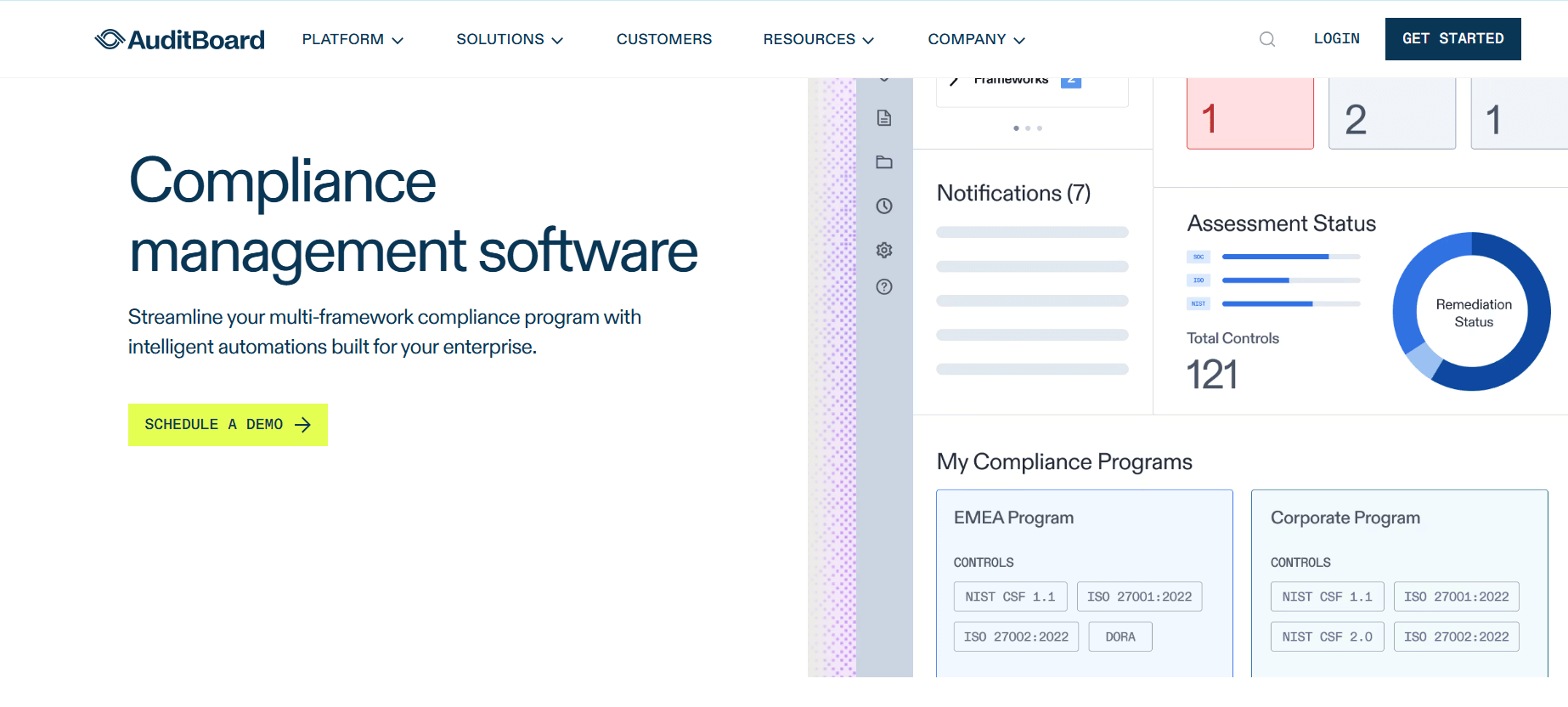
AuditBoard brings risk, audit, and compliance work into one connected system and gives every team shared access to the same data. The platform adds automation to routine tasks and connects with more than 200 third-party tools. In addition, it supports major frameworks such as SOC 2, SOX, and ISO. Therefore, companies that link compliance with internal audit and governance can keep documentation in one place and make testing cycles easier to plan. Moreover, the product fits mid-market and enterprise organizations better than very early-stage audit programs, and it helps large teams manage complex requirements with clearer oversight.
Features
- The platform supports compliance frameworks such as SOC 2, ISO 2700x, NIST, CMMC, and PCI DSS
- The system automates compliance workflows and reduces manual follow-ups
- The tool tracks issues and manages remediation tasks
- Teams can plan audits and organize workpapers in one location
- Users can run risk assessments and view reporting dashboards
- The product enables collaboration and maintains detailed audit trails
Pros
- The product performs well for SOX and internal audit programs
- The structure supports organized testing cycles
- Teams collaborate with stakeholders more easily
- Reports meet the needs of audit leadership
- The system grows with program complexity
Cons
- The tool does not focus on SOC 2 automation
- Custom pricing may challenge some budgets
- Implementation and adoption require time
Pricing
- The company does not publish pricing and begins every engagement with a demo and a quote
Best For
- Audit and SOX teams that need centralized control
- Organizations with active internal audit functions
- Businesses that want clear, real-time views of compliance status
8. OneTrust
OneTrust operates as a comprehensive privacy, risk, and compliance platform that organizations use to manage GDPR, data governance, and third-party risk tasks. Companies adopt the platform when they handle heavy privacy obligations and complex data structures. It supports activities such as data mapping, impact assessments, cookie consent management, and vendor reviews. Therefore, privacy and governance leaders rely on it to organize daily compliance work. In addition, compliance teams use OneTrust to arrange assessments, keep clear documentation, and prepare reports for auditors and executives. The platform offers wide capabilities, yet teams must confirm the exact modules they require and prepare for a structured implementation process.
Features
- Privacy management: The platform automates workflows, reporting, and tasks connected to laws such as GDPR, CCPA, and HIPAA, and it helps teams track obligations step by step.
- Data governance: The system allows businesses to define policies, enforce rules, and monitor data use, so organizations gain visibility and control over information assets.
- Consent and preferences management: The tool collects, stores, and manages user permissions, and this process helps companies meet regulations while building customer trust.
- Responsible AI tools: The software guides organizations to monitor artificial intelligence and machine learning projects and encourages ethical decision making.
- Data discovery and classification: The platform scans structured and unstructured data across databases, file shares, and cloud systems, and then it identifies sensitive information for protection.
Pros
- Strong support for GDPR and privacy programs
- Broad platform that covers many compliance needs
- Effective vendor risk workflow options
- Built for enterprise governance requirements
- Clear reporting for internal and external stakeholders
Cons
- Complex deployments require significant time and planning
- Costs increase when teams add multiple modules
- May exceed the needs of companies focused only on SOC 2
Pricing
- Available through demo request
Best For
- Organizations focused on privacy and data governance
- Companies that need AI-driven data classification to speed governance work
- Large enterprises that can manage premium pricing and broad functionality.
9. ServiceNow GRC

ServiceNow GRC delivers governance, risk, and compliance tools that work directly with IT workflows and the Configuration Management Database. The platform connects compliance activities to daily operations, so teams manage issues through tickets, change requests, and structured workflows. In addition, it fits naturally for companies that already rely on ServiceNow for IT service management. Organizations adopt this solution to handle large compliance programs and to link risk data with real operational processes. However, the system often needs dedicated setup and planning to match internal controls and reporting goals. Furthermore, businesses must prepare resources to guide deployment and ongoing management.
Features
- Integrated risk and compliance workflows
- Control testing with issue remediation tickets
- Policy management and employee attestations
- CMDB-linked evidence collection and reporting
- Role-based access controls with audit trails
Pros
- Works well for large and complex organizations
- Connects deeply with existing IT workflows
- Supports strong governance and permission models
- Produces detailed reports after proper configuration
- Helps teams manage remediation in daily operations
Cons
- Implementation often takes significant time
- Needs administrators with specialized knowledge
- Pricing and licensing require custom discussions
Pricing
- Contact the vendor for demo and pricing details
Best For
- Enterprise compliance workflows.
10. MetricStream

MetricStream provides governance, risk, and compliance solutions that support enterprise growth and structure. The platform helps organizations manage compliance tasks across different regulations and jurisdictions, and it strengthens decision making with clear analytics and reporting tools. In addition, MetricStream focuses on large organizations that require one central GRC system to cover many risk and compliance areas. The software supports regulatory compliance, internal controls, audits, policy management, and third-party risk through configurable workflows. Furthermore, it becomes most useful when companies need consistent processes across many business units and locations. Therefore, teams can build common standards and monitor performance in one environment. MetricStream deployments often require careful planning and governance steps, yet the platform delivers strong enterprise capabilities after teams align it with their operating model.
Features
- Enterprise compliance management workflows that organize daily tasks
- Policy management with employee attestations and tracking
- Audit management with control testing tools
- Third-party risk management modules for vendor oversight
- Dashboards, analytics, and reporting for leadership visibility
Pros
- Covers many GRC domains in one platform
- Works well for multi-entity governance structures
- Offers configurable workflows and controls
- Provides useful enterprise reporting options
- Supports developed and growing compliance programs
Cons
- Requires significant time and effort during implementation
- Feels too complex for small business needs
Pricing
Available upon request for a demo
Best for
Large enterprises with complex compliance obligations across several jurisdictions and organizations that need a full enterprise GRC suite.
11. Scrut
Scrut Automation helps businesses maintain continuous compliance with frameworks like SOC 2, ISO 27001, GDPR, and HIPAA without manual overhead. It collects evidence automatically, monitors risks in real time, and integrates with cloud, HR, and DevOps tools. Teams can identify, assess, and reduce risks proactively, keeping security compliance from slowing down growth.
Features
- Compliance workflows: Assign, track, and complete tasks while sharing artifacts and collaborating across teams
- Vendor and employee compliance: Monitor vendor performance, assess supply chain risks, and provide employee training through built-in modules
- Trust Vault: Share audit results and compliance posture securely with prospects
Pros
- Covers a wide range of frameworks with pre-built policies for diverse regulatory needs
- Integrates with multiple systems, simplifying evidence collection and risk monitoring
- Offers support from in-house compliance experts with over 50 years of experience
- Dashboards deliver clear visibility into compliance activities and risk posture
Cons
Some users find the initial setup complex due to the platform’s extensive features
Pricing
Contact the vendor for pricing information
Best For
Scrut Automation suits cloud-native companies with 50–500 employees managing several compliance frameworks at once. It works well for teams that need unified visibility into compliance, risk, and security.
12. Riskonnect

Riskonnect helps organizations manage risk and compliance in a connected way. It supports operational risk management, compliance workflows, and incident tracking, allowing teams to see the full picture of risk across the business. Organizations can use it to track risks, monitor incidents, conduct assessments, and generate reports that inform decision-making. When compliance and operational risk intersect, Riskonnect ensures data and remediation efforts stay coordinated. If your goal is a comprehensive integrated risk management approach rather than just audit automation, Riskonnect offers a strong solution. You should confirm it meets your reporting requirements, framework needs, and integrates with your existing systems.
Features
- Manage operational risk and compliance workflows
- Track incidents and issues across teams
- Conduct risk assessments and create remediation plans
- Access dashboards and analytics for reporting
- Configure workflows and control permissions for different roles
Pros
- Supports operational risk programs effectively
- Enables reporting across multiple business functions
- Offers flexible workflow configuration
- Provides detailed remediation and issue tracking
- Can scale to enterprise-level needs
Cons
- Pricing and scope require customization
- Implementation may take longer than some tools
- Not designed for quick SOC 2 audits
Pricing
Contact Riskonnect to schedule a demo
Best For
Organizations that need operational risk and compliance management.
13. NAVEX One

NAVEX One helps organizations strengthen compliance programs with tools for policy management, training, incident reporting, and third-party risk assessment. Many enterprises rely on NAVEX One to ensure employees consistently acknowledge policies, complete required training, and report issues, while keeping thorough documentation and audit trails. Moreover, it supports initiatives around workplace culture and conduct, helping companies foster ethical behavior. Teams seeking automated security audits might combine it with technical evidence collection solutions for a more comprehensive approach.
Features
- Manage policies and track employee acknowledgments efficiently
- Deliver ethics and compliance training programs
- Report incidents and handle case management smoothly
- Evaluate third-party risks and perform due diligence
- Access dashboards and generate compliance reports with ease
Pros:
- Strengthens ethics and policy-driven programs
- Offers well-structured workflows for incident reporting
- Tracks training and employee attestations effectively
- Supports enterprise governance standards
- Provides clear metrics and reporting on program performance
Cons:
- Does not automate SOC 2 evidence collection
- Pricing is customized and add-ons may increase costs
- Implementation requirements vary depending on program scope
Pricing
Contact NAVEX One for custom pricing details
Best For
Organizations prioritizing policy management and whistleblowing compliance
Enterprises focusing on ethics and governance initiatives.
No software can replace knowledgeable security professionals guiding your compliance program. The best Software for Compliance Management (SOC 2, ISO 27001, GDPR) in 2026 boosts your team’s efficiency and supports their efforts, but it cannot replace strategic thinking, risk assessment, or a strong security culture. Invest in a tool that fits your specific needs, and invest just as much in the people and processes that make compliance effective rather than just a formality.
Successful compliance programs in 2026 combine advanced automation with active leadership, a security-aware culture, and a mindset of continuous improvement. Select your compliance platform as part of a complete approach to building customer trust, protecting sensitive data, and driving business growth through demonstrable security practices.