

If you manage client wealth for a living, trust is the foundation of your business. And in 2026, trust increasingly depends on proving that your technology, data, and internal systems meet modern security standards. That’s exactly what SOC 2 compliance services for wealth management firms are built to deliver.
Wealth management firms handle highly sensitive financial and personal data, including portfolio values, tax records, estate plans, and banking credentials. As a result, a single breach can damage client trust, trigger regulatory scrutiny, and create significant business risks.
Meanwhile, institutional clients and enterprise prospects increasingly require SOC 2 Type 2 reports before signing agreements. Consequently, SOC 2 has become a business necessity for RIAs, family offices, and WealthTech platforms.
However, choosing the right provider can be challenging. The market includes automation platforms, CPA audit firms, boutique advisors, and enterprise vendors, with pricing ranging from $7,500 to over $100,000.
To make the decision easier, we researched and ranked the 12 best SOC 2 compliance services for wealth management firms, evaluating pricing, features, strengths, weaknesses, and overall fit.
The 12 Best SOC 2 Compliance Services for Wealth Management Firms
1. Vanta

Vanta is one of the most widely adopted SOC 2 compliance automation platform in the market. With over 10,000 customers, 400+ integrations, and a dedicated Trust Center feature, Vanta has become the go-to starting point for wealth management firms and WealthTech companies pursuing their first or fifth SOC 2 certification. Vanta continuously monitors your cloud environment, collects evidence automatically, and flags failing controls in real time. For wealth management firms that manage sensitive client financial data across cloud infrastructure, Vanta’s breadth of integrations (AWS, Azure, GCP, Salesforce, Okta, and many others) makes evidence collection nearly seamless.
Features
- 400+ pre-built integrations covering major cloud, HR, and identity platforms
- Continuous automated evidence collection — no manual screenshots
- Real-time compliance dashboard with risk scoring
- Trust Center for sharing compliance status with clients and prospects
- Built-in vendor risk management module
- Support for 30+ frameworks including SOC 2, ISO 27001, HIPAA, PCI DSS
- Large auditor network with partner pricing on audit fees
Pros
- Largest integration library in the market (400+)
- Fast time-to-audit-ready (often 4–8 weeks for SOC 2 Type 1)
- Trusted brand — auditors and enterprise buyers recognize Vanta reports
- Excellent Trust Center for wealth management business development
- Strong self-serve experience for smaller teams
Cons
- Audit fees are separate
Enterprise customers sometimes report slower support response times
Pricing
- Plans starts around $10,000–$12,000/year for a single framework (e.g., SOC 2) for companies under 50 employees.
- Growing wealth management firms with 50–200 employees typically pay $25,000–$55,000/year.
- Enterprise and multi-framework deals commonly reach $80,000–$110,000+/year. Audit fees from a CPA firm are separate and run an additional $10,000–$50,000 depending on scope.
Best For
WealthTech startups and growing RIAs that want the fastest, most recognized path to SOC 2 compliance and a polished Trust Center to share with institutional clients.
Overall Verdict
Vanta is the market leader for good reason. The breadth of integrations, the auditor network, and the Trust Center make it the safest, most versatile choice for most wealth management firms.
2. Drata
Drata’s platform stands out for its technical depth, it automates more control tests than most competitors and provides real-time dashboards that show exactly which controls are passing or failing. For wealth management firms with dedicated IT and security teams, Drata’s agentic AI capabilities and its structured auditor workspace make it a compelling choice.
Features
- 300+ integrations with automated continuous monitoring
- Structured auditor workspace for faster evidence review
- SOC 2, ISO 27001, HIPAA, PCI DSS, GDPR, and 15+ frameworks
- Real-time failing control alerts with remediation guidance
- Transparent per-framework add-on pricing
Pros
- Strong auditor workspace
- Deep technical automation — catches more misconfigurations than peers
- Excellent for multi-framework compliance programs
Cons
- Less startup-friendly for very small teams
- Fewer total integrations than Vanta
Pricing
- Starts at $7,500–$15,000/year for a single framework under 50 employees.
- Advanced tier runs $15,000–$25,000/year (up to $50,000 at scale).
- Enterprise ranges from $25,000–$100,000+/year.
Best For
Wealth management firms and WealthTech companies with internal engineering or IT security teams that want deep automation and are comfortable negotiating SaaS contracts.
Overall Verdict
Drata delivers excellent technical depth and competitive pricing transparency. If you have the internal capacity to leverage its automation, it rivals Vanta at a slightly lower cost. The onboarding fee and renewal escalation are real risks to budget for.
3. Secureframe
While Vanta and Drata lean toward self-serve, Secureframe provides dedicated compliance managers across most pricing tiers, making it a strong fit for wealth management firms that don’t have a full-time CISO or compliance engineer. Secureframe AI, added automated risk assessment and policy drafting on top of its already strong evidence collection engine. With 300+ integrations and 20+ frameworks, Secureframe covers the full range of certifications that financial services firms need.
Features
- Dedicated compliance manager across most pricing tiers
- 300+ integrations including all major cloud and SaaS platforms
- Cross-framework control mapping, overlapping controls identified automatically
- Continuous monitoring with real-time failing control alerts
- 20+ frameworks including SOC 2, ISO 27001, HIPAA, PCI DSS, GDPR
- Built-in vendor assessment questionnaires
- Automated policy generation from your actual tech stack
Pros
- Dedicated compliance manager
- Strong for non-technical buyers who need guidance throughout
- Cross-framework control mapping saves effort on multi-cert programs
Cons
- Audit is separate — budget $15,000–$50,000 additional
- Smaller customer base than Vanta/Drata may mean fewer platform-fluent auditors
- Support quality can vary by tier and region
Pricing
- Secureframe Fundamentals starts at $10,000–$35,000/year depending on team size and scope.
- Higher tiers for multi-framework or enterprise needs run $35,000–$85,000+/year.
- Audit fees from a CPA firm are separate and typically $15,000–$50,000.
Best For
Wealth management operations teams and smaller RIAs that want a guided compliance experience with a human expert available throughout — not just during onboarding.
Overall Verdict
Secureframe earns its place for firms that want more hand-holding than Vanta or Drata typically provide at mid-tier pricing. The higher entry price is offset by the dedicated compliance manager, which can significantly reduce internal time investment.
4. Sprinto
Sprinto is an end-to-end compliance automation and management platform purpose-built for cloud-hosted SaaS companies. It has carved out a niche as the most affordable major SOC 2 platform for early-stage companies. Sprinto’s pricing starts at $7,500–$10,000/year on AWS Marketplace, making it the lowest-cost entry point among the major platforms. For seed-stage or Series A WealthTech startups that need SOC 2 to close enterprise deals but don’t have a large compliance budget, Sprinto provides a competitive path.
Features
- Pre-built compliance programs with auditor-friendly structure
- Role-based access controls for security and compliance teams
- Continuous control monitoring with real-time non-compliance alerts
- SOC 2, ISO 27001, GDPR, HIPAA, and 20+ additional frameworks
- Dedicated compliance expert team for personalized guidance
- Automated evidence collection across major cloud platforms
- Built-in risk management and vendor assessment tools
Pros
- Lowest starting price among major platforms
- Strong compliance expert team for personalized support
- Pre-built auditor-friendly programs reduce time-to-audit
- Competitive for sub-100-employee companies on a single framework
Cons
- Enterprise capabilities less mature than Vanta or Drata
- Smaller auditor network than Vanta or Drata
- Less suitable for complex multi-framework enterprise programs
Pricing
Sprinto starts at $7,500–$10,000/year for small teams on a single framework. Growth-stage companies typically pay $15,000–$30,000/year at renewal. Custom enterprise pricing available for larger organizations. Audit fees are separate from a CPA firm.
Best For
Pre-Series B WealthTech startups that need SOC 2 compliance on a tight budget without sacrificing automation quality or expert guidance.
Overall Verdict
Sprinto is the smartest budget play for early-stage WealthTech firms. The pricing is genuinely competitive, the compliance expert team is a standout feature, and the platform delivers on its core promise. Just be ready for renewal pricing discussions as you grow.
5. Thoropass
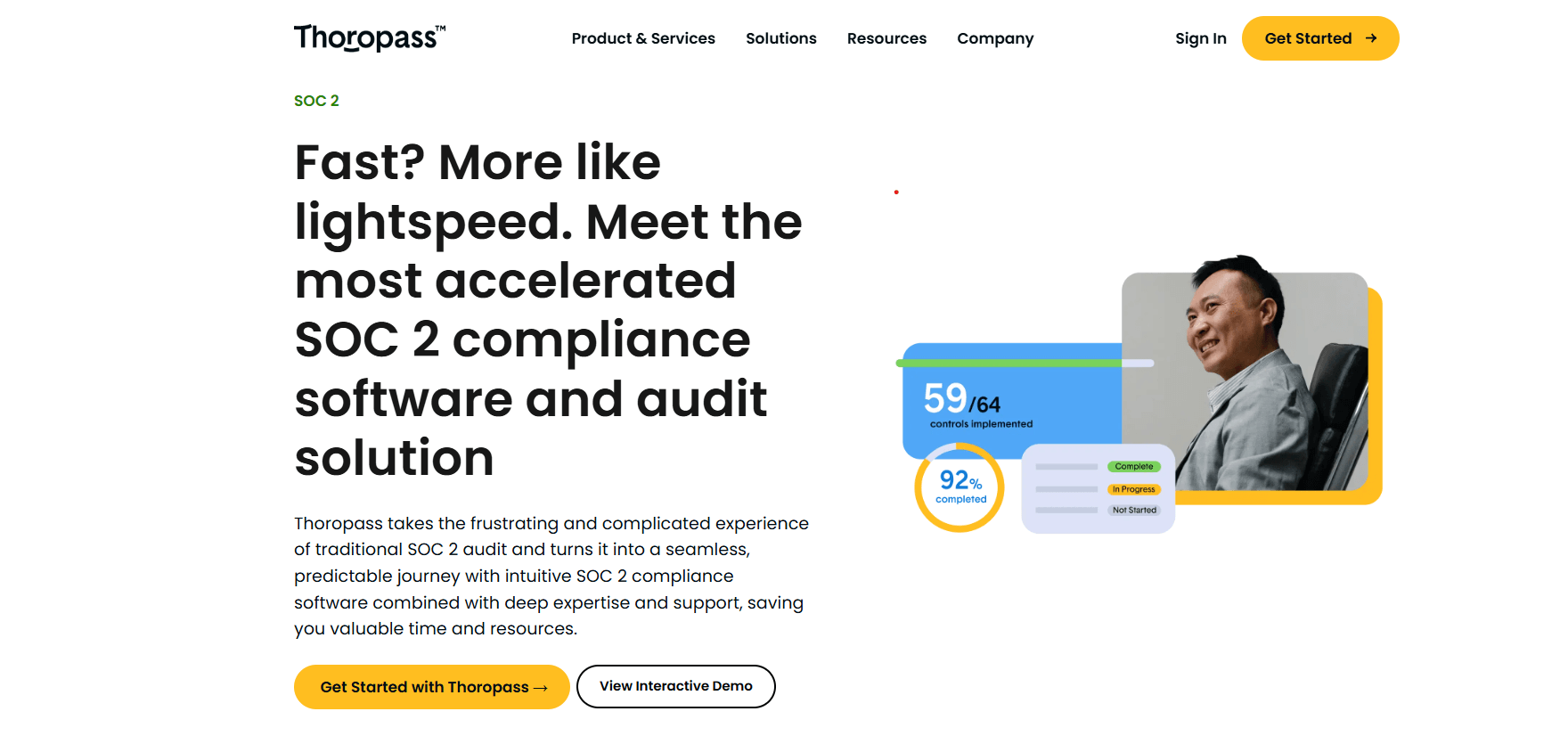
Thoropass is the only major SOC 2 platform that bundles the compliance automation software and the CPA audit under one contract. This eliminates the typical 4–8 week handoff between a platform like Vanta and a separate audit firm, making Thoropass the fastest path to a completed SOC 2 report for most wealth management firms. The platform supports 30+ frameworks.
Features
- Bundled platform + CPA audit under one contract — no separate auditor procurement
- 30+ frameworks including SOC 2, ISO 27001, HIPAA, PCI DSS, HITRUST
- Fixed-fee pricing eliminates audit cost surprises
- Penetration testing and security assessment services included in some plans
- Pre-built templates and workflows for common compliance paths
- Data room functionality for auditor evidence sharing
Pros
- One contract, one vendor — eliminates auditor procurement complexity
- Faster audit completion vs. platform-plus-separate-auditor model
- Fixed-fee pricing, no surprise audit invoices
- Strong customer support with clear audit workflows
Cons
- Auditor lock-in — you can’t choose a different CPA firm
- Less automation depth than Drata for technical control testing
- International framework templates may require adaptation
Pricing
Thoropass all-in pricing (platform + audit bundled) typically runs $30,000–$50,000 for a standard SOC 2 Type II engagement at a 50–100 person company.
Best For
Wealth management firms and financial advisors that want a single vendor for their entire SOC 2 journey — from readiness through audit completion — without managing multiple vendor relationships.
Overall Verdict
Thoropass earns its place for firms that value simplicity and speed over maximum audit firm choice. The bundled model genuinely saves time and often money.
6. A-LIGN
A-LIGN has grown into a multi-framework compliance powerhouse supporting organizations across financial services, SaaS, healthcare, and government. For wealth management firms that need an audit report trusted by institutional clients, regulators, and due diligence teams, A-LIGN delivers unmatched credibility through its scale, experience, and strong AICPA Peer Review standing.
Features
- A-SCEND audit management platform with FedRAMP
- Multi-framework coverage: SOC 2, ISO 27001, HITRUST, FedRAMP, PCI DSS
- Works with all major GRC platforms: Vanta, Drata, Secureframe
- Cross-service framework reuse reduces duplicate evidence collection
Pros
- Most recognized SOC 2 audit firm — reports carry maximum credibility
- Deep financial services experience across hundreds of engagements
- Works with any compliance platform the client already uses
- EvidenceIQ AI speeds up audit evidence review
- Strong multi-framework capability for complex programs
Cons
- Premium pricing — not the most affordable option for small firms
- May be over-engineered for a first SOC 2 at a 10-person RIA
Pricing
A-LIGN pricing is custom and not publicly disclosed. Based on market data, SOC 2 Type II audits typically run $25,000–$75,000+ depending on scope, company size, and frameworks included.
Best For
Mid-market and enterprise wealth management firms, large RIAs, and WealthTech companies that need maximum audit credibility for institutional clients, regulators, or acquirers.
Overall Verdict
If the name on the audit report matters to your clients or regulators, A-LIGN is the gold standard. The pricing reflects the brand premium, but for firms where institutional trust is a business requirement, the investment is justified.
7. Coalfire
Coalfire’s differentiation lies in its deep federal and government compliance expertise, FedRAMP, CMMC, DoD which flows through to unusually technical audit teams on all engagements including commercial SOC 2. For wealth management firms with complex infrastructure, cloud-native architectures, or federal-adjacent client bases, Coalfire’s technical depth is a meaningful advantage.
Features
- 3,000+ assessments annually
- FedRAMP 3PAO and CMMC C3PAO capability
- SOC 2, HIPAA combined engagements with shared evidence
- Deep cloud security advisory for AWS, Azure, and GCP environments
- Partners with Vanta for AI-powered compliance acceleration
- Works with Drata for structured evidence workflows
Pros
- Technically deep audit teams — genuine cybersecurity expertise, not just compliance checkbox
- Strong financial services and FinTech experience
- Multi-framework capability covering SOC 2, HIPAA, PCI, and federal standards
- AI-powered audit tools for faster evidence processing
- Works with all major GRC platforms
Cons
- May feel like overkill for a simple SOC 2 Type 1 at a small RIA
- Startup-focused SOC 2 volume lower than A-LIGN or Prescient
- Some report longer sales cycle than boutique firms
Pricing
Coalfire SOC 2 Type II pricing typically runs $25,000–$80,000 depending on scope and complexity. Year 2+ renewals commonly run $15,000–$40,000.
Best For
Wealth management firms with complex cloud architectures, those serving federal agencies or government pension funds, and firms needing SOC 2 alongside HIPAA or federal compliance.
Overall Verdict
Coalfire delivers genuine technical depth that standard compliance-checkbox audit firms can’t match. The premium is real, but so is the difference in auditor capability for complex environments. For straightforward SOC 2 at a small RIA, look at Prescient or Johanson Group first.
8. Prescient Security

Prescient Security serves more than 5,000 customers and has completed over 3,600 SOC 2 audits. Over the years, they have built a strong reputation as trusted compliance partners for fast-growing technology companies. In particular, Prescient has become a preferred auditor for organizations already using Vanta.
As a result, WealthTech firms can benefit from a highly simplified audit experience that minimizes operational disruption. Furthermore, Prescient’s deep Vanta integration, Slack-based communication, and fully remote audit model help accelerate audit timelines while reducing administrative overhead.
Features
- Deep Vanta partner — native integration for streamlined evidence review
- Slack-based audit communication — same-day responses
- No on-site visits — fully remote audit process
- SOC 2 + ISO 42001 bundled for AI/ML companies
- SOC 1/2/3, ISO 27001, PCI DSS, HIPAA, and 25+ frameworks
Pros
- Fastest audit communication in the market (Slack, same-day)
- Best fit for Vanta users — minimal friction in evidence handoff
- Senior-led engagements — you talk to the actual auditor, not a coordinator
- ISO 42001 capability — particularly valuable for AI-driven WealthTech firms
- No on-site visits — therefore reducing travel costs and coordination efforts
Cons
- Smaller overall footprint than A-LIGN or Coalfire
- Pricing is not publicly disclosed; therefore, prospective clients must request a custom quote
Pricing
Prescient Security’s SOC 2 Type II audits typically range from $20,000 to $75,000, depending on company size, audit scope, and the number of frameworks included.
Best For
Series A–B WealthTech startups that already use Vanta and want a fast, efficient audit process. It is also an excellent choice for firms seeking ISO 42001 certification to support AI-powered financial services products.
Overall Verdict
If your WealthTech company already operates on Vanta, Prescient is one of the strongest auditor options available. Not only does its Slack-first communication model speed up the audit process, but its senior-led approach also ensures direct access to experienced auditors throughout the engagement.
9. Insight Assurance
Insight Assurance operates through a dual structure: the LLC provides CPA-licensed audit services, while its consulting arm handles advisory work. For wealth management firms that want Big 4-caliber auditors at prices that don’t require Big 4 budgets, Insight Assurance delivers.
Features
- SOC 1, SOC 2, SOC 3 audits led by former Big 4 professionals
- AI-powered audit tools for faster turnaround and real-time visibility
- ISO 27001, PCI DSS, HIPAA, and 20+ additional frameworks
- Dual-structure: CPA audit + consulting advisory under one firm
- Dedicated client teams for continuity across audit cycles
Pros
- Former Big 4 expertise at significantly lower price points
- Global reach — relevant for wealth management firms with international operations
- AI-assisted audit tools accelerate report delivery
- Dual structure handles both audit attestation and compliance advisory
Cons
Smaller brand recognition than A-LIGN or Coalfire for institutional buyers
Pricing
Insight Assurance pricing is custom and requires a direct quote. Based on the firm’s positioning, SOC 2 Type II engagements are estimated at $15,000–$50,000.
Best For
Mid-size wealth management firms and RIAs that want the assurance of Big 4-quality auditors but need pricing that reflects their stage and don’t need a Big 4 brand name on the report cover.
Overall Verdict
Insight Assurance punches well above its weight. The Big 4 pedigree, and global reach are impressive. For wealth management firms that care more about audit quality than brand recognition, this is an underrated option.
10. Schellman
With 1,000+ SOC reports issued annually and 700+ active clients, Schellman is the premier choice for wealth management firms serving government pension funds, federal agencies, or highly regulated institutional clients.
Features
- 14 accreditations — broadest certification portfolio of any specialized audit firm
- Financial services, government, healthcare, and tech specialization
- Fixed-fee model for predictable cost planning
- Dedicated audit teams with senior leadership involvement
- SOC 2, ISO 27001, FedRAMP, CMMC, HITRUST, PCI DSS coverage
- Disciplined methodology — detailed, timely reports
Pros
- Gold standard for government-adjacent and highly regulated industries
- Fixed-fee pricing — no scope creep surprises
- Senior leadership involvement throughout engagements
- 14 accreditations — handles virtually any compliance framework
Cons
- Premium pricing — $20,000–$100,000 for Type II audits
- May be over-engineered for straightforward commercial SOC 2
Pricing
Schellman SOC 2 Type II audits are priced at $20,000–$100,000 depending on scope, with most mid-market engagements falling in the $25,000–$60,000 range.
Best For
Large RIAs, family offices, and wealth management firms serving government entities, institutional investors, or highly regulated clients where audit firm credibility is a top-tier requirement.
Overall Verdict
Schellman is the premium specialist choice for complex, regulated wealth management environments. The 14 accreditations, government clearance, and fixed-fee model are genuine competitive advantages. Don’t hire them for a startup SOC 2 Type 1, their capabilities are best utilized by firms with complex compliance needs.
11. Johanson Group
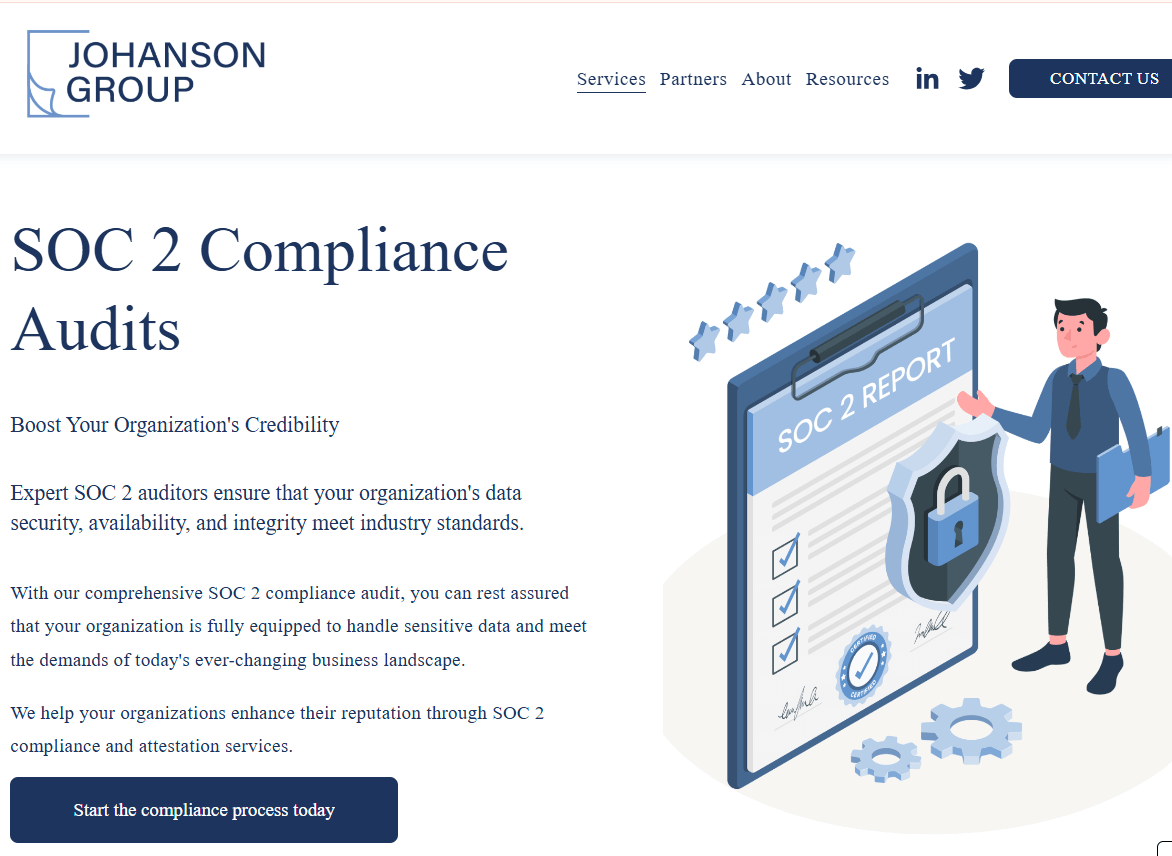
Johanson Group, LLP is one of the most startup-friendly SOC 2 CPA firms in the United States. The firm specializes in fast, fixed-fee SOC 2 Type 1 and Type 2 attestations, with a reputation for delivering Type 1 reports in 1–3 weeks. Johanson Group focuses on companies already using compliance platforms like Drata, Vanta, Secureframe, or Rippling, leveraging the evidence those platforms collect to accelerate the audit timeline. For smaller wealth management firms and RIAs pursuing their first SOC 2 on a budget, Johanson Group is the most efficient combination of price, speed, and quality.
Features
- SOC 2 Type 1 report delivery in 1–3 weeks — fastest in the market
- Fixed-fee pricing — no surprise invoices
- SOC 1, SOC 2, SOC 3, ISO 27001, PCI DSS, and HIPAA coverage
- Focus on security program improvement beyond compliance checkbox
- Hundreds of completed examinations with proven efficiency
Pros
- Fastest SOC 2 Type 1 in the market
- Fixed-fee pricing removes budget uncertainty
- Works seamlessly with all major compliance platforms
- Customized reports — not generic copy-paste deliverables
- Senior management involved throughout, not just at sign-off
Cons
- Less suitable for large enterprise or highly complex environments
- Smaller firm — fewer resources for massive multi-framework programs
Pricing
Johanson Group offers fixed-fee pricing. SOC 2 Type 1 typically starts at $5,000–$12,000 for companies already on a compliance platform. SOC 2 Type 2 audits typically run $12,000–$30,000 depending on scope and observation period.
Best For
Smaller RIAs, independent financial advisors, and early-stage WealthTech startups pursuing their first SOC 2 Type 1 or Type 2 on a tight timeline and budget.
Overall Verdict
For speed and value at the startup and small business end of the market, Johanson Group has no peer. The 1–3 week Type 1 delivery is a legitimate competitive advantage that can help wealth management firms close enterprise deals faster.
12. Advantage Partners
Advantage Partners is a boutique compliance and advisory firm that specializes in delivering highly personalized SOC 2 compliance services to financial services and WealthTech clients. Unlike the large automation platforms or national audit firms, Advantage Partners operates as a consultative partner helping wealth management firms navigate readiness assessments, control design, policy development, and audit preparation with a dedicated advisor throughout.
Features
- Dedicated compliance advisor assigned to each engagement
- SOC 2 readiness assessments and gap analysis for financial services
- Control design and policy development tailored to wealth management operations
- Audit preparation and evidence organization support
- Post-audit remediation and continuous compliance advisory
Pros
- Highest-touch advisory model on this list
- Flexible engagement models for different budget stages
- Post-audit support included — not just a one-time audit
- Ideal for firms without internal compliance or security staff
Cons
- Does not issue SOC 2 audit reports — partners with a CPA firm for the attestation
- Less automation than Vanta, Drata, or Secureframe
Pricing
Advantage Partners pricing is custom and engagement-based. Direct quote required.
Best For
Boutique wealth management firms, family offices, and independent RIAs that need a human expert to guide their compliance journey from start to finish — especially those without internal IT or security staff.
Overall Verdict
Advantage Partners is the right choice when you need a compliance advisor, not just a compliance tool. The financial services regulatory context, high-touch engagement model, and post-audit support are genuinely valuable for firms that are new to SOC 2.
Choosing the Right SOC 2 Compliance Services for Your Wealth Management Firm
SOC 2 compliance is no longer optional for wealth management firms that want to win and retain institutional clients, satisfy regulatory scrutiny, and protect the financial data their clients entrust to them.
The good news is that the market for SOC 2 Compliance Services for Wealth Management Firms has never been more mature or accessible. Automation platforms have cut preparation time by 50–70%. Boutique audit firms deliver quality reports in 1–3 weeks. Bundled solutions eliminate the complexity of managing multiple vendors.
The key is choosing the right combination of platform and auditor for your specific situation. Whatever your path, the most important step is starting. Every month you delay SOC 2 compliance is a month you’re leaving enterprise client opportunities on the table and taking on unnecessary regulatory and cybersecurity risk.