

SOC 2 Compliance Platforms for Manufacturing Software have become essential for software vendors serving the manufacturing sector. Companies that build MES, PLM, ERP extensions, IIoT platforms, quality management systems, supply chain visibility solutions, or shop-floor connectivity software now face intense security scrutiny.
These organizations manage highly sensitive information, including proprietary CAD files, production schedules, supplier pricing data, machine telemetry, and OT (operational technology) network access. Security, procurement, and compliance teams expect vendors to prove they can protect this data. Without SOC 2 attestation, software providers often struggle to pass vendor assessments and win enterprise contracts.
Choosing the right SOC 2 compliance platform is therefore a critical decision for manufacturing software companies. Unfortunately, many “best SOC 2 software” lists focus on generic SaaS businesses and overlook the unique challenges of manufacturing environments.
Manufacturing software vendors frequently support hybrid cloud and on-premises deployments. They also integrate with complex PLM and MES ecosystems and manage risks created by OT and IT convergence.
We highlight the best SOC 2 compliance platforms for manufacturing software that best support these manufacturing-specific requirements and help vendors meet growing customer expectations.
Top 12 SOC 2 Compliance Platforms for Manufacturing Software
1. Vanta

Vanta is the most widely adopted compliance automation platform on the market, and for good reason: its integration library is enormous, its automated evidence collection is mature, and its UI is genuinely easy for non-security people to use. For manufacturing software vendors with a primarily cloud-based architecture (AWS/Azure/GCP-hosted dashboards, APIs, and customer portals), Vanta is consistently one of the fastest paths to a clean SOC 2 Type I and Type II report.
Features
- Continuous control monitoring across 375+ integrations
- Automated evidence collection that refreshes on a schedule
- Built-in policy templates mapped to SOC 2, ISO 27001, NIST CSF, HIPAA, and GDPR
- Vendor risk management module with automated security questionnaire processing
- Auditor portal that streamlines collaboration with your chosen audit firm
- Employee security training and access review workflows
Pros
- Largest integration ecosystem
- Multi-framework mapping means SOC 2 work carries over to ISO 27001 if you’re selling internationally
- Trust Center is genuinely useful for manufacturing buyers who want to self-serve security documentation during procurement
Cons
- Pricing can climb quickly once you add multiple frameworks or vendor risk modules
- Can be too much for very early-stage companies.
Pricing
Vanta does not publish flat public pricing; quotes are based on company size, frameworks, and modules. Industry estimates and marketplace listings put entry-level annual pricing around $7,500–$10,000/year, with mid-market manufacturing software vendors typically landing in the $15,000–$30,000/year range once vendor risk and multi-framework modules are added.
Verdict
Vanta is the best overall choice among the Top 12 Best SOC 2 Compliance Platforms for Manufacturing Software for vendors whose product is primarily cloud-hosted and who anticipate needing ISO 27001 or additional frameworks within 12–24 months. If your architecture is cloud-first with limited on-prem footprint, Vanta will get you to your first SOC 2 report fastest.
2. Drata
Drata built its reputation on automation depth and speed-to-audit. For manufacturing software vendors under pressure from a large enterprise customer’s procurement deadline, Drata’s workflow-driven approach to closing compliance gaps quickly is a major draw.
Features
- Automated evidence collection across cloud infrastructure, code repositories, and identity providers
- Continuous control monitoring with real-time alerts when a control drifts out of compliance
- Risk management module with a built-in risk register and treatment plans
- Auditor collaboration hub with direct auditor access to evidence
- Multi-framework support
Pros
- Among the fastest implementation timelines reported by users.
Strong risk register functionality, useful for manufacturing vendors that need to document supply-chain and OT-adjacent risks for customer security reviews
Clean, modern interface that non-technical team members (marketing, ops, HR) can navigate for their compliance tasks
Responsive customer success teams during onboarding
Cons
- Some users report that customization of policy templates beyond the defaults requires more effort than expected
Pricing
Drata’s pricing is also quote-based. Third-party estimates suggest a starting point similar to Vanta, around $7,500/year for smaller companies, scaling into the $20,000–$40,000+/year range for mid-market companies adding multiple frameworks and risk modules.
Verdict
Drata is an excellent pick among the Top 12 Best SOC 2 Compliance Platforms for Manufacturing Software for vendors racing against an enterprise deal’s security review deadline. Its speed-focused automation and strong risk register make it a good match for teams that need to demonstrate audit-readiness and risk maturity quickly to land a major manufacturing OEM as a customer.
3. Scytale
Scytale differentiates itself by pairing AI-driven automation with dedicated compliance experts who actively work alongside your team throughout the audit process — not just respond to support tickets.
Features
- AI agent that automates policy creation, gap analysis, and evidence mapping
- Dedicated GRC expert assigned to guide your team through scoping, remediation, and audit prep
- Multi-framework cross-mapping (SOC 2, ISO 27001, GDPR, HIPAA, and others) so work isn’t duplicated across frameworks
- Continuous monitoring with automated evidence refresh
- Custom policy creation tailored to company size and industry
Pros
- The combination of automation plus a real human expert is particularly valuable for manufacturing software companies without an in-house security or compliance hire
- Multi-framework cross-mapping reduces duplicate evidence work for vendors selling into both U.S. and international manufacturing markets
- Intuitive interface that doesn’t require a security background to operate day-to-day
Cons
- Smaller integration library compared to Vanta or Drata, though core cloud integrations are well covered
- As a relatively newer entrant compared to legacy GRC players, some enterprise procurement teams may be less familiar with the brand.
Pricing
Scytale pricing is custom-quoted based on company size, framework count, and support tier. Reported starting points are competitive with other automation platforms, generally in the lower-to-mid five-figure annual range, with the dedicated expert support bundled into most tiers rather than sold as a costly add-on.
Verdict
Scytale stands out as the best choice for lean teams common at mid-sized manufacturing software vendors that want a guided hand through their first (or first multi-framework) audit rather than a pure self-serve tool.
4. Sprinto
Sprinto was built specifically to help fast-moving, technically-driven companies maintain continuous SOC 2 readiness without dedicating significant internal headcount to compliance. Its heavy use of automation and AI for evidence mapping makes it a strong fit for manufacturing software vendors whose engineering teams are stretched thin.
Features
- Connects with 160+ services for automated evidence collection
- AI and GPT-based automation for mapping evidence to controls and flagging gaps
- Continuous compliance monitoring with real-time dashboards
- Built-in risk assessments and treatment workflows
- Multi-framework support (SOC 2, ISO 27001, GDPR, HIPAA)
- Dedicated implementation support during onboarding
Pros
- Strong reputation for combining automation with proactive guidance, which helps teams new to SOC 2 avoid common missteps
- Efficient onboarding process, with many users reporting audit-readiness achieved faster than expected
- Risk assessment workflows are well-suited to documenting third-party and supply-chain risks relevant to manufacturing customers.
Cons
- Less depth in enterprise-grade GRC features (e.g., advanced risk quantification) compared to platforms like OneTrust or LogicGate
- Some users note that highly customized or unusual tech stacks (common in industrial software) may require manual evidence collection
Pricing
Sprinto’s pricing is quote-based, but it is generally positioned as a more cost-effective option than Vanta or Drata for smaller teams, with entry pricing reportedly starting in the lower five-figure annual range and scaling based on frameworks and employee count.
Verdict
Sprinto earns its as the go-to option for lean manufacturing software startups, think 10-50 employee teams building a niche shop-floor app or supplier portal that need strong automation without the enterprise price tag or complexity.
5. Secureframe
Secureframe positions itself heavily around multi-framework compliance, making it a natural consideration for manufacturing software vendors who know from day one that SOC 2 alone won’t be enough especially those selling into automotive, aerospace, or defense-adjacent manufacturing supply chains where ISO 27001 and other frameworks are frequently required.
Features
- Unified dashboard for managing SOC 2, ISO 27001, HIPAA, PCI DSS, and other frameworks simultaneously
- Automated evidence collection across cloud and SaaS integrations
- Policy templates and control libraries mapped across frameworks
- Vendor risk management and access review automation
- Continuous monitoring with alerting on control failures
Pros
- Multiple compliance frameworks at once, which is common for manufacturing software vendors selling to global OEMs
- Sales process, while heavier than self-serve competitors, often results in a more tailored initial setup for complex environments
- Solid library of pre-built policies that reduce the drafting burden for smaller teams
Cons
- The platform can feel disjointed when managing complex, multi-system evidence — a relevant concern for manufacturing vendors with hybrid cloud/on-prem architectures
Pricing
Secureframe pricing is custom-quoted, with packages typically bundling multiple frameworks. Reported starting prices are in a similar range to Vanta and Drata, with multi-framework bundles pushing costs higher depending on company size and integration count.
Verdict
If your manufacturing software product is already being evaluated by customers in Europe or Asia (where ISO 27001 is often a baseline expectation alongside SOC 2), Secureframe’s multi-framework approach makes it one of the more practical entries in our Top 12 best SOC 2 compliance platforms for Manufacturing Software.
6. Thoropass
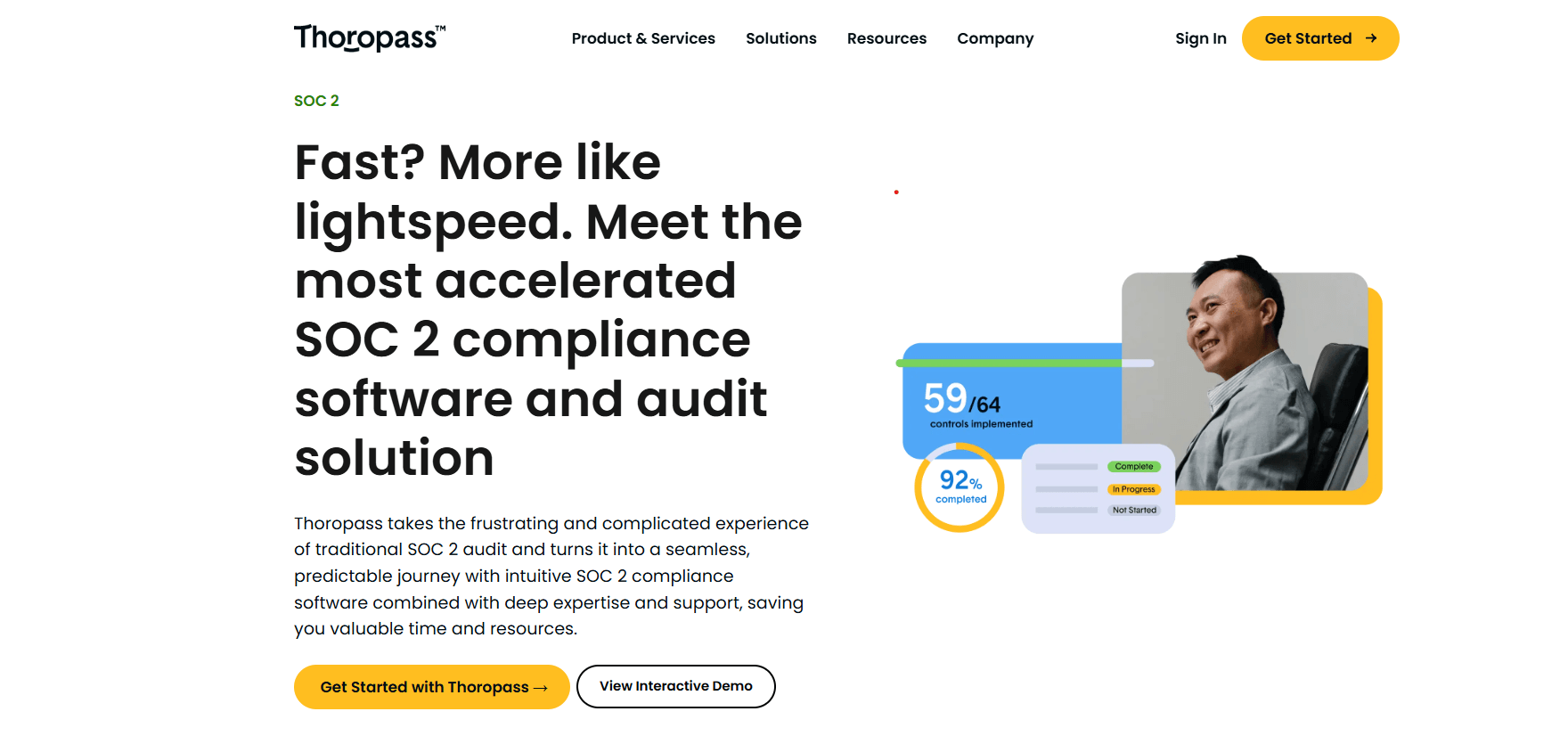
Thoropass (formerly Laika) takes a distinctive approach: instead of just selling you software and leaving you to find an audit firm, Thoropass bundles the compliance platform together with its own in-house auditors. This closed-loop model means the tool is built specifically around what the auditor checking your evidence will actually look for.
Features
- Integrated platform-plus-audit-firm model — Thoropass’s own auditors conduct your SOC 2 examination
- Automated evidence collection and continuous monitoring
- Fixed, transparent pricing that includes the audit fee itself not just the software
- Highly guided, white-glove onboarding experience
Pros
- Eliminates the often-stressful process of separately sourcing and vetting an audit firm — a significant time-saver for manufacturing software vendors without compliance experience
- Fixed pricing that bundles the audit fee provides budget predictability, which finance teams at smaller manufacturing software vendors tend to appreciate
- Particularly valuable for manufacturing software vendors without a dedicated in-house information security team
Cons
- Less flexibility if you already have a preferred audit firm relationship you’d like to keep
- Integration breadth, while solid for cloud-native stacks, is not as extensive as Vanta’s library
Pricing
Thoropass’s transparent, bundled pricing (platform plus audit) is one of its strongest selling points. While exact figures vary by company size and framework scope, the all-inclusive model often makes total first-year costs comparable to or more predictable than buying software and an audit separately from two different vendors.
Verdict
Thoropass is one of the strongest picks in our Top 12 Best SOC 2 Compliance Platforms for Manufacturing Software for vendors who want a single point of accountability from initial gap assessment all the way through the final audit report especially smaller manufacturing software companies acting as the de facto security team for their entire product development chain.
7. Scrut Automation
Scrut Automation has carved out a position specifically targeting mid-market manufacturing and technology service providers, making it one of the more directly relevant platforms on this list for the audience of this article.
Features
- Unified risk view spanning cloud infrastructure, employees, and third-party vendors
- Automated evidence collection with continuous control monitoring
- Specialized security awareness training modules, including content tailored to industrial environments (e.g., social engineering risks on the factory floor)
- Multi-framework support across SOC 2, ISO 27001, and others
Pros
- One of the only platforms on this list with security awareness training content specifically built around industrial and factory-floor scenarios
- Strong reputation for ROI and rapid deployment relative to cost
- Responsive support, frequently cited as a differentiator versus larger, more impersonal competitors
Cons
- Smaller overall integration library and brand recognition compared to Vanta or Drata
- As a mid-market-focused platform, very large enterprises may eventually outgrow certain modules
Pricing
Scrut is generally positioned as an affordable, mid-market-friendly option, with pricing reported to be competitive relative to Vanta and Drata for comparable feature sets — making it attractive for budget-conscious manufacturing software vendors that still need robust automation.
Verdict
Given its purpose-built features for manufacturing and industrial environments, PLM access reviews and factory-floor security training in particular, Scrut Automation deserves serious consideration in any Top 12 Best SOC 2 Compliance Platforms for Manufacturing Software comparison, especially for mid-market vendors whose products integrate directly with engineering and production systems.
8. OneTrust
OneTrust is the global leader in privacy management software, and its SOC 2 capabilities sit within a much broader integrated risk management platform. For manufacturing software vendors whose products handle significant amounts of personal data (HR systems integrations, workforce management tools, supplier contact databases) alongside operational data, OneTrust’s privacy-first approach can be a major asset.
Features
- Integrated risk management spanning third-party risk, compliance reporting, audit support, and incident management
- Updated data mapping capabilities providing visibility into data flows across systems
- SOC 2 reporting alongside broader privacy frameworks (GDPR, CCPA, and others)
- Incident management and response workflows
Pros
- Enterprise-grade platform that scales well as a manufacturing software company grows from mid-market to enterprise
- Broad risk management capabilities extend well beyond SOC 2, useful if your customers also demand privacy impact assessments or data processing agreements
Cons
- Significantly more complex than purpose-built SOC 2 automation tools
- Pricing tends to be on the higher end, reflecting its enterprise positioning
Pricing
OneTrust’s pricing is enterprise-tier and quote-based, generally positioned above pure-play SOC 2 automation tools given the breadth of its risk and privacy management modules. Manufacturing software vendors should expect a meaningfully higher investment than with platforms like Sprinto or Scrut.
Verdict
OneTrust rounds out the upper end of our SOC 2 compliance platforms for manufacturing software list as the choice for larger or fast-scaling vendors whose compliance needs extend well beyond SOC 2 into broad privacy and enterprise risk management particularly those handling significant volumes of personal data tied to supplier and workforce systems.
9. Hyperproof
Hyperproof is built around the idea of compliance operations as an ongoing program rather than a one-time audit push. Its workflow and collaboration tools are designed for organizations that expect to manage SOC 2 alongside several other frameworks indefinitely.
Features
- Centralized control repository that maps evidence across multiple frameworks and audits simultaneously
- Workflow automation for assigning, tracking, and verifying compliance tasks across teams
- Risk register and risk management workflows
- Integrations with cloud infrastructure, ticketing, and identity providers for automated evidence collection
- Reporting dashboards designed for both internal stakeholders and external auditors
Pros
- Strong fit for manufacturing software vendors that already juggle SOC 2, ISO 27001, and customer-specific security questionnaires on a recurring basis
- Collaboration features make it easier to distribute compliance tasks across engineering, IT, HR, and operations teams.
- Flexible framework mapping reduces duplicate work as new requirements
Cons
- Automation depth for evidence collection, while solid, is generally viewed as less extensive than Vanta or Drata’s libraries
- Can require more internal program management effort to get full value from its workflow tools
Pricing
Hyperproof pricing is quote-based and generally positioned in the mid-to-upper range relative to pure automation tools, reflecting its broader compliance operations focus rather than a single-audit tool.
Verdict
For manufacturing software vendors that have moved past their first SOC 2 audit and are now managing an ongoing portfolio of frameworks, audits, and customer security reviews, Hyperproof is a strong long-term operational fit among SOC 2 compliance platforms for Manufacturing Software.
10. JupiterOne
JupiterOne takes a graph-based approach to asset inventory and security posture, mapping relationships between cloud resources, devices, users, and data. For manufacturing software vendors with sprawling, complex environments multiple products, acquired codebases, or extensive device fleets, this asset-centric view can be a major advantage for SOC 2 scoping and evidence.
Features
- Graph-based asset inventory mapping relationships across cloud infrastructure, applications, devices, and users
- Continuous visibility into the attack surface, supporting SOC 2 control evidence around asset management
- Integration with cloud providers, identity systems, and security tools for automated data ingestion
- Query-based reporting for custom compliance and security questions
- Supports SOC 2 and other framework mappings via asset and control relationships
Pros
- The graph-based asset model is genuinely useful for manufacturing software vendors with complex, multi-product environments.
- Strong for ongoing security posture management beyond just compliance
- Flexible querying allows custom reports tailored to unusual environments, including hybrid on-prem/cloud setups
Cons
- Smaller ecosystem of compliance-specific templates and policy libraries compared to dedicated SOC 2 platforms
- Best suited to teams with at least some internal security engineering capacity to take advantage of the graph model
Pricing
JupiterOne pricing is quote-based and tends to scale with the size and complexity of the environment being mapped, making it more cost-effective for smaller, simpler environments and a meaningful investment for larger, multi-product manufacturing software portfolios.
Verdict
JupiterOne is a strong specialist choice in for vendors with complex, sprawling technical environments think a manufacturing software company that has grown through acquisition and now operates several distinct product lines with overlapping infrastructure.
11. LogicGate
LogicGate is a heavyweight in the broader GRC (Governance, Risk, and Compliance) space. While it’s not a SOC 2 in a box tool in the way Sprinto or Scrut are, it offers significant configurability for organizations that need SOC 2 compliance to live within a larger, enterprise-grade risk management program.
Features
Highly configurable workflow engine (“Risk Cloud”) that can be adapted to model SOC 2 controls alongside broader enterprise risk processes
Risk registers, control libraries, and policy management modules
Integration capabilities for pulling evidence from cloud and on-prem systems
Reporting and dashboarding for executive and board-level risk visibility
Supports modeling of custom frameworks alongside SOC 2 — useful for manufacturing-specific frameworks like IEC 62443
Pros
- Complete freedom to customize workflows and control models
- Excellent for organizations practicing model-based compliance, where SOC 2 is one piece of a broader enterprise risk framework
- Scales well to support board-level risk reporting.
Cons
- The configurability that makes LogicGate powerful also makes it more complex to implement.
- Less suited to small teams or companies pursuing their first SOC 2 report on a tight timeline
- Generally a higher total cost of ownership when factoring in implementation effort
Pricing
LogicGate is positioned as an enterprise GRC platform with quote-based pricing that reflects its configurability and implementation requirements — typically a larger investment than purpose-built SOC 2 automation tools, both in licensing and implementation services.
Verdict
LogicGate is best suited for larger manufacturing software vendors or those serving highly regulated manufacturing sub-sectors like aerospace, medical device, or defense that need SOC 2 compliance to be one component of a much broader, customizable enterprise risk management program.
12. Strike Graph
Strike Graph rounds out our list as a strong option for early-stage manufacturing software companies that need to get a SOC 2 report in place often because a single large customer is requiring it without the cost or complexity of enterprise-tier platforms.
Features
- Guided gap analysis to identify what controls need to be implemented before pursuing SOC 2
- Automated evidence collection across common cloud and SaaS tools
- Pre-built policy templates and control frameworks
- Direct connections with audit firm partners to streamline the path from readiness to attestation
- Multi-framework support for companies that anticipate needing ISO 27001 down the line
Pros
- Generally positioned as one of the more affordable entry points into SOC 2 automation
- Gap analysis tooling is helpful for teams that genuinely don’t know where to start
- Streamlined connections to audit partners reduce the friction of finding and vetting an auditor independently
Cons
- Smaller integration library and feature set compared to the larger platforms on this list
- Support resources, while helpful, are less extensive than platforms with larger customer success teams
Pricing
Strike Graph is generally positioned at the more affordable end of the market, making it one of the more accessible options for cash-conscious early-stage manufacturing software companies pursuing their first SOC 2 report.
Verdict
Strike Graph closes out our Top 12 Best SOC 2 Compliance Platforms for Manufacturing Software as the practical choice for very early-stage vendors often pre-Series B who need to satisfy one or two large manufacturing customers’ security requirements without committing to a larger platform’s price tag before they’re ready.
Conclusion: Finding the Right Fit Among the Top 12 Best SOC 2 Compliance Platforms for Manufacturing Software
There is no single “best” platform for every manufacturing software company, the right choice depends on your architecture, your customers’ framework requirements, your team’s compliance maturity, and your budget. What’s clear from this comparison of the Top 12 Best SOC 2 Compliance Platforms for Manufacturing Software is that the strongest options share a common thread: they reduce the manual burden of evidence collection while addressing the realities of hybrid environments, multi-framework demands, and the supply-chain risk concerns that matter so much to manufacturing buyers.
Whichever platform you choose from this list of the Top 12 Best SOC 2 Compliance Platforms for Manufacturing Software, the most important step is starting now,manufacturing customers increasingly treat SOC 2 attestation as a baseline requirement, not a nice-to-have, and the sooner you begin, the sooner that requirement stops being a barrier to closing deals.