

Every business runs on trust. But for identity verification startups, trust isn’t just important. It’s the product. You’re not just handling customer data. You’re responsible for government IDs, biometric scans, facial matching templates, Social Security fragments, and the kind of information fraudsters are constantly trying to steal. So when someone asks, “Where is your SOC 2 report?” you should have a report from a licensed CPA firm ready to share.
Most articles about SOC 2 Certification Firms for Identity Verification Startups focus on generic SaaS businesses like project management tools, CRMs, and marketing platforms. They rarely address the challenges identity verification (IDV) companies face. These startups handle biometric data protected under state biometric privacy laws, meet NIST 800-63 identity assurance levels, manage KYC/AML data-sharing obligations, and work with banking and fintech customers who review every page of a SOC 2 report before signing a contract.
Why Identity Verification Startups Need Specialized SOC 2 Certification Firms
Generalist auditors often apply a one-size-fits-all approach and may overlook the controls enterprise customers expect from identity verification companies.
- Biometric data handling: Identity verification platforms process highly sensitive biometric data. Therefore, your auditor should know how to evaluate controls for encryption, retention, access, and secure deletion while meeting privacy laws.
- Document and PII processing: These companies handle passports, driver’s licenses, utility bills, and other personal documents. In addition, experienced auditors know how to scope OCR, fraud detection, and storage systems accurately. This helps you avoid unnecessary audit costs and coverage gaps.
- KYC/AML requirements: Many identity verification startups support banks and fintech companies. Because of this, auditors should understand KYC and AML expectations and how they influence your SOC 2 audit.
- Fraud and security risks: Identity verification platforms face threats such as synthetic identity fraud and attacks on AI-powered verification systems. As a result, auditors with relevant experience can assess your controls more effectively.
- Multi-framework compliance: If you operate internationally, you may need more than SOC 2. For example, you might also require ISO 27001, ISO 27701, or GDPR compliance. Therefore, choose a firm with experience across multiple compliance frameworks.
Top 12 best SOC 2 certification firms for identity verification startups.
1. A-LIGN
A-LIGN is a Tampa, Florida-based compliance firm and one of the highest-volume SOC 2 issuers in the world, with thousands of clients and tens of thousands of completed audits across its history. For an identity verification startup that expects to eventually need FedRAMP, HITRUST, or PCI DSS on top of SOC 2, for example, if you’re pursuing government ID-verification contracts or bank partnerships — A-LIGN’s breadth is hard to match.
Features
- A-SCEND platform with AI-assisted evidence scoring and cross-framework control reuse, so a control tested for SOC 2 doesn’t need to be re-tested from scratch for ISO 27001 or HITRUST
- Top-three FedRAMP 3PAO status and CMMC C3PAO authorization, relevant for identity verification vendors selling into government agencies
- Broad framework coverage: SOC 1/2/3, ISO 27001, ISO 42001, HITRUST, PCI DSS, and FedRAMP under one roof
- Global audit capability including ISAE 3000 for international identity verification companies
Pros
- A single platform reduces duplicate audit work as your compliance roadmap expands
- Deep experience with technology, fintech, and healthcare clients — all adjacent to identity verification’s risk profile
- Strong brand recognition that carries real weight with enterprise procurement teams and banking partners
Cons
- Pricing sits above boutique specialist firms, which matters for pre-seed and seed-stage teams
- The platform-driven audit style may feel less personal than a boutique CPA firm’s hands-on partner access
Pricing: Type 2 engagements typically run in the mid-tier specialist range, generally landing between $20,000 and $80,000 depending on scope, trust services criteria selected, and whether multiple frameworks are bundled into the same engagement.
Verdict: A-LIGN is the strongest of the SOC 2 certification firms for identity verification startups that already know they’ll need more than SOC 2 alone, particularly those targeting government or heavily regulated banking clients.
2. Schellman & Company
Schellman is one of the largest independent SOC examination providers in the United States, issuing thousands of SOC reports annually across dozens of assessment types. The firm is PCAOB-registered and structures itself so that Schellman & Company handles attest work while a separate advisory arm handles non-attest consulting, preserving auditor independence, which matters if your enterprise customers scrutinize conflict-of-interest questions during vendor security review. Schellman’s “single assessor” model lets identity verification companies pursue SOC 2 and ISO 27001 concurrently under one firm, which is valuable if you’re expanding into European or APAC markets where ISO 27001 carries more weight than SOC 2.
Features
- Single-assessor approach for concurrent SOC 2 and ISO 27001 audits, reducing coordination overhead
- Growing practice in AI-specific assurance work, including AI red-teaming and ISO 42001 assessments, directly relevant if your identity verification stack uses machine-learning-based document or face matching
- SOC for Supply Chain reporting, useful if your biometric matching or OCR vendors are part of your control environment
- Exclusive focus on attestation and compliance work rather than diluting expertise across financial audit or tax services
Pros
- Extremely deep, focused expertise — auditors “live and breathe” compliance frameworks rather than treating SOC 2 as a side practice
- Fast report delivery, with draft reports often available within about three weeks of fieldwork
- Strong subservice-organization risk methodology, which matters given how many identity verification companies rely on third-party biometric or document-verification APIs
Cons
- High-volume client base can mean less individualized partner attention compared to a smaller boutique CPA firm
- Best fit for teams that already have baseline security maturity rather than very early pre-readiness startups
Pricing: Engagements generally fall in the mid-tier to upper-mid-tier range, commonly cited between $20,000 and $95,000 for a Type 2 audit depending on scope and whether ISO 27001 is bundled in.
Verdict: Among SOC 2 certification firms for identity verification startups with international ambitions, Schellman’s ability to combine SOC 2 and ISO 27001 into one audit cycle is a genuine efficiency advantage.
3. Prescient Security

Prescient Security is built differently from most CPA firms in this space: its leadership and many of its auditors came up through penetration testing and application security rather than traditional accounting. That technical-first DNA matters enormously for identity verification startups whose core risk isn’t just “who has admin access to the database” but “how resilient is our facial-matching model to spoofing and adversarial inputs.” Prescient operates under an AICPA-recognized alternative practice structure and has built a specific practice around AI and large language model providers, pairing SOC 2 with ISO 42001 for companies whose identity-verification pipeline includes ML-based fraud detection.
Features
- Auditors with real penetration-testing and application-security backgrounds, not just accounting credentials
- SOC 2 + ISO 42001 bundled engagements for AI/ML-heavy identity verification and biometric matching platforms
- Deep Vanta integration with same-day Slack-based audit communication, and no on-site visit requirements for most engagements
Pros
- Genuinely useful, specific technical guidance when a control gap is found, rather than generic checklist language
- Fast fieldwork-to-report timelines, often two to six weeks
- Strong fit for teams already running Drata, Vanta, or Secureframe
Cons
- Does not cover every niche framework — confirm coverage for country-specific identity regulations upfront
Pricing: SOC 2 Type 2 engagements are generally quoted between $10,000 and $75,000, positioning Prescient in the mid-range compared to other identity-verification-relevant specialist firms.
Verdict: If your product depends on biometric matching algorithms, liveness detection, or any ML-driven identity signal, Prescient Assurance is arguably the most technically literate of the SOC 2 certification firms for identity verification startups on this list.
4. Johanson Group LLP
Johanson Group is a boutique CPA firm with a reputation for hands-on partner involvement and some of the fastest turnaround times in the specialist tier. For an early-stage identity verification startup racing to close an enterprise deal that’s gated on a SOC 2 report, Johanson’s combination of speed and fixed-fee pricing is genuinely valuable, the firm is also an IAS-accredited ISO 27001 certification body, meaning it can issue actual ISO certificates rather than just SOC-style attestations.
Features
- Quoted turnaround of one to three weeks from fieldwork to report delivery among the fastest in the specialist tier
- IAS-accredited certification body for ISO 27001, 27017, 27018, and 27701, useful for identity verification companies expanding into markets that expect ISO certification specifically
- Multi-framework coverage including HIPAA/HITECH, PCI DSS, GDPR, CCPA, NIST CSF, and the German BSI C5 standard for companies pursuing European enterprise deals
- Drata Alliance member, and integrates with Rippling’s automated compliance offering
Pros
- Fixed-fee, predictable pricing that startup finance teams can budget around
- Genuine boutique-firm attentiveness — direct partner access rather than being routed to junior staff
- Strong reputation among first-time SOC 2 buyers specifically because of speed
Cons
- Smaller firm size means less capacity for very large, complex, multi-entity audits
- Less brand recognition than the largest national firms, which occasionally comes up in enterprise vendor reviews
Pricing: Type 1 audits for seed-stage companies generally run $10,000–$15,000, Type 2 audits for Series A-stage companies run roughly $15,000–$25,000, and combined Type 1 + Type 2 bundles run approximately $20,000–$30,000.
Verdict: For identity verification startups that need “we have SOC 2” fast and don’t yet require FedRAMP or HITRUST, Johanson Group is one of the best-value SOC 2 certification firms for identity verification startups in this guide.
5. Linford & Company
Linford & Company is a Denver-based CPA firm specializing almost exclusively in SOC examinations and related attestation work. Its differentiator is staffing: many of its auditors and leaders previously worked at Big Four firms or large consultancies, meaning identity verification startups get Big Four-caliber audit rigor without Big Four pricing. The firm also handles HITRUST, HIPAA, and FedRAMP assessments, useful if your identity verification product touches healthcare identity proofing.
Features
- Auditors with Big Four and major consultancy backgrounds bringing enterprise-grade methodology to smaller engagements
- Focus on SOC 1, SOC 2, and HITRUST, with HIPAA and FedRAMP support available
- Distributed, remote-first team built around encrypted collaboration, a sensible fit for identity verification companies that are understandably cautious about who touches sensitive evidence
- Frequently recommended specifically for startups and smaller organizations where budget is the binding constraint
Pros
Genuinely competitive pricing relative to audit quality and auditor experience level
Strong reputation for thoroughness without unnecessary bureaucracy
Good option if HITRUST is on your roadmap alongside SOC 2 for healthcare-adjacent identity verification
Cons
- Smaller firm footprint means less bandwidth for very large, multi-subsidiary engagements
- Less name recognition than Schellman or A-LIGN in some enterprise vendor security reviews
- Multi-framework breadth is narrower than firms like A-LIGN or Johanson Group
Pricing: Regional CPA firms in this tier, including Linford, generally quote $20,000–$95,000 for a Type 2 engagement depending on scope, with lower-end pricing achievable for simpler, single-criterion audits typical of early-stage startups.
Verdict: If budget is the primary constraint and you still want auditors with genuine enterprise-grade training, Linford & Company belongs near the top of any list of SOC 2 certification firms for identity verification startups.
6. Sensiba LLP
Sensiba LLP is a certified public accounting and advisory firm that ranks among the top 100 U.S. accounting firms and holds the distinction of being California’s first accounting B Corporation. Its SOC 2 practice combines CPAs with information security professionals fluent in AWS, GCP, and Azure all common infrastructure choices for identity verification startups running document-scanning and biometric-matching workloads in the cloud.
Features
- Fixed-fee pricing structured to reduce costs roughly 25–30% versus traditional hourly billing models
- Deep familiarity with major compliance automation platforms, including Drata, Secureframe, Sprinto, and Vanta
- AI-assisted evidence review to speed up testing cycles
- B Corp certification, which resonates with identity verification startups whose enterprise buyers increasingly weigh ESG and values-alignment in vendor selection.
Pros
- Strong client retention and long-standing firm history dating back to 1977
- Genuinely useful for VC-backed startups closing their first enterprise contract on a tight timeline
- Multi-framework capability, including SOC 2 alongside ISO 27001, within a single engagement window
Cons
- Typical engagement length (roughly four to eight months for combined SOC 2 + ISO 27001) is longer than some pure-specialist boutique competitors
Pricing: Sensiba’s fixed-fee structure generally lands in the mid-range for specialist firms, broadly comparable to the $20,000–$60,000 band typical for combined-framework Type 2 engagements.
Verdict: A strong pick among SOC 2 certification firms for identity verification startups that want cloud-native technical fluency paired with a firm whose values and brand story resonate with mission-driven enterprise buyers.
7. Insight Assurance

Insight Assurance has built its reputation around handling audits across multiple frameworks simultaneously and maintaining unusually high client retentionacross thousands of completed engagements. For identity verification startups juggling SOC 2 alongside privacy assessments, ISO 27001, or HIPAA, Insight Assurance’s unified approach can meaningfully shorten total audit time compared to running separate engagements with separate firms.
Features
- Comprehensive framework coverage spanning SOC 1/2/3, ISO 27001, PCI DSS, HIPAA/HITECH, GDPR/CCPA, HITRUST, FedRAMP, and CMMC
- Direct client-to-auditor communication rather than being routed through account managers
- Final SOC 2 report delivery typically within four to six weeks of testing completion
- Leadership and staff holding CPA, CISA, QSA, CISM, and other credentials, with many alumni of Big Four firms
Pros
- Very high client retention suggests consistently good service delivery
- Multi-framework depth rivals much larger firms despite Insight Assurance’s more boutique positioning
- Continuous compliance monitoring helps identity verification startups avoid last-minute scrambles before renewal audits
Cons
- Multi-framework breadth means you’ll want to confirm which specific identity-verification-relevant frameworks (like state biometric privacy assessments) they’ve actually executed before signing
- Regional office structure means team composition can vary by engagement
Pricing: Positioned competitively against other specialist firms, typically in the same general $15,000–$60,000 Type 2 range depending on scope and number of frameworks bundled.
Verdict: One of the more underrated SOC 2 certification firms for identity verification startups that need genuine multi-framework coverage without paying Big Four rates.
8. BARR Advisory
BARR Advisory is a cybersecurity and compliance firm serving clients from early-stage startups to Fortune 1000 enterprises across more than 20 countries. It’s among a small number of U.S. firms accredited for both ISO 27001 certification and SOC 2 attestation, which matters directly for identity verification companies expanding into markets where ISO 27001 is the expected standard rather than SOC 2.
Features
- Adaptive audit methodology that the firm states reduces client effort compared to traditional audit approaches
- Dual accreditation for SOC 2 audits and ISO 27001 certification under one firm
- Team credentialed across CPA, CISA, CISSP, and CIPP designations — the CIPP privacy credential specifically useful for identity verification companies managing biometric and PII-heavy data flows
Pros
- Genuinely fast, adaptive audit process designed to minimize the internal burden on lean startup teams
- Strong dual-framework credibility for companies expanding internationally
- Cloud-first methodology fits identity verification companies running entirely on modern infrastructure
Cons
- Smaller firm than the largest national players, which can mean tighter capacity during peak audit seasons
- Less name recognition outside the compliance-conscious startup and cloud-native enterprise segment
Pricing: BARR generally competes in the same fixed-rate specialist band as other boutique firms, commonly cited in the $20,000–$70,000 range for Type 2 engagements depending on framework scope.
Verdict: For identity verification startups that need genuine ISO 27001 accreditation alongside SOC 2 not just SOC 2 mapped loosely to ISO controls, BARR Advisory is one of the strongest SOC 2 certification firms for identity verification startups on this list.
9. KirkpatrickPrice
KirkpatrickPrice serves SaaS, FinTech, and healthcare technology clients with what it describes as an education-forward audit approach meaning the firm spends real time helping first-time compliance teams understand why each control matters, not just whether it passes. For an identity verification startup where the compliance function might be a single overworked founder or ops lead, this teaching-oriented style can be the difference between a stressful audit and a manageable one.
Features
- Strong focus on FinTech and healthcare technology clients, both industries with meaningful overlap with identity verification’s regulatory pressure points
- Education-forward methodology aimed at helping non-specialist teams genuinely understand their control environment
- SOC 1 and SOC 2 specialization alongside broader information security auditing services
- Reputation for auditor responsiveness during the engagement, cited repeatedly by companies that have worked with the firm
Pros
- Genuinely helpful for founders and small compliance teams who are navigating their first SOC 2 audit without dedicated in-house compliance expertise
- Strong FinTech-adjacent experience translates well to KYC and identity-verification data handling requirements
- Long track record dating back to 2005 provides institutional audit experience
Cons
- Less multi-framework breadth than firms like A-LIGN or Insight Assurance
- Best suited to companies that want a teaching relationship rather than the fastest possible turnaround
Pricing: Generally competitive with other specialist firms, typically falling in the $15,000–$75,000 range for a Type 2 engagement depending on scope.
Verdict: A strong choice among SOC 2 certification firms for identity verification startups whose internal team is compliance-first-timers and would benefit from an auditor that teaches as it tests.
10. Coalfire
Coalfire occupies a distinctive niche: it’s a mid-tier cybersecurity advisory and assessment firm with deep federal compliance capability, operating as one of the largest FedRAMP Third Party Assessment Organizations (3PAOs) in the country by volume. If your identity verification startup is pursuing government ID-verification contracts, or serving state agencies, benefits programs, or federal identity-proofing initiatives, Coalfire’s FedRAMP and CMMC depth is a genuine differentiator that most boutique SOC 2 firms simply cannot match.
Features
- One of the largest FedRAMP 3PAOs in the United States, with deep CMMC assessment capability as well
- Broader cybersecurity advisory portfolio beyond SOC 2, including penetration testing and security assessments that overlap naturally with identity verification’s fraud and adversarial risk concerns
- Federal-cleared audit professionals with credentials specific to government compliance work
- Positioned between boutique commercial firms and the largest mid-tier nationals
Pros
- Unmatched federal compliance depth for identity verification companies with a government sales motion
- Broader security assessment capability beyond attestation alone
- Strong reputation in federal agency vendor risk management documentation
Cons
- Overkill for a pure commercial B2B SaaS identity verification company with no government ambitions
Pricing: Generally runs $25,000–$80,000 for a Type 2 engagement, with federal-adjacent work (FedRAMP, CMMC) pushing costs meaningfully higher depending on authorization level.
Verdict: Not the right fit for every identity verification company, but for those selling into government agencies, Coalfire is the clearest standout among SOC 2 certification firms for identity verification startups with regulatory ambitions beyond commercial SaaS.
11. Thoropass
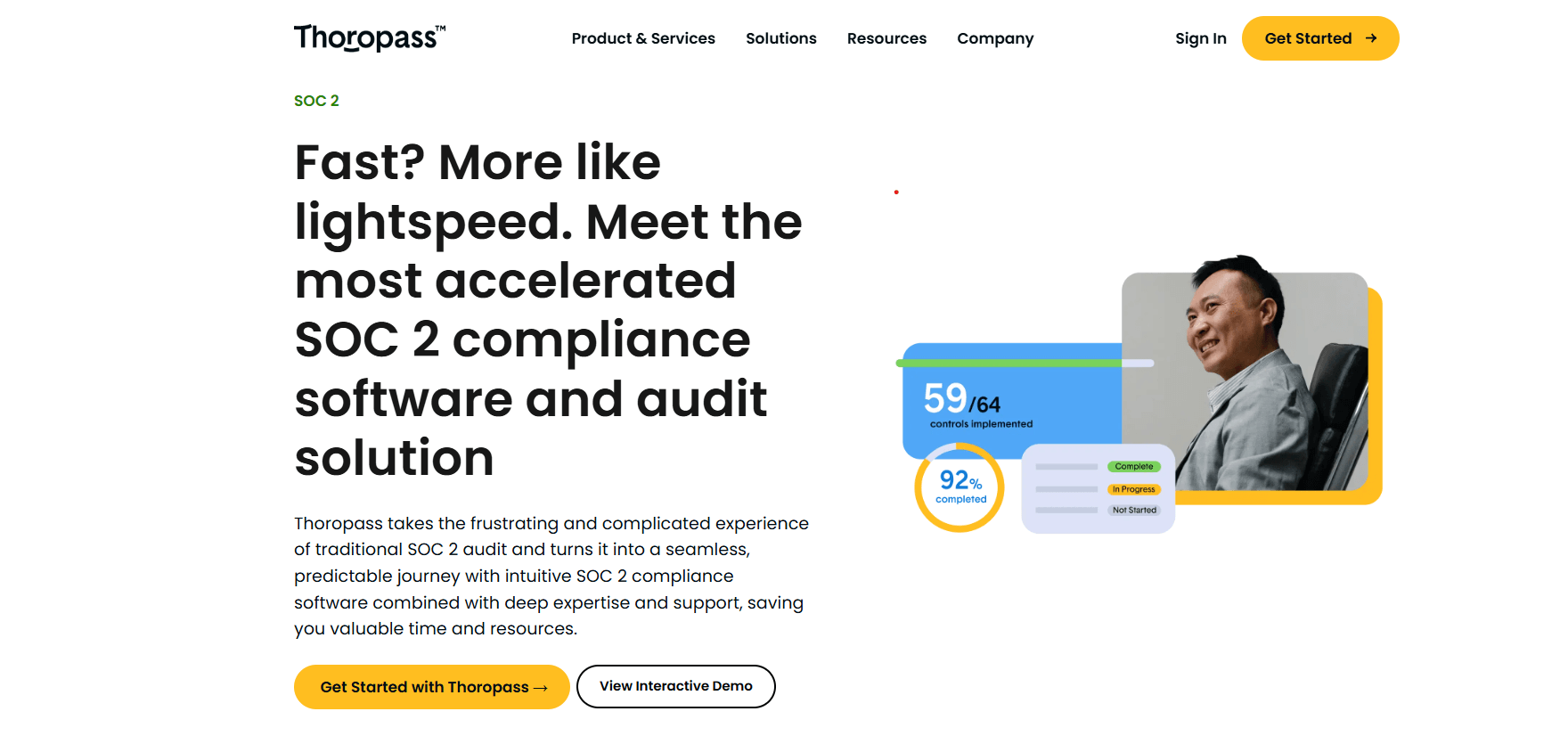
Thoropass distinguishes itself by combining a compliance automation platform with an in-house audit arm, eliminating the handoff between a GRC tool like Vanta or Drata and a separate CPA firm. For an identity verification startup pursuing its very first SOC 2, ISO 27001, HIPAA, or PCI DSS report, this single-vendor model can meaningfully reduce coordination overhead one contract, one support relationship, one place where evidence lives.
Features
- Combined GRC platform and licensed CPA audit arm under one vendor relationship
- Fixed-fee, four-to-six week audit timelines aimed squarely at first-time SOC 2 buyers
- Shared evidence collection across SOC 2, ISO 27001, HIPAA, PCI DSS, and HITRUST when multiple frameworks are pursued together
- Designed for companies under roughly 200 employees still building their first compliance program from scratch
Pros
- Removes the friction of managing separate platform and audit-firm relationships
- Fixed, predictable pricing well-suited to startup budgeting cycles
- Strong fit for identity verification companies that haven’t yet chosen a standalone GRC platform
Cons
- Bundled platform-plus-audit model may feel restrictive if you already have a preferred GRC tool
- Newer entrant relative to legacy CPA firms, which occasionally matters to conservative enterprise buyers
Pricing: Fixed-fee packages generally start in the $15,000–$35,000 range for early-stage Type 2 engagements, competitive with pure specialist boutique firms.
Verdict: A smart choice among SOC 2 certification firms for identity verification startups that want to avoid managing multiple vendors during their first compliance push.
12. Withum

Withum is a dedicated cybersecurity and risk advisory practice serving SaaS, HR tech, and digital health clients. What sets Withum apart from the purely SOC 2-focused firms on this list is breadth: the firm can combine your SOC 2 audit with M&A cybersecurity due diligence, financial audit readiness, and transaction advisory work, genuinely useful for identity verification startups approaching a fundraising round, acquisition conversation, or eventual IPO where investors will scrutinize security posture alongside financials.
Features
- Full-service CPA firm capability spanning SOC 2 attestation, financial audit, and transaction advisory under one roof
- Dedicated cybersecurity and risk advisory practice with SaaS and digital health specialization
- Established national ranking and reputation that carries weight in institutional due diligence contexts
- Ability to support identity verification startups through the entire lifecycle from first SOC 2 report to eventual liquidity event
Pros
- Rare ability to combine security attestation with financial and transactional advisory in one relationship
- National firm credibility that resonates strongly with institutional investors and acquirers
- Deep bench strength for companies scaling quickly and needing more than just a SOC 2 report
Cons
- Pricing sits above boutique specialist firms, reflecting the broader service scope
- Best suited to later-stage companies rather than very early pre-seed teams
Pricing: As a full-service national CPA firm, Withum’s SOC 2 engagements typically run in the $20,000–$95,000 range, with total cost varying based on whether transaction advisory or financial audit work is bundled in.
Verdict: The right pick among SOC 2 certification firms for identity verification startups that are simultaneously thinking about their next funding round, acquisition conversation, or long-term exit strategy.
Conclusion
Choosing among SOC 2 certification firms for identity verification startups isn’t a box-checking exercise, it’s a decision that shapes how fast you close your next enterprise deal and how much scrutiny your report survives when a bank’s security team actually reads it. The 12 firms in this guide were selected specifically because they understand, at varying depths, what makes identity verification different: biometric data sensitivity, KYC-adjacent obligations, fraud-facing infrastructure, and the multi-framework reality many identity verification companies eventually face as they scale internationally or into regulated industries.
Whichever firm you choose from this list of the best SOC 2 certification firms for identity verification startups, get a scoped proposal, confirm active AICPA licensure, and start your readiness work well before your first fieldwork call, that’s what actually determines whether your audit is a smooth formality or an expensive scramble.