

Quantum computing startups face security challenges that most SaaS companies never encounter. They build technology that could one day reshape or even breakthe encryption standards that protect today’s internet. At the same time, they must convince enterprise customers, government agencies, and investors that they take security seriously. They need strong controls, clear processes, and proof that they can protect sensitive data. That’s why choosing the right SOC 2 providers for quantum computing startups requires more than finding a firm that checks compliance boxes. You need a provider that understands both emerging technology and enterprise security expectations.
Your startup may run a hybrid infrastructure that combines cloud platforms with physical lab equipment, such as cryogenic systems, control electronics, and photonic benches. You may also work with the Department of Defense, DARPA, IARPA, or national laboratories. Those partnerships often introduce export control requirements and Controlled Unclassified Information (CUI) obligations alongside SOC 2.
Access control can also become more complicated. Many quantum computing startups rely on research-heavy teams where scientists and engineers need broad access to labs, simulations, and specialized tools to do their work. That makes it much harder to enforce least-privilege access than it is at a typical software startup.
Why Quantum Computing Startups Need Specialized SOC 2 Providers
- Quantum startups face stricter compliance requirements: Enterprise customers often expect SOC 2 alongside frameworks like NIST SP 800-171 or CMMC. Choose a provider that understands these additional security requirements.
- Export controls affect your security program: Dual-use technologies introduce extra requirements for access controls, data handling, and data residency. Your provider should understand these risks.
- Your infrastructure goes beyond the cloud: Quantum startups often manage cloud platforms, lab networks, specialized hardware, and on-premises computing. Your provider should assess both digital and physical environments.
- Customers expect modern cryptograph: Many buyers now ask about post-quantum cryptography (PQC) and encryption practices during security reviews. A knowledgeable provider can help you prepare.
- Research teams need flexible controls: Scientists and hardware engineers require broader access than a typical software team. Your provider should create controls that fit your workflow instead of relying on generic templates.
The 12 Best SOC 2 Providers for Quantum Computing Startups
1.Vanta
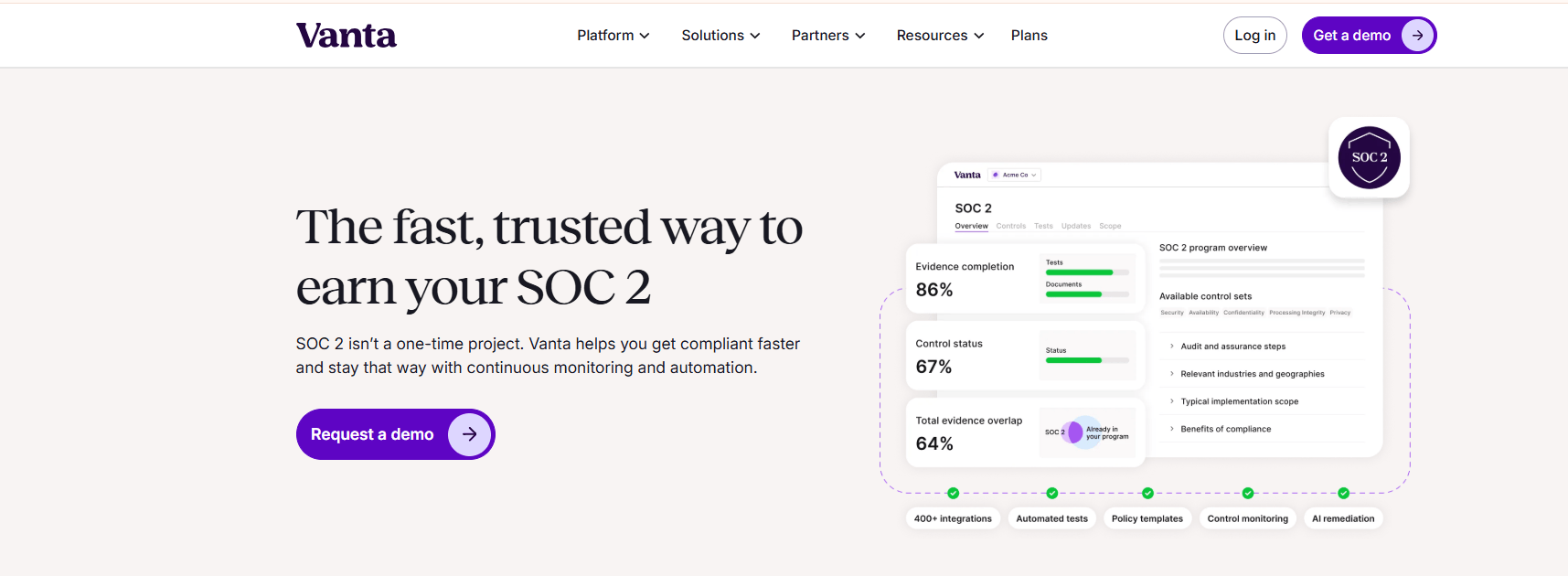
Vanta is the most widely adopted compliance automation platform on the market, and it’s frequently the default recommendation among SOC 2 providers for quantum computing startups that need to move fast on a first audit. It connects to your cloud infrastructure, identity provider, HR system, and version control to pull evidence continuously rather than relying on manual screenshotting.
Features:
- Continuous control monitoring across AWS, GCP, Azure, and major SaaS tools
- Built-in trust center / trust portal for sharing your security posture with prospects
- Pre-built control mappings for SOC 2, ISO 27001, HIPAA, and GDPR
- Large auditor partner marketplace, including firms experienced with deep-tech and hardware-adjacent companies
- AI-assisted evidence review to flag gaps before your auditor does
Pros:
- Fastest time-to-evidence of the major platforms, useful when a defense or enterprise deal is gating on SOC 2
- Large integration library reduces manual work for the cloud-hosted portion of your stack
- Strong brand recognition with enterprise security teams, which can shorten vendor security review cycles
Cons:
- Weaker out-of-the-box support for on-premises lab equipment, cryogenic hardware networks, or air-gapped simulation clusters — you’ll need custom control mapping
- Can feel like overkill and administratively heavy for a five-person research team pre-Series A
- Does not issue the SOC 2 report itself; you still need a separate CPA firm
Pricing: Typically starts in the $7,500+/year range according to marketplace listings, scaling with headcount and integrations; enterprise-tier quotes run higher for multi-framework programs.
2. Drata
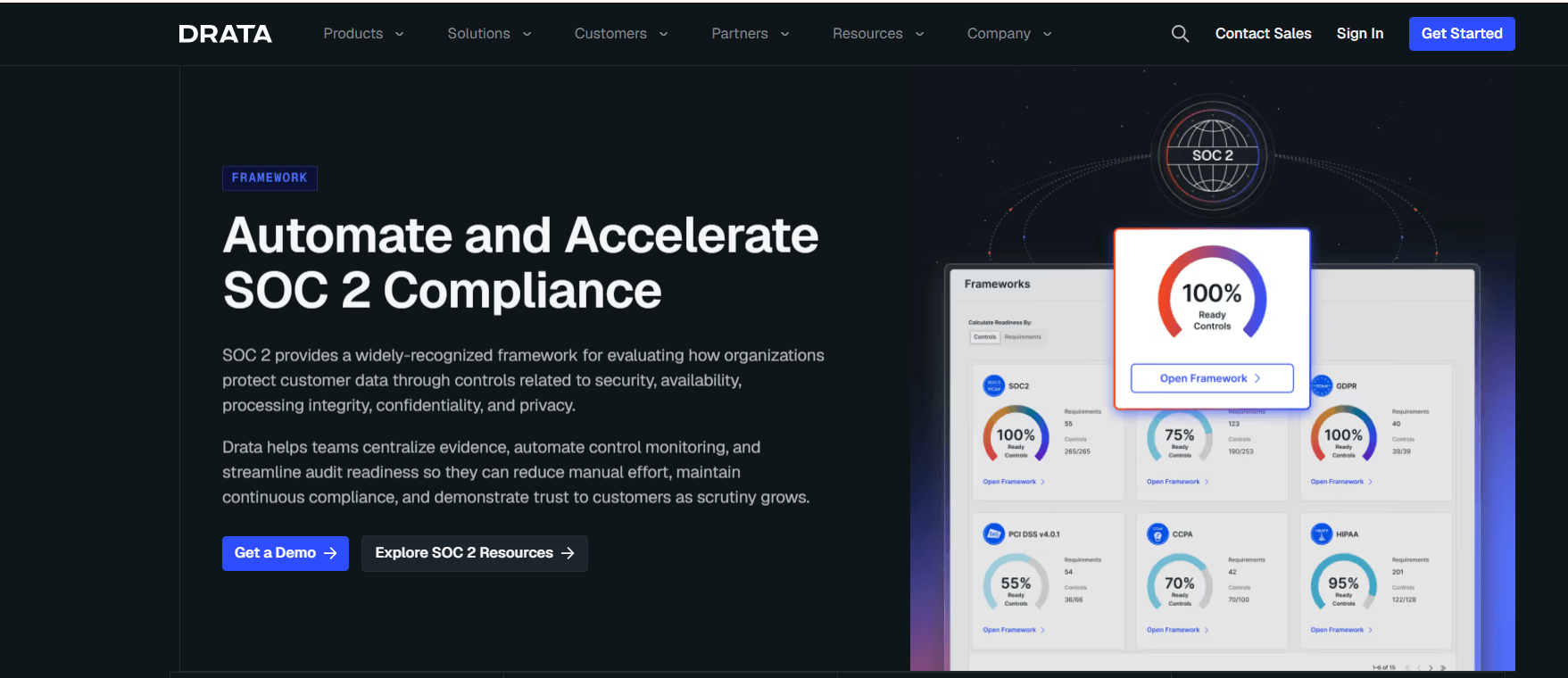
Drata is Vanta’s closest competitor and is often the pick among SOC 2 providers for quantum computing startups that expect to layer on additional frameworks (ISO 27001, NIST 800-171, CMMC-adjacent controls) as they move deeper into government and defense contracting.
Features:
- Highly automated evidence collection with granular control-level detail
- Strong multi-framework mapping, so one piece of evidence can satisfy overlapping controls across SOC 2, ISO, and NIST frameworks
- Risk management module for tracking vendor and third-party risk, relevant if you rely on specialized fabs, cryogenics suppliers, or component vendors
- Auditor Hub for streamlined collaboration during fieldwork
Pros:
- Efficient control mapping is genuinely useful once you’re juggling SOC 2 plus a government-facing framework simultaneously
- Detailed audit trail supports Type II observation periods well
- Active partner network of CPA firms comfortable with hardware and hybrid environments
Cons:
- Steeper learning curve than some lighter-weight competitors
- Like Vanta, cloud-integration-first design means lab and physical infrastructure controls often require manual workarounds
- Pricing can climb quickly once you add frameworks beyond SOC 2
Pricing: Custom quotes; industry reporting places most growth-stage programs in a similar band to Vanta, with multi-framework add-ons increasing the annual cost.
3. Secureframe

Secureframe positions itself toward small and mid-sized companies that want compliance automation bundled with security awareness training and a customer-facing trust page, useful for quantum startups whose research staff may not have gone through formal security onboarding before.
Features:
- Built-in employee security training modules, helpful for research-heavy teams new to formal InfoSec practice
- Vendor risk management and policy template library
- Trust portal for sharing compliance status with enterprise and government prospects without a lengthy back-and-forth
- Integrations across common cloud and DevOps tools
Pros:
- Genuinely strong for teams with little existing security process, since it builds foundational habits (training, policy sign-off) into the platform
- Simpler interface than some competitors, which matters for small ops teams wearing multiple hats
- Reasonable mid-market pricing relative to enterprise-only competitors
Cons:
- Less depth on complex, multi-framework government scoping than Drata
- Not built with hardware/lab environments in mind — expect manual evidence gathering for physical security controls
- Smaller auditor partner network than Vanta or Drata
Pricing: Positioned as an SMB-friendly option; expect a lower entry price than enterprise-tier platforms, with cost scaling by employee count and framework count.
4. Sprinto
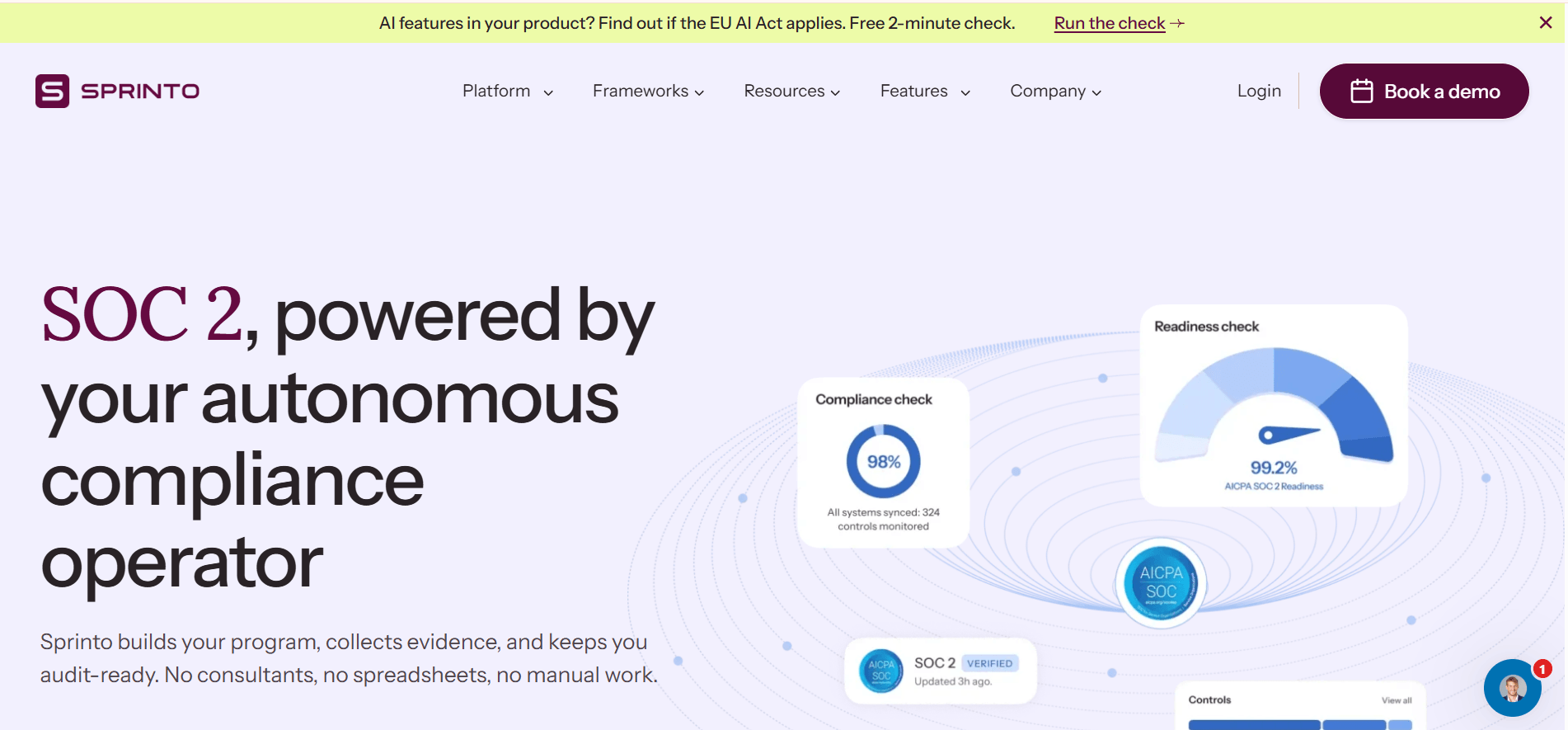
Sprinto is frequently recommended for early-stage startups that need to move through SOC 2 quickly on limited engineering bandwidth, a common scenario for pre-Series A quantum computing companies where the founding team is still mostly scientists and hardware engineers rather than dedicated security staff.
Features:
- Guided, checklist-driven implementation designed to minimize the security expertise required internally
- Automated evidence collection with continuous control checks
- Integrated risk assessments and policy generation
- Direct-to-audit workflow that shortens the path from “no controls” to “Type I report”
Pros:
- Genuinely fast for early-stage companies with minimal existing security tooling
- Lower administrative overhead than platforms built for larger compliance teams
Cons:
- Less suited to companies with complex hybrid or classified/CUI-adjacent environments
- Smaller ecosystem of integrations for specialized lab or HPC tooling
Pricing: Generally positioned as one of the more affordable full automation platforms, aimed squarely at early-stage budgets.
5. Scytale
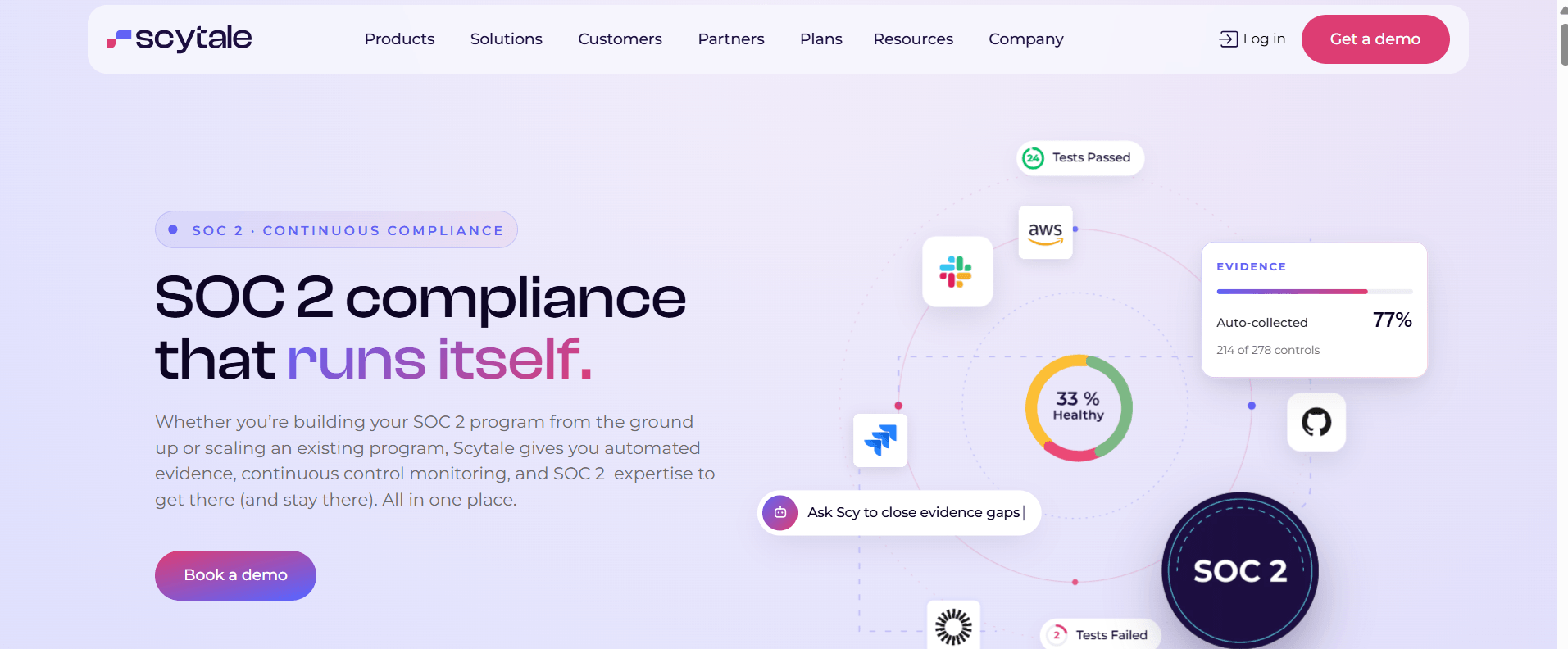
Scytale combines automation with a heavier advisory layer, pairing the software with human compliance experts. For quantum computing startups without an in-house security hire, that advisory layer can be the difference between a smooth first audit and a confused scramble two weeks before fieldwork.
Features:
- AI-assisted evidence review that flags likely audit findings before they reach your auditor
- Dedicated advisory support throughout implementation, not just software access
- Multi-framework mapping across SOC 2, ISO 27001, and emerging AI-governance frameworks
- Centralized collaboration hub for distributed research and engineering teams
Pros:
- The advisory layer is genuinely valuable for research-first teams unfamiliar with formal compliance processes
- Strong customer support reputation relative to pure self-serve platforms
- Increasingly relevant AI-governance framework coverage, useful if your quantum-classical hybrid stack includes ML components
Cons:
- Advisory-heavy model can mean more human touchpoints (and coordination overhead) than a pure self-serve platform
- Smaller company than Vanta or Drata, with a correspondingly smaller integration marketplace
- Less specific government-contractor track record than firms like Schellman
Pricing: Custom quotes based on company size and framework scope; positioned as a mid-market option with advisory services bundled in.
6. Thoropass
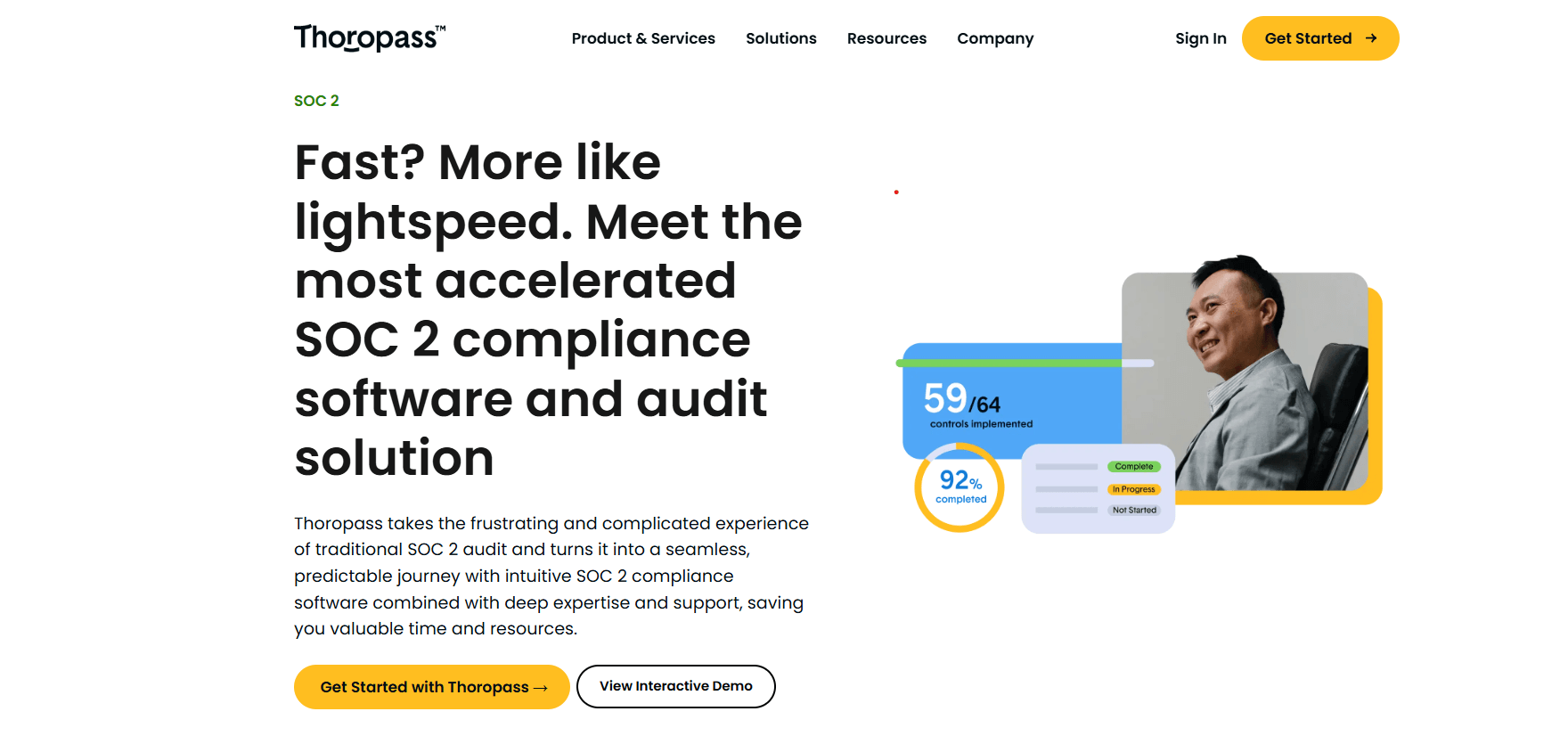
Thoropass is unusual among SOC 2 providers for quantum computing startups because it bundles the GRC automation software and the actual CPA audit under one contract, removing the “platform plus separate auditor” coordination headache entirely.
Features:
- Single contract covering both compliance automation and the independent SOC 2 audit
- In-house auditors familiar with fast-moving, first-time SOC 2 companies
- Type I and Type II observation period tracking built into the same workflow
- Reasonable integration coverage for common cloud and DevOps tooling
Pros:
- Removes a major point of friction: no separate vendor search for a CPA firm once you’ve chosen your platform
- Fixed-fee pricing structures generally starting in the $15,000 range, giving budget certainty for pre-Series-B companies
- Fast typical timelines for first-time Type I reports
Cons:
- Less flexibility if you’d prefer to mix and match a best-in-class platform with a specialist government-focused auditor
- Coverage for on-prem lab/hardware environments still generally requires manual evidence supplementation
- Smaller footprint in defense-heavy compliance circles compared to firms like Schellman or A-LIGN
Pricing: Bundled packages commonly start around $15,000 for a first Type I engagement, scaling with company size and Type II observation length.
7. Strac Comply
Strac Comply pairs SOC 2 evidence automation with live data security monitoring (PII/PHI/sensitive-data discovery across your stack), which is a meaningful advantage for quantum computing startups handling proprietary research data, customer algorithms, or CUI-adjacent files that need to be tracked, not just access-controlled on paper.
Features:
- Combined compliance automation and sensitive-data discovery/classification
- Continuous monitoring of where sensitive files (including research IP) actually live across your environment
- SOC 2 control mapping alongside data-loss-prevention style alerting
- Integrations across common cloud storage, SaaS, and communication tools
Pros:
- The active data-security layer is genuinely differentiated, useful for research-heavy teams that don’t always know where sensitive experimental data has spread
- Reduces the gap between “we have a policy” and “we can prove data actually stays where it should”
- Newer platform with a faster iteration cycle on feature requests
Cons:
- Smaller, newer vendor with a shorter enterprise track record than Vanta or Drata
- Fewer government/defense-specific case studies publicly available
- Still requires a separate CPA firm for the actual attestation
Pricing: Custom quotes; positioned competitively against the major automation platforms with the added data-security functionality bundled in.
8. Prescient Security
Prescient Security is a CPA firm built around SOC 2, ISO 27001, and adjacent cybersecurity attestations, with deep familiarity working on top of the Vanta platform. It’s a strong fit if your quantum computing startup has already implemented Vanta and needs an auditor who won’t need extensive hand-holding on the platform side.
Features:
- Deep Vanta integration and workflow familiarity
- Slack-based, same-day audit communication with no on-site visits required, which suits distributed research teams
- SOC 2 bundled with ISO 42001 for companies with meaningful AI/ML components in their quantum-classical stack
- Competitive, transparent pricing relative to larger national firms
Pros:
- Efficient, low-friction communication style that fits fast-moving startups
- Competitive pricing without a meaningful drop in audit quality, according to independent reviews
- ISO 42001 bundling is a genuine advantage if your quantum computing stack includes AI-driven control software or error-correction models
Cons:
- Less brand recognition with large enterprise security teams than Schellman or A-LIGN
- Primarily built around cloud-native companies; hybrid lab environments will need extra scoping conversations upfront
- Smaller firm size limits capacity for very large, multi-subsidiary audits
Pricing: Entry-level engagements often start around $20,000, positioned competitively against boutique and mid-tier peers.
9. A-LIGN
A-LIGN is one of the most commonly shortlisted specialist SOC 2 audit firms for technology companies, notable for having built its own proprietary compliance workflow technology (A-SCEND) rather than relying entirely on third-party platforms.
Features:
- Proprietary A-SCEND platform for managing evidence collection and audit workflow in-house
- Broad framework coverage beyond SOC 2, including ISO 27001, PCI DSS, and FedRAMP-adjacent work
- Established track record with hundreds of technology company engagements
- National footprint with more surge capacity for larger or more complex engagements than boutique firms
Pros:
- Owning its own technology stack can mean tighter integration between evidence collection and audit fieldwork
- Strong recognition among enterprise and government buyers evaluating your report
- Capacity to handle multi-entity or rapidly scaling companies without outgrowing the firm
Cons:
- Pricing generally sits above boutique firms like Johanson Group or Prescient Security
- Less “white glove,” partner-level intimacy than smaller specialist shops
- Can feel like more process than a five-person quantum research team actually needs at the pre-seed stage
Pricing: Mid-tier pricing, generally landing between boutique specialist firms and Big Four national firms — commonly cited in the $20,000–$80,000 range depending on scope.
10. Schellman
Of every firm on this list, Schellman has the clearest, most explicit track record with government, defense, and highly regulated clients, making it arguably the most natural fit among SOC 2 providers for quantum computing startups that are already working with defense primes, national labs, or classified-adjacent programs. The firm holds a wide range of accreditations spanning SOC, ISO, FedRAMP, HITRUST, PCI, and CMMC, and has publicly disclosed work with security-sensitive defense technology clients.
Features:
- Broad cross-compliance capability under one roof: SOC, ISO, FedRAMP, HITRUST, PCI, and CMMC
- Deep government and defense sector specialization
- Early positioning around ISO 42001 (AI governance) and Microsoft SSPA expertise, relevant for quantum-classical hybrid platforms with AI components
- National scale with capacity for large, multi-year, multi-framework engagements
Pros:
- Unmatched fluency, on this list, with the export control, CUI, and defense-contracting context that many quantum startups eventually operate in
- One firm can realistically cover SOC 2 today and CMMC or FedRAMP-adjacent work later, avoiding a second vendor search
- Reputation carries real weight with the most security-conscious enterprise and government buyers
Cons:
- Premium pricing relative to boutique and mid-tier competitors commonly the most expensive specialist option on this list
- Lacks a proprietary technology platform in the way A-LIGN or Prescient does, meaning heavier reliance on your existing GRC platform for evidence
Pricing: Type II engagements commonly range from roughly $20,000 to $100,000, with timelines from three to twelve months depending on scope and framework count.
11. Johanson Group LLP
Johanson Group is a boutique, SOC-examination-focused CPA firm known for direct partner involvement and fast fixed-fee turnarounds — frequently the fastest credentialed path to “we have a SOC 2 report” when an enterprise or government prospect is gating a contract on it.
Features:
- Fixed-fee Type I engagements often completed in one to three weeks
- Direct senior-partner engagement rather than being routed to junior staff
- Comfortable working alongside Vanta, Drata, Secureframe, and other major platforms
- Type II observation periods can start in parallel with Type I delivery, compressing your overall timeline
Pros:
- Genuinely fast — valuable when a deal is actively waiting on your report
- Personalized, hands-on service that suits first-time SOC 2 organizations without in-house compliance staff
- Fixed pricing avoids the budget uncertainty of hourly-billed audits
Cons:
- Smaller firm means less bandwidth for very large, complex, multi-entity engagements
- Less deep government-contractor specialization than Schellman
- Boutique scale may not scratch the “brand recognition” itch some enterprise buyers look for
Pricing: Fixed-fee engagements commonly starting around $15,000 for an early-stage Type I audit.
12. Sensiba LLP
Sensiba LLP has built a reputation among venture-backed startups particularly those already running Drata as the auditor of choice for closing that pivotal first enterprise contract that requires SOC 2. Its partnerships span Drata, Vanta, Secureframe, and Sprinto, giving it flexibility regardless of which platform your quantum computing startup has already adopted.
Features:
- Broad multi-platform partnership network (Drata, Vanta, Secureframe, Sprinto)
- B Corp credibility, which some mission-aligned deep-tech investors and customers specifically value
- SOC 2 plus ISO bundling available for companies anticipating international enterprise or government customers
Pros:
- Strong fit for VC-backed startups that want an auditor fluent in “we need this report to close a specific deal by a specific date”
- Platform-agnostic approach avoids being locked into one automation vendor
- Track record specifically with growth-stage, venture-funded technology companies rather than only mature enterprises
Cons:
- Less explicit government/defense specialization than Schellman
- Mid-tier pricing sits above boutique firms, without quite the national-scale surge capacity of A-LIGN or Schellman
Pricing: Positioned in the mid-tier range, generally comparable to A-LIGN and other specialist technology-sector audit firms.
Choosing the Right SOC 2 Provider for Your Quantum Computing Startup
The right SOC 2 provider depends on your startup’s stage, customers, and compliance goals. Whatever provider you choose, look beyond price and audit timelines. The best SOC 2 providers for quantum computing startups understand the challenges that set your business apart. They know how to assess hybrid cloud and laboratory environments, build practical controls for research teams, and support companies preparing for post-quantum security requirements. When you find that fit, SOC 2 becomes more than a compliance requirement. It becomes proof that your startup takes security, trust, and long-term growth seriously.