

If you process, store, or transmit cardholder data, compliance is more complex than it is for most SaaS companies. The same applies if your business sits anywhere in the payment layer of a fintech stack. A generic list of SOC 2 software won’t be enough. Payment processors face extra compliance requirements. These include PCI DSS, sponsor bank due diligence, card network rules, and enterprise security reviews. Customers also care about transaction integrity, not just uptime.
Choosing the wrong SOC 2 provider can be expensive. It may lead to a rejected report, delays in bank partnerships, or an unexpected second audit.
This guide covers the 12 best SOC 2 providers for payment processing companies in 2026. We’ve included AICPA-accredited audit firms, compliance automation platforms, and PCI-focused specialists.
For each provider, we break down the features, pricing, pros, and cons. We also looked at which firms understand cardholder data environments (CDEs). Just as importantly, we considered who can handle a combined SOC 2 and PCI DSS engagement without making you collect the same evidence twice. Finally, we focused on providers with real experience working with payment processors, not just SaaS companies.
Whether you’re a seed-stage payments startup preparing for your first SOC 2 Type I report or a Series C payment processor renewing a Type II, this list will help you find the right fit. That way, you can avoid unnecessary delays, extra audit costs, and the wrong compliance partner.
Why Payment Processing Companies Need a Different Kind of SOC 2 Provider
Most “best SOC 2 auditor” content is written for generic B2B SaaS: user data, cloud infrastructure, maybe a HIPAA add-on. Payment processing companies operate in a different compliance universe. Card networks and acquiring banks require PCI DSS regardless of whether you also want SOC 2 it isn’t optional if cardholder data touches your systems. Sponsor banks and card networks impose contractual audit rights that are separate from what your enterprise software customers ask for. And SOC 2’s Processing Integrity criterion usually skipped by ordinary SaaS vendors becomes essential for anyone handling transaction authorization, settlement, or reconciliation.
That’s the lens this list of SOC 2 providers for payment processing companies uses. A provider that’s excellent for a marketing SaaS tool but has never scoped a cardholder data environment isn’t a fit here, no matter how well it ranks on generic software review sites.
The Top 12 Best SOC 2 Providers for Payment Processing Companies
1. Thoropass
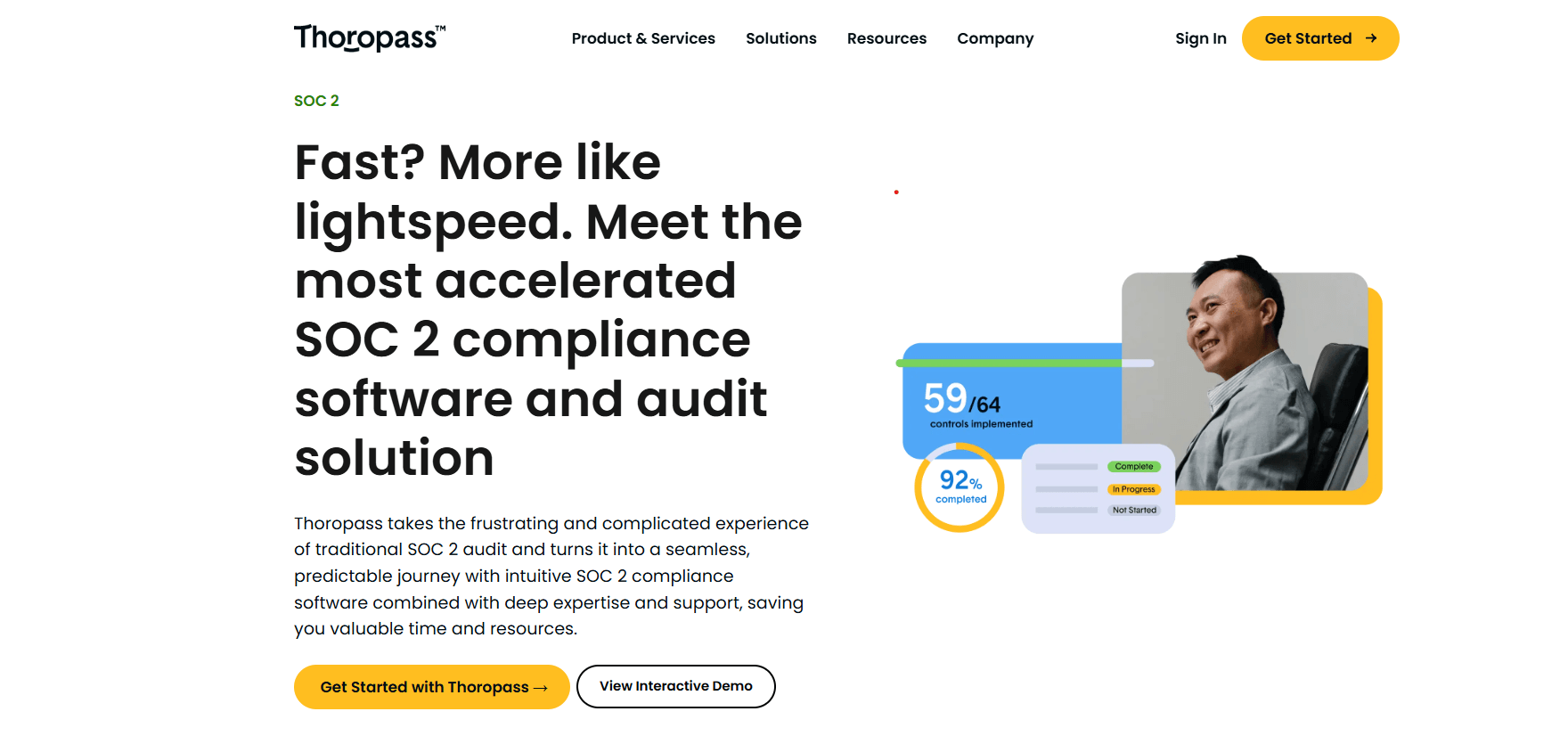
Thoropass is the standout name on this list of SOC 2 providers for payment processing companies because it is one of the only vendors that owns both halves of the equation: a proprietary GRC platform and an in-house, AICPA-peer-reviewed CPA firm (operating as Laika Compliance, LLC dba Thoropass Assurance) that also holds PCI QSAC and Approved Scanning Vendor (ASV) status, plus HITRUST Accredited External Assessor credentials. For a payment processor that needs SOC 2 and PCI DSS evidence to come from a coordinated source, that combination is rare in the market.
Features:
- First Pass AI pre-screen evidence before formal audit fieldwork begins, which the company says has cut average audit cycles from roughly 73 days to 29
- In-house PCI QSAC and ASV credentials mean you don’t need to hire a separate assessor for your Report on Compliance
- Supports 30+ frameworks (SOC 1, SOC 2, ISO 27001, PCI DSS 4.0, HITRUST, GDPR) with shared evidence across concurrent engagements
- Embedded auditor model the same team scopes, executes fieldwork, and signs the final report, removing the handoff between a readiness platform and a separate CPA firm
- Trust Center and auditor collaboration portal for enterprise due-diligence requests
Pros
- Rare single-vendor combination of GRC software and PCI-credentialed CPA firm
- Strong fit for payment processors that also need HITRUST or ISO 27001 alongside SOC 2
- Reported 25–50% savings versus hiring a traditional audit firm plus a separate PCI QSA
Cons
- Best suited to companies with under roughly 200 employees; larger, more complex payment processors may find the templates less flexible.
- Some reviewers note that AI-driven monitoring features still need to mature
Pricing: Bundled software-plus-audit pricing, not published as fixed tiers.
Best fit: Early- to growth-stage payment processors and fintechs that want one vendor to handle SOC 2, PCI DSS, and potentially HITRUST or ISO 27001 without juggling separate contracts.
2. Schellman
Schellman is one of the few U.S. SOC 2 auditors that holds both a DoD facility security clearance and FedRAMP 3PAO authorization, alongside PCI QSA credentials a combination that matters if your payment processing business also touches government contracts or federal cloud requirements. Among the audit firms on this list of SOC 2 providers for payment processing companies, Schellman is frequently named alongside A-LIGN as having the most well-documented fintech and payments audit practice.
Features:
- PCI QSA and ASV credentials for combined SOC 2 + PCI DSS engagements
- FedRAMP 3PAO and DoD clearance for payment processors with government-adjacent customers
- Deep bench of CISA/CISSP-certified auditors with fintech-specific engagement history
- Integrated audit methodology that reuses evidence across SOC 2, ISO 27001, and PCI DSS
Pros:
- Strong track record specifically with payment processors, lenders, and BaaS platforms
- Broad accreditation portfolio reduces the need for multiple audit vendors as you scale into new frameworks
- Global delivery team supports multinational payment operations
Cons
- Pricing sits above boutique specialist firms, expect enterprise-tier fees
- Less suited to very early-stage startups needing a fast, low-cost Type I
Pricing: SOC 2 Type II engagements typically start in the $20,000–$50,000+ range for mid-market payment companies, scaling into six figures for complex, multi-framework engagements with FedRAMP or CMMC layered in.
Best fit: Mid-market to enterprise payment processors that need combined SOC 2 + PCI DSS + potentially FedRAMP coverage from a single, highly credentialed audit firm.
3. A-LIGN
A-LIGN is the largest issuer of SOC 2 reports in the world, with more than 31,000 audits completed and 5,700+ clients, and it holds PCI DSS QSA credentials directly. Its proprietary A-SCEND platform integrates with Vanta, Drata, Secureframe, and Sprinto, which means A-LIGN can serve as the audit layer regardless of which automation tool your payments team already uses. That flexibility is a big reason it appears so often on lists of SOC 2 providers for payment processing companies.
Features:
- A-SCEND audit-management platform with EvidenceIQ AI evidence scoring and cross-framework evidence reuse
- Ten accreditations including AICPA, PCI DSS, ISO 27001, HITRUST, FedRAMP 3PAO, and CMMC C3PAO
- Remote-first delivery model with report turnaround as fast as 2–4 weeks for well-prepared clients
Pros:
- Massive scale means predictable timelines even during peak audit season
- Below-average Type II pricing relative to other multi-accreditation firms of similar size
- Works with virtually any GRC platform your payments team is already using
Cons:
- Being the largest issuer means less of a boutique, high-touch relationship than smaller specialist firms offer
- Some customers report needing to push for senior-auditor access on larger engagements
Pricing: SOC 2 Type II audits typically run $15,000–$50,000, with PCI DSS assessments priced separately based on cardholder data environment complexity and SAQ or ROC scope.
Best fit: Mid-market to enterprise payment processors juggling multiple overlapping frameworks (SOC 2, ISO 27001, HITRUST, PCI DSS) that want one firm managing all of them.
4. Coalfire
Coalfire is one of the largest specialist compliance assessors globally, issuing more than 500 SOC reports annually and serving as a top-three FedRAMP 3PAO. Roughly three-quarters of its SOC engagements serve cloud service providers, and its PCI DSS QSA practice is well established for payment processors operating at real growth, think card issuers, ledgering platforms, and infrastructure providers rather than early-stage startups.
Features:
- PCI DSS QSA and FedRAMP 3PAO credentials under one roof
- Coalfire Federal operates as an independent C3PAO entity for payment companies with DoD-adjacent obligations
- Compliance Essentials platform with MCP-compatible Audit AI for evidence workflows
Pros:
- Trusted by major cloud providers, which signals real depth on infrastructure-level payment security controls
- Strong fit for payment processors operating at PCI DSS Level 1 scale
- Broad accreditation stack reduces long-term vendor sprawl as compliance needs grow
Cons:
- Sized for larger organizations, smaller payment startups may find the engagement model heavier than necessary
- Premium pricing reflects its enterprise-grade positioning
- Longer lead times for scoping calls given engagement volume
Pricing: Enterprise-tier pricing, generally starting in the $30,000–$50,000+ range for SOC 2 Type II and scaling significantly higher for PCI DSS Level 1 ROC work at payment-processor scale.
Best fit: Large or fast-scaling payment processors and card infrastructure providers needing PCI DSS Level 1 alongside SOC 2 and FedRAMP.
5. VikingCloud

VikingCloud is one of the largest PCI DSS service providers globally and is frequently the vendor payment businesses first encounter through their acquiring bank or payment processor relationship, since costs are often bundled into merchant services agreements. Its Asgard compliance platform gives payment companies a single dashboard for tracking PCI and SOC 2-relevant evidence, which is valuable for any organization needing to demonstrate oversight of downstream merchants under SOC 2’s vendor-management criteria.
Features:
- Full suite of PCI credentials: QSA, ASV, and PFI (forensic investigator) capabilities
- Deep integrations with payment acquirers and partners, often enrolling merchants automatically
- Built to support acquirers and PSPs managing large merchant portfolios
Pros:
- Unmatched experience specifically with merchant portfolio oversight, a core SOC 2 vendor-management requirement for payment businesses
- Direct QSA engagement pricing is competitive relative to other PCI-native providers
- Streamlined compliance for companies already inside an acquirer’s compliance program
Cons:
- SOC 2 is not VikingCloud’s core specialty — it’s a PCI-first provider, so companies wanting a SOC 2-first relationship may prefer a dedicated CPA firm
- Some users report frequent automated reminders and upsell offers tied to acquirer programs
Pricing: Costs are frequently bundled into merchant services or acquirer relationships; for direct QSA engagements, pricing is generally competitive with other PCI-native providers but not publicly listed.
Best fit: Payment processors, PSPs, and acquirers that need PCI DSS as the primary driver, with SOC 2 evidence generated as a secondary benefit of the same compliance program.
6. BARR Advisory
BARR Advisory has built its practice around high-value, regulated data environments, healthcare, government, and financial services which makes it a natural fit for payment processors that need SOC 2 evidence to satisfy multiple overlapping regulatory audiences at once. It’s a smaller, more boutique alternative to A-LIGN or Coalfire, with a design philosophy that reuses evidence across SOC 2, PCI DSS, HITRUST, and FedRAMP rather than treating each as a separate project.
Features:
Comprehensive compliance programs spanning SOC 2, PCI DSS, HITRUST, and FedRAMP
Evidence-reuse methodology designed to reduce audit fatigue across multiple frameworks
Documented fintech and financial services experience among boutique firms
More personalized, relationship-driven engagement model than large national firms
Pros:
Strong choice for payment processors also serving regulated verticals like healthcare payments or government disbursements
Reduces the total number of vendor relationships needed to manage overlapping compliance programs
Boutique responsiveness without sacrificing AICPA accreditation
Cons:
- Smaller team size than A-LIGN, Coalfire, or Schellman means less bench depth for very large, complex engagements
- Less brand recognition among some enterprise procurement teams compared to Big Four or top-three national firms
Pricing: SOC 2 Type II engagements generally fall in the $20,000–$45,000 range for mid-market payment companies, with combined-framework engagements priced higher.
Best fit: Payment processors serving regulated verticals (healthcare payments, government disbursements, financial services) that want a boutique firm capable of harmonizing multiple compliance frameworks.
7. Vanta

Vanta remains one of the most widely adopted compliance automation platforms, with more than 14,000 customers and an auditor marketplace that connects payment companies directly with vetted CPA firms — including some with fintech-specific experience. For a payment processing company that wants the fastest path to a first SOC 2 report, Vanta’s automated evidence collection across 400+ integrations is hard to match.
Features:
- Over 1,200 automated tests and 400+ integrations spanning cloud infrastructure, identity providers, and ticketing systems
- Cross-mapped controls across 35+ frameworks including SOC 2, PCI DSS, ISO 27001, and HIPAA
- Auditor marketplace with pre-scoped audit requirements and direct evidence-sharing workflows
- Vanta AI for guided policy generation and control remediation
- Trust Centers for self-serve compliance documentation with enterprise prospects
Pros:
- Fastest realistic path to first-time SOC 2 attestation for a payments startup with a relatively standard cloud stack
- Large integration library reduces manual evidence-gathering work significantly
- Strong fit for companies that also need SOX-relevant controls ahead of an IPO
Cons:
- Some integrations can be limited for less common tools in a payments tech stack, requiring manual workarounds
- Pricing scales meaningfully as you add frameworks and headcount
Pricing: Starts around $7,500/year at the startup tier according to AWS Marketplace listings; fintech-focused programs typically run $10,000–$15,000/year at entry level, scaling to $50,000–$80,000+/year for enterprise multi-framework programs. Audit fees are separate.
Best fit: Payment processors and fintechs that want the fastest, most automated route to a first SOC 2 report and are comfortable hiring a separate PCI QSA alongside the platform.
8. Drata
Drata is frequently the pick for payment processors that need deep automation across more than one framework at once. Its control mapping spans 26+ frameworks, and its SOC 2/PCI DSS overlap implementation is genuinely well built evidence collected for SOC 2’s CC6.1 (access controls) automatically maps to the corresponding PCI DSS requirement, cutting duplicate evidence uploads.
Features:
- Pull-request-level evidence collection from GitHub and GitLab, useful for payment platforms with frequent code deploys
- Daily automated tests across 300+ integrations including Stripe-adjacent infrastructure, AWS, and Okta
- Pre-built SOX control mappings for pre-IPO payment companies
- Strong change-management evidence for CC8.1, which auditors scrutinize closely in money-movement environments
Pros:
- Reduction in audit and data-collection time compared to manual processes
- Well-suited fintech-specific strengths in change management and continuous monitoring
- Broad framework support minimizes tool-switching as your compliance program grows
Cons:
- Initial setup can be complex for teams without a dedicated compliance hire
- Does not include an in-house PCI QSA, so a separate assessor relationship is still required
- Support responsiveness can vary depending on your account tier
Pricing: Entry-level pricing generally starts around $7,500–$15,000/year for startups, growing to $15,000–$30,000+/year for growth-stage, multi-framework payment companies. Audit fees from a partnered or independent CPA firm are additional.
Best fit: Payment processors with active engineering teams shipping frequent code changes who need tight, automated change-management evidence alongside SOC 2 and PCI DSS.
9. Secureframe
Secureframe distinguishes itself with a more guided, expert-supported onboarding experience than some of the fully self-serve platforms on this list. It condenses 200+ controls into a structured process and supports 40+ frameworks, with continuous monitoring and dedicated auditor assistance — a meaningful difference for a payment processing team without a dedicated in-house compliance lead.
Features:
- More than 150 (some sources cite 300+) integrations for automated control testing and evidence collection
- Guided policy creation, employee training, and cloud security modules built into onboarding
- Daily automated tests with strong emphasis on intuitive design for non-technical compliance owners
- Vendor risk management workflows suited to payment companies overseeing multiple sub-processors
Pros:
- The expert-guidance layer genuinely reduces the learning curve for teams new to compliance frameworks
- Strong multi-framework support (SOC 2, PCI DSS, ISO 27001, HIPAA, GDPR) under one roof
- Well-reviewed customer support experience relative to more self-serve competitors
Cons:
- Interface, while intuitive, has room for improvement according to some long-term users
- Not the best fit for teams that want to move fast and fully independently without vendor-side guidance
Pricing: Entry-level pricing typically starts around $10,000–$35,000/year, scaling to $35,000–$60,000/year for growth-stage, multi-framework payment programs. Audit fees are separate.
Best fit: Payment processing companies without a dedicated compliance hire that want more hands-on guidance through their first SOC 2 and PCI DSS cycles.
10. Sprinto
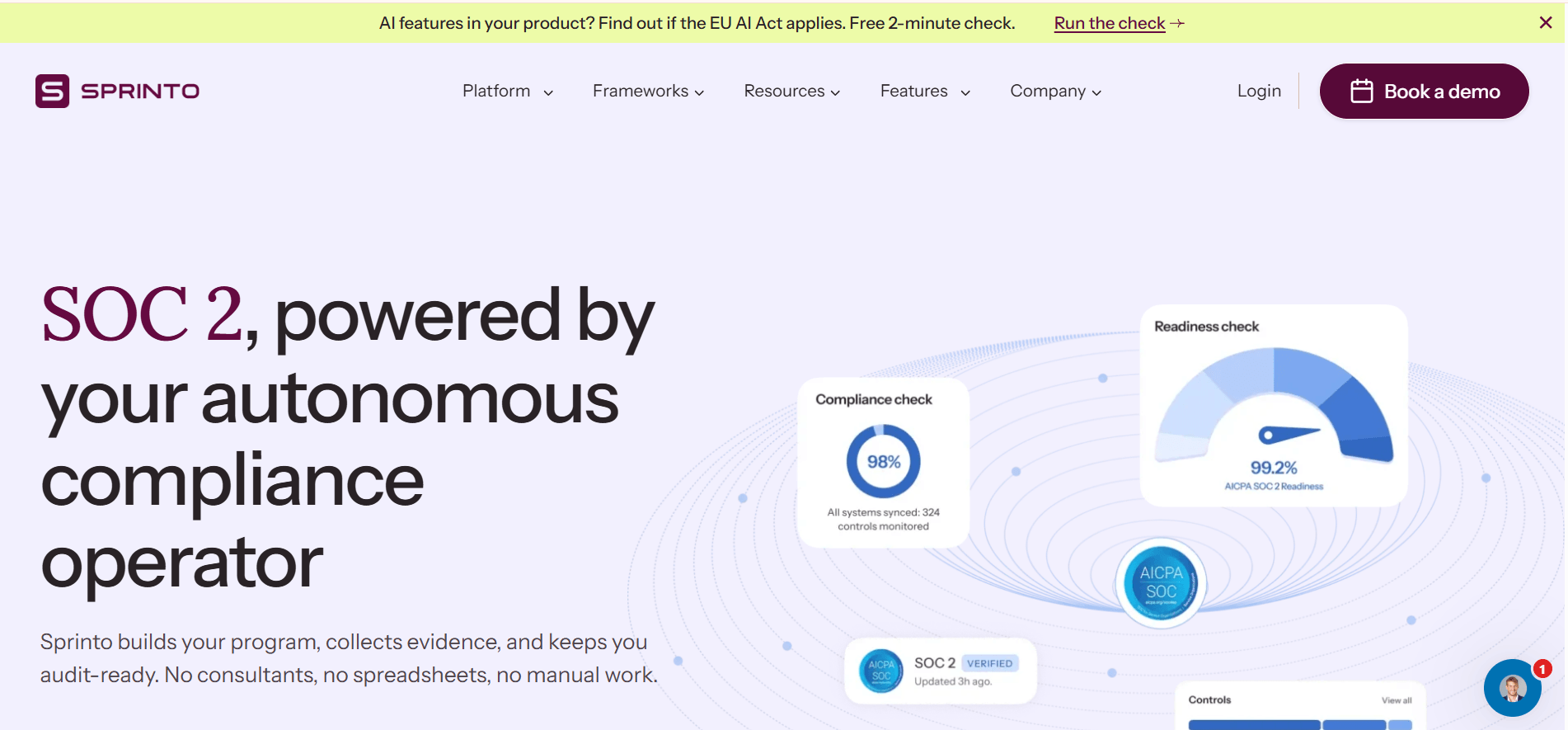
Sprinto positions itself as an AI-native GRC platform focused on speed-to-compliance, and it’s a strong fit among SOC 2 providers for payment processing companies that are still early-stage and need to move fast without sacrificing rigor. Its combination of automation and dedicated expert guidance appeals to founders navigating their first audit cycle.
Features:
- Automated majority of compliance tasks with continuously monitored controls and real-time evidence collection
- Supports SOC 2, ISO 27001, HIPAA, PCI DSS, and more, run in parallel where relevant
- Custom pricing model scaled to organization size and framework count
- Personalized guidance model pairing automation with a dedicated compliance expert throughout the process
Pros:
- Combines automation with hands-on expert support, which many early-stage teams find reduces anxiety around a first audit
- Flexible enough to adapt as a payment startup scales from Type I to Type II
- Consistently praised for customer support quality among users transitioning from spreadsheet-based compliance tracking
Cons:
- Custom, quote-based pricing makes upfront budgeting harder than platforms with published tiers
- Best suited to earlier-stage companies rather than large, multi-entity payment processors
Pricing: Quote-based; comparable early-stage tiers in the category generally start around $8,000–$15,000/year, with audit fees additional.
Best fit: Early-stage payment and fintech startups that want an AI-assisted platform paired with dedicated human guidance for their first SOC 2 cycle.
11. Johanson Group LLP
Johanson Group specializes in SOC 1, SOC 2, SOC 3, ISO 27001, and HIPAA audits, and it’s frequently the pick when a payment processor needs a SOC 2 Type I report quickly to satisfy an immediate enterprise or banking-partner requirement. Its three-step process, scoping, execution, and report delivery is built for speed, often delivering a fixed-fee Type I in as little as one to three weeks for well-prepared companies already running a GRC platform like Drata, Vanta, or Secureframe.
Features:
- Three-step scoping, execution, and delivery process assessed against the Trust Services Criteria
- Fixed-fee pricing model that avoids the scope-creep billing some larger firms are known for
- Fast turnaround for Type I reports, with Type II observation periods often starting in parallel
- Works alongside existing automation platforms rather than requiring a switch
Pros:
- One of the fastest credentialed paths for a payment company under contract pressure
- Fixed-fee model provides budget predictability that’s rare among audit firms
- Works well for companies already using a separate GRC platform
Cons:
- No in-house PCI QSA credential, so a separate PCI assessor relationship is still required for cardholder data environments
- Primarily positioned for pre-Series A through Series B companies rather than late-stage enterprises
Pricing: Fixed-fee Type I reports are typically priced lower than comparable Type II engagements from larger firms, generally in the lower five figures; exact quotes depend on scope and framework count.
Best fit: Payment startups under time pressure from an enterprise deal or banking partner that need a fast, fixed-fee Type I report from an accredited CPA firm.
12. Aptible

Aptible earns its place on this list of SOC 2 providers for payment processing companies for a genuinely unique reason: it’s the only option here that itself holds a PCI DSS Service Provider Level 2 attestation at the infrastructure layer. For companies building payment rails, a PayFac model, or card-issuing infrastructure from scratch, that means you can inherit PCI-attested infrastructure controls rather than building your cardholder data environment compliance program entirely from zero.
Features:
- PCI DSS Service Provider Level 2 attestation built directly into the hosting/infrastructure layer
- Combines infrastructure-level compliance inheritance with SOC 2 control support
- Designed specifically for companies building payment rails, PayFac models, or embedded finance products
- Pairs well with a separate GRC tool (commonly Drata or Sprinto) to cover the administrative half of a compliance program
Pros:
- Only option on this list offering PCI-attested infrastructure inheritance, which meaningfully reduces cardholder data environment scope for infrastructure-heavy payment builders
- Strong fit for teams that want PCI-attested infrastructure from day one rather than retrofitting it later
- Reduces engineering burden for teams building novel payment infrastructure
Cons:
- Not a full SOC 2 audit firm on its own you’ll still need a separate CPA firm or GRC platform for the administrative and policy side of compliance
- Requires pairing with another tool, adding a second vendor relationship
Pricing: To achieve SOC 2 compliance using Aptible, you need their Production plan, which costs $499/month base fee plus your actual infrastructure usage.
Best fit: Companies building payment rails, PayFac infrastructure, or card-issuing platforms from the ground up that want PCI-attested infrastructure baked in rather than assessed after the fact.
The Best SOC 2 Providers for Payment Processing Companies
There’s no single “best” answer across every stage and structure of payment business, but if you need one recommendation, Thoropass is the strongest overall pick among SOC 2 providers for payment processing companies in 2026, thanks to its rare combination of an in-house PCI QSAC, automation tooling, and coordinated audit delivery. For enterprise-scale payment infrastructure, Schellman and Coalfire offer the accreditation depth to match. For the fastest first-time audit, Vanta and Drata remain the automation leaders. And for teams building payment rails from scratch, Aptible’s PCI-attested infrastructure is a genuine differentiator you won’t find anywhere else on this list.
Whatever stage your business is at, the core lesson holds across every one of these SOC 2 providers for payment processing companies: don’t treat SOC 2 and PCI DSS as two separate projects. The providers on this list that let you run both in a single coordinated cycle will save you the most time, the most engineering hours, and ultimately the most money.