

Climate tech startups are reshaping the global economy — but as they scale, they face a security challenge that can make or break enterprise deals: SOC 2 compliance. Investors, utilities, and corporate clients increasingly demand proof that a startup handles sensitive data responsibly before signing any contract. Consequently, finding the best SOC 2 firms for climate tech startups has become just as critical as hiring the right engineering team or closing the right funding round.
However, not every SOC 2 firm understands the unique infrastructure of a climate tech company. From IoT sensor networks and carbon tracking APIs to distributed energy management systems, climate platforms carry compliance requirements that generic auditors often overlook. Therefore, choosing a firm that combines technical depth with startup agility, rather than settling for the nearest available CPA, can save months of back-and-forth and thousands of dollars in unnecessary rework.
In this article, we break down the top 12 SOC 2 firms that climate tech startups should consider. Whether you are a pre-seed company pursuing your first Type I report to unlock enterprise sales, or a Series B startup building a long-term compliance program ahead of a major utility partnership, this guide covers the right options at every stage. We evaluate each firm on its features, pricing model, audit approach, and fit for the climate tech ecosystem — so you can make a confident, informed decision.
Top 12 Best SOC 2 Firms for Climate Tech Startups

Vanta leads the compliance automation space and has become a go-to platform for technology startups pursuing SOC 2 certification quickly. Founded in 2018, Vanta automates evidence collection across cloud infrastructure, helping startups connect their AWS, GCP, Azure, and other tech stack integrations in hours rather than weeks. Climate tech startups particularly benefit from Vanta’s ability to integrate with data-heavy environments, a common feature in energy management and carbon tracking platforms. Vanta also pairs startups with a network of vetted auditors, simplifying the search for a qualified CPA firm.
Features
- Continuous automated evidence collection across 200+ integrations
- Real-time compliance monitoring dashboards
- Built-in vendor risk management
- Auditor network with pre-vetted CPA firms
- Support for multiple frameworks simultaneously (SOC 2, ISO 27001, HIPAA, GDPR)
- Policy templates tailored to SaaS and cloud-native companies
Pros
- Dramatically reduces manual evidence gathering, saving weeks of engineering time
- Offers an intuitive, clean UI that non-security teams can navigate easily
- Maintains continuous monitoring so startups stay audit-ready year-round
- Provides a large library of pre-built integrations relevant to climate tech stacks
- Connects startups directly to trusted auditors within the platform
Cons
- Carries a relatively high price point that may strain pre-seed or bootstrapped teams
- Relies heavily on automation, which can miss context-specific nuances in complex climate data environments
- Does not perform the actual audit — startups still need to engage a separate CPA firm
- Occasionally produces false positives in monitoring alerts, requiring manual review
2. Drata
Drata positions itself as an intelligent compliance automation platform, competing closely with Vanta while offering a slightly more enterprise-oriented experience. The platform continuously monitors security controls and maps them automatically to SOC 2 Trust Service Criteria. For climate tech startups managing IoT sensor networks, distributed energy systems, or third-party grid data APIs, Drata’s granular control monitoring proves especially valuable. The company has grown rapidly since its 2020 founding and earned strong recognition in the compliance automation market.
Features
- Automated control monitoring with real-time alerts
- 85+ native integrations with cloud and DevOps tools
- Custom control builder for unique or non-standard environments
- Risk management and vendor assessment modules
- Dedicated customer success managers for guided implementation
- Audit hub that centralizes communication with auditors
Pros
- Delivers highly detailed control monitoring that suits data-intensive climate platforms
- Offers a dedicated customer success manager who accelerates onboarding
- Provides a custom control builder — invaluable for startups with proprietary energy data workflows
- Supports multiple compliance frameworks simultaneously, future-proofing the compliance program
- Produces audit-ready reports that auditors accept with minimal additional work
Cons
- Costs more than several competitors, particularly at the enterprise tier
- Requires a steeper initial setup compared to simpler tools
- Some integrations need manual configuration, adding engineering overhead
- The volume of notifications can overwhelm small security teams without dedicated personnel
3. Secureframe
Secureframe delivers compliance automation with a strong emphasis on speed-to-certification. The platform targets startups and growth-stage companies that need SOC 2 Type I or Type II reports within tight timelines — often driven by enterprise sales requirements. Climate tech companies frequently encounter this pressure when selling to utilities, municipalities, or large industrial clients who require security assurances before signing contracts. Secureframe’s dedicated compliance managers and pre-built test libraries make it a compelling option for resource-constrained teams.
Features
- Automated evidence collection with 150+ integrations
- Compliance manager assigned to each customer
- Pre-built tests mapped to SOC 2 Trust Service Criteria
- Personnel management tools for tracking employee compliance training
- Continuous control monitoring with remediation guidance
- Support for SOC 2, ISO 27001, PCI DSS, and HIPAA
Pros
- Assigns a dedicated compliance manager who guides the entire certification process
- Accelerates time-to-certification with pre-built, mapped test libraries
- Handles personnel compliance tracking, reducing HR and security team coordination
- Offers clear remediation guidance when controls fail, reducing guesswork
- Integrates smoothly with popular DevOps tools common in climate tech engineering stacks
Cons
- The platform’s interface feels less polished compared to Vanta or Drata
- Advanced customization options remain limited for highly complex environments
- Pricing tiers can escalate quickly as integrations and users increase
- Some users report slower response times from support outside business hours
4. Thoropass
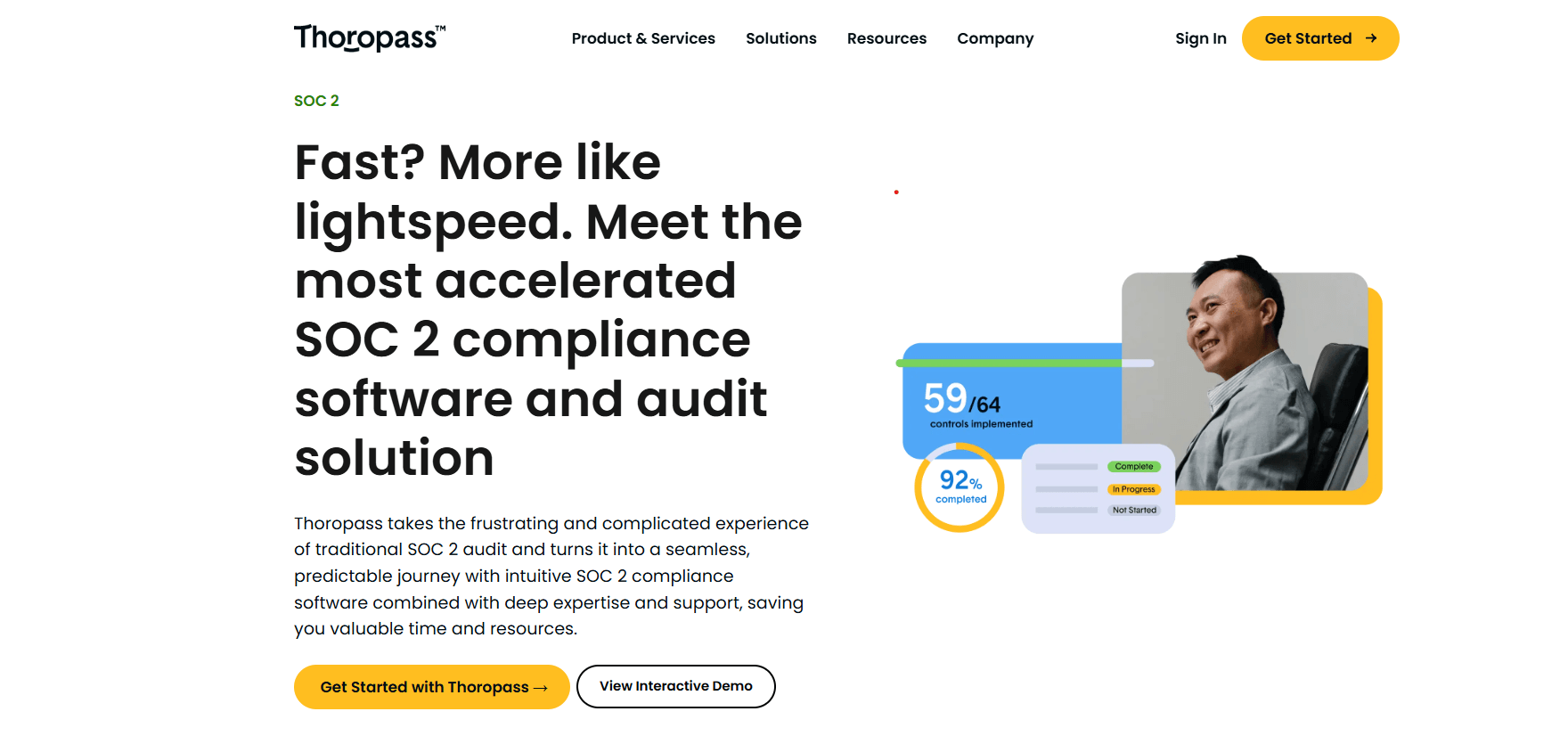
Thoropass combines compliance automation software with in-house audit services — a differentiated model that eliminates the need to separately source a CPA firm. This end-to-end approach proves particularly attractive for climate tech startups that want a single vendor managing both preparation and attestation. Thoropass employs licensed CPAs who conduct the SOC 2 audit directly within the platform, streamlining communication and reducing the back-and-forth typical of traditional audit engagements. Their team brings experience across SaaS, fintech, and increasingly, climate and sustainability platforms.
Features
- Integrated audit services performed by in-house CPAs
- Automated evidence collection and control monitoring
- Single platform for both compliance readiness and audit execution
- Dedicated compliance advisor throughout the engagement
- Support for SOC 2 Type I and Type II, ISO 27001, and HIPAA
- Audit timeline management with clear milestone tracking
Pros
- Eliminates the need to find and coordinate with a separate auditing firm
- Reduces total cost by bundling preparation software and audit services
- Streamlines communication since the same team handles preparation and attestation
- Provides milestone-based timelines that keep startup teams accountable
- Employs CPAs who understand modern cloud-native architectures
Cons
- The in-house audit model means less auditor choice compared to open marketplaces
- Some enterprises prefer audits from brand-name Big Four or regionally recognized firms
- The platform’s automation depth lags slightly behind Vanta and Drata in integration breadth
- Scaling beyond SOC 2 to highly regulated frameworks may require additional tools
5. A-LIGN
A-LIGN stands as one of the largest dedicated cybersecurity and compliance firms in the United States, performing thousands of SOC 2 audits annually. Unlike automation-first platforms, A-LIGN brings a full-service professional services model — meaning their CPAs and security consultants conduct hands-on assessments rather than relying primarily on automated evidence scrapers. Climate tech startups that operate in regulated energy markets, handle critical infrastructure data, or work with government clients often find A-LIGN’s rigorous, credential-heavy approach more credible with institutional stakeholders.
Features
- Full-service SOC 2 Type I and Type II audit execution
- Readiness assessment services prior to formal audit
- Penetration testing and vulnerability assessment add-ons
- ISO 27001, FedRAMP, PCI DSS, and HITRUST certifications
- Dedicated audit team with industry-specific expertise
- Scalable services from startup audits to enterprise enterprise-wide assessments
Pros
- Carries exceptional credibility with enterprise, government, and utility clients
- Offers readiness assessments that identify gaps before the formal audit begins
- Provides a full suite of complementary security services under one roof
- Brings deep expertise in regulated industries, which overlaps with energy and climate sectors
- Scales effectively as climate tech startups grow into mid-market companies
Cons
- Costs significantly more than automation-first platforms, particularly for early-stage startups
- Operates on longer engagement timelines compared to software-led approaches
- Requires more internal preparation and documentation before engaging
- Less suited for startups seeking rapid, low-cost certification primarily for sales purposes
6. Prescient Assurance

Prescient Assurance operates as a specialized SOC 2 audit firm with a strong focus on technology companies, including SaaS platforms, fintech tools, and increasingly, climate technology businesses. The firm combines the rigor of traditional CPA-led audits with practical startup-friendly engagement models. Prescient Assurance partners closely with compliance automation platforms like Vanta and Drata, allowing climate tech startups to leverage their automation investments while still receiving a credible, independent audit opinion from licensed CPAs.
Features
- SOC 2 Type I and Type II audit services performed by licensed CPAs
- Deep integration with Vanta, Drata, and Secureframe workflows
- Readiness assessment and gap analysis services
- Flexible engagement timelines suited to startup schedules
- SOC 2 + ISO 27001 combined audit offerings
- Transparent, fixed-fee pricing structures
Pros
- Works seamlessly within automation platform workflows, reducing audit friction
- Offers transparent, predictable pricing — rare in traditional audit engagements
- Provides flexible scheduling that accommodates startup product cycles
- Brings strong technical understanding of cloud-native and API-driven architectures
- Maintains a startup-friendly communication style throughout the engagement
Cons
- Lacks the brand recognition of Big Four or national firms for certain enterprise clients
- Primarily serves technology companies, with less exposure to hardware-heavy climate tech
- Team size may limit bandwidth during peak audit seasons
- International audit recognition may be limited compared to globally recognized firms
7. Johanson Group
The Johanson Group is a CPA and advisory firm that has carved out a strong niche in SOC reporting for technology and cloud-based businesses. The firm performs hundreds of SOC 2 engagements annually and has developed streamlined processes that work well for growing startups. Climate tech companies that use the Johanson Group benefit from their experience with complex, multi-tenant SaaS environments and their willingness to work closely with startups using compliance automation platforms to gather evidence efficiently.
Features
- SOC 2 Type I and Type II attestation services
- SOC 1 and SOC 3 reporting as complementary offerings
- Readiness assessment and pre-audit consulting
- Experience with multi-cloud and hybrid infrastructure environments
- Collaborative evidence review process with audit automation tool integrations
- Competitive pricing relative to larger national CPA firms
Pros
- Brings significant experience with cloud-native startups and SaaS architectures
- Offers competitive pricing compared to Big Four and larger regional firms
- Works collaboratively with clients who use Vanta, Drata, or Secureframe
- Provides clear, actionable feedback during the readiness phase
- Maintains consistent audit teams across engagements, reducing knowledge transfer friction
Cons
- Has less brand recognition than larger national firms, which may matter to certain enterprise buyers
- Geographic footprint is primarily U.S.-based, limiting international audit support
- May not have deep familiarity with emerging climate tech subsectors like carbon markets or grid software
- Smaller team size can create scheduling constraints during busy periods
8. Schellman
Schellman ranks among the top independent cybersecurity assessment and compliance firms globally, regularly appearing on lists of the most prolific SOC 2 audit providers. The firm serves a wide range of technology companies and brings particular strength in handling complex, regulated environments — an increasingly relevant profile for climate tech startups working with utilities, federal agencies, or critical infrastructure operators. Schellman’s team includes specialists across cloud security, FedRAMP, and ISO standards, making them a strong choice for climate companies anticipating regulatory complexity as they scale.
Features
- SOC 2 Type I and Type II audit execution by experienced CPAs
- Specialization in FedRAMP, ISO 27001, PCI DSS, and HITRUST alongside SOC 2
- Cloud security expertise across AWS, Azure, and Google Cloud
- Global audit capabilities with offices across the United States
- Technology-assisted audit processes for efficient evidence review
- Dedicated account teams for ongoing compliance relationships
Pros
- Offers outstanding credibility with enterprise, government, and utility stakeholders
- Brings deep cross-framework expertise that benefits climate startups facing multiple compliance requirements
- Provides technology-assisted auditing that speeds up evidence review without sacrificing rigor
- Maintains strong relationships with cloud providers, aiding in infrastructure-specific control assessments
- Scales effectively alongside climate tech companies as they mature
Cons
- Carries premium pricing that places it out of reach for very early-stage startups
- Operates on formal engagement models that require significant client preparation
- Less agile than startup-focused boutique firms in adapting to rapidly changing product architectures
- Sales and onboarding processes can feel bureaucratic for lean startup teams
9. BAAR Advisory

BARR Advisory is a cloud-focused cybersecurity and compliance firm that places strong emphasis on building long-term compliance programs rather than one-time audit checkboxes. The firm serves technology-forward companies and brings notable expertise in cloud security frameworks, making it well-suited for climate tech startups whose infrastructure lives primarily in the cloud. BARR Advisory takes a consultative approach — working alongside startup teams to build sustainable security programs that grow with the business rather than simply passing a single audit.
Features
- SOC 2 Type I and Type II audit and advisory services
- Cloud security program development and architecture review
- Continuous compliance advisory retainers
- Risk management framework development
- ISO 27001 and HITRUST certifications alongside SOC 2
- Strategic compliance roadmap planning for scaling startups
Pros
- Takes a long-term, program-building approach that serves fast-growing climate companies well
- Offers cloud security architecture expertise that directly benefits cloud-native climate platforms
- Provides advisory retainers that maintain compliance posture between formal audits
- Brings consultative engagement style that educates startup teams rather than just auditing them
- Excels at building compliance programs from scratch for first-time SOC 2 pursuers
Cons
- Costs more than transactional audit-only firms due to the advisory-heavy model
- May feel over-engineered for startups seeking a simple, fast Type I report
- Advisory retainers require ongoing budget commitments that early-stage startups may not sustain
- Less well-known than Schellman or A-LIGN in certain enterprise procurement conversations
10. Moss Adams

Moss Adams is a top-15 U.S. accounting and advisory firm with a dedicated technology practice that serves startups and growth-stage companies. Their SOC 2 team brings the credibility of a major regional firm combined with practical experience working with venture-backed technology companies. Climate tech startups that anticipate raising institutional capital, pursuing IPOs, or entering partnerships with large energy companies often find Moss Adams’s brand recognition invaluable during due diligence processes. The firm’s presence in climate-heavy regions like California, the Pacific Northwest, and Texas adds geographic relevance.
Features
- SOC 2 Type I and Type II audit services by licensed CPAs
- Technology industry practice with startup-specific experience
- Risk advisory and cybersecurity consulting services
- ESG and sustainability advisory services — directly relevant to climate tech missions
- M&A due diligence support inclusive of security compliance review
- National presence with strong West Coast and Texas market coverage
Pros
- Carries strong brand recognition with investors, acquirers, and enterprise clients
- Offers ESG advisory services that complement climate tech companies’ core missions
- Provides M&A-ready audit opinions that hold up during investor due diligence
- Brings a broad professional services bench for tax, accounting, and compliance under one roof
- Maintains regional presence in key climate tech hubs like San Francisco, Seattle, and Austin
Cons
- Commands premium pricing consistent with a top-15 national firm
- Engagement processes are more formal and slower than nimble boutique firms
- Less specialized in purely technical cloud security compared to dedicated cybersecurity firms
- May assign less experienced staff to smaller startup engagements compared to larger clients
11. Strike Graph
Strike Graph offers a compliance automation platform specifically designed to make SOC 2 certification accessible and affordable for startups. The platform differentiates itself by offering flexible pricing and a risk-based approach to compliance — meaning it tailors the control framework to the startup’s actual risk profile rather than applying a one-size-fits-all checklist. Climate tech startups with leaner teams and tighter budgets find Strike Graph’s model particularly appealing. The platform also connects startups to a network of auditors and provides in-app guidance throughout the certification journey.
Features
- Risk-based compliance framework that customizes controls to the startup’s environment
- Automated evidence collection with 50+ integrations
- Auditor network built into the platform
- Step-by-step guided certification workflow
- Policy and procedure templates for rapid documentation
- Support for SOC 2, ISO 27001, and HIPAA
Pros
- Offers one of the most startup-accessible pricing models in the compliance automation market
- Applies a risk-based approach that avoids unnecessary control overhead for lean teams
- Provides clear, guided workflows that demystify the SOC 2 process for first-timers
- Includes access to an auditor network, simplifying the search for a qualified CPA firm
- Scales down complexity appropriately for early-stage climate tech companies
Cons
- Has fewer native integrations than
- Carries less brand recognition than market leaders, which can matter in competitive enterprise sales
- The platform’s feature set is less mature than established competitors
- Customer support resources are more limited compared to larger platforms
12. Sensiba
Sensiba is a California-based accounting and advisory firm that has built a strong technology practice with particular depth in climate, clean energy, and sustainability sectors. This industry focus makes Sensiba uniquely relevant for climate tech startups — the firm not only performs SOC 2 audits but also brings genuine understanding of carbon accounting, renewable energy financing, and ESG reporting. Startups in solar, energy storage, carbon markets, or climate data analytics benefit from working with auditors who understand their business model, not just their IT controls.
Features
- SOC 2 Type I and Type II audit services
- Clean energy and climate tech industry expertise
- ESG reporting and sustainability advisory services
- R&D tax credit advisory relevant to climate tech innovation
- Cybersecurity risk assessments and advisory services
- California-based with strong West Coast market presence
Pros
- Brings genuine clean energy and climate sector expertise — a rare differentiator among SOC 2 firms
- Offers ESG and sustainability advisory services that align directly with climate tech missions
- Provides R&D tax credit guidance that adds direct financial value to climate startups
- Understands the regulatory and market context of energy, carbon, and climate data businesses
- Maintains a collaborative, approachable engagement style suited to startup teams
Cons
- Has a primarily California-focused footprint, limiting coverage for startups in other regions
- Carries less national brand recognition than larger firms, which may affect perception with non-West Coast enterprise clients
- Smaller team size limits capacity during high-demand audit periods
- Less automation-forward than platform-first competitors, requiring more manual coordination