

tIf you’re building a virtual reality, augmented reality, or spatial computing product, you already know your data problem doesn’t look like a typical SaaS company’s. You’re not just storing emails and payment details, you’re capturing eye-tracking data, hand and body movement, room scans, voice, and sometimes biometric signals that can identify a person more precisely than a fingerprint. That’s exactly why enterprise buyers, platform partners (Meta, Apple, Pico, Varjo), and investors are asking VR/AR startups for SOC 2 reports earlier than they ask traditional software companies. This guide breaks down the Top 12 Best SOC 2 Consultants for VR/AR Startups, based on how well each one actually understands spatial data, biometric classification, and immersive-tech infrastructure not just generic cloud security checklists.
Why VR/AR Startups Face Unique SOC 2 Challenges
- Handle biometric data carefully: VR/AR platforms collect eye tracking, facial expressions, hand movements, gait, and other physiological data. Many of these qualify as biometric or sensitive personal data, so your SOC 2 scope must include stronger privacy and confidentiality controls.
- Protect spatial and environmental data: Room scans, object recognition, and spatial mapping can reveal sensitive details about a user’s home or workplace. You need controls that secure this data throughout its lifecycle.
- Assess every third-party SDK: Most VR/AR products rely on Unity, Unreal Engine, and analytics SDKs to collect and process data. Your SOC 2 consultant should review every embedded SDK to identify third-party risks and close security gaps before the audit.
- Meet enterprise security expectations: Enterprise customers expect more than an engaging VR/AR experience. They want proof that your platform protects sensitive data, documents security processes, and follows consistent controls. A SOC 2 report often serves as the first requirement during vendor evaluations.
The Top 12 Best SOC 2 Consultants for VR/AR Startups
1. Vanta
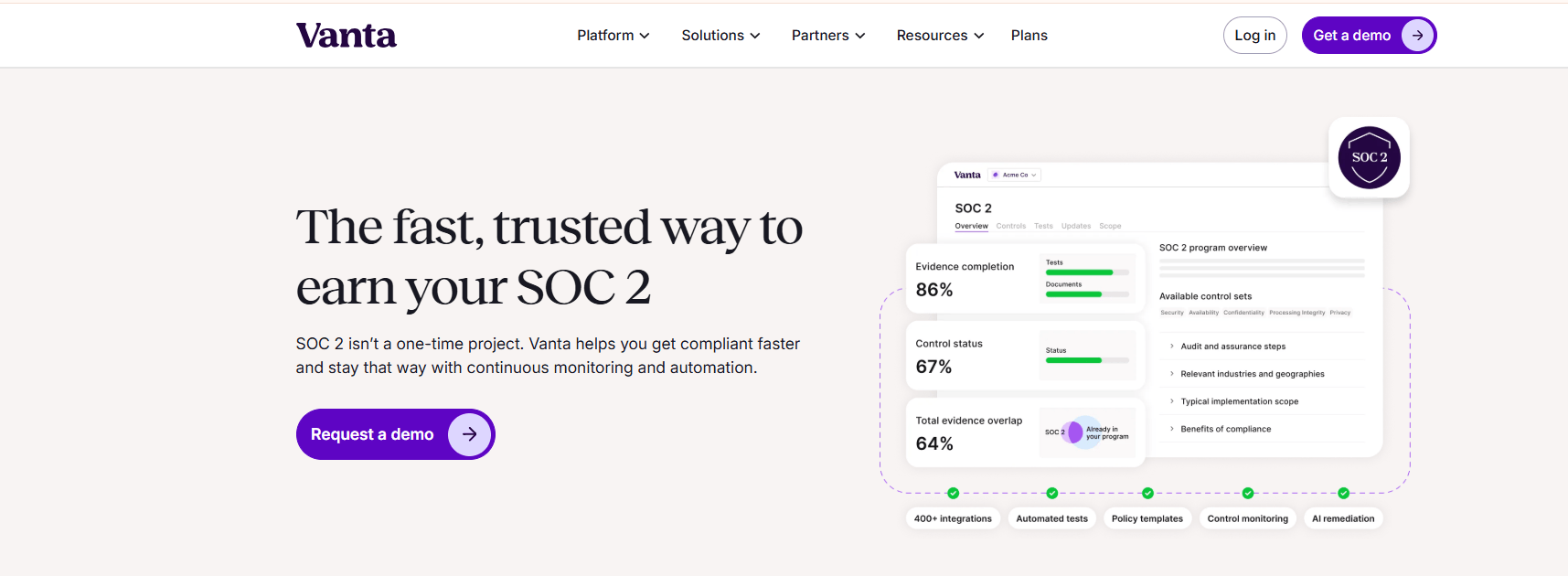
Vanta is the most widely deployed compliance automation platform in the startup world, and for VR/AR founders it’s usually the fastest way to get continuous evidence collection wired into cloud infrastructure and dev tooling. The vendor is a platform rather than a hands-on consultancy, but it anchors a large ecosystem of managed service providers who specialize in different verticals, which matters if your team has no in-house security hire.
Features:
- Continuous control monitoring across cloud infrastructure (AWS, GCP, Azure) and dev tooling (GitHub, Okta, Jira)
- 300+ pre-built integrations
- Automated evidence collection
- Risk register and vendor risk management
- Trust page for sharing your security posture with enterprise prospects
- Support for SOC 2, ISO 27001, HIPAA, and GDPR in one workspace
Pros:
- Fastest time-to-readiness of any platform on this list
- Huge integration library covering most modern cloud and dev stacks
- Large partner network of MSPs who can bolt on hands-on policy writing and remediation
- Trust page is genuinely useful in enterprise sales conversations with platform partners like headset OEMs
Cons:
- Doesn’t write your policies or scope biometric data classification on its own
- Needs a knowledgeable MSP partner or in-house security lead layered on top
- Spatial-data-specific risks can get missed in generic templates without that added expertise
Pricing: Typically quoted per year based on company size and framework count; most early-stage startups land in the low-to-mid five figures annually before adding an implementation partner’s fees.
Verdict: A strong default choice if you’re comfortable pairing the platform with a specialized MSP that understands immersive tech data flows.
2. Drata

Drata is Vanta’s closest competitor and, for many reviewers, the strongest all-round pick for 10–50 person cloud-native companies, citing the fastest time to a signed Type 1 report, deep integration coverage, and high auditor satisfaction. For a VR/AR startup running on standard cloud infrastructure, Drata’s integration depth can meaningfully shorten your readiness timeline.
Features:
- Automated evidence collection across cloud, HR, and identity systems
- Pre-built policy templates
- Auditor collaboration workspace
- Risk management module
- Support for multiple frameworks in parallel
Pros:
- Fastest reported time to a signed Type 1 report and the highest auditor satisfaction scores in its network
- Clean UI that non-technical marketing and ops staff can actually navigate during evidence requests
- Strong support during the audit handoff itself
Cons:
- Default control templates are written for generic SaaS, not spatial or biometric data types
- Your team or an implementation partner still has to map eye-tracking and room-scan data into the right Trust Services Criteria
Pricing: Reported to land as low as roughly $7,500 for small teams, scaling up with company size and the number of frameworks in scope.
Verdict: A great fit if your VR/AR product’s backend is straightforward cloud infrastructure and you want speed above all else.
3. Secureframe
Secureframe positions itself around simplifying and automating SOC 2 compliance, covering policies, employee training, cloud security, and risk management backed by a team of security experts, not just software. That hybrid “software plus humans” model is useful for VR/AR teams that want automation but also want someone to talk through unusual data types like motion capture or spatial mesh data.
Features:
- Automated monitoring across cloud and SaaS tools
- Employee security training modules
- Vendor risk assessments
- Policy template library
- Access to compliance experts for scoping questions
Pros:
- Built-in access to human compliance experts, useful for edge cases like scoping whether hand-tracking data counts as biometric information
- Solid employee security training content, useful for onboarding a growing engineering team
Cons:
- Less specialized in spatial computing specifically than firms that have directly audited immersive-tech clients
- You’ll still need to bring domain expertise about your headset SDKs to the scoping conversation
Pricing: Custom quotes based on employee count and framework scope; generally positioned in a similar band to Vanta and Drata for early-stage companies.
Verdict: Good middle ground for founders who want automation with a safety net of human compliance support.
4. Sprinto
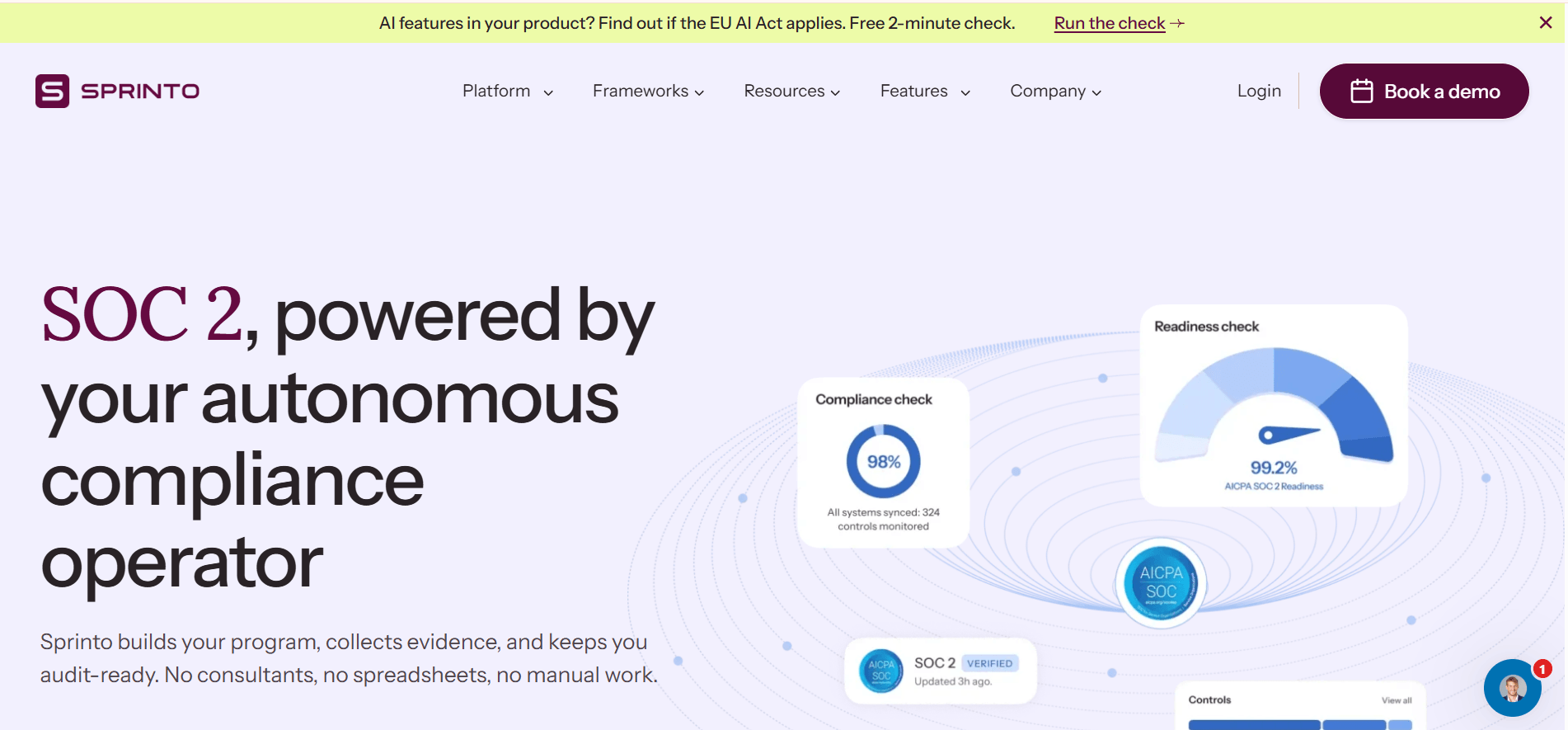
Sprinto focuses on making regulatory compliance and risk visibility fast and frictionless through AI-native GRC, adapting to companies from startup through enterprise while keeping internal controls and evidence updated automatically. For VR/AR teams juggling multiple compliance frameworks, Sprinto’s multi-framework approach can consolidate the workload.
Features:
- Automated compliance monitoring
- Integration-based evidence collection
- Multi-framework support (SOC 2, GDPR, HIPAA, and more in one system)
- Real-time risk dashboards
- Workflow automation for policy acknowledgment and training
Pros:
- Startup-tier pricing starts from around $6,000 per year for a single framework, one of the more accessible entry points on this list
- AI-native approach helps flag control gaps automatically rather than waiting for a manual review cycle
Cons:
- Spatial and biometric data nuances specific to headsets and motion capture pipelines aren’t baked into default templates
- Requires a knowledgeable implementation partner or in-house lead to translate VR/AR-specific risks into the platform’s control library
Pricing: Single-framework startup tier starts around $6,000 per year, scaling with additional frameworks and headcount.
Verdict: One of the most budget-friendly entry points if you need SOC 2 plus GDPR or HIPAA in one system.
5. Thoropass
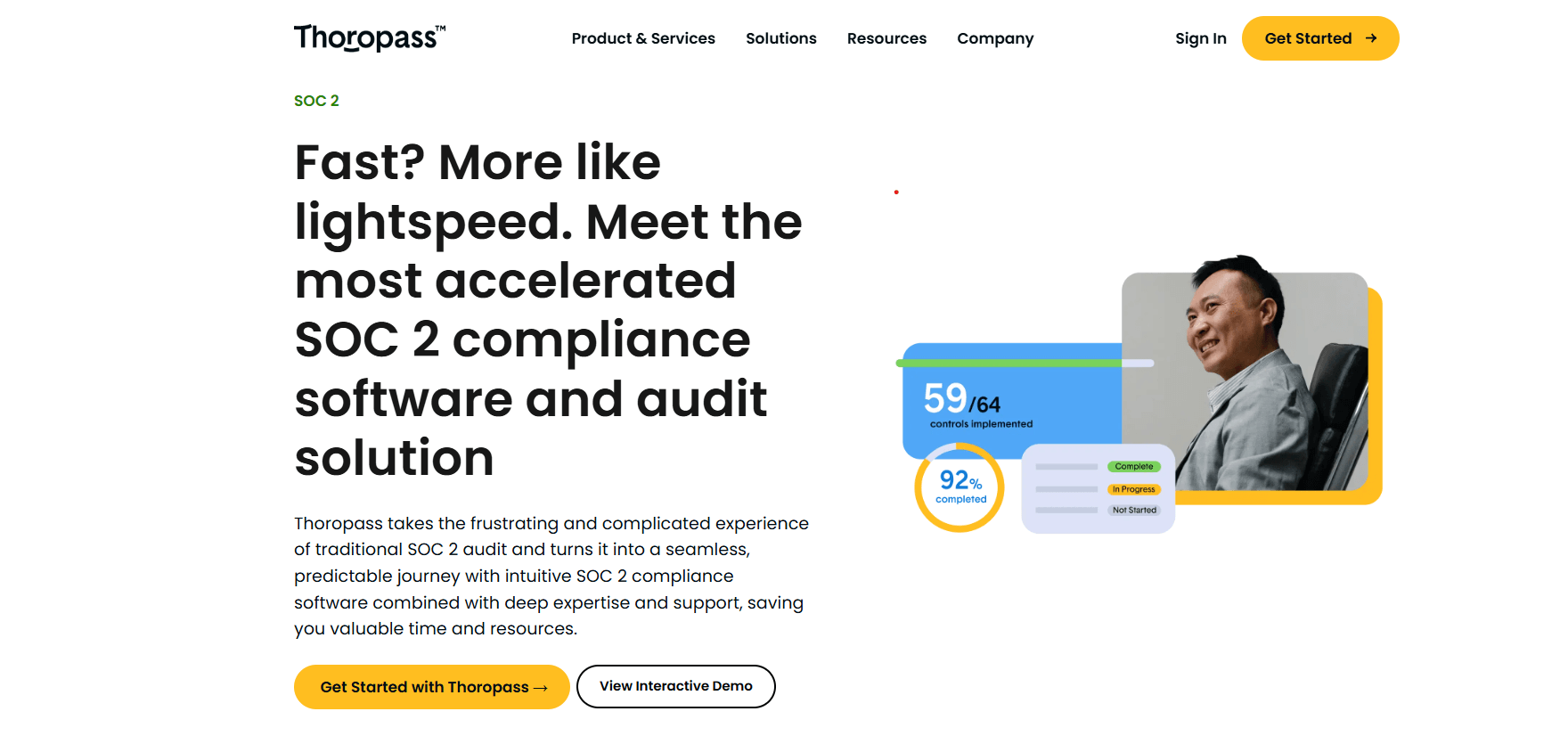
Thoropass pairs compliance automation software with an in-house audit team, which means you can sometimes go from readiness to a completed audit without switching vendors mid-process. It frames SOC 2 as a widely recognized standard developed by the AICPA and built on the Trust Services Criteria of security, availability, processing integrity, confidentiality, and privacy — with a startup needing to choose at least one criterion and a report type to test against.
Features:
- Compliance automation dashboard
- In-house audit delivery (often no separate CPA firm needed)
- Policy templates
- Guided readiness workflows
Pros:
- Software vendor and audit team under one roof, reducing the classic “the platform says we’re ready but the auditor disagrees” friction
- Solid onboarding materials that walk founders through Trust Services Criteria selection
Cons:
- Because the audit and platform come from the same company, some enterprise buyers scrutinize independence more closely than they would with a separate CPA firm
Pricing: Custom quotes; generally comparable to other automation-plus-audit bundles in the five-figure annual range for early-stage companies.
Verdict: A strong choice if you want to minimize vendor handoffs between readiness and the actual audit.
6. Scrut Automation

Scrut helps simplify SOC 2 Type 1 and Type 2 preparation with prebuilt controls and automated evidence gathering, providing real-time visibility into compliance posture backed by a team of SOC 2 experts. It has built a reputation for unusually deep risk-register documentation, useful for VR/AR startups selling into risk-averse enterprise or government-adjacent buyers.
Features:
- Automated evidence collection
- Prebuilt control mapping
- Risk register with control-to-risk linkage
- Multi-framework support
- Vendor risk management
Pros:
- Risk documentation depth holds up better than many U.S.-brand platforms when auditors press on control linkage, and it’s a strong option for teams selling into APAC markets that expect rigorous, risk-register-heavy audits
- Useful if your VR/AR product is expanding into APAC enterprise or government training contracts
Cons:
- Less name recognition among U.S. enterprise security teams compared to Vanta or Drata, which can occasionally slow down vendor security review conversations
Pricing: Custom quotes based on scope and headcount; generally competitive with other mid-market automation platforms.
Verdict: Worth shortlisting if your go-to-market includes APAC enterprise or government-adjacent immersive training deals.
7. Prescient Security

Prescient Security is a cybersecurity and compliance firm specializing in cloud-native technologies and modern application security, providing penetration testing, compliance audits, and attestation services across 25+ frameworks in the U.S., Europe, and APAC. The firm serves 5,000+ customers and reports more than 3,600 SOC 2 audits, 1,000+ ISO audits, and 4,800+ penetration tests, and is CREST accredited and listed by the Cloud Security Alliance as a Certified STAR Auditor.
Features:
- SOC 2 Type I and Type II audits
- Penetration testing
- ISO 27001 audits
- Support for combining SOC 2 with newer frameworks like ISO 42001 for AI governance
Pros:
- Audits leading AI and large language model providers, and is positioned for B2B SaaS startups from Series A through growth stage that prioritize speed without sacrificing thoroughness — a good match for VR/AR startups whose gesture recognition or scene-understanding models raise AI governance questions alongside standard SOC 2 scope
- Teams already using Slack benefit from same-day audit communication
Cons:
- Broad framework coverage (25+) means you’ll want to be specific during scoping so you’re not paying for accreditations irrelevant to a spatial computing product
Pricing: Custom quotes based on framework combination and company size; positioned as a full audit firm rather than a budget automation tool.
Verdict: Strong pick if your VR/AR product leans heavily on machine learning for gesture or scene recognition and you want SOC 2 and AI governance handled together.
8. A-LIGN
A-LIGN is one of the largest independent audit firms offering SOC 2 services alongside ISO, PCI DSS, HITRUST, FedRAMP, and CMMC assessments under one roof. The firm’s SOC 2 practice helps startups and public companies meet the five Trust Services Criteria through readiness assessments, gap remediation, evidence collection, and monitoring, with compliance expertise spanning SOC, ISO, PCI DSS, HITRUST, FedRAMP, GovRAMP, CMMC, HIPAA, and NIST, delivered through one engagement team that includes accredited auditors recognized across PCI, HITRUST, FedRAMP, and CMMC.
Features:
- Single-engagement-team delivery across multiple frameworks
- Readiness assessments
- Gap remediation support
- Evidence collection guidance
- Continuous monitoring options
Pros:
- One-team, multi-framework model useful for VR/AR companies selling into healthcare (medical-VR), defense (training simulations), or government contracts
- Lets you layer HITRUST or FedRAMP requirements onto your SOC 2 engagement without switching firms
Cons:
- Scale and breadth come with a more enterprise-oriented sales and engagement process than boutique startup-focused firms
- Expect a longer sales cycle than a self-serve platform
Pricing: Custom quotes; generally positioned at a higher price point than pure-automation platforms, reflecting the multi-framework, accredited-auditor model.
Verdict: The strongest option on this list if your VR/AR roadmap includes healthcare, defense, or government training simulation contracts down the line.
9. Schellman
Schellman is one of the most widely recognized independent CPA firms performing SOC 2 examinations, known for handling high-volume, complex audits across cloud, SaaS, and infrastructure companies. For VR/AR startups that have already outgrown a pure-automation platform and need an independent auditor with deep bench strength, Schellman is a common landing spot.
Features:
- SOC 1, SOC 2, and SOC 3 examinations
- ISO 27001 certification services
- PCI DSS assessments
- Cloud security assessments
- Delivered by teams of licensed CPAs and information security auditors
Pros:
- Strong reputation among enterprise security reviewers, which can shorten vendor security review cycles once your report is in hand
- Experienced with complex, multi-entity corporate structures if your VR/AR company has separate hardware and software subsidiaries
Cons:
- As an independent audit firm rather than a readiness platform, you’ll typically need a separate automation tool or consultant to handle evidence collection and gap remediation first
Pricing: Custom quotes based on scope, typically billed on a project basis tied to audit complexity and Trust Services Criteria selected.
Verdict: A solid choice for the audit itself once your VR/AR startup has readiness work substantially complete through another platform or consultant.
10. Control Logics

The firm has served 250+ companies globally and offers SOC 1/2/3 audits, SOC Readiness Assessments, SOX, ISO certifications, HIPAA, GDPR, and CCPA compliance services through a boutique, centralized team rather than a distributed platform-partner network.
Features:
- SOC readiness assessments
- Full audit support across SOC 1/2/3
- ISO certification guidance
- Multi-framework privacy compliance (GDPR, CCPA, HIPAA) alongside SOC 2
Pros:
- Boutique size means direct access to senior consultants rather than being routed through junior staff
- Useful for a VR/AR founder who needs to explain unusual data types like room-mesh scans in plain language and get a real answer, not a templated response
- Best suited for growing companies that need a US-based team to build and run a SOC 2 or ISO 27001 program end-to-end, from gap assessment through audit, rather than just buying compliance tooling
Cons:
- Smaller team size than platform-backed competitors means less bandwidth for very large or fast-scaling engagements
- Less brand recognition among enterprise security reviewers than Vanta, Drata, or A-LIGN
Pricing: Custom, project-based quotes; boutique firms in this tier typically price closer to independent consulting rates than platform subscription pricing.
Verdict: A strong option for founders who want a hands-on, senior-consultant relationship rather than a self-serve dashboard.
11. Latacora
Latacora popularized the “retained security team” model for startups — instead of hiring a full-time security hire, you get an embedded team that spans compliance, cloud security, and product security. It is frequently cited as the pick for tech-forward startups that want ongoing security engineering, not just a point-in-time audit prep exercise.
Features:
- Embedded security team spanning cloud infrastructure review
- Product security guidance
- Compliance program management (including SOC 2)
- Incident response readiness
Pros:
- Operates as an embedded, retained security team for high-performing startups, spanning compliance, cloud, and product security for the long haul
- Genuinely valuable for VR/AR startups whose security needs extend well beyond SOC 2 into securing headset firmware update pipelines, cloud rendering infrastructure, and SDK data flows
Cons:
- Priced and structured for startups that need continuous security engineering support, not just a SOC 2 checkbox
- More engagement than necessary if all you need is a fast, cheap audit
Pricing: Retainer-based, typically higher monthly commitment than a pure compliance automation subscription, reflecting the embedded security engineering scope.
Verdict: Best for well-funded VR/AR startups that want security engineering and SOC 2 compliance handled by the same team long-term.
12. Workstreet

Workstreet positions itself as delivering full-stack solutions that turn compliance into a growth accelerator, describing itself as Vanta’s number one managed service provider and offering AI-first security solutions for high-growth technology companies. For VR/AR startups already using or considering Vanta as their automation backbone, Workstreet is one of the most established implementation partners layered on top of it.
Features:
- Policy writing and gap remediation on top of the Vanta platform, combined with expert implementation so founding teams can focus on shipping product
- Broader trust-solutions consulting for scaling security programs
Pros:
- Deep, specific familiarity with the Vanta platform means fewer configuration mistakes and faster time-to-audit for VR/AR teams already on Vanta
- Strong focus on translating compliance work into something usable in enterprise sales conversations
Cons:
- Value is most pronounced if you’re already committed to Vanta specifically
- Less relevant if you’ve chosen a different automation platform
Pricing: Custom quotes based on scope of implementation work layered on top of your Vanta subscription.
Verdict: The natural pairing if you’ve already picked Vanta and want a specialized implementation partner rather than doing the configuration work yourself.
Conclusion
Choosing from the Top 12 Best SOC 2 Consultants for VR/AR Startups isn’t really about picking the biggest logo, it’s about finding a firm or platform that understands why your eye-tracking telemetry, room scans, and hand-motion data aren’t the same compliance problem as a typical SaaS signup form. Vanta, Drata, Sprinto, and Secureframe give you speed and automation; Prescient Security, A-LIGN, and Schellman give you audit depth and multi-framework range; Control Logics and Latacora give you the kind of senior, hands-on attention that catches spatial-data edge cases before an auditor does. Whichever you choose from this list of the Top 12 Best SOC 2 Consultants for VR/AR Startups, the goal is the same: a report that actually reflects how your immersive product handles the most sensitive data your users will ever hand over, not just a template built for a company that only stores names and email addresses.