

Introduction
Fleet managers face rising repair bills, tighter compliance rules, and drivers who have little time for paperwork. As a result, choosing the best fleet maintenance software in 2026 has become as much a financial decision as a technical one. The right platform schedules preventive maintenance, tracks work orders and parts, and flags problems before they turn into costly breakdowns. In contrast, the wrong choice leaves your team buried in spreadsheets and unplanned downtime.
To help you decide, we’ve listed the 20 leading platforms, from simple maintenance trackers to full telematics suites. For each one, we explain the key features, pros and cons, and current pricing. Read on to find the option that fits your fleet size, budget, and maintenance goals.
Top 20 best Fleet Maintenance Software in 2026
1. Fleetio

Fleetio, headquartered in Birmingham, Alabama, builds cloud software that centers on maintenance, inspections, and asset records rather than GPS hardware. The company reports that it supports more than 8,500 fleets and over 8 million assets. Its Maintenance Shop Network also connects fleets to outside repair shops, so approvals and payments flow through a single workflow.
In 2026, Fleetio pushed aggressively into practical AI. The company opened a beta of AI Service Advisor in March, and the tool reviews repair orders, ranks issues by urgency, and guides approvals. Fleetio says early results showed assets spending 16% fewer hours in the shop. Later releases let the advisor turn recurring fault codes into unified issues and automatically approve acceptable repair orders.
Features
- Fleetio schedules preventive maintenance by meter reading, time interval, or fault code, and it adds work orders, parts management, and recall management on higher tiers.
- Fleetio Go, the mobile app, lets drivers complete inspections, submit fuel receipts, and chat with support from the field.
- Smart Uploads uses AI to convert service invoices and receipts into structured maintenance records.
- Meanwhile, AI Service Advisor assesses work orders, flags exceptions, and can auto-approve routine repairs inside the Shop Network.
- Finally, open integrations connect Fleetio to telematics providers, fuel cards, and accounting tools.
Pros.
- The platform offers unlimited users, so technicians, drivers, and managers all log in without extra seat fees.
- Moreover, the Shop Network and AI tools target real repair spend instead of cosmetic dashboards.
- A 14-day free trial lets teams test workflows before they commit.
Cons
- However, per-vehicle pricing climbs quickly for very large fleets.
- Fleetio sells no telematics hardware, so fleets must connect a partner for automatic odometer and fault-code data.
Pricing
- Essential costs 4pervehiclepermonthonannualbilling(5 monthly).
- Professional costs $7 per vehicle per month and adds outsourced maintenance, parts management, work orders, and recall management.
- Premium costs $10 per vehicle per month.
Best for: Maintenance-first fleets that want one system for service, inspections, and repair approvals
2. AUTOsist

AUTOsist targets fleets that want a straightforward maintenance system without enterprise complexity. The platform bundles preventive maintenance, inspections, and parts inventory under one per-vehicle price, and it lets owners add GPS tracking and cameras later.
Because AUTOsist separates a maintenance-only package from connected-vehicle bundles, buyers can start lean. Consequently, a ten-truck contractor can digitize service records first and then layer on telematics when budget allows.
Features
- Automated preventive maintenance reminders trigger by mileage, engine hours, or calendar date.
- Likewise, digital inspections replace paper DVIRs and send defects straight to the maintenance queue.
- Parts inventory and work order tools track consumption against each vehicle.
- Optionally GPS and AI dash camera packages add location and safety data under the same account.
Pros
- The per-vehicle price is easy to understand and forecast.
- Also, fleets can start with maintenance only and expand into GPS or cameras.
- Review sites rate the product highly for ease of use.
Cons
- Bundled GPS and camera packages raise the cost to $28 and $55 per vehicle, so budgets can stretch fast.
- Similarly, large public-sector or multi-shop operations may find the feature depth lighter than purpose-built enterprise systems.
Pricing
The All-in Maintenance package costs $6 per vehicle per month on annual billing or $7 on monthly billing, with a $59 monthly minimum that covers five vehicles. Maintenance plus GPS costs $28 per vehicle per month, and maintenance plus GPS and cameras costs $55 per vehicle per month. Both bundles bill annually with a five-vehicle minimum.
Best for: Small and mid-sized fleets that want simple, predictable per-vehicle pricing
3. Whip Around

Whip Around starts from a simple premise: a maintenance program fails when drivers skip inspections. The platform therefore makes pre-trip and post-trip checks fast, then converts failed items into defects and work orders.
Importantly, Whip Around separates inspection-only and maintenance tiers. Fleets that need only DVIRs pay less, while teams that want full service tracking upgrade to the Pro plan.
Features
- Customizable inspection forms and templates capture photos, signatures, and defects.
- In addition, asset profiles with VIN lookups keep vehicle details in one place.
- The Pro plan adds maintenance schedules, work order management, service history, cost tracking, and time tracking.
- Furthermore, mileage-based notifications warn managers before service comes due.
- Finally, the mobile app supports English and Spanish.
Pros
- A free Basic plan and a free trial reduce the risk of testing the product.
- Besides that, Standard and Pro plans include unlimited users.
- The vendor requires no long-term contracts..
Cons
- However, maintenance tools sit behind the higher-priced Pro plan.
- Also, the initial asset setup may be tedious.
Pricing
Basic is free. Standard costs $5 per asset per month for inspections, and Pro costs $10 per asset per month with maintenance tools. A Fixed Unlimited plan uses custom flat-fee pricing for larger fleets. Billing runs per asset, per month, without a contract.
Best for: Inspection-led fleets that struggle to get drivers to complete walkarounds
4. RTA Fleet360

RTA, founded in 1979, builds Fleet360 to follow an asset from acquisition to disposal. The system tracks preventive maintenance, repair orders, technician labor, parts, fuel, inspections, accidents, warranties, and budgets. As a result, finance teams receive the cost reports they expect, and shop foremen get the controls they need.
RTA also added a built-in AI assistant that answers plain-language questions from live fleet data. In addition, the company reports that Utah selected Fleet360 for more than 10,000 assets, which shows its appeal to government buyers.
Features
- Parts inventory, barcoding, kits, purchase orders, and vendor management come on every plan.
- Moreover, work orders support VMRS coding, which standardizes repair reporting.
- Fuel island management and fuel or EV charge cost integrations track energy spend.
- Meanwhile, higher tiers add accident management, motor pool tools, shop scheduling, and advanced integrations.
- The built-in AI assistant answers questions about assets, parts, costs, and compliance.
Pros
- Every plan includes unlimited users.
- RTA publishes its pricing, which is rare among enterprise-grade systems.
- Parts and purchasing controls run deeper than many lightweight rivals.
Cons
- A 100-asset minimum excludes very small fleets.
- Implementation costs sit outside the subscription price.
Pricing
- Pro costs $6 per asset per month
- Advanced costs $8
- Enterprise costs $11, all billed annually with unlimited users. At the 100-asset minimum, those tiers start at $7,200, $9,600, and $13,200 per year.
Best for: Municipal, public-sector, and large mixed fleets with in-house shops

Fullbay is cloud shop-management software built for heavy-duty repair operations. It covers service orders, estimates, invoicing, parts, payments, texting, and reporting. Therefore, an in-house fleet shop can run a professional repair-order workflow instead of juggling spreadsheets.
Features
- Service order workflow moves each job from estimate to invoice.
- Likewise, preventive maintenance tracking and inspection documentation keep compliance records organized.
- Parts and inventory tools connect purchasing to repair orders.
- In addition, customer texting and payment handling speed up approvals.
- Finally, higher tiers integrate with the MOTOR Truck Service Guide and Mitchell 1 ProDemand and TruckSeries.
Pros
- The product targets heavy-duty workflows instead of generic auto repair.
- Besides that, Integrations with truck service guides save technician research time.
- Customers rate support quality highly.
Cons
- The product offers no free plan, and it does not replace telematics.
- Moreover, fleets without a shop will not use most of its features.
Pricing
Basic at $188, Pro at $258, and Elite at $318 per month on annual agreements. Additional Elite users cost $119 per month each, and enterprise pricing requires a quote.
Best for: Heavy-duty truck and trailer repair shops, including fleets that run their own diesel shop
6. Fleet Maintenance Pro

Fleet Maintenance Pro, from MTC, handles cars, trucks, vans, trailers, and heavy construction equipment. Its automated alert system flags preventive maintenance when users open the program. Furthermore, the vendor sells both a cloud version and Windows desktop packages, which suits teams that still prefer local software.
Features
- Preventive maintenance alerts appear automatically based on meter or date schedules.
- In addition, fleet inventory tracking monitors parts and supplies.
- Customizable reporting adapts to different fleet types.
- Finally, work order, vendor, and warranty tracking round out the core module set.
Pros
- Buyers can choose between a cloud subscription and a perpetual license.
- Also, public pricing makes comparison simple.
- The software scales from a handful of units to large mixed fleets.
Cons
- Cloud pricing charges per user, so large technician teams pay more.
- Similarly, the desktop heritage can feel dated beside mobile-first competitors.
Pricing
- Cloud Basic costs $35 per user per month on monthly billing or $30 on annual billing.
- Cloud Premium costs $60 monthly or $50 annually, and Enterprise requires a quote.
Best for: Budget-conscious teams that want either a cloud subscription or a one-time desktop license
7. Simply Fleet

Simply Fleet positions itself as a low-cost alternative to Fleetio and AUTOsist. It offers a free plan for up to five vehicles and three users, and its paid tiers charge only a few dollars per vehicle. The vendor also added AI credits for reporting, receipt scanning, and voice logging.
Notably, the company announced a pricing change effective September 15, 2026. Its pricing page also quotes slightly different numbers in different places, so buyers should confirm the current rate in writing.
Features
- Preventive maintenance scheduling, digital inspections, fuel logging, trip logs, and expense tracking come with Essential.
- Advanced adds work order management, parts inventory, and priority support.
- Moreover, a telematics add-on pulls odometer readings automatically and turns fault codes into issues. It supports Geotab, Samsara, Motive, and Verizon Connect.
- Optional add-ons cover WEX fuel card imports and small tools and equipment tracking.
- Finally, pooled AI credits power chat-based reports, receipt scanning, and voice entries.
Pros
- The free plan lets tiny fleets start at no cost.
- Furthermore, per-vehicle rates sit among the lowest in the market.
- Monthly billing carries no mandatory annual contract.
Cons
- However, the vendor is smaller and newer than established rivals.
- Also, chat support appears only on the Advanced plan.
Pricing
The Free plan covers five vehicles. Essential shows 3pervehiclepermonth(30 per year), and Advanced shows 5pervehiclepermonth(50 per year).
Best for: Very small fleets and cost-sensitive teams that want a genuine free tier
8. Chevin FleetWave

Chevin Fleet Solutions, based in the United Kingdom and founded in 1990, sells FleetWave as a modular, web-based platform. It supports cars, vans, commercial vehicles, and off-road equipment, and it includes country-specific compliance management. Consequently, multinational fleets can standardize on one system across regions.
Chevin sells three plans: Lite, Core, and Advanced. Core adds full maintenance, rental and vehicle-hire tools, a KPI wizard, custom roles, branding, and SmartForms. Advanced adds workshop tools, inventory, advanced reporting, a technician app, and unlimited integrations.
Features
- Vehicle, driver, defect, fuel, accident, fine, and costing records live in one database.
- In addition, the FleetWave Driver app and Technician app collect data in the field.
- SmartForms let administrators build custom digital forms.
- Finally, telematics integration, custom roles, branding, and custom notifications support enterprise governance.
Pros
- Highly configurable workflows suit complex organizations.
- Also, country-specific compliance helps cross-border fleets.
- A tiered structure lets smaller teams start with Lite.
Cons
- Advanced pricing requires a sales conversation.
- Finally, the public review base is small, with nine reviews on Capterra.
Pricing
Chevin lists Lite at about £3 per vehicle per month in the United Kingdom. Core sits in the low single digits per vehicle, while Advanced uses custom quotes.
Best for: International and enterprise fleets that need country-specific compliance and flexible configuration
9. Fleet Complete
Fleet Complete sells a modular telematics platform that includes tracking, dispatch, video, ELD, and maintenance modules. In the United States, AT&T also resells the product as AT&T Fleet Complete. SelectHub concludes that Fleet Complete suits buyers who need bundled hardware, dispatch, and field service, while Fleetio fits maintenance-heavy fleets better.
Features
- Fleet, asset, and resource trackers monitor vehicles, equipment, and field workers.
- Likewise, maintenance reminders and diagnostics support preventive service.
- Dispatch, video telematics, and hours-of-service modules expand the platform.
- Finally, flexible modules let customers pay only for what they deploy.
Pros
- Modular pricing avoids paying for unused features.
- Also, the platform covers vehicles, assets, and workers.
- Carrier relationships help large organizations procure it.
Cons
- Fleet Complete does not publish a general price list.
- Moreover, hardware and installation fees stay outside advertised rates.
- Maintenance depth trails dedicated systems.
Pricing
Fleet Complete quotes by fleet size and modules. Fleet Tracker at $17.10 per month, Dispatch at $23.75, Enhanced Fleet Tracking at $35.15, Video Telematics at $19.00, and Hours of Service at $6.65. Installation can add $50 to $150 per vehicle.
Best for: Fleets that want modular telematics, dispatch, and field-service tools in one cloud
10. Teletrac Navman

Teletrac Navman’s TN360 platform combines GPS tracking, driver management, fuel monitoring, and maintenance workflows. Directory listings note closed-loop maintenance workflows, and the platform supports inspections, work orders, parts inventory, and warranty tracking.
Features
- Closed-loop maintenance workflows connect defects, work orders, and repairs.
- Real-time tracking, job dispatch, and fuel monitoring support daily operations.
- Driver fatigue management and safety scorecards support compliance.
- AI-driven insights and alerts flag issues early.
Pros
- Driver management features rank among the strongest in the category.
- The platform scales from small to large fleets.
- Maintenance and compliance data sit in one system.
Cons
- Pricing is not transparent online.
- Contracts can run long by default.
Pricing
Teletrac Navman sells by request.
Best for: Compliance-heavy fleets that want closed-loop maintenance workflows alongside strong driver management
11. MaintainX

MaintainX is a mobile-first computerized maintenance management system (CMMS) that many fleets adopt when vehicles form part of a broader maintenance program. Importantly, Autodesk completed its acquisition of MaintainX on August 3, 2026, in a deal valued at roughly $3.6 billion. MaintainX now sits inside Autodesk Operations Solutions, so buyers should ask about roadmap, migration paths, and pricing at renewal.
Features
- Work orders, procedures, and real-time messaging run from the mobile app.
- Essential adds repeating work orders, preventive maintenance, and a three-month window of advanced analytics.
- Premium adds meter-based maintenance, parts inventory and purchasing, and open API access.
- Barcode scanning and unlimited assets simplify equipment tracking.
Pros
- A free Basic plan lets teams start with unlimited work orders.
- Technicians find the mobile experience easy to learn.
- MaintainX publishes both monthly and annual prices.
Cons
- Per-user pricing grows with every technician.
- MaintainX is a general CMMS, not a dedicated fleet product.
Pricing
- Basic is free.
- Essential costs $20 per user per month on annual billing or $25 monthly.
- Premium costs $65 per user per month annually or $75 monthly.
- Enterprise uses custom pricing.
Best for: Mixed maintenance teams that service vehicles alongside facilities, plants, or field equipment
12. UpKeep
UpKeep delivers a mobile-friendly CMMS with work orders, asset management, and an AI assistant called Nova. Capterra shows a 4.6 rating from more than 1,300 reviews. Notably, UpKeep raised its Essential plan from $20 to $24 per user per month during 2026, so older pricing guides are now out of date.
Features
- Essential includes unlimited work orders, unlimited locations, asset management, barcode scanning, and data import.
- Nova AI comes with every plan, with monthly credits ranging from 250 on Essential to 1,000 on Enterprise.
- Premium adds checklists and preventive maintenance scheduling, according to Reliamag’s comparison.
- Professional and Enterprise plans add deeper analytics and integrations.
Pros
- UpKeep publishes entry and mid-tier prices.
- The free trial needs no credit card.
- The independent vendor has not been absorbed into a larger suite.
Cons
- Per-user pricing raises costs for larger technician teams.
- UpKeep serves general maintenance rather than fleet-specific needs.
Pricing
- Essential costs $24 per user per month and
- Premium costs $55 per user per month
- Professional and Enterprise plans use quotes.
Best for: Small to mid-sized teams that want an easy mobile CMMS with published entry pricing
13. Limble CMMS

Limble, headquartered in Lehi, Utah, offers a flexible CMMS with configurable preventive maintenance logic, workflows, and reporting. As of October 2026, Limble sells Standard, Premium+, and Enterprise plans, and it routes buyers through an online price calculator instead of a simple per-user table. Furthermore, the free Basic tier described earlier in 2026 no longer appears.
Features
- Unlimited assets and custom fields come on every plan.
- Work requests, dashboards, and analytics help managers track performance.
- Premium+ adds offline mobile access and fuller checklist usage.
- Enterprise adds custom asset fields, downtime tracking, and warranty tracking.
- Implementation help, online training, and support come included with licenses.
Pros
- Configuration depth suits complex maintenance programs.
- The vendor earns strong marks for support.
- Onboarding and training carry no extra charge.
Cons
- Offline mode and many checklist features require Premium+.
- SSO, IoT, and ERP integrations may cost extra.
- The product has no free plan or free tier.
Pricing
- Standard near $28 per user per month
- Premium+ near $69
- Enterprise on custom quote.
Best for: Teams that want a deeply configurable CMMS with a strong support reputation
14. Fiix by Rockwell Automation

Fiix, acquired by Rockwell Automation in 2021, offers a cloud CMMS with Free, Basic, Professional, and Enterprise plans. The free tier gives small teams unlimited work orders, assets, and requests, though it caps active preventive maintenance schedules.
Features
- Free tier supports unlimited work orders and assets with a limited number of active PMs.
- Basic adds unlimited preventive maintenance, resource-based scheduling, and pass/fail inspections.
- Professional adds multi-site management, purchasing and RFQs, and custom analytics.
- Enterprise adds advanced integrations, a dedicated sandbox, and single-tenant options.
Pros
- A real free plan lets teams prove value first.
- Rockwell backing reassures industrial buyers.
- The mobile app supports field technicians.
Cons
- Predictive maintenance and advanced features sit in higher tiers.
- Per-user pricing and implementation add cost for larger teams.
Pricing
Fiix offers a limited free plan.
Basic costs about $45 per user per month
Professional costs about $75
Enterprise requires a custom quote.
Best for: Teams that want a free entry point and a path to an enterprise-backed CMMS
15. AssetWorks FleetFocus

AssetWorks builds FleetFocus, including the widely deployed M5 fleet management system, as a web-based fleet and equipment platform for public-sector and enterprise customers. It describes the system as capable of tracking unlimited assets, users, and locations, and it covers preventive maintenance, work orders, operating expenses, and equipment-usage billing.
The platform also includes a telematics module that ingests data from multiple third-party vendors at once. State agencies have published M5 materials, which confirms its long government track record.
Features
- Preventive maintenance forecasting and workshop booking help shops plan labor.
- Work order processing, inventory control, and repair tracking run from one system.
- Fuel management and fuel-card transaction handling capture energy costs.
- A telematics module supports several vendors at the same time.
- Equipment-usage billing supports internal chargeback models.
Pros
- The system handles very large asset counts and multiple locations.
- Government buyers can often purchase through cooperative contracts.
- Its modular design covers fleet, equipment, and facility assets.
Cons
- AssetWorks does not publish general pricing.
- Some companies may find the system hard to manage.
Pricing
AssetWorks sells by quote
Best for: Government agencies, transit systems, and very large asset-heavy organizations
16. Samsara

Samsara connects vehicle gateways, AI dash cams, and a cloud dashboard with a growing Connected Maintenance product. In 2026, the company added several maintenance-specific releases. Shop Planner ranks every asset that needs attention by urgency, drawing on DVIRs, overdue preventive maintenance, fault codes, and predictive alerts. Moreover, a flagged asset becomes a work order in a few clicks.
In October 2026, Samsara introduced Predictive Insights for battery deterioration and active engine derates. These insights appear in the prioritized maintenance list so a shop foreman can open a work order while the vehicle still sits in the yard. Samsara also announced agentic tools for warranty claims and, in September, expanded its open APIs to cover preventive maintenance schedules, parts, technician time cards, and warranties.
Features
- AI fault code intelligence explains codes, urgency, and regulatory impact.
- Smart work orders combine multiple required services into one shop visit.
- DVIR, preventive maintenance schedules, parts, and cost analysis live in the same dashboard.
- AI invoice processing reads repair bills and fills in work history.
- Open APIs let customers sync maintenance data with ERP and accounting systems.
Pros
- Native telematics eliminates manual odometer and engine-hour entry.
- Maintenance, safety, and compliance share one data model.
- The product roadmap moves quickly, with monthly releases through 2026.
Cons
- Hardware and installation add upfront cost.
- Maintenance depth, while improving, still trails dedicated systems for in-house parts and purchasing.
Pricing
Samsara quotes by fleet size.
Best for: Telematics-driven maintenance at scale, especially for fleets that want cameras, ELD, and maintenance in one platform
17. Geotab

Geotab sells GO telematics devices and the MyGeotab platform through a network of resellers. The platform captures engine diagnostics, accelerometer data, and EV battery data, then exposes it through maintenance reminders, work orders, and a large third-party marketplace. As a result, fleets can pair Geotab data with a dedicated maintenance system such as Fleetio.
Geotab introduced its next-generation GO devices in February 2026, including a GO Plus that runs AI models at the edge, with North American orders reported to open in April. In addition, Geotab completed the purchase of Verizon Connect’s international commercial operations in Europe and Australia in October 2025, which extended its reach among small and mid-sized fleets.
Features
- Engine diagnostics and fault code monitoring trigger maintenance reminders.
- Maintenance work orders and service tracking support basic shop workflows.
- The Geotab Marketplace adds specialized apps for routing, fuel tax, and maintenance.
- Rate plans scale from basic tracking up to active tracking with enhanced data.
- EV monitoring and battery insights support mixed fleets.
Pros
- An open data platform and API ecosystem give IT teams flexibility.
- The global reseller network provides local support.
- Rapid hardware refreshes keep the device lineup current.
Cons
- Resellers set prices, so two fleets in the same city can pay different rates.
- Native maintenance depth stays lighter than a dedicated fleet maintenance system.
Pricing
Geotab does not publish prices.
Best for: Data-driven fleets that value an open platform and a large marketplace of maintenance add-ons
18. Motive

Motive, formerly KeepTruckin, built its reputation on ELD compliance and has expanded into AI dash cams, spend management, and fleet maintenance. The product reads fault codes, fuel use, and mileage, and it supports DVIRs so drivers can report defects. Motive also integrates with maintenance platforms.
Features
- Vehicle diagnostics and fault code alerts support proactive service.
- DVIR and roadside inspection tools document vehicle condition.
- ELD, hours-of-service, and IFTA reporting keep trucking compliance in the same app.
- AI dash cams and driver coaching address safety.
- Integrations connect Motive to TMS, maintenance, and fuel systems.
Pros
- Trucking-specific compliance tools run deep.
- Self-installation reduces setup cost for many fleets.
- Hardware and software work together without third-party glue.
Cons
- Pricing requires a quote, and hardware costs extra.
- Fleets without ELD or camera needs may find the platform broader than necessary.
Pricing
Motive quotes pricing by fleet.
Best for: Trucking fleets that need ELD compliance, AI dash cams, and maintenance alerts together
19. Verizon Connect
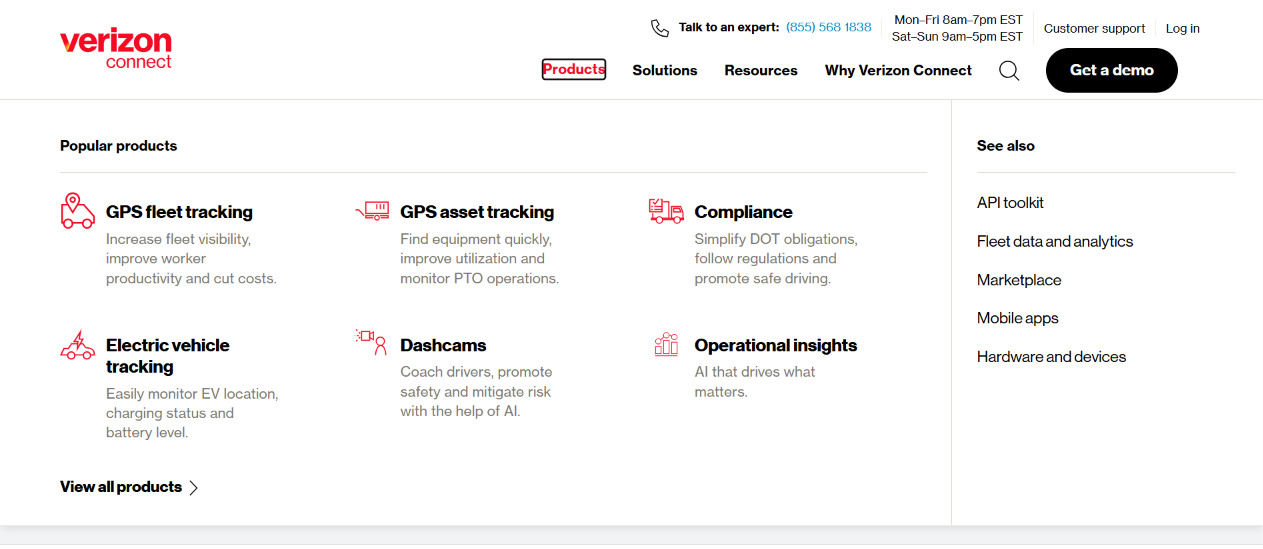
Verizon Connect Reveal tracks odometer and engine data, then triggers preventive maintenance tasks. Users create service schedules and send reminders to drivers, and reports cover maintenance cost analysis. Moreover, the platform includes an AI dash camera option, ELD logbook, and truck-legal navigation.
Features
- Odometer and engine-data triggers create preventive maintenance reminders.
- Maintenance cost analysis reports highlight expensive vehicles.
- GPS tracking, ELD logbook, and IFTA mileage reporting support compliance.
- Driver and manager mobile apps keep teams in sync.
- 24/7 phone support assists customers outside business hours.
Pros
- Hardware often arrives bundled with the subscription.
- Support includes round-the-clock phone access.
- Feature depth satisfies complex fleets.
Cons
- Verizon does not publish a public rate card.
- Per-vehicle pricing adds up for large fleets.
Pricing
Verizon Connect uses custom pricing.
Best for: Large mixed fleets that want bundled hardware, phone support, and deep customization
20. Azuga

Azuga, now part of Bridgestone Mobility Solutions after a 2021 acquisition, offers GPS tracking, driver safety scoring, and scheduled maintenance alerts. Furthermore, because Bridgestone owns it, Azuga integrates tire-pressure monitoring data, which most competitors do not offer natively.
Features
- Scheduled maintenance alerts use vehicle data to flag upcoming service.
- GPS tracking, geofencing, and driver scores come in every tier.
- ELD, IFTA, dash cam, and asset tracking add-ons expand coverage.
- Tire-pressure monitoring integrates through Bridgestone.
- Driver rewards encourage safer habits.
Pros
- Azuga publishes plan prices, which simplifies comparison.
- Plug-and-play devices speed installation.
- Bridgestone ties provide a tire and service ecosystem.
Cons
- Firstly, maintenance features focus on alerts rather than full work-order management.
- Competitors report that the Bridgestone acquisition did not lower prices.
Pricing
- BasicFleet costs $25 per vehicle per month,
- SafeFleet costs $30, and CompleteFleet costs $35, which equals $300, $360, and $420 per vehicle per year.
- The SafetyCam AI tier costs about $42 per vehicle per month. Azuga bills per vehicle without large upfront hardware costs, and it quotes cameras separately.