A business intelligence tool sits in an unusually sensitive position. It connects to a customer’s Snowflake or BigQuery warehouse, pulls data from Salesforce and HubSpot, runs on AWS or GCP, and often gets broad read access to the data enterprise security teams care most about protecting. That makes SOC 2 Firms for Business Intelligence Tool Companies an important consideration early in the sales cycle. SOC 2 is not simply a formality. For many enterprise buyers, it is a gate that can stop a deal until the company clears it.
Choosing the wrong SOC 2 partner can cost more than the audit fee. A first Type II report can take three to twelve months to complete, and a provider that cuts corners can damage your credibility with enterprise security teams that review the report in detail.
This guide compares 12 SOC 2 firms for business intelligence tool companies, including compliance automation platforms and licensed CPA audit firms. We look at what each provider actually does, verified pricing where available, key features, pros and cons, and the type of BI company each provider suits best.
One distinction matters throughout this guide: compliance automation platforms such as Vanta, Drata, and Secureframe help companies collect evidence, manage controls, and monitor compliance. Only a licensed CPA firm can issue and sign the actual SOC 2 report. Some providers offer both compliance software and audit services under one roof, while most focus on one side of the process.
Top 12 Best SOC 2 Firms for Business Intelligence Tool Companies
1. Vanta
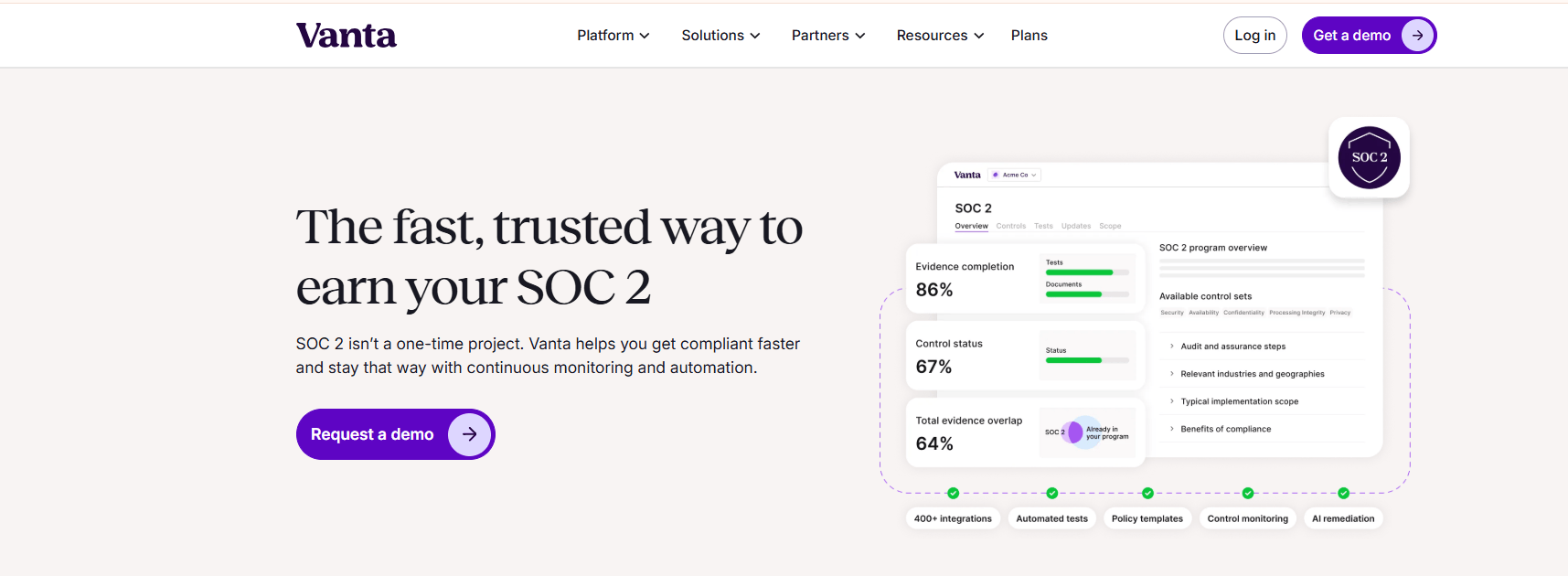
Vanta is a compliance automation platform that helps companies prepare for SOC 2, ISO 27001, HIPAA, GDPR, and other compliance frameworks. It connects to cloud infrastructure, identity providers, development tools, and business applications, then continuously tests controls and collects evidence for an independent CPA firm to review. Vanta does not issue the SOC 2 report itself because auditor-independence rules require the audit to remain separate from the platform that helps prepare the company.
For business intelligence companies, Vanta stands out because it covers infrastructure that sits at the center of a typical BI stack. Its direct Snowflake integration can track databases, identify sensitive data, and support access reviews and MFA testing. Its AWS integration also automates evidence collection for controls covering areas such as IAM, encryption, logging, and backups. Vanta adds a Trust Center that lets BI companies share security and compliance information with prospects, which can help sales teams respond to enterprise procurement requests without repeatedly sending the same documents.
Key Features
- Continuous control monitoring across connected systems
- Native AWS integration for encryption, IAM, logging, and backup controls
- Native Snowflake integration for access reviews and sensitive-data tagging
- Public Trust Center for sharing security information with prospects
- Network of independent CPA audit partners
- Support for SOC 2, ISO 27001, HIPAA, GDPR, and other frameworks
Pros
- Strong brand recognition among enterprise security teams
- Direct Snowflake integration fits a BI company’s data-warehouse environment
- Large network of auditors familiar with Vanta’s evidence format
- Trust Center can help sales teams respond to security reviews faster
Cons
- Pricing is not publicly listed
- Third-party data places Vanta toward the premium end of the market
- Add-ons such as the Trust Center can increase the total cost
- Companies must coordinate Vanta with a separate CPA firm for the audit
Pricing
- Vendor pricing: Not publicly listed
- Independent estimates: Approximately $10,000–$80,000 per year
- Reported median contract: Approximately $20,000 per year
- SOC 2 audit fees: Billed separately by the CPA firm
Best For
Business intelligence companies running on AWS and Snowflake that want one of the most recognizable compliance platforms among enterprise security teams and are willing to pay more for that familiarity.
2. Drata

Drata is a compliance automation platform that continuously monitors controls across SOC 2, ISO 27001, HIPAA, GDPR, PCI DSS, and more than 20 other frameworks. The platform brings evidence collection, policy management, risk management, vendor assessments, and security workflows into one system.
Drata has a native Snowflake integration that focuses on user-access reviews, making it particularly relevant to business intelligence companies. BI platforms often receive broad read access to customer data warehouses, so security teams frequently scrutinize who can access those environments and how companies review that access. Drata also positions its platform as AI-native GRC, using automation to support risk scoring, evidence collection, and compliance workflows rather than simply storing compliance documentation.
Key Features
- Continuous control monitoring across cloud, identity, and development tools
- Native Snowflake integration for warehouse-access reviews
- Centralized risk register and risk scoring
- Key risk indicator tracking
- Policy management and vendor risk assessments
- Security training workflows
- Support for 25+ additional compliance frameworks
Pros
- Snowflake access reviews directly address a common BI security requirement
- Broad framework coverage supports future ISO 27001 or HIPAA plans
- Combines risk, policy, vendor, and compliance management
- Continuous monitoring reduces manual evidence collection
Cons
- Costs can increase significantly with headcount and additional frameworks
- Lower employee tiers have headcount limits
- Third-party reviews cite onboarding and framework add-on costs
- Audit fees remain separate from the platform
Pricing
- Vendor pricing: Not publicly listed
- Independent procurement data: Approximately $7,500/year for companies with up to 50 employees
- 51–200 employees: More than $37,000/year in reported pricing data
- Enterprise: Custom pricing
- SOC 2 audit fees: Separate
Best For
Business intelligence companies that expect to pursue SOC 2 alongside ISO 27001, HIPAA, or other frameworks and want one platform to manage the wider compliance program.
3. Secureframe
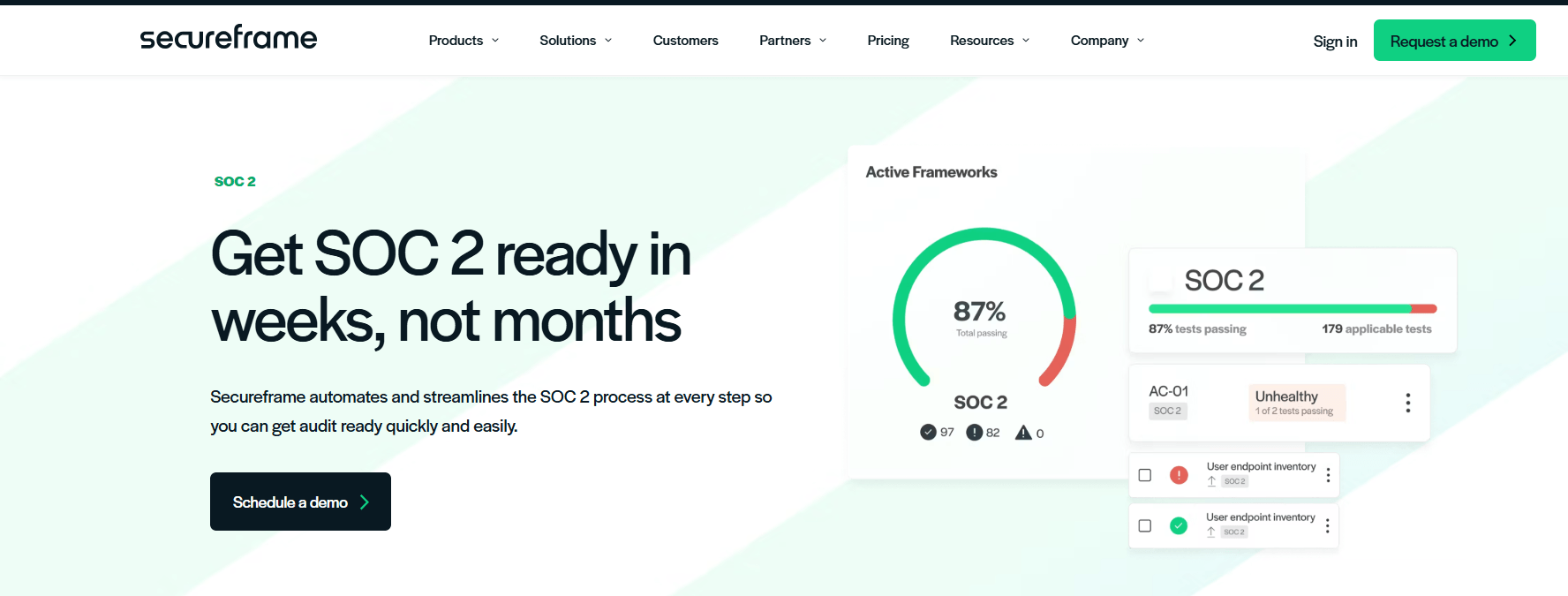
Secureframe automates compliance work across SOC 2, ISO 27001, HIPAA, PCI DSS, GDPR, and CMMC 2.0. It connects with cloud, identity, development, and business systems to collect evidence and test controls continuously.
For business intelligence companies, Secureframe’s security questionnaire automation is one of its most useful capabilities. Enterprise prospects often send BI vendors lengthy security questionnaires during procurement, creating additional work for security, engineering, and sales teams. Secureframe can suggest answers to these questionnaires for review, reducing the amount of repetitive work involved. The platform also provides a Trust Center for sharing compliance information and includes its Comply AI capabilities for helping teams identify and understand control gaps.
Key Features
- Automated evidence collection across cloud, identity, and code systems
- Security questionnaire automation with suggested answers
- Public Trust Center
- Comply AI for explaining control gaps
- Support for SOC 2, ISO 27001, HIPAA, PCI DSS, GDPR, and CMMC 2.0
Pros
- Questionnaire automation addresses a major enterprise-sales pain point
- Broad framework support suits growing BI companies
- Mid-market alternative to larger compliance platforms
- Trust Center supports enterprise security reviews
Cons
- Pricing is not publicly listed
- Implementation and training can add to the total cost
- Questionnaire automation still requires human review
- Audit fees are separate
Pricing
- Vendor pricing: Not publicly listed
- Independent Vendr data: Approximately $7,500–$8,000/year for entry deployments
- Reported median contract: Approximately $20,000/year
- Enterprise deployments: Approximately $60,000–$70,000+
- SOC 2 audit fees: Separate
Best For
Business intelligence companies that regularly receive customer security questionnaires and want to reduce the manual work involved in responding to enterprise prospects.
4. Sprinto
Sprinto is a cloud-native compliance automation platform designed with SaaS companies in mind. It supports SOC 2, ISO 27001, GDPR, HIPAA, and other frameworks while connecting to more than 100 tools across cloud infrastructure, HR, CRM, collaboration, and development environments.
One important difference for business intelligence companies is Sprinto’s framework-based pricing approach rather than a traditional per-seat model. A BI company may have engineers, analysts, sales staff, customer-success teams, and other employees participating in its compliance program. Avoiding a per-seat pricing structure can make costs easier to manage as the company grows. Sprinto also combines automated evidence collection with guided audit workflows and continuous control monitoring.
Key Features
- Continuous monitoring across 100+ integrations
- Framework-based pricing rather than per-seat pricing
- Role-based permissions and workflow automation
- Automated compliance alerts
- Pre-built SOC 2, ISO, NIST, GDPR, and HIPAA programs
- Automated evidence collection
- Guided audit workflows
Pros
- No per-seat fees can make costs more predictable as the team grows
- Startup-focused positioning
- Broad integration coverage for SaaS and cloud environments
- Automated monitoring reduces manual compliance work
Cons
- Pricing is not publicly listed
- Third-party estimates vary significantly
- Lower enterprise recognition than Vanta or Drata
- Companies still need a separate CPA firm for the audit
Pricing
- Vendor pricing: Not publicly listed
- Independent estimates: Approximately $6,000–$25,000/year
- Reported median contract: Approximately $15,000/year
- SOC 2 audit fees: Separate
Best For
Early-stage business intelligence companies that want a recognized compliance automation platform without paying per employee as the team expands.
5. Thoropass

Thoropass combines compliance automation with an integrated audit service. Instead of buying compliance software from one company and hiring a separate CPA firm, a business can manage both parts of the SOC 2 process through Thoropass. The company assigns a Compliance Architect and Customer Success Manager to each account and supports the company from readiness through the completed report.
This model can work particularly well for smaller business intelligence companies that do not have dedicated compliance staff. A BI company can use the platform to manage evidence, risks, policies, and controls while working with the same provider through the audit process. Thoropass supports SOC 2, ISO 27001, HIPAA, HITRUST, PCI DSS, and GDPR.
Key Features
- Compliance automation combined with audit services
- Dedicated Compliance Architect
- Dedicated Customer Success Manager
- Risk Register for tracking risks and remediation
- SOC 2, ISO 27001, HIPAA, HITRUST, PCI DSS, and GDPR support
- Platform and signed audit report from one provider.
Pros
- Removes the need to coordinate separate software and audit vendors
- Dedicated support throughout the engagement
- Useful for companies pursuing HITRUST alongside SOC 2
- One provider remains accountable across readiness and audit
Cons
- Costs more than several pure compliance-automation platforms
- ISO certification-body fees remain separate
- Some reviews describe a stronger advisory component than fully self-service platforms
- Bundled services may be more than a small BI startup needs
Pricing
- Vendor pricing: Not publicly listed
- Independent estimates: Platform-plus-audit packages starting around $14,500/year
- Reported average contracts: Approximately $30,000/year
- Reported contract range: Approximately $21,000–$53,000
- Bundled small-business engagements: Approximately $35,000–$80,000
Best For
Business intelligence companies that want one provider to manage compliance software, readiness, and the SOC 2 audit rather than coordinating multiple vendors.
6. Scrut Automation
Scrut Automation is a governance, risk, and compliance platform that supports more than 50 frameworks, including SOC 2, ISO 27001, GDPR, HIPAA, and PCI DSS. It also provides continuous monitoring against more than 230 CIS benchmarks.
Scrut’s main advantage for business intelligence companies is the breadth of its compliance coverage. A BI company may start with SOC 2 but later need ISO 27001, HIPAA, or another framework when it begins selling to healthcare, financial-services, or other regulated customers. Scrut lets the company manage those programs within one platform rather than adopting a separate system for every framework. The platform also includes policy templates, application integrations, centralized reporting, and implementation support.
Key Features
- 50+ compliance frameworks
- 70+ application integrations
- 230+ CIS benchmark checks
- 75+ customizable policy templates
- Centralized compliance dashboard
- Cross-framework compliance visibility
- Implementation support
Pros
- Extensive framework coverage supports long-term compliance plans
- High user ratings on G2 and Capterra
- Hands-on implementation support
- Useful for companies managing several frameworks
Cons
- Pricing is not publicly listedBroad GRC capabilities may exceed the needs of a SOC 2-only startup
- Separate audit fees can increase first-year costs
- Direct comparison with simpler SOC 2 tools can be difficult because of its broader scope
Pricing
- Vendor pricing: Not publicly listed
- Independent platform estimates: Approximately $15,000/year
- Estimated SOC 2 audit fees: Approximately $15,000–$40,000
- Estimated total first-year engagement: Often $40,000–$70,000
- These figures are estimates, not vendor-confirmed prices
Best For
Business intelligence companies planning SOC 2 alongside ISO 27001, HIPAA, or other frameworks and looking for one platform to manage the entire compliance roadmap.
7. Strike Graph
Strike Graph is a compliance SaaS platform focused on SOC 2 Type I, SOC 2 Type II, and ISO 27001. Unlike most compliance platforms on this list, Strike Graph publishes pricing rather than requiring every prospect to request a custom quote. The platform uses API-driven integrations to collect evidence and gives companies a dashboard for tracking controls, tasks, and audit readiness.
Strike Graph also offers an integrated auditor option. This allows a business intelligence company to manage compliance preparation and the audit through a single relationship if it prefers not to source a CPA firm separately. Its pricing transparency can also help smaller BI companies estimate their compliance budget before entering a sales process.
Key Features
- API-driven evidence collection
- SOC 2 Type I and Type II support
- ISO 27001 support
- Published pricing tiers
- Optional integrated auditor service
- Control and task tracking
- Audit-readiness dashboard
Pros
- Published pricing makes initial budgeting easier
- Lower entry point than several larger platforms
- Integrated auditor option can reduce vendor coordination
- Suitable for companies pursuing an initial SOC 2
Cons
- Smaller integration ecosystem than Vanta, Drata, or Secureframe
- Lower enterprise brand recognition
- Companies should verify current pricing before committing to a budget
Pricing
- Custom pricing
- Audit costs may be separate depending on the selected package
Best For
Budget-conscious business intelligence startups that want to see pricing before speaking with sales and can accept a smaller platform in exchange for greater pricing transparency.
8. A-LIGN
A-LIGN combines compliance automation with audit services through its A-SCEND platform and CPA practice. This structure allows a business intelligence company to use one provider for evidence management and the signed SOC 2 report.
A-LIGN also covers a wide range of standards beyond SOC 2, including ISO 27001, ISO 27701, ISO 22301, HITRUST, FedRAMP, and PCI DSS. That breadth can become valuable for BI companies that plan to sell into healthcare, government, or payments-related markets. Its control-mapping capabilities can also reduce duplicate evidence collection when a company pursues several assessments.
Key Features
- A-SCEND compliance automation platform
- In-house SOC 1 and SOC 2 audit services
- ISO 27001, ISO 27701, ISO 22301, HITRUST, FedRAMP, and PCI DSS support
- Control mapping across multiple assessments
- Startup Partnership Program
- Combined automation and audit services
Pros
- One provider can handle compliance software and the signed report
- Startup Partnership Program offers discounted access for qualifying companies
- Broad accreditation coverage supports complex compliance roadmaps
- Useful for BI companies targeting regulated markets.
Cons
- Standard pricing is not publicly listed
- Large provider may offer less individualized attention than a boutique firm
- Companies may not need its full accreditation range
- The broad service offering can add complexity for a simple first SOC 2
Pricing
- Startup Partnership Program: A-SCEND free for one year
- Stated A-SCEND value: $6,000
- Type II SOC 2 security-only audit: $15,000 for qualifying companies
- Program eligibility: Portfolio companies of qualifying incubators, accelerators, and venture funds
- Standard pricing outside the program: Not publicly listed
Best For
Growing business intelligence companies that expect to pursue several certifications as they expand into healthcare, government, payments, or other regulated markets.
9. Schellman
Schellman is a large independent SOC examination provider and PCAOB-registered CPA firm that performs more than 2,000 SOC reports each year across nearly 60 assessment types. The firm separates its attest and advisory practices to maintain auditor independence.
For business intelligence companies, Schellman’s multi-framework and AI assessment capabilities make it particularly relevant to companies moving beyond a basic SOC 2. Its single-assessor model can support SOC 2 and ISO 27001 through one firm, reducing duplicated evidence collection. Schellman also offers AI Red Teaming and ISO 42001 assessment services, which can matter for BI companies that add AI-powered analytics, natural-language querying, or other AI features that increase scrutiny around data handling and security.
Key Features
- SOC 2 and ISO 27001 assessments through one assessor
- AI Red Teaming
- ISO 42001 assessment capability
- SOC for Supply Chain
- SOC for Cybersecurity
- Nearly 60 assessment types
- PCAOB registration
- Separate attest and advisory entities
Pros
Strong enterprise recognition
AI assessment capabilities fit BI companies adding AI features
Concurrent assessments can reduce duplicated evidence collection
Broad assessment coverage supports complex compliance programs
Cons
- Higher pricing than many specialist SOC 2 firms
- May be excessive for a pre-revenue or seed-stage BI startup
- More formal engagement model than smaller firms
- Less suited to companies needing only a simple first SOC 2
Pricing
- Vendor pricing: Not publicly listed
Estimated Type I engagements: Approximately $15,000–$30,000
Estimated Type II engagements: Approximately $20,000–$100,000
Comparable specialist SOC 2 firms: Approximately $20,600–$61,200 on average
Audit pricing varies significantly by scope and complexity
Best For
Growth-stage and enterprise business intelligence companies, particularly those building AI-powered analytics products or planning several compliance assessments.
10. Johanson Group
Johanson Group is a boutique CPA firm that has become a common audit option within Vanta, Drata, and Secureframe ecosystems. Rather than competing with large firms on the number of frameworks or enterprise services they offer, Johanson Group focuses on straightforward SOC 2 audits for smaller companies.
This approach can suit an early-stage business intelligence company with one product and a relatively contained technology environment. The firm focuses on structured audits and straightforward communication while keeping pricing below many larger SOC 2 providers. Its limited scale, however, can become a constraint as a BI company adds products, entities, frameworks, or more complex customer requirements.
Key Features
- SOC 2 Type I and Type II examinations
- Integration with Vanta, Drata, and Secureframe ecosystems
- Structured audit process
- Early-stage company focus
- Fixed-feeling pricing compared with larger firms
Pros
- Among the lower-cost CPA audit options in this list
- Strong reviewer ratings for process clarity and communication
- Good fit for a simple technology environment
- Works with major compliance automation platforms
Cons
- Smaller capacity than larger CPA firms
- Less suited to complex multi-product or multi-entity environments
- Some reviewers report billing issues
- Growing companies may eventually need a larger audit firm
Pricing
- Vendor pricing: Not publicly listed
- Independent estimates for Type II: Approximately $6,000–$15,000
- Pricing generally falls toward the lower end of the specialist SOC 2 market
- Compliance platform fees: Separate
Best For
Early-stage business intelligence companies with one product, a contained technology stack, and a tight budget for their first SOC 2 Type II audit.
11. Prescient Assurance
Prescient Assurance built its audit practice around high-volume, startup-friendly SOC 2 engagements and fast turnaround times. The firm also provides application security and penetration-testing services, which gives business intelligence companies another relevant security service through the same provider.
That combination matters because enterprise customers increasingly review more than a SOC 2 report when they assess a BI vendor. They may also ask for penetration-test results or application-security evidence. Prescient connects directly with Vanta, Drata, and Secureframe, allowing evidence from those platforms to move into the audit process with less manual handoff.
Key Features
- SOC 2 Type I and Type II audits
- Application security services
- Penetration testing
- Vanta, Drata, and Secureframe integrations
- Startup-focused audit model
- Fast-turnaround engagements
Pros
- Faster turnaround than many larger audit firms
- Penetration testing complements SOC 2 requirements
- Startup-focused pricing
- Integration with major compliance platforms
Cons
- High-volume model can mean a lighter-touch engagement
- Companies may need to handle more project management themselves
- Less enterprise brand recognition than Schellman or A-LIGN
- Pricing varies by scope and is not publicly listed
Pricing
- Vendor pricing: Not publicly listedIndependent Type II estimates: Approximately $8,000–$20,000
- Final pricing depends on audit scope and company complexity
- Compliance platform fees: Separate
Best For
Seed-to-Series-A business intelligence companies that want an affordable, relatively fast SOC 2 Type II audit and may also need penetration testing.
12. BARR Advisory
BARR Advisory is a CPA firm that focuses heavily on cloud-native technology companies, particularly B2B SaaS businesses running on AWS, Azure, or Google Cloud. That specialization makes it a strong match for many business intelligence platforms, which commonly rely on one or more of these cloud environments.
BARR also supports SOC 1, SOC 2, ISO 27001, and HITRUST assessments and can coordinate evidence across multiple frameworks. This approach can help a BI company avoid collecting the same evidence repeatedly when it needs more than one assessment. BARR’s consistent audit teams also give companies continuity throughout the engagement rather than rotating staff across different stages of the audit.
Key Features
- SOC 1 and SOC 2 assessments
- ISO 27001 assessments
- HITRUST assessments
- AWS, Azure, and Google Cloud specialization
- Multi-framework evidence coordination
- Consistent audit teams throughout engagements
- B2B SaaS specialization
Pros
- Cloud and SaaS specialization fits many BI platforms
- Estimated pricing sits below some larger specialist SOC 2 firms
- Same audit team can remain involved throughout the engagement
- Multi-framework approach can reduce duplicate evidence work
Cons
- Smaller bench than large firms such as Schellman or A-LIGN
- Less enterprise name recognition than the largest providers
- Companies pursuing only SOC 2 may not need its broader capabilities
- Best value comes from companies that need more than one assessment
Pricing
- Vendor pricing: Not publicly listed
- Estimated Type I engagements: Approximately $5,000–$20,000
- Estimated Type II engagements: Approximately $15,000–$50,000
- Comparable specialist SOC 2 firms: Approximately $20,600–$61,200 on average
- Compliance platform fees: Separate where applicable
Best For
Cloud-native business intelligence companies running on AWS, Azure, or GCP that want an auditor experienced with B2B SaaS infrastructure and potentially plan to pursue additional frameworks.
Conclusion
Choosing among SOC 2 Firms for Business Intelligence Tool Companies comes down to more than finding the cheapest compliance platform or auditor. A BI company needs to consider how well the provider fits its infrastructure, customer requirements, growth plans, and internal resources.
For companies running heavily on AWS and Snowflake, platforms such as Vanta and Drata offer strong infrastructure integrations and continuous monitoring. Secureframe can make sense for BI companies that spend significant time answering customer security questionnaires, while Sprinto offers a more startup-focused approach. Companies that want compliance software and auditing under one provider can consider Thoropass or A-LIGN.
The auditor also matters. Specialist firms such as Johanson Group and Prescient Assurance can suit early-stage companies looking for a more affordable first SOC 2, while Schellman and BARR Advisory may make more sense for larger or more complex BI environments. Companies planning to enter regulated markets may also benefit from providers that support frameworks beyond SOC 2.
Before choosing a provider, look beyond the headline price. Check its integrations with your actual technology stack, the frameworks you expect to need, the level of support included, audit fees, and how well the provider is recognized by your target customers. The right SOC 2 Firms for Business Intelligence Tool Companies should not only help you complete an audit. It should help remove a security barrier from your sales process and support the company’s growth into larger enterprise accounts.