SOC 2 vendors with automated compliance tools have changed how organizations approach security audits. These platforms shorten audit timelines from months to weeks. In addition, they help teams maintain a consistent security posture throughout the year. Consequently, companies face fewer security gaps, less audit fatigue, and lower internal compliance workload. Moreover, these tools handle many time-consuming tasks that teams once managed manually. They monitor controls continuously, collect evidence automatically, manage policies, assess vendor risk, and support collaboration with auditors. Furthermore, teams access all these functions from one centralized dashboard, which keeps compliance activities organized and visible.
For SaaS companies, cloud providers, and any organization that handles sensitive customer data, a SOC 2 report now serves as the leading proof of trust. Enterprise buyers often request it before signing contracts. In addition, investors review it during due diligence when they evaluate operational risk. Regulatory bodies also expect companies to demonstrate strong security practices. However, achieving and maintaining SOC 2 compliance, particularly SOC 2 Type II, has traditionally required significant time and effort. Teams often relied on spreadsheets, chased documents across departments, and coordinated closely with consultants for months. Therefore, many organizations struggled with long preparation cycles and heavy administrative work.
We examines twelve leading SOC 2 vendors with automated compliance tools. The goal is to help decision-makers choose a vendor that fits their compliance strategy and operational needs.
Top 12 Best SOC 2 Vendors with Automated Compliance Tools

Vanta continues to set the standard for SOC 2 compliance platforms, and many companies compare newer tools against it before making a decision. The platform stands out due to the size of its automation engine and the number of systems it connects with across a typical startup technology stack. In fact, Vanta supports more than 375 native integrations, which currently represents the largest integration ecosystem among SOC 2 platforms. Consequently, organizations connect their cloud services, identity providers, ticketing tools, and development platforms without relying on manual uploads.
Furthermore, Vanta performs more than 1,200 automated control checks every hour across multiple compliance frameworks. Therefore, teams observe their compliance posture continuously instead of reviewing controls only during periodic internal checks. In addition, this constant monitoring helps security teams detect potential gaps earlier and respond before an auditor raises concerns. Meanwhile, built-in policy libraries and risk tools support the broader compliance program, which helps companies maintain visibility across vendors, employees, and security controls.
Features
- Automated evidence collection that integrates with 375+ cloud, identity, endpoint, and ticketing systems and organizes compliance documentation automatically
- Continuous control testing with 1,200+ automated hourly checks across SOC 2 Trust Services Criteria
- Policy template library with customizable policies and employee security awareness training tracking
- Vendor risk management tools that automate third-party risk reviews and track vendor compliance status
- Trust Center portal that allows customers to access SOC 2 reports, security documentation, and compliance updates while reducing incoming security questionnaires
- AI-assisted capabilities that help draft questionnaire responses, generate risk assessments, and highlight compliance gaps.
Pros
- Largest native integration ecosystem in the compliance automation market with more than 375 integrations
• Fast onboarding process that helps teams prepare for audits within a few weeks
• Well-developed Trust Center that improves transparency for customers and partners
• Active GRC community support and strong customer success resources
Cons
- Technical teams sometimes consider the automation depth less detailed compared with developer-centric platforms
- Large feature set can feel overwhelming during the first onboarding phase
Pricing
• Custom pricing with five tiers: Core, Plus, Growth, Scale, and Enterprise.
Drata stands apart from many SOC 2 compliance platforms through its core philosophy. The company treats compliance as an ongoing engineering practice rather than a periodic audit task. Therefore, teams monitor controls continuously instead of preparing only when an audit approaches. Moreover, Drata designed the platform with auditors in mind from the start. It includes a dedicated Audit Hub where certified auditors access evidence directly. Consequently, teams avoid exporting files or reformatting documentation during reviews.
Features
AI-powered trust management that assists with control mapping, gap analysis, risk scoring, and automated questionnaire responses; therefore, teams reduce many hours of compliance work each year
• Continuous control monitoring that connects with more than 75 tools, including AWS, GCP, GitHub, and HR platforms; meanwhile, the system collects and validates evidence against SOC 2 controls in real time
• Audit Hub that gives certified auditors direct access to organized evidence packages; consequently, audit reviews move faster and require fewer manual requests
• Broad framework coverage with pre-built control mappings for SOC 2, ISO 27001, PCI DSS, HIPAA, GDPR, CCPA, FedRAMP, and other standards; therefore, teams manage several frameworks within one platform
• Automated evidence collection that captures screenshots, logs, configurations, and access records; meanwhile, engineering teams avoid the manual documentation tasks that usually consume large amounts of time.
Pros
- Strong compliance automation designed specifically for developer-focused teams
- CI/CD integration that monitors compliance throughout the software development lifecycle
- No-code custom control tests that support complex infrastructure environments
- Monitoring dashboards that provide clear visibility into ongoing compliance status
Cons
- Some integrations require extra setup; therefore, they may not connect instantly like simpler tools
- The engineering-focused design can feel technical for compliance teams without development backgrounds
Pricing
• Custom pricing available through the sales team
Secureframe is a SOC 2 compliance platform designed for startups and mid-market companies that want strong automation along with human guidance that feels similar to an internal compliance team. The platform manages evidence collection, policy documentation, and vendor oversight in one environment. In addition, it supports organizations that need consistent visibility across their compliance efforts. However, although many users find the platform approachable, some teams report an early learning period, and the interface occasionally requires refinement. Nevertheless, companies of different sizes rely on Secureframe to automate compliance tasks, reduce manual documentation work, and maintain accurate audit records. Furthermore, the platform supports frameworks such as SOC 2, HIPAA, PCI DSS, and GDPR, which allows organizations to expand their compliance coverage when business needs evolve.
Features
- Comply AI: Secureframe’s proprietary AI engine identifies failing controls in cloud environments and corrects them automatically. In addition, it performs risk assessments and updates policy documents, which helps teams resolve issues instead of simply identifying them.
- Integrated GRC Platform: Secureframe combines compliance, risk management, and security oversight within one platform. Furthermore, cross-framework control mapping removes duplicate work when teams pursue SOC 2 alongside ISO 27001, PCI DSS, or HIPAA.
- 300+ Native Integrations: The platform connects with AWS, Azure, GCP, GitHub, Okta, Google Workspace, Salesforce, and more than 300 additional tools. Consequently, evidence collection occurs automatically across most modern technology stacks.
- Automated Policy Builder: AI-powered policy creation helps teams generate documentation quickly. Moreover, version control, framework updates, and collaboration tools keep policies ready for audit review.
- Vendor Risk Assessment: Secureframe centralizes vendor risk management. It distributes automated questionnaires, evaluates risk scores, and monitors vendor activity continuously.
- Auditor-Friendly Workflows: Auditors access evidence directly within the platform. Therefore, teams reduce the long email chains that often slow down SOC 2 audits.
Pros
- Comply AI actively corrects compliance issues rather than only identifying them
- Strong support for multiple frameworks with intelligent control mapping
- Responsive customer support that includes compliance specialists and former auditors
- Quick onboarding, and many companies reach audit readiness within six weeks
Cons
• Initial setup may feel complex for organizations with highly customized IT environments
Pricing
• Two main tiers: Fundamentals and Complete
• Pricing begins at approximately $7,500 per year for organizations with up to 100 employees
Sprinto stands apart from many SOC 2 platforms through its blend of intelligent automation and direct human guidance. Instead of handing startups a simple checklist, the platform analyzes existing cloud infrastructure and connects it to SOC 2 controls. It also identifies gaps and then provides clear instructions for remediation. Consequently, teams new to compliance gain direction without feeling overwhelmed. In addition, the platform walks organizations through each step of the process while compliance experts remain available for support. Therefore, companies maintain progress while still learning how the framework applies to their environment.
Features
- Guided onboarding with step-by-step setup and preconfigured SOC 2 and ISO 27001 controls that help new compliance teams complete the process without prior experience
Intelligent automation that connects existing engineering processes to SOC 2 controls, identifies compliance gaps, and generates remediation task lists with assigned ownership
- Continuous monitoring that connects with cloud infrastructure, collects evidence, tracks system configurations, and monitors employee access across platforms
- Smart workflows that guide teams through operational compliance tasks such as employee onboarding, security training completion, and policy acknowledgments
- Automated alerts that detect non-compliant configurations or access changes and assign corrective actions to the responsible team members with deadlines.
Pros
- Automates both technical and operational controls inside one platform, which simplifies compliance management
- Pre-approved compliance programs help teams prepare for audits faster
- Strong presence in the APAC market with regional support for customers
- Built-in device security checks remove the need for a separate device management tool for basic compliance needs
Cons
- Advanced customization remains more limited than what large enterprise governance platforms offer
Pricing
- Starts at about $4,000–$5,000 per year for one framework for teams with 10–50 employees
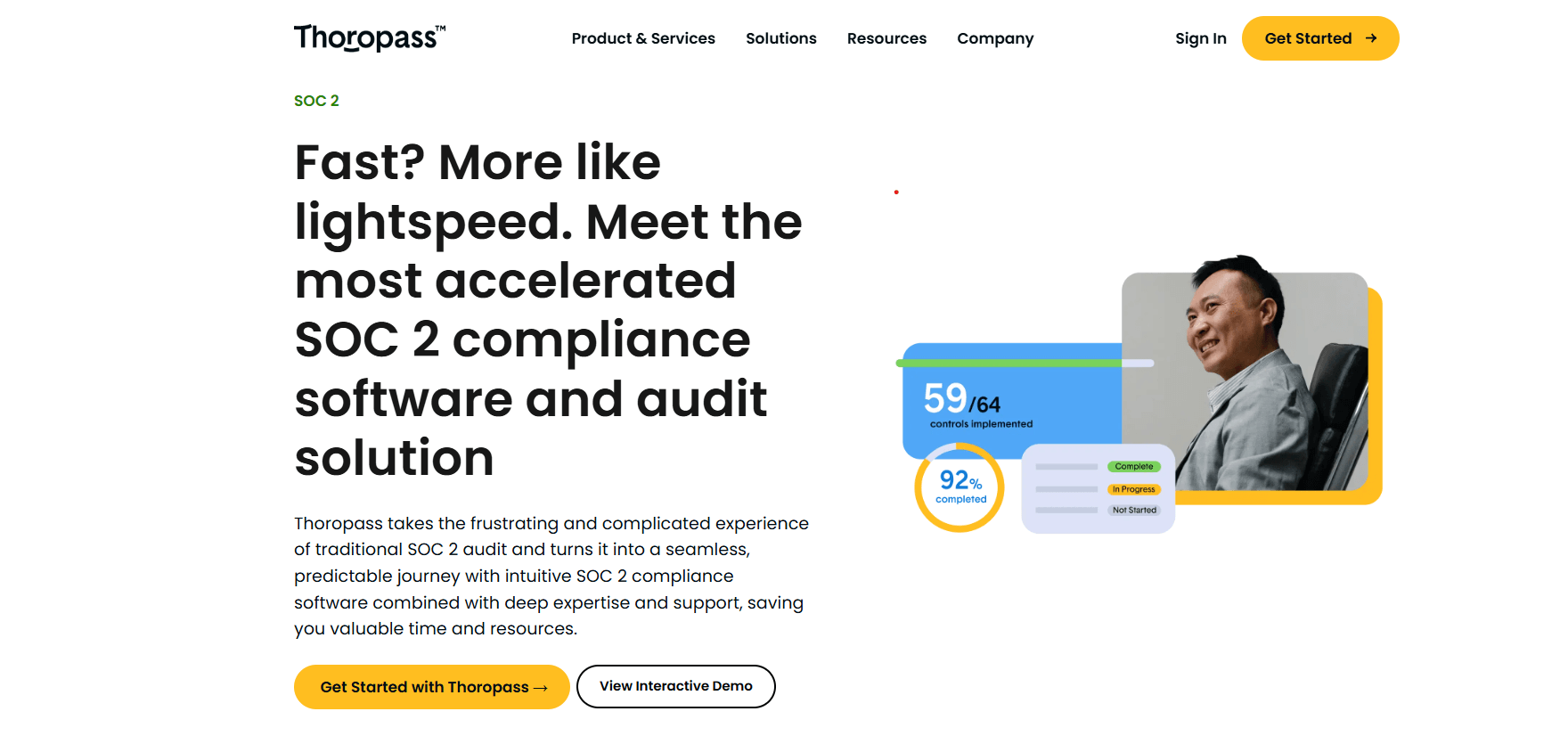
Thoropass, previously known as Laika before its 2023 rebrand, holds a distinctive position in the SOC 2 compliance market. The company operates both as a compliance automation platform and as an audit firm. Therefore, teams do not manage separate vendors for preparation and audit execution. Instead, Thoropass brings both activities into one connected workflow. Furthermore, this structure reduces coordination issues and keeps compliance tasks, documentation, and audit communication inside a single system. In addition, organizations maintain clearer visibility into their progress while auditors review evidence within the same environment.
Features
- Built-in audit firm where Thoropass employs in-house auditors who work inside the platform environment, which removes the need to search for, evaluate, and coordinate with a separate audit provider
- First Pass AI technology that accelerates evidence gathering and verification while machine learning reviews collected documentation for completeness and accuracy before auditors examine it
- Continuous control monitoring that connects with cloud platforms, identity providers, and version control systems to gather evidence automatically and update compliance status in real time
- Risk register and vendor tracking that present a unified view of organizational risk while teams evaluate, track, and address issues alongside vendor compliance oversight
- Support for more than 30 frameworks including SOC 2, HIPAA, PCI DSS, ISO 27001, GDPR, CCPA, and HITRUST within one platform.
Pros
- All-in-one structure combines compliance software and audit execution within a single vendor relationship, which reduces operational friction
- AI-assisted evidence screening helps auditors review documentation faster while minimizing last-minute audit surprises
- Wide framework coverage supports organizations with multiple compliance obligations
- Experienced auditors participate directly in the platform’s guidance and support model
Cons
Some users indicate interest in deeper automation across additional compliance processes
Pricing
• Custom pricing based on team size, selected frameworks, and whether audit services are included
• Typical reported cost falls around $10,000–$20,000 per year for SOC 2 Type I with the audit included
Scytale stands out among SOC 2 vendors through its mix of compliance automation and direct guidance from experienced GRC professionals. Most platforms focus only on software. However, Scytale assigns specialists who guide organizations from early readiness through final audit completion. Consequently, companies without an internal compliance team gain both technical tools and practical direction. In addition, this combination of automation and human support helps teams move forward with more clarity and confidence.
The platform’s automation engine manages demanding compliance tasks, including evidence collection, control monitoring, user access reviews, and vendor risk oversight. At the same time, Scytale introduces an advanced AI assistant known as the Scy GRC agent. This system answers compliance questions, explains remediation steps, and assists teams with complex governance, risk, and compliance activities. Therefore, teams spend less time interpreting requirements and more time improving their security posture. Furthermore, the AI assistant reduces the mental workload on compliance teams throughout the year while keeping tasks organized and visible.
Features
- Dedicated GRC experts who guide organizations from SOC 2 readiness through audit certification with hands-on support
- Multi-framework mapping that connects controls across SOC 2, ISO 27001, PCI DSS, HIPAA, GDPR, and more than 30 frameworks to reduce duplicate work
- Automated evidence collection that connects with cloud platforms, HR systems, and developer tools to gather documentation auditors can verify
- Continuous monitoring that tracks control effectiveness at all times and alerts teams when compliance drift appears
- Auditor workspace that allows assessors to review evidence and collaborate without leaving the platform.
Pros
- Multi-framework mapping allows teams to reuse evidence across standards, which improves efficiency
- Integrated penetration testing removes the need for separate basic security testing engagements for SOC 2 preparation
Cons
- The combined model of software and expert guidance may feel unnecessary for organizations that already maintain experienced internal compliance teams
Pricing
• Custom pricing. Organizations must contact Scytale for a personalized quote.
Scrut offers a compliance platform designed for startups that want quick deployment while still maintaining strong oversight of their security controls. Many teams searching for SOC 2 vendors with automated compliance tools consider Scrut a practical option, especially when they need structured compliance guidance without building a full internal compliance department. The platform provides a large policy library, automated evidence gathering for most SOC 2 controls, and centralized compliance management. Consequently, lean teams can organize their compliance program efficiently while maintaining visibility across every control area. In addition, Scrut connects policies, controls, and risks inside one environment, which helps teams understand how security practices support overall business risk management.
Features
- 100+ pre-built policies with customizable templates and expert guidance, which helps teams create a compliant policy structure faster•
- Single-window compliance management where teams manage controls, policies, and audit preparation from one interface without switching between tools
- Multi-framework coverage including SOC 2, ISO 27001, GDPR, HIPAA, and CCPA, while cross-mapping allows teams to reuse evidence across multiple audits
- Integrated risk management tools that connect compliance controls with business risks, which encourages a more informed approach to security governance.
Pros
- Automated evidence collection reduces documentation effort significantly compared with manual processes
- Flexible configuration options support organizations with complex or unique compliance requirements
Cons
- Risk-focused design introduces additional complexity, therefore some teams experience a longer learning period compared with simpler checklist-based platforms
Pricing
• Modular SaaS subscription with optional audit readiness add-ons
• Custom pricing available through direct quotes from Scrut Automation.
Hyperproof operates as a compliance operations platform known for its evidence-focused approach to SOC 2 automation. Among SOC 2 vendors with automated compliance tools, it stands out for building its entire workflow around the evidence lifecycle. Many compliance platforms treat evidence as a secondary task; however, Hyperproof places it at the center of the user experience. The system links every piece of evidence to the correct control, checks whether it remains current, and prepares documentation for auditors at any time. Consequently, teams avoid confusion during audits while maintaining better visibility into compliance progress.
In addition, the platform introduces evidence freshness scoring, a feature that labels documentation as current, stale, or expired. This capability helps compliance teams track the validity of records throughout the observation period. Furthermore, the system reduces a common audit problem when companies discover outdated evidence too late in the process. Therefore, organizations maintain confidence that their documentation reflects actual operational practices.
Features
- Evidence freshness tracking that automatically scores compliance evidence as current, stale, or expired, which helps teams monitor documentation quality
- Evidence reuse that connects and reuses evidence across multiple frameworks, which reduces duplicate collection for shared controls
- 100+ integrations connecting with Slack, AWS, Google Cloud, Jira, Asana, ServiceNow, and many other tools for automated evidence collection
- Multi-framework capability supporting SOC 2, ISO 27001, NIST, HIPAA, PCI DSS, and custom frameworks running at the same time
- Audit workflow module that tracks requests, monitors progress, and supports communication between teams and auditors
- Custom compliance programs that allow organizations to design their own frameworks with detailed access permissions.
Pros
- Supports one of the largest framework libraries in the market, with more than 100 frameworks available
- Flexible configuration allows teams to build custom controls and manage complex compliance workflows
- Cross-framework control mapping reduces repeated work when organizations manage several frameworks at once
Cons
• Integration library remains smaller than some competitors, which may require custom connections for uncommon tools
• Interface design feels less modern to some users when compared with newer compliance platforms
Pricing
• Tiered SaaS pricing based on user count and the number of control sets included
AuditBoard leads the enterprise segment among SOC 2 compliance platforms. The system delivers a full governance, risk, and compliance environment that extends beyond SOC 2 automation. In addition, it supports internal audit programs, SOX compliance, risk oversight, ESG reporting, and information security management inside one connected architecture. Consequently, many organizations consider it when evaluating SOC 2 vendors with automated compliance tools, especially when their compliance and risk programs operate across several departments.
Large enterprises often connect audit, risk, and compliance programs tightly across the organization. Therefore, AuditBoard organizes these activities within a unified data structure that keeps information consistent across teams. Furthermore, once teams identify a risk, the platform pushes that information into audit planning, compliance tracking, and remediation tasks. Meanwhile, departments avoid reconciling data across separate systems, which helps leadership maintain a clear view of risk and compliance activity throughout the organization.
Features
- Connected risk architecture that links internal audit, SOX, risk management, compliance, and ESG reporting within one integrated workflow environment
- Enterprise automation that manages risk assessments, policy approvals, remediation plans, and control testing through automated workflows
- Dedicated SOX compliance module with centralized controls and automated task management
- Enterprise risk management tools that support risk identification, evaluation, monitoring, and remediation through executive dashboards
- ESG reporting tools that manage environmental, social, and governance data and produce structured reports for stakeholders
- Vendor risk management capabilities that evaluate third-party risk, track vendors, and manage enterprise supplier relationships
Pros
- Strong internal audit capabilities compared with many platforms in the compliance technology market
- Dashboards that provide leadership and board members with clear compliance and risk visibility
Cons
- Implementation timelines often take longer than those of lighter compliance platforms
- Onboarding may challenge teams that lack dedicated audit or compliance specialists
Pricing
• Custom enterprise licensing based on selected modules and organizational requirements.
OneTrust operates as a unified platform for organizations that want to manage data privacy, security compliance, and vendor risk inside one connected system. Many companies compare it with other SOC 2 vendors with automated compliance tools; however, OneTrust extends beyond traditional compliance software. The platform connects privacy management and security oversight in the same environment, which helps organizations track both responsibilities together. In addition, global regulations such as GDPR, CCPA, and other emerging privacy laws continue to link security and privacy expectations more closely. Therefore, companies often look for platforms that handle both areas instead of managing them separately. For teams that want SOC 2 compliance alongside strong privacy governance, OneTrust delivers capabilities that many SOC 2 vendors with automated compliance tools do not provide.
Features
- Unified Trust Platform that connects security compliance, privacy management, and risk oversight inside one workspace
- Automated compliance tools that map policies and controls across frameworks such as SOC 2, ISO 27001, GDPR, and HIPAA
- Privacy governance features that extend beyond SOC 2 to include data protection management, consent tracking, and broader privacy compliance
- Vendor risk management with centralized third-party assessments, automated questionnaires, and continuous vendor risk scoring
- Evidence automation that collects compliance documentation and tracks control readiness across multiple frameworks.
Pros
- Covers multiple disciplines including privacy, security, ESG oversight, ethics management, and third-party risk in a single environment
- More than 150 patents support the platform’s underlying technology and product development
Cons
Deployment may require significant time and planning for large organizations
Pricing
• Custom pricing based on organization size, frameworks selected, and deployment scope
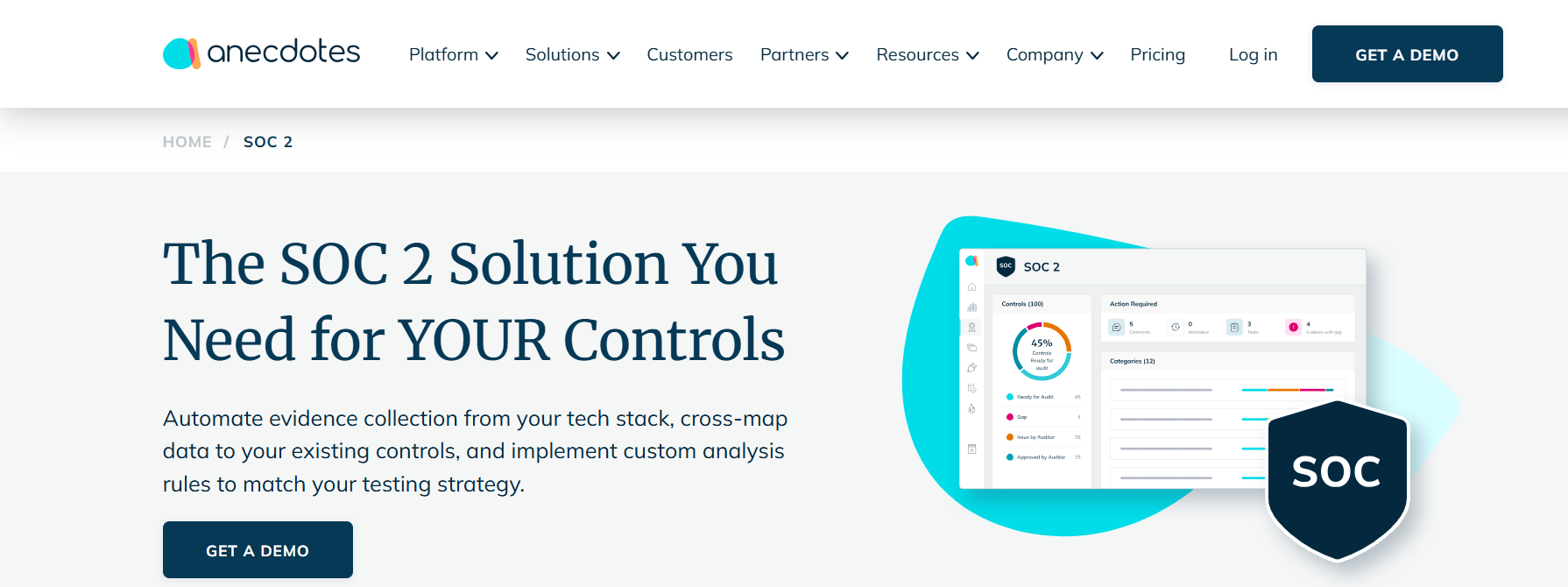
Anecdotes operates as a compliance data platform built for engineering teams that want technical visibility into their security controls. Among SOC 2 vendors with automated compliance tools, the platform focuses heavily on data ingestion and system integrations. Instead of asking compliance teams to configure every control manually or upload evidence one file at a time, Anecdotes collects compliance data directly from your infrastructure. It connects with CI/CD pipelines, cloud environments, identity providers, and ticketing systems. Then it maps that data to the relevant compliance frameworks. Consequently, engineering teams review compliance status within systems they already use. In addition, the platform presents compliance information in a technical format that fits naturally into existing development workflows. Therefore, organizations maintain oversight while engineering and security teams continue their normal operations without constant manual reporting.
Features
- Extensive integrations that connect with CI/CD pipelines, cloud infrastructure, identity providers, and ticketing systems so the platform can ingest compliance data automatically
- Control mapping that links technical evidence to the correct controls across SOC 2 and other compliance frameworks
- Compliance data platform that stores compliance-related information in one centralized location where teams can query, analyze, and generate reports
- Continuous monitoring that provides real-time visibility into control status across connected systems and detects configuration drift automatically
- Multi-framework support that covers SOC 2, ISO 27001, HIPAA, GDPR, and custom frameworks with intelligent cross-mapping between standards
Pros
- Continuous compliance automation that keeps control data updated across systems
- Support for more than 40 frameworks, including SOC 2, ISO 27001, HIPAA, and GDPR
- Flexible configuration with custom frameworks and no-code rule creation
- User-friendly interface that simplifies onboarding while customer support remains responsive
- Strong fit for organizations managing several compliance programs at once
Cons
- Initial setup can require significant time and planning for complex environments
- Some capabilities appear as add-on features, including training content
- Integration issues may occur occasionally with certain tools
Pricing
Companies must request pricing based on the plan that best matches their compliance needs.
Strike Graph operates as a compliance SaaS platform that helps companies achieve security certifications such as SOC 2 Type I, SOC 2 Type II, and ISO 27001. Among SOC 2 vendors with automated compliance tools, it focuses on helping organizations build security and compliance programs quickly while reducing the manual work that often slows audit preparation. In addition, the platform connects to common business systems and infrastructure through API integrations, so it collects audit evidence automatically instead of requiring teams to upload documents manually. Consequently, companies prepare for audits faster while maintaining a clear record for auditors to review. Furthermore, cybersecurity certifications often help B2B organizations build credibility with enterprise buyers. Therefore, Strike Graph supports companies that want to strengthen trust and close enterprise deals without long compliance timelines.
Features
- Compliance SaaS platform that supports certifications such as SOC 2 Type I, SOC 2 Type II, and ISO 27001
- Automated evidence collection through API integrations with business systems and infrastructure
- Risk-based assessment engine that selects cybersecurity controls based on the organization’s risk profile
- Support for more than 25 frameworks including SOC 2, ISO standards, HIPAA, PCI DSS, GDPR, CMMC, DORA, NIS2, TISAX, HITRUST, and multiple NIST variants
- Compliance dashboards and documentation tools that prepare evidence for auditor review
Pros
- Risk-first model creates focused compliance programs that reflect the organization’s real security risks
- Access to an auditor network helps companies locate a qualified CPA firm for formal SOC 2 audits
Cons
- Framework coverage remains narrower than some competitors such as Vanta, Drata, or Thoropass for organizations that must meet broader regulatory requirements
- Some integrations continue to develop when compared with older compliance platforms
Pricing
- Certify plan starts at $9,000 per year
- Scale plan starts at $18,000 per year
- Enterprise plan starts at $27,000 per year
Conclusion
SOC 2 compliance no longer acts as a simple administrative requirement. Instead, it functions as a strategic business asset that helps companies secure enterprise contracts, attract investors, and show a real commitment to protecting customer data. Therefore, organizations now treat compliance as part of their growth strategy rather than a late-stage obligation. The twelve SOC 2 vendors with automated compliance tools highlighted in this guide reflect a market that continues to mature quickly. Some platforms focus on early-stage startups that need simple onboarding, while others support large enterprises that manage complex governance and risk programs.
However, one lesson stands out clearly. Manual SOC 2 compliance creates operational risk in 2026. Teams that rely on spreadsheets, scattered documentation, and periodic audits struggle to maintain visibility into their security posture. Meanwhile, organizations that adopt automated compliance systems maintain continuous oversight of controls and documentation. Consequently, these companies build trust faster with enterprise buyers, respond to security reviews more confidently, and move through procurement cycles with fewer delays.
In the end, the right SOC 2 automation vendor changes how teams approach compliance. Instead of treating audits as stressful one-time projects, organizations manage security controls continuously throughout the year. Furthermore, leadership teams gain clearer insight into compliance performance across departments. Ultimately, when companies choose the right platform early, SOC 2 compliance shifts from a regulatory burden into a real competitive advantage.