Smart home technology companies handle a level of security complexity that few other industries face. Beyond securing cloud servers and mobile apps, these businesses must also protect firmware, device provisioning pipelines, and the constant stream of data flowing from cameras, locks, thermostats, and sensors placed inside customers’ homes. As a result, finding the best SOC 2 firms for smart home technology companies has become essential for any manufacturer that wants to win enterprise deals, reassure retail partners, and earn genuine consumer trust. Choosing the right compliance partner, therefore, is not simply a matter of checking a box; it directly shapes how quickly a company reaches audit readiness and how convincingly it can prove its security posture to the outside world.
This article breaks down the best SOC 2 firms for smart home technology companies currently serving the connected-device market, ranging from fully automated compliance platforms to boutique CPA firms that specialize in hardware-adjacent audits. Along the way, each option is evaluated on its features, strengths, limitations, and pricing, so that founders and compliance leads can quickly identify which vendor best fits their stage of growth. Ultimately, whether a company needs speed, technical depth, or an all-in-one platform-and-audit solution, this guide makes it easier to move from research straight into a confident vendor decision.
Top 12 Best SOC 2 Firms for Smart Home Technology Companies
1. Schellman
Schellman is an accredited, independent CPA and ISO certification body rather than a software vendor, and many smart home technology companies bring it in specifically for the audit portion after preparing evidence in a separate automation tool. Its assessors have deep experience testing IoT device security, cloud infrastructure, and physical manufacturing controls, which suits hardware-heavy smart home businesses well.
Features
- Independent CPA firm accredited for SOC 1, SOC 2, SOC 3, ISO 27001, and PCI DSS assessments
- Assessors experienced specifically with connected-device and IoT security testing
- Flexible engagement models that work alongside third-party compliance automation platforms
- Penetration testing and technical security assessment services available under the same engagement
- Global assessment capability for smart home brands selling across multiple regulatory regions
Pros
- Deep technical expertise in hardware and IoT-specific control testing
- Independence from any single software platform gives companies flexibility in tooling choice
- Strong credibility with enterprise and retail partners evaluating vendor risk
Cons
- Does not provide its own automation software, so companies need a separate readiness platform
- Engagement timelines can run longer without built-in automation tooling
Pricing
Schellman’s audit fees are quoted per engagement, generally ranging from $20,000 to $70,000 depending on scope, with hardware-heavy assessments trending toward the higher end.
Scrut Automation combines compliance automation with built-in risk management, and smart home companies managing distributed manufacturing partners appreciate how the platform ties vendor risk scoring directly into the SOC 2 evidence workflow. Its cloud security posture monitoring also helps device makers keep firmware update infrastructure and telemetry pipelines aligned with control requirements.
Features
- Continuous control monitoring paired with cloud security posture management
- Integrated vendor and third-party risk registers, useful for tracking component suppliers
- Automated policy generation and employee acknowledgment tracking
- Support for SOC 2, ISO 27001, HIPAA, and GDPR from a single dashboard
- Risk assessment templates tailored to hardware supply chains and manufacturing partners
Pros
- Strong built-in risk management that goes beyond pure evidence collection
- Competitive pricing relative to larger enterprise-focused platforms
- Responsive customer support during implementation
Cons
- Smaller integration ecosystem than Vanta or Drata
- Less brand recognition among enterprise procurement teams, which can require extra explanation during vendor reviews
Pricing
Scrut Automation typically starts around $8,000 per year for early-stage teams, with mid-market smart home companies paying between $15,000 and $25,000 depending on framework scope.
Scytale focuses heavily on white-glove customer success, pairing every smart home technology client with a dedicated compliance success manager. That level of hands-on guidance helps hardware teams that are unfamiliar with audit language translate technical device-security practices into controls an assessor can verify.
Features
- Dedicated compliance success manager assigned to every account
- Automated evidence collection across cloud, code repository, and HR systems
- Pre-built policy library mapped to SOC 2 Trust Services Criteria
- Auditor-agnostic model that lets companies choose their preferred CPA firm
- Real-time compliance score that tracks readiness progress over time
Pros
- High-touch support suits teams without prior audit experience
- Flexibility to select any external auditor rather than a single bundled option
- Clean, straightforward interface for smaller compliance teams
Cons
- Smaller integration catalog compared with the largest platforms
- Less proven track record at very large enterprise scale
Pricing
Scytale generally prices in the $8,000 to $18,000 per year range for growth-stage companies, with audit fees arranged separately through the client’s chosen CPA firm.
Strike Graph markets itself around pricing transparency, publishing tiered plans rather than requiring every prospect to book a sales call. Budget-conscious smart home startups often shortlist it for exactly that reason, since founders can estimate compliance costs early in planning rather than negotiating blind.
Features
- Published, tiered pricing plans visible without a sales call
- Automated evidence collection and control monitoring across common cloud platforms
- Risk assessment and gap analysis tools built into the core platform
- Support for SOC 2, ISO 27001, and HIPAA from a shared control library
- Marketplace access to independent auditors for the formal assessment stage
Pros
- Most transparent published pricing in the category
- Lower entry cost than several larger competitors
- Straightforward setup for smaller engineering teams
Cons
- Fewer native integrations than category leaders like Drata or Vanta
- Advanced enterprise features are less mature than higher-priced platforms
Pricing
Strike Graph’s Certify tier starts near $10,000 per year, which remains one of the lowest published starting prices for a full-featured SOC 2 automation platform.
Coalfire brings decades of cybersecurity advisory experience to SOC 2 engagements, and smart home technology companies with complex, multi-region infrastructure often choose it when they need consulting-grade support alongside the audit. Its assessors regularly work with connected-device manufacturers on penetration testing and secure development practices in addition to standard control testing.
Features
- Full-service cybersecurity advisory combined with SOC 2 and SOC 3 audit services
- Deep experience assessing IoT and connected-device security architectures
- Penetration testing, secure code review, and cloud security assessments available alongside compliance work
- Support for multiple frameworks including SOC 2, ISO 27001, FedRAMP, and StateRAMP
- Global delivery teams for smart home brands operating across several countries
Pros
- Consulting-grade technical depth beyond standard evidence review
- Strong reputation with enterprise and government-adjacent buyers
- Broad framework and service coverage under one firm
Cons
- Premium pricing relative to software-first platforms
- Engagement pace can feel more traditional than automated self-service tools
Pricing
Coalfire engagements are custom-quoted, with SOC 2 audits for mid-sized smart home companies commonly ranging from $30,000 to $80,000 depending on scope and additional advisory services.
Johanson Group is a boutique CPA firm that has built a specific niche around SOC 2 audits for technology companies, including hardware and IoT businesses that need a licensed assessor without the overhead of a large national firm. Smart home startups that already use a separate automation platform for evidence collection often bring in Johanson Group specifically for the audit report itself.
Features
- Boutique CPA firm specializing almost exclusively in SOC audits
- Flexible engagement structure that pairs well with third-party automation platforms
- Experienced with Type I and Type II reports for early-stage and growth-stage technology companies
- Direct partner-level involvement rather than layered account management
- Competitive turnaround times for smaller, well-prepared engagements
Pros
- Specialized SOC 2 focus brings deep audit-specific expertise
- Personalized service from a smaller firm structure
- Often more cost-effective than large national audit firms
Cons
- Does not offer its own automation software, requiring a separate readiness platform
- Smaller firm size can mean less capacity during peak audit season
Pricing
Johanson Group typically quotes SOC 2 Type II audits in the $15,000 to $35,000 range for small and mid-sized smart home companies, billed separately from any compliance automation software.

Vanta ranks among the most widely adopted compliance automation platforms, and smart home technology companies gravitate toward it because it turns evidence collection for connected-device ecosystems into a mostly automated process. Since smart home vendors often manage a sprawling mix of cloud backends, mobile apps, and firmware update pipelines, Vanta’s continuous monitoring approach helps teams keep every control mapped to the Trust Services Criteria without constant manual chasing. The platform pulls directly from AWS, Azure, GCP, and dozens of DevOps tools, which matters for hardware companies whose infrastructure spans device provisioning services, telemetry pipelines, and consumer-facing apps.
Features
- Continuous, automated evidence collection across cloud, identity, and device-management integrations
- Pre-built control mappings for SOC 2, ISO 27001, and other frameworks, useful for smart home firms pursuing multiple certifications at once
- An in-app auditor marketplace that connects companies with vetted CPA firms, removing the need to shop separately for an auditor
- Trust Center pages that let smart home brands publicly showcase their security posture to retailers and enterprise partners
- Risk management workflows tailored to vendor and third-party risk, relevant given how many component suppliers a hardware company touches
Pros
- Fast time-to-readiness thanks to guided workflows and pre-mapped controls
- Strong integration depth with cloud and identity providers
- Transparent dashboard that non-technical stakeholders can follow
Cons
- Hardware-specific controls, such as firmware signing or supply-chain attestation, still require manual documentation
- Costs can climb quickly once a company adds multiple frameworks
Pricing
Vanta prices annually based on company size and the number of frameworks selected, with typical mid-market packages landing between $10,000 and $30,000 per year before audit fees.

Drata built its reputation on deep automation, and that reputation carries real weight for smart home technology companies juggling continuous firmware releases alongside cloud-native services. Because Drata refreshes evidence daily rather than on a periodic schedule, security teams at IoT hardware companies gain near real-time visibility into control drift, which is especially valuable when frequent over-the-air updates could otherwise introduce configuration gaps unnoticed between audit cycles.
Features
- Daily automated control testing that flags drift before it becomes an audit finding
- A dedicated auditor collaboration hub that keeps evidence requests, fieldwork, and sign-off in one place
- Broad framework library spanning SOC 2, ISO 27001, HIPAA, and PCI DSS for companies whose smart locks or cameras touch payment or health data
- Custom control builder for company-specific requirements, such as device provisioning or secure boot processes
- Workforce security modules covering background checks, security training, and access reviews for distributed engineering teams
Pros
- Among the most automated platforms available, reducing manual evidence-gathering hours
- Clear dashboards that make it easy to track readiness by control family
- Strong support for multi-framework programs as companies scale
Cons
- Onboarding can take longer than lighter-weight competitors for smaller teams
- Per-framework add-ons increase the total contract value
Pricing
Drata’s plans are quoted individually after a scoping call, and mid-sized smart home companies typically report annual license costs in the $15,000 to $35,000 range, with audit fees billed separately.
Secureframe pairs automation with guided, hands-on support, which appeals to smart home startups that lack a dedicated compliance hire. The platform’s onboarding specialists frequently include former auditors, so device manufacturers get practical feedback on how to document controls around firmware distribution, cloud telemetry, and customer data handling before an assessor ever reviews the evidence.
Features
- Automated evidence collection spanning more than 35 supported frameworks
- Editable policy templates that can be adapted to hardware-plus-software business models
- AI-assisted control mapping that suggests where custom policies fit within the Trust Services Criteria
- Vendor risk management tooling for tracking component suppliers, contract manufacturers, and cloud subprocessors
- Employee onboarding workflows covering device enrollment, security training, and policy acknowledgment
Pros
- Responsive, hands-on support during initial setup
- Intuitive interface that shortens the learning curve for first-time compliance owners
- Solid multi-framework coverage for companies expanding beyond SOC 2
Cons
- Pricing sits slightly above some leaner competitors
- Some integrations for niche IoT device-management platforms may require manual evidence uploads
Pricing
Secureframe generally starts near $7,500 to $10,000 per year for smaller teams, with enterprise-level smart home companies paying upward of $25,000 depending on framework count and employee headcount.
Sprinto positions itself as the fastest route to a first SOC 2 report, and early-stage smart home technology companies without an in-house compliance team often value that speed the most. The platform layers automated checks on top of a structured project plan, which keeps founders and small security teams from getting lost while they document controls for both cloud infrastructure and connected device fleets.
Features
- Live readiness tracking that shows exactly which controls remain open before audit fieldwork begins
- More than 200 integrations covering cloud providers, HR systems, and ticketing tools
- Built-in task assignment so non-technical teammates can own specific evidence items
- Continuous compliance monitoring that re-tests controls automatically after remediation
- Support for multiple frameworks alongside SOC 2, including ISO 27001 and GDPR, useful for smart home brands selling internationally
Pros
- Strong value for early-stage and resource-constrained teams
- Guided implementation reduces the risk of missed controls
- Flat, seat-independent pricing model in many packages
Cons
- Integration depth trails larger platforms like Vanta or Drata for complex enterprise stacks
- Less suited to very large organizations with highly customized control environments
Pricing
Sprinto typically starts around $6,000 to $12,000 annually for startups, scaling into the $20,000-plus range for larger smart home companies adding frameworks or headcount.
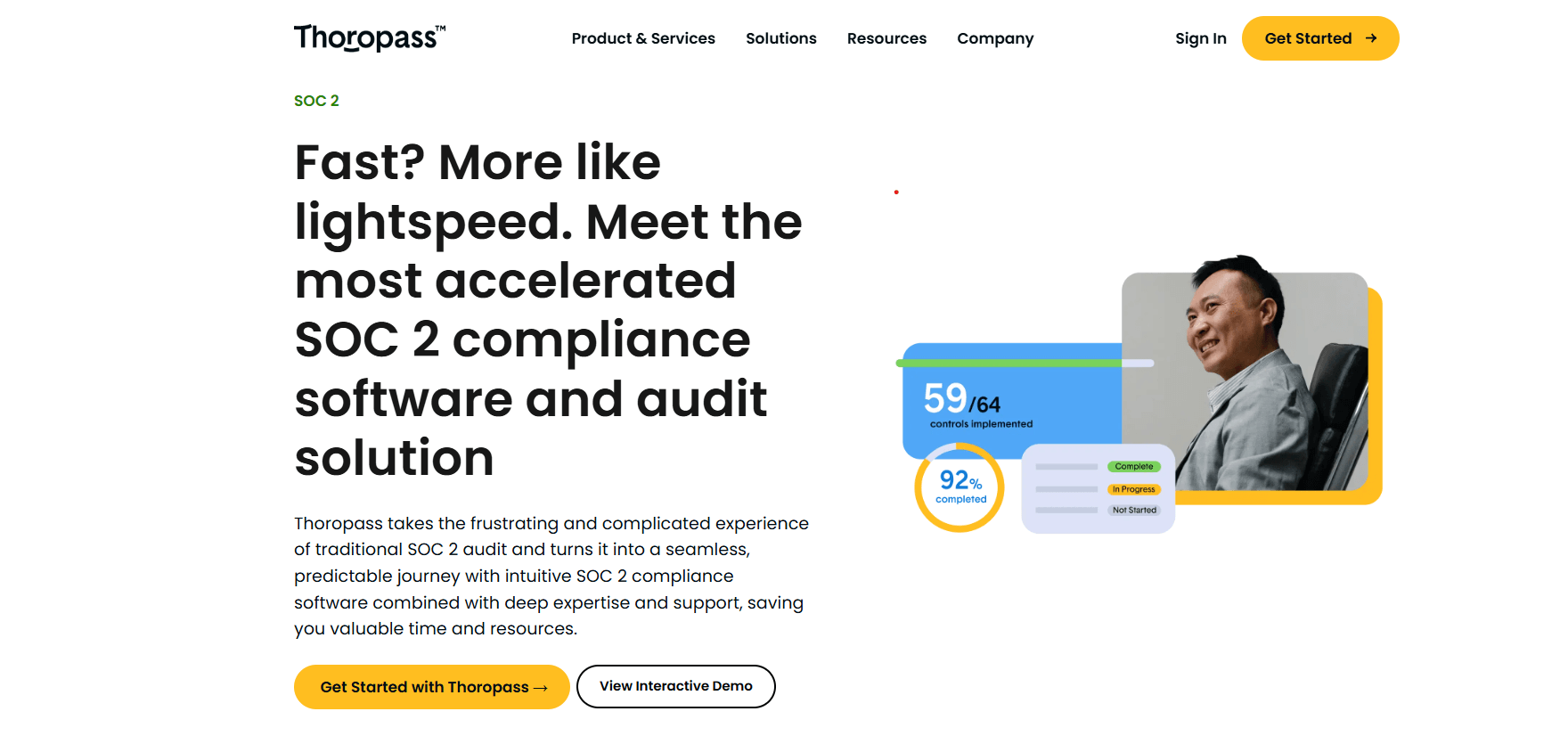
Thoropass bundles the compliance automation platform and the audit itself under one roof, which simplifies vendor management for smart home companies that would rather not coordinate separately with a software vendor and a CPA firm. That single-vendor model tends to reduce friction during the handoff between evidence collection and formal audit fieldwork.
Features
- Combined platform-plus-audit model with in-house auditors
- Automated evidence collection integrated with a guided compliance checklist
- Support for SOC 2, ISO 27001, HIPAA, and PCI DSS under one contract
- Dedicated compliance advisors who help translate hardware and firmware controls into audit-ready language
- Policy center with customizable templates suited to hybrid hardware-software businesses
Pros
- Simplifies vendor management by combining software and audit services
- Advisors bring auditor-level expertise into the evidence-building process
- Predictable, bundled pricing reduces surprise audit fees
Cons
- Less flexibility to choose a different external auditor later
- Smaller integration marketplace than category leaders
Pricing
Thoropass bundles platform and audit fees together, with typical packages for growing smart home companies ranging from $20,000 to $45,000 for a first Type II engagement.
A-LIGN operates as both a licensed CPA firm and a technology provider through its A-SCEND platform, giving smart home technology companies a single partner for both the audit and the readiness software. That dual role appeals to hardware manufacturers that want direct access to experienced assessors rather than relying entirely on a self-serve automation tool.
Features
- A-SCEND compliance management platform paired directly with in-house CPA auditors
- Single-vendor path from readiness assessment through report issuance
- Support for SOC 1, SOC 2, ISO 27001, FedRAMP, and PCI DSS
- Dedicated project managers who coordinate evidence requests and audit timelines
- Experience serving hardware and IoT clients that require both physical and logical security testing
Pros
- Direct access to an established, accredited audit firm rather than a third-party marketplace
- Broad framework coverage suits companies planning multiple certifications
- Strong reputation among enterprise buyers evaluating vendor security posture
Cons
- Costs tend to run higher than pure-software platforms
- The audit-firm-led model can move at a more traditional, less self-service pace
Pricing
A-LIGN engagements are quoted per project, and smart home companies typically report combined platform-and-audit costs between $25,000 and $60,000 depending on scope and framework count.